

Key Takeaways
- Taiwan's Company Act imposes mandatory resident director requirements and minimum capital thresholds that create structural constraints for foreign investors who lack an existing local presence.
- Foreign-invested enterprises must navigate MOEAIC and FSC oversight simultaneously, generating a compliance burden that extends well beyond standard company registration procedures.
- At a standard corporate income tax rate that sits above many competing regional jurisdictions, Taiwan's tax environment reduces the net return on invested capital for incorporated entities.
- Cross-border capital remittance rules place additional procedural friction on businesses that depend on routine fund transfers between a Taiwan entity and its overseas parent or affiliates.
Taiwan operates under a well-defined, heavily regulated corporate framework governed primarily by the Company Act, which sets specific obligations for foreign investors at the formation stage and throughout the life of the entity.
The disadvantages of incorporating in Taiwan span regulatory, operational, financial, and structural categories — each examined separately in this article.
Not every drawback applies equally across all situations. The friction you encounter depends significantly on your business structure, the industry you operate in, and whether your entity involves foreign capital or cross-border transactions.
Foreign investors establishing a subsidiary, branch, or representative office for the first time are most likely to encounter the full range of these challenges. Those entering capital-intensive or restricted sectors face additional layers of compliance beyond standard company formation requirements.
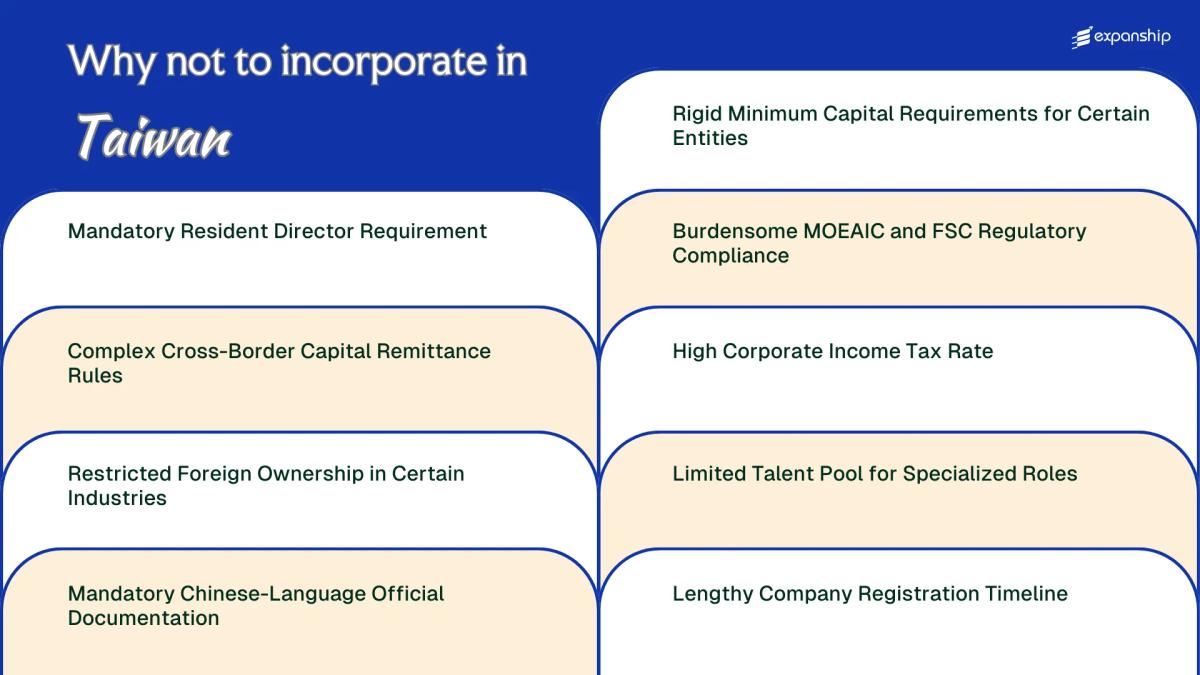
Mandatory Resident Director Requirement
The Taiwan resident director requirement is one of the more operationally limiting aspects of setting up a local company. Under the Company Act, at least one director of a company limited by shares must be a resident of Taiwan.
What the Residency Rule Requires
Foreign nationals can serve as directors, but at least one director must hold Taiwan residency status, meaning a valid Alien Resident Certificate (ARC) or equivalent documentation confirming lawful, long-term presence. If your founding team is entirely based overseas, this requirement forces you to either relocate a qualified individual or engage a nominee director, which introduces both cost and governance exposure.
Why This Creates a Structural Problem
The restriction is not waived for wholly foreign-owned entities or companies incorporated under the Statute for Investment by Foreign Nationals. Your operational control remains intact on paper, but the legal director structure depends on a person whose residency status can change, creating continuity risk that most offshore structures do not carry.
If your resident director loses ARC status, your company may fall out of compliance with the Company Act, potentially triggering regulatory scrutiny or the need for emergency director replacement.
Complex Cross-Border Capital Remittance Rules
Taiwan cross-border capital remittance restrictions impose a layered approval process that can delay or complicate how your business moves money across borders. Foreign-invested enterprises must register their capital through the Investment Commission under the Ministry of Economic Affairs (MOEAIC) before remitting funds out of the country, and any unregistered capital loses the legal protection that enables repatriation.
The Foreign Exchange Control Act and the Central Bank of the Republic of China's regulations govern outbound transfers. Transactions exceeding USD 1 million generally require supporting documentation and are subject to Central Bank scrutiny.
For a foreign business owner, these rules translate into concrete friction:
- Delays in repatriating profits when documentation does not precisely match the original registered capital structure, stalling cash flow planning across jurisdictions.
- Dividend remittances require proof of tax clearance from the National Taxation Bureau, adding a compliance step that extends the transfer timeline.
- Any capital increase or decrease must be re-registered with MOEAIC, meaning your firm cannot quietly adjust its funding structure without triggering a new review cycle.
- Unregistered foreign capital cannot be legally repatriated, exposing investors who skip the initial registration to permanent capital trapping.
Firms with straightforward, fully documented capital structures face fewer obstacles. The burden concentrates on businesses that restructure capital post-incorporation or operate across multiple funding rounds without updating their MOEAIC registration.

Company Incorporation in Taiwan
Understand the full regulatory process for establishing a foreign-invested entity in Taiwan, including MOEAIC registration and capital remittance compliance.
Restricted Foreign Ownership in Certain Industries
Taiwan restricted industries foreign ownership is governed primarily by the Foreign Investment Act (FIA) and a negative list framework administered by the Investment Commission under the Ministry of Economic Affairs (MOEA). Foreign businesses cannot freely enter every sector — certain industries are either fully closed or subject to equity caps that effectively limit operational control.
| Sector | Restriction Type | Foreign Equity Cap |
|---|---|---|
| Terrestrial television broadcasting | Prohibited | 0% |
| Cable television systems | Restricted | Up to 60% |
| Telecommunications (Type I carriers) | Restricted | Up to 49% |
| Domestic airlines | Restricted | Up to 49% |
| Publishing (certain categories) | Restricted | Varies by category |
For foreign investors targeting media, telecoms, or transport, these equity ceilings mean you cannot hold a majority stake, which strips you of unilateral decision-making authority over the entity you are funding. A foreign firm that cannot control board decisions or dividend policy carries real governance risk.
The restrictions are not static. The negative list is periodically revised, meaning sectors that appear open during initial planning may face new constraints before a transaction closes.
Beyond outright caps, certain restricted sectors require prior approval from multiple regulatory bodies, including the National Communications Commission for broadcasting and telecoms. Each additional approval layer extends your timeline and introduces the possibility of conditional or refused entry.
Mandatory Chinese-Language Official Documentation
Taiwan's Chinese language documentation requirement applies to virtually all formal submissions made to government agencies. Articles of incorporation, board resolutions, financial statements, and regulatory filings must be prepared in Mandarin. Foreign business owners who do not read or write Chinese must engage certified translators or local legal professionals for every official document, adding recurring cost to an already involved setup process.
This obligation is not limited to the registration phase. Ongoing compliance, including annual report submissions and correspondence with the Ministry of Economic Affairs (MOEA), requires the same standard. A single mistranslation in a regulatory filing can trigger requests for correction or delay approvals.
Taiwan language barriers in company registration are especially acute when dealing with notarized foreign documents. These must be translated into Mandarin and authenticated through a process involving Taiwan's overseas representative offices before they carry legal weight locally.
- All incorporation documents submitted to the MOEA must be in Mandarin
- Foreign-language source documents require certified Mandarin translation plus authentication
- Board resolutions and shareholder meeting minutes must also comply with the Mandarin requirement
- Errors or omissions in translated filings can result in formal rejection or correction notices
Taiwan does not recognize English as a co-official administrative language, meaning even multinational firms with global English-language governance standards must maintain entirely separate Mandarin documentation sets for local compliance purposes.
Rigid Minimum Capital Requirements for Certain Entities
Under Taiwan's Company Act, certain regulated industries and activity types trigger statutory minimum paid-in capital thresholds that do not apply uniformly across all entity structures. These Taiwan minimum capital requirements drawbacks are particularly consequential for foreign founders who may not anticipate mandatory capital commitments before operations begin.
Scope of the Requirement
The thresholds vary by sector: labor dispatch companies must maintain at least NT$5 million in paid-in capital, while some financial service-adjacent businesses face significantly higher floors set by the Financial Supervisory Commission. Because Taiwan's authorities can also require capital verification through a certified public accountant before registration is approved, your firm may bear professional fees and administrative delays before earning a single dollar of revenue.
Burden on Foreign Entities
For foreign investors, the Taiwan statutory capital requirements function as a de facto barrier to low-capital entry models common in other Asia-Pacific jurisdictions. Capital locked into paid-in requirements reduces operational liquidity during the critical early stage of a business. While the Company Act does not impose a blanket minimum for standard limited companies, sector-specific rules under separate regulations can override that general flexibility entirely.
Navigating Taiwan's Capital Requirement Hurdles
Understand which sector-specific capital thresholds apply to your business structure in Taiwan and what they mean for your entry strategy.
Burdensome MOEAIC and FSC Regulatory Compliance
Foreign businesses operating in Taiwan face the Taiwan MOEAIC FSC compliance burden across two separate and demanding regulatory channels, each with distinct filing obligations and oversight authority.
- The Ministry of Economic Affairs Investment Commission (MOEAIC) requires foreign investors to obtain pre-approval before remitting capital into restricted sectors, adding mandatory review time before any operations can begin.
- The Financial Supervisory Commission (FSC) imposes ongoing disclosure and reporting obligations on foreign firms conducting regulated financial activities, requiring dedicated local compliance resources.
- Any changes to a foreign company's shareholding structure or investment scope must be re-reported to the MOEAIC, creating a continuous administrative obligation rather than a one-time registration requirement.
- Regulated entities must maintain FSC-compliant internal audit frameworks, which typically require retaining qualified local legal or compliance counsel to satisfy Taiwanese standards.
- Failure to meet MOEAIC or FSC filing deadlines can result in penalties or investment approval revocation, directly threatening your firm's legal standing in the market.
High Corporate Income Tax Rate
Taiwan corporate income tax rate drawbacks are most apparent when you compare the statutory rate against regional peers. Under the Income Tax Act, profit-seeking enterprises are subject to a flat corporate income tax rate of 20% on net income exceeding NTD 120,000.
That rate sits above Singapore's 17% and Hong Kong's 16.5%, both of which compete directly for the same foreign investment flows into Asia. For a firm choosing between regional holding structures, the differential compounds over time.
The retained earnings surtax adds further pressure. Under the amendments to the Income Tax Act effective from 2018, undistributed earnings retained beyond the following fiscal year are subject to an additional 5% surtax, raising the effective tax burden on reinvested profits.
This discourages foreign-owned entities from retaining earnings for operational expansion within the entity itself, since doing so triggers an additional tax liability rather than a neutral outcome.
A foreign-owned limited company in Taiwan generating NTD 10,000,000 in net profit faces a base corporate tax of NTD 2,000,000. If NTD 5,000,000 of after-tax earnings remain undistributed into the following year, an additional surtax of NTD 250,000 applies, bringing the total tax liability for that cycle to NTD 2,250,000.
Limited Talent Pool for Specialized Roles
Taiwan's talent shortage in specialized roles is a practical constraint that directly affects how foreign companies staff their operations. The island's domestic labor market is relatively small, with a population of approximately 23 million, and competition for engineers, semiconductor specialists, and bilingual finance or legal professionals is intense.
Established domestic firms, particularly those within the semiconductor and electronics supply chain, absorb a significant share of qualified candidates. Your business enters a hiring environment where it competes against entrenched local employers who offer deep professional networks and long-term career stability that a newly incorporated foreign entity cannot immediately match.
Bringing in overseas talent does not offer a simple alternative. Foreign skilled workers must obtain an Employment Gold Card or a standard work permit through the Workforce Development Agency (WDA) under the Ministry of Labor, and the qualifying criteria, including minimum salary thresholds and educational or experience requirements, restrict the candidate pool further.
Roles requiring Mandarin fluency alongside international professional credentials are particularly scarce. This combination is a genuine structural gap, not a temporary condition, and it extends timelines for building functional local teams.
Work permits issued through the WDA tie foreign employees to specific employers and approved job functions, meaning your hiring flexibility is constrained even after the initial permit is secured.
Lengthy Company Registration Timeline
The Taiwan company registration timeline problems begin well before your business opens its doors. Incorporating a company in Taiwan typically requires sequential approvals across multiple government agencies, including the Ministry of Economic Affairs (MOEA) and the National Taxation Bureau, which cannot always be processed concurrently.
Foreign-invested companies face additional steps. Pre-approval from the Investment Commission under the MOEA is required before registration proceeds, adding a layer that domestic firms do not encounter.
The full process, from name reservation to obtaining a unified business number and completing tax registration, can take four to eight weeks under standard conditions. For firms in regulated sectors, this timeline extends further.
Each delay has a direct cost: staff on standby, lease agreements running, and market entry windows narrowing. Jurisdictions such as Singapore and Hong Kong commonly complete equivalent procedures within one to three business days, making Taiwan's incorporation process comparatively slow for time-sensitive foreign entrants.
Overcoming Taiwan's Incorporation Challenges
Overcoming Taiwan incorporation challenges requires structural preparation before the registration process begins, not adjustments made in response to compliance failures. Foreign businesses that plan entity structure, capital allocation, and documentation requirements in advance face fewer procedural setbacks.
- Appoint a Taiwan-resident director prior to submitting incorporation documents to the Ministry of Economic Affairs.
- Obtain prior Investment Commission approval under the Statute for Investment by Foreign Nationals before remitting capital into Taiwan.
- Audit your intended business activities against the negative list published by the MOEAIC to identify restricted sectors before selecting a corporate structure.
- Prepare all incorporation documents in Traditional Chinese, as the Companies Act requires official filings in Mandarin.
- Engage a local agent familiar with FSC reporting obligations if your entity operates in a regulated financial sector.
These steps address the structural constraints embedded in Taiwan's Companies Act, the Foreign Exchange Settlement Rules, and sector-specific regulations administered by the FSC and MOEAIC. Compliance requirements across these frameworks are interdependent, and a deficiency in one area can delay approvals across others.
Taiwan's Business Potential at a Glance
Taiwan carries real incorporation friction — mandatory resident directors, restricted foreign ownership, and cross-border capital controls create measurable operational costs. That said, the island's advanced manufacturing base, skilled technical workforce, and position within global semiconductor and electronics supply chains make it a credible destination for businesses whose model aligns with its regulatory structure.
| Pros | Cons |
|---|---|
| Taiwan operates a stable, rules-based legal and commercial environment with predictable regulatory enforcement. | A mandatory resident director requirement adds staffing cost and governance complexity for foreign-owned entities. |
| The jurisdiction hosts a deep talent pool in engineering, electronics, and manufacturing sectors. | Foreign ownership is prohibited or capped in sectors governed by the Negative List under the Statute for Investment by Foreign Nationals. |
| Treaty networks and export-oriented infrastructure support international business operations. | Corporate income tax is set at 20%, which is less competitive than several regional peers. |
| The New Taiwan Dollar is freely convertible under general trade transactions. | Cross-border capital remittance requires MOEAIC approval and is subject to foreign exchange controls under the Foreign Exchange Regulation Act. |
| Taiwan's workforce participation rate supports operational continuity for most industries. | Official company documentation must be filed in Mandarin Chinese, adding translation costs for foreign operators. |
Corporate Compliance Services in Taiwan
Maintain statutory compliance for your Taiwan-registered entity, covering annual filings, regulatory reporting, and ongoing obligations under the Company Act and relevant authorities.
Conclusion
Taiwan's structural barriers are real and measurable. The Taiwan company formation cons summary presented across this blog reflects a jurisdiction that offers genuine commercial opportunity alongside significant procedural and regulatory friction. The resident director requirement, restrictions on foreign ownership in designated sectors, and the cross-border capital remittance rules administered through the Central Bank of the Republic of China each impose concrete compliance obligations. Structural preparation before filing with the MOEAIC reduces downstream delays. Professional guidance from advisors familiar with local regulatory requirements remains a practical necessity rather than an optional consideration.
Expanship's Taiwan Expansion Services
Incorporating in Taiwan means contending with MOEAIC foreign investment approvals, FSC licensing thresholds, mandatory Chinese-language filings, resident director obligations, and sector-specific ownership caps. Expanship's Taiwan company incorporation services are structured around these specific compliance requirements, reducing the administrative load your team would otherwise absorb while working through unfamiliar regulatory procedures.
Beyond registration, our scope covers the full formation-to-operation cycle. We work across the following areas:
- We prepare and submit all company registration documents with the relevant Taiwan authorities.
- Our team provides registered agent and local office support for your entity.
- We liaise directly with government bodies, including the MOEAIC and FSC, on your behalf.
- Post-incorporation compliance management keeps your business in good standing over time.
- We facilitate introductions to local banking institutions appropriate to your structure.
- Tax registration and coordination with Taiwan's National Taxation Bureau are handled as part of the process.
Reach out to Expanship Taiwan to discuss your formation requirements.
Frequently Asked Questions (FAQ)
The Investment Commission under the Ministry of Economic Affairs (MOEAIC) reviews all inbound foreign direct investment, but the scrutiny is significantly heavier in restricted or sensitive industries such as telecommunications, media, utilities, and defence-adjacent sectors. Even outside those sectors, the MOEAIC approval process adds a mandatory pre-registration step that domestic investors do not face, extending your overall incorporation timeline. Failure to obtain MOEAIC approval before proceeding exposes the investment to legal invalidity.
Violations of the Regulations Governing the Declaration of Foreign Exchange Receipts and Disbursements can result in fines, forced repatriation of funds, and restrictions on future foreign exchange transactions through designated banks. The Central Bank of the Republic of China (CBC) oversees these declarations, and unreported or misdeclared transactions are treated as regulatory breaches rather than minor administrative oversights. Repeated violations can trigger enhanced scrutiny on all subsequent remittances made by your entity.
At a headline rate of 20%, Taiwan's corporate income tax is higher than Singapore's 17% and Hong Kong's 16.5%, making it a measurable disadvantage for profit-repatriation planning. The rate applies to net income, and an additional retained earnings surtax of up to 5% under the Income Tax Act can apply if profits are not distributed, compounding the effective tax burden. For holding structures where dividend distribution is deferred, this surtax materially increases the cost of incorporation.
Taiwan's Company Act and associated regulations require that statutory filings, articles of incorporation, and official correspondence with government agencies be submitted in Traditional Mandarin Chinese. Documents submitted in a foreign language without a certified Chinese translation will be rejected by the Ministry of Economic Affairs, causing filing delays and potentially triggering non-compliance notices. There is no formal waiver mechanism for this requirement, regardless of the foreign investor's country of origin.
Minimum capital thresholds in Taiwan vary by entity type and industry, and there is no general waiver process available to foreign investors. Certain regulated industries, including financial services overseen by the Financial Supervisory Commission (FSC), impose statutory paid-in capital minimums that can reach tens of millions of New Taiwan Dollars. Even for standard limited companies, the registered capital must be fully verified by a certified public accountant before the registration is completed, making undercapitalisation a registration blocker rather than a post-incorporation issue.
Taiwan has a relatively small population of approximately 23 million, and competition for professionals with bilingual capabilities, advanced technical skills, or international finance experience is intense, particularly in sectors like semiconductors, biotech, and fintech. Hiring delays directly affect your ability to meet post-incorporation operational requirements, including those tied to regulatory staffing thresholds in licensed industries. Relying on expatriate hires introduces additional work permit and visa processing steps under the Employment Services Act, which adds both cost and lead time.
Taiwan's registration process, which involves MOEAIC approval, capital verification by a CPA, and sequential filings with the Ministry of Economic Affairs, typically takes six to twelve weeks for a foreign-invested entity, compared to one to three days in Hong Kong or Singapore for equivalent structures. Each stage is a hard dependency; you cannot proceed to the next without formal clearance from the preceding authority. This sequential structure means that any document rejection or information request resets the clock on that specific stage.
Legal Disclaimer
The information provided in this article is for general informational purposes only and does not constitute legal, tax, or professional advice. While we strive to ensure the accuracy and timeliness of the content, laws and regulations are subject to change, and the application of laws can vary widely based on specific facts and circumstances.
Readers should not act upon this information without seeking professional counsel tailored to their individual situation. Expanship and its authors disclaim any liability for actions taken or not taken based on the content of this article.
For specific advice regarding your business setup, compliance requirements, or any legal matters, please consult with qualified legal and tax professionals in the relevant jurisdiction.