

Key Takeaways
- Foreign investors must comply with the Turkish Commercial Code (Law No. 6102) as the primary legislative framework governing entity formation, with the Trade Registry under the Ministry of Customs and Trade serving as the competent registration authority.
- Minimum share capital thresholds apply depending on the entity type selected, and failure to meet these requirements results in rejection of the registration application by the Trade Registry.
- Beneficial ownership disclosure obligations require entities to register UBO information in Turkey's beneficial ownership registry, making this a non-optional compliance step rather than a voluntary disclosure.
- Registered office compliance is enforced at the provincial Trade Registry level, meaning businesses cannot satisfy the address requirement through a non-local or nominal arrangement.
Incorporation requirements in Turkey are governed by the Turkish Commercial Code (Law No. 6102), which came into force in 2012 and serves as the primary legislative framework for company formation. The Trade Registry, operating under the oversight of the Ministry of Customs and Trade, is the competent authority responsible for registering commercial entities.
This article covers the structural, documentary, and regulatory requirements applicable to businesses seeking formal registration.
Failure to satisfy these requirements results in rejection of the registration application or, where an entity begins operating without proper registration, exposure to administrative penalties under applicable Turkish law.
Requirements differ depending on the entity type selected, the sector in which the business operates, and whether the investor is a foreign national or a locally domiciled individual. You can refer directly to the Turkish Commercial Code on the official legislative database.
This article is most relevant to foreign investors and non-resident business owners evaluating Turkey business formation regulations before committing to a specific structure.
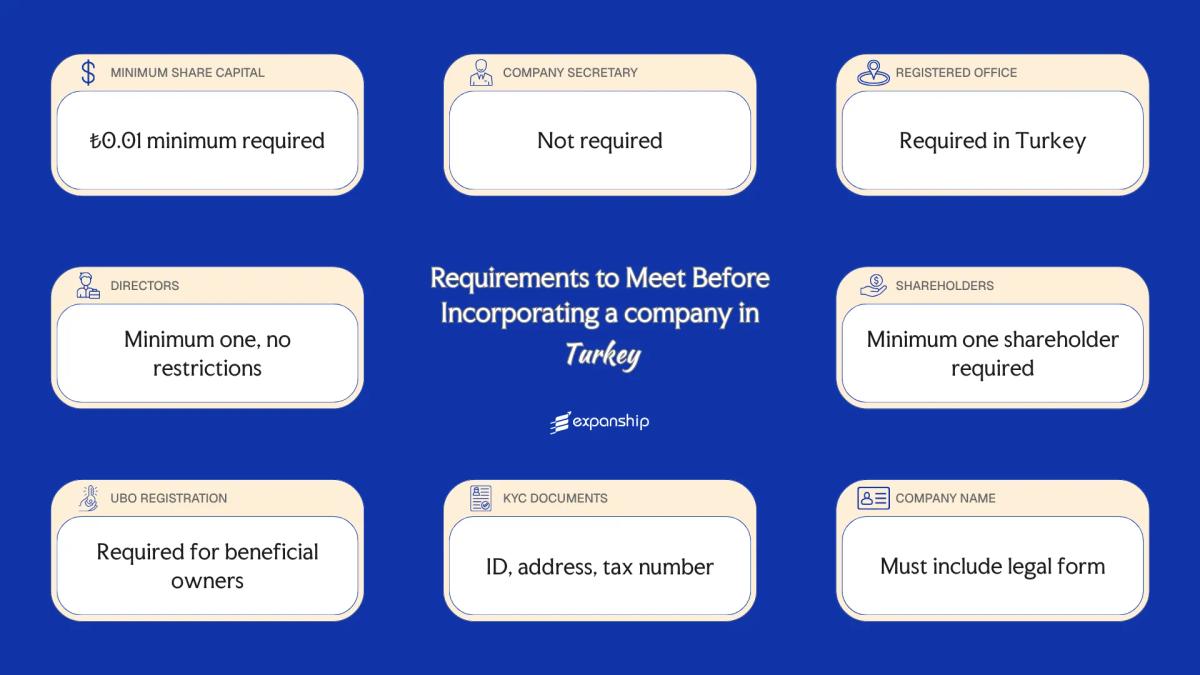
Minimum Share Capital Requirements in Turkey
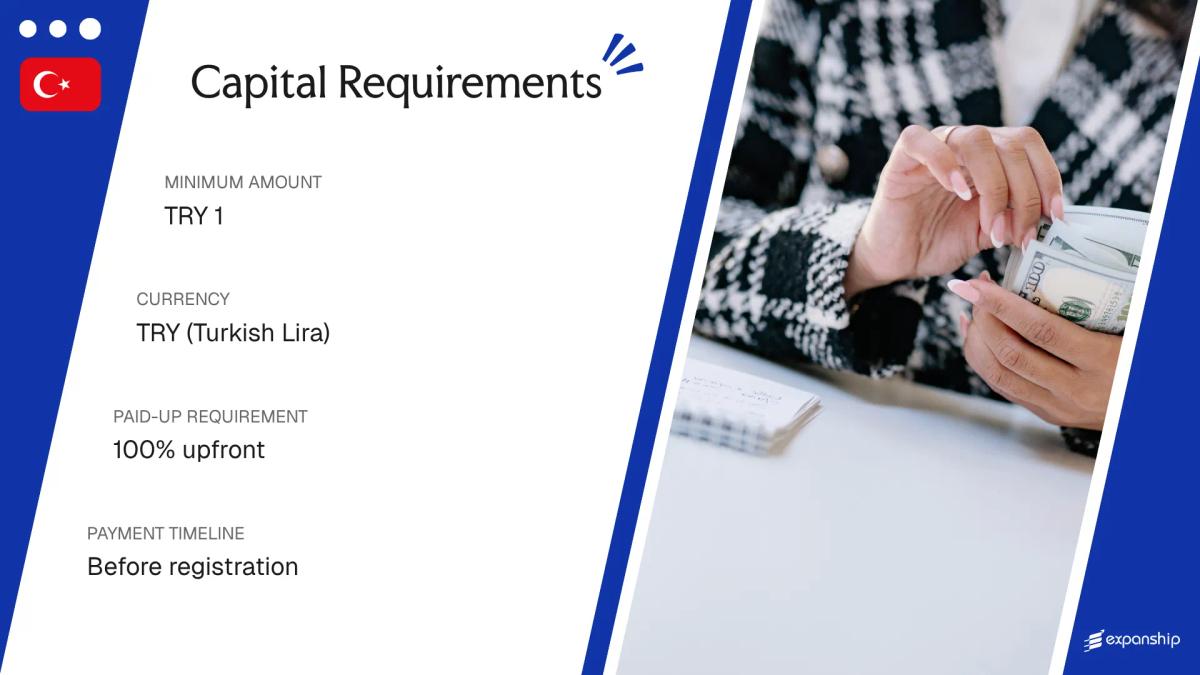
Minimum share capital requirements in Turkey vary depending on the legal structure your business adopts under the Turkish Commercial Code (Türk Ticaret Kanunu). Both principal entity types operate on a par value share system, meaning each share carries a nominal value defined in the articles of association.
Capital deposit is verified at the point of incorporation through the relevant Trade Registry (Ticaret Sicili Müdürlüğü), and the requirement constitutes a statutory obligation tied to registration rather than a recurring annual condition.
| Parameter | Detail |
|---|---|
| Minimum Authorized Share Capital | TRY 50,000 for an Anonim Şirket (AS); TRY 10,000 for a Limited Şirketi (Ltd. Şti.) |
| Maximum Authorized Share Capital | No statutory maximum |
| Minimum Paid-Up Capital | TRY 12,500 for an AS (25% of minimum); TRY 10,000 for a Ltd. Şti. (100%) |
| Paid-Up Requirement at Incorporation | 25% for AS at registration; 100% for Ltd. Şti. at registration |
| Accepted Currency | Turkish Lira (TRY) |
| Accepted Forms of Contribution | Cash and non-cash assets (subject to independent valuation for in-kind contributions) |
| Timeframe to Deposit Capital | Remaining 75% of AS capital must be paid within 24 months of registration |
For an Anonim Şirket, only 25% of the minimum capital must be deposited before registration. The remaining 75% is legally due within 24 months, but this deferred balance remains a binding statutory obligation, not a discretionary commitment.
Company Secretary Requirements in Turkey
Under Turkish commercial law, there is no statutory requirement for a dedicated company secretary role in the conventional sense. Your business will not need to appoint a separate officer carrying that title to satisfy company secretary requirements Turkey imposes during or after formation.
That said, certain administrative and compliance functions must still be fulfilled. A limited liability company (limited şirketi) or joint-stock company (anonim şirketi) must maintain statutory books, file annual returns with the relevant Trade Registry Office (Ticaret Sicili Müdürlüğü), and ensure general assembly records are properly documented.
Where Turkey corporate secretary obligations are concerned, these duties typically fall to the board of directors or the appointed manager (müdür). The following reflects who may fulfil these administrative responsibilities:
- No separate licensing is required to perform company secretarial functions.
- A resident or non-resident individual may act as the responsible manager.
- A legal entity may serve in a managerial capacity under certain structural conditions.
- Public notarisation of key corporate records is handled through Turkish notaries, not a designated secretary.

Incorporate a Company in Turkey
Set up your legal entity in Turkey with guidance on Trade Registry filings, statutory obligations, and ongoing compliance requirements.
Registered Office Requirements in Turkey
Registered office requirements in Turkey mandate that every company maintain a physical address within the country, formally recorded with the relevant trade registry office (ticaret sicili müdürlüğü) under the Turkish Commercial Code (Türk Ticaret Kanunu No. 6102). Using a non-compliant or fictitious address can result in the deregistration of the entity or administrative sanctions imposed by the trade registry.
- A physical address located within Turkey is required; P.O. boxes do not satisfy this requirement.
- Virtual office addresses are permitted, provided the service supplier can demonstrate the address has functional use as a business location.
- The address must be domiciled in Turkey; foreign addresses are not accepted for registry purposes.
- Either ownership documentation or a valid lease agreement for the premises must be held on record to support the registered address.
- The registered address is publicly listed in the Turkish Trade Registry Gazette (Türkiye Ticaret Sicili Gazetesi) and accessible through the central registry system (MERSİS).
- Any change to the registered address requires formal notification to the relevant trade registry office, and the amendment must be published in the Trade Registry Gazette to take legal effect.
Director Requirements in Turkey
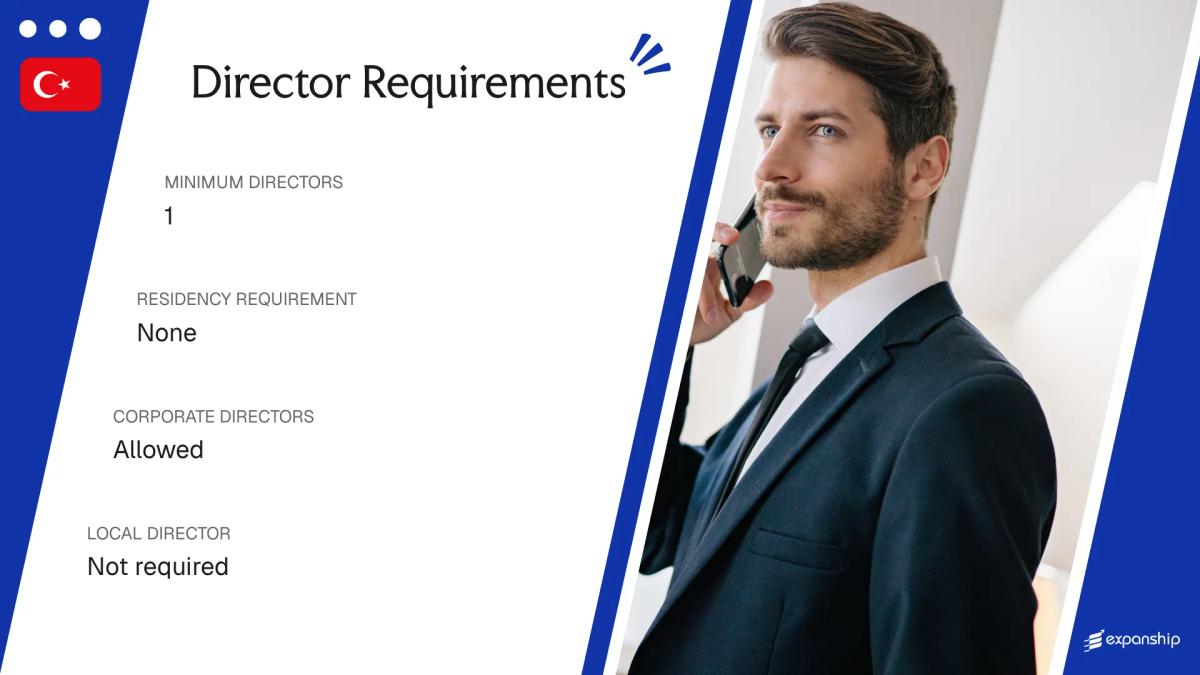
Under the Turkish Commercial Code (Law No. 6102), director requirements for a Turkey company cover statutory duties that extend well beyond administrative oversight, including fiduciary obligations, liability for unpaid public debts, and personal accountability for resolutions passed in bad faith.
| Parameter | Detail |
|---|---|
| Minimum Number of Directors | One director is required for a limited liability company (Ltd. Şti.); a joint-stock company (A.Ş.) requires a minimum of one board member. |
| Maximum Number of Directors | No statutory maximum is prescribed under the Turkish Commercial Code. |
| Local/Resident Director Required | No statutory requirement for a resident or locally domiciled director. |
| Nationality Restrictions | No nationality restrictions apply; foreign nationals may serve as directors. |
| Minimum Age Requirement | Directors must be at least 18 years of age and have full legal capacity under Turkish civil law. |
| Corporate Directors Permitted | Legal entities may serve on the board of a joint-stock company, provided a natural person is designated as their representative. |
| Director Must Be a Shareholder | No requirement; directors of an A.Ş. are not obligated to hold shares in the company. |
| Publicly Listed on Registry | Director information is registered with the relevant Trade Registry Office and is publicly accessible. |
| Disqualification Conditions | Individuals convicted of fraud, bankruptcy offences, or certain crimes listed under the Turkish Commercial Code are disqualified from directorship. |
Under Turkish Commercial Code Article 370, a sole director of a joint-stock company holds all board powers individually, meaning a single foreign national with no local ties can exercise full executive authority without any co-director or resident counterpart.
Shareholder Requirements in Turkey
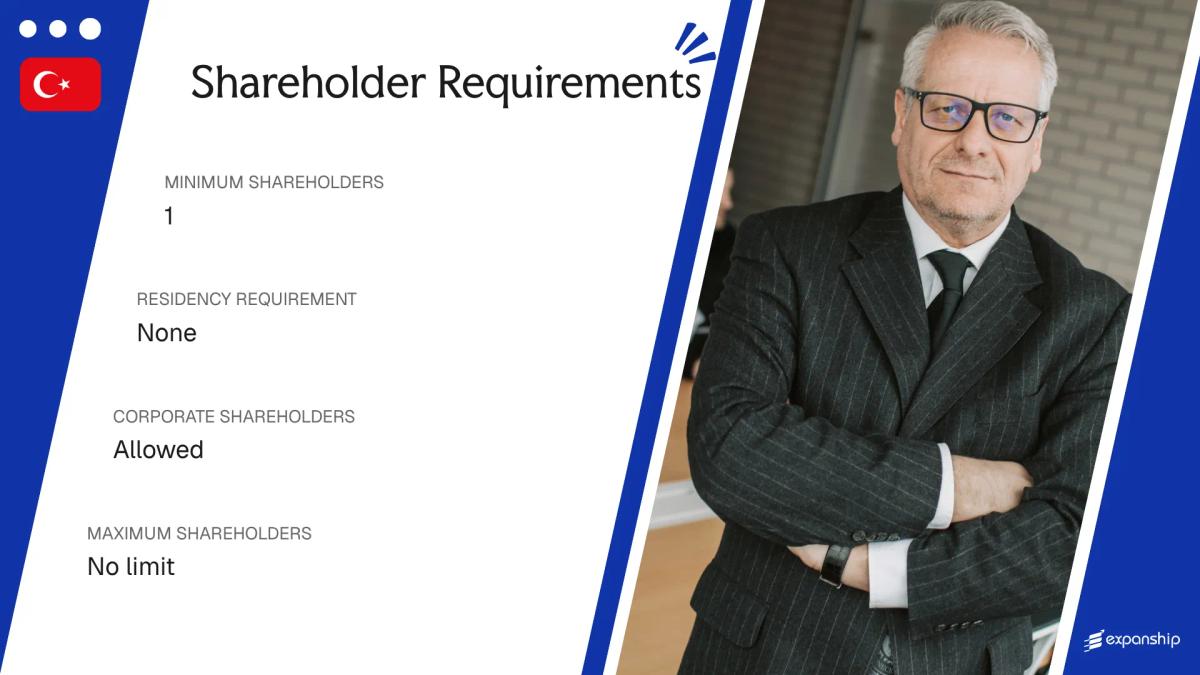
A Turkish Anonim Şirket (A.Ş.) requires a minimum of one shareholder, with no statutory ceiling on the maximum number. Single-member structures are fully permitted under the Turkish Commercial Code (TCC No. 6102).
Nationality and Residency Restrictions
Meeting the shareholder requirements for a Turkey company carries no nationality or residency conditions. Foreign individuals and entities may hold up to 100% of shares without restriction under Turkey's Foreign Direct Investment Law (No. 4875).
Corporate Shareholders
Corporate entities are permitted to act as shareholders in an A.Ş. No additional conditions specific to corporate ownership are imposed beyond standard TCC registration requirements.
Shareholder Liability
Liability is limited to each shareholder's subscribed capital contribution. Turkish company ownership regulations do not extend personal liability to shareholders except in cases involving unpaid public debts, where courts may pierce the corporate veil.
Register of Shareholders
An A.Ş. must maintain a share ledger recording all shareholders and transfers. This register is not publicly accessible, though share transfers must be reflected promptly and certain changes reported to the Trade Registry.
Shareholder Structure Guidance for Your Turkish Incorporation
Get expert support in structuring your shareholder arrangement in compliance with the Turkish Commercial Code before you incorporate.
UBO / Beneficial Ownership Disclosure Requirements in Turkey
Beneficial ownership disclosure Turkey requirements are governed primarily by the General Communiqué on the Identification of Ultimate Beneficial Owners (Serial No. 1), issued under the Tax Procedure Law, alongside obligations set out in Law No. 5549 on the Prevention of Laundering Proceeds of Crime. A beneficial owner is defined as any natural person who directly or indirectly holds 25% or more of a legal entity's shares or voting rights, or who exercises control through other means.
- At the time of incorporation, the company must submit a beneficial owner declaration to the Turkish Revenue Administration (Gelir İdaresi Başkanlığı).
- If no individual meets the 25% threshold, the natural person exercising effective control must still be declared.
- Any change in beneficial ownership must be reported to the Revenue Administration within one month of the change occurring.
- Obliged entities under Law No. 5549, including banks and financial institutions, must verify UBO information as part of customer due diligence.
| Parameter | Detail |
|---|---|
| Ownership Threshold for UBO Status | 25% of shares or voting rights |
| Filing Authority | Turkish Revenue Administration (Gelir İdaresi Başkanlığı) |
| Disclosure Deadline at Incorporation | At the time of incorporation |
| Publicly Accessible Register | No public register; filings are held by the Revenue Administration |
| Penalties for Non-Disclosure | Administrative fines under the Tax Procedure Law |
| Ongoing Update Obligation | Within one month of any change in beneficial ownership |
KYC / Document Requirements in Turkey
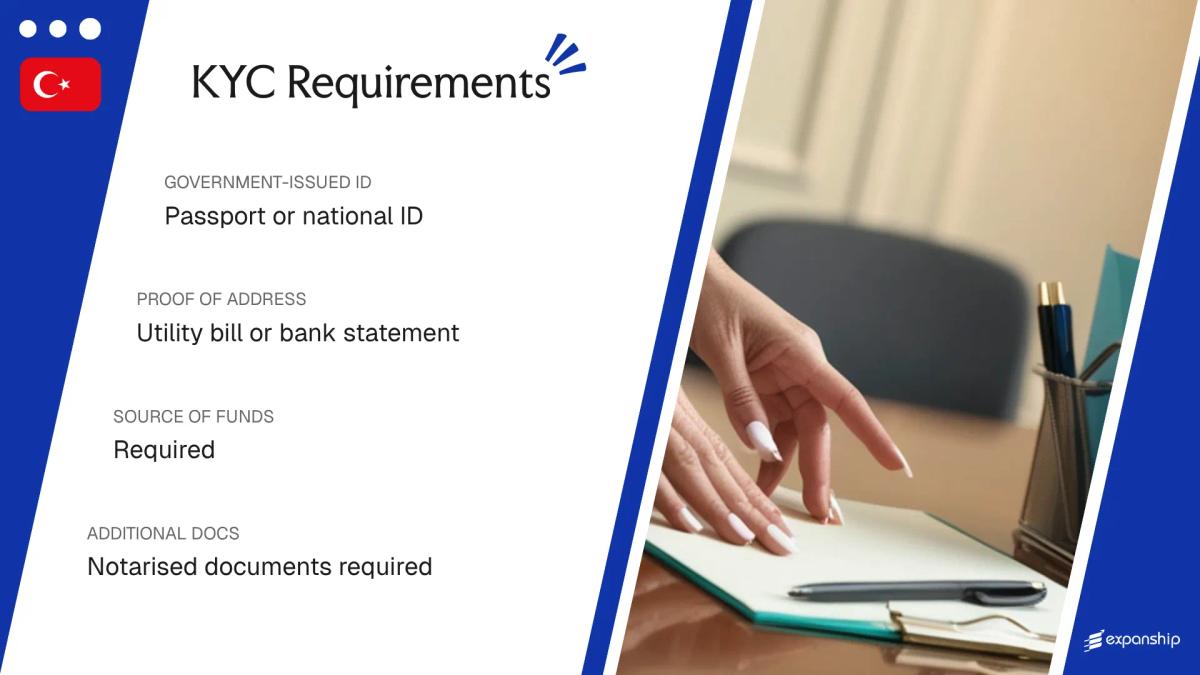
KYC document requirements Turkey stem from the obligations set out under the Anti-Money Laundering Law (Law No. 5549) and its implementing regulations, enforced by MASAK (Mali Suçları Araştırma Kurulu), Turkey's Financial Intelligence Unit.
Individual / Personal Documents
- Valid passport or national identity card for each individual shareholder, director, or beneficial owner
- Proof of residential address dated within the last three months (utility bill or bank statement)
- Tax identification number, where the individual holds one
- Specimen signature declaration, notarised before a Turkish notary
Corporate Documents
- Certificate of incorporation or equivalent formation document for the corporate shareholder or director
- Articles of association or constitutional document of the foreign or domestic entity
- Current register of directors confirming authorised signatories
- Proof of registered address of the corporate entity, issued within the last three months
Source of Funds Documentation
- Recent bank statements covering a minimum of three months prior to incorporation
- Audited financial statements for corporate shareholders, where applicable
- A written declaration of source of funds may be required by the notary or trade registry
Notarisation and Apostille Requirements
- Foreign-issued documents must be apostilled under the Hague Convention before submission to the Turkish Trade Registry
- All non-Turkish documents require certified translation into Turkish by a sworn translator
- Notarisation of signature declarations must be performed before a Turkish notary or consular officer
Mismatched names between identity documents and trade registry filings are the most frequent cause of application rejection at Turkish Trade Registry offices.
Company Name Requirements in Turkey
Company name requirements Turkey are assessed by the relevant trade registry at the point of incorporation, with each proposed name reviewed for uniqueness and compliance before registration is approved. Names that conflict with existing registrations in the same sector are rejected.
Your firm's name must be in Turkish, include a word describing the business activity, and end with the appropriate legal form suffix — such as "A.Ş." for a joint stock company or "Ltd. Şti." for a limited liability company. No minimum word count is formally prescribed, but the name must reflect the business subject.
Certain words are restricted and require prior governmental approval before use — terms implying state affiliation, financial institutions, or national references fall into this category. Words that are misleading, contrary to public morality, or already protected under trademark law are prohibited outright.
Name reservation is available through the Turkish Trade Registry system prior to formal incorporation. Reserved names are typically held for a limited period, after which the reservation lapses if the incorporation process is not completed.
Compliance Services for Companies in Turkey
Maintain ongoing regulatory compliance for your Turkish entity, from annual filings to statutory obligations under Turkish commercial law.
Conclusion
Turkey company incorporation requirements span several regulatory areas governed primarily by the Turkish Commercial Code (Law No. 6102) and administered through the Trade Registry. Minimum capital thresholds, director residency considerations, and UBO disclosure obligations under the beneficial ownership registry are among the more structurally significant elements for foreign investors to account for. Registered office requirements are enforced at the provincial Trade Registry level, meaning local address compliance is not discretionary. Once these obligations are understood, the practical next step is engaging with the registration process itself and the documentation flows it demands.
Expanship's Corporate Formation Services in Turkey
Expanship's turkey company formation services are structured around the specific requirements set by Turkish commercial law, including Trade Registry filings, notarisation protocols, and the capital deposit obligations applicable to JSCs and LLCs. Our team manages the operational weight of coordinating between notaries, the relevant Trade Registry Office, and the Revenue Administration, so your attention stays on building the business rather than deciphering procedural requirements.
Beyond initial registration, our company registration assistance in Turkey covers a defined scope of services:
- We prepare and file all incorporation documents, including articles of association and Trade Registry applications.
- A registered office address and local agent are provided for your entity's official correspondence.
- We liaise directly with government bodies and regulatory authorities on your behalf.
- Ongoing post-incorporation compliance obligations are tracked and managed as your business evolves.
- Banking introduction support is available to help connect your entity with suitable local financial institutions.
- Tax registration and coordination with the Revenue Administration are handled as part of the formation process.
Reach out to Expanship Turkey to discuss your incorporation requirements.
Frequently Asked Questions (FAQ)
Yes, the required minimum share capital varies by entity type under the Turkish Commercial Code (TCC). An Anonim Şirketi (A.Ş.) requires a minimum of TRY 250,000, while a Limited Şirketi requires TRY 10,000. If you are forming an A.Ş. with registered capital system status, the minimum threshold rises to TRY 500,000.
Failure to register or update beneficial ownership information with the Central Registry Agency (MKK) and the relevant Tax Authority can result in administrative fines under Turkish regulations. The obligation applies to legal entities that meet defined thresholds of ownership or control, typically 25% or more of shares or voting rights. Non-compliance can also trigger heightened scrutiny during tax audits and AML reviews conducted by the Financial Crimes Investigation Board (MASAK).
A foreign national can hold 100% of the shares in a Turkish Limited Şirketi, as Turkish law permits full foreign ownership in most sectors without requiring a local partner. Certain regulated industries, such as broadcasting, aviation, and maritime transport, carry sector-specific foreign ownership restrictions under separate legislation. Outside those sectors, no minimum local shareholding applies.
A physical or commercially recognised address in Turkey is required for registration with the Trade Registry, as the registered office must be verifiable and capable of receiving official correspondence. Virtual office addresses provided by licensed business centre operators are generally accepted, provided they meet the Trade Registry's address verification standards. A P.O. box alone is not sufficient.
Foreign corporate shareholders must provide apostilled or notarised copies of their certificate of incorporation, articles of association, and a certificate of good standing, all translated into Turkish by a sworn translator. Individual foreign shareholders are required to submit a notarised passport copy and, in some cases, a tax identification number obtained from the Turkish Revenue Administration. The additional layer of entity-level documentation for corporate shareholders reflects the Trade Registry's need to verify the legal existence and authority structure of the parent company.
If the Trade Registry Office rejects a proposed company name because it conflicts with an existing registration or violates the naming rules set out in the Turkish Commercial Code, you must submit an alternative before the incorporation process can proceed. Names that are identical or misleadingly similar to already-registered entities, or that include restricted terms requiring special ministerial approval, are the most common grounds for rejection. Preparing multiple name options in advance reduces the risk of delays in the overall registration timeline.
Legal Disclaimer
The information provided in this article is for general informational purposes only and does not constitute legal, tax, or professional advice. While we strive to ensure the accuracy and timeliness of the content, laws and regulations are subject to change, and the application of laws can vary widely based on specific facts and circumstances.
Readers should not act upon this information without seeking professional counsel tailored to their individual situation. Expanship and its authors disclaim any liability for actions taken or not taken based on the content of this article.
For specific advice regarding your business setup, compliance requirements, or any legal matters, please consult with qualified legal and tax professionals in the relevant jurisdiction.