
Key Takeaways
- Joint stock companies (Anonim Şirket) incorporated under the Turkish Commercial Code (Law No. 6102) must maintain a minimum paid-in capital of TRY 250,000, a threshold that erodes in real terms against a currency that has experienced sustained double-digit inflation.
- Employer social security contribution obligations in Turkey represent a substantial payroll cost that increases the total cost of employment well beyond the nominal salary agreed with any hire.
- Foreign investors operating in regulated sectors — including media, aviation, and financial services — face statutory caps on foreign ownership that cannot be circumvented through standard corporate structuring.
- Turkey's tax legislation is subject to frequent amendment by the Revenue Administration (Gelir İdaresi Başkanlığı), creating ongoing compliance uncertainty that requires continuous legal monitoring rather than a one-time setup exercise.
Turkey operates under a heavily regulated commercial framework, and foreign investors considering entry through local incorporation will encounter a defined set of structural, fiscal, and administrative constraints. The disadvantages of incorporating in Turkey span regulatory compliance, capital requirements, currency policy, and sector-specific restrictions — each examined individually in the sections that follow.
The severity of these constraints is not uniform. A small limited liability company (Limited Şirket) faces a materially different compliance burden than a joint stock company (Anonim Şirket) operating in a licensed sector, so your experience will depend significantly on the entity type and industry you choose.
This article is most relevant to foreign entrepreneurs, multinational subsidiaries, and institutional investors seeking to establish a directly owned commercial presence under the Turkish Commercial Code. Those relying on distributors or agency arrangements will encounter fewer of these constraints directly.
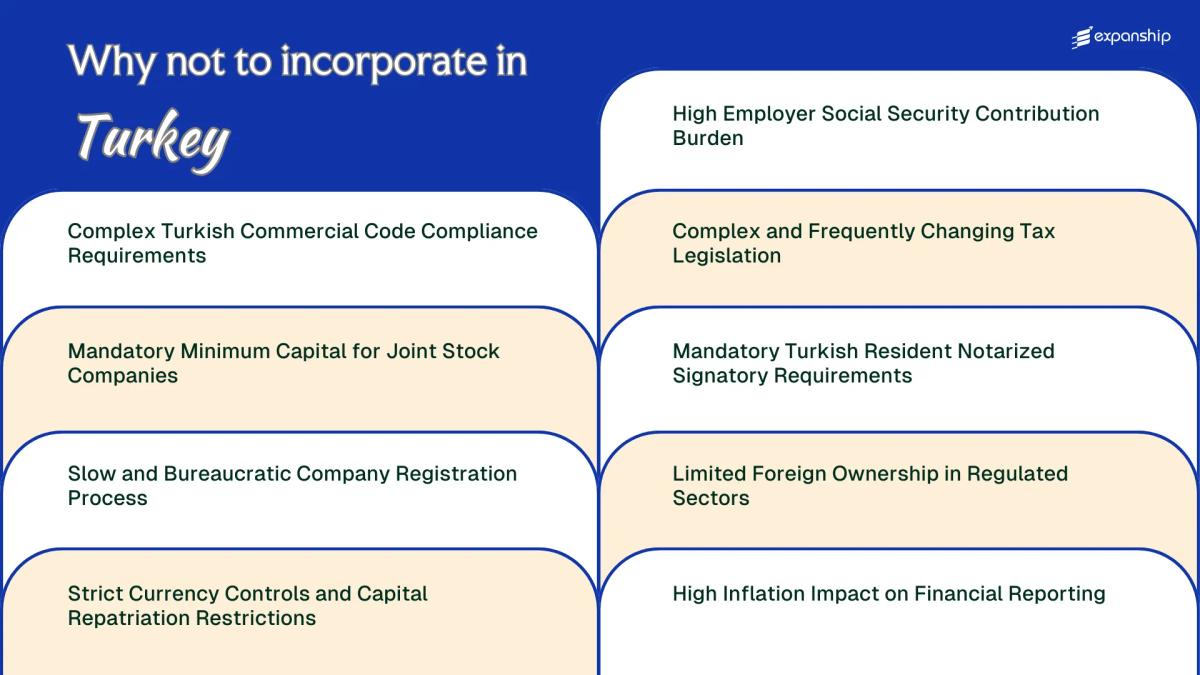
Complex Turkish Commercial Code Compliance Requirements
Turkish Commercial Code compliance challenges extend well beyond basic registration. Foreign firms operating through a Turkish anonim şirket (A.Ş.) or limited şirket (Ltd. Şti.) face a dense regulatory framework that demands continuous legal attention.
Mandatory General Assembly and Board Formalities
Under the Turkish Commercial Code (Law No. 6102, known as the TTK), joint stock companies must hold annual general assembly meetings with formally documented agendas, minutes, and shareholder notifications. These are not administrative formalities you can delegate informally; they require notarized documentation and, in many cases, a Ministry of Commerce-appointed independent observer.
TTK compliance requirements impose strict deadlines on financial statement preparation, auditor appointments, and profit distribution resolutions, all of which must align with Turkish Accounting Standards (TAS).
Ongoing Disclosure and Record-Keeping Obligations
Turkey corporate governance restrictions require A.Ş. entities to maintain and update a share ledger, board resolutions registry, and mandatory trade registry filings through the relevant Trade Registry Directorate. Any structural change, from address updates to capital amendments, triggers fresh notarization and public disclosure obligations.
For foreign parent companies, these Turkish Commercial Code burdens for foreign companies translate into recurring local legal costs that most comparable EU jurisdictions do not impose at the same procedural intensity.
Failure to comply with TTK general assembly and disclosure deadlines can result in administrative fines and, in serious cases, judicial dissolution proceedings initiated by the Ministry of Commerce.
Mandatory Minimum Capital for Joint Stock Companies
Turkey joint stock company capital requirements impose a statutory floor that can strain early-stage foreign ventures before operations begin. Under the Turkish Commercial Code (TCC, Law No. 6102), a Joint Stock Company (Anonim Şirket, or AŞ) must have a minimum paid-in capital of TRY 250,000. Given Turkey's persistently high inflation, this figure erodes in real value rapidly, yet the nominal threshold still requires upfront commitment.
For non-resident founders, converting foreign currency to meet this threshold exposes your business to exchange rate risk at the point of incorporation.
Mandatory share capital restrictions in Turkey create several practical burdens:
- Capital must be deposited into a blocked bank account before registration, tying up funds that could otherwise support early operating costs
- At least 25% of each share's nominal value must be paid in at incorporation, with the remainder due within 24 months, creating a deferred financial obligation that complicates cash flow planning
- If your firm operates in banking or capital markets, sector-specific regulators impose substantially higher minimums, multiplying the initial capital commitment beyond the TCC baseline
Non-cash capital contributions require independent expert valuation under court appointment, adding time and cost to the incorporation process.

Company Incorporation in Turkey
Incorporate your Anonim Şirket in Turkey with full compliance support, from capital structuring to registration.
Slow and Bureaucratic Company Registration Process
The Turkey company registration process problems begin before your entity is even formed. Registering a limited liability company (LTD Şti) or joint stock company (AŞ) requires sequential approvals across multiple government bodies, and a single missing document restarts the queue rather than pausing it.
All new companies must register through MERSIS, the Central Registry Record System operated by the Union of Chambers and Commodity Exchanges of Turkey (TOBB). While MERSIS digitized the initial application, the system frequently requires in-person follow-up at the relevant Trade Registry Office, and notarization requirements add mandatory waiting periods that digital submission cannot bypass.
| Stage | Mandatory Requirement | Delay Risk |
|---|---|---|
| Pre-registration | Notarized articles of association | 2–5 business days for notary scheduling |
| MERSIS submission | Tax office approval of company address | Rejected if lease documentation is incomplete |
| Trade Registry filing | Sworn translator for foreign-language documents | Additional certification adds 3–7 days |
| Post-registration | Social Security Institution (SGK) notification | Must be completed within 30 days or penalties apply |
Foreign founders face a compounding burden: documents originating outside Turkey must be apostilled and officially translated by a certified sworn translator, a step that courts and registries will not waive. Each translation certification is document-specific, so a multi-document incorporation adds cumulative costs and time.
The slow business registration in Turkey directly delays your ability to open a corporate bank account, sign contracts, or hire staff, since most counterparties require a registered entity with a tax number before engaging commercially.
Strict Currency Controls and Capital Repatriation Restrictions
Turkey currency controls restrictions foreign companies represent one of the most operationally disruptive aspects of running a foreign-owned entity in the country. The Central Bank of the Republic of Turkey (CBRT) holds broad authority over foreign exchange transactions, and the regulatory environment has tightened considerably since 2018.
Under CBRT regulations, foreign exchange transactions above certain thresholds require documentation that proves the commercial basis of the transfer. This creates friction for routine cross-border payments, dividend remittances, and intercompany loans. For treasury-sensitive operations, delays in approving transfers can directly affect cash flow planning across your group structure.
Capital repatriation is technically permitted but subject to procedural scrutiny by authorized intermediary banks. In practice, your local bank must verify compliance before releasing funds abroad, adding processing time and compliance cost that you would not face in most EU or Gulf jurisdictions.
The Turkish lira's structural volatility compounds this further. Repatriated profits may carry materially less value than when originally recorded, depending on the timing of conversion.
- All foreign exchange transactions above regulatory thresholds require supporting commercial documentation submitted to an authorized bank.
- Dividend repatriation requires proof of tax clearance and audited financials before bank processing.
- Foreign currency borrowing between related parties is subject to CBRT reporting obligations.
- Lira-denominated profits converted to foreign currency are subject to exchange rate risk at the time of transfer, not at the time of accrual.
Turkey requires resident companies to conduct most domestic transactions in Turkish lira, meaning even foreign-owned subsidiaries cannot freely price internal contracts in foreign currency under certain conditions set by the foreign exchange legislation amended in 2018.
High Employer Social Security Contribution Burden
The Turkey employer social security contribution burden ranks among the most direct payroll cost pressures facing foreign-owned entities registered in the country. Employer obligations under the Social Insurance and General Health Insurance Law (Law No. 5510) are administered by the Sosyal Güvenlik Kurumu (SGK) and apply from the first hired employee.
Statutory Rates and What They Cost Your Business
Employers are required to contribute approximately 20.5% of gross wages toward SGK, covering long-term insurance, short-term insurance branches, and general health insurance. For a business building a local team, this rate materially inflates your actual cost-per-employee well beyond the agreed salary figure.
How This Compares and Who Bears the Weight
The OECD average employer social security rate sits closer to 16-17%, making SGK contributions a structurally elevated cost relative to comparable markets. Some incentive schemes exist that temporarily reduce employer contributions for specific worker profiles, but they are conditional and time-limited, offering no permanent relief for general hiring needs. This structure creates a persistent cost disadvantage for foreign firms that anticipated staffing costs based on headline wage figures alone.
Addressing Employment Cost Challenges in Turkey
Understand the full scope of SGK obligations and payroll cost structures before committing to a Turkish incorporation strategy.
Complex and Frequently Changing Tax Legislation
Turkey tax legislation challenges foreign companies operating through a local entity stem from a regulatory environment that changes faster than most compliance cycles allow. The Revenue Administration (Gelir İdaresi Başkanlığı) issues frequent amendments to the Corporate Tax Law No. 5520, VAT Law No. 3065, and related communiqués, often with short implementation windows.
- Corporate tax rate changes, such as the temporary increase to 25% for most entities, require immediate recalculation of your tax provisioning and financial projections.
- Transfer pricing documentation obligations under the Corporate Tax Law impose annual reporting burdens on foreign-owned entities transacting with related parties abroad.
- VAT withholding mechanisms applied to certain service transactions create cash flow timing mismatches that affect working capital planning.
- E-invoice and e-ledger mandates enforced by the Revenue Administration require system upgrades that generate unexpected IT compliance costs.
- Tax loss carryforward rules, currently limited to five years, restrict your ability to offset early-stage losses against future profits in capital-intensive entry phases.
Mandatory Turkish Resident Notarized Signatory Requirements
Turkey resident notarized signatory requirements apply directly to company formation and ongoing operations. Under the Turkish Commercial Code (TCC) No. 6102, authorized signatories on binding corporate documents must execute signatures before a Turkish notary public, a process that cannot be replicated by remote signing or foreign notarization without apostille validation.
For a foreign founder without physical presence in the country, this creates a recurring operational dependency. Every binding declaration, power of attorney, or trade registry filing that requires notarized signature demands either your physical attendance at a Turkish notary or the appointment of a locally resident representative authorized to sign on the firm's behalf.
Maintaining a mandatory Turkish resident representative adds a layer of cost and control risk that has no equivalent in many EU jurisdictions. That individual holds legal authority over critical filings, and any disruption to that relationship, whether contractual or personal, can delay compliance deadlines with the Trade Registry Office (Ticaret Sicili Müdürlüğü).
A foreign-owned limited liability company (Ltd. Şti.) appointing a locally resident notarized signatory can expect annual representative fees ranging from USD 3,000 to USD 8,000, depending on scope of authority, before accounting for individual notarization fees of approximately TRY 500–1,500 per transaction under current notary tariff schedules.
Limited Foreign Ownership in Regulated Sectors
Turkey foreign ownership restrictions in regulated sectors represent a structural constraint, not an administrative one. Certain industries are governed by sector-specific licensing laws that cap or condition foreign equity participation, meaning your chosen business activity determines whether full foreign ownership is legally permissible at all.
Under the Foreign Direct Investment Law No. 4875, foreign investors nominally enjoy equal treatment with domestic investors. In practice, sector-specific legislation overrides this principle in several industries.
Affected sectors include:
- Broadcasting and media, where the Radio and Television Supreme Council (RTÜK) enforces ownership thresholds under Law No. 6112
- Aviation, where operating license conditions restrict foreign shareholding ratios
- Maritime transport, where cabotage rights under the Cabotage Law limit foreign-flagged vessel operations
- Private security services, which require majority Turkish ownership under Law No. 5188
- Land transportation, where foreign ownership conditions apply to route licensing
Each restriction creates a concrete barrier. If your business model depends on majority control, these caps force a restructured ownership arrangement that may dilute your operational authority or complicate governance.
The restrictions are not uniform. Some apply only above specific ownership thresholds, while others attach to licensing conditions that RTÜK or relevant ministries enforce at the permit stage rather than at incorporation.
Even if your company is validly incorporated with full foreign ownership, the relevant sectoral regulator can deny, suspend, or revoke an operating license if ownership structure does not comply with the applicable sector-specific law at the time of licensing review.
High Inflation Impact on Financial Reporting
Turkey inflation financial reporting problems are most acute for foreign-owned entities required to comply with Turkish Accounting Standards, particularly TAS 29, which governs financial reporting in hyperinflationary economies.
TAS 29 requires restating financial statements in current purchasing power terms when cumulative inflation over three years approaches or exceeds 100%. This restatement process is technically demanding and requires specialized local accounting expertise, adding material cost to your annual reporting obligations.
Turkish lira depreciation compounds the difficulty. Asset values, revenue figures, and intercompany balances can shift substantially between reporting periods, distorting performance metrics and complicating consolidation into a parent company's foreign-currency accounts.
Auditors must apply inflation-adjusted figures under TAS 29, and external audits of restated financials take considerably longer and cost more than standard audits in stable-currency jurisdictions. For a foreign group reporting under IFRS at the parent level, reconciling TAS 29-adjusted Turkish subsidiaries introduces an additional layer of complexity that has no equivalent in most other European or Middle Eastern markets.
Overcoming Turkey's Incorporation Challenges
Overcoming Turkey's incorporation challenges requires structural preparation rather than reactive adjustments. Foreign businesses that map their compliance obligations before registration consistently face fewer procedural delays.
- Engage a licensed Turkish notary early to authenticate all founding documents and satisfy the signatory requirements under the Turkish Commercial Code (TCC).
- Register through the Trade Registry via the MERSIS system to formalise incorporation and reduce manual processing bottlenecks.
- Establish your joint stock company with the minimum TRY 250,000 capital threshold documented and deposited prior to Trade Registry submission.
- Appoint a qualified independent auditor from the outset to manage TCC-mandated financial reporting obligations under high-inflation accounting conditions.
- Structure equity contributions and dividend repatriation plans in compliance with the Capital Movements Circular issued by the Central Bank of the Republic of Turkey.
- Confirm sector classification before entity formation to identify any foreign ownership caps imposed under regulated industry legislation.
Each of these steps intersects with overlapping regulatory requirements across the TCC, tax legislation, and foreign exchange rules. Treating them as isolated actions rather than an interconnected compliance framework increases exposure to procedural delays and statutory penalties.
Turkey's Business Potential Despite the Drawbacks
Turkey business potential despite drawbacks is a real conversation, not a hypothetical one. The compliance burdens, capital requirements, and currency restrictions covered in this blog are genuine friction points. At the same time, the country's geographic position bridging European and Asian markets, its population of over 85 million, and its established manufacturing and export infrastructure make it a commercially relevant destination for foreign businesses that enter with accurate expectations.
| Consideration | Drawback | Counterpoint |
|---|---|---|
| Market access | Currency controls and repatriation restrictions complicate profit extraction | A large domestic consumer base and export corridors to both Europe and the Middle East generate substantial revenue potential |
| Compliance burden | Turkish Commercial Code requirements demand ongoing legal and accounting resources | Established local professional infrastructure exists to support ongoing compliance |
| Setup process | Company registration involves multiple agencies and notarized documentation, extending timelines | Once registered, the entity operates within a legally recognized framework under the Turkish Commercial Code |
| Capital requirements | Joint stock companies must meet mandatory minimum capital thresholds before operating | Capital requirements are defined and predictable, allowing advance financial planning |
| Cost of employment | Employer social security contribution rates add significant cost to each hire | A large, relatively young labor force gives businesses access to a broad talent pool |
| Tax environment | Frequent legislative changes increase reliance on specialist tax advice | Corporate tax rates are defined by law and apply uniformly to resident entities |
High inflation has compounded financial reporting complexity, and the regulatory environment rewards preparation over improvisation.
Compliance Services for Companies in Turkey
Ongoing compliance for Turkish-registered entities covers Commercial Code obligations, tax filings, social security reporting, and annual general meeting requirements under local law.
Conclusion
The Turkey company incorporation drawbacks summary points to a jurisdiction with real structural friction. High employer social security contribution rates, which can exceed 20% of gross wages, materially raise operating costs beyond what headline tax rates suggest. Frequent amendments to tax legislation through Presidential decrees create ongoing compliance exposure. Currency control mechanisms administered by the Central Bank of the Republic of Turkey add further complexity for foreign-owned entities managing cross-border capital flows. Structural preparation and specialist local legal support remain the practical prerequisites for any foreign business entering this market.
Expanship's Support for Your Turkey Expansion
Expanship Turkey company formation support covers the specific compliance obligations that make incorporating here operationally demanding — from Trade Registry filings under the Turkish Commercial Code to managing your ongoing reporting duties with the Revenue Administration. The firm's role is to reduce the administrative burden these requirements place on your team, not to circumvent the regulatory framework itself.
Beyond initial registration, Expanship offers practical support across the full incorporation lifecycle.
- Preparing and submitting company registration documents to the Istanbul or relevant provincial Trade Registry Office.
- Providing a registered agent and local office address for official correspondence.
- Handling government filings and liaising directly with relevant regulatory authorities on your behalf.
- Managing post-incorporation compliance obligations, including annual filings and statutory deadlines.
- Introducing your business to suitable local banking institutions to support account opening.
- Registering your entity for tax purposes and coordinating with the Revenue Administration and local tax offices.
Reach out to Expanship Turkey to discuss your incorporation requirements.
Frequently Asked Questions (FAQ)
Both entity types are governed by the Turkish Commercial Code (Law No. 6102), but the compliance burden is heavier for Joint Stock Companies, which face stricter board composition rules, mandatory independent audits above certain thresholds, and more formal general assembly requirements. A Limited Liability Company (Limited Şirketi, or Ltd. Şti.) carries lighter ongoing obligations, though it still requires a notarized articles of association and trade registry filings that can slow the process considerably.
Employers who fail to remit Social Security Institution (SGK) contributions on time face late payment penalties and interest charges that accrue daily under Turkish social security legislation. The SGK has broad enforcement authority, including the ability to freeze company bank accounts and initiate legal proceedings, making non-compliance a material financial risk rather than a minor administrative issue.
Foreign founders face the same formal registration steps as Turkish nationals, but the practical burden is higher because certain documents must be apostilled, translated by a sworn translator, and notarized in Turkey. The requirement for a notarized Turkish resident signatory in some structures adds another layer of dependency that a domestic founder would not encounter.
Turkey has been subject to hyperinflationary accounting standards under IAS 29, which requires entities to restate financial statements in current purchasing power terms when cumulative inflation exceeds 100% over three years. This creates significant accounting complexity and additional audit costs, particularly for foreign parent companies that must then reconcile restated Turkish financials with their home-country reporting standards.
Restrictions on foreign ownership in sectors such as aviation, broadcasting, and certain financial services are set by sector-specific legislation and are not waivable by contract or corporate structuring alone. In some cases, a foreign investor can hold an indirect economic interest through a Turkish-majority-owned entity, but operational control and licensing rights remain limited, which materially affects the value of the investment.
Turkey's tax framework is amended regularly through Presidential Decrees and annual budget laws, meaning a tax position that was compliant in one fiscal year may not be in the next without proactive updates to internal processes. The Turkish Revenue Administration (GİB) conducts tax audits that can reach back multiple years, and understated tax liabilities attract both penalty surcharges and inflation-adjusted interest that can substantially exceed the original tax amount.
Dividend repatriation is legally permitted, but it requires compliance with Turkish foreign exchange regulations administered by the Central Bank of the Republic of Turkey (TCMB) and involves mandatory bank reporting for transfers above certain thresholds. In periods of currency volatility, the practical impact of converting Turkish Lira dividends into hard currency at unfavorable exchange rates can significantly reduce the effective return on investment compared to what the nominal dividend figure suggests.
Legal Disclaimer
The information provided in this article is for general informational purposes only and does not constitute legal, tax, or professional advice. While we strive to ensure the accuracy and timeliness of the content, laws and regulations are subject to change, and the application of laws can vary widely based on specific facts and circumstances.
Readers should not act upon this information without seeking professional counsel tailored to their individual situation. Expanship and its authors disclaim any liability for actions taken or not taken based on the content of this article.
For specific advice regarding your business setup, compliance requirements, or any legal matters, please consult with qualified legal and tax professionals in the relevant jurisdiction.