

Key Takeaways
- Turkey's corporate tax rate of 25%, combined with double tax treaty coverage across 90+ countries, reduces the risk of double taxation for foreign investors operating across multiple jurisdictions simultaneously.
- Under the Turkish Commercial Code (Law No. 6102), non-residents can hold shares in a limited şirketi without mandatory local partnership requirements, giving foreign investors full structural control from the point of registration.
- Businesses incorporated in Turkey benefit from the EU Customs Union agreement, allowing goods to move into European markets without standard customs duties applying to third-country exports.
- Manufacturers and technology firms draw on materially different incentive structures — from Organized Industrial Zone benefits to R&D deductions under the Income Tax Law — meaning the jurisdiction's fiscal advantages are sector-specific rather than uniform.
Incorporating a business in Turkey — an independent republic and EU candidate state — presents a distinct set of structural and commercial considerations for foreign investors. Company registration falls under the oversight of the Trade Registry, which operates under the Ministry of Customs and Trade. The most common vehicle used by foreign businesses is the limited şirketi. Turkey operates a territorial-leaning tax system with active treaty obligations, keeping its overall tax posture moderate rather than punitive.
Foreign ownership is broadly permitted across most sectors, and the legal framework under the Turkish Commercial Code (Law No. 6102) allows non-residents to hold shares without mandatory local partner requirements in standard commercial entities. This openness extends to repatriation of profits and capital, which is generally unrestricted under foreign exchange regulations.
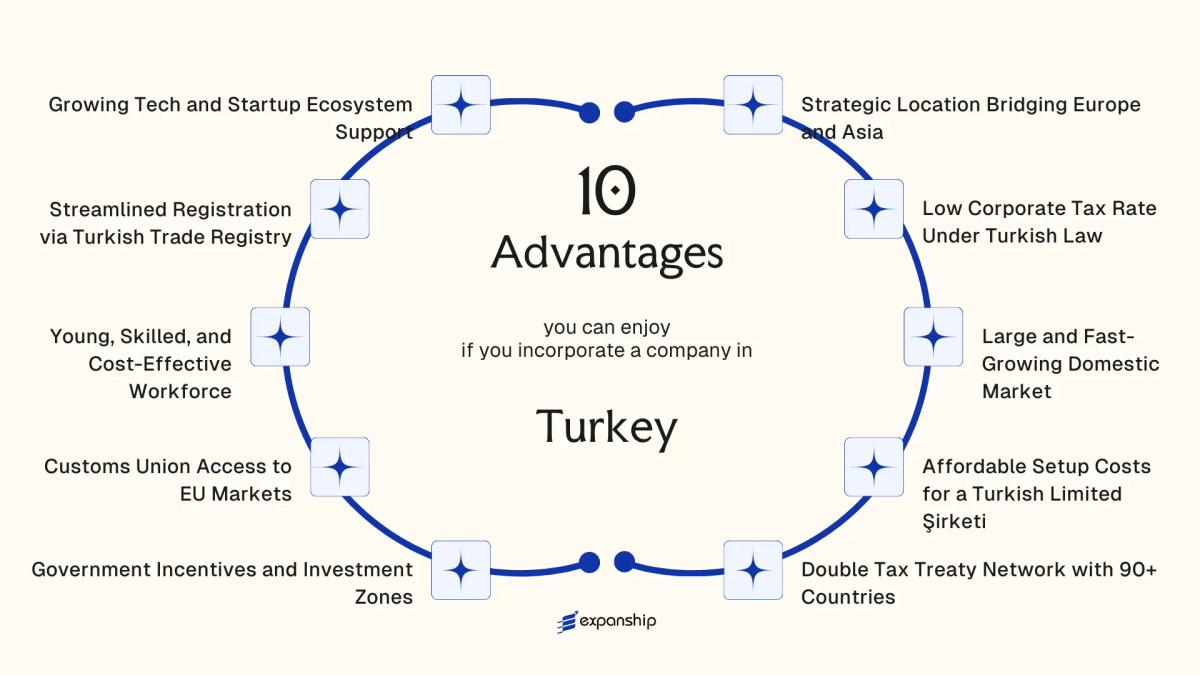
The benefits of incorporating in Turkey span tax efficiency, market access, and structural flexibility. This article examines the specific advantages that make Turkey company formation a practical option for businesses operating across multiple regions.
Strategic Location Bridging Europe and Asia
Turkey's geographic position places it at the intersection of Europe, Asia, the Middle East, and North Africa, making Turkey strategic location Europe Asia business considerations a material factor in incorporation decisions. Sitting across two continents, an entity registered here can realistically serve multiple regional markets from a single operational base.
Access to Surrounding Markets Within Short Transit Distance
Istanbul's logistics infrastructure connects your business to over 1.5 billion consumers within a four-hour flight radius. This reach spans the EU, Gulf states, Central Asia, and Sub-Saharan Africa, giving a foreign-registered firm geographic coverage that few single jurisdictions can match at comparable operating costs.
Continental Connectivity Backed by Physical Infrastructure
The country's ports, including the Port of Mersin on the Mediterranean and Ambarlı near Istanbul, rank among the busiest freight hubs in the region. Overland, the Trans-European Transport Network corridors extend into Turkish territory, meaning goods can move by road or rail between European and Asian markets with your Turkish-registered company positioned along that corridor.
A company incorporated here can serve as a single regional hub for distribution, procurement, or trading operations across three continents without establishing separate entities in each market.
Low Corporate Tax Rate Under Turkish Law
Turkey's standard corporate income tax rate is set at 25% under the Kurumlar Vergisi (Corporate Tax Law No. 5520). While that headline figure is not the lowest globally, the rate interacts with a series of structural features that reduce the effective tax burden on qualifying companies well below the nominal rate.
Resident corporations can deduct R&D expenditures at 100%, apply accelerated depreciation on qualifying assets, and benefit from a participation exemption on foreign-source dividends under specific conditions outlined in the same law. Each of these mechanisms directly reduces taxable income, meaning the statutory rate is rarely the rate your business actually pays.
For foreign investors, the practical appeal of Turkey's corporate tax framework lies in its predictability:
- Corporate Tax Law No. 5520 has remained the foundational statute since 2006, providing a stable legislative basis rather than a patchwork of ad hoc rules
- The participation exemption removes double taxation on dividends received from foreign subsidiaries, which matters for holding structures
- Deductibility rules are codified and consistently applied, reducing exposure to arbitrary interpretation by the Revenue Administration (Gelir İdaresi Başkanlığı)
Taxable income is calculated on a worldwide basis for resident entities, so understanding the exemptions available under domestic law is essential before structuring your entity.

Company Incorporation in Turkey
Establish your Turkish limited şirketi with full compliance support across registration, tax, and post-incorporation requirements.
Large and Fast-Growing Domestic Market
Turkey's population stands at approximately 85 million, making it one of the most populous countries in Europe and the Middle East combined. For a foreign business targeting a single-country market, that scale translates directly into addressable demand without the complexity of operating across multiple jurisdictions.
| Indicator | Figure |
|---|---|
| Population | ~85 million |
| Median Age | ~33 years |
| GDP (2023 est.) | ~$1.1 trillion (PPP) |
| Urban Population Share | ~77% |
| Internet Penetration | ~83% |
Consumer spending has expanded steadily across sectors including retail, e-commerce, manufacturing, and financial services. A young median age, sitting around 33 years, supports sustained consumption patterns over a longer horizon than many European markets where aging demographics compress growth projections. Your business benefits from a consumer base that is not only large but structurally oriented toward continued spending growth.
Geographic concentration matters here too. Istanbul alone accounts for roughly 20% of national GDP, meaning a single urban presence can capture a disproportionate share of national demand. Ankara and Izmir add further density. For firms establishing a Turkish limited şirketi, this concentration reduces the distribution infrastructure required to reach high-value customers.
Foreign companies registered under the Foreign Direct Investment Law No. 4875 receive equal treatment to domestic firms, removing a structural barrier that exists in several comparable emerging economies.
Affordable Setup Costs for a Turkish Limited Şirketi
Affordable Turkish Limited Şirketi setup costs are one of the more concrete financial advantages available to foreign founders. The statutory minimum share capital for a Limited Şirketi (Ltd. Şti.) is just 10,000 Turkish Lira, as set out under Article 580 of the Turkish Commercial Code (Law No. 6102). At current exchange rates, this translates to a modest sum in USD or EUR, meaning your initial capital commitment stays low while you establish market presence.
Registration fees paid to the Turkish Trade Registry are calculated on a fixed-fee basis rather than as a percentage of share capital. This structure benefits smaller foreign entrants because your incorporation cost does not scale with ambition.
Notarization, trade registry publication in the Turkish Trade Registry Gazette, and tax registration are all handled within a defined administrative process, with most fees set by official tariff schedules rather than subject to negotiation or variable billing.
Keep the following points in mind:
- Minimum capital of 10,000 TRY must be deposited per legal requirement
- At least 25% of cash contributions must be paid before registration; the remainder within 24 months
- A registered address in Turkey is mandatory for the entity
- Trade Registry Gazette publication fees are set annually by official tariff
A single-shareholder Limited Şirketi is fully permitted under Turkish Commercial Code, removing the need to bring in a nominal co-founder solely to meet a multi-shareholder requirement.
Double Tax Treaty Network with 90+ Countries
Turkey's double tax treaty network benefits extend across more than 90 bilateral agreements, covering major economies in Europe, Asia, the Middle East, and North America. For a foreign business operating through a Turkish entity, these treaties directly reduce withholding tax rates on dividends, interest, and royalties paid across borders — costs that would otherwise erode returns on cross-border activity.
Reduced Withholding Rates on Cross-Border Payments
Under domestic Turkish tax law, withholding tax on dividends paid to non-resident shareholders is generally 10%. Treaty provisions frequently reduce this rate further — the treaty with the Netherlands, for example, can bring dividend withholding to 5% under qualifying ownership thresholds. For businesses routing regional profits, the difference between treaty and non-treaty rates has a direct effect on net distributions.
Interest and royalty payments carry their own withholding exposures under Turkish law. Active treaties can cap these rates at levels significantly below the statutory defaults, which matters to businesses that license intellectual property into their Turkish subsidiary or extend intercompany financing from abroad.
Preventing Double Taxation on the Same Income
Each treaty follows either the exemption or credit method to prevent the same income from being taxed in both Turkey and the counterpart state. This means profits earned by your Turkish firm and subsequently distributed or repatriated are not taxed twice in full. Businesses operating in treaty partner countries can confirm their entitlement under the relevant bilateral agreement published by the Turkish Revenue Administration (Gelir İdaresi Başkanlığı).
Clarify Your Treaty Position Before Setting Up in Turkey
Our team can identify which bilateral tax treaties apply to your structure and how they affect your withholding exposure and profit repatriation strategy.
Government Incentives and Investment Zones
Turkey government investment incentives for businesses span several structured programs administered under the Investment Incentive System, coordinated by the Ministry of Industry and Technology and the Presidency of the Republic of Turkey Investment Office.
- The Investment Incentive System groups projects into regional, general, priority, and strategic investment categories under Council of Ministers Decree No. 2012/3305. Projects classified as strategic or priority-level can access reduced corporate tax rates, VAT exemptions, customs duty waivers, and employer social security premium support for up to ten years, depending on the investment region and sector.
- Organized Industrial Zones (OIZ) offer registered businesses reduced energy costs, infrastructure provided at state expense, and exemption from certain municipal taxes. Turkey organized industrial zone benefits also include a reduced corporate tax rate of 1% for manufacturing entities operating within designated zones.
- Free zones operating under Free Zones Law No. 3218 allow qualifying exporters to pay zero corporate income tax on profits derived from goods produced and sold abroad. Turkey free zone investment advantages extend to exemptions from VAT, customs duties, and certain stamp taxes.
- TCDD investment incentive program benefits apply to logistics and rail-connected facilities, offering infrastructure cost support for businesses that integrate with state rail networks, reducing long-term freight and warehousing expenditure.
Customs Union Access to EU Markets
Turkey customs union EU market access benefits date to 1996, when the Customs Union Agreement with the European Union entered into force under Decision No. 1/95 of the EC-Turkey Association Council. Under this arrangement, industrial goods and processed agricultural products move between Turkey and EU member states without customs duties or quantitative restrictions. For a company incorporated here, this means your goods can enter 27 EU member states duty-free, without the tariff costs that apply to exporters based outside the union.
The practical implication is direct: a foreign-owned firm manufacturing or trading industrial products from a Turkish entity gains the same tariff treatment on EU-bound exports as a company based in Germany or France, at a fraction of the operating cost.
This also means your business adopts the EU's Common External Tariff on imports from third countries, aligning your supply chain tariff structure with EU norms by default.
A manufacturer exporting €5 million in industrial goods annually from Turkey to Germany pays €0 in customs duties under the Customs Union. The same shipment originating from a non-member country such as India or Vietnam would typically attract EU MFN tariffs ranging from 3.7% to 12%, translating to €185,000 to €600,000 in annual duty costs.
Young, Skilled, and Cost-Effective Workforce
Turkey skilled workforce advantages for businesses are grounded in measurable demographics. Over 60% of the population is under 40, producing a continuous pipeline of working-age candidates across technical, engineering, and commercial disciplines.
Turkish universities graduate roughly 800,000 students annually, with engineering and natural sciences consistently among the highest-enrollment faculties. Minimum wage levels, set each year by the Minimum Wage Determination Commission under the Labour Act No. 4857, remain substantially below Western European benchmarks. For a foreign firm hiring locally, this gap between skill level and labor cost translates directly into lower operational expenditure without proportional compromise on output quality.
Key workforce advantages relevant to foreign employers:
- Proficiency in English and German is common among university graduates in major cities such as Istanbul, Ankara, and Izmir
- The Social Security Institution (SGK) governs employer contribution rates, which are calculable and predictable from the outset of hiring
- Specific investment zones, including Organized Industrial Zones, offer reduced employer SGK contribution incentives for qualifying firms
Employer SGK contribution rates and any applicable zone-based reductions are subject to periodic regulatory revision, so confirm current rates directly with the SGK or a licensed local advisor before finalizing your payroll cost projections.
Streamlined Registration via Turkish Trade Registry
Turkey trade registry streamlined registration benefits begin with MERSİS, the Central Trade Registry System operated by the Ministry of Customs and Trade. This digital platform allows founders to complete incorporation filings online before physically attending the trade registry office, reducing duplicate data entry and cutting pre-registration preparation time considerably.
Under Turkish Commercial Code No. 6102, a limited şirketi (limited liability company) can be registered within one to three business days of submitting complete documentation to the relevant Trade Registry Directorate. That timeline gives foreign founders a defined, predictable window for activating their entity, rather than the open-ended waiting periods common in markets with manual or multi-agency processes.
Registration through MERSİS generates a single tax identification number and triggers simultaneous notification to the Social Security Institution (SGK) and the Tax Administration. Your business does not need to visit multiple agencies to complete these registrations independently, which reduces administrative friction during the post-incorporation setup phase.
The minimum capital requirement for a limited şirketi is 10,000 Turkish lira, with no obligation to deposit the full amount at the time of registration. A notarised articles of association, proof of registered address, and shareholder identity documentation are the primary filing requirements.
Key procedural features of the MERSİS-based process include:
- Online pre-application before registry attendance
- Simultaneous SGK and tax office notification upon registration
- No minimum paid-up capital requirement at the point of filing
- Single company number assigned across all public databases
Growing Tech and Startup Ecosystem Support
Turkey startup ecosystem benefits for tech companies have become a concrete policy outcome, not just a trend. Law No. 4691, the Technology Development Zones Law, established a formal framework that grants software and R&D-focused companies operating inside designated technoparks full exemption from corporate income tax on qualifying revenues, a benefit scheduled to remain in effect through at least 2028 under current legislation. For a foreign-owned firm establishing a Turkish entity, this means income generated from software, R&D activities, and technology-based production can be entirely sheltered from the standard 25% corporate rate.
Turkey's technopark advantages for foreign businesses extend beyond the tax exemption itself. Employees whose work qualifies under the zone's R&D criteria benefit from income tax withholding exemptions on their wages, which directly reduces your payroll cost structure without requiring complex optimization arrangements.
The Teknoloji Geliştirme Bölgesi framework currently covers more than 90 active technoparks, many of which are co-located with major universities including METU, Bogazici, and Istanbul Technical University. Physical proximity to these institutions gives resident companies structured access to graduate talent pipelines and collaborative research programs.
Beyond the zones themselves, the Scientific and Technological Research Council (TUBITAK) administers grant and support programs specifically targeting early-stage technology firms, including funding mechanisms accessible to companies with foreign shareholders. Eligibility conditions typically require that R&D activities be conducted within Turkey and that the applicant entity be registered under Turkish commercial law.
- Corporate tax exemption applies only to revenues earned within the technopark zone's defined scope
- TUBITAK grants are project-based and subject to periodic application cycles
- Wage incentives are tied to the employee's specific role classification under the zone administration
Why Turkey Stands Out Against Competing Jurisdictions
Assessed against its most relevant competitors, Turkey's incorporation profile holds up on several parameters that matter to foreign investors: cost of entry, market access, and treaty coverage. The three jurisdictions below — UAE, Poland, and Georgia — were selected because they target a comparable pool of international business owners and are frequently evaluated alongside a Turkish entity. What the table shows is not simply a ranking, but a structural picture of where each jurisdiction has made deliberate trade-offs.
UAE and Georgia attract with low or zero corporate tax, yet neither offers Turkey's combination of a 90-plus country double tax treaty network and direct Customs Union access to EU markets under the 1995 Ankara Agreement framework. Poland, as an EU member, shares that market access but carries higher labour costs and a more complex compliance burden for non-EU founders. For businesses targeting both European and Middle Eastern supply chains from a single registered entity, this geographic and treaty profile is a structural advantage, not merely a geographic talking point.
| Parameter | Turkey | UAE (Mainland) | Poland | Georgia |
|---|---|---|---|---|
| Corporate Tax Rate | 25% standard | 9% (federal) | 19% standard | 15% standard |
| Double Tax Treaties | 90+ countries | 130+ countries | 90+ countries | 60+ countries |
| EU Customs Union Access | Yes (1995 Agreement) | No | Yes (EU member) | Limited (DCFTA) |
| Minimum Share Capital (Standard LLC) | TRY 10,000 | AED 150,000+ (varies) | PLN 5,000 | GEL 0 |
| Local Director Required | No | Yes (some structures) | No | No |
| Foreign Ownership | 100% permitted | 100% (free zones) | 100% permitted | 100% permitted |
Compliance Services for Companies in Turkey
Stay current with Turkish Trade Registry filing requirements, annual obligations under the Turkish Commercial Code, and ongoing statutory deadlines for your Turkish entity.
Conclusion
Turkey's position as a transcontinental hub, combined with a corporate tax rate of 25% and a double tax treaty network covering over 90 countries, creates a measurable structural case for foreign incorporation. The benefits of incorporating in Turkey are most pronounced for businesses targeting both European and Middle Eastern markets simultaneously, given the Customs Union agreement with the EU and the geographic access it enables.
That said, the advantages of setting up a company in Turkey are not uniform across all business types. A firm focused on manufacturing will draw differently on the Organized Industrial Zone incentives than a technology startup accessing R&D deductions under the Income Tax Law. The weight of each benefit depends on your sector, ownership structure, and the markets you intend to serve.
Foreign investors who align their structure with the relevant legal frameworks — from the Turkish Commercial Code governing limited şirketi formation to the investment incentive certificates issued by the Ministry of Industry and Technology — are better positioned to extract the practical value the jurisdiction offers. The path from registration through the Turkish Trade Registry to full operational status is well-defined, and the regulatory environment is designed to accommodate foreign shareholding without mandatory local partnership. For businesses where those conditions apply, the structural fit is clear, and formalising that structure is the logical next step.
Start Your Turkish Company Formation with Expanship Today
Expanship supports the full formation process for a limited şirketi (Ltd. Şti.) under the Turkish Commercial Code No. 6102, handling the registration steps that require coordination with the Istanbul or regional Trade Registry Offices, the Central Registration System (MERSİS), and post-incorporation tax enrolment with the relevant Revenue Administration (Gelir İdaresi Başkanlığı). Every stage of the process discussed in this blog, from entity structuring to ongoing compliance, falls within the scope of services Expanship provides to foreign investors and business owners.
Turkey company formation with Expanship covers the preparation and legalization of incorporation documents in accordance with Turkish notarial requirements, including apostille procedures where applicable. The service extends from initial filing through to active company maintenance:
- Document preparation, notarization, and apostille coordination
- Registered office address and local agent provision
- MERSİS filing and Trade Registry liaison
- Tax registration with the Revenue Administration and Chamber of Commerce enrolment
- Post-incorporation compliance management, including annual obligations
- Banking introduction assistance for corporate account opening
To discuss your structure and begin the formation process, contact Expanship Turkey directly.
Frequently Asked Questions (FAQ)
The standard corporate income tax rate under the Corporate Tax Law No. 5520 is 25%. This rate applies to resident companies on their worldwide income and to non-resident companies on income sourced within the country. Specific investment incentive certificates and zone-based arrangements can reduce the effective rate, but the standard statutory rate remains 25%.
Under the Customs Union agreement in force between Turkey and the European Union since 1996, industrial goods produced by a Turkish-registered company can enter EU member state markets without customs duties. The arrangement covers manufactured products but excludes agricultural goods and services. A company incorporated locally can therefore access EU markets for eligible product categories without requiring a separate EU-based entity.
Turkey's network of over 90 bilateral tax treaties generally includes provisions on dividend withholding tax, though the applicable rate varies by treaty. Under domestic law, the standard withholding rate on dividends paid to non-resident shareholders is 10%, but a relevant tax treaty can reduce this rate if the foreign parent qualifies under the treaty's residency and beneficial ownership conditions. The specific rate must be confirmed against the treaty between Turkey and the shareholder's country of residence.
A registered business address in Turkey is a legal requirement for incorporation through the Trade Registry Offices (Ticaret Sicili Müdürlükleri). The address must be a verifiable physical location within the relevant province's jurisdiction. Virtual office arrangements that satisfy the documentary requirements of the relevant Trade Registry Office are generally accepted in practice, though requirements can vary slightly by province.
A limited şirketi must maintain a minimum paid-in capital of 10,000 Turkish lira under the Turkish Commercial Code (Türk Ticaret Kanunu, Law No. 6102). If the company's net assets fall below the required threshold due to losses, the shareholders are obligated under Article 376 of the same Code to take corrective measures, which can include injecting additional capital or resolving to wind up the company. Failure to act on a capital loss can expose the directors and managers to personal liability.
The investment incentive schemes administered by the Ministry of Industry and Technology are available to both foreign-owned and domestically-owned companies, provided the investment meets the eligibility criteria set out in the relevant Council of Ministers decree. Incentives including VAT exemptions, customs duty exemptions, and tax reductions are tied to the investment certificate (yatırım teşvik belgesi) rather than the nationality of the shareholder. Certain strategic investment categories carry higher support thresholds regardless of ownership structure.
Registration through a Trade Registry Office generally takes between one and five business days once all required documentation has been submitted in the correct form. The timeline assumes that the articles of association, notarized identity documents, and capital deposit confirmation are complete and compliant. Delays typically arise from document deficiencies or apostille requirements for foreign-sourced documents rather than from the registry process itself.
Legal Disclaimer
The information provided in this article is for general informational purposes only and does not constitute legal, tax, or professional advice. While we strive to ensure the accuracy and timeliness of the content, laws and regulations are subject to change, and the application of laws can vary widely based on specific facts and circumstances.
Readers should not act upon this information without seeking professional counsel tailored to their individual situation. Expanship and its authors disclaim any liability for actions taken or not taken based on the content of this article.
For specific advice regarding your business setup, compliance requirements, or any legal matters, please consult with qualified legal and tax professionals in the relevant jurisdiction.