

Key Takeaways
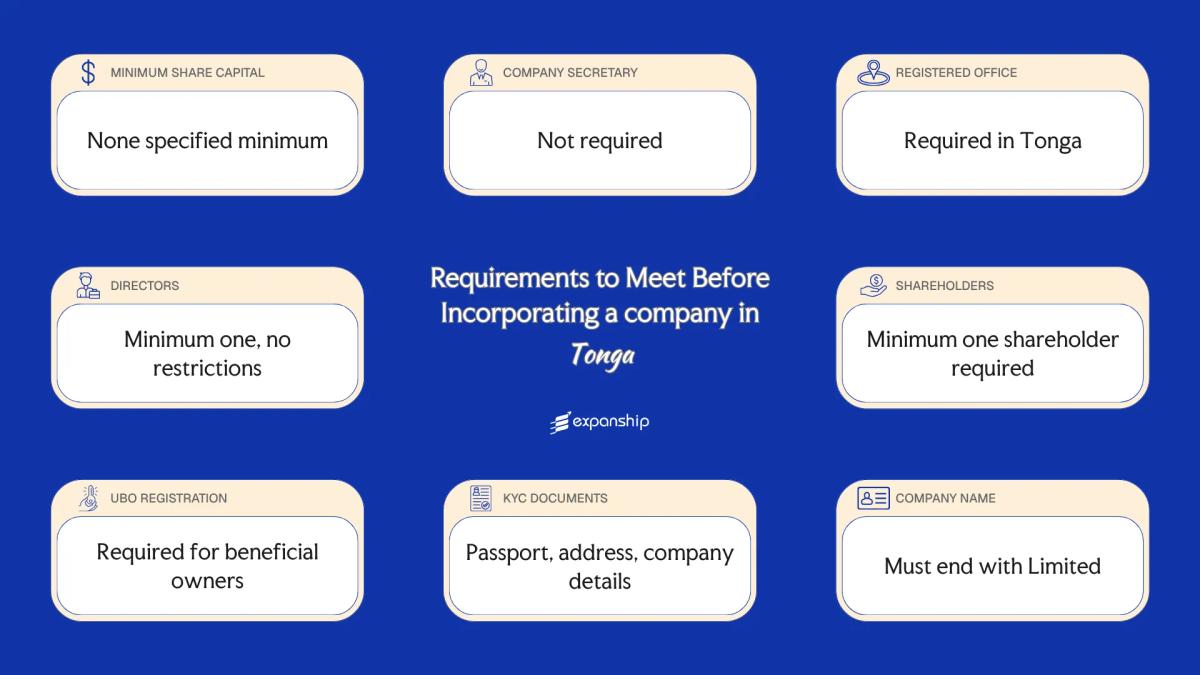
- Foreign and domestic companies incorporating in Tonga must satisfy the structural, documentary, and directorship conditions set out in the Companies Act 1995 before the Tonga Business Registry will approve a registration application.
- Beneficial ownership information must be disclosed in accordance with the Financial Transactions Reporting Act, making UBO transparency a mandatory compliance obligation rather than a voluntary disclosure.
- A locally maintained registered office is a standing legal requirement throughout the life of the company, not merely a condition of the initial application submitted to the Registrar of Companies.
- Companies with foreign directors or shareholders face additional scrutiny from the Ministry of Commerce, Tourism and Labour, and must ensure all KYC documentation meets the Registrar's standards prior to submission.
Corporate entity formation in Tonga is governed by the Companies Act and administered through the Tonga Business Registry, which operates under the Ministry of Commerce, Tourism and Labour. Meeting the incorporation requirements in Tonga is a prerequisite for obtaining legal registration; failure to satisfy these conditions results in rejection of the application or, in cases of post-registration non-compliance, potential deregistration.
This article covers the structural, documentary, and regulatory conditions your business must satisfy before and during the registration process. Requirements can differ depending on the type of entity being formed, the industry sector, and whether the applicant is a foreign national or locally resident investor.
Foreign entrepreneurs, offshore holding company owners, and non-resident directors setting up a company in Tonga will find this article most relevant to their situation.
Minimum Share Capital Requirements in Tonga
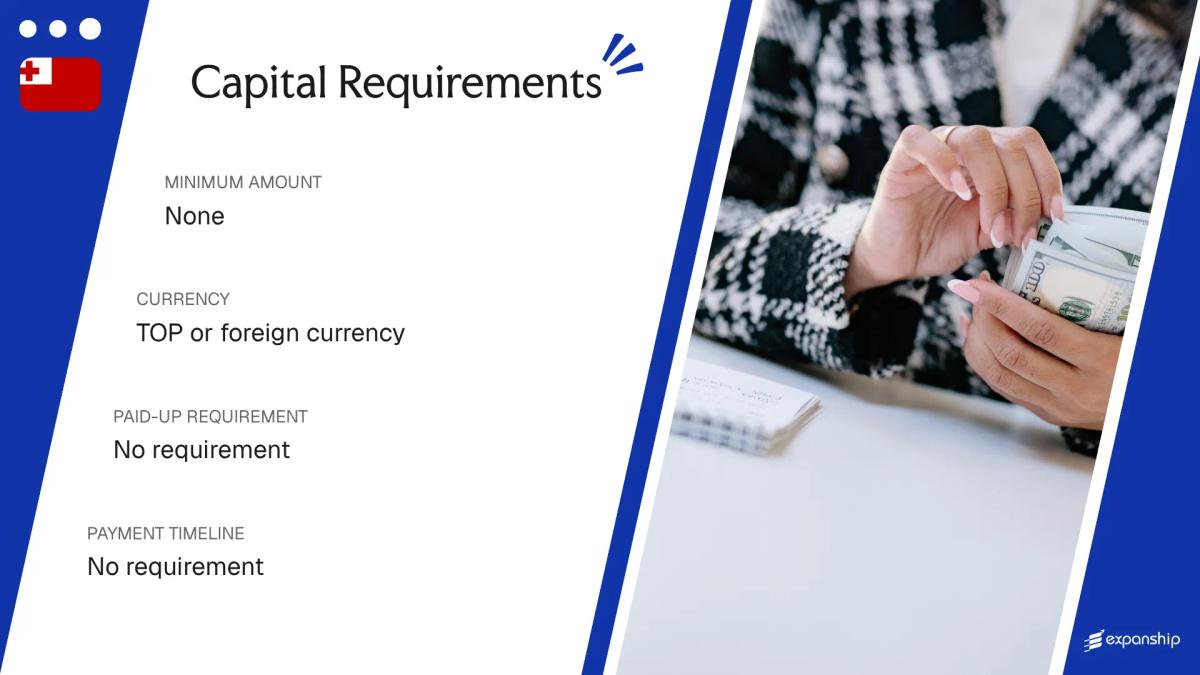
Tonga minimum share capital requirements are governed under the Companies Act 2010, administered by the Tonga Business Registry (MFNP). No statutory minimum authorized or paid-up capital is prescribed for standard private companies incorporated under this Act.
Shares in Tonga may be issued with or without par value, depending on how the constitution of the firm is structured at the time of registration. The Registry does not require a bank certificate or capital deposit verification as a precondition to incorporation.
| Parameter | Detail |
|---|---|
| Minimum Authorized Share Capital | No statutory requirement |
| Maximum Authorized Share Capital | No statutory requirement |
| Minimum Paid-Up Capital | No statutory requirement |
| Paid-Up Requirement at Incorporation | No statutory requirement |
| Accepted Currency | Tongan Paʻanga (TOP) or foreign currency as permitted by the constitution |
| Accepted Forms of Contribution | Cash or non-cash consideration, as permitted under the Companies Act 2010 |
| Timeframe to Deposit Capital | No statutory timeframe prescribed |
Even without a prescribed minimum, your company's constitution must still define its share structure. A company incorporated without an authorized capital clause may face complications when issuing shares or onboarding investors later.
Company Secretary Requirements in Tonga
Under the Companies Act of Tonga, appointing a company secretary is a mandatory requirement for all registered companies. Meeting the company secretary requirements Tonga imposes is a condition of maintaining good standing with the Registrar of Companies.
The secretary holds formal responsibilities for corporate record-keeping, ensuring statutory filings are submitted on time, and maintaining the company's registers. Tonga corporate secretary obligations extend to coordinating board meetings and certifying documents filed with the Registrar.
Qualification criteria for who may serve as company secretary:
- Must be a natural person; a corporate entity generally cannot fulfill this role
- No statutory requirement for the secretary to be resident in Tonga
- Must be at least 18 years of age
- No specific professional licensing is prescribed under general company law
- Cannot be an undischarged bankrupt

Incorporate a Company in Tonga
Register your business entity in Tonga with guided support through the Registrar of Companies process.
Registered Office Requirements in Tonga
Registered office requirements in Tonga are governed under the Companies Act 1995, which mandates that every registered company maintain a physical address within the Kingdom at all times. Failure to comply can result in regulatory action by the Tonga Business Enterprise Registry, including potential deregistration of the entity.
- A physical address is required; a P.O. Box alone does not satisfy the registered office requirement.
- The address must be located within Tonga; overseas addresses are not accepted.
- Virtual offices may be used provided they supply a genuine, verifiable street address in the Kingdom.
- No ownership of premises is required; a lease or service agreement confirming use of the address is sufficient.
- The registered office address is publicly listed on the company registry and accessible to third parties.
- Any change to the registered office address must be formally notified to the Tonga Business Enterprise Registry within the prescribed statutory period.
Director Requirements in Tonga
Under the Companies Act 1995, directors of a Tongan company assume statutory duties including acting in good faith in the best interests of the entity and avoiding conflicts of interest. Liability can attach personally where a director authorises trading while the company is insolvent or fails to maintain proper records as required under the Act.
| Parameter | Detail |
|---|---|
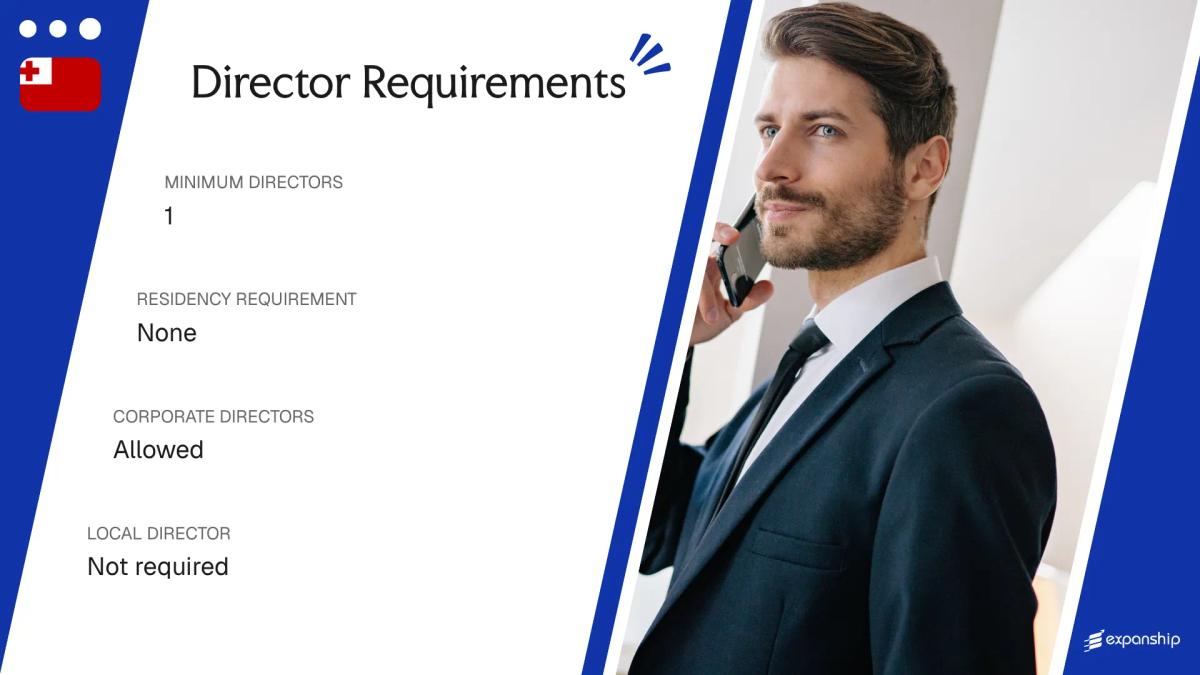
| Minimum Number of Directors | One director is required. |
| Maximum Number of Directors | No statutory maximum is prescribed. |
| Local/Resident Director Required | No residency requirement is imposed under the Companies Act 1995. |
| Nationality Restrictions | No nationality restrictions apply. |
| Minimum Age Requirement | Directors must be at least 18 years of age. |
| Corporate Directors Permitted | No statutory prohibition exists, though practice should be confirmed against current regulatory guidance. |
| Director Must Be a Shareholder | No statutory requirement for a director to hold shares. |
| Publicly Listed on Registry | Director details are filed with the Tonga Business Registry but public accessibility should be verified directly with the Registry. |
| Disqualification Conditions | A person who is bankrupt or has been convicted of certain offences may be disqualified from acting as a director. |
Despite having no residency requirement, Tonga does not permit bearer shares or nominee director arrangements that obscure the identity of the true controller, meaning director transparency obligations exist even without a local presence mandate.
Shareholder Requirements in Tonga
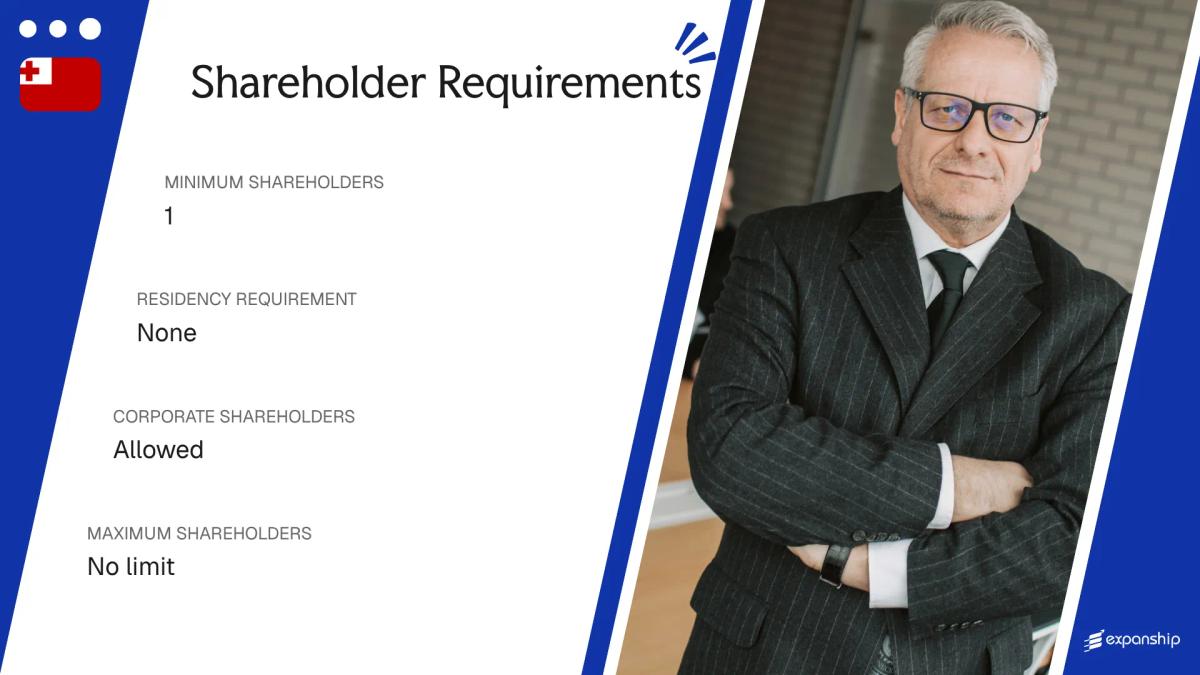
Under the Companies Act of Tonga, a private company requires a minimum of one shareholder, permitting a sole shareholder structure. No statutory maximum is prescribed for private companies.
Nationality and Residency Restrictions
Shareholder requirements in Tonga do not impose nationality or residency conditions on individual shareholders. Foreign nationals may hold full ownership in a Tongan-registered entity without a mandatory local equity component.
Corporate Shareholders
Corporate entities are permitted to act as shareholders in a Tonga-registered company. The appointing entity must provide documentation establishing its legal existence and authorised signatories.
Shareholder Liability
Liability is limited to the amount unpaid on each shareholder's shares. No general circumstance extends liability beyond that contribution under standard company structures governed by the Companies Act.
Register of Shareholders
A register of shareholders must be maintained at the registered office. This register is not publicly accessible by default, though updates are required when ownership changes occur.
Setting Up Shareholder Structures for Your Tonga Company
Get guidance on ownership structuring, documentation, and compliance requirements when incorporating in Tonga.
UBO / Beneficial Ownership Disclosure Requirements in Tonga
Beneficial ownership disclosure Tonga falls under the Financial Institutions Act and the anti-money laundering framework administered by the National Reserve Bank of Tonga.
- Identify any natural person who holds or controls 25% or more of shares or voting rights in the company, or who otherwise exercises ultimate effective control.
- Record beneficial ownership information in the company's internal register, maintained at the registered office.
- Submit required ownership details to the Tonga Financial Intelligence Unit as part of AML compliance obligations at or around the time of incorporation.
- Update the register whenever ownership or control changes.
| Parameter | Detail |
|---|---|
| Ownership Threshold for UBO Status | 25% or more of shares or voting rights, or ultimate effective control |
| Filing Authority | Tonga Financial Intelligence Unit |
| Disclosure Deadline at Incorporation | At or around registration |
| Publicly Accessible Register | No statutory requirement |
| Penalties for Non-Disclosure | Penalties apply under the Financial Institutions Act |
| Ongoing Update Obligation | Yes; updates required upon any change in ownership or control |
KYC / Document Requirements in Tonga
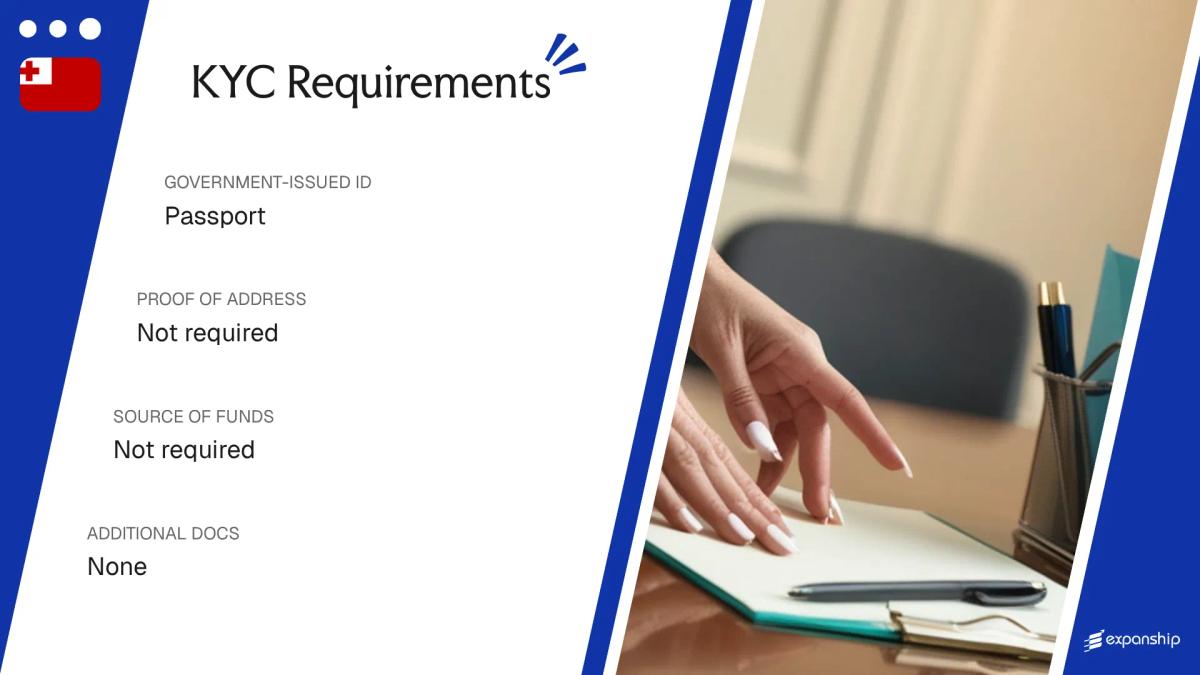
KYC document requirements in Tonga are governed by the Financial Transactions Reporting Act 2004, administered by the Tonga FIU, which sets out the due diligence obligations that registered agents and service providers must fulfil before completing company formation.
Individual / Personal Documents
- Valid government-issued photo identification, such as a passport or national ID card
- Proof of residential address dated within three months, such as a utility bill or bank statement
- Signed declaration or consent form where required by the registered agent
- Recent passport-sized photograph may be required by some registered agents
Corporate Documents
- Certificate of incorporation or equivalent from the entity's home jurisdiction
- Constitutional documents, such as articles of association or memorandum of association
- Register of directors and register of shareholders from the corporate entity
- Proof of registered address for the corporate shareholder or director
Source of Funds Documentation
- Bank statements covering a minimum of three to six months prior to incorporation
- Audited financial statements where the subscribing entity is a corporate body
- Written explanation of the origin of funds if the capital source is not self-evident
Notarisation and Apostille Requirements
- Foreign identity documents generally require notarisation by a qualified notary public
- Documents originating from Hague Convention countries should carry an apostille
- Certified translations into English are required for any documents in another language
Incomplete or unverified source of funds documentation is the most common cause of incorporation delays under Tonga's due diligence review process.
Company Name Requirements in Tonga
Company name requirements in Tonga follow a standard approval process administered at the point of registration, where proposed names are assessed for uniqueness and compliance with applicable naming rules before incorporation proceeds.
Names must be in English or include an English translation, and the legal suffix must reflect the company type, such as "Limited" or "Ltd" for private companies. No specific character limits are publicly codified, but the name must be sufficiently distinct to avoid confusion with existing registered entities.
Certain words are restricted or prohibited outright. Terms implying government affiliation, royal connections, banking or financial services functions, or professional designations typically require prior consent from the relevant authority before they can be used in a company name.
Name reservation is generally available prior to incorporation, allowing you to secure a proposed name while preparing formation documents. The reservation period and application process are handled through the registrar, though confirmed durations may vary and should be verified directly with the relevant office.
Compliance Services for Companies in Tonga
Stay current with Tonga's corporate compliance obligations, from annual filings to regulatory reporting requirements.
Conclusion
Tonga company incorporation requirements are governed primarily by the Companies Act 1995, administered through the Ministry of Commerce, Tourism and Labour. Resident directorship, a locally maintained registered office, and beneficial ownership disclosure under the Financial Transactions Reporting Act each carry specific obligations that shape how a foreign entity structures its presence here.
Once these requirements are understood, the practical next step is engaging qualified local agents and preparing compliant documentation before submitting to the Registrar of Companies. That preparation determines how efficiently the registration process moves forward.
Expanship's Company Formation Services in Tonga
Tonga's incorporation framework, governed by the Companies Act 1995 and overseen by the Tonga Business Registry, places specific demands on foreign businesses, from sourcing a local registered office to meeting beneficial ownership disclosure obligations. Expanship's Tonga company formation services are built around these requirements, reducing the coordination burden of working across local regulators, document preparation, and ongoing compliance obligations.
Beyond initial registration, your business can access a broader range of support:
- We prepare and file all incorporation documents with the Tonga Business Registry on your behalf.
- A local registered office and registered agent are provided to satisfy statutory requirements.
- We liaise directly with government bodies to manage regulatory filings and approvals.
- Post-incorporation compliance, including annual returns and record maintenance, is managed on a continuing basis.
- Banking introduction assistance is available to support your firm's operational setup.
- Tax registration and liaison with the Tonga Revenue Services is handled as part of your setup.
To discuss your requirements, contact Expanship Tonga.
Frequently Asked Questions (FAQ)
Non-compliance with beneficial ownership disclosure obligations under Tonga's anti-money laundering framework can result in fines and potential deregistration of the company. The Tonga Financial Intelligence Unit has the authority to investigate and refer cases for prosecution, meaning penalties are not merely administrative. Directors and officers can face personal liability where non-disclosure is found to be deliberate.
Yes, foreign nationals are permitted to serve as directors of a company incorporated in Tonga, including as the sole director. There is no statutory requirement under the Companies Act 1995 mandating that at least one director be a Tongan resident or citizen. That said, certain regulated industries may impose additional fit-and-proper requirements regardless of nationality.
Your company is legally required to maintain a valid registered office address in Tonga at all times, and any change must be notified to the Registrar of Companies. Failure to keep this information current can result in regulatory notices going undelivered and potential compliance defaults being recorded against the entity. Persistent non-compliance can expose the company to deregistration proceedings.
Yes, corporate shareholders face additional document requirements beyond what is collected from individual shareholders. For a corporate entity acting as shareholder, you will typically need to provide certified constitutional documents, proof of good standing, and beneficial ownership information tracing back to natural persons. Individual shareholders generally need to provide government-issued identification and proof of address.
The Registrar of Companies in Tonga can reject a proposed name that is deemed misleading, offensive, or too similar to an existing registered name, even if not identical. Names that imply a connection to government bodies or regulated financial activities also face heightened scrutiny and may require separate ministerial approval. Your proposed name should be checked against the companies register before submitting your incorporation application.
Under Tonga's Companies Act 1995, a company is required to appoint a secretary, and the secretary must be a natural person. A director of the same company can serve concurrently as secretary, provided the company has more than one director, since a sole director cannot simultaneously hold the secretary position. The secretary's details must be recorded with the Registrar of Companies.
Legal Disclaimer
The information provided in this article is for general informational purposes only and does not constitute legal, tax, or professional advice. While we strive to ensure the accuracy and timeliness of the content, laws and regulations are subject to change, and the application of laws can vary widely based on specific facts and circumstances.
Readers should not act upon this information without seeking professional counsel tailored to their individual situation. Expanship and its authors disclaim any liability for actions taken or not taken based on the content of this article.
For specific advice regarding your business setup, compliance requirements, or any legal matters, please consult with qualified legal and tax professionals in the relevant jurisdiction.