
Key Takeaways
- Tonga's corporate governance regime, administered under the Companies Act through the Ministry of Commerce, Tourism and Labour, remains structurally immature compared to established incorporation jurisdictions, creating procedural uncertainty for foreign registrants.
- Businesses requiring institutional banking relationships face compounded difficulty due to Tonga's underdeveloped local financial infrastructure, which limits access to standard corporate banking services.
- With a minimal double taxation treaty network, companies incorporated in Tonga are exposed to a higher risk of being taxed on the same income in multiple jurisdictions, increasing the overall tax burden on cross-border operations.
- Geographic isolation and restricted foreign investment sectors together narrow the viable use cases for a Tonga-registered entity, particularly for businesses dependent on physical supply chains or operating in controlled industries.
Tonga operates under an evolving regulatory framework, with corporate governance still maturing relative to more established incorporation destinations. The disadvantages of incorporating in Tonga span structural, financial, geographic, and administrative categories, each of which this article examines in turn.
Not every drawback applies equally across all business types. A firm focused purely on digital services will face a different set of constraints than one requiring physical logistics or local labour.
Foreign investors from larger, treaty-connected jurisdictions — particularly those expecting institutional banking access or sophisticated legal infrastructure — are most likely to encounter friction when registering a business here. Corporate registration in Tonga is governed by the Companies Act, administered through the Ministry of Commerce, Tourism and Labour.
The drawbacks of Tonga company formation vary in severity depending on your entity structure, industry classification, and intended operational scope.
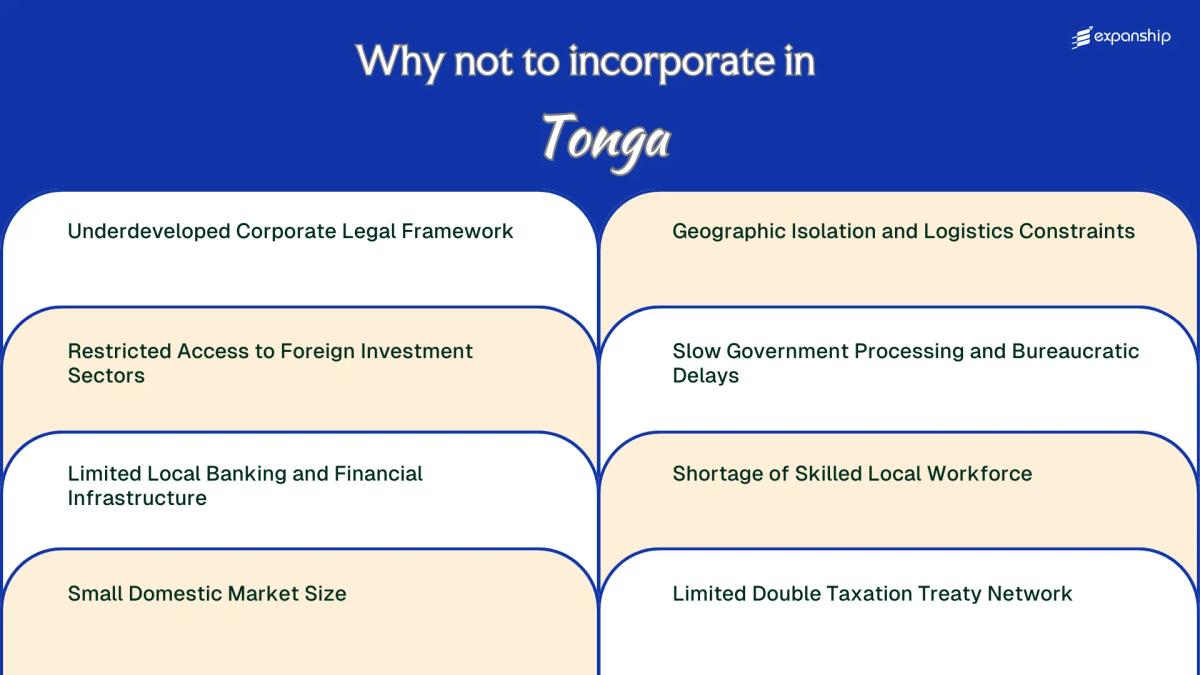
Underdeveloped Corporate Legal Framework
Tonga corporate law limitations are rooted in a legislative framework that has not kept pace with international commercial standards. The Companies Act of Tonga provides a basic structure for incorporation, but it leaves significant gaps that affect how foreign-owned entities operate and seek redress.
Thin Statutory Protections for Foreign Shareholders
The Companies Act lacks detailed provisions on minority shareholder protections, director liability thresholds, and dispute resolution mechanisms that are standard in more mature jurisdictions. For a foreign investor, this means contractual arrangements and internal governance documents carry disproportionate weight, because statutory fallback protections are limited.
Underdeveloped business legal framework in Tonga also means there is no dedicated commercial court, so corporate disputes are handled through a general court system with limited specialist capacity.
Weak Enforcement Mechanisms
Corporate governance risks in Tonga are compounded by enforcement gaps. The Registrar of Companies has limited administrative resources, which reduces the practical accountability of directors and officers registered under local entities.
Where a foreign business depends on consistent enforcement of fiduciary obligations or statutory filing requirements, the absence of a well-resourced regulatory body creates real legal exposure.
If a corporate dispute arises, the absence of specialist commercial courts and thin statutory protections means you may have no reliable legal mechanism for timely resolution or recovery.
Restricted Access to Foreign Investment Sectors
Foreign investment restrictions in Tonga are codified under the Investment Act 2011, which establishes a formal division between sectors open to foreign participation and those reserved exclusively for Tongan nationals or joint-venture arrangements with local partners.
Under this framework, the Tonga Investment Board administers a Reserved Activities List that bars foreign-owned entities from operating in a range of commercially viable sectors. This directly limits which business models you can legally pursue through a foreign-held company.
Sectors commonly protected from foreign ownership include:
- Retail trade at certain scales forces you to either abandon the market or negotiate a local partnership, adding legal and operational complexity to your structure
- Agriculture and fishing concessions require local ownership, meaning your entity cannot hold the underlying assets directly
- Domestic transport services restrict foreign participation, creating a structural barrier if your business model depends on in-country logistics
- Certain tourism-related activities involving land use are subject to local ownership requirements, limiting real estate control for resort or hospitality ventures
Even where foreign participation is permitted, minimum investment thresholds set by the Board can disqualify smaller entities from obtaining approval.

Company Incorporation in Tonga
Understand the legal requirements, ownership restrictions, and regulatory steps involved in registering a business entity in Tonga.
Limited Local Banking and Financial Infrastructure
Tonga banking infrastructure challenges begin with a sector dominated by a small number of commercial banks, including ANZ Bank Tonga and BSP Financial Group, with very limited options for business accounts beyond these institutions. For a foreign-incorporated entity, that concentration means your firm has little negotiating power over fees, service terms, or credit facilities.
Corporate banking problems extend to the correspondent banking relationships that Tongan banks maintain with international institutions. Due to de-risking trends in global banking, several Pacific Island banks have lost or struggled to maintain correspondent banking ties, which directly constrains cross-border wire transfers, foreign currency accounts, and trade finance facilities your business may depend on.
| Banking Requirement | Practical Limitation |
|---|---|
| Foreign currency accounts | Restricted availability; limited to select institutions |
| International wire transfers | Subject to correspondent banking gaps; delays common |
| Business credit facilities | Minimal unsecured lending options for foreign-owned entities |
| Digital banking infrastructure | Limited online banking functionality for corporate accounts |
| Payment processing | Few local merchant and gateway solutions for international commerce |
The National Reserve Bank of Tonga, which governs monetary policy and bank licensing under the National Reserve Bank of Tonga Act, does not operate a developed capital markets framework. No domestic bond or equity market exists through which your business could raise local capital.
These structural gaps mean that even routine treasury operations, such as repatriating profits or managing multi-currency exposure, carry friction that companies incorporated in more financially developed jurisdictions do not face.
Small Domestic Market Size
Tonga's population sits at approximately 100,000 people, spread across more than 170 islands. For a foreign business targeting local consumers, this limited consumer base creates a structurally constrained revenue ceiling that affects nearly every domestic-facing business model.
GDP per capita remains modest by regional standards, which directly compresses discretionary spending across most product categories. A firm that depends on local sales volume to achieve unit-cost efficiency will find that threshold difficult to reach.
Remittances from overseas Tongans account for a significant share of household income, making consumer spending patterns unpredictable and sensitive to external economic shifts. Any disruption to remittance flows can contract domestic demand rapidly.
Scaling within the market is not a viable path for most foreign-owned entities. Reaching break-even often requires an export or regional strategy from day one, adding operational complexity that would not exist in larger markets.
- Revenue projections must account for a consumer population under 100,000 with moderate purchasing power
- Domestic market size constraints restrict economies of scale in manufacturing and distribution
- Business plans relying solely on local sales face structural limits on growth and profitability
- Seasonal and remittance-linked income fluctuations affect consumer demand cycles unpredictably
Remittances to Tonga consistently exceed 30% of GDP, making household consumption more dependent on foreign income flows than on domestic economic output.
Geographic Isolation and Logistics Constraints
Tonga geographic isolation business risks extend beyond inconvenience — the country's position in the South Pacific places it thousands of kilometres from major trade hubs, directly affecting how your company receives goods, communicates with partners, and manages time-sensitive transactions.
Physical Distance and Freight Dependency
All significant cargo movement relies on limited shipping routes and infrequent vessel schedules, meaning supply chain delays are structural rather than exceptional. For a registered entity sourcing materials or fulfilling orders internationally, lead times that might run days elsewhere can stretch into weeks.
Air freight through Fua'amotu International Airport offers faster movement but at costs that compress already thin margins for most business models. The absence of a major regional transhipment hub nearby means your firm cannot easily consolidate cargo to reduce costs.
Infrastructure Gaps Compounding Isolation
Reliable broadband connectivity remains inconsistent across the island group, creating operational friction for businesses dependent on real-time data or cloud-based systems. Electricity supply outside the main island of Tongatapu is subject to interruptions, adding another layer of cost and unpredictability for any company with physical operations beyond the capital.
Assessing Operational Viability for Your Tonga Entity
Understand how geographic and infrastructure constraints may affect your incorporation structure and operational setup in Tonga before committing resources.
Slow Government Processing and Bureaucratic Delays
Tonga bureaucratic delays company registration are a consistent operational friction for foreign investors, with processing times across government agencies extending well beyond regional norms.
- The Ministry of Commerce, Tourism and Labour handles business registration, and its limited staffing and manual processing workflows mean incorporation timelines can stretch unpredictably, delaying your ability to open bank accounts or execute contracts.
- Document authentication requirements often depend on physical submission rather than digital channels, adding days or weeks to each administrative step.
- No centralized one-stop-shop mechanism exists for business registration, so interactions with multiple agencies must be sequenced separately, compounding total processing time.
- Public holiday schedules and restricted government office hours in Nuku'alofa reduce the effective processing window available each week.
- Responses to correspondence from foreign applicants are inconsistent in turnaround, creating uncertainty when your business formation timeline is tied to contractual or financing deadlines.
- Corrections or resubmissions triggered by procedural errors restart processing queues, and without a formal expedited processing track, there is no mechanism to recover lost time.
Shortage of Skilled Local Workforce
Tonga skilled workforce shortage is a structural constraint that directly affects how foreign businesses staff, operate, and scale. With a population of approximately 100,000 and significant emigration rates to New Zealand and Australia under regional labour mobility schemes, the domestic talent pool is persistently thin.
Professionals with qualifications in accounting, law, engineering, or finance are scarce locally. If your business requires technically skilled staff, you will likely face either prolonged vacancies or significant costs associated with expatriate recruitment.
Bringing in foreign workers requires work permits under Tonga's immigration framework, which adds administrative lead time and recurring compliance costs. This dependency on expatriate labour is not a short-term gap but a recurring structural feature of the local market.
- Accounting and audit professionals are in short supply, complicating statutory compliance obligations
- Legal professionals familiar with commercial transactions are limited
- IT and technical specialists are largely unavailable domestically
A foreign firm requiring two qualified accountants and one commercial lawyer locally could realistically spend 12 to 18 months on recruitment and permitting cycles before those roles are filled, with expatriate packages potentially exceeding three times the equivalent cost in a larger Pacific hub such as Fiji.
Limited Double Taxation Treaty Network
Tonga's double taxation treaty limitations are among the most consequential structural gaps for foreign businesses operating across borders. The kingdom has not concluded a broad network of bilateral tax treaties, leaving income flows between your entity and foreign parent companies, shareholders, or clients exposed to potential double taxation with no treaty relief mechanism in place.
Without a DTT, dividends, interest, and royalties paid from a Tongan company to overseas recipients may be subject to withholding tax in Tonga and again taxed in the recipient's home country. Countries with extensive treaty networks, such as Singapore or the Netherlands, allow businesses to reduce or eliminate this layered tax burden, an option your firm simply does not have when structuring through this jurisdiction.
The absence of treaty protections also affects how foreign tax authorities treat Tonga-sourced income. Tax residency determinations, permanent establishment thresholds, and foreign tax credit claims all become harder to resolve without a governing treaty framework to reference.
- No treaty coverage means no reduced withholding rates on cross-border passive income.
- Transfer pricing disputes lack the mutual agreement procedure (MAP) mechanism that DTTs provide.
- Investors from high-tax jurisdictions face full domestic rates on both ends of a transaction.
If your business involves cross-border royalty flows, intercompany loans, or dividend repatriation, the absence of a DTT means you cannot rely on any bilateral relief mechanism to prevent double taxation, regardless of your home country's domestic rules.
Overcoming These Incorporation Challenges
Overcoming Tonga incorporation challenges requires a structural approach rather than ad hoc fixes. The disadvantages covered in this blog are interconnected, and addressing them begins before the company is formally registered.
- Register your entity through the Tonga Business Registry to confirm sector eligibility under the Investment Promotion Act before committing capital.
- Establish banking relationships early by engaging with domestic banks directly, given the absence of major international banking networks in-country.
- Structure your entity to operate primarily across international markets, reducing dependence on the limited domestic consumer base.
- Appoint a locally resident director or agent to satisfy regulatory requirements and help manage processing timelines with the relevant government offices.
- Review your home jurisdiction's unilateral tax relief provisions to offset the absence of a bilateral double taxation agreement with Tonga.
These steps address the structural constraints outlined in this blog, but they operate within a regulatory framework that continues to develop incrementally. Formal compliance with the Companies Act and applicable investment regulations remains the baseline requirement for any foreign-owned entity.
Tonga's Overall Business Viability
Tonga business viability risks are real and measurable, but they do not eliminate the jurisdiction as a credible option for foreign businesses with the right operational model. For entities that require a low-cost Pacific incorporation with minimal domestic activity, the structural limitations documented in this blog are manageable rather than prohibitive.
| Pros | Cons |
|---|---|
| Low corporate tax environment reduces the overall tax burden for qualifying entities. | The corporate legal framework lacks depth, with limited statutory guidance on complex commercial arrangements. |
| Tonga's International Business Companies structure offers a recognized offshore vehicle. | Foreign investment restrictions under the relevant reserve list exclude entire sectors from foreign ownership. |
| Geographic position provides a Pacific Islands presence for regional operational purposes. | Physical isolation increases logistics costs and extends supply chain timelines considerably. |
| Incorporation fees and annual maintenance costs remain comparatively low. | Government processing delays slow company registration and ongoing regulatory approvals. |
| No double taxation treaty obligations can simplify certain cross-border structures. | The absence of tax treaties increases withholding tax exposure in treaty-reliant business models. |
Compliance Services for Companies in Tonga
Maintain your Tonga-registered entity in good standing with annual filing, regulatory reporting, and ongoing compliance support.
Conclusion
The cons of Tonga company formation are not theoretical — they reflect structural realities tied to geography, institutional capacity, and regulatory development. Banking access remains constrained by a thin correspondent network, and the absence of substantive double taxation treaties limits how efficiently cross-border structures can operate. Bureaucratic processing timelines add friction at every stage of the entity lifecycle. For businesses weighing these factors, qualified in-country and international support is not optional — it is a practical requirement for keeping a registered entity operational and compliant.
Expanship's Support for Your Tonga Expansion
Tonga expansion support services involve more than filing documents. Working through the Ministry of Commerce, Tourism and Labour, managing foreign investment approvals under the Foreign Investment Act, and meeting ongoing compliance requirements with the Tonga Revenue and Customs Service each carry real operational weight. Expanship helps reduce that burden by handling the procedural side so you can focus on the business itself.
Our corporate services span the full incorporation lifecycle and beyond:
- We prepare and submit your company registration documents in accordance with local requirements.
- A registered agent and office address are provided to satisfy statutory presence obligations.
- We liaise directly with government departments and regulatory bodies on your behalf.
- Post-incorporation compliance management keeps your entity in good standing over time.
- Banking introduction assistance connects your business with suitable local or regional financial institutions.
- Tax registration and coordination with the Tonga Revenue and Customs Service are handled as part of the process.
Reach out to Expanship Tonga to discuss your incorporation plans.
Frequently Asked Questions (FAQ)
The gap in corporate legislation affects all registered entities, but the impact is most acute for foreign-owned businesses that require predictable frameworks for shareholder agreements, dispute resolution, and asset protection. Tonga's Companies Act provides baseline registration rules, but it does not offer the depth of commercial law protections found in more established offshore or onshore jurisdictions. Disputes that escalate beyond straightforward contract matters face a court system with limited corporate law precedent.
Geographic isolation increases logistics costs significantly, as Tonga depends on infrequent shipping routes and limited air freight capacity for goods and materials. Beyond physical transport, slow telecommunications infrastructure and inconsistent digital connectivity can delay routine business operations. These are recurring costs embedded in daily operations, not one-time setup expenses.
Foreign-owned companies in Tonga face genuine difficulty opening and maintaining corporate bank accounts, with a small number of commercial banks operating in the country and heightened due diligence requirements applied to non-resident directors and shareholders. Comparable Pacific jurisdictions such as Vanuatu have more developed financial services infrastructure and a broader range of banking options for international businesses. The combination of limited banking options and slow account-opening processes creates operational delays from the outset.
If your business activity falls within a sector reserved for Tongan nationals or requires a foreign investment permit under the Foreign Investment Act, operating without proper clearance exposes the entity to penalties, forced cessation of activity, or license revocation. The Tonga Foreign Investment Division administers these restrictions, and approvals are not guaranteed even after application. Restricted sectors include certain retail, fishing, and land-related activities, which eliminates common entry-point business models for foreign investors.
Tonga's skilled workforce constraints are broadly comparable to other small Pacific Island nations, but the combination of a small total population and high emigration rates makes local talent recruitment persistently difficult. Many qualified Tongans work abroad, reducing the available pool for professional, technical, and managerial roles. This means most foreign businesses must either rely on expatriate staff, which carries immigration and cost implications, or accept operational limitations.
Government processing times for company registration and related approvals in Tonga are longer than in more digitally advanced jurisdictions, with manual processing and limited online filing infrastructure contributing to delays. Post-registration steps such as obtaining tax identification, sector-specific licenses, and foreign investment approvals add further time before your entity can legally commence operations. Planning for a multi-week to multi-month setup timeline is a practical reality, not a worst-case scenario.
Using a Tongan entity purely as a holding structure does reduce direct exposure to the limited domestic consumer market, but the jurisdiction's weak treaty network, banking infrastructure gaps, and underdeveloped legal framework still apply regardless of the operational model. A holding structure does not insulate your business from compliance burdens, banking access difficulties, or the absence of meaningful tax treaty relief. Jurisdictions with comparable strategic positions in the Pacific but stronger legal and financial infrastructure may offer more practical holding company environments.
Legal Disclaimer
The information provided in this article is for general informational purposes only and does not constitute legal, tax, or professional advice. While we strive to ensure the accuracy and timeliness of the content, laws and regulations are subject to change, and the application of laws can vary widely based on specific facts and circumstances.
Readers should not act upon this information without seeking professional counsel tailored to their individual situation. Expanship and its authors disclaim any liability for actions taken or not taken based on the content of this article.
For specific advice regarding your business setup, compliance requirements, or any legal matters, please consult with qualified legal and tax professionals in the relevant jurisdiction.