

Key Takeaways
- Tonga's territorial tax structure exempts foreign-sourced earnings from local corporate income tax, allowing internationally oriented entities to retain a materially larger share of offshore revenue than they would in most onshore jurisdictions.
- Companies incorporated under the Companies Act 1995 benefit from low annual compliance costs and a registration process that imposes minimal administrative burden on foreign operators from the outset.
- Full foreign ownership is permitted across a wide range of commercial sectors, eliminating the equity dilution or local partner requirements that constrain market entry in many comparable Pacific jurisdictions.
- The absence of capital gains tax and inheritance tax strengthens Tonga's utility for cross-border holding structures, where asset transfers and long-term value accumulation are central to the entity's commercial purpose.
Tonga is an independent Polynesian kingdom located in the South Pacific Ocean, comprising over 170 islands and sitting within a region of growing economic activity. Company registration falls under the oversight of the Ministry of Revenue and Customs, which administers business formation processes in the country. Foreign businesses incorporating here most commonly do so through an International Business Company. The kingdom operates a territorial tax posture, meaning income sourced outside its borders is generally not subject to local corporate tax. Foreign direct investment is broadly welcomed, with the legal framework permitting full foreign ownership across a wide range of commercial sectors.
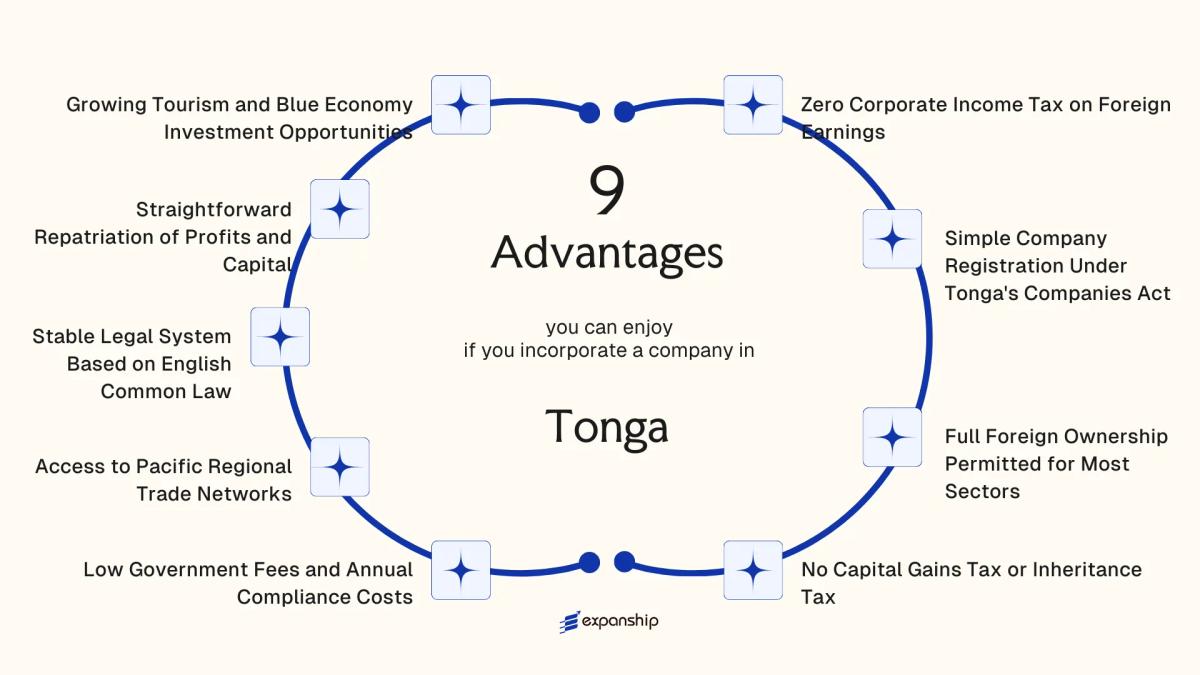
The benefits of incorporating in Tonga extend across tax structure, regulatory simplicity, and access to Pacific trade networks. This article examines the concrete advantages your business gains by establishing a legal presence here.
Zero Corporate Income Tax on Foreign Earnings
Foreign-sourced income earned by a company registered in Tonga is not subject to corporate income tax under the country's territorial tax system. This structure means your business retains earnings generated outside Tonga in full, without a domestic tax liability reducing that income.
How the Territorial Principle Applies to Your Company
Tonga's Income Tax Act applies corporate tax only to income with a Tongan source. A business incorporated here but operating internationally — through contracts, services, or investments conducted abroad — falls outside the scope of that domestic charge on those foreign earnings.
For a holding company or an internationally active firm, this distinction is material. Profits routed through a Tongan entity from overseas operations remain untaxed at the corporate level locally, preserving capital that would otherwise be reduced by rates that commonly reach 25–30% in many OECD jurisdictions.
What This Means for Structuring Foreign Revenue
Tonga zero tax on foreign earnings is not an incentive scheme requiring application or approval. It reflects the baseline operation of the Income Tax Act, making eligibility straightforward for any qualifying entity whose revenue originates outside Tongan territory.
Foreign profits earned through your Tongan entity are not taxed domestically, allowing full retention of offshore income under the standard operation of the Income Tax Act.
Simple Company Registration Under Tonga's Companies Act
Tonga's Companies Act 1995 governs the registration of companies in the kingdom, and the process it establishes is notably accessible for foreign incorporators. A single registration filing with the Tonga Companies Office is sufficient to form a private company, without requiring a local partner, nominee director, or minimum paid-up capital at the time of incorporation.
The Tonga Companies Act registration benefits become apparent when you compare the documentation burden here to other incorporation regimes. The statutory requirements are minimal by design:
- A company name reservation does not require prior regulatory approval beyond a basic availability check
- No audited financial statements are required at the point of formation
- The memorandum and articles of association follow standardised templates, reducing the need for bespoke legal drafting
- Registered office requirements are satisfied through a licensed local agent, which your business can appoint without establishing a physical presence
Registration under the Act produces a separate legal entity with limited liability from the date of incorporation. That separation is meaningful: your personal assets and those of co-investors are shielded from the company's obligations by statute, not merely by contract. For a foreign investor operating across multiple markets, that structural clarity reduces exposure from the moment the entity is formed.

Company Incorporation in Tonga
Register your company in Tonga under the Companies Act 1995 with Expanship handling the filing, registered agent appointment, and compliance setup.
Full Foreign Ownership Permitted for Most Sectors
Tonga full foreign ownership benefits represent one of the more straightforward structural advantages available to non-resident investors in the Pacific region. Under the Tonga Companies Act 1995, foreign nationals can hold 100 percent of shares in a Tongan company across the majority of commercial sectors, with no mandatory local partner or joint venture requirement.
This matters because ownership dilution is a real cost in many jurisdictions. Where local partnership rules apply, foreign investors often face governance complications, profit-sharing obligations, and exit constraints that reduce effective control. The absence of such requirements in Tonga means your firm retains full decision-making authority from incorporation through to any eventual restructuring or sale.
| Sector Category | Foreign Ownership Permitted | Notes |
|---|---|---|
| General commerce and trade | Up to 100% | No restrictions under Companies Act 1995 |
| Tourism and hospitality | Up to 100% | Subject to land lease arrangements |
| Financial services | Up to 100% | Subject to National Reserve Bank licensing |
| Land ownership | Not permitted | Foreign entities must lease land |
Certain sectors involving land, natural resources, or licensed financial activities carry additional regulatory requirements. The National Reserve Bank of Tonga oversees financial sector licensing, and while a foreign firm can own the operating entity outright, sector-specific approvals remain separate obligations. Tonga foreign investor ownership rights therefore apply at the company structure level, distinct from any activity-specific licensing your business may need to obtain.
No Capital Gains Tax or Inheritance Tax
Tonga imposes no capital gains tax on the disposal of assets. For a foreign investor holding shares in a Tongan-registered company, this means proceeds from asset sales, equity transfers, or business disposals flow out without a tax charge at the point of gain. That structural feature directly protects investment returns in a way that many higher-tax jurisdictions do not.
Tonga also levies no inheritance tax or estate duty. Ownership stakes in a local entity can pass between generations or be restructured among shareholders without triggering a wealth transfer tax. This matters particularly to family offices and holding structures where long-term succession planning is part of the corporate strategy.
Under the Income Tax Act of Tonga, the general income tax framework applies primarily to ordinary income derived domestically. Capital receipts fall outside its scope for non-residents, reinforcing the Tonga tax-free capital gains position for investors who structure correctly through an International Business Company or similar vehicle.
Keep these points in mind while relying on this benefit:
- Confirm asset classification with a local tax adviser; the distinction between revenue and capital receipts still applies
- No bilateral tax treaties currently override domestic capital gains exemptions for most investors
- Inheritance rules may intersect with foreign estate laws depending on where beneficiaries are domiciled
- Verify current legislation directly via the Attorney General's Office before finalising any structure
Tonga has never introduced a capital gains tax regime at any point in its legislative history, meaning there is no legacy framework, transitional rule, or grandfathering clause to account for when structuring an exit.
Low Government Fees and Annual Compliance Costs
Tonga low annual compliance costs are a direct product of how the country has structured its corporate regulatory regime. Under the Companies Act 1995, registered companies face relatively modest annual filing obligations, and the fees levied by the Tonga Business Enterprise Centre (TBEC) and the Ministry of Revenue and Customs remain low compared to many Pacific and offshore jurisdictions. For a foreign business owner, this translates into predictable, contained overhead year after year.
Annual Filing Obligations and Fee Structure
Government fees for maintaining a company in good standing are assessed annually and are tied to company type rather than revenue or capital base. This fixed-fee structure means your maintenance costs do not scale upward as the business grows, which is a meaningful advantage for companies that reinvest earnings or hold assets internationally. A firm incorporated here faces no variable compliance levy simply because its balance sheet has expanded.
Annual returns must be filed with the Registrar of Companies, and the process is administrative in nature rather than disclosure-intensive. Foreign-owned entities are not required to publish financial statements publicly, which reduces both the compliance burden and the associated professional fees for external audit or reporting. The combination of low statutory fees and limited disclosure requirements keeps the total annual cost of maintaining a Tongan entity well below what comparable structures typically incur in higher-scrutiny jurisdictions.
Cost Predictability for Foreign Entities
Affordable company maintenance costs allow for straightforward budgeting from year one. There are no minimum capital requirements that tie up funds, and no escalating fee tiers based on turnover or headcount.
Plan Your Tonga Incorporation Cost Structure
Speak with an Expanship specialist to understand the full annual compliance cost profile for your Tonga entity and how to keep your obligations straightforward from day one.
Access to Pacific Regional Trade Networks
Tonga Pacific regional trade access benefits extend from the Kingdom's active participation in Pacific regional frameworks, most notably PACER Plus (Pacific Agreement on Closer Economic Relations Plus), which came into force in 2020.
- PACER Plus, negotiated under the Pacific Islands Forum framework and signed by Tonga alongside 13 other Pacific nations, provides preferential market access to Australia and New Zealand. For a business incorporated in Tonga that meets rules-of-origin requirements, this means reduced tariff exposure on eligible goods exported to two of the region's largest economies.
- Forum membership positions incorporated entities to engage with regional development financing instruments and trade facilitation mechanisms coordinated through bodies such as the Pacific Islands Forum Secretariat and the Pacific Community (SPC).
- Regional proximity to Fiji, Samoa, and Vanuatu, combined with shared Pacific trade architecture, reduces the structural barriers that typically complicate intra-regional commerce for businesses operating across multiple Pacific Island markets simultaneously.
- Tonga's membership in the World Trade Organization since 2007 adds a multilateral dimension, meaning your entity benefits from most-favored-nation treatment in WTO member markets beyond the Pacific region.
Rules-of-origin thresholds under PACER Plus determine which goods qualify for preferential tariff treatment, so product sourcing and local value-addition matter when structuring export operations.
Stable Legal System Based on English Common Law
Tonga's legal framework derives from English common law, a foundation inherited through its historical ties with Britain and retained after the country gained full sovereignty in 1970. For a foreign business owner, this matters because common law systems produce predictable, precedent-based outcomes in commercial disputes, reducing the uncertainty that can make contract enforcement in unfamiliar jurisdictions costly and slow.
The Companies Act 1995 and the associated court system operate within this common law tradition. Contractual rights, fiduciary duties, and creditor protections follow principles that legal counsel from the UK, Australia, New Zealand, and other common law countries can readily interpret and apply on your behalf, without requiring entirely jurisdiction-specific expertise.
Tonga's judiciary maintains institutional independence, and its structure includes a Supreme Court with civil and commercial jurisdiction. This gives your entity access to a formal adjudication mechanism rather than reliance on administrative discretion.
A 2022 report by the Pacific Islands Forum Secretariat noted that Pacific small island states with inherited common law frameworks, including Tonga, demonstrate greater consistency in contract enforceability outcomes compared to civil law counterparts in the region.
Straightforward Repatriation of Profits and Capital
Tonga profit repatriation advantages stem largely from the absence of exchange controls that would otherwise restrict how foreign investors move capital out of the country. There is no general legislative framework imposing restrictions on the transfer of dividends, loan repayments, or capital proceeds to overseas accounts.
For a foreign business owner, this has a direct practical consequence: profits generated by your Tonga-registered company can be distributed to shareholders abroad without requiring prior approval from a central monetary authority. The National Reserve Bank of Tonga oversees monetary policy, but foreign currency transactions by compliant businesses are not subject to repatriation ceilings or mandatory reinvestment requirements.
Capital introduced into the business, whether as equity or inter-company loans, can similarly be withdrawn upon winding down or restructuring the entity. This gives foreign investors predictable exit conditions, which is a material factor when structuring cross-border investment.
- No ceiling on the amount of profits that can be transferred abroad
- No mandatory retention of earnings within the jurisdiction
- No prior approval process required for standard dividend remittances
Foreign exchange freedom applies to lawfully structured and compliant entities; businesses operating in restricted or licensed sectors may be subject to additional conditions imposed by sectoral regulators.
Growing Tourism and Blue Economy Investment Opportunities
Tonga blue economy investment opportunities have expanded considerably as the government formalizes its ocean-based economic development agenda. The country's Exclusive Economic Zone covers approximately 700,000 square kilometers of Pacific Ocean, creating a substantial resource base for fisheries, aquaculture, seabed research, and marine tourism ventures.
Tourism as a Regulated Investment Sector
Foreign businesses incorporating here can access tourism projects that fall under the oversight of the Tonga Tourism Authority, the statutory body responsible for sector development and promotion. Investment in resorts, dive operations, and eco-tourism requires registration and may involve coordination with the Foreign Investment Division under the framework of the Foreign Investment Act. This regulatory structure means your business operates within a defined legal environment rather than an ambiguous one, which supports contract enforcement and dispute resolution.
Blue Economy Business Structure
- Fisheries licensing and aquaculture concessions are administered under the Fisheries Management Act
- Marine-based enterprises can qualify for consideration under Tonga's national development plans, which prioritize ocean-economy sectors
- Joint ventures with local entities are permitted and commonly used in resource-linked industries
Why Sector Focus Matters for Your Entity
Investing in a prioritized sector can carry practical advantages: government development plans tend to concentrate infrastructure spending and regulatory attention in those areas. For a foreign firm, operating within a formally designated growth sector means your business activity aligns with national policy, which can facilitate licensing timelines and interagency coordination under the Companies Act framework.
Why Tonga Stands Out Among Pacific Island Jurisdictions
Compared against other Pacific Island jurisdictions, the Tonga advantages over Pacific Island jurisdictions become clearest when viewed through the lens of structural consistency rather than individual features. Vanuatu is frequently cited as a Pacific offshore option, and the Cook Islands attracts attention for asset protection structures, while Fiji positions itself as a regional commercial hub. Each of these targets a comparable pool of foreign investors, making them the most relevant benchmarks for a business evaluating Pacific incorporation options.
What distinguishes Tonga from these peers is less about any single provision and more about the combination of factors operating under a single framework. The Companies Act 1995 governs corporate conduct through a recognisable common law structure, the absence of capital gains and inheritance tax applies without requiring a special economic zone designation, and full foreign ownership is accessible under general company law rather than through discretionary approval processes that apply in Fiji for certain sectors. That coherence reduces administrative friction across the company lifecycle, not just at the point of registration.
| Parameter | Tonga | Vanuatu | Cook Islands | Fiji |
|---|---|---|---|---|
| Corporate Income Tax on Foreign Earnings | None | None | None | Applicable |
| Capital Gains Tax | None | None | None | None |
| Foreign Ownership (General Sectors) | 100% permitted | 100% permitted | Restricted in some sectors | Restricted; FIU approval required |
| Legal System | English Common Law | Hybrid (French/English) | English Common Law | English Common Law |
| Special Regime Required for Tax Benefits | No | No | Varies by structure | No, but sector restrictions apply |
Compliance Services for Companies in Tonga
Maintain your Tonga company's good standing with annual filings, registered agent requirements, and regulatory obligations under the Companies Act 1995.
Conclusion
Tonga presents a coherent case for foreign incorporation when its structural advantages are taken together rather than in isolation. The absence of tax on foreign-sourced earnings, combined with low annual compliance costs under the Companies Act 1995, means your operational overhead stays contained from the first year of registration. For entities structured around international trade or Pacific regional activity, this combination carries meaningful financial weight.
Full foreign ownership rights across most sectors remove a structural barrier that restricts entry in many comparable jurisdictions. That freedom, paired with a legal system grounded in English common law, gives your business a predictable operating environment without requiring you to adapt to an unfamiliar legal tradition.
Whether this structure suits your business depends on your industry, the nature of your revenues, and how your entity is positioned within a wider group structure. A firm deriving primarily domestic Tongan income, for example, faces a different calculation than one using a Tongan entity as part of a cross-border holding arrangement. The benefits of incorporating in Tonga are most pronounced for foreign-facing structures where the tax treatment of offshore earnings and the ease of profit repatriation are primary considerations. Understanding precisely how those rules apply to your specific circumstances is the step that determines whether registration translates into a genuine structural advantage.
Start Your Tonga Company Formation With Expanship Today
Tonga company formation with Expanship covers the full scope of what a foreign incorporator needs to establish and maintain a legal business presence under the Companies Act 2004. From preparing formation documents to liaising with the Tonga Business Registry and meeting ongoing obligations with the Ministry of Commerce, Tourism, and Labour, the process is handled end-to-end.
Expanship's services for Tonga incorporations include:
- Company name reservation and preparation of incorporation documents under the Companies Act 2004
- Filing with the Tonga Business Registry and coordination with the Ministry of Commerce, Tourism, and Labour
- Provision of a registered agent and local registered office address
- Post-incorporation compliance management, including annual return preparation and filing
- Document legalization and notarization where required for cross-border use
- Banking introduction assistance to support account opening with local or regional financial institutions
To discuss your specific requirements, contact Expanship Tonga directly.
Frequently Asked Questions (FAQ)
Registration timelines vary depending on the completeness of documentation submitted to the Registrar of Companies, but standard incorporations are generally processed within a few business days to two weeks. The Companies Act governs the registration process, and delays most commonly occur when name reservation, constitutional documents, or director details require clarification. Engaging a local registered agent can help keep the process on track.
Foreign earnings are not subject to corporate income tax in Tonga, provided the income is sourced from outside the jurisdiction. This territorial tax treatment means a company conducting international operations through a Tongan entity retains foreign income free of local corporate tax. Domestic income may be treated differently, so the nature and source of revenue matters when assessing tax exposure.
Tonga's Companies Act does not impose a blanket requirement for a locally resident director for all company types, though specific structures or licensing conditions may apply depending on the business activity. You should review the applicable provisions under the Act alongside any sector-specific licensing rules. Requirements can differ between an international business entity and a company operating domestically.
Neither capital gains tax nor inheritance tax applies under Tonga's current tax legislation. This means disposals of assets held through a registered entity do not generate a separate capital gains liability, and succession of business interests is not subject to an estate-based levy. This position reflects the general tax structure in place and should be confirmed against any future legislative amendments.
Failure to meet filing or fee obligations under the Companies Act can result in penalties, loss of good standing, or ultimately deregistration of the entity by the Registrar of Companies. Reinstatement is possible in some cases but involves additional fees and administrative steps. Maintaining timely annual returns and paying prescribed government fees is the most straightforward way to preserve the entity's registered status.
Annual government fees in Tonga are generally modest compared to several other Pacific incorporation destinations, reflecting the jurisdiction's relatively low-cost regulatory structure. The specific fee schedule is set by the Registrar of Companies and is subject to periodic revision, so current figures should be verified at the time of incorporation. Overall compliance costs, including registered agent fees, tend to remain competitive within the Pacific region.
Tonga does not impose exchange controls that restrict the repatriation of profits or capital by foreign-owned companies. Funds can generally be transferred abroad without requiring central bank approval, subject to standard anti-money laundering and financial reporting obligations. Confirming the position with the National Reserve Bank of Tonga at the time of incorporation is advisable, as exchange control policy can change.
Legal Disclaimer
The information provided in this article is for general informational purposes only and does not constitute legal, tax, or professional advice. While we strive to ensure the accuracy and timeliness of the content, laws and regulations are subject to change, and the application of laws can vary widely based on specific facts and circumstances.
Readers should not act upon this information without seeking professional counsel tailored to their individual situation. Expanship and its authors disclaim any liability for actions taken or not taken based on the content of this article.
For specific advice regarding your business setup, compliance requirements, or any legal matters, please consult with qualified legal and tax professionals in the relevant jurisdiction.