

Key Takeaways
- Foreign and domestic investors must register their company through the Registre National des Entreprises (RNE), the centralised registry that replaced the former tribunal-based system under Tunisia's updated administrative framework.
- The minimum share capital obligation varies by legal form, meaning an SA carries a materially higher threshold than a SARL, and this figure must be deposited and documented before registration is approved.
- Under the Code des Sociétés Commerciales and applicable anti-money laundering legislation, beneficial ownership information must be disclosed as part of the formation process, with non-disclosure constituting a compliance breach rather than a procedural oversight.
- A registered office address must be physically located within Tunisia and supported by verifiable documentation, making a nominal or virtual address insufficient to satisfy the statutory requirement.
Incorporating in Tunisia is governed primarily by the Commercial Companies Code (Code des Sociétés Commerciales), with entity registration administered through the Registre National des Entreprises (RNE), which replaced the earlier tribunal-based registry system.
Meeting the full set of incorporation requirements in Tunisia is a prerequisite for legal recognition. Failure to satisfy these conditions results in rejection of the registration application or, in cases of post-registration non-compliance, exposure to administrative penalties and potential suspension of operating authorisation.
The requirements covered in this article span structural, documentary, and governance obligations across the formation process. Specific thresholds and conditions vary depending on the legal form you choose, whether your firm operates in a regulated sector, and your status as a foreign or resident investor.
This article is most directly relevant to foreign entrepreneurs and corporate investors seeking to establish a locally registered presence through an entity such as a SARL or SA.
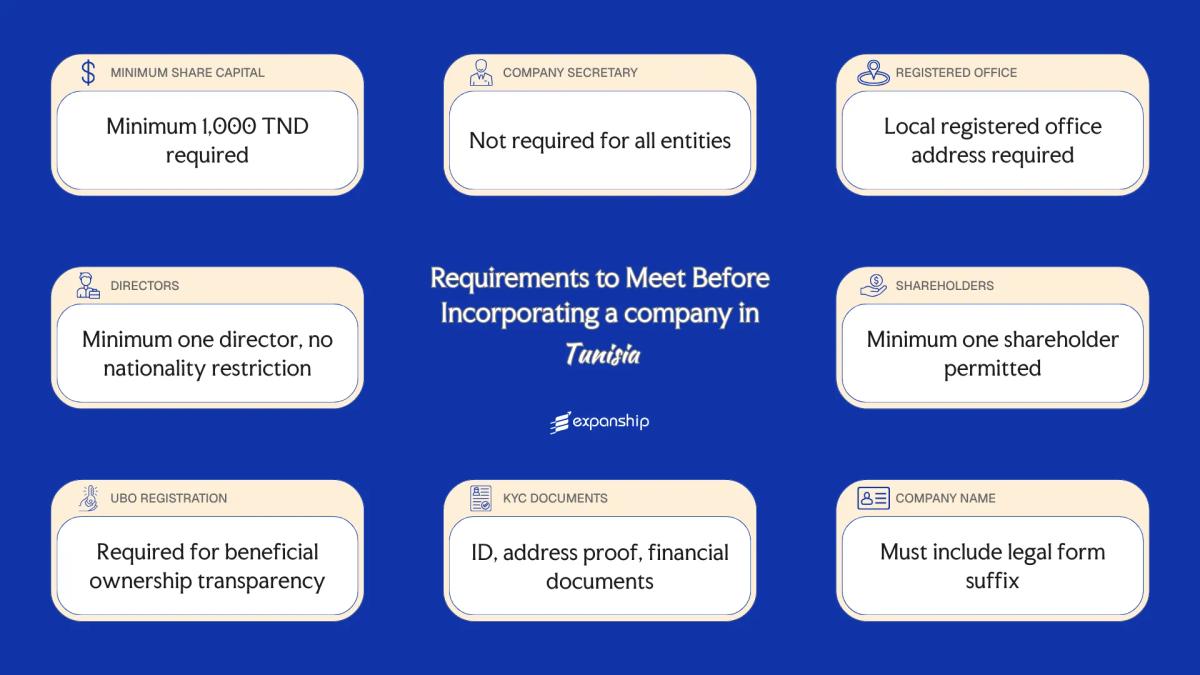
Minimum Share Capital Requirements in Tunisia
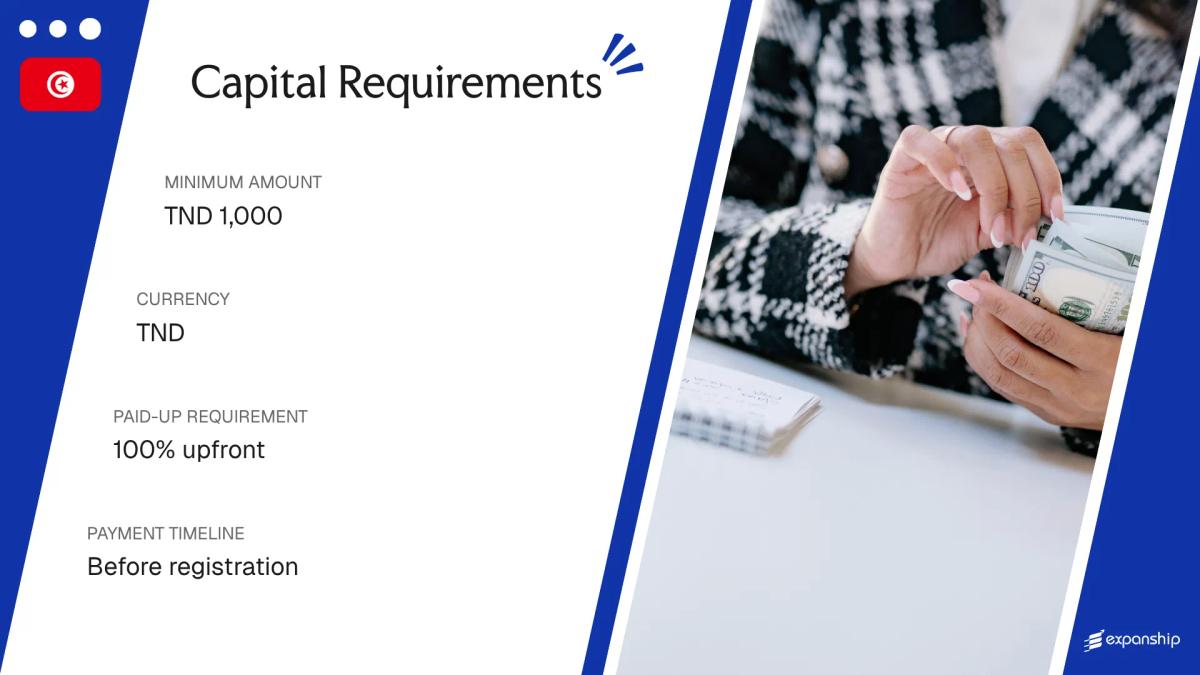
Minimum share capital requirements in Tunisia vary by legal entity type and are governed primarily by the Commercial Companies Code (Code des Sociétés Commerciales). The relevant registry for verifying capital at incorporation is the Registre National des Entreprises (RNE), and a notarized deposit certificate from an approved Tunisian bank is required before registration can be completed.
Under the par value share system applicable in Tunisia, shares must have a nominal value assigned at the time of incorporation. Capital deposited at incorporation is not simply a one-time formality; the structure of authorized and paid-up capital must be maintained in accordance with the entity's statutes throughout its operational life.
| Parameter | Detail |
|---|---|
| Minimum Authorized Share Capital | TND 1,000 for SARL; TND 5,000 for SA |
| Maximum Authorized Share Capital | No statutory maximum |
| Minimum Paid-Up Capital | TND 1,000 for SARL; TND 5,000 for SA |
| Paid-Up Requirement at Incorporation | At least 50% of cash contributions for SA; full amount for SARL |
| Accepted Currency | Tunisian Dinar (TND) |
| Accepted Forms of Contribution | Cash and in-kind contributions; in-kind assets must be appraised |
| Timeframe to Deposit Capital | Prior to filing for registration with the RNE |
The bank deposit certificate confirming capital payment must be obtained before submitting incorporation documents to the RNE. Registration will not proceed without it.
Company Secretary Requirements in Tunisia
Under Tunisian corporate law, there is no statutory requirement for a dedicated company secretary position equivalent to those found in common law systems. That said, company secretary requirements Tunisia practitioners should note that certain administrative and compliance functions must still be assigned internally within the entity's governance structure.
For a Société à Responsabilité Limitée (SARL) or Société Anonyme (SA), these functions typically fall to appointed managers (gérants) or board officers under the Code des Sociétés Commerciales. Whoever holds this role bears responsibility for maintaining statutory registers, filing annual returns with the Registre National des Entreprises, and ensuring corporate resolutions are properly documented.
Eligible persons for carrying out these functions generally must meet the following criteria:
- Natural persons must have full legal capacity under Tunisian civil law.
- No specific professional licensing is required for internal company secretarial functions.
- Foreign nationals may serve, subject to residency and work authorization conditions.
- Corporate entities may fulfil the function through designated officers or legal representatives.
- No minimum age beyond general civil majority (18 years) is prescribed.

Incorporate a Company in Tunisia
Set up your business entity in Tunisia with guidance on legal structure, registration, and compliance requirements.
Registered Office Requirements in Tunisia
Every company incorporated in Tunisia must maintain a registered office — known as the siège social — which serves as the official address for legal correspondence and government notifications; non-compliance can result in the entity being struck from the Registre National des Entreprises or facing administrative sanctions under Tunisian commercial law.
- A physical address within Tunisia is required; a P.O. box alone does not satisfy the siège social requirement.
- Virtual office addresses are not formally recognized under Tunisian company law as a compliant registered office.
- The address must be located in Tunisia; a foreign address cannot fulfill this obligation.
- Supporting documentation — either proof of ownership or a valid lease agreement — must be held on file to justify the declared address.
- The registered address is publicly listed in the Registre National des Entreprises and is accessible to third parties.
- Any change to the siège social must be formally declared to the Registre National des Entreprises, typically requiring an updated filing and, for certain entity types, a shareholders' resolution.
Director Requirements in Tunisia

Upon appointment, directors in a Tunisia company assume statutory duties under the Code des Sociétés Commerciales (CSC), including obligations of loyalty, diligence, and fiduciary responsibility toward the entity. Liability extends to mismanagement, failure to file required declarations, and violations of the company's articles of association.
| Parameter | Detail |
|---|---|
| Minimum Number of Directors | A SARL requires at least one gérant; an SA requires a board of at least three directors. |
| Maximum Number of Directors | For an SA, the board may not exceed twelve members under the CSC. |
| Local/Resident Director Required | No statutory requirement for a resident or locally domiciled director. |
| Nationality Restrictions | No nationality restrictions apply, though foreign nationals must comply with applicable work and residency permit rules if operating locally. |
| Minimum Age Requirement | Directors must be at least eighteen years of age. |
| Corporate Directors Permitted | Corporate directors are not permitted; only natural persons may serve as directors or gérants. |
| Director Must Be a Shareholder | A gérant of a SARL is not required to be a shareholder; SA board members may be required to hold qualifying shares per the articles. |
| Publicly Listed on Registry | Director details are filed with the Registre National des Entreprises (RNE) and are publicly accessible. |
| Disqualification Conditions | Persons subject to bankruptcy proceedings, criminal convictions involving financial misconduct, or court-ordered disqualification under the CSC are ineligible to serve. |
Unlike many civil law jurisdictions, Tunisia permits a single individual to simultaneously hold the role of gérant and sole associate in a SARL unipersonnelle, concentrating full management and ownership in one person with no co-director requirement.
Shareholder Requirements in Tunisia
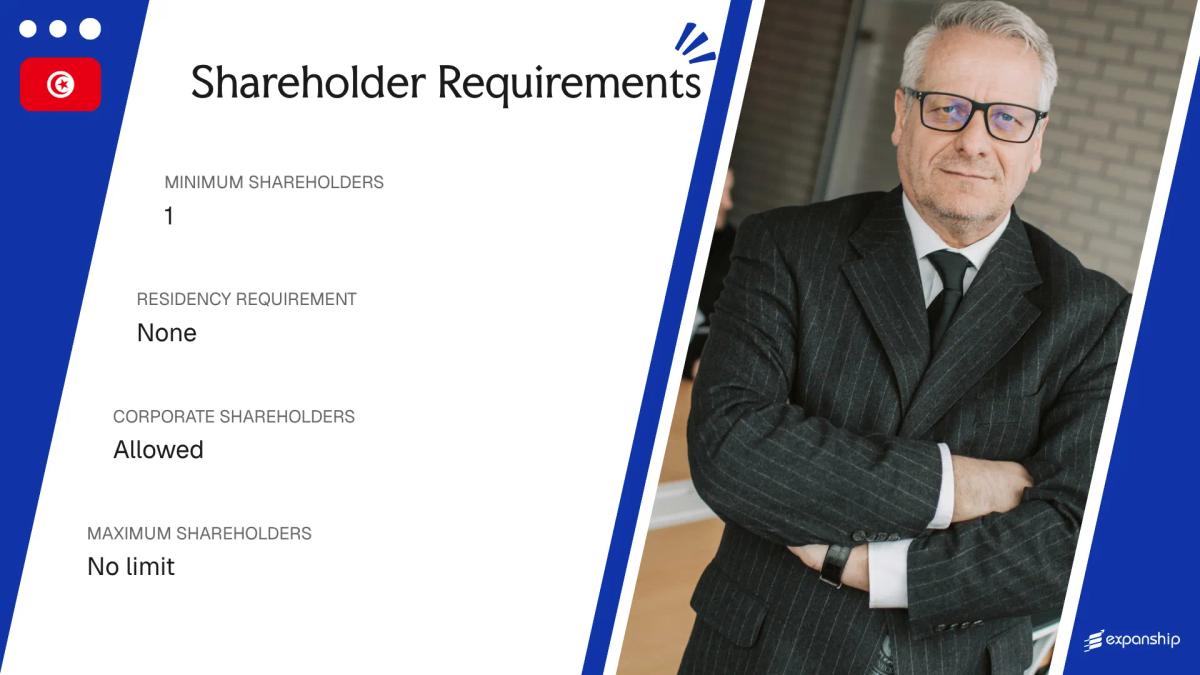
Under Tunisian law, a Société à Responsabilité Limitée (SARL) requires a minimum of one shareholder and permits up to 50 associés. A single-member structure is recognized as the SUARL (Société Unipersonnelle à Responsabilité Limitée).
Nationality and Residency Restrictions
Meeting the shareholder requirements Tunisia company law sets out does not require shareholders to hold Tunisian nationality or residency. Foreign ownership is generally permitted, though certain regulated sectors impose restrictions on non-resident shareholding percentages under applicable investment legislation.
Corporate Shareholders
Legal entities may hold shares in a Tunisian SARL. No prohibition exists against corporate shareholders, provided the standard incorporation and identification formalities are satisfied.
Shareholder Liability
Each associé's liability is limited to their capital contribution. Extended personal liability does not arise under ordinary circumstances in an SARL structure.
Register of Shareholders
A register of associés must be maintained at the company's registered office. This record is not publicly accessible through the Registre National des Entreprises, but must reflect any transfers or ownership changes as they occur.
Shareholder Structuring Guidance for Your Tunisia Incorporation
Get tailored advice on meeting associé requirements and structuring ownership for your Tunisian entity.
UBO / Beneficial Ownership Disclosure Requirements in Tunisia
Beneficial ownership disclosure Tunisia is governed by the Anti-Money Laundering Law No. 2015-26 and subsequent amendments, which define a beneficial owner as any natural person who ultimately owns or controls 25% or more of a company's capital or voting rights.
- Identify all natural persons holding 25% or more of the entity's shares or exercising effective control over management decisions.
- Compile the required identifying information for each UBO, including full legal name, nationality, date of birth, and residential address.
- Submit UBO declarations to the Registre National des Entreprises (RNE) at the time of incorporation or registration.
- Notify the RNE of any changes to beneficial ownership within the prescribed period following the change.
| Parameter | Detail |
|---|---|
| Ownership Threshold for UBO Status | 25% of share capital or voting rights |
| Filing Authority | Registre National des Entreprises (RNE) |
| Disclosure Deadline at Incorporation | At the time of company registration |
| Publicly Accessible Register | No statutory requirement for public access |
| Penalties for Non-Disclosure | Sanctions under Law No. 2015-26; specific fines subject to regulatory enforcement |
| Ongoing Update Obligation | Yes; updates required upon any change in beneficial ownership |
KYC / Document Requirements in Tunisia
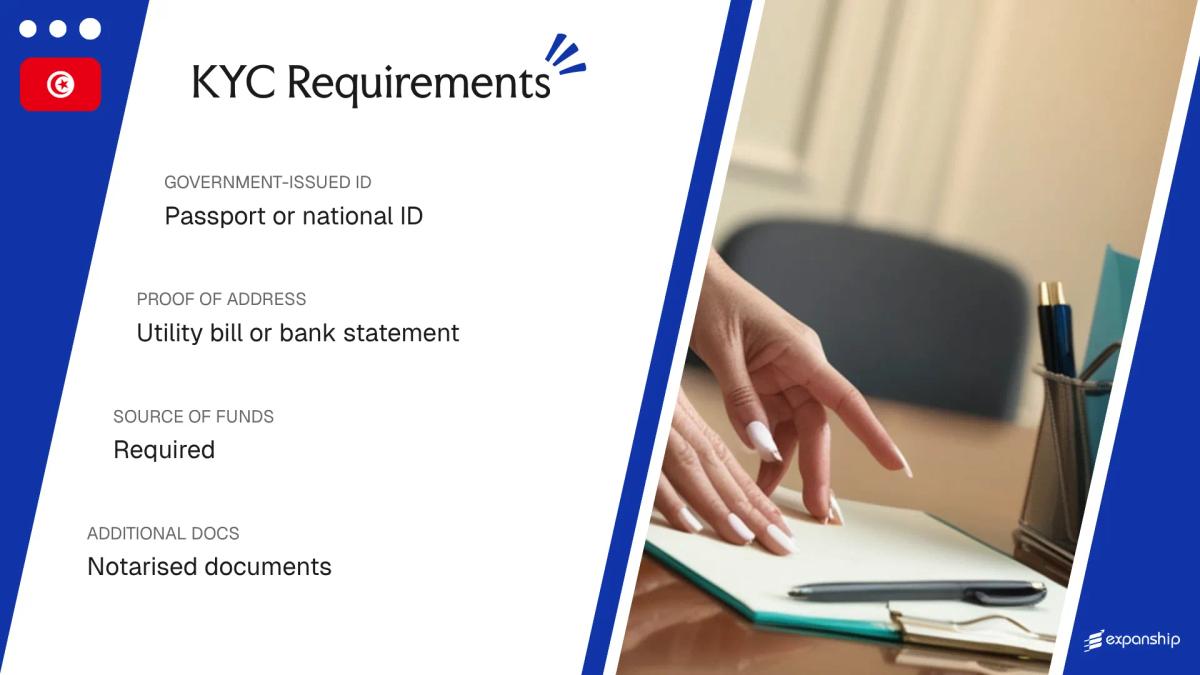
KYC document requirements Tunisia follow the framework established under Law No. 2015-26 on combating money laundering and terrorism financing, supervised by the Commission Tunisienne des Analyses Financières (CTAF).
Individual / Personal Documents
- Valid national identity card or passport for each director, shareholder, or beneficial owner
- Proof of residential address dated within three months (utility bill or bank statement)
- Specimen signature form, as required by the notary handling incorporation
- Recent passport-sized photographs may be requested by the notary
Corporate Documents
- Certificate of incorporation or equivalent constitutional registration document of the parent entity
- Articles of association or equivalent constitutional document
- Current register of directors and shareholders of the corporate shareholder
- Proof of registered office address for the corporate entity
Source of Funds Documentation
- Recent bank statements covering the origin of capital to be injected
- Audited financial statements where the shareholder is an established corporate entity
- A written declaration of source of funds may be required if bank documentation is inconclusive
Notarisation and Apostille Requirements
- Foreign documents must generally be apostilled under the Hague Convention or legalised through the Tunisian consulate of the issuing country
- All non-Arabic and non-French documents require certified translation by a sworn translator
- Notarisation of identity documents by a local notary is standard practice during deed execution
Unsigned or uncertified translations of foreign corporate documents are among the most common causes of registration delays at the Registre National des Entreprises.
Company Name Requirements in Tunisia
Proposed company name requirements Tunisia are assessed during the incorporation process through a name availability check conducted before registration is finalized. Names that conflict with existing registered entities or that violate public order standards are rejected at this stage.
Your chosen name must include a legal suffix that reflects the entity type, such as "SARL" for a limited liability company or "SA" for a société anonyme. Arabic is the official language of business registration, though French transliterations are commonly accepted in practice.
Certain words are restricted from use without prior authorization from relevant government authorities, including terms that reference financial institutions, governmental bodies, or regulated professions. Names that are misleading, contrary to public morals, or that imply a connection to the state are outright prohibited.
Name reservation is available through the Registre National des Entreprises (RNE), the body responsible for commercial registration in Tunisia. A reservation secures the proposed name for a defined period while incorporation formalities are completed, though you should confirm current reservation durations directly with the RNE.
Compliance Services for Companies in Tunisia
Maintain your business in good standing with ongoing compliance support tailored to Tunisian regulatory requirements.
Conclusion
Tunisia company incorporation requirements span several distinct legal obligations governed primarily by the Code des Sociétés Commerciales and administered through the Registre National des Entreprises. Among the more consequential requirements are the minimum share capital thresholds tied to entity type and the beneficial ownership disclosure obligations introduced under anti-money laundering legislation. Registered office rules also carry practical weight, as the address must be physically located within the country and supported by verifiable documentation. Once these obligations are clearly understood, foreign investors are positioned to move from planning into the formal registration process.
Expanship's Corporate Formation Services in Tunisia
Expanship's Tunisia corporate formation services are structured around the actual requirements you'll encounter when incorporating here: APII approvals for foreign-invested companies, notarial deed preparation, and timely registration with the Registre National des Entreprises. Our role is to reduce the operational burden those steps place on your team, particularly when coordinating across multiple Tunisian authorities from abroad.
Our service scope covers the full formation process and beyond.
- We prepare and file all registration documents, including the company statutes and required declarations.
- A registered office address and resident agent are provided to satisfy local presence requirements.
- We liaise directly with the RNE, APII, and other relevant authorities on your behalf.
- Post-incorporation obligations, including annual filings, are tracked and managed for your entity.
- Banking introduction support is available to help your firm establish a local account.
- Tax registration and coordination with Tunisian fiscal authorities is handled as part of the setup process.
To discuss your requirements, contact Expanship Tunisia.
Frequently Asked Questions (FAQ)
The minimum share capital for an SARL is 1,000 TND, and at least half must be deposited in a blocked bank account prior to registering with the Registre National des Entreprises (RNE). The remaining balance must be paid up within five years of incorporation. Failure to deposit the required portion upfront can prevent the issuance of the company's tax identification number (matricule fiscal).
The beneficial ownership disclosure obligation, introduced under Tunisia's anti-money laundering framework aligned with FATF recommendations, applies broadly across corporate structures including SARLs and SAs. Any natural person holding 25% or more of shares or voting rights is typically reportable. Non-compliance can result in sanctions imposed by the Commission Tunisienne des Analyses Financières (CTAF).
The RNE will reject the registration, and you must submit an alternative name before the incorporation process can proceed. A preliminary name availability check through the RNE portal is advisable before drafting the company statutes, since the name is embedded in the constitutive documents. Resubmitting with a revised name extends the overall timeline and may incur additional notarisation costs if the statutes must be amended.
Foreign ownership is generally permitted up to 100% in most offshore and export-oriented activities under the Investment Law No. 2016-71, but onshore activities in certain regulated sectors require a minimum 51% Tunisian shareholding. The applicable restrictions depend on the business activity code (nomenclature des activités) declared at registration. The API (Agence de Promotion de l'Investissement Extérieur) can confirm sector-specific thresholds before you structure your shareholding.
Operating without a valid registered office address can result in the RNE suspending the company's active status and notifying the tax authorities, which may trigger a tax compliance review. Tunisian law requires the registered office address to correspond to an actual, accessible location where official correspondence and administrative notices can be served. Prolonged non-compliance can ultimately lead to administrative dissolution proceedings.
Notarisation is mandatory for SAs and recommended for SARLs when real property contributions are involved, but standard cash-contribution SARLs can be constituted through a private deed (acte sous seing privé) without notarisation. The distinction matters because notarised deeds carry higher upfront costs and registration fees calculated on the stated capital. Either way, the statutes must be deposited with the RNE and published in the official gazette (JORT) to achieve legal existence.
Legal Disclaimer
The information provided in this article is for general informational purposes only and does not constitute legal, tax, or professional advice. While we strive to ensure the accuracy and timeliness of the content, laws and regulations are subject to change, and the application of laws can vary widely based on specific facts and circumstances.
Readers should not act upon this information without seeking professional counsel tailored to their individual situation. Expanship and its authors disclaim any liability for actions taken or not taken based on the content of this article.
For specific advice regarding your business setup, compliance requirements, or any legal matters, please consult with qualified legal and tax professionals in the relevant jurisdiction.