
Key Takeaways
- Offshore entities qualifying under Tunisia's 1992 Export Promotion Code can reduce their effective corporate tax burden to near zero during the applicable incentive period, making the jurisdiction particularly cost-efficient for export-oriented manufacturing and services businesses.
- Investment Law No. 71-2016 grants foreign shareholders legally enforceable arbitration rights and capital repatriation guarantees, replacing discretionary protections with codified ones that can be relied upon in cross-border disputes.
- Tunisia's location on the northern African coast provides incorporated entities with simultaneous access to EU trade agreements and the African Continental Free Trade Area framework, serving as a single base for reaching both market blocs.
- Foreign investors establishing a SARL through the Registre National des Entreprises operate within a territorial tax system, meaning income sourced outside Tunisia's borders is generally not subject to domestic corporate tax.
Incorporating a business in a foreign jurisdiction requires a clear understanding of the legal and regulatory environment from the outset. The benefits of incorporating in Tunisia draw interest from investors across Europe, the Middle East, and sub-Saharan Africa — the country occupies a strategic position at the crossroads of these markets as a sovereign republic on the northern coast of the African continent.
Company registration falls under the oversight of the Registre National des Entreprises, the national authority responsible for business registration and corporate records. Foreign investors most commonly establish a SARL when entering the market. The tax framework is territorial in orientation, applying corporate tax primarily to income sourced within the country's borders.
Foreign ownership is generally permitted across a wide range of sectors, with specific restrictions and authorization requirements applying in industries deemed sensitive under the Investment Law No. 71 of 2016. The broader regulatory environment reflects an active policy stance toward attracting foreign direct investment.
This article examines the principal advantages that make Tunisia company formation a viable option for international businesses and investors.
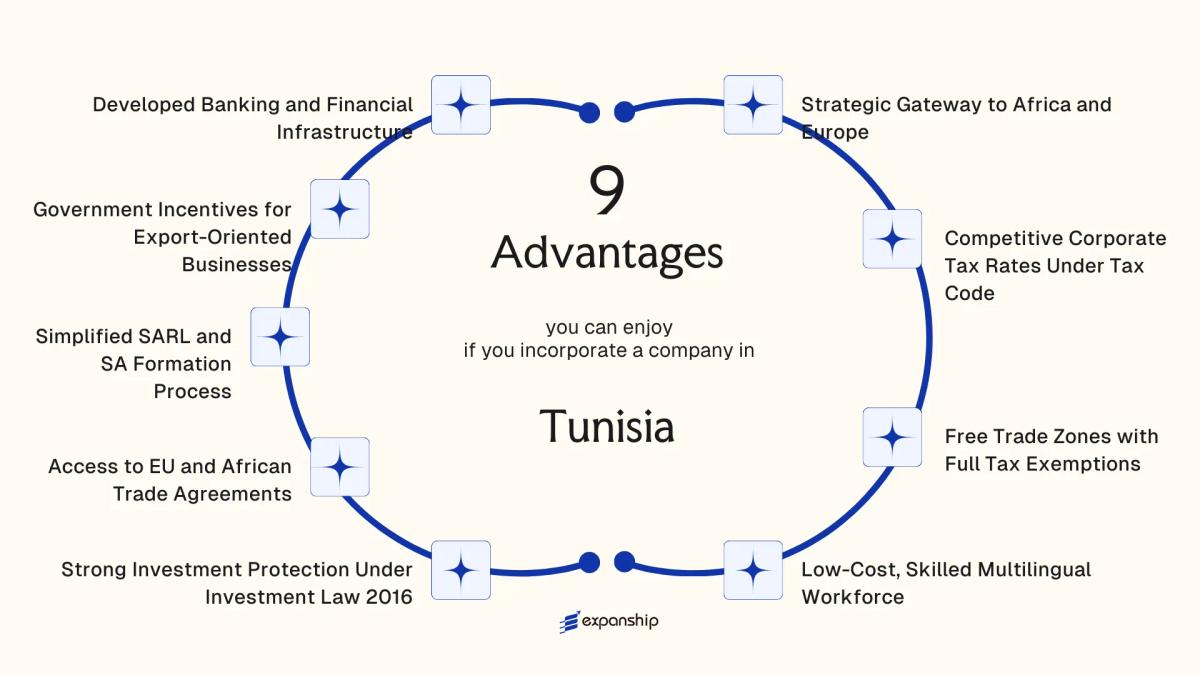
Strategic Gateway to Africa and Europe
Tunisia's strategic location across Africa and Europe positions the country at a crossing point between two major economic blocs, with direct access to the Mediterranean basin and the African interior.
Proximity to European and African Markets
Situated approximately 150 kilometers from Sicily, Tunisia sits closer to continental Europe than most African countries. This geographic reality reduces freight time and logistics costs for firms that need to serve both EU consumers and sub-Saharan distributors from a single base of operations.
A Functional Transit Point, Not Just a Label
The Port of Rades and Tunis-Carthage International Airport handle significant volumes of commercial cargo, giving physically established entities concrete infrastructure to act on the country's geographic position. Your business can use Tunisia as an operational hub without routing goods through more congested Mediterranean ports.
Signed bilateral agreements with over 70 countries, including the EU Association Agreement, mean that goods produced or processed in Tunisia carry preferential tariff status in multiple destination markets, which directly affects your firm's cost structure and export margins.
A company registered in Tunisia can access both EU and African markets under separate preferential trade arrangements from a single operational base.
Competitive Corporate Tax Rates Under Tax Code
Tunisia's corporate tax structure offers measurable advantages that directly affect your bottom line. The standard corporate income tax rate stands at 15% for most industrial and service companies, which compares favourably against many European jurisdictions where rates frequently exceed 25%. This rate applies under the Tunisian Tax Code (Code de l'IRPP et de l'IS), which governs corporate income taxation for both resident entities and foreign-owned firms operating in the country.
Certain sectors attract reduced rates. Companies in agriculture and fishing, for example, benefit from a 10% corporate tax rate, reducing the fiscal burden for businesses operating in those industries. The 15% rate itself represents a structural advantage: lower tax obligations at the entity level mean retained earnings remain higher, giving your business more capital to reinvest without additional tax planning complexity.
The Tunisia corporate tax rate advantages extend further when you consider the regime's clarity. The Tax Code establishes defined thresholds, sector-specific rates, and documented exemption categories, which reduces ambiguity during annual compliance cycles.
Conditions do apply. Foreign-owned firms must register with the Tax Authority (Direction Générale des Impôts) and file annual returns to access standard rate treatment.
Key structural features that favour foreign-owned businesses:
- Sector-based rate differentiation means your entity may qualify for a lower rate by industry classification alone
- The 15% standard rate applies without a minimum paid-up capital threshold, reducing entry barriers
- Defined statutory exemption categories are codified in the Tax Code, not subject to discretionary approval

Company Incorporation in Tunisia
Register your company in Tunisia with full compliance support across legal, tax, and regulatory requirements.
Free Trade Zones with Full Tax Exemptions
Tunisia free trade zones tax exemption benefits are most concentrated in the country's designated offshore zones, which operate under a distinct legal and fiscal framework separate from the onshore tax regime.
Under Law No. 72-38 of 1972 and its subsequent amendments, companies classified as "fully exporting" entities are entitled to a ten-year full exemption from corporate income tax, followed by a reduced rate thereafter. Qualifying firms must derive at least 70% of their revenue from export activity. This threshold defines eligibility clearly, allowing foreign investors to structure their operations with certainty about which fiscal treatment applies.
| Parameter | Detail |
|---|---|
| Tax exemption period | 10 years from first profitable year |
| Post-exemption CIT rate | 10% (reduced rate for exporters) |
| Minimum export revenue threshold | 70% of total turnover |
| VAT treatment | Exempt on qualifying export transactions |
| Governing legislation | Law No. 72-38 of 1972 (as amended) |
Beyond income tax, offshore-status entities are also exempt from VAT on goods and services used within their operations, which directly reduces input costs for manufacturing and service firms. For a foreign business owner running an export-oriented operation, this dual exemption on corporate income and consumption tax significantly affects the cost base from day one.
The Agency for the Promotion of Industry and Innovation (API) oversees qualification and registration for offshore status, providing a defined administrative point of contact for compliance purposes.
Low-Cost, Skilled Multilingual Workforce
Tunisia's skilled multilingual workforce advantages are among the most operationally significant factors for foreign businesses establishing a regional presence. The country produces over 70,000 university graduates annually, with strong concentrations in engineering, IT, finance, and applied sciences — fields directly relevant to services export and technology operations.
French and Arabic are both official working languages, and English proficiency is increasingly common among graduate-level professionals. For a firm targeting European clients or North African markets, this linguistic range reduces the cost and complexity of client-facing operations without requiring separate regional offices.
Salary benchmarks for skilled professionals remain substantially below Western European equivalents, even at mid-to-senior levels. This cost differential, combined with Tunisia's Labour Code framework governing employment contracts, working hours, and social contributions, gives your business a predictable cost structure from the outset.
Keep these points in mind when hiring locally:
- Employment contracts must comply with the Labour Code and applicable collective agreements (conventions collectives) for the relevant sector
- Social security contributions are administered through the Caisse Nationale de Sécurité Sociale (CNSS)
- Foreign nationals in senior roles may require work authorisation through the relevant ministry
Tunisia has more engineers per capita than several EU member states, making it a significant source of technical talent at a fraction of Western European labour costs.
Strong Investment Protection Under Investment Law 2016
Tunisia's Investment Law 2016 (Law No. 2016-71) replaced the earlier 1993 Investment Code and introduced a structurally different set of protections that directly reduce the legal risk exposure foreign businesses face when committing capital to the country. The law applies to both domestic and foreign investors, but its guarantees carry particular weight for non-resident entities operating under unfamiliar regulatory conditions.
Statutory Protections Against State Interference
Under Articles 20 to 25 of Law No. 2016-71, foreign investors are entitled to full repatriation of profits, dividends, and capital in convertible currency without prior administrative approval. This removes a friction point that commonly traps capital in jurisdictions where repatriation requires case-by-case authorisation. Your business retains practical control over its earnings from the outset.
The law also prohibits expropriation except in cases of public interest, and mandates fair and prompt compensation when expropriation does occur. That statutory guarantee limits the government's ability to take unilateral action against privately held assets without legal accountability.
Treaty-Based Protection Through FIPA Network
Tunisia has concluded over 50 bilateral investment promotion and protection agreements (FIPAs), including treaties with major EU member states and Gulf economies. These agreements provide an additional layer of protection beyond domestic law, allowing investors to pursue international arbitration in the event of a dispute with the state.
The 2016 law itself explicitly recognises access to international arbitration, including under ICSID rules, as a dispute resolution option. That access matters because it places investor-state disputes outside local court jurisdiction, where enforcement of foreign judgments can be less predictable.
Understand Your Investment Protections Before You Commit
Speak with our team about how Tunisia's Investment Law 2016 and bilateral treaty network apply to your specific business structure and capital exposure.
Access to EU and African Trade Agreements
Tunisia EU trade agreement benefits for businesses are a direct result of the country's Association Agreement with the European Union, which has been in force since 1998 under the Euro-Mediterranean framework. This agreement established a free trade area for industrial goods between Tunisia and EU member states, eliminating tariffs on a significant share of manufactured exports. For a company producing or processing goods locally, this means duty-free access to a market of over 440 million consumers without the customs costs that apply to non-associated countries.
- The Association Agreement covers industrial products, meaning qualifying exports face zero EU import duties, reducing the landed cost of your goods in European markets.
- Negotiations for a Deep and Comprehensive Free Trade Area (DCFTA) with the EU have been underway, which would extend preferential access to services and public procurement, areas not currently covered by the 1998 agreement.
- As a signatory to the African Continental Free Trade Area (AfCFTA), the country offers businesses a formal pathway to preferential trade terms across 54 African member states, covering a combined GDP exceeding USD 3 trillion.
- The Agadir Agreement, signed with Egypt, Jordan, and Morocco, provides additional cumulation of origin rules that allow manufacturers to source inputs from member countries while retaining preferential trade status with the EU.
Simplified SARL and SA Formation Process
Tunisia SARL SA formation advantages stem largely from accessible capital thresholds and a registration process consolidated through a single administrative channel. The Centre de Formalités des Entreprises (CFE), operating under the API (Agence de Promotion de l'Investissement et de l'Innovation), allows foreign investors to complete company registration in a single location rather than navigating multiple government bodies.
A SARL requires a minimum share capital of 1,000 TND, while an SA requires 5,000 TND for non-publicly traded firms. These thresholds are low relative to many comparable jurisdictions in the MENA region, reducing the upfront capital commitment required to establish a legal presence.
For foreign-owned entities, ownership is permitted at up to 100% in most sectors outside the onshore "reserved activities" list under Investment Law No. 2016-71. This means your company can be fully foreign-held without requiring a local partner, which directly affects control over operational decisions and profit repatriation.
A foreign investor establishing a SARL in Tunisia with 1,000 TND in share capital and two shareholders can complete legal incorporation within approximately 3 to 5 working days through the CFE, compared to regional averages that can extend to several weeks in markets such as Algeria or Libya.
Government Incentives for Export-Oriented Businesses
Tunisia government incentives for export businesses are primarily structured through the Investment Law No. 2016-71 and the Tax Incentives Code (Code d'Incitations aux Investissements), which together define the offshore company regime.
Under this framework, a company qualifies as "offshore" if at least 70% of its output is exported. This threshold matters because qualifying firms benefit from a 10-year full corporate tax exemption, after which a reduced rate applies rather than the standard regime.
The practical benefits for qualifying exporters include:
- Full exemption from customs duties on imported equipment and raw materials used in production
- Exemption from VAT on goods and services tied to export activity
- Free transfer of profits and capital in foreign currency, without exchange control restrictions
The Agency for the Promotion of Industry and Innovation (APII) oversees registration and compliance for industrial export entities, while the Foreign Investment Promotion Agency (FIPA) handles broader investor facilitation.
Foreign currency accounts are permitted for offshore firms, which removes a significant friction point when managing cross-border payments and repatriating revenue.
The 70% export threshold must be maintained on an ongoing basis; falling below it can result in reclassification out of the offshore regime and loss of associated tax advantages.
Developed Banking and Financial Infrastructure
Tunisia banking infrastructure advantages for businesses are grounded in a regulated, multi-tier financial system supervised by the Banque Centrale de Tunisie (BCT), which operates under the Central Bank Act and sets monetary policy, licensing requirements, and prudential standards for all credit institutions.
BCT Supervision and Banking Access for Foreign Firms
Over 30 banks operate under BCT authorization, including several with offshore banking licenses. Offshore entities incorporated under the 1985 Offshore Companies Law can open foreign currency accounts and conduct transactions entirely in convertible currencies, which removes exchange conversion friction for firms billing international clients.
Offshore Banking Provisions
Resident foreign investors and offshore companies can maintain multi-currency accounts denominated in euros, US dollars, or other major currencies. This structure allows your firm to receive foreign revenue, pay international suppliers, and repatriate profits without converting to Tunisian dinars, subject to applicable BCT regulations on capital movements.
Trade Finance and Regional Correspondent Networks
Tunisian commercial banks maintain correspondent banking relationships across Europe, the Gulf, and Sub-Saharan Africa. For an import-export operation, this means access to letters of credit, documentary collections, and trade finance instruments through local institutions rather than requiring external banking arrangements.
Digital and Electronic Payment Infrastructure
The national interbank payment system, managed through the Centre Monétique Interbancaire (CMI), supports electronic transfers and card-based settlement. Firms operating locally can process B2B payments through SWIFT-connected institutions, reducing settlement delays that are common in markets with less developed payment clearing systems.
Why Tunisia Stands Out Against Regional Competitors
Foreign investors comparing North African incorporation options typically weigh Tunisia against Morocco and Egypt, given their overlapping profiles as trade-oriented economies with onshore and offshore business frameworks. What the comparison reveals is not just a difference in rates or rules, but in the structural consistency of the incentives on offer. Tunisia's Investment Law 2016 provides statutory guarantees covering profit repatriation, foreign ownership, and dispute resolution within a single codified framework, whereas comparable protections in Egypt and Morocco are distributed across multiple legislative instruments, which can complicate due diligence for incoming investors.
On workforce cost relative to skill level, Tunisia's combination of French and Arabic fluency, technical graduate output, and proximity to European time zones positions it differently from Egypt, where labour markets are larger but less oriented toward European business norms, and from Morocco, where similar advantages exist but at comparatively higher urban labour costs. The parameters below reflect areas where the structural features of Tunisian incorporation hold a measurable or documented position.
| Parameter | Tunisia | Morocco | Egypt |
|---|---|---|---|
| Standard Corporate Tax Rate | 15% (companies under certain regimes) | 20–35% (progressive scale) | 22.5% |
| Offshore/Export Tax Exemption | Available for fully exporting entities | Available via CFC status | Limited equivalents |
| Foreign Ownership (General Onshore) | Up to 49% without prior approval; 100% in export sectors | Generally permitted with sector restrictions | Permitted with sector-specific limits |
| Investment Protection Law | Investment Law 2016 (unified code) | Investment Charter 1995 (fragmented) | Investment Law 72/2017 |
| Arbitration Access | ICSID and bilateral treaty network | ICSID access available | ICSID access available |
| Multilingual Workforce | Arabic, French, some English | Arabic, French, some English | Arabic, limited French/English |
| Free Zone Availability | Yes, multiple zones | Yes (Tanger Free Zone, others) | Yes (QIZ, SEZONE, others) |
Compliance Services for Companies in Tunisia
Maintain your Tunisian entity in good standing with accurate filings, renewals, and regulatory reporting handled by specialists in local corporate law.
Conclusion
Tunisia's position as a benefits of incorporating in Tunisia argument rests on a single coherent logic: the country combines geographic access, cost efficiency, and a codified legal framework that foreign investors can rely on.
Free trade zone structures under the 1992 Export Promotion Code offer full tax exemption for qualifying offshore entities, reducing the effective tax burden to near zero for export-oriented businesses over the incentive period. Separately, Investment Law 2016 (Law No. 71-2016) provides arbitration rights and repatriation guarantees that give foreign shareholders enforceable protections rather than discretionary ones.
Your specific industry and operational structure will determine how much weight each of these factors carries. A manufacturing firm exporting to the EU will draw different value from Tunisia company formation advantages than a services firm targeting sub-Saharan African markets through the Continental Free Trade Area framework.
The path from a well-structured incorporation to sustained compliance requires ongoing engagement with bodies such as the Foreign Investment Promotion Agency (FIPA) and the Tax Administration. Knowing which benefits apply to your entity type, and maintaining eligibility for them, is where the practical work begins.
Start Your Tunisia Company Formation with Expanship
Expanship's services for Tunisia company formation cover the full formation lifecycle, from structuring your SARL or SA under the Companies Code to filing with the Registre National des Entreprises and meeting the compliance obligations set by the Centre de Promotion des Exportations and other relevant authorities. The benefits covered across this blog, tax exemptions in free trade zones, protections under Investment Law 2016, and access to bilateral trade agreements, each carry specific documentation and regulatory requirements that vary by entity type and business activity.
Working with Expanship on your Tunisian incorporation means a single point of coordination across all administrative stages:
- Preparation and legalization of incorporation documents in accordance with Tunisian notarial requirements
- Registered agent and registered office provision within the required jurisdiction
- Filing and liaison with the Registre National des Entreprises on your behalf
- Post-incorporation compliance management, including annual filings and statutory record maintenance
- Banking introduction assistance to support your corporate account opening with local financial institutions
- Guidance on free trade zone registration and export incentive documentation where applicable
Reach out to Expanship Tunisia to begin your formation.
Frequently Asked Questions (FAQ)
Companies established in Tunisia's Free Trade Zones benefit from a total exemption on corporate income tax for the duration of their operations, along with exemptions from VAT and most customs duties on imported equipment and raw materials. This regime is governed under the Investment Law No. 2016-71 and administered through designated zone authorities. The exemptions apply strictly to activities conducted within the zone; any sales into the domestic Tunisian market are subject to standard tax treatment.
Registering a SARL in Tunisia generally takes between one and three weeks, provided all documentation is submitted correctly to the relevant Trade Registry (Tribunal de Première Instance) and formalities at the One-Stop Shop (Guichet Unique) are completed. Delays commonly arise from notarization requirements for the articles of association or from sector-specific licensing. The minimum share capital for a SARL is 1,000 Tunisian dinars.
Investment Law No. 2016-71 guarantees foreign investors the right to transfer profits, dividends, and capital proceeds abroad in convertible currency, subject to compliance with Tunisian exchange control regulations administered by the Central Bank of Tunisia (BCT). The law also provides protection against expropriation without fair compensation and grants access to international arbitration for dispute resolution. These protections apply to both SARL and SA structures operating under the offshore or authorized investment frameworks.
Tunisia has concluded double taxation agreements with over 50 countries, including major trading partners across Europe, the Arab world, and sub-Saharan Africa. These treaties generally reduce or eliminate withholding taxes on dividends, interest, and royalties paid between treaty countries, directly affecting your firm's effective tax burden on cross-border transactions. The specific withholding tax rates and eligible income categories vary by individual treaty, so the applicable agreement between Tunisia and your home jurisdiction will determine the precise benefit.
No mandatory requirement exists for a local director or Tunisian resident shareholder when forming an offshore SARL or SA under Investment Law No. 2016-71. For onshore entities in certain regulated sectors, a local partner or qualified resident manager may be required by the relevant supervisory authority. In practice, having a local registered agent or legal representative is commonly used to manage administrative correspondence with Tunisian authorities, though this is not a statutory incorporation requirement for most business types.
An offshore company that begins generating revenue from the local Tunisian market loses its offshore tax status for the portion of income derived from domestic sales, which then becomes subject to the standard corporate income tax rate. Reclassification can also trigger VAT registration obligations and additional reporting requirements with the Direction Générale des Impôts. The thresholds and procedures for reclassification are assessed on a case-by-case basis, and maintaining clear accounting separation between offshore and onshore revenue streams is a standard compliance measure.
Legal Disclaimer
The information provided in this article is for general informational purposes only and does not constitute legal, tax, or professional advice. While we strive to ensure the accuracy and timeliness of the content, laws and regulations are subject to change, and the application of laws can vary widely based on specific facts and circumstances.
Readers should not act upon this information without seeking professional counsel tailored to their individual situation. Expanship and its authors disclaim any liability for actions taken or not taken based on the content of this article.
For specific advice regarding your business setup, compliance requirements, or any legal matters, please consult with qualified legal and tax professionals in the relevant jurisdiction.