

Key Takeaways
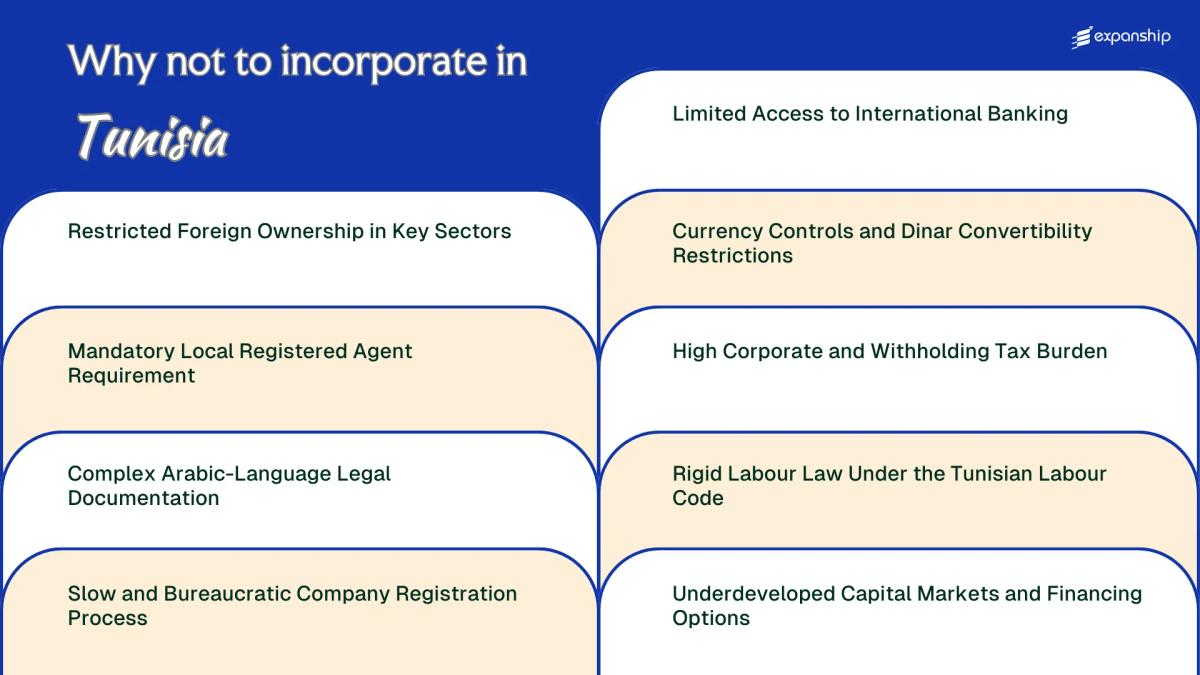
- Foreign investors operating in restricted sectors face ownership caps enforced under Tunisia's investment legislation, limiting full operational control and requiring local partnership arrangements that complicate governance structures.
- The Tunisian dinar remains non-freely convertible, and currency control regulations impose material constraints on profit repatriation and cross-border capital transfers for foreign-owned entities.
- Under the Code des Sociétés Commerciales and related administrative procedures, company registration involves multi-agency coordination that extends timelines and increases setup costs compared to more streamlined jurisdictions.
- Corporate and withholding tax obligations, combined with a labour framework governed by the Tunisian Labour Code that restricts workforce flexibility, create a compounded compliance burden for foreign employers operating onshore.
Tunisia operates under an evolving but heavily regulated commercial framework, governed primarily by the Code des Sociétés Commerciales and overseen by bodies including the Agence de Promotion de l'Investissement Extérieur (APII). The disadvantages of incorporating in Tunisia span regulatory, financial, and operational categories, each carrying distinct implications for foreign-owned entities.
The drawbacks you may encounter differ considerably based on your sector, chosen legal structure, and whether your firm operates onshore or under the offshore regime.
This article is most relevant to foreign investors, non-resident entrepreneurs, and multinational firms considering a wholly or partially foreign-owned entity in the Tunisian market.
Restricted Foreign Ownership in Key Sectors
Foreign ownership restrictions in Tunisia are not uniform across the economy. Certain sectors apply equity ceilings that structurally limit how much of a business a foreign investor can own or control.
Sector-Specific Equity Ceilings Under the Investment Law
Tunisia's Investment Law No. 2016-71 governs foreign participation in most commercial activities, but several sectors retain hard caps on foreign equity. Retail trade, certain professional services, and specific financial activities restrict non-resident ownership, often capping foreign stakes at 49% or less, which means your firm cannot hold a majority position without regulatory dispensation.
Obtaining an exception requires prior authorisation from the High Investment Council or sector-specific regulators, a process that adds time and unpredictability to your market entry.
Practical Cost for Foreign Business Owners
Where the 49% ceiling applies, you are structurally dependent on a local majority partner for decision-making authority, creating governance risk that is difficult to contractually neutralise. This is not a procedural formality; it directly affects dividend control, strategic direction, and exit options.
If your target sector falls under Tunisia's sector investment limitations for foreigners, you may be legally barred from holding a controlling stake, meaning a local partner retains ultimate authority over the entity.
Mandatory Local Registered Agent Requirement
Foreign companies incorporating in Tunisia face a mandatory local registered agent requirement that adds recurring cost and administrative dependency to the entity's basic structure. Under Tunisian law, all commercial entities must maintain a registered legal domicile within the country, and in practice this means engaging a locally approved representative or domiciliation service to satisfy the requirement.
This is not a one-time setup cost. Your business incurs annual fees for a service that provides no direct commercial value, yet without which the company cannot maintain its legal standing.
The practical burdens this creates include:
- Official correspondence from the APII (Agency for the Promotion of Industry and Innovation) or the tax authority is directed to the registered address, meaning delays occur if your representative does not forward documents promptly
- Any change of registered agent requires formal notification through administrative channels, generating paperwork and potential continuity gaps
- Your firm's legal domicile is controlled by a third party, which limits operational flexibility if that relationship breaks down
Companies operating across multiple jurisdictions will find this structure less flexible than arrangements permitted in, for example, common law jurisdictions where directors can serve as the registered point of contact.

Company Incorporation in Tunisia
Set up your business entity in Tunisia with guidance on legal domiciliation, registration requirements, and ongoing compliance obligations.
Complex Arabic-Language Legal Documentation
Arabic legal documentation challenges Tunisia present a concrete operational barrier from the moment your entity begins the incorporation process. Under Tunisian law, all official corporate documents, including the statutes of incorporation, shareholder agreements, and filings submitted to the Registre National des Entreprises (RNE), must be prepared in Arabic. If your founding documents originate in another language, certified translation into Arabic is mandatory before any submission is accepted.
| Requirement | Detail | Burden on Foreign Business |
|---|---|---|
| Corporate statutes language | Must be in Arabic for RNE submission | Certified translation required for every foreign-language draft |
| Notarisation requirement | Arabic documents must be notarised by a Tunisian notary | Adds cost and processing time before filing can proceed |
| Ongoing compliance filings | Annual accounts and regulatory submissions must be in Arabic | Permanent reliance on bilingual legal or accounting support |
| Certified translator qualification | Must be a court-approved translator | Restricts your choice of service providers and increases cost |
Every amendment to your company's statutes, whether triggered by a capital change or a shareholder restructuring, requires the same Arabic notarisation cycle. This is not a one-time setup cost; it recurs throughout the life of the entity.
Foreign directors without Arabic proficiency cannot independently review the documents they are legally signing. That dependency on third-party legal translation increases both exposure to drafting errors and the ongoing cost of maintaining the firm's compliance obligations.
Slow and Bureaucratic Company Registration Process
The slow company registration process in Tunisia stems from a multi-agency structure that requires sequential approvals rather than a unified window. Your business must pass through the Registre National des Entreprises (RNE), notarial authentication, and tax authority enrollment as distinct steps, each with its own processing queue.
Delays frequently arise from document verification backlogs at the RNE. A foreign-owned entity often waits longer than a domestically owned one due to additional scrutiny on foreign capital declarations under the 1993 Foreign Investment Code.
Notarized founding documents require official Arabic translation before the RNE will process them. That translation requirement adds time and cost before the registration file is even submitted.
- RNE registration is a mandatory step and cannot be bypassed or completed remotely without a local representative
- Capital deposit certificates from a Tunisian bank must be obtained before the incorporation file is finalized
- Foreign capital declarations require approval from the Central Bank of Tunisia in certain ownership structures
- Notarized articles of association must be in Arabic to be accepted by the competent authorities
Tunisia's RNE was digitized to reduce registration time, yet foreign-owned entities are still routinely subject to manual reviews that the digital portal was designed to eliminate.
Limited Access to International Banking
Limited access to international banking is a recurring obstacle for foreign businesses operating in Tunisia. The Central Bank of Tunisia (BCT) maintains significant oversight over foreign currency transactions, and that control directly shapes what corporate accounts can and cannot do.
Structural Barriers to Opening a Corporate Account
Foreign-owned entities, particularly offshore companies incorporated under the 1994 Investment Incentives Code framework, face strict account segmentation rules. Your business may be required to maintain separate resident and non-resident accounts, limiting how freely funds can move between local operations and overseas counterparties.
Correspondent banking relationships between Tunisian commercial banks and major international institutions remain limited compared to North African peers such as Morocco. This means international wire transfers can be slow, subject to additional compliance checks, and sometimes declined outright.
Practical Consequences for Foreign Business Owners
Tunisia business banking restrictions on foreigners extend to accessing multi-currency accounts and international payment platforms. Many global fintech solutions and foreign correspondent banks apply enhanced due diligence to Tunisian corporate accounts, adding friction and delay to routine transactions.
Opening a corporate bank account in Tunisia problems often surface during the BCT's foreign currency approval process, where routine cross-border payments require prior authorisation rather than operating through standard correspondent channels.
Addressing Banking and Operational Challenges in Tunisia
Understand the specific banking restrictions and regulatory requirements that affect foreign-owned entities in Tunisia, and get structured guidance on how to manage them.
Currency Controls and Dinar Convertibility Restrictions
Tunisia dinar convertibility restrictions create a direct barrier to profit repatriation, as the Tunisian dinar (TND) is not freely convertible on the capital account and its movement is governed by the Central Bank of Tunisia (BCT) under the Foreign Exchange Code.
- Foreign companies operating under the onshore regime cannot freely convert or transfer TND-denominated profits abroad without prior BCT approval, introducing delays and administrative dependency into routine financial operations.
- The Foreign Exchange Code prohibits non-residents from holding TND accounts outside the country, which limits how your business structures cross-border liquidity.
- Repatriating capital gains requires documentary proof of the original inward investment, and any shortfall in that documentation can result in the BCT blocking the transfer entirely.
- Exchange controls apply asymmetrically — foreign currency can enter more freely than it can leave, which creates a structural imbalance that disadvantages exit planning.
- Offshore-regime companies receive broader convertibility rights, but qualifying for that status restricts your firm to predominantly export-oriented activity.
High Corporate and Withholding Tax Burden
The high corporate tax burden in Tunisia applies at a standard Impôt sur les Sociétés (IS) rate of 15%, but this baseline is misleading. Sectors classified as strategic or highly profitable — including financial services, telecommunications, and energy — face a 35% IS rate, which significantly increases the effective tax cost for foreign-owned entities operating in those industries.
Dividend repatriation is subject to withholding tax, creating a second layer of taxation on profits that foreign shareholders seek to extract. For companies outside a favourable double tax treaty network, this withholding exposure compounds the overall tax drag on cross-border investment structures.
Tunisia's tax treaty coverage is limited in scope relative to major outbound investment hubs. Where no applicable treaty exists, your business absorbs the full statutory withholding rate without relief.
- Financial and banking sector entities: 35% IS rate
- Telecommunications and hydrocarbons: 35% IS rate
- Standard commercial companies: 15% IS rate
- Dividend withholding: subject to treaty or domestic rate
A foreign holding company receiving dividends from a Tunisian subsidiary in the telecom sector faces a 35% corporate tax at the subsidiary level, followed by dividend withholding on the distributed profit — meaning a significant portion of earnings is taxed twice before reaching the parent entity.
Rigid Labour Law Under the Tunisian Labour Code
Tunisia Labour Code restrictions on businesses are codified in the Code du Travail, a framework that dates to 1966 and has undergone only limited structural reform since. For a foreign employer, this translates into a system where operational flexibility is significantly constrained by law rather than left to contractual negotiation.
Terminating an employee in Tunisia is not a unilateral decision. Dismissals require documented just cause, prior notice, severance entitlements, and in many cases approval or notification through the relevant labour inspection authority (Inspection du Travail). This process increases both the cost and the timeline of workforce restructuring, creating a material liability that foreign business owners often underestimate at the point of hiring.
Fixed-term contracts are restricted in duration and renewal, meaning your firm cannot indefinitely delay converting workers to open-ended contracts. Once a worker reaches the statutory threshold, the employment relationship is treated as permanent under Tunisian law, carrying the full suite of dismissal protections.
Collective redundancy triggers additional procedural requirements, including consultation with employee representatives and administrative oversight. For a foreign-owned entity scaling down operations or exiting the market, this adds regulatory friction with direct cost implications.
Regardless of your firm's size or sector, Tunisian employment law treats any dismissal without documented legitimate cause as abusive, exposing your business to reinstatement orders or compensatory damages awarded by the labour tribunal.
Underdeveloped Capital Markets and Financing Options
Underdeveloped capital markets in Tunisia present a concrete structural barrier for foreign-incorporated businesses seeking equity financing or public market access. The Bourse de Tunis remains small by regional standards, with limited liquidity and a narrow investor base, meaning that listing shares is rarely a viable fundraising mechanism for foreign-owned entities.
Access to the exchange is further constrained by eligibility requirements that favour established domestic firms. Your business would likely depend on bank credit as the primary financing channel, yet Tunisian commercial banks apply conservative lending criteria and often require substantial local collateral.
Private equity and venture capital activity remains limited outside a small number of state-affiliated funds. The absence of a developed secondary debt market also restricts structured financing instruments that foreign investors typically rely on elsewhere.
Tunisia business financing limitations effectively mean your entity must arrive adequately capitalised, as accessing growth funding locally cannot be assumed.
Strategies to Overcome These Obstacles
Overcoming Tunisia incorporation challenges requires structural preparation rather than reactive fixes. Foreign businesses that anticipate regulatory friction at the outset are better positioned to manage compliance obligations across multiple fronts.
- Register your entity through the Guichet Unique at the Centre de Formalités des Entreprises to consolidate mandatory registration steps under one administrative process.
- Appoint a Tunisian-resident legal representative before submitting incorporation documents, satisfying the mandatory local agent requirement under Tunisian commercial law.
- Obtain certified Arabic translations of all foundational corporate documents prior to notarisation, as bilingual drafting reduces delays in the official approval chain.
- Structure equity ownership to comply with the foreign investment thresholds set by the Investment Law No. 2016-71 before selecting your business activity code.
- Open a Special Resident Account or a Non-Resident Account through a licensed Tunisian bank to manage dinar convertibility restrictions on capital transfers.
- Establish payroll terms contractually within the bounds of the Labour Code (Code du Travail) before hiring, particularly regarding dismissal procedures and working hour limits.
Mitigating risks of business setup in Tunisia does not eliminate the underlying regulatory constraints; it reduces exposure to procedural non-compliance. Each step above addresses a discrete obligation within a framework governed by the BCT, the tax authority, and sector-specific regulators.
Tunisia's Overall Investment Appeal
Tunisia investment appeal despite drawbacks is a fair description of the country's current position among emerging market destinations. The regulatory and structural obstacles documented throughout this blog are real and material. Yet the country retains a functional legal framework under the Investment Law No. 71 of 2016, a literate and French-speaking workforce, and preferential trade access to the European Union under the Association Agreement.
| Pros | Cons |
|---|---|
| Investment Law No. 71 of 2016 provides a codified framework with defined guarantees for foreign investors | Foreign ownership is restricted or capped in several onshore sectors, requiring local partners |
| EU Association Agreement offers preferential market access for export-oriented businesses | The Tunisian dinar is not freely convertible, constraining cross-border capital flows |
| A civil law system with established commercial courts provides some legal predictability | Company registration involves multiple agencies and can extend well beyond 30 days |
| Geographic proximity to European markets reduces logistics costs for manufacturing operations | Corporate and withholding tax rates add a combined burden that exceeds many comparable jurisdictions |
| A relatively educated, multilingual labour pool is available at competitive wage levels | Labour law under the Tunisian Labour Code limits workforce flexibility through rigid dismissal rules |
Compliance Services for Companies in Tunisia
Keep your Tunisian entity in good standing with local regulatory, tax, and reporting obligations.
Conclusion
The cons of incorporating in Tunisia are real and recurring, not edge cases that careful planning always sidesteps. Currency inconvertibility under Banque Centrale de Tunisie rules, sector-based foreign ownership ceilings, and a registration process that routinely extends beyond projected timelines represent structural conditions your business must price into any market entry decision. Knowing these constraints before committing capital shapes whether your chosen entity structure, financing model, and operational timeline remain viable once you are legally present in the country. Specialist guidance on local regulatory requirements becomes a practical necessity rather than an optional layer.
Expanship's Tunisia Expansion Services
Forming a company in Tunisia brings specific operational obligations that require local knowledge to manage correctly. From coordinating with the Registre National des Entreprises to meeting Arabic-language documentation requirements and working within the Investment Law framework, the compliance burden can weigh heavily on foreign investors. Expanship works alongside your team to reduce that burden by handling the procedural and administrative layers that slow down Tunisia company formation challenges Expanship clients most commonly encounter.
Expanship's Tunisia business setup services cover the full formation and post-incorporation cycle across one coordinated engagement.
- Your entity registration and Arabic-language document preparation are handled from the outset.
- A local registered agent and compliant office address are provided to satisfy Tunisian requirements.
- Government filing and liaison with relevant authorities, including the RNE and tax offices, are managed directly.
- Ongoing compliance obligations are tracked and fulfilled after your company is operational.
- Banking introductions are arranged to support account opening efforts.
- Tax registration and coordination with local fiscal authorities are completed on your behalf.
Speak with Expanship Tunisia to discuss your incorporation requirements.
Frequently Asked Questions (FAQ)
No, the restriction does not apply uniformly. Under the Investment Law No. 2016-71, certain sectors classified as onshore or regulated — including retail trade, some services, and strategic industries — impose caps on foreign equity participation or require a Tunisian majority partner. Fully export-oriented companies operating under the offshore regime face fewer ownership constraints, but that structure comes with its own operational limitations regarding domestic market access.
Submissions that do not meet the Arabic-language requirement are rejected by the Registre National des Entreprises or the relevant notarial authority, which restarts the processing timeline. All constitutive documents, including articles of association, must be drafted or officially translated into Arabic before notarisation. This adds both cost and time to the incorporation process, particularly when your source documents originate in a third language other than French.
Tunisia's standard corporate income tax rate of 15% is not exceptionally high on paper, but the effective burden increases considerably when withholding taxes on dividends, royalties, and service fees paid to non-residents are factored in. Withholding rates on dividends paid to foreign parent companies can reach 10% under domestic law, and the treaty network, while present, does not cover all major investor home countries. Morocco and Egypt, for comparison, offer more developed treaty networks and in some sectors lower effective rates.
The Tunisian Labour Code makes unilateral redundancy legally difficult and financially costly. Terminating employees without the approval of the labour inspectorate (Inspection du Travail) exposes the company to reinstatement orders or significant indemnity obligations. The approval process for collective dismissals is lengthy and not guaranteed, which means workforce reduction cannot be treated as a straightforward cost-management tool.
No. The requirement for a locally based registered agent or representative is separate from the director structure and is tied to the company's legal domicile and service-of-process obligations in Tunisia. A foreign-resident director does not satisfy the requirement for a physical, legally recognised local presence. Non-compliance creates gaps in the company's ability to receive official correspondence and may result in the entity being struck from the commercial register.
Certified translation and notarisation costs vary by document volume, but foreign investors typically incur additional expenses of several hundred to over a thousand US dollars solely for linguistic compliance requirements. Notarial fees in Tunisia are partially regulated but depend on the declared capital amount and document complexity. These costs compound when the company structure involves multiple shareholders or cross-border agreements that each require individual translation and authentication.
For foreign-owned entities, opening a corporate bank account in Tunisia involves extended due diligence by local banks, which are subject to strict requirements under the central bank's foreign exchange regulations. Correspondent banking relationships between Tunisian banks and major international institutions are more limited than in the UAE or Morocco, which constrains the speed and cost of cross-border transactions. This is a known operational friction point, not an isolated compliance formality.
Legal Disclaimer
The information provided in this article is for general informational purposes only and does not constitute legal, tax, or professional advice. While we strive to ensure the accuracy and timeliness of the content, laws and regulations are subject to change, and the application of laws can vary widely based on specific facts and circumstances.
Readers should not act upon this information without seeking professional counsel tailored to their individual situation. Expanship and its authors disclaim any liability for actions taken or not taken based on the content of this article.
For specific advice regarding your business setup, compliance requirements, or any legal matters, please consult with qualified legal and tax professionals in the relevant jurisdiction.