
Key Takeaways
- Foreign investors must satisfy structural, financial, and documentary compliance obligations under the Civil Code of Turkmenistan and the Law on Enterprises before the Ministry of Justice will approve a registration application.
- Entities with foreign capital participation face distinct incorporation thresholds and procedural conditions that differ from those applied to domestically owned companies in the same sector.
- Director residency requirements impose governance constraints that must be addressed at the structural planning stage, prior to submitting any registration documentation.
- A registered legal address within Turkmenistan is a mandatory condition for entity formation, and failure to establish one will result in rejection of the application by the Ministry of Justice.
Entity formation in Turkmenistan is governed by the Civil Code of Turkmenistan and the Law on Enterprises, with the Ministry of Justice serving as the primary registration authority overseeing the incorporation requirements in Turkmenistan. Relevant provisions are published through the official legal portal at Turkmenistan Law.
Requirements span structural, financial, and documentary categories, each of which carries mandatory compliance obligations. Failure to satisfy these conditions results in rejection of the registration application or, where deficiencies arise post-registration, suspension of operating rights.
Specific thresholds and procedural expectations differ based on the legal form of the entity, the sector in which it operates, and whether the ownership structure involves foreign capital. Your business setup requirements may not mirror those of a domestic firm in the same industry.
This article is primarily relevant to foreign investors and internationally incorporated businesses seeking to establish a legal presence through a formal registration process under Turkmen law.
Minimum Share Capital Requirements in Turkmenistan
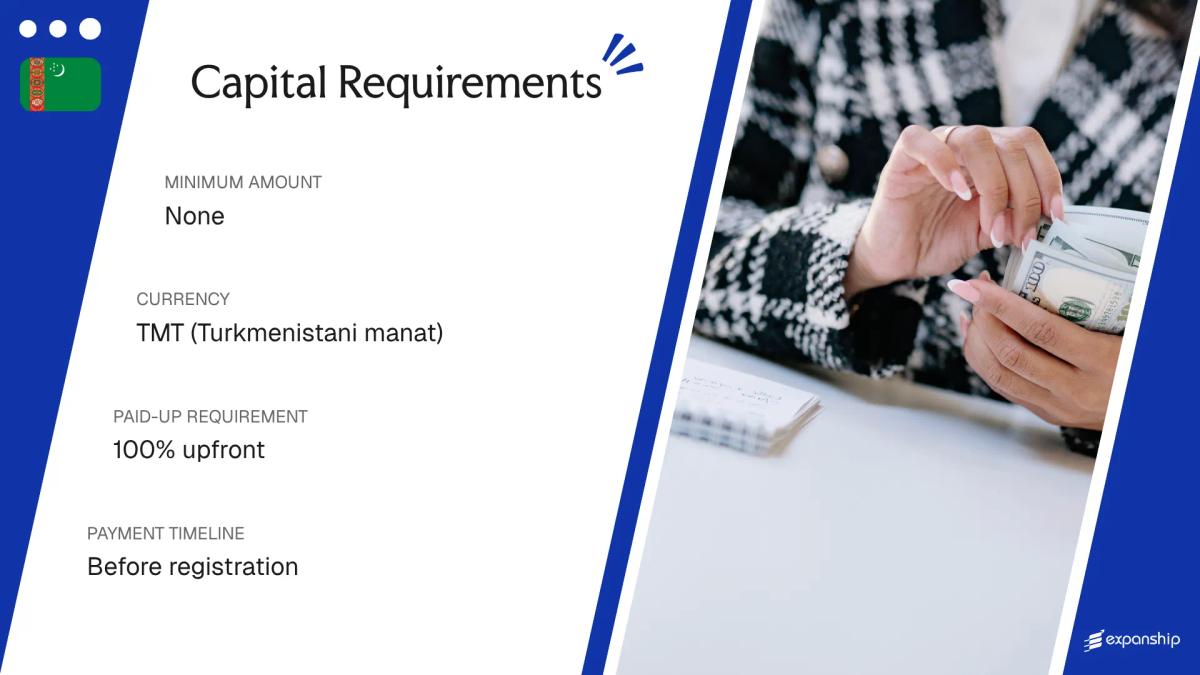
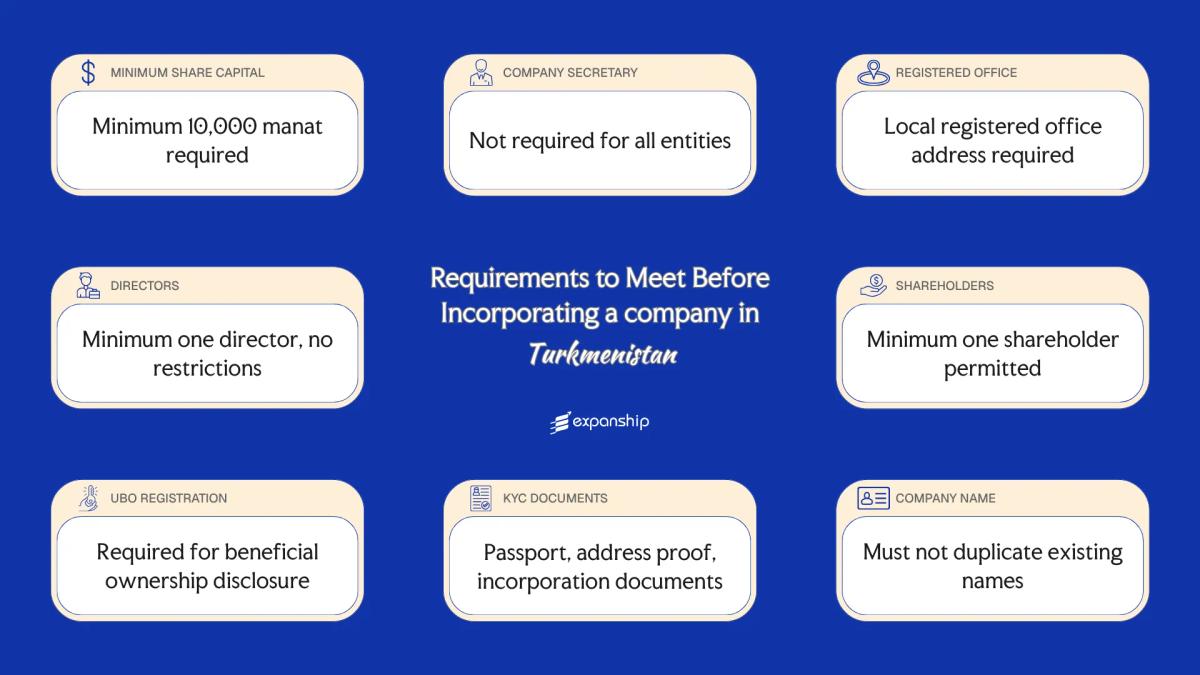
Turkmenistan minimum share capital requirements are governed primarily by the Law on Enterprises in Turkmenistan and related civil legislation, which establishes authorized capital as a mandatory structural element for registered entities. The Ministry of Justice oversees company registration, and capital documentation forms part of the incorporation file submitted to the State Registry.
Share capital obligations under Turkmen law operate on a par value system, where each share or participation interest carries a nominal value. This is a statutory incorporation requirement, not simply a one-time formality, as the authorized capital figure must be maintained and reflected in the founding documents throughout the life of the entity.
| Parameter | Detail |
|---|---|
| Minimum Authorized Share Capital | No universally published statutory minimum for all entity types; specific figures apply per entity form under applicable legislation |
| Maximum Authorized Share Capital | No statutory maximum |
| Minimum Paid-Up Capital | No statutory requirement published for all entity types |
| Paid-Up Requirement at Incorporation | Capital must be partially contributed prior to or at the point of state registration |
| Accepted Currency | Turkmenistan Manat (TMT) |
| Accepted Forms of Contribution | Cash and non-cash contributions, including property and rights with assessed monetary value |
| Timeframe to Deposit Capital | Remaining capital contributions generally due within one year of incorporation |
Even where no specific minimum figure is prescribed for your entity type, the founding documents must define an authorized capital amount. Omitting this or leaving it undefined will result in registration rejection by the State Registry.
Company Secretary Requirements in Turkmenistan
Turkmenistan does not operate a company secretary system in the conventional sense used across common law jurisdictions. Under the Civil Code and the Law on Enterprises, the entity's management obligations are fulfilled through its executive body, typically a director or governing board, rather than a separately appointed corporate secretary.
That said, certain corporate governance functions associated with company secretary requirements in Turkmenistan are assigned to designated officials within the firm. These duties include maintaining the statutory register, certifying internal resolutions, and ensuring records are kept in accordance with the requirements set by the Ministry of Justice of Turkmenistan.
Qualification criteria for those fulfilling this role generally include:
- The individual must be a natural person; a corporate entity cannot hold this function.
- No statutory requirement for the person to be a Turkmenistan resident has been confirmed under general enterprise law.
- The appointee must have legal capacity under Turkmenistani civil law.
- No formal licensing or professional certification is mandated for this role by default.
- The function may be assigned to an existing officer of the company rather than a standalone appointment.

Incorporate a Company in Turkmenistan
Set up your legal entity in Turkmenistan with end-to-end support covering structure, documentation, and regulatory compliance.
Legal Address Requirements in Turkmenistan
Meeting the legal address requirements in Turkmenistan is a foundational step for any entity seeking to register and operate under the Civil Code and the Law on Enterprises.
- A physical address within Turkmenistan is required; virtual offices are generally not accepted as a registered office address.
- The address must be located in Turkmenistan; foreign addresses do not satisfy registered office requirements.
- A lease agreement or proof of ownership for the premises is typically required to substantiate the address at registration.
- The registered address is recorded in the State Registry of Legal Entities and is publicly accessible.
- Any change to the registered office address must be formally notified to the Ministry of Justice or the relevant registration authority.
- Operating with a non-compliant or fictitious address can result in administrative penalties and may expose the business to suspension or deregistration proceedings.
Director Requirements in Turkmenistan

Under Turkmenistan's Civil Code and the Law on Enterprises, director requirements in Turkmenistan impose statutory duties of loyalty, due care, and fiduciary responsibility toward the entity and its shareholders. A director assumes personal liability for decisions that result in financial harm to the company if those decisions are found to violate applicable law or the firm's founding documents.
| Parameter | Detail |
|---|---|
| Minimum Number of Directors | One director is required. |
| Maximum Number of Directors | No statutory maximum is prescribed. |
| Local/Resident Director Required | No statutory requirement for a locally resident director. |
| Nationality Restrictions | No nationality restrictions are imposed under general company law. |
| Minimum Age Requirement | Directors must have reached the age of majority, which is 18 years. |
| Corporate Directors Permitted | Corporate directors are generally not recognised; natural persons are required. |
| Director Must Be a Shareholder | No statutory requirement for a director to hold shares in the business. |
| Publicly Listed on Registry | Director information is recorded in the State Registry of Legal Entities. |
| Disqualification Conditions | Persons with certain criminal convictions or declared legally incapable by a court are disqualified from directorship. |
Despite Turkmenistan's highly state-controlled economy, foreign nationals face no statutory nationality bar to serving as a director of a privately registered entity.
Shareholder Requirements in Turkmenistan
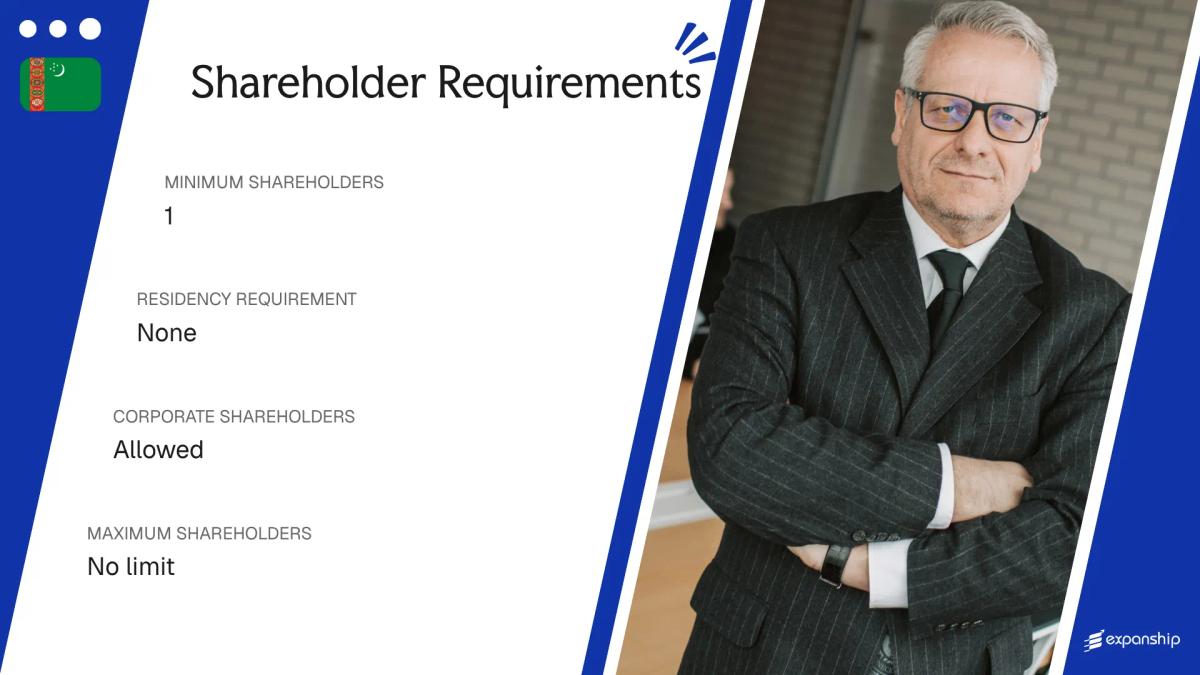
Under Turkmenistan's Civil Code and the Law on Limited Liability Companies, a limited liability company (LLC) may be founded by a single individual or legal entity, making a sole shareholder structure permissible. The maximum number of shareholders in an LLC is generally capped at fifty.
Nationality and Residency Restrictions
Meeting the shareholder requirements in Turkmenistan does not obligate foreign nationals to hold local residency. Foreign ownership is permitted, though certain sectors subject to specific licensing may impose restrictions on the foreign ownership percentage.
Corporate Shareholders
Legal entities, including foreign corporations, may act as shareholders in a Turkmenistan-registered company. No general prohibition prevents a corporate body from holding shares, provided it satisfies applicable registration and documentation requirements.
Shareholder Liability
Shareholder liability in an LLC is limited to the value of each participant's contribution to the charter capital. Extended personal liability does not generally arise unless a court establishes grounds for piercing the corporate veil.
Register of Shareholders
A register of participants must be maintained by the company itself. This register is not publicly accessible in the same manner as filings held by the Ministry of Justice, though updates are required when ownership changes occur.
Shareholder Structuring Support for Your Turkmenistan Entity
Get guidance on structuring shareholder arrangements that meet local regulatory requirements when setting up a company in Turkmenistan.
UBO / Beneficial Ownership Disclosure Requirements in Turkmenistan
Formal UBO disclosure requirements specific to Turkmenistan are not established under a publicly documented statutory framework, and there is no confirmed centralized beneficial ownership register currently in operation.
Turkmenistan has not fully aligned with FATF recommendations on beneficial ownership transparency, and no legislation equivalent to the EU's Anti-Money Laundering Directives has been identified as governing UBO registration obligations for domestic or foreign-owned entities.
KYC / Document Requirements in Turkmenistan
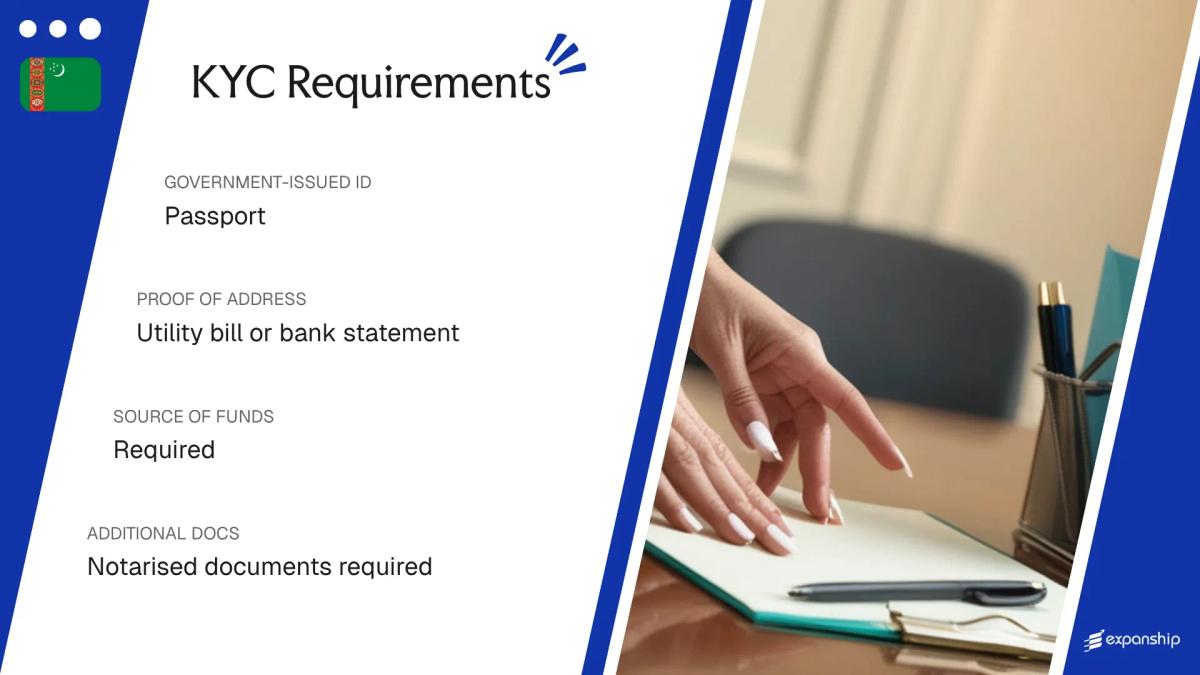
KYC requirements for Turkmenistan company registration are governed by the Law of Turkmenistan "On Countering the Legalisation of Criminally Obtained Income and the Financing of Terrorism," administered by the Financial Monitoring Service under the Ministry of Finance. Submitting incomplete or unverified documentation to the Ministry of Justice at the point of incorporation is the primary cause of registration delays.
Individual / Personal Documents
- Valid passport or national identity document for each individual director, shareholder, or beneficial owner
- Proof of residential address dated within three months, such as a utility bill or bank statement
- A specimen signature may be required for notarial purposes during the registration process
- Completed personal information form as specified by the registration authority
Corporate Documents
- Certificate of incorporation or equivalent formation document for any corporate shareholder or director
- Constitutional documents, such as the charter or articles of association, confirming the entity's structure
- Current register of directors and shareholders issued by the relevant home jurisdiction authority
- Proof of the corporate entity's registered address in its country of incorporation
Source of Funds Documentation
- Bank statements covering a minimum recent period evidencing the origin of capital to be introduced
- Audited financial accounts where the investing entity is an operating business
- A written declaration of source of funds may be required for individual contributors
Notarisation and Apostille Requirements
- Foreign-issued documents generally require apostille certification under the Hague Convention framework
- All non-Turkmen language documents must be accompanied by a certified translation into Turkmen or Russian
- Notarisation by a licensed notary in the document's country of origin is typically required before apostille
Documents submitted without certified Turkmen or Russian translation are routinely rejected by the Ministry of Justice during registration review.
Company Name Requirements in Turkmenistan
Company name requirements in Turkmenistan are assessed at the point of registration through the Ministry of Justice, which reviews proposed names for uniqueness and conformity with applicable naming rules. Names already registered or confusingly similar to existing entities will be rejected.
All business names must be rendered in Turkmen or Russian. A legal suffix indicating the entity type is mandatory — for example, "Jogapkärçiligi Çäklendirilen Jemgyýet" (JCJ) for a limited liability company.
Certain words are restricted from use without prior governmental approval, including terms referencing state bodies, national symbols, or financial institutions. Words that imply official affiliation or mislead the public about the nature of the business are generally prohibited.
Name reservation is available prior to formal registration, though the specific duration and procedural steps are governed by the Ministry of Justice's internal registration process. Reservation is applied for as part of the pre-incorporation filing.
Compliance Services for Companies in Turkmenistan
Expanship supports businesses registered in Turkmenistan with ongoing compliance obligations, including name maintenance, regulatory filings, and statutory record-keeping.
Conclusion
Turkmenistan company incorporation requirements span entity structure, capital thresholds, director and shareholder composition, registered address provisions, and beneficial ownership disclosure under the framework administered by the Ministry of Justice. Foreign equity participation and local address obligations are among the more consequential conditions for foreign investors to address early. Residency requirements for directors also affect how your business structures its governance from the outset. Once these requirements are understood, the practical work of preparing documentation, engaging local registered agents, and coordinating with Turkmen authorities begins.
Expanship's Corporate Services for Turkmenistan Expansion
Incorporating in Turkmenistan involves navigating a concentrated regulatory environment where the State Registry and sector-specific licensing bodies each impose distinct documentation and compliance obligations. Expanship's Turkmenistan corporate services are structured around these specific requirements, from preparing founding documents in accordance with the Civil Code to coordinating submissions with the relevant state authorities. Your operational burden is reduced, not because the process becomes simple, but because the procedural steps are handled by people who know them.
Expanship supports your expansion across the full incorporation and post-formation cycle:
- We prepare and file all company registration documentation with the relevant state registry.
- Our team provides registered agent and legal address services in Ashgabat.
- We liaise directly with government bodies for regulatory filings and authority correspondence.
- Ongoing compliance obligations are managed on your behalf after the entity is established.
- We facilitate introductions to local banking institutions suited to your business profile.
- Tax registration and coordination with local fiscal authorities are handled as part of the engagement.
To discuss your requirements, contact Expanship Turkmenistan.
Frequently Asked Questions (FAQ)
Foreign nationals can serve as directors of a Turkmenistan-registered entity, but certain regulated sectors may impose residency or nationality conditions on management. The general framework under Turkmenistan's civil code does not mandate local directorship for standard commercial entities. Specific licensing requirements in industries such as energy or banking can override this default rule.
Full foreign ownership is permitted in many sectors, though strategic industries are subject to restrictions or require government approval. The Foreign Investment Law of Turkmenistan grants foreign investors the right to establish and operate businesses, but joint venture arrangements may be required in areas deemed sensitive to national interests. You should conduct a sector-specific review before assuming full ownership is available for your intended activity.
Foreign shareholders and directors must typically provide certified copies of their passports, proof of residential address, and documentation confirming the source of funds or corporate structure. Where a corporate shareholder is involved, the full chain of ownership must be evidenced through constituent documents, which may require apostille or notarisation depending on the country of origin. Turkmenistan's registration authorities may request certified Turkmen or Russian translations of all foreign-language documents.
Failure to disclose accurate beneficial ownership information can result in administrative penalties and, in serious cases, grounds for the dissolution of the registered entity. Turkmenistan has aligned its UBO disclosure requirements with broader anti-money laundering obligations, meaning non-compliance carries regulatory risk beyond a simple fine. The State Registration Service has the authority to investigate discrepancies in ownership declarations.
Names that imply a connection to state institutions, use protected terms such as "national" or "Turkmenistan," or are identical to an already-registered entity will be rejected during the name approval process. The name must also reflect the legal form of the entity, for example including "LLC" or its Turkmen equivalent. Applications are reviewed by the State Registration Service under the Ministry of Finance, which maintains the official register of approved business names.
A registered legal address in Turkmenistan must correspond to a physical, verifiable location where official correspondence and inspections can be directed. Virtual office arrangements that cannot demonstrate a genuine physical presence are unlikely to satisfy the requirements set by the State Registration Service. Using an address that does not reflect the actual operational location of the business can expose the entity to compliance issues during post-registration audits.
Legal Disclaimer
The information provided in this article is for general informational purposes only and does not constitute legal, tax, or professional advice. While we strive to ensure the accuracy and timeliness of the content, laws and regulations are subject to change, and the application of laws can vary widely based on specific facts and circumstances.
Readers should not act upon this information without seeking professional counsel tailored to their individual situation. Expanship and its authors disclaim any liability for actions taken or not taken based on the content of this article.
For specific advice regarding your business setup, compliance requirements, or any legal matters, please consult with qualified legal and tax professionals in the relevant jurisdiction.