
Key Takeaways
- Foreign investors in Turkmenistan are prohibited from holding majority ownership across most economically significant sectors, structurally limiting the scope of control any foreign-incorporated entity can exercise over its own operations.
- The Civil Code, administered by the Ministry of Justice of Turkmenistan, operates within a broader regulatory environment where implementing rules are applied inconsistently, making legal compliance difficult to maintain with certainty.
- State dominance over the banking sector restricts foreign businesses from accessing reliable financial infrastructure, and limited foreign currency convertibility creates material obstacles to repatriating profits or settling cross-border obligations.
- Turkmenistan's heavily regulated internet and communications environment imposes operational constraints on foreign businesses that rely on standard digital infrastructure for internal coordination or market engagement.
Incorporating in Turkmenistan places your business within one of the most tightly controlled regulatory environments among post-Soviet economies, where state authority extends directly into commercial activity in ways that have few parallels elsewhere. The disadvantages of incorporating in Turkmenistan span ownership restrictions, financial access, legal unpredictability, and operational constraints — each examined in the sections that follow.
The weight of these disadvantages shifts depending on your industry, entity structure, and intended level of market presence. A firm seeking a minority trading arrangement faces different barriers than one pursuing a wholly foreign-owned production subsidiary.
Primary legislation governing commercial entities can be referenced in the Civil Code, administered through the Ministry of Justice of Turkmenistan. This article is most relevant to foreign investors and multinational firms considering direct incorporation or a registered commercial presence in the country.
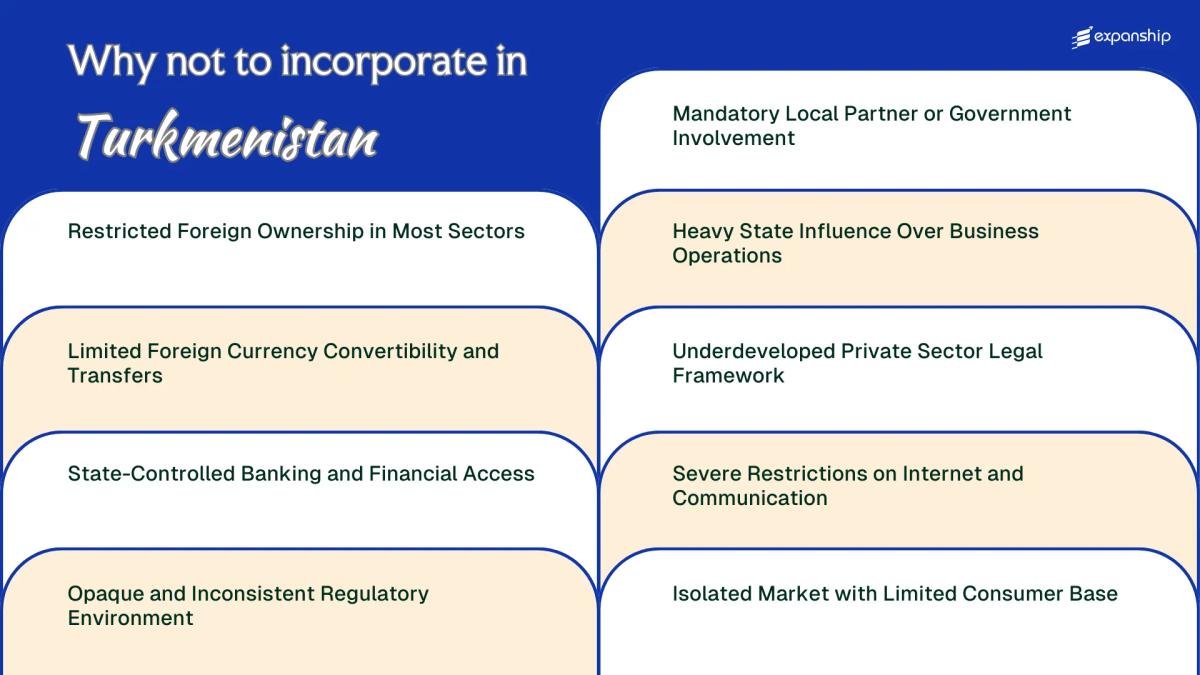
Restricted Foreign Ownership in Most Sectors
Foreign ownership restrictions in Turkmenistan affect virtually every commercially significant sector, leaving foreign investors with limited structural options and narrowing the range of viable business models from the outset.
Sectoral Barriers That Constrain Foreign Control
Under the Law on Foreign Investment and related sector-specific regulations, foreign entities face outright prohibitions or strict ownership ceilings in strategic industries including energy, telecommunications, media, and land use. Because hydrocarbon resources are constitutionally designated as state property, upstream oil and gas participation typically requires production sharing agreements with Türkmengaz or Türkmennebit, where the foreign party holds a subordinate commercial position rather than independent ownership.
Outside the extractive sector, foreign companies in most industries cannot hold a controlling stake without explicit government approval, which is granted on a discretionary basis. This discretion introduces structural unpredictability: your business cannot rely on a transparent, rules-based threshold to determine eligibility.
Why Ownership Ceilings Create Operational Risk
Minority ownership positions reduce your firm's ability to direct strategy, repatriate earnings, or exit the investment on commercially rational terms. Foreign investment limitations in Turkmenistan are compounded by the absence of bilateral investment treaty protections with most major capital-exporting nations, which removes a standard legal safeguard available in other jurisdictions.
A foreign business operating under a minority ownership structure in Turkmenistan has limited legal recourse if state-affiliated partners override commercial decisions or block dividend distributions.
Limited Foreign Currency Convertibility and Transfers
Turkmenistan foreign currency transfer restrictions present one of the most operationally damaging obstacles for foreign-owned entities. The Central Bank of Turkmenistan maintains strict controls over foreign exchange, and the official exchange rate for the Turkmen manat (TMT) has long diverged from parallel market rates, creating a structural pricing distortion that directly erodes your profit margins on any cross-border transaction.
Repatriating earnings is not a straightforward process. Approvals for currency conversion and outward transfers are subject to regulatory discretion rather than transparent, rules-based criteria, meaning timelines are unpredictable and approvals are not guaranteed.
The practical friction this creates for a foreign business owner includes:
- Converting manat-denominated revenues into hard currency requires central bank approval, leaving retained earnings effectively trapped during the approval period
- The gap between the official and informal exchange rates means that converted funds often reflect a rate unfavorable to the foreign shareholder
- Transfer delays disrupt dividend schedules and inter-company loan repayments, forcing your parent entity to absorb liquidity shortfalls
- Documentary requirements for outward transfers can involve multiple state agencies, multiplying administrative costs
These controls apply even when underlying transactions are commercially legitimate. Currency convertibility problems in Turkmenistan disproportionately affect businesses whose operating model depends on regular profit repatriation.

Company Incorporation in Turkmenistan
Understand the regulatory and financial constraints before establishing a legal entity in Turkmenistan.
State-Controlled Banking and Financial Access
Turkmenistan state-controlled banking risks are embedded in the structure of the financial system itself. The sector is dominated by state-owned institutions, including the Central Bank of Turkmenistan, which supervises a network of government-controlled commercial banks. Private and foreign banks operate under severe constraints, leaving your business with few independent banking relationships to rely on.
Account access for foreign-registered entities is difficult to obtain and slow to establish. Approvals are subject to discretionary review by state institutions, with no transparent published timeline or criteria, making financial planning unreliable from the outset.
| Restriction | Practical Impact on Foreign Firms |
|---|---|
| No independent private banking sector | No competitive alternatives to state banks |
| Discretionary account approval process | No predictable timeline for operational readiness |
| Foreign currency account access limited | Hard currency transactions require separate regulatory clearance |
| Limited correspondent banking relationships | Cross-border wire transfers face delays or rejection |
| State banks prioritise government-linked entities | Foreign private firms receive lower service priority |
Credit facilities for foreign firms are rarely extended on commercial terms. State banks direct lending toward government-affiliated projects, which means your entity is unlikely to access local financing for working capital or expansion.
Even basic services such as international wire transfers depend on the bank's existing correspondent relationships, which are narrow. A transaction that would clear within hours in most developed markets can take weeks or fail entirely.
Opaque and Inconsistent Regulatory Environment
Turkmenistan regulatory environment challenges stem partly from the absence of a consolidated, publicly accessible body of business law. Regulations are frequently issued through presidential decrees and ministerial orders that may not be published in full or translated into languages accessible to foreign investors.
The Ministry of Finance and Economy oversees much of the regulatory framework affecting foreign entities, yet formal guidance for compliance obligations is inconsistently disseminated. Your legal team may encounter conflicting instructions across government departments with no clear resolution mechanism.
Opaque business regulations in Turkmenistan mean that licensing conditions, reporting timelines, and approval thresholds can shift without advance notice. This exposes your business to retroactive compliance failures that could not have been anticipated at the time of incorporation.
Inconsistent compliance requirements across different state bodies also create parallel obligations that are difficult to reconcile without local legal counsel embedded in government networks.
- Regulatory changes may be issued by presidential decree with immediate effect and no transition period
- No centralized public register of current licensing requirements exists for foreign-owned entities
- Sector-specific rules may contradict general foreign investment law, with no binding precedent to resolve the conflict
- Administrative penalties can be applied retroactively under broad ministerial discretion
Turkmenistan has no independent judiciary to challenge regulatory decisions, meaning administrative disputes against state bodies have no neutral arbitration path domestically.
Mandatory Local Partner or Government Involvement
Mandatory local partner requirements in Turkmenistan apply across a broad range of sectors, effectively limiting how much ownership and control a foreign company can retain from the outset.
Structural Conditions That Force Shared Ownership
Under Turkmenistan's Foreign Investment Law and related sectoral regulations, foreign entities in energy, agriculture, and certain industrial activities are required to enter joint ventures with state-owned enterprises or locally registered partners. This structure means your firm's equity stake, profit distribution, and operational decisions are constrained by a partner you did not choose on open-market terms.
The government's preference for state involvement in joint ventures introduces a significant imbalance in negotiating power. Turkmenistan state involvement in foreign companies is not incidental — it is structurally embedded in licensing and approval processes managed by relevant ministries.
Practical Risks of Forced Partnership
Forced local partnership risks extend beyond equity dilution. Decisions on hiring, procurement, and reinvestment often require partner consent, which can delay operations or expose proprietary processes to state-affiliated entities.
Minority ownership positions in these arrangements can also limit your ability to enforce contractual protections under international arbitration norms, given the country's limited treaty commitments in this area.
Guidance on Structuring Your Entry into Turkmenistan
Understand partnership obligations and state involvement requirements before committing to incorporation in Turkmenistan.
Heavy State Influence Over Business Operations
State interference in Turkmenistan business operations extends well beyond standard regulatory oversight, giving government bodies direct authority over how private and foreign-owned companies function day to day.
- The State Agency for Foreign Investment has broad discretionary powers to review and intervene in foreign business activities, meaning operational decisions that would normally rest with company management can be subject to government approval or reversal.
- Strategic sectors including energy, telecoms, and transport are effectively state-administered, so your firm may find itself commercially dependent on state entities as the sole counterparty, supplier, or distributor.
- Presidential decrees have historically overridden existing business agreements without a formal legislative process, exposing your contracts to unilateral cancellation with limited legal recourse.
- State-owned enterprises receive preferential treatment in procurement and licensing, which structurally disadvantages private foreign firms competing for the same contracts.
- Turkmenistan political risk for foreign businesses is compounded by the absence of an independent judiciary capable of challenging government interference on commercial grounds.
Underdeveloped Private Sector Legal Framework
Turkmenistan's private sector legal framework limitations run deep, and they translate directly into unpredictable operating conditions for any foreign entity. The Civil Code and commercial legislation exist on paper, but their application lacks consistency, with courts exercising wide discretionary powers in contract disputes.
Contract enforcement is a particular liability. Judicial independence is not structurally guaranteed, and commercial cases involving foreign firms are frequently resolved in ways that favour state-connected parties.
Investor protection mechanisms that foreign businesses rely on elsewhere — clear dispute resolution procedures, enforceable arbitration clauses, transparent insolvency processes — remain underdeveloped. Your firm cannot assume that a signed agreement carries the same legal weight it would under a mature commercial law system.
- Arbitration awards are difficult to enforce domestically
- No independent commercial court system exists to handle disputes impartially
- Intellectual property protections are limited in practical scope
A foreign manufacturer operating under a joint venture agreement experiences a contract breach by its local partner. Pursuing the dispute through domestic courts takes an estimated 3 to 5 years, with legal costs exceeding $40,000 USD and no realistic expectation of an impartial ruling, based on general conditions reported by the World Bank's Doing Business indicators for Central Asian economies with similarly low rule-of-law scores.
Severe Restrictions on Internet and Communication
Internet restrictions in Turkmenistan create concrete operational friction for any foreign business. The country consistently ranks among the least connected nations globally, with state-owned Turkmentelecom holding a monopoly over telecommunications infrastructure. Your firm cannot simply select a competing provider or negotiate better service terms.
VPN usage is legally restricted and actively suppressed, meaning secure remote access to international systems — standard practice in most corporate environments — carries regulatory and legal risk. This directly affects your ability to manage cloud-based operations, communicate with overseas offices, or run software dependent on unfiltered connectivity.
Foreign messaging platforms, many international news sites, and business communication tools face routine blocking. The practical consequence is that routine coordination between a local entity and a foreign parent company becomes slower and less reliable than in virtually any comparable emerging market.
- Access to global SaaS platforms may be inconsistent or entirely unavailable
- International video conferencing and file-sharing tools can be inaccessible without workarounds that carry legal exposure
- Reliance on local telecommunications infrastructure means outages and bandwidth constraints are outside your control
VPN services are prohibited under Turkmenistan's telecommunications regulations, and foreign businesses operating locally cannot assume that standard encrypted communication tools used in other jurisdictions will function legally or reliably within the country.
Isolated Market with Limited Consumer Base
Turkmenistan's isolated market limitations stem directly from its population size and economic structure. With approximately 6 million residents and a GDP heavily concentrated in state-controlled energy sectors, your addressable consumer base for private commercial activity is structurally narrow.
Disposable income among the general population remains constrained by state-subsidized pricing policies and public sector wage dominance. A foreign firm targeting retail, consumer goods, or services will find that demand volumes rarely justify the cost of establishing and maintaining a local legal presence.
The state controls distribution channels in several key sectors, which limits how your business can physically reach end consumers even when demand exists. Most private commercial activity concentrates around Ashgabat, leaving the rest of the country commercially underserved and logistically difficult to access.
Foreign firms operating in export-oriented industries face fewer constraints from domestic demand, but for those targeting local sales, the small consumer base risks Turkmenistan presents are compounded by restricted market access channels that are largely outside private sector control.
Overcoming Turkmenistan's Incorporation Challenges
Overcoming Turkmenistan's incorporation challenges requires a structured approach that accounts for state control, currency restrictions, and limited legal recourse rather than treating them as temporary inconveniences.
- Identify which sectors permit foreign equity participation under the Law on Foreign Investment before structuring your entity type.
- Formalise any local partnership arrangement through a notarised agreement that complies with the Civil Code of Turkmenistan to reduce exposure from undefined obligations.
- Open accounts only through state-authorised banks and document all hard currency conversion requests submitted to the Central Bank of Turkmenistan.
- Register your business with the Ministry of Finance and maintain current compliance filings to avoid administrative suspension.
- Establish communication and data handling protocols that comply with state telecommunications regulations given restrictions on internet and digital infrastructure.
These steps address documented structural barriers, but they do not eliminate the underlying constraints imposed by Turkmenistan's centralised regulatory system. The State Agency for Registration of Legal Entities retains broad discretionary authority, and compliance alone does not guarantee operational continuity.
Turkmenistan's Business Potential Weighed Honestly
Turkmenistan business risks versus opportunities present a stark calculus for foreign investors. The barriers documented in this blog, from currency inconvertibility to state-controlled banking and opaque regulation, are structural rather than incidental. Yet the country holds one of the world's largest natural gas reserves, and the government's stated interest in attracting foreign capital into energy and infrastructure gives certain business profiles a genuine foothold.
| Pros | Cons |
|---|---|
| Substantial natural gas and energy sector assets create defined opportunities for upstream and infrastructure investment | Foreign ownership is restricted across most sectors, limiting the scope of permissible business activity |
| Government-to-government agreements can provide a degree of operational stability for large-scale projects | Currency controls and limited convertibility make it difficult to repatriate profits or hold foreign exchange |
| Low labour costs relative to regional peers reduce operational expenditure for qualifying ventures | State-controlled banks restrict access to credit facilities and independent financial services |
| Special economic zones offer a degree of regulatory separation from the general investment environment | Most foreign investors are required to engage a local partner or accept government co-ownership arrangements |
| The regulatory framework remains inconsistent, with no independent judiciary to enforce contractual rights |
Your assessment must account for the fact that internet restrictions directly constrain operational communication, and the domestic consumer market remains too small to support most commercially viable retail or service strategies.
Compliance Services for Companies in Turkmenistan
Maintaining regulatory compliance in Turkmenistan requires close attention to local statutory requirements, state reporting obligations, and licensing conditions. This service covers the ongoing compliance needs of registered entities operating in the jurisdiction.
Conclusion
Turkmenistan incorporation drawbacks summary points to a single consistent pattern: structural barriers that are not incidental but built into how the economy functions. Currency inconvertibility under the Central Bank of Turkmenistan's controls and the requirement for state or local partner involvement in most sectors are not administrative hurdles but foundational conditions. Knowing this shapes how you assess entry. For businesses that proceed with clear-eyed expectations about what operating here requires, qualified legal and corporate support becomes less optional and more essential to any realistic plan.
Expanship's Role in Your Turkmenistan Expansion
Expanship Turkmenistan company formation support is designed to reduce the operational weight of incorporating in one of the world's most restrictive business environments. From satisfying the State Registry Agency requirements to managing mandatory local partner arrangements and foreign currency documentation, the procedural burden on foreign firms is substantial. Expanship works alongside your business to handle the groundwork these obligations generate.
Our team works across the full incorporation and post-registration cycle.
- Your company registration and all supporting document preparation are handled end to end.
- A registered agent and local office address are provided to meet statutory presence requirements.
- We liaise directly with government bodies and regulatory authorities on your firm's behalf.
- Post-incorporation compliance management keeps your entity in good standing as requirements evolve.
- Banking introduction assistance connects your business with viable financial access points.
- Tax registration and coordination with local authorities are managed to meet filing obligations.
Reach out through Expanship Turkmenistan to discuss your incorporation requirements.
Frequently Asked Questions (FAQ)
The local partnership requirement applies most stringently in strategic sectors such as energy, telecommunications, and natural resources, but government involvement is expected across virtually all significant commercial activity. Foreign entities operating outside joint venture structures face regulatory obstruction in licensing, land access, and banking services. In practice, fully foreign-owned companies have limited operational viability without some form of state-connected local participation.
Without ministerial clearance, your business cannot complete registration, obtain operating licenses, or open a bank account with a state-controlled institution. Turkmenistan has no independent appeals tribunal that can override ministry decisions, so a refusal effectively stalls the entire entity. There is no statutory deadline by which a ministry must respond, meaning delays can be indefinite.
Yes, Turkmenistan consistently ranks as one of the world's most restricted internet environments, below even most other Central Asian jurisdictions. Turkmentelecom holds a state monopoly over connectivity infrastructure, and international VoIP services are blocked, making routine business communication with foreign offices or clients technically difficult. Internet speeds are among the slowest globally, and bandwidth limitations directly affect any firm dependent on cloud systems or real-time data transfer.
Contract disputes between foreign firms and Turkmen state entities are rarely resolved through neutral adjudication, as the judiciary lacks formal independence from the executive branch. Turkmenistan is a signatory to the New York Convention on the Recognition and Enforcement of Foreign Arbitral Awards, but enforcement of foreign arbitral awards against state-owned counterparties in domestic courts has been inconsistent. Foreign businesses have reported outcomes that favour state-linked parties regardless of contractual terms.
Precise fee structures vary by institution, but all major commercial banks in Turkmenistan are state-owned, and foreign companies are subject to account conditions that include mandatory currency conversion at official rates, which diverge materially from parallel market rates. This gap represents a direct financial loss on every inbound or outbound transaction. Foreign firms also face restrictions on holding foreign currency accounts domestically, limiting financial planning options.
Exiting is procedurally complex and financially risky, particularly if the entity holds assets or has outstanding obligations to state entities. Business closure requires approvals from tax authorities, the Ministry of Finance, and sectoral regulators, and there is no defined statutory timeline for completing liquidation. Companies that entered through joint ventures with state-linked partners may face asset disputes or be unable to repatriate remaining capital without lengthy negotiation.
Legal Disclaimer
The information provided in this article is for general informational purposes only and does not constitute legal, tax, or professional advice. While we strive to ensure the accuracy and timeliness of the content, laws and regulations are subject to change, and the application of laws can vary widely based on specific facts and circumstances.
Readers should not act upon this information without seeking professional counsel tailored to their individual situation. Expanship and its authors disclaim any liability for actions taken or not taken based on the content of this article.
For specific advice regarding your business setup, compliance requirements, or any legal matters, please consult with qualified legal and tax professionals in the relevant jurisdiction.