
Key Takeaways
- Businesses incorporated in Turkmenistan are subject to a corporate income tax rate of 8%, positioning the jurisdiction below most regional peers and reducing the baseline fiscal burden on foreign-owned entities.
- Companies aligned with the hydrocarbon supply chain gain access to state-backed investment frameworks and Caspian Basin market corridors that are structurally unavailable in more restrictive neighboring jurisdictions.
- Under Turkmenistan's national investment legislation, full foreign ownership is legally permitted in designated sectors, removing the equity dilution requirements that apply elsewhere in the region.
- The Ministry of Justice serves as the central registration authority, and foreign firms operating within designated special economic zones benefit from reduced tax burdens that compound the already low standard corporate rate.
Turkmenistan is a sovereign, landlocked nation in Central Asia, bordered by Kazakhstan, Uzbekistan, Afghanistan, Iran, and the Caspian Sea. The country operates under a presidential republic system, with the state maintaining significant control over key economic sectors. Company registration falls under the authority of the Ministry of Justice, which oversees the formation and legal standing of business entities operating within the country. Foreign firms seeking a formal presence most commonly establish a Limited Liability Company as their primary legal vehicle.
From a fiscal standpoint, the country operates a low-tax regime, with corporate rates positioned below most regional peers. Foreign direct investment is formally welcomed under national legislation, and certain sectors permit full foreign ownership, though the degree of openness varies by industry and is subject to state policy.
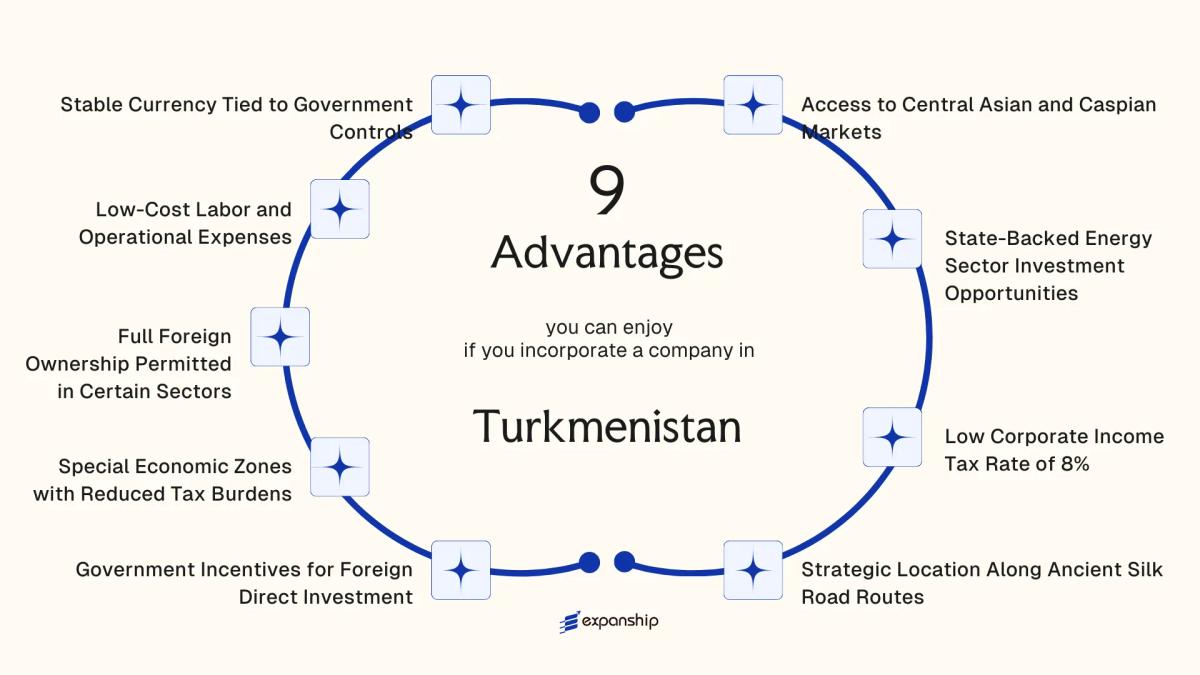
The benefits of incorporating in Turkmenistan are shaped by a combination of geographic positioning, regulatory policy, and sectoral opportunity. This article examines the concrete advantages your business may access by forming a company here.
Access to Central Asian and Caspian Markets
Turkmenistan's geographic position creates direct commercial exposure to a combined population exceeding 75 million people across Central Asia, plus access to Caspian littoral states including Azerbaijan, Iran, Kazakhstan, and Russia. For a foreign business owner, this means a single registered entity can serve as an operational base for multi-country distribution without requiring separate incorporation in each market.
Caspian Access and Trade Connectivity
The 2018 Convention on the Legal Status of the Caspian Sea, signed by all five littoral states, established a framework governing maritime navigation and resource use that directly affects how businesses move goods across the sea. Companies registered in Turkmenbashi — the country's principal Caspian port — can access shipping routes into Azerbaijan and Kazakhstan without the overland border crossings that add cost and transit time.
Regional Trade Framework
Turkmenistan maintains bilateral trade agreements with neighboring states that reduce friction for goods moving across its borders. Your firm gains proximity to both the Chinese-backed Belt and Road corridor and the Trans-Caspian International Transport Route, two freight networks increasingly used by manufacturers exporting between Asia and Europe.
A company incorporated here can physically position inventory or operations within reach of five Caspian markets under a single regulatory address.
State-Backed Energy Sector Investment Opportunities
Turkmenistan holds some of the world's largest natural gas reserves, ranking consistently among the top five globally by proven reserve volume. For foreign investors, Turkmenistan energy sector investment opportunities are anchored directly in state structures, meaning access is governed by formal agreements rather than open-market speculation.
The state oil and gas company Türkmengaz and its oil-focused counterpart Türkmennebit serve as the primary counterparties for foreign firms entering the hydrocarbon sector. Contracts are typically structured as production sharing agreements (PSAs), which define cost recovery terms, profit splits, and operational rights in writing before any capital is deployed. This reduces ambiguity around return structures from the outset.
Foreign entities operating under PSA frameworks benefit from several features that distinguish this market from other state-controlled hydrocarbon regimes:
- Revenue terms are fixed contractually, insulating your firm from unilateral regulatory changes during the agreement period
- PSA structures allow cost recovery before profit division, which improves capital planning for long-cycle extraction projects
- State backing through Türkmengaz provides a creditworthy counterparty, reducing default risk compared to private-sector arrangements in less stable markets
The legal basis for foreign participation sits within the Law on Hydrocarbons, which outlines licensing, subsoil rights, and investor protections applicable to non-resident entities.

Incorporate a Company in Turkmenistan
Establish your legal presence in Turkmenistan's energy market with a properly structured entity recognized under local law.
Low Corporate Income Tax Rate of 8%
Turkmenistan's standard corporate income tax rate sits at 8 percent, established under the Tax Code of Turkmenistan. That figure is significantly below the global average corporate rate, which the OECD has tracked at over 20 percent in recent years. For a foreign-owned entity generating profit in-country, the difference in retained earnings is material from the first fiscal year.
| Tax Type | Rate | Applicable Entity |
|---|---|---|
| Corporate Income Tax | 8% | Legal entities operating in Turkmenistan |
| Withholding Tax (dividends) | 15% | Non-resident recipients |
| Minimum Tax Base | Gross income where applicable | Entities with low declared profit |
The Tax Code also governs how taxable income is calculated, and the general framework allows deduction of ordinary business expenses before applying the 8 percent rate. This means your firm's effective tax burden can fall further depending on its cost structure, making the statutory rate a ceiling rather than an absolute figure for most operating businesses.
Resident legal entities, including those with full or partial foreign ownership, are subject to this rate on income sourced within the country. The rate applies uniformly across most commercial sectors, which reduces the compliance uncertainty that arises in jurisdictions with tiered or sector-variable rate schedules. For a foreign investor structuring a subsidiary or joint venture, a predictable flat rate simplifies financial modelling and profit repatriation planning.
Strategic Location Along Ancient Silk Road Routes
Turkmenistan's geographic position places your business at the intersection of overland corridors connecting China, Russia, the Middle East, and Europe. The Turkmenistan Silk Road strategic location benefits are grounded in infrastructure, not history alone. The country sits at the center of the Trans-Caspian International Transport Route, a corridor that links Central Asia to European markets via the Caspian Sea and the South Caucasus.
The Lapis Lazuli Corridor, which Turkmenistan formally joined in 2017, extends freight access from Afghanistan through Turkmenistan to Turkey, reducing transit time compared to traditional sea routes. For a trading or logistics entity, this means direct overland access to markets that were previously reachable only through multiple transshipment points.
Road and rail networks connect to Iranian, Uzbek, and Kazakh border crossings, giving a registered firm access to the broader Eurasian freight system without rerouting through third-party hubs.
Keep the following in mind when structuring your business around this locational benefit:
- Transit operations benefit most from the Lapis Lazuli Corridor framework
- Caspian port access at Turkmenbashi connects to Azerbaijani and Iranian terminals
- Cross-border trade agreements govern customs procedures at each corridor entry point
- Freight volumes and transit times depend on bilateral rail and road agreements, which can change
Turkmenistan operates one of Central Asia's largest cargo airports at Turkmenbashi, designed specifically to support Silk Road corridor freight, not just domestic logistics.
Government Incentives for Foreign Direct Investment
Turkmenistan government incentives for foreign direct investment are grounded in a formal legal framework rather than ad hoc policy decisions. The Law on Foreign Investment provides the foundational guarantees, including protection against nationalization without compensation and the right to repatriate profits in foreign currency. These protections reduce the legal exposure that typically concerns foreign capital entering frontier markets.
Profit Repatriation and Legal Guarantees
Under the foreign investment law, your firm retains the right to transfer dividends, proceeds from asset sales, and other income abroad without mandatory reinvestment requirements. This convertibility assurance is meaningful in a region where capital controls can otherwise trap earnings onshore. The State Agency for Investment and State Property Management of Turkmenistan oversees foreign investor registrations and acts as the primary governmental point of contact for businesses seeking state support.
Sector-Specific Incentives and Investment Agreements
Foreign entities operating under production sharing agreements, particularly in the hydrocarbon sector, receive contractually defined fiscal terms that insulate them from subsequent legislative changes. This stabilization clause mechanism means your tax and regulatory conditions remain fixed for the duration of the agreement, regardless of future amendments to domestic law. Individual investment agreements negotiated with the government can also include customs duty exemptions on imported equipment and materials designated for qualifying projects, reducing the capital expenditure burden during the setup and operational phases of your investment.
Get Clarity on Turkmenistan's Investment Incentives
Speak with a specialist about which government incentives and legal protections apply to your business structure and sector in Turkmenistan.
Special Economic Zones with Reduced Tax Burdens
Turkmenistan's primary special economic zone is the Avaza National Tourist Zone, established on the Caspian Sea coast under a dedicated legal framework that grants resident businesses a distinct tax regime from the standard national rate. For foreign investors, the Avaza special economic zone Turkmenistan benefits center on a formal reduction in fiscal obligations that directly lowers the cost of operating within the zone compared to the general corporate environment.
- Businesses registered within the Avaza zone are exempt from corporate income tax for an initial period under the zone's enabling legislation, which means your firm retains a higher share of earnings during the establishment phase than it would under the standard 8% corporate rate applied elsewhere.
- Property tax exemptions apply to assets used within the zone, reducing the fixed cost of holding commercial real estate or infrastructure on-site.
- Value-added tax relief on qualifying transactions within the zone lowers the effective tax burden on goods and services exchanged between zone-registered entities.
- The zone operates under state oversight coordinated through designated government bodies, meaning the regulatory environment is centrally administered rather than fragmented across local authorities, which simplifies compliance for a foreign-owned entity unfamiliar with the broader national system.
Eligibility for these concessions is generally tied to registration within the zone and alignment with approved activity categories, particularly those connected to tourism, hospitality, and supporting infrastructure.
Full Foreign Ownership Permitted in Certain Sectors
Turkmenistan full foreign ownership permitted sectors exist primarily within trade, services, and certain manufacturing activities, where foreign nationals can hold 100 percent equity in a registered legal entity without a mandatory local partner. This structure is governed under the Law on Foreign Investment, which establishes the legal basis for wholly foreign-owned enterprises and defines the sectors where full ownership rights apply.
For your business, this means operational control remains entirely with the foreign founder. Profit repatriation decisions, management appointments, and strategic direction are not subject to local shareholder approval or interference.
Sectors requiring joint ventures or local participation do exist under the same legislative framework, so confirming eligibility for your specific activity before registration is a practical necessity.
A foreign investor establishing a 100% wholly owned trading company in Turkmenistan retains full claim to after-tax profits. At the 8% corporate income tax rate, a company generating USD 500,000 in annual net profit would retain USD 460,000, with no portion contractually owed to a local co-founder.
Full ownership rights also mean your entity's legal structure directly reflects the actual ownership reality, which simplifies auditing, intercompany transactions, and consolidation into a parent company's financial statements.
Low-Cost Labor and Operational Expenses
Turkmenistan low cost labor business advantages are grounded in the country's wage structure, which remains significantly below regional averages seen in Gulf states or Eastern European markets. Monthly wages across non-specialist sectors are among the lowest in the post-Soviet space, allowing foreign-owned entities to staff operations at a fraction of the cost required in comparable Central Asian economies.
Office rental and utility costs follow a similar pattern. State controls on energy pricing mean that electricity and gas expenses for commercial premises stay at levels that reduce fixed overhead materially, which directly improves margin on operations requiring continuous power or climate control.
The labor force holds reasonable technical education levels inherited from Soviet-era vocational training systems, meaning your firm gains cost efficiency without sacrificing baseline workforce competency in engineering, construction, or administrative functions.
- Low entry-level wages reduce payroll burden for labor-intensive operations
- State-subsidized utilities lower recurring overhead for manufacturing or processing businesses
- Locally trained technical workers are available at domestic salary rates
Foreign firms operating under the Law on Foreign Investment must comply with local labor regulations, including requirements to prioritize Turkmen nationals in hiring, which may affect your staffing flexibility and overall headcount structure.
Stable Currency Tied to Government Controls
The Turkmenistan manat currency stability advantages for foreign businesses stem directly from a fixed exchange rate regime maintained by the Central Bank of Turkmenistan. Since 2015, the manat has been pegged at a fixed rate against the US dollar, currently set at approximately 3.5 TMT per USD. For a foreign investor budgeting multi-year operational costs or repatriating earnings, this peg eliminates the currency volatility risk that affects many emerging market investments.
Under this arrangement, the government sets and enforces the exchange rate rather than allowing market forces to determine it. This means your financial projections for labor, procurement, and local operational expenses remain calculable without hedging instruments or exposure to speculative swings.
Turkmenistan government currency control business benefits also extend to transaction predictability. Businesses operating under contracts denominated in manat can price their obligations with a high degree of certainty relative to their home currency, particularly for USD-based entities.
Key structural features of this regime that affect foreign businesses include:
- The Central Bank of Turkmenistan administers currency controls, including rules governing foreign currency accounts and conversion approvals
- Repatriation of profits in foreign currency is subject to regulatory approval, which firms must factor into cash flow planning
- Currency exchange for business purposes typically occurs through state-authorized channels, including designated state banks
For a foreign firm operating in a sector where input costs are fixed in local currency, the Turkmenistan exchange rate stability for foreign investors translates directly into cost base predictability over the contract or project duration.
Why Turkmenistan Stands Out Against Regional Competitors
Comparing Turkmenistan against its immediate neighbours reveals a consistent pattern: where other Central Asian states have layered their foreign investment frameworks with bureaucratic conditions or variable tax treatment, the structure here remains comparatively direct. The jurisdictions most relevant to this comparison are Kazakhstan, Uzbekistan, and Azerbaijan, each of which targets overlapping investor profiles, particularly those seeking energy sector access, regional trade positioning, or low-cost operational bases.
The Turkmenistan advantages over regional competitors are most visible in two areas that tables cannot fully capture: the combination of a flat 8% corporate tax rate applied without a graduated threshold system, and the absence of currency convertibility as a competitive claim, given that the manat's fixed-rate controls reduce unpredictable exchange exposure in ways that free-float regimes in Kazakhstan and Uzbekistan do not. For foreign businesses requiring cost predictability across multi-year contracts, this distinction carries operational weight.
| Parameter | Turkmenistan | Kazakhstan | Uzbekistan | Azerbaijan |
|---|---|---|---|---|
| Corporate Income Tax Rate | 8% | 20% | 15% | 20% |
| Foreign Ownership (General) | Permitted in designated sectors | Generally permitted | Generally permitted | Generally permitted |
| Special Economic Zones | Yes | Yes (multiple SEZs) | Yes (multiple SEZs) | Yes (Alat FEZ) |
| Energy Sector FDI Framework | Production-sharing agreements | Production-sharing agreements | Production-sharing agreements | Production-sharing agreements |
| Currency Regime | Fixed (state-controlled) | Free float | Managed float | Managed float |
Compliance Services for Companies in Turkmenistan
Maintain your Turkmenistan entity in good standing with ongoing regulatory filings, reporting obligations, and statutory compliance support.
Conclusion
Turkmenistan's position as a gateway to Central Asian energy markets, combined with a corporate income tax rate of 8% and state-backed investment frameworks, forms a coherent case for incorporating here. The benefits of incorporating in Turkmenistan are most pronounced for businesses oriented toward the hydrocarbon supply chain, regional trade corridors, or export-facing manufacturing within designated special economic zones.
That case, however, is not uniform across all business types. Sectors outside energy or trade infrastructure face more restricted ownership structures and a narrower incentive framework, meaning the strength of the jurisdiction depends significantly on the alignment between your business activity and the areas where the government has actively structured advantages for foreign entities.
For businesses that do align, the combination of low operational costs, access to Caspian Basin markets, and specific FDI concessions under domestic investment legislation creates a fiscally and geographically advantageous base. The path forward depends on matching your corporate structure and sectoral focus to the legal frameworks that govern foreign participation in this market.
Start Your Turkmenistan Company with Expanship Today
Expanship's company formation services in Turkmenistan cover the full registration lifecycle, from selecting the appropriate legal structure under the Civil Code of Turkmenistan to filing with the Ministry of Justice and meeting the ongoing compliance requirements imposed by the State Tax Service. The entity types, tax obligations, special economic zone eligibility rules, and foreign ownership conditions discussed throughout this blog each carry their own procedural requirements, and Expanship's team works directly within that regulatory framework.
For businesses ready to proceed, Expanship handles the following:
- Document preparation, notarization, and apostille legalization
- Registered agent and legal address provision within Turkmenistan
- Government filing and liaison with the Ministry of Justice
- Post-incorporation compliance management, including annual reporting obligations
- Tax registration with the State Tax Service
- Banking introduction assistance for corporate account opening
Expanship Turkmenistan is available to assist with your incorporation and ongoing compliance needs.
Frequently Asked Questions (FAQ)
The standard corporate income tax rate is 8%, which applies broadly to legal entities operating within the country. This rate is established under the Tax Code of Turkmenistan and represents one of the lower statutory rates among Central Asian jurisdictions. Specific activities or entities operating within designated special economic zones may qualify for further reductions or exemptions depending on the applicable zone regulations.
Entities registered within designated special economic zones are subject to a separate tax regime that can reduce the standard corporate tax burden below the baseline 8% rate. The precise concessions vary by zone and the nature of the registered activity. Your business would need to satisfy the qualifying criteria set by the relevant zone administration to access those reduced rates.
The government administers targeted incentive frameworks for foreign investors, including provisions under the Law on Foreign Investment that address profit repatriation, asset protection, and operational guarantees. These measures are designed to provide a defined legal basis for foreign capital participation rather than leaving investor protections to administrative discretion. State-backed structures, particularly in the energy sector, also create formalized channels through which foreign firms can engage with government-controlled projects.
The manat is not freely convertible on international markets; its exchange rate is maintained under government controls. For foreign investors, this means currency conversion and profit repatriation are subject to regulatory oversight rather than open-market exchange. The practical implications for your firm depend on the sector of operation and any specific terms negotiated within investment agreements or zone licensing arrangements.
The country shares borders with Kazakhstan, Uzbekistan, Afghanistan, and Iran, and holds a Caspian Sea coastline, giving registered businesses physical access to multiple regional trade corridors. This positioning along historically significant overland routes between Asia and Europe allows firms to structure distribution or transit operations that serve several adjacent markets from a single base. Access to Caspian shipping also opens connectivity to Azerbaijan and the broader South Caucasus without requiring overland transit through third countries.
Foreign investors can establish several entity types under Turkmen civil and commercial law, including limited liability companies and joint stock companies, with the limited liability company being the more common structure for foreign-owned operations. The Civil Code and sector-specific legislation govern the formation requirements, minimum capital thresholds, and governance obligations for each form. Choosing the appropriate structure depends on your intended activity, the scale of operations, and whether a joint venture arrangement with a state entity is required.
Legal Disclaimer
The information provided in this article is for general informational purposes only and does not constitute legal, tax, or professional advice. While we strive to ensure the accuracy and timeliness of the content, laws and regulations are subject to change, and the application of laws can vary widely based on specific facts and circumstances.
Readers should not act upon this information without seeking professional counsel tailored to their individual situation. Expanship and its authors disclaim any liability for actions taken or not taken based on the content of this article.
For specific advice regarding your business setup, compliance requirements, or any legal matters, please consult with qualified legal and tax professionals in the relevant jurisdiction.