

Key Takeaways
- Foreign investors must comply with the Foreign Business Act B.E. 2542, which caps foreign ownership at 49% in many sectors, making equity structure a foundational decision before registration begins.
- Thai private company formation requires a minimum of three promoters to sign the memorandum of association, a threshold that sets Thai incorporation procedure apart from many other jurisdictions.
- The Department of Business Development under the Ministry of Commerce serves as the primary registry for private entities, and all structural, capital, and documentation requirements must be satisfied before registration is granted.
- Share capital, directorship composition, registered office address, and shareholder structure are each treated as discrete compliance obligations under the Civil and Commercial Code, and deficiencies in any one area result in application rejection.
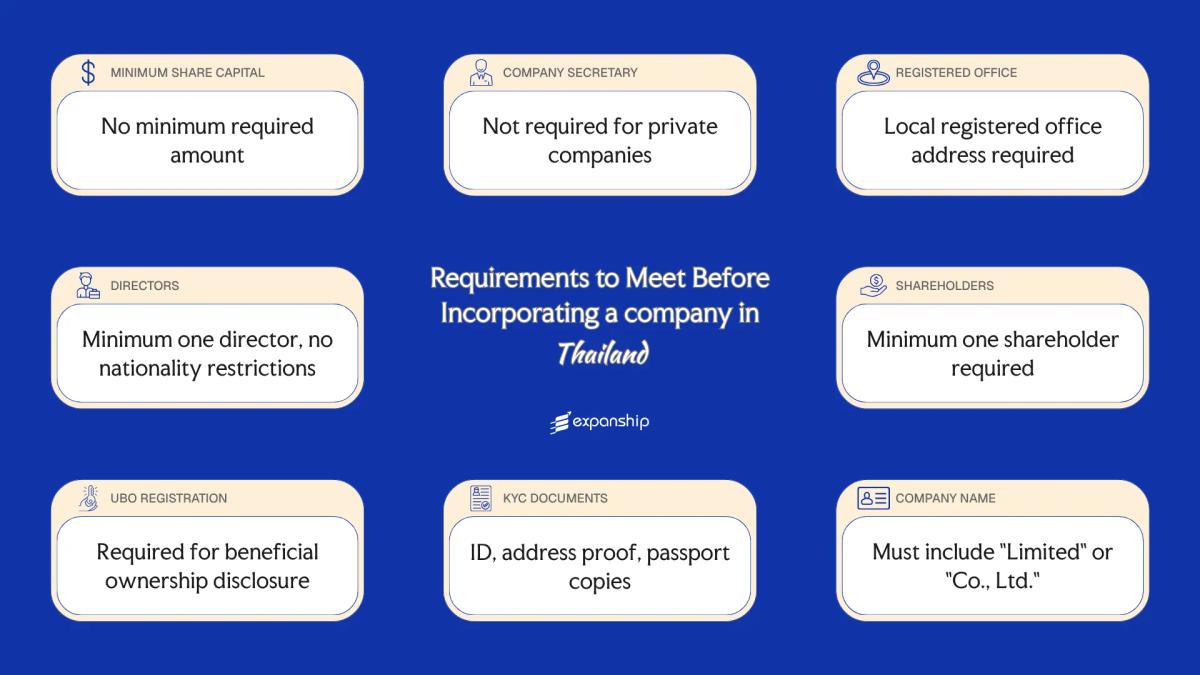
Company formation in Thailand is governed by the Civil and Commercial Code, with the Department of Business Development (DBD) under the Ministry of Commerce serving as the primary registry for most private entities. Meeting the incorporation requirements in Thailand is a prerequisite to legal registration; failure to satisfy them results in rejection of the application or inability to obtain a business licence.
This article addresses structural, capital, personnel, and documentation requirements that apply across the formation process. Specific obligations vary depending on the entity type, the industry sector, and whether the business involves foreign ownership under the Foreign Business Act.
Foreign investors acquiring majority ownership, joint venture partners, and branch operators are among those most directly affected by these Thailand company registration requirements.
Minimum Share Capital Requirements in Thailand
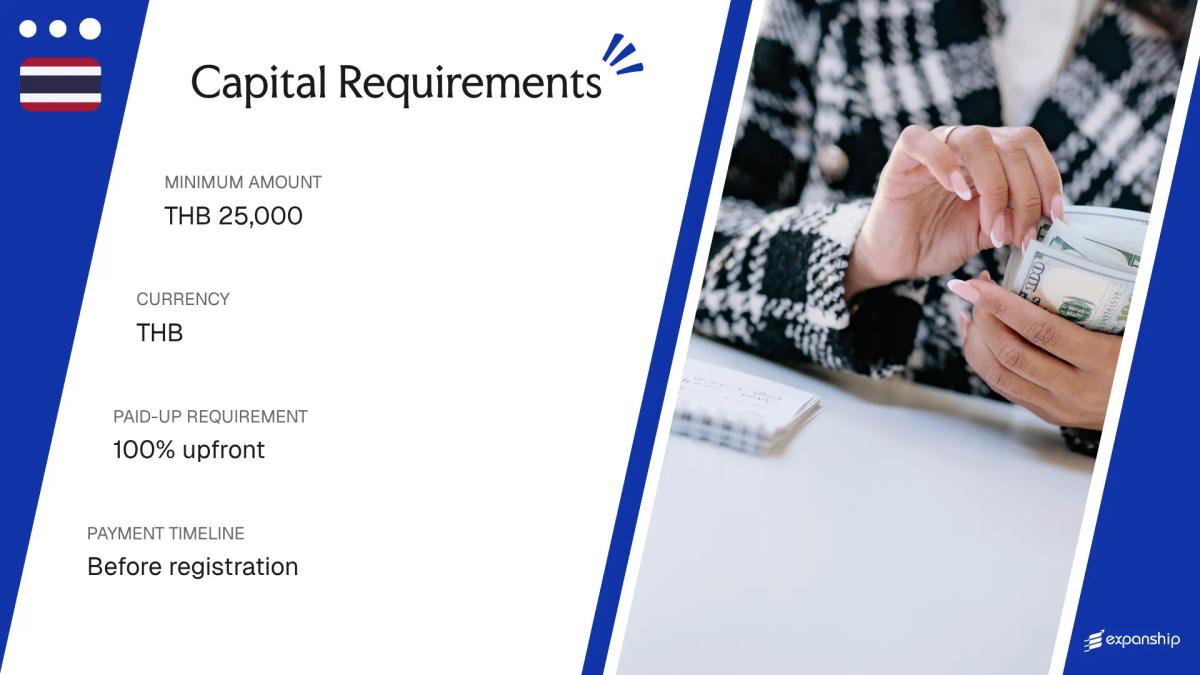
Under the Civil and Commercial Code of Thailand, a private limited company (บริษัทจำกัด) operates on a par value share system, meaning each share must have a defined face value. Thailand minimum share capital requirements are not set at a fixed statutory minimum for most private limited companies, though in practice the Department of Business Development (DBD) under the Ministry of Commerce oversees registration and reviews capital adequacy.
Registered capital must be divided into equal-value shares, with each share carrying a par value of at least 5 Thai Baht. At least 25% of the total registered capital must be paid up at the time of incorporation, with no mandatory requirement to deposit funds into a dedicated escrow or blocked account verified by a bank prior to registration.
| Parameter | Detail |
|---|---|
| Minimum Authorized Share Capital | No statutory minimum for most private limited companies |
| Maximum Authorized Share Capital | No statutory maximum |
| Minimum Paid-Up Capital | No statutory minimum; 25% of registered capital must be paid up |
| Paid-Up Requirement at Incorporation | 25% of total registered shares must be paid up upon incorporation |
| Accepted Currency | Thai Baht (THB) |
| Accepted Forms of Contribution | Cash; non-cash contributions (property, assets) are permissible |
| Timeframe to Deposit Capital | No mandatory pre-incorporation bank deposit requirement |
If your entity requires a Foreign Business License under the Foreign Business Act B.E. 2542, minimum registered capital thresholds apply separately and are set by the DBD, not the Civil and Commercial Code.
Company Secretary Requirements in Thailand
Under the Civil and Commercial Code, private limited companies in Thailand are not required to appoint a company secretary. There is no statutory equivalent of a mandatory corporate secretary role for Thai limited companies at the private entity level.
Publicly listed companies registered under the Securities and Exchange Act are a different matter. The Securities and Exchange Commission (SEC) requires that listed firms appoint a qualified company secretary to support board governance and regulatory reporting obligations.
For entities subject to this requirement, the company secretary's duties include:
- Organising board meetings and shareholders' meetings in accordance with SEC rules
- Preparing and maintaining statutory records, including meeting minutes and director registers
- Coordinating disclosure filings submitted to the Stock Exchange of Thailand
- Advising the board on corporate governance obligations under SEC regulations
Qualification criteria for serving in this role include:
- Sufficient knowledge of securities law, corporate law, and accounting principles
- No prohibitions under SEC regulations that would disqualify the individual from holding the position
- Thai company secretaries may be an individual or, in some cases, a juristic person engaged to perform the function

Incorporate a Company in Thailand
Set up your business entity in Thailand with accurate filings, structural guidance, and ongoing compliance support.
Registered Office Requirements in Thailand
Registered office requirements in Thailand are governed by the Civil and Commercial Code, which mandates that every limited company maintain a registered address where official correspondence and government notices can be served. Non-compliance, including the use of an invalid or inaccessible address, can result in failed service of legal documents and potential penalties from the Department of Business Development (DBD) under the Ministry of Commerce.
- A physical address is required; P.O. boxes are not accepted as a registered office address.
- The address must be located within Thailand and correspond to the province stated in the company's memorandum of association.
- Virtual office addresses may be used, provided the provider can receive official correspondence and the address is a genuine, accessible location.
- No ownership of the premises is required, but a lease or written consent from the property owner is generally expected to support the address registration.
- The registered address is publicly listed on the DBD company registry and accessible through the DBD e-Service portal.
- Any change to the registered address must be formally notified to the DBD, typically through Form BorOrJor 5, within the prescribed timeframe.
Director Requirements in Thailand
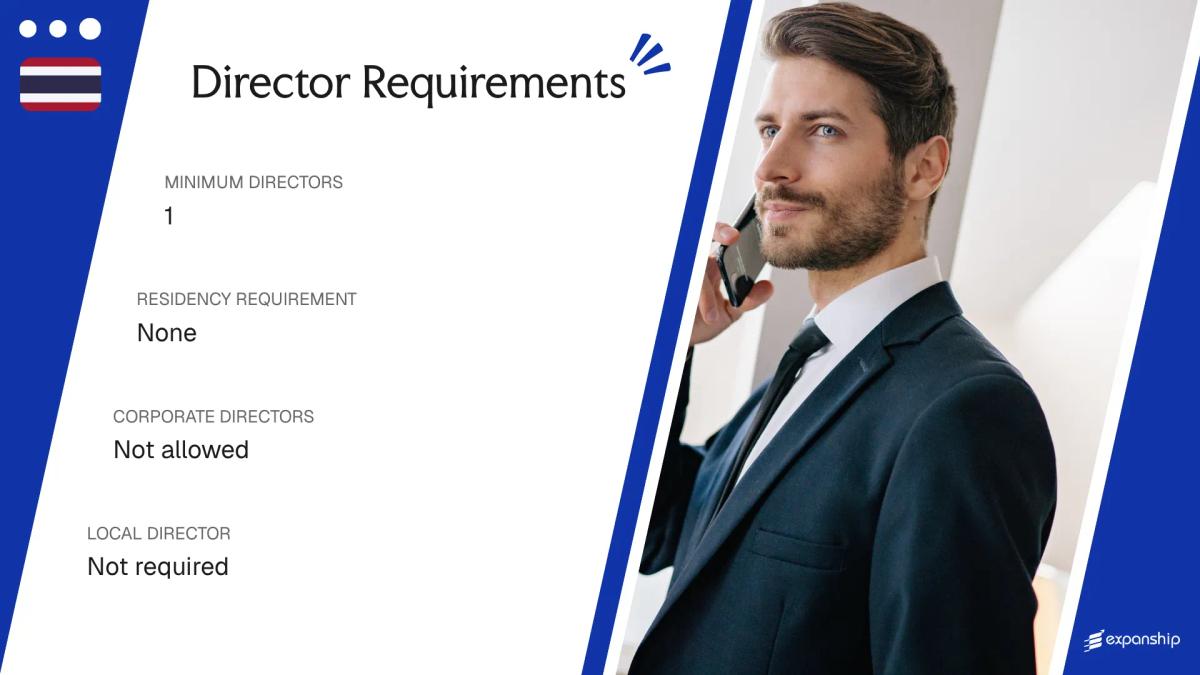
Under the Civil and Commercial Code (CCC) of Thailand, directors of a private limited company (บริษัทจำกัด) assume fiduciary duties to act in the best interests of the entity, with personal liability exposure for negligent or unlawful acts committed in the course of their duties.
| Parameter | Detail |
|---|---|
| Minimum Number of Directors | At least one director is required under the CCC. |
| Maximum Number of Directors | No statutory maximum; the articles of association govern this. |
| Local/Resident Director Required | No statutory requirement for a Thai-resident director. |
| Nationality Restrictions | No nationality restrictions apply; foreign nationals may serve as directors. |
| Minimum Age Requirement | Directors must have reached the age of legal majority, which is 20 years under Thai law. |
| Corporate Directors Permitted | Corporate directors are not permitted; only natural persons may serve. |
| Director Must Be a Shareholder | No statutory requirement for a director to hold shares in the company. |
| Publicly Listed on Registry | Director details are filed with the Department of Business Development (DBD) and form part of the public record. |
| Disqualification Conditions | A person adjudged incompetent or quasi-incompetent by a court, or who has been imprisoned for certain offences, may be disqualified from serving. |
Despite foreign nationals facing majority ownership restrictions under the Foreign Business Act B.E. 2542, there is no parallel restriction on serving as a director, meaning a foreign national can hold full directorial authority in a company where Thai shareholders hold the majority of shares.
Shareholder Requirements in Thailand
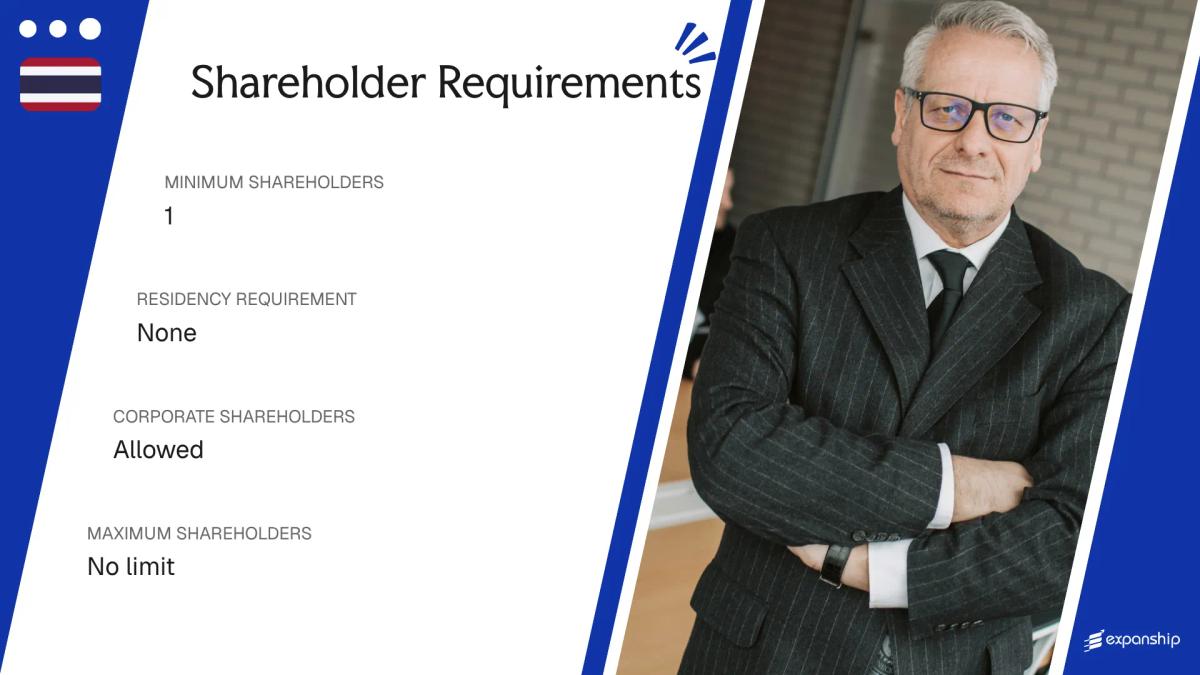
A Thai private limited company (บริษัทจำกัด) requires a minimum of three shareholders at all times, including at the time of incorporation. No sole shareholder structure is permitted, and there is no statutory maximum on shareholder numbers.
Nationality and Residency Restrictions
Shareholders are not required to be Thai nationals or residents. Under the Foreign Business Act B.E. 2542 (1999), foreign shareholders may face ownership restrictions in regulated sectors, where Thai nationals must collectively hold at least 51% of shares.
Corporate Shareholders
Corporate entities may hold shares in a Thai private limited company. No special conditions are imposed solely by virtue of a shareholder being a juristic person rather than an individual.
Shareholder Liability
Shareholder liability is limited to the amount remaining unpaid on their respective shares. Thai company law does not provide mechanisms to pierce the corporate veil under ordinary circumstances.
Register of Shareholders
A register of shareholders must be maintained at the company's registered office. This register is not publicly accessible by default, though it must be available for inspection by shareholders and presented during relevant filings with the Department of Business Development.
Set Up Your Shareholder Structure for a Thai Company
Get guidance on meeting the shareholder requirements when incorporating your business in Thailand.
UBO / Beneficial Ownership Disclosure Requirements in Thailand
Under Thailand's Anti-Money Laundering Act B.E. 2542 (1999) and subsequent amendments, beneficial ownership disclosure Thailand requirements apply primarily through the Department of Business Development (DBD) and the Anti-Money Laundering Office (AMLO). A beneficial owner is generally defined as a natural person who ultimately owns or controls 25% or more of the shares or voting rights in a legal entity.
- Identify all natural persons meeting the 25% ownership or control threshold within the company structure.
- Record beneficial ownership information in the company's internal register, maintained at the registered office.
- Submit UBO data to the DBD at the time of incorporation and upon any subsequent changes to ownership.
- Report beneficial ownership information to AMLO where the entity falls within a designated business or profession category.
| Parameter | Detail |
|---|---|
| Ownership Threshold for UBO Status | 25% of shares or voting rights |
| Filing Authority | Department of Business Development (DBD); AMLO for designated businesses |
| Disclosure Deadline at Incorporation | At the time of company registration |
| Publicly Accessible Register | No statutory public register |
| Penalties for Non-Disclosure | Fines under the Anti-Money Laundering Act; amount varies by violation |
| Ongoing Update Obligation | Required upon any change in beneficial ownership |
KYC / Document Requirements in Thailand
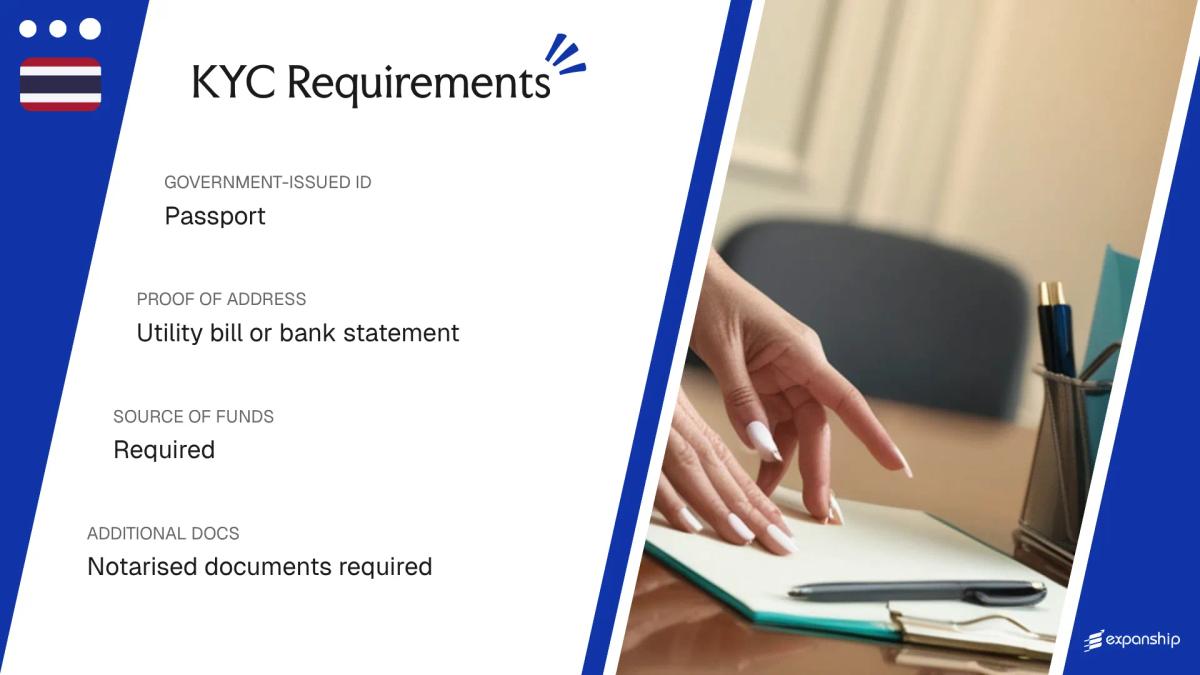
KYC document requirements Thailand are governed primarily by the Anti-Money Laundering Act B.E. 2542 (1999) and its amendments, administered by the AMLO.
Individual / Personal Documents
- Valid government-issued passport or national ID card for each individual director, shareholder, or beneficial owner
- Proof of residential address dated within three months, such as a utility bill or official bank statement
- A recent passport-sized photograph may be required by the Department of Business Development (DBD)
- Signed KYC declaration or customer due diligence form as specified by the registered agent or bank
Corporate Documents
- Certificate of incorporation or equivalent formation document for any corporate shareholder or director
- Constitutional documents, such as articles of association or memorandum, certified as current and valid
- Register of directors and register of shareholders from the corporate entity's home jurisdiction
- Proof of registered office address for the corporate entity, issued by a recognised authority
Source of Funds Documentation
- Bank statements covering a minimum of three to six months showing the origin of investment capital
- Audited financial statements or accountant-certified accounts where bank statements are insufficient
- A signed declaration of source of funds may be requested by the DBD or the opening bank
Notarisation and Apostille Requirements
- Foreign-issued documents generally require notarisation by a notary public in the country of origin
- Documents from non-Hague Convention countries must be legalised through the Thai embassy or consulate
- Official translations into Thai must be prepared by a certified translator and may require further attestation
Unsigned or uncertified translations of foreign corporate documents are among the most frequent causes of DBD registration delays.
Company Name Requirements in Thailand
Proposed company name requirements Thailand must be submitted to the Department of Business Development (DBD) for approval before registration proceeds. Names are assessed against an existing database to confirm they are not identical or confusingly similar to already-registered entities.
All company names must be written in Thai script. A private limited company must carry the suffix "บริษัท จำกัด" (or its transliteration, "Borisat Chamgat"), and a public limited company must use "บริษัท มหาชน จำกัด."
Certain words are prohibited without prior governmental authorization. Terms implying royal patronage, sovereign authority, or association with government bodies fall into a restricted category and require special clearance before use.
Name reservation is available through the DBD's online portal. A reserved name is valid for 30 days, during which the applicant must proceed with formal registration or the reservation lapses.
Compliance Services for Companies in Thailand
Ongoing compliance support for Thai-registered entities, covering annual filings, statutory obligations, and regulatory reporting requirements.
Conclusion
Thailand company incorporation requirements are defined primarily under the Civil and Commercial Code, with oversight from the Department of Business Development under the Ministry of Commerce. Meeting those requirements means satisfying rules across share capital, directorship, share ownership, registered office, and documentation before registration is granted.
Foreign equity restrictions remain one of the more consequential factors, given that the Foreign Business Act B.E. 2542 limits foreign ownership in many sectors to 49%. The minimum shareholder threshold of three promoters at the memorandum of association stage also distinguishes Thai incorporation procedure from many comparable jurisdictions.
Once these requirements are understood, the practical work of structuring an entity, preparing statutory documents, and engaging with the DBD begins.
Expanship's Corporate Services for Thailand Expansion
Forming a private limited company under the Civil and Commercial Code involves shareholder lists, director appointments, statutory meetings, and ongoing compliance filings with the Department of Business Development. Expanship's Thailand company formation services are structured to reduce the administrative load these requirements place on your team, particularly around document preparation and DBD submissions.
Our scope covers the full incorporation cycle and beyond:
- We prepare and file all registration documents with the DBD, including the Memorandum of Association and affidavits.
- A registered office address and agent are provided to satisfy Thailand's physical presence requirements.
- We liaise directly with government bodies, including the Revenue Department for tax registration.
- Post-incorporation obligations, such as annual balance sheet filings, are tracked and managed on your behalf.
- Banking introduction support is available to help your entity open a corporate account with a Thai financial institution.
Reach out to Expanship Thailand to discuss how we can support your market entry.
Frequently Asked Questions (FAQ)
Using Thai nationals as nominee shareholders to artificially meet the 51% local ownership requirement is a criminal offence under the Foreign Business Act B.E. 2542, carrying fines and potential imprisonment for both the nominee and the foreign party involved. The Department of Business Development (DBD) actively investigates nominee arrangements, particularly where Thai shareholders hold shares without corresponding economic benefit. Discovery can result in forced dissolution of the company in addition to criminal liability.
A foreign national can serve as a director of a Thai private limited company, including as the sole director, as Thai law imposes no nationality requirement on directors under the Civil and Commercial Code. However, if the director requires a work permit to perform their duties in Thailand, that authorisation must be obtained separately from the company registration process. Acting as a director in Thailand without a valid work permit is a violation of the Immigration Act B.E. 2522.
The THB 2 million registered capital threshold applies specifically to foreign-owned companies seeking a Foreign Business Licence under the Foreign Business Act, not to all Thai private limited companies generally. The Civil and Commercial Code does not impose a universal minimum capital requirement for private limited companies. BOI-promoted entities have their own capital conditions set on a project-by-project basis, which may exceed the Foreign Business Act threshold depending on the nature of the promoted activity.
The Department of Business Development requires certified copies of passports for foreign directors and shareholders, along with proof of address and, in some cases, notarised or apostilled supporting documents depending on the country of origin. Documents issued outside Thailand typically require authentication through the relevant Thai embassy or consulate, or via an apostille where Thailand's bilateral arrangements permit. Incomplete or improperly authenticated documents are a common cause of registration delays at the DBD.
A change of registered office address must be filed with the Department of Business Development within 14 days of the change taking effect, as required under the Civil and Commercial Code provisions governing company amendments. The updated address must still fall within Thailand and be capable of receiving official correspondence from the DBD and the Revenue Department. Failure to notify the DBD within the prescribed period can result in administrative penalties and discrepancies in official records used for tax and licensing purposes.
Thailand's beneficial ownership disclosure framework, introduced under anti-money laundering measures and operationalised through the DBD, requires companies to identify the natural persons who ultimately own or control the entity, regardless of the legal ownership structure on paper. This means a nominee arrangement designed to show majority Thai ownership for Foreign Business Act compliance purposes would still require disclosure of the foreign party as the true beneficial owner. The two frameworks operate simultaneously, and structuring ownership to satisfy one while obscuring the position under the other creates legal exposure under both regimes.
Legal Disclaimer
The information provided in this article is for general informational purposes only and does not constitute legal, tax, or professional advice. While we strive to ensure the accuracy and timeliness of the content, laws and regulations are subject to change, and the application of laws can vary widely based on specific facts and circumstances.
Readers should not act upon this information without seeking professional counsel tailored to their individual situation. Expanship and its authors disclaim any liability for actions taken or not taken based on the content of this article.
For specific advice regarding your business setup, compliance requirements, or any legal matters, please consult with qualified legal and tax professionals in the relevant jurisdiction.