

Key Takeaways
- Under the Foreign Business Act B.E. 2542 (1999), foreign investors in most service and trading activities cannot hold a majority stake without obtaining a Foreign Business License, which involves a lengthy and uncertain approval process administered by the DBD.
- Forming a private limited company in Thailand requires a minimum of three shareholders at all times, creating an ongoing structural obligation that can complicate ownership arrangements for small foreign-owned operations.
- Foreign entities are generally prohibited from owning land in Thailand, which limits the operational flexibility of businesses that require owned premises rather than leased arrangements.
- Work permit and visa requirements for foreign staff impose layered obligations on employers, including minimum capital thresholds and Thai-to-foreign employee ratios that must be maintained throughout the company's operation.
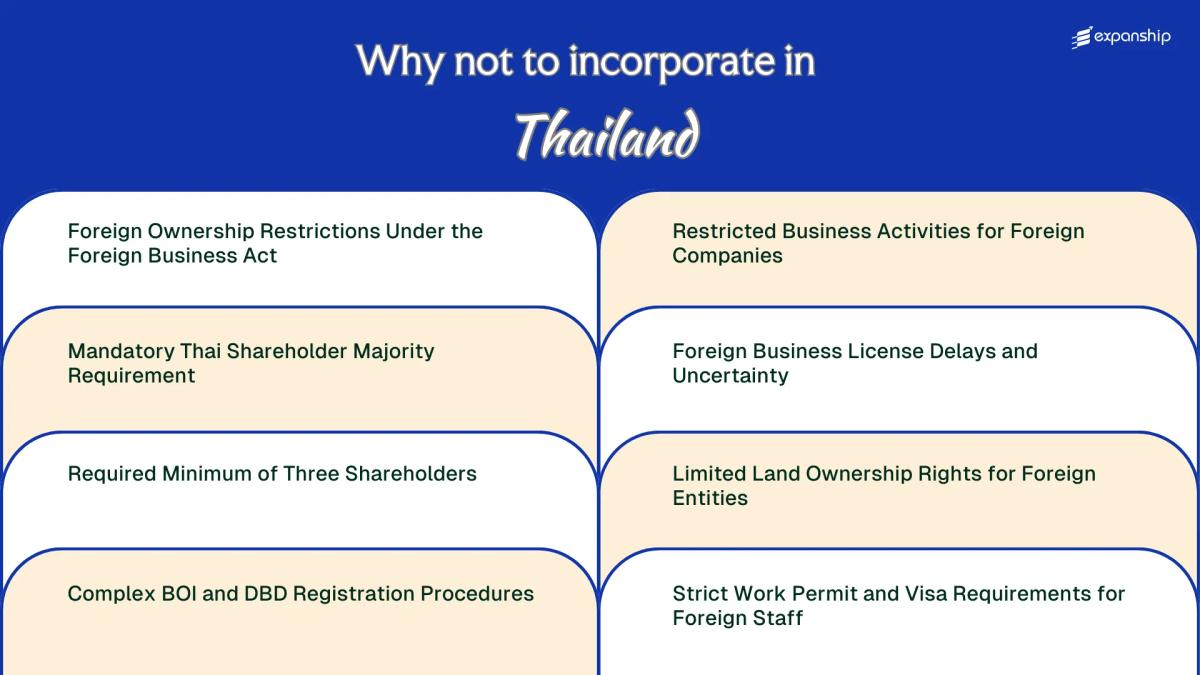
Thailand operates under a structured and closely regulated corporate framework, shaped primarily by the Foreign Business Act B.E. 2542 (1999) and administered through bodies such as the Department of Business Development (DBD) under the Ministry of Commerce. The disadvantages of incorporating in Thailand span ownership restrictions, licensing requirements, land rights, and staffing rules — each carrying distinct compliance obligations for foreign-owned entities.
How severely these drawbacks affect your business depends considerably on its structure, the industry it operates in, and the level of foreign participation involved. A purely service-based firm faces a different set of constraints than a manufacturing operation seeking BOI promotion.
This article is most relevant to foreign investors and multinational firms planning to establish an operational presence in Thailand, particularly those holding majority or full foreign ownership. For the governing corporate legislation, refer directly to the Foreign Business Act as published by the DBD.
Foreign Ownership Restrictions Under the Foreign Business Act
The Foreign Business Act (FBA), enacted as the Foreign Business Act B.E. 2542 (1999), is the primary statute governing what commercial activities foreign-owned entities may legally conduct in Thailand. Understanding the Foreign Business Act Thailand restrictions is foundational before committing capital or structure to any Thai entity.
Restricted Business Lists That Directly Limit Foreign Operations
The FBA divides restricted activities into three annexes. List 1 prohibits foreign participation entirely, covering activities such as rice farming, land trading, and forestry. Lists 2 and 3 allow foreign entry only with a Foreign Business License (FBL) issued by the Director-General of the Department of Business Development (DBD) or the Cabinet, depending on the category. Most services, retail, and trading activities fall within these lists, meaning your firm cannot simply register and operate without prior governmental approval.
Structural Exposure for Foreign Business Restrictions Thailand
Obtaining an FBL is not a formality. Approval timelines can extend beyond 60 days, and denial carries no automatic right of appeal through an expedited process. For businesses outside Board of Investment (BOI) promotion or Treaty of Amity protection, the FBA operates as a default barrier to majority foreign ownership across a wide range of sectors.
If your intended business activity appears in FBA Lists 2 or 3 and you lack BOI promotion or Treaty of Amity eligibility, operating without a Foreign Business License exposes your company to criminal penalties under Section 35 of the FBA, including fines and potential imprisonment of directors.
Mandatory Thai Shareholder Majority Requirement
The Thailand mandatory Thai shareholder requirement forces most foreign-owned companies to cede majority control before the business opens its doors. Under the Foreign Business Act B.E. 2542 (1999), foreigners are generally restricted to holding no more than 49% of shares in a Thai limited company, meaning at least 51% must be held by Thai nationals.
This structure means you do not control your own company. Decisions requiring a shareholder vote, including amendments to the articles of association, can be overridden by Thai shareholders whose interests may not align with yours.
Relying on nominee shareholders to satisfy this threshold carries significant legal risk. The DBD (Department of Business Development) and the Revenue Department actively scrutinize nominee arrangements, and structures found to circumvent the Foreign Business Act can result in company dissolution.
The practical burdens this creates include:
- Finding legally compliant Thai shareholders who are willing to hold a majority stake without acting as nominees
- Paying ongoing fees or structuring compensation arrangements to retain cooperative Thai shareholders
- Losing effective operational control if shareholder disputes arise, since Thai majority partners have the voting power to block or override decisions
- Restructuring ownership entirely if a Thai shareholder exits, which triggers DBD filings and potential regulatory review
BOI promotion can grant foreign majority or full ownership in qualifying industries, but eligibility is conditional and sector-specific, leaving most businesses without that option.

Company Incorporation in Thailand
Structure your Thailand entity correctly from the outset, with guidance on compliant ownership frameworks and DBD registration requirements.
Required Minimum of Three Shareholders
Under the Civil and Commercial Code, a Thai private limited company must be formed with a minimum of three shareholders at all times. The Thailand three shareholder minimum requirement applies not just at incorporation but throughout the life of the entity, meaning your shareholder count must remain at three or above continuously.
| Requirement | Threshold | Practical Burden |
|---|---|---|
| Minimum shareholders at incorporation | 3 | Solo founders and two-person partnerships cannot form a private limited company |
| Ongoing minimum during company life | 3 | If a shareholder exits, the structure falls below the legal threshold, triggering compliance exposure |
| Promoters required at formation stage | 3 | All three must sign the Memorandum of Association before registration with the Department of Business Development |
For a solo entrepreneur or a two-partner foreign venture, this threshold immediately creates a structural problem. A third shareholder must be found, often a nominee or a local contact, which introduces governance risk and complicates ownership arrangements.
Nominee shareholders are not legally prohibited under Thai company law, but they carry their own legal and practical risks that can undermine the integrity of your shareholding structure. The requirement to maintain three shareholders indefinitely also means that any departure, death, or dispute involving a shareholder can inadvertently put the company in breach of its registration obligations under the Civil and Commercial Code.
Complex BOI and DBD Registration Procedures
Thailand BOI DBD registration challenges stem from two parallel bureaucratic processes that operate under different ministries, each with its own documentation requirements, timelines, and approval conditions. Your business must satisfy both the Board of Investment under the Investment Promotion Act B.E. 2520 and the Department of Business Development under the Ministry of Commerce, and neither body coordinates approvals on your behalf.
BOI applications require detailed project proposals, capital expenditure commitments, and sector-specific eligibility criteria. Delays at this stage directly affect your ability to begin operations.
DBD registration for a limited company under the Civil and Commercial Code involves a separate filing sequence, including a memorandum of association registration, a statutory meeting, and final incorporation documents. Each step has a mandatory waiting period, which compounds total pre-operational timelines.
- BOI promotional privileges are conditional on meeting minimum investment thresholds and approved business activity categories
- DBD registration requires a registered address, memorandum of association, and minimum capital documentation before submission
- BOI approval does not automatically satisfy DBD requirements; both processes must be completed independently
- Errors in DBD filings require formal correction submissions, restarting portions of the registration queue
Even after receiving BOI approval, your company cannot legally commence business activities until the separate DBD incorporation process is fully completed and a tax ID is issued by the Revenue Department.
Restricted Business Activities for Foreign Companies
Restricted business activities for foreign companies in Thailand stem directly from the Foreign Business Act B.E. 2542 (1999), which divides prohibited and restricted sectors into three lists that categorically limit foreign participation.
Scope of the Restrictions Under the FBA
List One of the FBA contains absolute prohibitions — sectors such as rice farming, land trading, and Thai traditional medicine, where foreign entities cannot operate under any circumstances. Lists Two and Three cover businesses requiring a Foreign Business License (FBL) from the Department of Business Development, including service industries, retail trade, and construction, meaning your firm faces a structural ceiling before operations even begin.
Practical Burden on Foreign Business Owners
Securing an FBL is not a formality; approval is discretionary, timelines are unpredictable, and denial carries no obligation to provide detailed reasoning. Even businesses that fall outside List One face genuine uncertainty about whether their specific activity will be classified under a restricted category, creating material legal exposure during the pre-incorporation phase. Treaty-based exemptions under the US-Thailand Treaty of Amity offer a narrow carve-out, but only for American-owned entities.
Identifying Restricted Activities for Your Business in Thailand
Understand which FBA lists apply to your intended operations and what licensing obligations your structure may trigger before you commit to incorporation.
Foreign Business License Delays and Uncertainty
Thailand Foreign Business License delays present a significant operational risk, as the FBL approval process under the Foreign Business Act B.E. 2542 (1999) lacks a guaranteed timeline and can extend well beyond initial projections.
- Applications submitted to the Department of Business Development must pass through a cabinet-level review for certain business categories, meaning approval authority rests outside any single agency and creates unpredictable processing windows.
- The absence of a statutory deadline for FBL decisions forces your business to defer revenue-generating operations while awaiting an outcome with no confirmed date.
- FBL approval uncertainty in Thailand is compounded by the discretionary nature of the evaluation criteria, where authorities assess national interest and competitive impact on Thai businesses without published scoring standards.
- Approval rates for FBL applications are not publicly disclosed by the DBD, leaving applicants with no reliable benchmark to assess the probability of success before committing resources.
- Even approved licenses may attach conditions that restrict operational scope, limiting how your entity can actually function post-approval.
Limited Land Ownership Rights for Foreign Entities
Thailand land ownership restrictions for foreign entities are codified primarily under the Land Code Act B.E. 2497 (1954), which prohibits foreign nationals and foreign-majority companies from owning land freehold. For a foreign-owned business, this is not a procedural hurdle — it is a statutory ceiling on what your company can hold as a fixed asset.
A company in which foreign shareholders hold more than 49% of the shares is classified as a foreign entity under the Land Code and is therefore ineligible to register land title in its name. This directly limits your firm's ability to acquire premises, develop property, or use land as loan collateral.
Leasehold arrangements under the Civil and Commercial Code are capped at 30 years, with one possible renewal cycle. For businesses requiring long-term physical infrastructure, this tenure structure creates asset insecurity that affects long-term planning and financing.
Certain Board of Investment-promoted entities may access land ownership rights under the Investment Promotion Act B.E. 2520, but this applies only to promoted activities and specific project criteria — not to general commercial operations.
A foreign-majority manufacturing firm seeking to purchase a 2-rai industrial plot in Chonburi would be legally barred from holding title. Structuring the same acquisition through a 30-year lease with renewal terms adds legal overhead, limits mortgage eligibility, and reduces the asset's collateral value compared to freehold title held by a domestically owned company.
Strict Work Permit and Visa Requirements for Foreign Staff
Thailand work permit restrictions on foreign staff add a layer of operational friction that many business owners underestimate before establishing a presence in the country. Each foreign employee requires both a Non-Immigrant B visa and a separate work permit issued by the Department of Employment, and both must be obtained before legal employment begins.
Work permits are tied to a specific employer, a specific job title, and a specific work location. If your business relocates, restructures a role, or assigns an employee to a different site, the permit must be amended or reissued, creating recurring administrative overhead.
The staffing ratio requirement compounds this burden further. Under general rules, a company must maintain a minimum ratio of Thai employees to foreign workers, commonly cited as four Thai nationals per one foreign hire. For early-stage businesses with small headcounts, meeting this ratio restricts how many foreign specialists you can legally deploy.
Each permit application requires documentation including financial statements, company registration papers, and evidence of the employee's qualifications. Processing delays through the Department of Employment directly delay when a foreign hire can begin contributing to your operations.
The four-to-one Thai-to-foreign employee ratio applies per work permit issued, meaning your total number of legally employable foreign staff is directly capped by your Thai headcount at every stage of your company's growth.
Overcoming Thailand Incorporation Challenges
Overcoming Thailand incorporation challenges requires structural planning before registration, not adjustments made after problems arise. The Foreign Business Act, DBD registration requirements, and BOI eligibility criteria each impose conditions that must be addressed at the entity formation stage.
- Restructure shareholding to meet the 51% Thai national majority requirement under the Foreign Business Act before filing with the DBD.
- Apply for BOI promotion early if your business activity qualifies for foreign majority ownership exemptions under the Investment Promotion Act.
- Confirm whether your intended activity appears on the FBA's restricted lists and obtain a Foreign Business License prior to commencing operations.
- Ensure your company meets the minimum three-shareholder requirement at incorporation and maintain compliant shareholder records with the DBD.
- Structure visa and work permit applications in alignment with the minimum capital-per-foreign-employee ratio set by the Department of Employment.
These steps address discrete regulatory requirements, each governed by a separate statutory authority with its own timelines and criteria. Compliance across all of them simultaneously is a substantive administrative undertaking with no guaranteed outcome on any single application.
Thailand's Overall Investment Appeal
Thailand's investment appeal is real, but it comes with structural constraints that make it unsuitable for every foreign business model. The Thailand investment risks and limitations covered in this blog are not incidental frictions — several are embedded in primary legislation, including the Foreign Business Act B.E. 2542 and the Land Code Act. That said, the country's strategic location, established manufacturing base, and bilateral trade agreements continue to attract foreign capital across multiple sectors.
| Pros | Cons |
|---|---|
| Strategic Southeast Asian location with access to ASEAN markets | The Foreign Business Act restricts foreign equity to 49% across a wide range of activities |
| BOI promotion available in targeted industries, offering tax holidays and foreign ownership exceptions | BOI and DBD registration involve multi-agency procedures with uncertain timelines |
| Established legal framework for corporate registration through the Department of Business Development | A minimum of three shareholders is required, adding structural complexity for small teams |
| Well-developed export infrastructure and industrial estate network | Foreign entities cannot own land outright under the Land Code Act |
| Bilateral investment treaties with multiple countries offering some investor protections | Work permit and visa conditions for foreign staff are tied to strict employee-to-permit ratios |
Foreign Business License applications reviewed by the Foreign Business Committee carry no fixed approval timeline, and outcomes remain discretionary.
Compliance Services for Companies in Thailand
Meet your ongoing statutory obligations in Thailand, from annual filings and accounting requirements to corporate maintenance under the Department of Business Development.
Conclusion
The cons of Thailand company formation are well-documented: the Foreign Business Act B.E. 2542 restricts foreign equity in most sectors to 49%, and satisfying the Thai majority shareholder requirement while maintaining genuine operational control remains a structural difficulty for foreign investors. Delays under the Foreign Business License process add further uncertainty to entry timelines. These are not incidental friction points but embedded features of the regulatory framework. Knowing where the constraints apply, and how they interact, determines whether a given corporate structure can function as intended under Thai law.
Expanship's Thailand Expansion Services
Thailand company formation compliance services involve real regulatory weight — from Foreign Business Act restrictions and mandatory Thai shareholder structures to BOI and DBD registration procedures that demand precise documentation. Expanship works alongside your business to manage the operational burden these requirements place on foreign investors, helping you stay organised and compliant without taking on the full complexity alone.
Our service scope covers the practical steps that accompany incorporation in Thailand.
- We prepare and file all company registration documentation with the Department of Business Development.
- A registered agent and local office address are provided to satisfy statutory presence requirements.
- We liaise directly with government bodies, including the DBD and BOI where applicable.
- Post-incorporation compliance obligations are tracked and managed on your behalf.
- Banking introductions are facilitated to help your entity establish a local account.
- Tax registration and coordination with the Revenue Department are handled as part of the setup process.
Reach out to Expanship Thailand to discuss your incorporation requirements.
Frequently Asked Questions (FAQ)
The restrictions vary depending on which list your business activity falls under. The Foreign Business Act categorizes restricted activities across three lists, with List 3 covering the broadest range of service and commercial activities most commonly pursued by foreign investors. Some activities are entirely prohibited for foreign ownership, while others may qualify for exemptions through Board of Investment (BOI) promotion or a Foreign Business License.
Using nominee shareholders to artificially satisfy the Thai majority requirement is illegal under the Foreign Business Act and can result in criminal prosecution, fines, and forced dissolution of the company. The Department of Business Development (DBD) actively investigates ownership structures that appear designed to circumvent the law. Directors and shareholders involved can face personal liability, not just the entity itself.
The formal review period for a Foreign Business License application is up to 60 days from the date the application is accepted as complete by the DBD, but the process frequently extends longer due to requests for additional documentation or inter-agency consultation. There is no guaranteed approval, and the DBD retains broad discretionary authority to reject applications. Uncertainty over the outcome makes it a poor foundation for time-sensitive market entry plans.
Thailand requires a minimum of three shareholders at the time of incorporation for a private limited company, which is more restrictive than many comparable jurisdictions that allow single-member companies. This requirement applies throughout the life of the company, not just at formation, meaning you must maintain that minimum at all times. Dropping below three shareholders without rectifying the situation can expose the company to legal challenges regarding its valid existence.
Generally, no. Foreign-owned companies, particularly those where foreign shareholding exceeds 49%, are prohibited from owning land under the Land Code Act. A company with majority Thai ownership can technically hold land, but regulatory authorities scrutinize such structures carefully if foreign investors appear to be the true beneficiaries. This restriction has direct implications for businesses in hospitality, real estate development, and manufacturing that require secure land tenure.
Thailand applies a four-to-one ratio, requiring a company to employ at least four Thai nationals for every one foreign national who holds a work permit. This ratio must be maintained on an ongoing basis, and failure to meet it can result in the work permit being denied or revoked. For early-stage businesses with small headcounts, meeting this threshold before the foreign founders or key staff can legally work in Thailand creates a genuine operational bottleneck.
BOI promotion can grant exemptions from the foreign ownership caps in the Foreign Business Act for qualifying activities, allowing 100% foreign ownership in promoted categories. However, BOI promotion is not available for all business types and comes with its own conditions, including minimum investment thresholds, reporting obligations, and requirements to operate within promoted industries. Approval is not automatic, and the application and compliance process adds a layer of regulatory engagement that smaller businesses may find disproportionately demanding.
Legal Disclaimer
The information provided in this article is for general informational purposes only and does not constitute legal, tax, or professional advice. While we strive to ensure the accuracy and timeliness of the content, laws and regulations are subject to change, and the application of laws can vary widely based on specific facts and circumstances.
Readers should not act upon this information without seeking professional counsel tailored to their individual situation. Expanship and its authors disclaim any liability for actions taken or not taken based on the content of this article.
For specific advice regarding your business setup, compliance requirements, or any legal matters, please consult with qualified legal and tax professionals in the relevant jurisdiction.