

Key Takeaways
- Thailand's standard corporate income tax rate of 20 percent, combined with Board of Investment promotion tiers that can reduce that burden to zero for qualifying activities, gives incorporated entities a structurally lower effective tax cost than the headline rate suggests.
- Foreign-owned businesses can access majority or full ownership structures in Thailand through specific pathways that work within the Foreign Business Act B.E. 2542 (1999), making legal operational control achievable rather than simply theoretical.
- With over 61 double tax agreements in force, an entity incorporated in Thailand can materially reduce withholding tax exposure on cross-border income flows, directly improving capital efficiency for businesses operating across multiple jurisdictions.
- Formal company registration through the Department of Business Development under the Ministry of Commerce places a Thai Limited Company within a governed compliance framework that supports credibility with ASEAN trading partners and treaty-jurisdiction counterparties alike.
Situated in Southeast Asia, Thailand is an independent constitutional monarchy and a founding member of ASEAN. Company registration is administered by the Department of Business Development (DBD), operating under the Ministry of Commerce. Foreign businesses most commonly establish operations through a Thai Limited Company. The country operates a territorial-based corporate tax system, applying tax primarily to income sourced within its borders. Openness to foreign direct investment varies by sector, with restrictions codified under the Foreign Business Act B.E. 2542 (1999), though several pathways exist for foreign-owned entities to operate legally and hold majority stakes under the right conditions.
Across manufacturing, services, technology, and trade, foreign capital has consistently entered the market through formally registered entities. The benefits of incorporating in Thailand extend across tax policy, workforce access, treaty networks, and regional connectivity. This article examines those advantages in detail to help your business assess whether establishing a presence here aligns with your operational and commercial objectives.
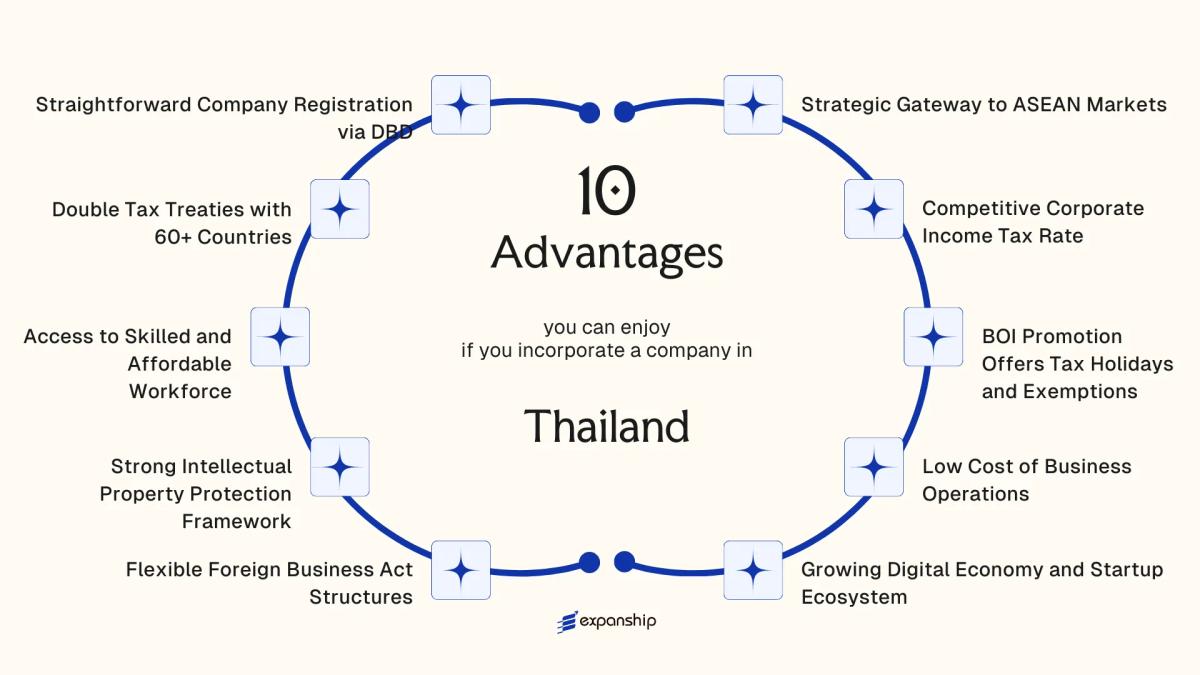
Strategic Gateway to ASEAN Markets
Thailand's geographic position at the center of mainland Southeast Asia makes it a functional base for reaching the broader ASEAN bloc, a combined market of over 670 million people with a GDP exceeding USD 3.6 trillion.
Regional Connectivity That Translates to Commercial Reach
Situated at the intersection of the Greater Mekong Subregion, your company gains overland access to Myanmar, Laos, Cambodia, and Malaysia, plus strong maritime and air connectivity toward Vietnam, Indonesia, and the Philippines. This physical reach is reinforced by ASEAN Free Trade Area commitments, under which tariffs on most goods traded between member states have been reduced to zero or near-zero.
As a signatory to the ASEAN Economic Community framework, goods, services, and investment flows operate under a more integrated regulatory structure than most other regional blocs offer at a comparable economic scale.
What ASEAN Membership Means for a Foreign-Owned Entity
A company incorporated in Thailand can access preferential trade terms negotiated collectively by ASEAN, including agreements with China, Japan, South Korea, India, and Australia under ASEAN+1 Free Trade Agreements. That network of agreements would otherwise require separate bilateral negotiations.
Regional supply chains routed through a Thai entity can qualify for these preferential tariff rates, provided rules-of-origin requirements under each relevant agreement are satisfied.
A Thailand-incorporated entity can serve as your regional holding or distribution point, accessing ASEAN preferential trade terms without requiring separate incorporation in each member state.
Competitive Corporate Income Tax Rate
Thailand's standard corporate income tax (CIT) rate is 20%, applied to net profits under the Revenue Code. For foreign companies assessing regional options, this positions the country competitively against markets like India (25–30%) and Japan (23.2% national rate, plus local levies). The Thailand corporate income tax rate advantages become particularly visible when you factor in reduced rates available to qualifying entities under the Revenue Code's tiered structure.
Small and medium-sized companies with paid-up capital not exceeding THB 5 million and net profits below THB 3 million are subject to reduced CIT rates, which can lower the effective tax burden well below the standard 20%. This graduated structure means a newly established foreign-owned entity with modest initial profits may face a lower tax liability than a comparable business operating in Singapore (17%) would face once wealth and dividend taxes are considered in full-stack comparisons.
The reduced rate structure benefits foreign businesses in practical ways:
- Net profit thresholds are defined in absolute figures, giving predictability when projecting post-tax returns
- Paid-up capital eligibility criteria align with the typical capital requirements for a Thai limited company registration
- The thresholds are codified in the Revenue Code, reducing interpretive ambiguity for tax planning purposes
Branches of foreign corporations are also subject to the standard 20% CIT rate on Thailand-sourced profits, with an additional remittance tax of 10% on profits transferred abroad, a factor to account for in structuring decisions.

Incorporate Your Company in Thailand
Set up a Thai limited company or BOI-registered entity with full support from entity structuring through Revenue Department registration.
BOI Promotion Offers Tax Holidays and Exemptions
Thailand BOI promotion tax holidays benefits draw significant attention from foreign investors seeking to reduce their initial tax burden during the early years of operation. The Board of Investment, operating under the Investment Promotion Act B.E. 2520, grants promoted companies corporate income tax exemptions of up to eight years, depending on the activity category and zone in which the business operates. For capital-intensive or technology-driven projects, this directly means years of profit retention without the drag of corporate tax, accelerating the return on your initial investment.
Eligibility is tied to the BOI's activity classification system, which groups qualifying businesses across categories such as advanced manufacturing, digital services, biotechnology, and regional headquarters operations.
| Zone | CIT Exemption Period | Additional Period (Promoted Activities) |
|---|---|---|
| Zone 1 (Bangkok & vicinity) | Up to 3 years | Possible extension based on activity |
| Zone 2 (Intermediate provinces) | Up to 7 years | Possible extension based on activity |
| Zone 3 (Targeted provinces) | Up to 8 years | Possible extension based on activity |
Beyond the CIT holiday, a promoted entity receives exemptions on import duties for machinery and raw materials used in export production. Your firm also gains permission to own land, which foreign-owned companies ordinarily cannot do under the Land Code. These non-tax benefits carry real operational weight, particularly for manufacturers and exporters structuring their regional supply chains through a Thai entity.
Low Cost of Business Operations
Running a company in Southeast Asia carries significant cost variation across borders, and low business operating costs in Thailand give foreign-owned entities a measurable financial advantage from day one. Office space in Bangkok's secondary business districts runs considerably below comparable space in Singapore or Kuala Lumpur, and outside the capital, costs drop further.
Utility rates, logistics fees, and general administrative overhead are governed by domestic pricing structures that remain modest relative to most developed markets. For a foreign firm establishing regional operations, this translates directly into lower monthly burn rates before a single product ships or service is billed.
Commercial lease agreements in Thailand follow standard contract law under the Civil and Commercial Code, which provides predictable terms without requiring specialist legal structuring. Registered office services and co-working arrangements are also widely available, allowing newly incorporated entities to establish a legal address at low cost while office costs remain contained.
Keep these points in mind:
- Operating costs vary significantly between Bangkok and provincial locations
- The Civil and Commercial Code governs standard lease terms
- Foreign Business Licenses may affect which service categories your firm can directly operate
- Cost projections should account for mandatory social security contributions under the Social Security Act B.E. 2533
Manufacturing firms promoted by the BOI can import machinery duty-free, which can reduce initial capital expenditure by a material amount that most cost comparisons overlook entirely.
Growing Digital Economy and Startup Ecosystem
Thailand's digital economy benefits for startups extend well beyond general market access. The National Digital Economy and Society Commission (NDESCC) oversees a formal agenda under the Digital Economy Promotion Act, which creates structured pathways for tech-oriented companies to operate with government backing rather than navigating an informal ecosystem.
Eastern Economic Corridor as a Digital Base
The Eastern Economic Corridor (EEC) designates specific zones — including the EECd digital zone — where qualifying digital businesses receive facilitated licensing, infrastructure support, and expedited regulatory processing. For a foreign-owned firm, this means reduced administrative friction when establishing operations in data, software, or platform-based sectors. The EEC Digital Industry Promotion is administered through the EEC Office, giving your business a single point of contact for approvals that would otherwise involve multiple agencies.
DEPA and Structured Support for Tech Firms
The Digital Economy Promotion Agency (DEPA) offers funding instruments, including matching grants and co-investment schemes targeted at digital startups and scaleups operating in Thailand. Access to DEPA programs can materially reduce your early-stage costs in a jurisdiction where operational expenses are already below regional peers like Singapore or Hong Kong. Eligibility generally requires registration as a juristic entity under Thai law and demonstration of a qualifying digital business activity, making incorporation a prerequisite rather than an option.
Unlock Thailand's Digital Economy Advantages for Your Business
Speak with our specialists to understand which programs, zones, and structures align with your digital or tech-focused incorporation in Thailand.
Flexible Foreign Business Act Structures
The Foreign Business Act B.E. 2542 (1999) restricts foreign-owned entities from operating in certain business categories, but it also creates structured pathways that, when used correctly, give foreign investors meaningful operational flexibility.
- A Foreign Business License (FBL) issued by the Foreign Business Committee allows a majority foreign-owned company to operate in List 2 or List 3 restricted activities. This means your firm is not automatically barred from sectors like retail, construction services, or certain professional services — it can qualify with the right application.
- US-incorporated entities benefit from the Treaty of Amity and Economic Relations between Thailand and the United States. Under this treaty, American companies can hold majority or full ownership in most business categories without requiring an FBL, a structural advantage not available to most other foreign nationalities.
- A Board of Investment-promoted entity can receive relaxed foreign ownership permissions in approved industries, making BOI promotion an indirect mechanism for bypassing standard FBA ownership caps.
- The 49% foreign ownership default under a Thai limited company still permits full operational control through shareholder agreements and preference share structures, provided these arrangements comply with the Department of Business Development's nominee shareholder prohibitions.
Strong Intellectual Property Protection Framework
Thailand intellectual property protection benefits businesses that hold patents, trademarks, or copyrights, primarily because enforcement sits within a dedicated legal structure rather than general civil courts. The Intellectual Property and International Trade Court (IP&IT Court), established under the Act for the Establishment of and Procedure for Intellectual Property and International Trade Court B.E. 2539 (1996), handles IP disputes with judges who carry subject-matter specialization. This reduces the time and unpredictability typically associated with IP litigation in generalist court systems.
The Department of Intellectual Property (DIP), under the Ministry of Commerce, administers trademark and patent registrations. Thailand is a member of the Paris Convention and the Berne Convention, meaning IP rights registered domestically carry reciprocal recognition across member states. For a foreign firm holding proprietary technology or brand assets, this treaty membership reduces the cost of multi-jurisdictional protection.
Trademark registration in Thailand grants an initial 10-year protection period, renewable indefinitely, with rights enforceable against infringing third parties through both civil and criminal channels.
A foreign technology firm registering a trademark and utility patent through the DIP gains enforceable rights across all Paris Convention member countries — over 170 jurisdictions — without filing separate applications in each, significantly reducing global IP management costs.
Access to Skilled and Affordable Workforce
Thailand skilled affordable workforce advantages are well-documented across manufacturing, technology, finance, and professional services sectors. The country produces over 300,000 university graduates annually, with significant output from engineering, IT, and business disciplines.
Minimum wage rates vary by province, ranging from approximately 330 to 370 THB per day as set by the Wage Committee under the Labour Protection Act B.E. 2541. For foreign firms hiring locally, this translates into substantially lower payroll costs compared to regional peers such as Singapore or South Korea, without a proportional reduction in technical competency.
The Board of Investment (BOI) actively supports firms in promoted industries to bring in foreign specialists, which complements local hiring rather than substituting it. This gives your business access to a mixed talent structure that suits both operational and senior management needs.
- Engineering and manufacturing talent is concentrated in the Eastern Economic Corridor (EEC), particularly in Chonburi and Rayong provinces.
- Bangkok hosts a growing pool of bilingual professionals across fintech, legal, and digital marketing functions.
- Vocational training is administered through the Department of Skill Development under the Ministry of Labour, producing trade-certified workers in targeted industries.
Work permit and foreign employee ratio rules under the Foreign Business Act and Labour Protection Act apply to your firm's headcount structure, and these limits affect how many expatriate staff you can legally employ relative to Thai nationals.
Double Tax Treaties with 60+ Countries
Thailand double tax treaty benefits for businesses stem from one of the more extensive DTA networks in Southeast Asia. As of current records, the country has concluded double taxation agreements with over 60 treaty partners, including major economies such as the United States, the United Kingdom, Germany, Japan, China, Singapore, and Australia.
Reduced Withholding Tax Rates
Without a DTA in place, dividends, interest, and royalties paid to foreign recipients are subject to a standard 15% withholding tax under the Revenue Code. Treaty provisions frequently reduce these rates — in some cases to 10% on dividends and 10–15% on royalties, depending on the specific agreement. For a foreign parent company receiving income from a Thai subsidiary, the difference in retained earnings across multiple distributions is material.
Elimination of Double Taxation
Each agreement follows one of two methods to prevent the same income from being taxed twice: the exemption method or the credit method. Your home jurisdiction's tax authority will generally accept Thai taxes paid as a credit or exempt the income, depending on which mechanism the applicable treaty prescribes. This directly affects your effective tax rate on repatriated profits.
Treaty Benefits for Common Business Structures
The practical scope of these agreements extends to:
- Permanent establishment definitions that limit Thai tax exposure for foreign service providers
- Capital gains provisions that, in select treaties, exempt gains on share disposals from Thai tax
- Reduced withholding on technical service fees where the treaty classifies them as business profits rather than royalties
Eligibility for treaty benefits requires that your entity qualifies as a tax resident of the relevant treaty partner country under that agreement's residency article.
Straightforward Company Registration via DBD
Registering a private limited company through the Department of Business Development (DBD) is one of the more accessible incorporation processes in Southeast Asia, and the Thailand DBD company registration advantages are partly structural. The DBD, which operates under the Ministry of Commerce, provides an online registration portal that allows the formation of a Thai private limited company (บริษัทจำกัด) without requiring in-person attendance at a ministry office in every case.
A private limited company requires a minimum of three promoters to sign the memorandum of association and a minimum registered capital that, while not fixed by statute for most activities, is set at THB 2 million for companies employing foreign nationals under work permit rules. This threshold is predictable, which allows you to plan capital requirements before filing rather than discovering them mid-process.
The DBD issues a company registration certificate and tax identification number within a defined processing period, typically within a few business days for straightforward applications. Receiving both the juristic person registration and the tax ID through a single administrative process reduces the number of agencies you must engage at the formation stage.
Key procedural advantages of DBD incorporation include:
- Online filing is available through the DBD e-Registration system for core formation documents
- The memorandum of association and articles of association follow standardized formats, reducing drafting complexity
- A registered company receives a 13-digit juristic person ID that serves across multiple regulatory filings
- Statutory books and share registers can be maintained digitally under updated DBD regulations
Why Thailand Stands Out Among Asian Business Hubs
Chosen for comparison are Singapore, Malaysia, and Vietnam — three jurisdictions that consistently appear on the shortlist of foreign investors evaluating an ASEAN base. Each targets a broadly similar investor profile: regionally oriented businesses seeking a combination of tax efficiency, operational cost control, and market access. Placing these four side by side shows where the distinctions are structural rather than marginal.
What the comparison surfaces is not simply a cost differential. The BOI promotion framework, the network of double tax agreements, and the Foreign Business Act's conditional market access provisions together create a layered regulatory environment that differs meaningfully from the more binary permit structures in Vietnam or the stricter foreign equity caps applied in certain Malaysian sectors. Singapore remains the regional benchmark for regulatory transparency, but its cost base is substantially higher across most operational parameters.
| Parameter | Thailand | Singapore | Malaysia | Vietnam |
|---|---|---|---|---|
| Standard Corporate Income Tax Rate | 20% | 17% | 24% | 20% |
| BOI / Investment Incentive Body | BOI (Board of Investment) | EDB | MIDA | MPI |
| Tax Holiday Availability | Up to 8 years (BOI-promoted) | Selective (Pioneer Status) | Up to 10 years (Pioneer Status) | Up to 4 years (Investment Law) |
| Double Tax Treaty Network | 60+ countries | 90+ countries | 70+ countries | 80+ countries |
| Foreign Equity Restriction Framework | Foreign Business Act (FBA) | Minimal restrictions | Selective sector caps | Sector-specific licensing |
| Minimum Paid-Up Capital (Foreign Company) | THB 2 million (general) | SGD 1 (no minimum) | MYR 1 (no minimum) | VND 0 (activity-dependent) |
Compliance Services for Companies in Thailand
Stay aligned with Thai regulatory requirements, from annual filings with the Department of Business Development to BOI reporting obligations and corporate tax submissions.
Conclusion
Thailand's position as an incorporated business destination rests on a combination of structural tax advantages and institutional frameworks that are uncommon at this income level. The benefits of incorporating in Thailand are most visible in the convergence of Board of Investment tax holidays, a network of over 61 double tax agreements, and a standard corporate income tax rate of 20 percent — each underpinned by enforceable regulatory mechanisms through bodies like the Revenue Department and the Department of Business Development.
For businesses with export ambitions or regional supply chains, the ASEAN market access and the treaty network carry particular weight. Your entity's effective tax burden can be reduced substantially depending on BOI promotion tier and treaty jurisdiction, which directly affects capital efficiency over the medium term.
The right fit still depends on your industry classification under the Foreign Business Act B.E. 2542, your intended ownership structure, and whether your activities qualify for BOI promotion under the Thailand Plus incentive scheme. A manufacturing firm and a digital services company face materially different regulatory entry points, and the advantages of setting up a business in Thailand apply differently across those profiles. Understanding which framework governs your specific activity determines how much of the available benefit structure you can access from the outset.
Start Your Thailand Company Formation With Expanship Today
Starting a Thailand company formation with Expanship means working with a firm that understands the full regulatory picture — from choosing between a Thai Limited Company and a Board of Investment-promoted entity, to meeting the Department of Business Development's ongoing disclosure requirements. Each structural and compliance decision covered in this blog has direct consequences for your timeline, tax position, and operational flexibility.
Expanship's services across the Thai incorporation process include:
- Preparation and notarization of Memorandum of Association, Articles, and shareholder documentation
- Registered office address and statutory agent provision in Thailand
- Filing and liaison with the Department of Business Development and the Revenue Department
- BOI application support and post-promotion compliance tracking
- Post-incorporation obligations including annual balance sheet filing and auditor coordination
- Banking introduction assistance with locally active financial institutions
Expanship Thailand is available to discuss your specific incorporation requirements.
Frequently Asked Questions (FAQ)
The standard corporate income tax rate is 20% on net profit, applied under the Revenue Code. Small and medium-sized enterprises with paid-up capital not exceeding THB 5 million may qualify for reduced rates on lower profit brackets. These reduced rates are set by ministerial regulation and are subject to periodic review.
Registration with the Department of Business Development (DBD) typically takes one to three business days for a private limited company once all required documents are submitted correctly. The process includes reserving a company name, filing a memorandum of association, and registering the entity. Delays generally arise from incomplete documentation or the need for notarisation of foreign-issued identity documents.
BOI-promoted entities can receive corporate income tax exemptions for periods ranging from three to eight years, depending on the activity category and investment zone. Certain promoted businesses located in designated special economic zones or lower-income provinces may qualify for extended exemption periods. Import duty exemptions on machinery and raw materials are also available under BOI promotion, subject to the specific conditions outlined in each promotion certificate.
Yes, withholding tax rates on dividends, interest, and royalties paid to foreign residents can be reduced under Thailand's double tax agreements, which cover over 60 countries. The applicable rate depends on the specific treaty with the recipient's country of residence; standard domestic withholding tax on dividends is 10%. A company must obtain a tax residency certificate from the relevant foreign authority and submit it to the Thai Revenue Department to claim treaty benefits.
Operating in a restricted category under List 2 or List 3 of the Foreign Business Act without a Foreign Business Licence is a criminal offence under Thai law, carrying penalties that include fines and potential imprisonment for responsible persons. The DBD and relevant authorities have the power to order the cessation of operations. Any contracts entered into in connection with unlicensed restricted activities may also be unenforceable.
There is no statutory requirement for a foreign director to be physically resident in Thailand, but at least one director must be available to sign documents and fulfil local compliance obligations. Practically, having at least one locally resident director facilitates dealings with the DBD, the Revenue Department, and the Social Security Office. For BOI-promoted entities, there may be additional conditions regarding local presence or reporting tied to the promotion certificate.
IP rights registered with the Department of Intellectual Property (DIP) are enforceable under the Trademark Act B.E. 2534, the Patent Act B.E. 2522, and the Copyright Act B.E. 2537. Rights holders can pursue civil and criminal remedies through Thai courts, and the DIP operates border measures in coordination with customs authorities to intercept infringing goods. Enforcement outcomes vary by case complexity, and rights holders are advised to maintain active monitoring of the register to address conflicting applications early.
Legal Disclaimer
The information provided in this article is for general informational purposes only and does not constitute legal, tax, or professional advice. While we strive to ensure the accuracy and timeliness of the content, laws and regulations are subject to change, and the application of laws can vary widely based on specific facts and circumstances.
Readers should not act upon this information without seeking professional counsel tailored to their individual situation. Expanship and its authors disclaim any liability for actions taken or not taken based on the content of this article.
For specific advice regarding your business setup, compliance requirements, or any legal matters, please consult with qualified legal and tax professionals in the relevant jurisdiction.