
Key Takeaways
- Togo's business structures are governed by the OHADA Uniform Act on Commercial Companies and Economic Interest Groups, a supranational framework binding across all 17 OHADA member states rather than domestic legislation alone.
- The SARL is the most commonly registered entity in Togo due to its single-shareholder option and lower minimum capital requirements compared to the Société Anonyme.
- Company incorporation and registration formalities in Togo are processed through the Centre de Formalités des Entreprises (CFE), which serves as the country's single-window authority.
- Foreign businesses seeking market presence without committing to a permanent establishment typically establish a representative or liaison office as an initial entry structure.
Introduction to Entity Types in Togo
Togo is a West African nation bordered by Ghana, Benin, and Burkina Faso, with a narrow southern coastline on the Gulf of Guinea. It is an independent republic and a member of the Economic Community of West African States (ECOWAS). Business registration falls under the jurisdiction of the Centre de Formalités des Entreprises (CFE), which operates as the single-window authority for company incorporation and formalities.
Legal entities in Togo are governed by the OHADA Uniform Act on Commercial Companies and Economic Interest Groups (Acte Uniforme relatif au droit des sociétés commerciales et du groupement d'intérêt économique), a supranational framework binding on all 17 OHADA member states. Togo applies a territorial tax system, meaning only locally sourced income is generally subject to corporate tax.
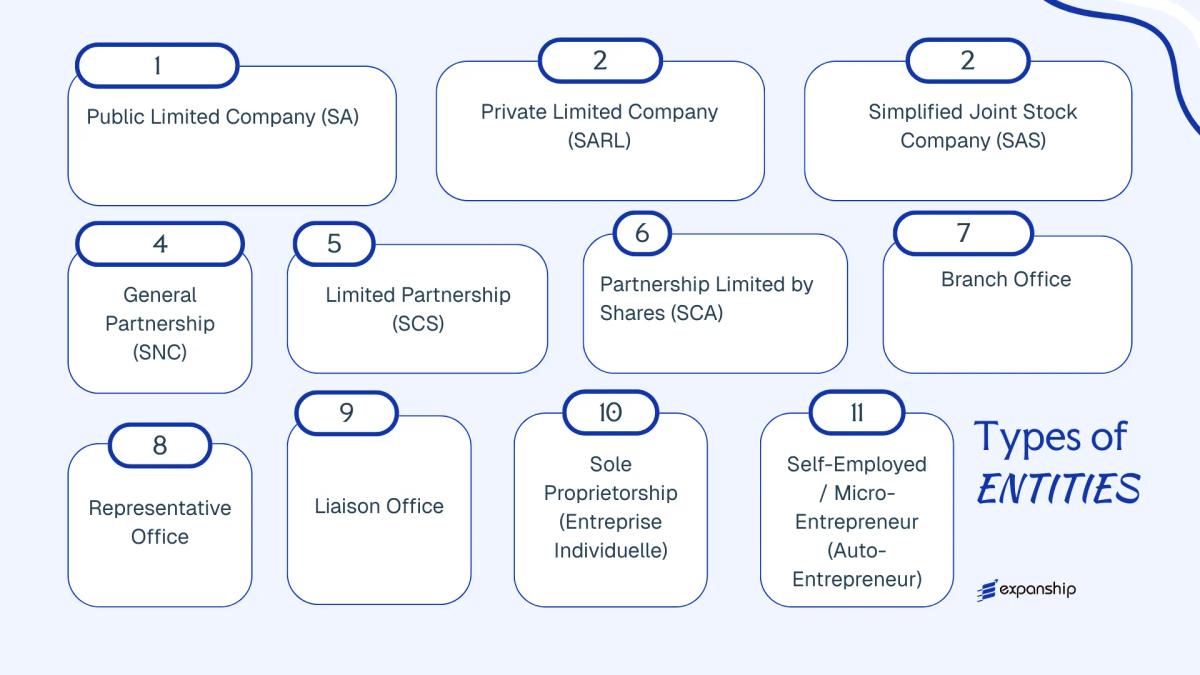
Available business structures include the Société Anonyme (SA), Société à Responsabilité Limitée (SARL), Société par Actions Simplifiée (SAS), Société en Nom Collectif (SNC), Société en Commandite Simple (SCS), Société en Commandite par Actions (SCA), branch offices, representative offices, liaison offices, and sole proprietorship forms including the Entreprise Individuelle and Auto-Entrepreneur. Each structure carries distinct requirements around capital, liability, governance, and suitability for your intended business activity.
An Overview of Business Structures in Togo
Togo recognises several distinct corporate structures, each governed primarily by the OHADA Uniform Act on Commercial Companies and Economic Interest Groups (Acte Uniforme relatif au droit des sociétés commerciales et du groupement d'intérêt économique), which applies uniformly across all OHADA member states including Togo. Alongside company-based forms, sole trader regimes and foreign establishment vehicles are also available under domestic commercial law. Each structure carries different implications for liability, governance, and taxation.
Business Structures at a Glance
| Entity Type | Legal Form | Liability | Taxed / Exempt | Local Trading | Minimum Members | Regulatory Authority | Governing Act |
|---|---|---|---|---|---|---|---|
| SA | Public limited company | Limited to shares | Taxed | Yes | 1 shareholder | RCCM / API-ZF | OHADA Uniform Act |
| SARL | Private limited company | Limited to contribution | Taxed | Yes | 1 member | RCCM | OHADA Uniform Act |
| SAS | Simplified joint stock company | Limited to shares | Taxed | Yes | 1 shareholder | RCCM | OHADA Uniform Act |
| SNC | General partnership | Unlimited, joint | Taxed | Yes | 2 partners | RCCM | OHADA Uniform Act |
| SCS | Limited partnership | Mixed liability | Taxed | Yes | 2 partners | RCCM | OHADA Uniform Act |
| SCA | Partnership limited by shares | Mixed liability | Taxed | Yes | 4 partners | RCCM | OHADA Uniform Act |
| Branch Office | Foreign extension | Parent liable | Taxed | Yes | N/A | RCCM | Togolese commercial law |
| Representative Office | Non-trading presence | Parent liable | Generally exempt | No | N/A | RCCM | Togolese commercial law |
| Entreprise Individuelle | Sole proprietorship | Unlimited personal | Taxed | Yes | 1 owner | RCCM | Togolese commercial law |
| Auto-Entrepreneur | Simplified sole trader | Unlimited personal | Simplified regime | Yes | 1 owner | RCCM | Togolese commercial law |
Each of these structures is examined in full in the sections below.
Société Anonyme (SA) — Public Limited Company
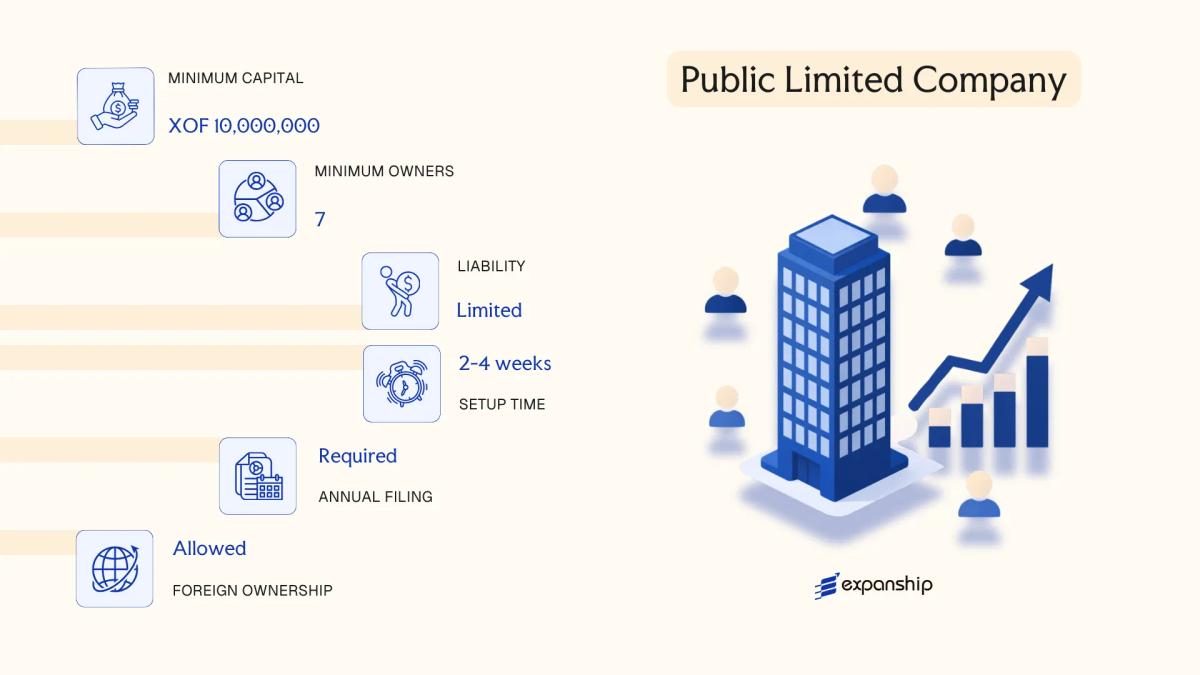
The Société Anonyme (SA) is governed by the OHADA Uniform Act on Commercial Companies and Economic Interest Groups, most recently revised in 2014. Registering a Société Anonyme SA Togo requires compliance with this supranational framework, which applies uniformly across all OHADA member states, including Togo.
As a distinct legal entity, the SA carries separate legal personality from its shareholders and offers full limited liability protection. Its structure is designed for larger enterprises, allowing public or private capital-raising through transferable shares.
Key Characteristics
| Requirement | Detail | Notes |
|---|---|---|
| Legal Form | Société Anonyme (SA) | Governed by OHADA Uniform Act 2014 |
| Members | Shareholders; minimum 1 shareholder (single-member SA permitted post-2014 reform) | No statutory maximum on shareholders |
| Governance | Board of Directors (minimum 3 directors) or single Administrator if one shareholder | Audit committee required above certain thresholds |
| Local Presence | Registered office in Togo required | No mandatory resident director under OHADA, but local address is compulsory |
| Capital | XOF 10,000,000 minimum paid-up share capital | At least one-quarter payable on incorporation; remainder within two years |
| Privacy | Shareholder register maintained; financial statements filed with RCCM | Limited confidentiality; beneficial ownership disclosures apply |
Focus Points
- Taxation: Corporate income tax applies at 27% on net profits; VAT at 18% on taxable supplies; withholding taxes apply to dividends, interest, and royalties paid to non-residents; stamp duties apply on certain capital contributions — refer to the Office Togolais des Recettes (OTR) for current rates.
- Annual Compliance: Statutory auditor (Commissaire aux comptes) mandatory; annual general meeting required; audited financial statements must be filed with the RCCM.
- Treaty Access: Togo is a member of the WAEMU tax treaty framework and has bilateral tax agreements with certain jurisdictions, which the SA can access as a resident entity.
- Conversion: An SA may be converted into an SARL or SAS by shareholder resolution, subject to OHADA procedural requirements.
- Restrictions: Foreign shareholding is generally unrestricted, though certain regulated sectors require prior ministerial authorisation.
Closing
The SA suits medium-to-large trading companies, holding structures, and businesses seeking external investment or eventual public listing. Its mandatory audit requirement and higher capital threshold make it administratively heavier than other entity forms.
The SA is most appropriate for large-scale enterprises, joint ventures with multiple institutional investors, or businesses planning to raise capital from the public.

Company Incorporation in Togo
Incorporate your Société Anonyme or other business entity in Togo with end-to-end support from Expanship.
Société à Responsabilité Limitée (SARL) — Private Limited Company
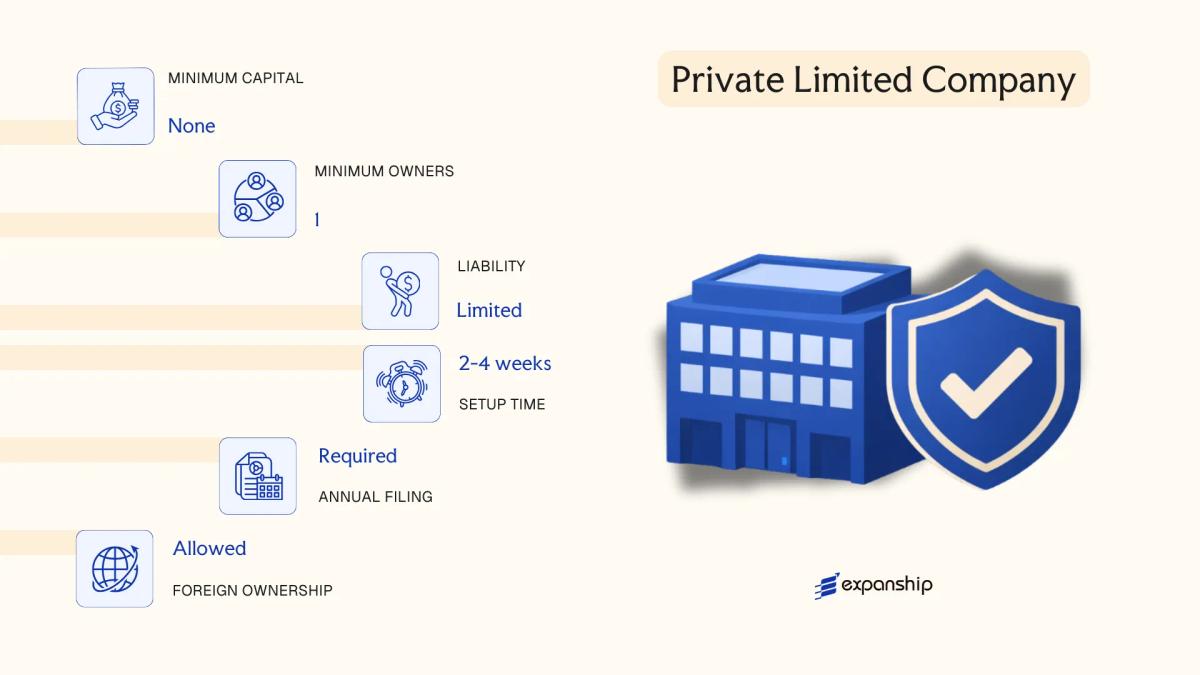
The Société à Responsabilité Limitée SARL Togo is governed by the OHADA Uniform Act on Commercial Companies and Economic Interest Groups, most recently revised in 2014. As a member of the OHADA treaty framework, Togo applies this supranational legislation directly, meaning the SARL's structure and requirements are uniform across all OHADA member states.
The SARL carries separate legal personality from the moment of its registration with the Centre de Formalités des Entreprises (CFE). Liability is capped at each associate's capital contribution, making this a hybrid structure that suits both small private firms and family-held businesses looking for formal incorporation without the governance burden of a public company.
Key Characteristics
| Requirement | Detail | Notes |
|---|---|---|
| Legal Form | Private limited company with separate legal personality | Governed by OHADA Uniform Act (2014) |
| Members | 1–100 associates | A single-associate SARL is permitted (SARL Unipersonnelle) |
| Management | One or more gérants (managers) | Gérant need not be an associate; no nationality restriction under OHADA |
| Local Presence | Registered office in Togo required | No statutory requirement for a local gérant, but a physical address is mandatory |
| Share Capital | No statutory minimum under the 2014 OHADA revision | Capital divided into parts sociales, not freely negotiable shares |
| Privacy | Associates' names appear in registration documents | No public shareholding; parts sociales transfer requires associate approval |
Focus Points
- Taxation: Subject to corporate income tax at the standard rate applicable in Togo; VAT registration required once turnover thresholds are met; withholding taxes apply to dividends, interest, and royalties paid to non-residents under domestic rules, subject to any applicable bilateral tax treaty.
- Annual compliance: Obligation to file annual financial statements with the RCCM (Registre du Commerce et du Crédit Mobilier) and hold an annual general meeting of associates.
- Transfer restrictions: Parts sociales are not freely transferable; any transfer to a third party requires prior approval from a qualified majority of associates.
- Conversion: A SARL may be converted into an SA or SAS once statutory conditions under the OHADA Uniform Act are satisfied.
- Treaty access: Togo has a limited bilateral tax treaty network; treaty benefits for a SARL depend on the residence of its associates and the applicable convention.
Closing
The SARL suits trading operations, holding structures, and domestic service businesses where close associate control over ownership transfers is a priority. The absence of a statutory minimum capital requirement lowers the entry threshold, though the restriction on freely transferable parts sociales limits its utility for businesses anticipating multiple external investors or future equity rounds.
The SARL is best suited for small to mid-sized private businesses, family-owned firms, and foreign investors establishing a locally incorporated operating entity with controlled ownership.
Société par Actions Simplifiée (SAS) — Simplified Joint Stock Company
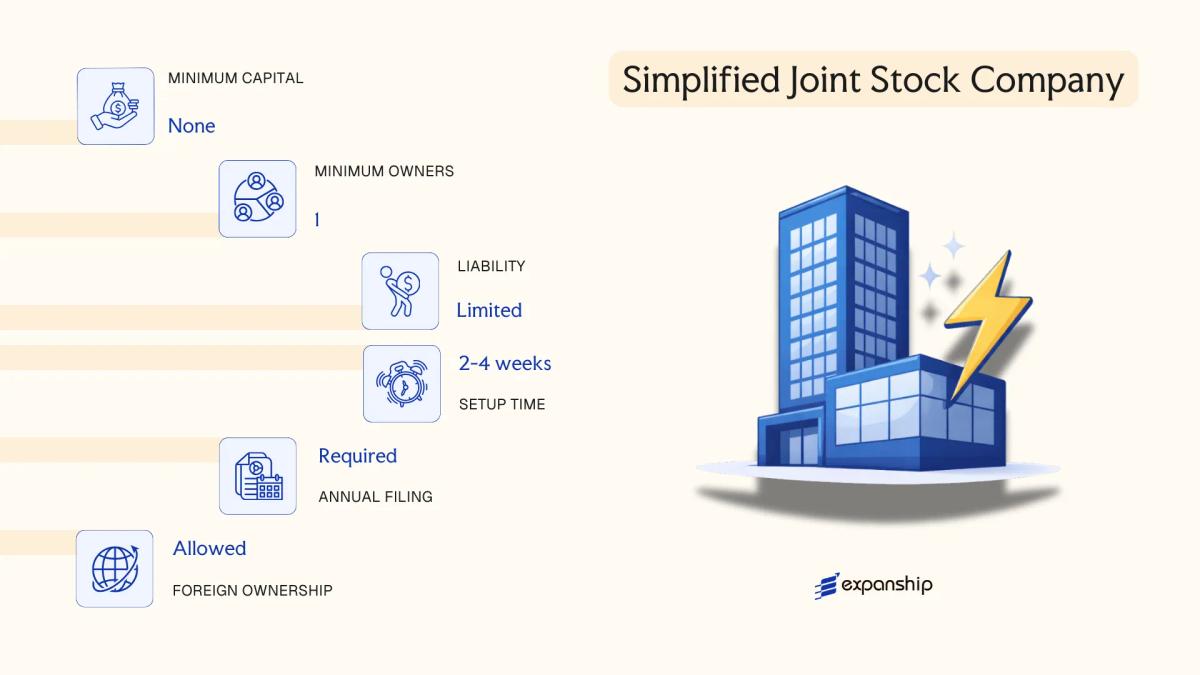
The Société par Actions Simplifiée SAS Togo is governed by the OHADA Uniform Act on Commercial Companies and Economic Interest Groups, most recently revised in 2014. As a distinct legal entity, it carries its own rights and obligations separate from its shareholders, with liability limited to capital contributions.
Compared to the SA, the SAS offers considerably more contractual freedom. Shareholders define governance arrangements through the company's statutes rather than through a fixed statutory framework, making this structure well suited to joint ventures, holding arrangements, and businesses requiring custom decision-making rules.
Key Characteristics
| Requirement | Detail | Notes |
|---|---|---|
| Legal Form | Société par Actions Simplifiée | Separate legal personality; limited liability |
| Members | Shareholders; minimum 1 (unipersonal SAS possible) | No maximum; at least one president required |
| Governance | President (mandatory); other officers optional | Structure defined by statutes, not by law |
| Local Presence | Registered office in Togo required | No mandatory local director under OHADA |
| Share Capital | No statutory minimum under the 2014 Act | Capital set freely in the statutes |
| Privacy | Shareholder identity disclosed at registration | Beneficial ownership disclosure applies |
Focus Points
- Taxation: Subject to corporate income tax (27% standard rate under Togolese law), VAT at 18%, and applicable withholding taxes on dividends, interest, and royalties paid to non-residents.
- Annual Compliance: Annual financial statements required; filing obligations with the RCCM (Registre du Commerce et du Crédit Mobilier).
- Conversion: Can be converted to an SA or SARL subject to meeting the target entity's statutory requirements.
- Restrictions: Cannot make public offerings of securities; capital raising is limited to private placement among shareholders.
Closing
The SAS suits investors seeking a flexible corporate vehicle for holding structures, intra-group arrangements, or joint ventures where bespoke governance is a priority. Its principal limitation is the restriction on public fundraising, which confines capital access to private channels.
Best suited for joint ventures, holding companies, and investor-backed ventures where shareholders require tailored governance arrangements beyond what the SA's fixed statutory framework permits.
Partnerships [Société en Nom Collectif (SNC), Société en Commandite Simple (SCS), Société en Commandite par Actions (SCA)]
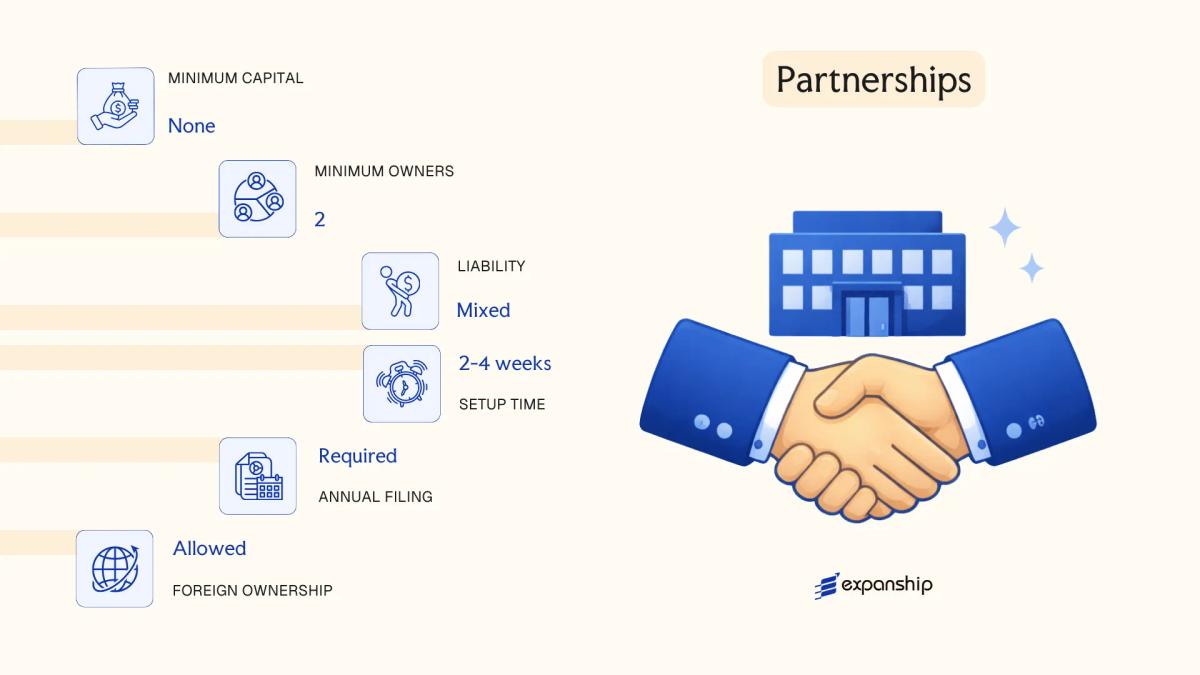
Partnership structures in Togo — SNC, SCS, and SCA — are governed by the OHADA Uniform Act on Commercial Companies and Economic Interest Groups, originally adopted in 1997 and revised in 2014. All three forms carry separate legal personality upon registration with the Centre de Formalités des Entreprises (CFE), distinguishing them from purely contractual arrangements under Togolese civil law.
Liability treatment varies significantly across these forms. In an SNC, all partners bear joint and unlimited personal liability for company debts. The SCS and SCA introduce a two-tier membership structure, separating general partners who carry unlimited liability from limited partners or shareholders whose exposure is capped at their capital contribution.
Key Characteristics
| Requirement | SNC | SCS / SCA | Notes |
|---|---|---|---|
| Legal Form | General partnership | Commandite (limited) partnership | SCA issues negotiable shares; SCS does not |
| Members | Associés (partners) | Commandités (general) + Commanditaires (limited) | SNC: min. 2 partners, no cap; SCS: min. 2; SCA: min. 4 |
| Liability | Unlimited, joint and several (all partners) | Unlimited (commandités); limited to contribution (commanditaires) | Commanditaires may not act in management |
| Registered Office | Physical address in Togo required | Physical address in Togo required | CFE registration mandatory |
| Share Capital | No statutory minimum | No statutory minimum for SCS; SCA requires negotiable share capital | SCA capital divided into transferable shares |
| Privacy | Partner identities disclosed in RCCM register | General partners disclosed; limited partners recorded | OHADA register is publicly accessible |
Focus Points
- Taxation: Corporate profits subject to the standard Togolese corporate income tax rate; VAT obligations apply to commercial activities; partners in an SNC may face personal income tax on distributed profits depending on classification.
- Annual compliance: Filing of annual financial statements with the RCCM (Registre du Commerce et du Crédit Mobilier) is required; accounts must conform to OHADA Acte Uniforme accounting standards (SYSCOHADA).
- Management restrictions: In an SCS or SCA, commanditaires are legally barred from conducting management acts on behalf of the firm; breach of this rule converts their liability to unlimited.
- Conversion: An SNC may be converted to an SARL or SA subject to partner consent and compliance with applicable OHADA procedures.
- Treaty access: Togo's tax treaty network is limited; partnership entities should verify treaty eligibility before structuring cross-border flows through these forms.
Sub-Types
Société en Nom Collectif (SNC)
The SNC is the baseline general partnership, where every associé holds trading status and unlimited joint liability. It suits closely held family businesses or professional firms where all parties accept full exposure.
Société en Commandite Simple (SCS)
The SCS separates active management (commandités) from passive investors (commanditaires), making it a practical vehicle for structures where capital contributors require liability protection without taking on operational roles.
Société en Commandite par Actions (SCA)
The SCA functions similarly to the SCS but divides the commanditaire interest into negotiable shares, enabling capital-raising comparable to an SA while preserving the commandités' control over management. It is more complex to administer than either the SNC or SCS.
Closing
Partnership forms are most commonly used for family-held trading operations, professional service firms, or investment structures requiring a clear division between active managers and passive capital contributors. The dual-liability structure of the SCS and SCA offers investor protection, but the unlimited exposure of general partners in all three forms represents a material structural risk for foreign principals.
These structures suit closely held businesses or investment arrangements where at least one party is prepared to accept unlimited liability in exchange for full management control.
Foreign Business Establishments [Branch Office, Representative Office, Liaison Office]
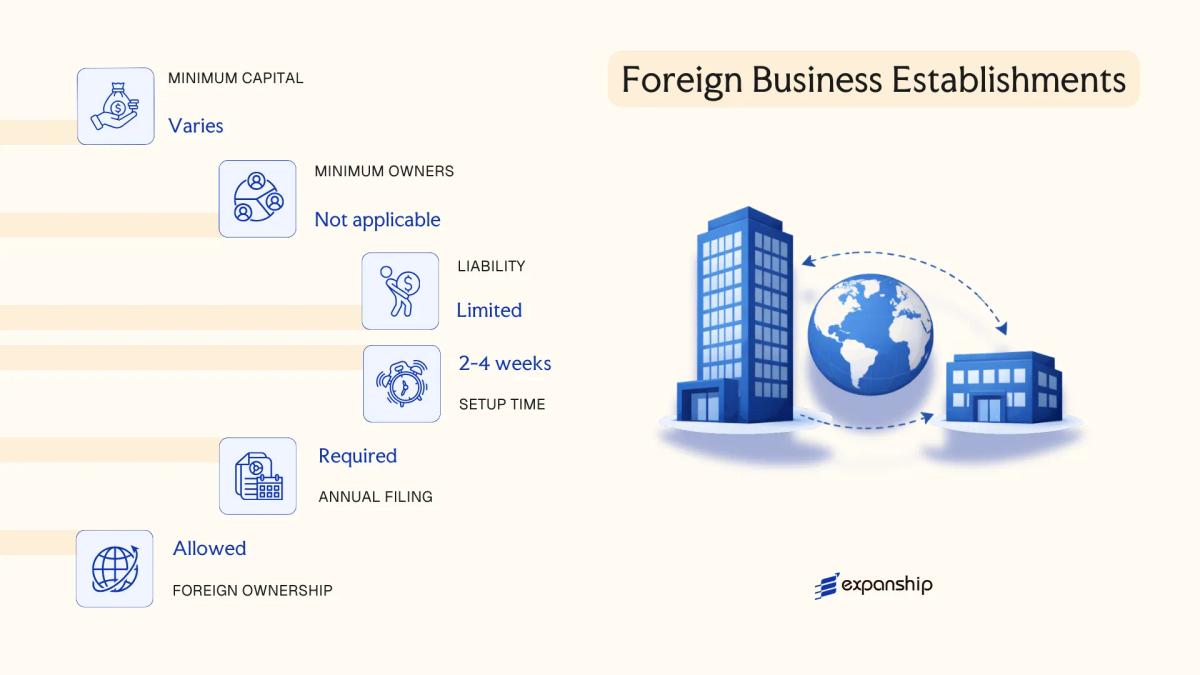
Foreign company establishment in Togo is governed primarily by the OHADA Uniform Act on Commercial Companies and Economic Interest Groups (revised 2014), which sets the legal framework for how non-resident entities may operate within the country. A branch office has no separate legal personality from its parent; the foreign parent company remains fully liable for all obligations the branch incurs.
Completing a foreign branch office registration in Togo requires enrollment with the Centre de Formalités des Entreprises (CFE) and entry in the Registre du Commerce et du Crédit Mobilier (RCCM). Lighter-touch structures, such as a representative or liaison office, do not conduct revenue-generating activities and carry narrower compliance obligations.
Key Characteristics
| Requirement | Detail | Notes |
|---|---|---|
| Legal Form | Extension of foreign parent (Branch) / Non-trading presence (Rep/Liaison) | No separate legal personality for any of the three |
| Management | Resident or non-resident Permanent Representative | Must hold a valid mandate from the parent board |
| Local Presence | Registered address in Togo; CFE and RCCM registration required | Branch requires a physical office; Rep/Liaison may use a registered address |
| Capital | No statutory minimum | Parent company's capital remains the backing |
| Liability | Parent bears unlimited liability for branch obligations | Rep/Liaison offices carry limited exposure given no commercial activity |
| Privacy | Parent company details become part of the public RCCM record | Annual accounts may need to be filed referencing the parent |
Focus Points
- Taxation: Branches are subject to corporate income tax at the standard rate of 27% on Togolese-sourced profits; VAT at 18% applies to taxable supplies; a branch profits remittance withholding tax may apply when funds are repatriated to the parent.
- Economic substance: The branch must demonstrate genuine operational activity in Togo; nominee arrangements with no real management presence risk reclassification.
- Annual compliance: Branches must file annual financial statements with the RCCM and submit tax returns to the Direction Générale des Impôts (DGI); representative and liaison offices have lighter filing requirements but must not generate local revenue.
- Treaty access: Togo is a member of the OHADA zone; treaty access depends on the parent's jurisdiction and applicable bilateral tax agreements, which are limited in number.
- Restrictions: Representative and liaison offices are prohibited from invoicing clients, signing commercial contracts in their own capacity, or remitting profits.
Sub-Types
Branch Office
A branch is an operational extension of the foreign parent that can conclude contracts, employ staff, and generate revenue in Togo. It is the appropriate structure when the foreign entity intends to conduct substantive commercial activity without incorporating a separate local company.
Representative Office
A representative office Togo requirements permit only promotional, market research, and liaison activities on behalf of the parent. It cannot bill clients directly or enter into revenue-generating contracts.
Liaison Office
Functionally similar to a representative office, a liaison office is restricted to coordinating communications between the parent and local counterparts. The distinction between the two lighter structures is largely administrative in practice under Togolese regulatory treatment.
When to Use This Structure
Branch offices suit foreign firms testing the Togolese market before committing to a locally incorporated entity, while representative and liaison offices serve businesses that need a local contact point without triggering full commercial registration. The principal advantage of a branch is operational speed; the key limitation is that full parent liability exposure has no statutory cap.
Foreign companies seeking market entry or a limited commercial footprint in Togo before deciding on full local incorporation.
Sole Proprietorship [Entreprise Individuelle, Auto-Entrepreneur]
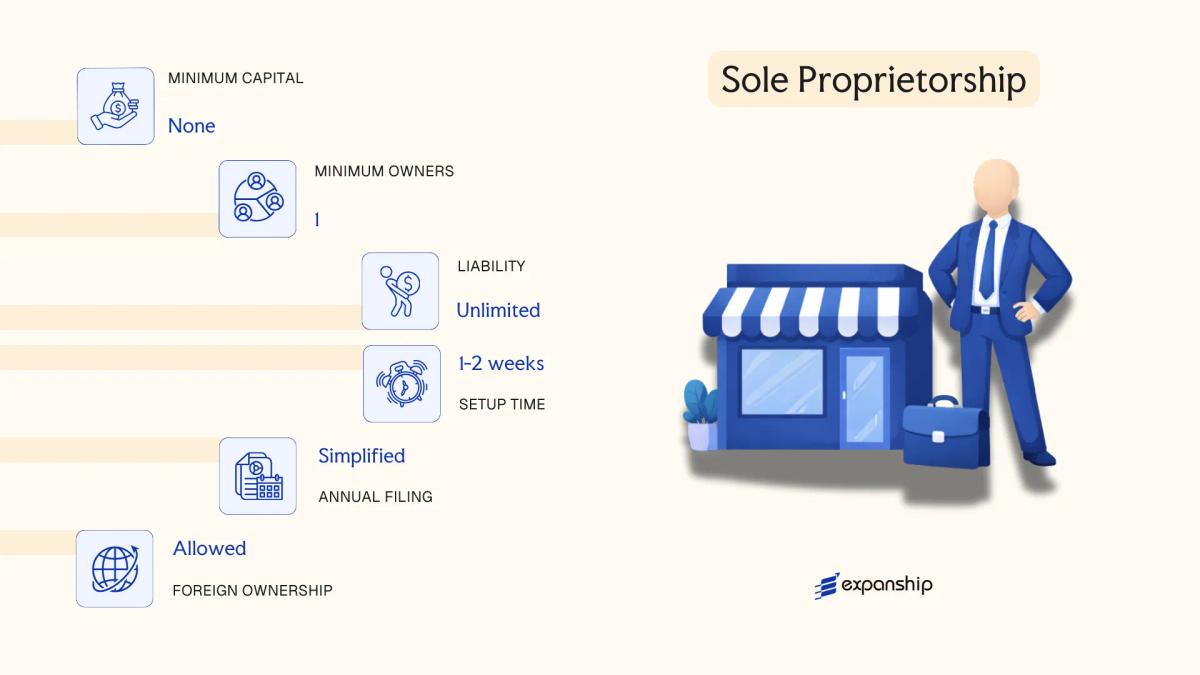
The sole proprietorship in Togo, known as the Entreprise Individuelle, operates under the OHADA Uniform Act on General Commercial Law (Acte Uniforme relatif au Droit Commercial Général), most recently revised in 2010. Unlike capital-based entities, this form carries no separate legal personality — the proprietor and the business are legally identical, meaning personal assets remain exposed to business liabilities.
Registration is handled through the Centre de Formalités des Entreprises (CFE), which consolidates the administrative steps required to formalize a self-employed business setup. The auto-entrepreneur regime, introduced to lower barriers for micro-entrepreneurs, functions as a simplified sub-category with reduced administrative obligations.
Key Characteristics
| Requirement | Detail | Notes |
|---|---|---|
| Legal Form | Unincorporated sole proprietorship | No separate legal personality from the owner |
| Members | Single proprietor | No minimum capital; no shareholders or directors |
| Local Presence | Registered business address required | Must be declared at CFE registration |
| Capital | No statutory minimum | Proprietor's personal assets are at risk |
| Liability | Unlimited personal liability | Business debts enforceable against personal estate |
| Privacy | Business name and owner identity publicly registered | Registered in the RCCM (Registre du Commerce et du Crédit Mobilier) |
Focus Points
- Taxation: Subject to personal income tax (Impôt sur le Revenu des Personnes Physiques); VAT applies if turnover exceeds applicable thresholds; auto-entrepreneurs benefit from a flat-rate simplified tax regime.
- Annual Compliance: Annual declaration of activity and renewal of RCCM registration required.
- Treaty Access: No access to corporate tax treaties; treaties apply only to incorporated entities.
- Conversion: Can be converted into an SARL or other OHADA-recognized entity as the business grows.
- Restrictions: Foreign nationals may face additional authorization requirements to operate as sole proprietors.
Sub-Types
Auto-Entrepreneur
The auto-entrepreneur regime applies to micro-scale operators falling below defined turnover thresholds and offers a streamlined registration process with a fixed-rate tax contribution replacing standard income tax declarations. It is intended for individuals running small service or trade activities with minimal administrative capacity.
Recommendations
The Entreprise Individuelle suits early-stage, low-risk activities where the proprietor operates alone without external investors. Its primary advantage is the low cost and speed of setup; its core limitation is unlimited personal liability, which exposes the owner's private assets to all business obligations.
Local sole traders, freelancers, and micro-entrepreneurs testing a business concept before committing to a formal incorporated structure.
How to Choose the Right Entity Type in Togo
Knowing how to choose a company type in Togo before incorporation prevents structural problems that are expensive or legally complex to unwind later.
Why Your Entity Choice Matters
The structure you register has binding legal and financial consequences from day one.
- Forming a branch office when your activities constitute independent local trading may place the operation outside the intended regulatory scope, exposing it to penalties under the OHADA Uniform Act on Commercial Companies.
- Selecting a structure without the capacity to maintain a physical presence, local staff, or resident management can trigger substance-related reporting failures with the Office Togolais des Recettes (OTR).
- Registering under a general partnership (SNC) when liability containment is a priority means each associate remains personally liable for all company debts — there is no corrective mechanism short of dissolution and re-registration.
- Choosing a multi-shareholder company structure when a sole proprietorship would suffice adds mandatory governance obligations, including annual general meetings and formal capital accounts, that generate recurring compliance costs without operational benefit.
Key Factors to Consider
- Business Activity: Active trading, asset holding, and regulated sectors each correspond to distinct structures under the OHADA Uniform Act on Commercial Companies and Economic Interest Groups.
- Ownership and Management: Single-founder operations typically suit the SARL or Auto-Entrepreneur status, while multi-party ventures requiring board governance point toward the SA or SAS.
- Liability Exposure: Your tolerance for personal liability determines whether a limited-liability structure is necessary or whether a partnership form is acceptable.
- Tax Objectives: Your eligibility for specific regimes administered by the OTR, including the synthetic tax (impôt synthétique) for small enterprises, depends on the entity type and turnover thresholds.
- Substance Capacity: If you cannot realistically maintain staff or a registered office in the country, certain structures carry heavier compliance burdens than others.
- Exit Strategy: Not all structures permit straightforward conversion or redomiciliation; the SA allows share transfers more freely than the SARL, which restricts transfers to third parties by default.
Compliance Services for Companies in Togo
Ongoing compliance support for Togolese entities, including annual filings, OTR obligations, and corporate maintenance.
Conclusion
Togo operates under the OHADA Uniform Act on Commercial Companies, which defines a fixed set of recognized structures for incorporating a company in Togo guide purposes and beyond. The SARL remains the most registered entity type in the country, largely because of its single-shareholder option and lower capital threshold relative to the SA. Larger firms seeking public capital access typically opt for the SA, while the SAS suits ventures requiring flexible shareholder arrangements. Partnerships such as the SNC and SCS carry unlimited liability and tend to serve family-owned or professional services businesses. Foreign groups entering without committing to a permanent establishment generally form a representative or liaison office first.
Regulatory alignment with OHADA member states continues to standardize corporate governance across the region, which may gradually improve Togo's attractiveness for cross-border structuring. Professional guidance tailored to your specific activity and ownership structure will help you move through the RCCM registration process without procedural delays.
How Expanship Can Assist You
Expanship's company formation services in Togo cover the full process — from selecting between a SARL, SA, or SAS to meeting the registration requirements set by the Centre de Formalités des Entreprises (CFE) and the Tribunal de Commerce de Lomé. Your choice of entity affects capital requirements, governance obligations, and ongoing reporting duties, all of which we address from the start.
Our Togo business incorporation assistance covers every stage of the setup and post-registration process:
- Document preparation, notarization, and legalization
- Registered agent and registered office provision in Togo
- Filing with the CFE and RCCM (Registre du Commerce et du Crédit Mobilier)
- Post-incorporation compliance management, including annual reporting
- Banking introduction assistance for corporate account opening
- Ongoing liaison with local authorities on your behalf
Ready to move forward? Contact [Expanship Togo](tg/contact-us) to discuss your entity setup.
Frequently Asked Questions (FAQ)
The Société à Responsabilité Limitée (SARL) is the most frequently incorporated entity. Its relatively low capital threshold, capped liability, and single-member eligibility make it accessible for small and medium-sized businesses.
An SA requires a minimum of three shareholders and a higher share capital, while an SARL can be formed by a single associate. Both structures carry full legal personality and limited liability, but the SA faces stricter governance requirements, including a board of directors and mandatory external auditors once certain thresholds are met.
The SAS offers comparatively greater confidentiality, as its bylaws and shareholder arrangements are not all subject to full public disclosure. Nominee arrangements are legally permissible under OHADA rules, though beneficial ownership reporting obligations have expanded in recent years.
No. An SNC requires at least two partners, and an SCS must have at least one general and one limited partner. By contrast, the SARL and SAS both permit single-founder formation under OHADA rules.
Foreigners may incorporate an SA, SARL, or SAS without mandatory local partnership requirements. A branch office is also available to foreign companies, though it does not carry separate legal personality from its parent.
Yes. OHADA law allows transformation from one entity form to another, such as converting an SARL into an SA, provided procedural and capital requirements of the target structure are met. The process requires shareholder approval and re-registration with the RCCM.
No. Representative offices and liaison offices do not constitute independent legal entities; they remain extensions of their foreign parent. All incorporated forms, including the SA, SARL, SAS, SNC, and SCA, hold distinct legal personality under OHADA law.
Legal Disclaimer
The information provided in this article is for general informational purposes only and does not constitute legal, tax, or professional advice. While we strive to ensure the accuracy and timeliness of the content, laws and regulations are subject to change, and the application of laws can vary widely based on specific facts and circumstances.
Readers should not act upon this information without seeking professional counsel tailored to their individual situation. Expanship and its authors disclaim any liability for actions taken or not taken based on the content of this article.
For specific advice regarding your business setup, compliance requirements, or any legal matters, please consult with qualified legal and tax professionals in the relevant jurisdiction.