
Key Takeaways
- Entities incorporating in Togo must comply with the OHADA Uniform Act on Commercial Companies and Economic Interest Groups, which establishes the binding legal framework for company formation across all OHADA member states, including Togo.
- The minimum share capital threshold differs by entity type, with the SARL and SA subject to distinct capital requirements that must be satisfied before registration is completed through the Centre de Formalités des Entreprises (CFE).
- A physical registered office address located within Togo is a mandatory formation requirement, not an optional administrative detail, and must be established prior to submission of the registration application to the RCCM.
- Foreign investors operating in regulated sectors face additional compliance obligations beyond the standard incorporation requirements, making sector-specific regulatory review a necessary step before proceeding with formal registration.
Company formation in Togo is governed by the OHADA Uniform Act on Commercial Companies and Economic Interest Groups, which Togo adopted as a member state of the Organisation for the Harmonisation of Business Law in Africa. The Centre de Formalités des Entreprises (CFE) serves as the primary administrative body through which incorporation requirements in Togo are processed and registered.
This article covers the structural, documentary, and compliance requirements applicable to entities seeking formal registration under Togolese law, as detailed in the OHADA Uniform Act.
Failure to satisfy these requirements results in rejection of the registration application or, where an entity operates without proper formation, exposure to legal penalties under applicable OHADA provisions.
Requirements vary depending on entity type, the sector in which your business operates, and whether foreign ownership is involved. Certain industries may trigger additional regulatory obligations beyond standard company registration requirements in Togo.
This article is most relevant to foreign investors and non-resident business owners intending to establish a legal presence through a formally registered entity in the country.
Minimum Share Capital Requirements in Togo
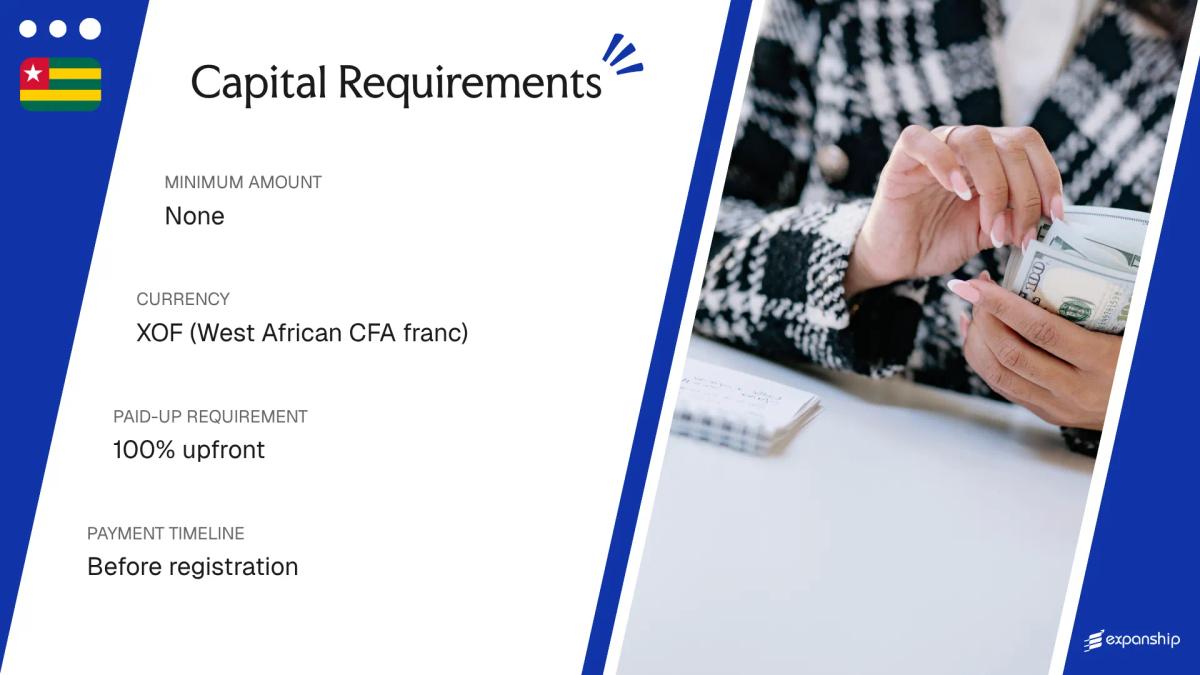
Minimum share capital requirements in Togo are governed by the OHADA Uniform Act on Commercial Companies and Economic Interest Groups (AUDSCGIE), which applies uniformly across all OHADA member states including Togo. The RCCM (Registre du Commerce et du Crédit Mobilier) oversees company registration and verifies capital declarations at the point of incorporation.
Share capital operates on a par value system, where each share carries a nominal value established in the company's statutes. Capital deposit requirements vary by entity type and must be satisfied before the RCCM will complete registration.
| Parameter | Detail |
|---|---|
| Minimum Authorized Share Capital | FCFA 100,000 for SARL; FCFA 10,000,000 for SA |
| Maximum Authorized Share Capital | No statutory maximum |
| Minimum Paid-Up Capital | SARL: full amount at incorporation; SA: at least one quarter of cash contributions |
| Paid-Up Requirement at Incorporation | SA requires 25% of subscribed cash capital deposited before registration |
| Accepted Currency | CFA Franc (XOF) |
| Accepted Forms of Contribution | Cash (numéraire) and contributions in kind (apports en nature) |
| Timeframe to Deposit Capital | Prior to filing with the RCCM |
For a Société Anonyme, the remaining 75% of subscribed cash capital must be paid up within three years of registration. Failing to meet this schedule can affect the legal standing of the share issuance.
Company Secretary Requirements in Togo
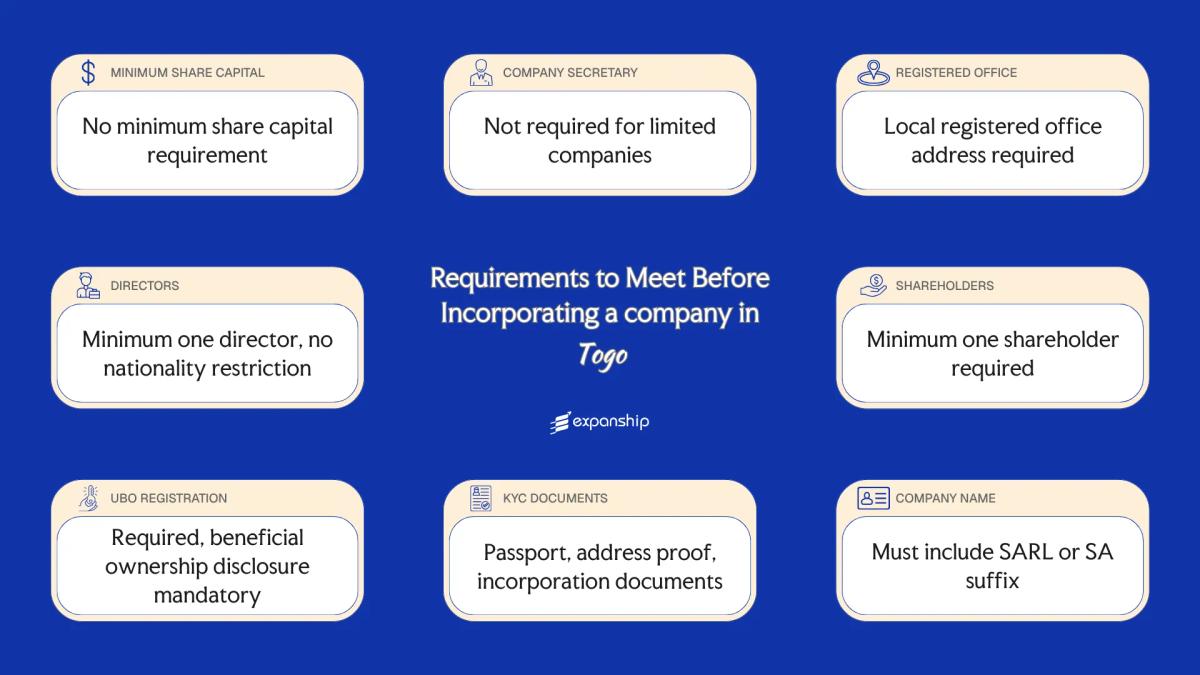
Under the OHADA Uniform Act on Commercial Companies, which governs corporate law in Togo, there is no statutory requirement for a dedicated company secretary role equivalent to that found in common law jurisdictions. For a Société à Responsabilité Limitée (SARL) or Société Anonyme (SA), company secretary requirements in Togo are minimal as a formal position, though certain administrative and compliance functions must still be fulfilled.
Those duties typically fall to the gérant (manager) or an appointed officer, covering obligations such as maintaining statutory registers, filing annual accounts with the RCCM (Registre du Commerce et du Crédit Mobilier), and ensuring resolutions are properly recorded.
Qualification criteria for whoever performs this secretarial or administrative compliance function:
- No statutory minimum age is prescribed beyond general civil capacity requirements
- The role may be filled by an individual or a corporate entity
- No mandatory professional licensing or formal secretary qualification is required under OHADA rules
- Non-resident individuals or foreign entities may generally serve in this capacity
- The gérant of the company may assume these responsibilities directly

Incorporate a Company in Togo
Set up your legal entity in Togo with guidance on OHADA compliance, RCCM registration, and ongoing corporate maintenance.
Registered Office Requirements in Togo
Registered office requirements in Togo are governed under the OHADA Uniform Act on Commercial Companies, which mandates that every company maintain a physical address within the country where official correspondence and legal notices can be delivered. Failure to maintain a compliant siège social can result in administrative sanctions, including the company being struck off the RCCM (Registre du Commerce et du Crédit Mobilier).
- A physical address is required; a P.O. box alone does not satisfy the siège social obligation.
- The address must be located within Togo, not in another OHADA member state or abroad.
- Virtual office arrangements are not explicitly recognized under OHADA rules; a genuinely occupiable premises is expected.
- Supporting documentation, such as a lease agreement or proof of ownership, must be submitted at the time of RCCM registration.
- The registered address is recorded in the RCCM and forms part of the publicly accessible commercial registry file.
- Any change to the siège social must be formally notified to the RCCM through an amendment filing before the change takes legal effect.
Director Requirements in Togo
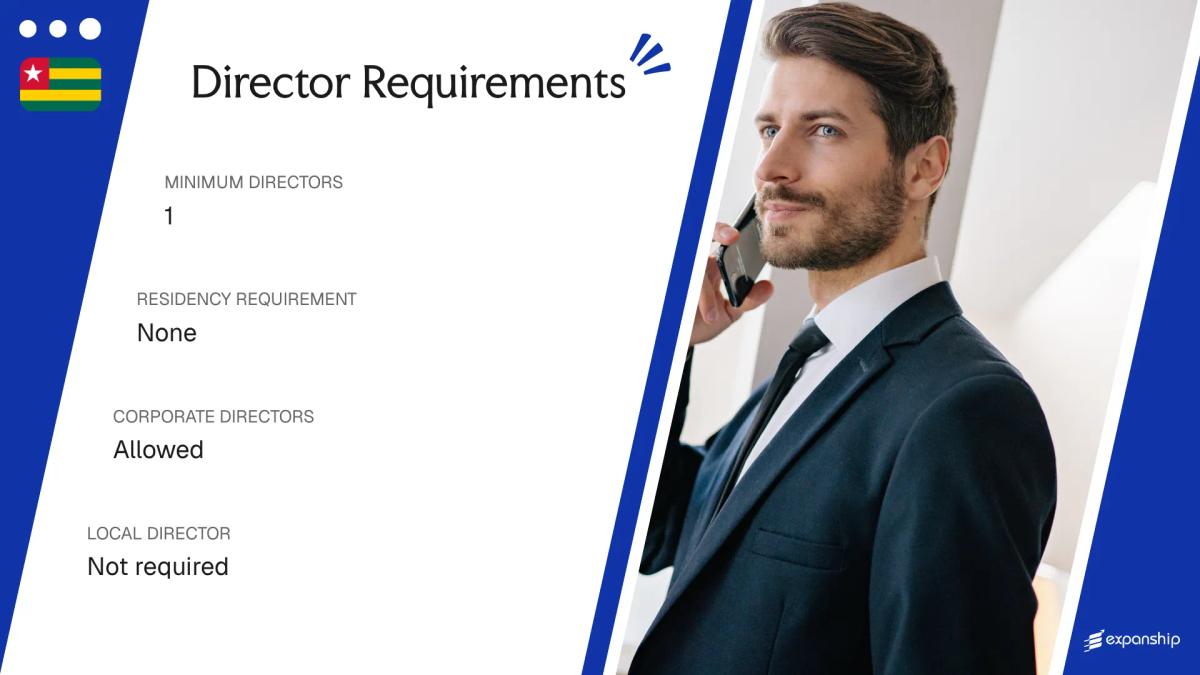
Under the OHADA Uniform Act on Commercial Companies (AUDSC), director requirements in Togo company formations assign statutory duties of management, fiduciary care, and legal representation to the appointed gérant or directeur général from the date of incorporation. Directors bear personal liability for violations of applicable law, breaches of the company's statutes, and mismanagement causing harm to the entity or third parties.
| Parameter | Detail |
|---|---|
| Minimum Number of Directors | One director is required for a SARL; an SA requires a board of at least three directors. |
| Maximum Number of Directors | For an SA, the board may not exceed twelve members under the AUDSC. |
| Local/Resident Director Required | No statutory requirement for a resident or locally domiciled director. |
| Nationality Restrictions | No nationality restrictions are imposed under the AUDSC as applicable in Togo. |
| Minimum Age Requirement | Directors must be at least eighteen years of age at the time of appointment. |
| Corporate Directors Permitted | Corporate directors are not permitted; only natural persons may serve as directors under the AUDSC. |
| Director Must Be a Shareholder | No statutory requirement for a director to hold shares in the company. |
| Publicly Listed on Registry | Director identities are filed with the Registre du Commerce et du Crédit Mobilier (RCCM) and are publicly accessible. |
| Disqualification Conditions | Persons subject to judicial interdiction, prior conviction for financial crimes, or declared bankrupt may be disqualified from serving. |
Despite Togo operating under the OHADA framework, which is often associated with civil-law formality, there is no requirement that a director be a national or resident of the country, meaning a company can be fully directed from abroad without any local representative on the board.
Shareholder Requirements in Togo
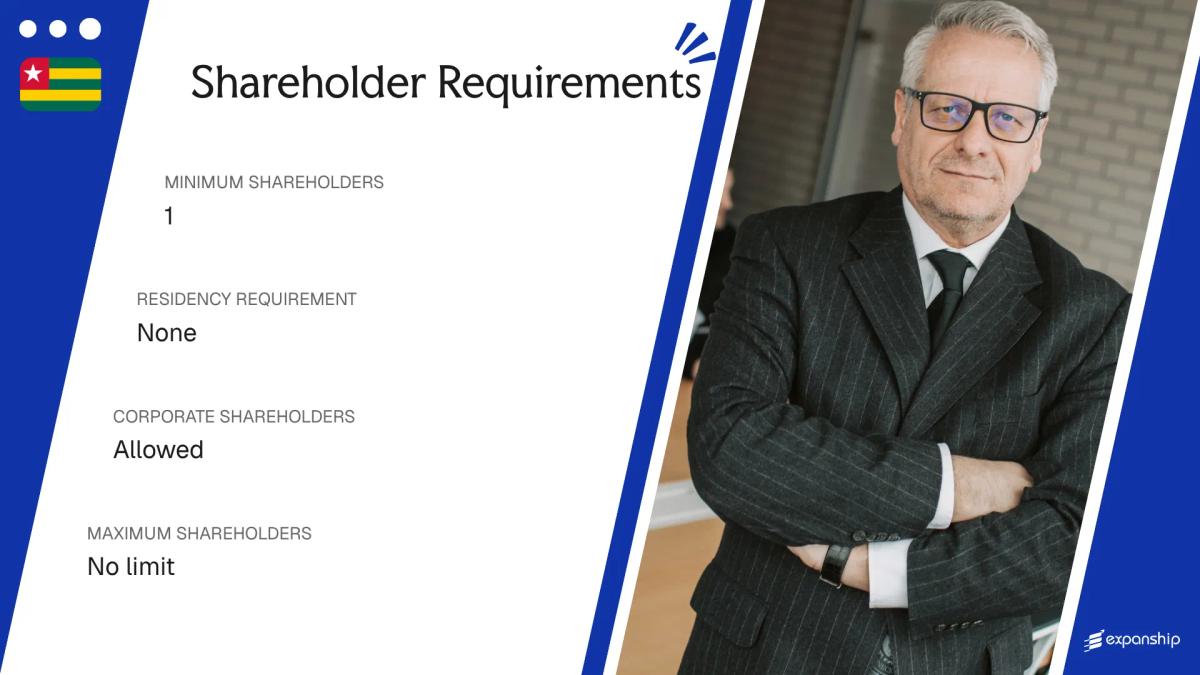
Under the OHADA Uniform Act on Commercial Companies, a Société à Responsabilité Limitée (SARL) requires a minimum of one shareholder and permits up to 50. Meeting the shareholder requirements for Togo incorporation means a sole-associate structure is fully permissible, making the SARL accessible for single-founder ventures.
Nationality and Residency Restrictions
No nationality or residency requirement applies to shareholders under OHADA-governed entities registered in Togo. Foreign nationals may hold up to 100% of the share capital without restriction.
Corporate Shareholders
Legal entities, including foreign-incorporated companies, may hold shares in a Togolese SARL or SA. No special authorization is required solely on account of the shareholder being a corporate body.
Shareholder Liability
In a SARL, each associé's liability is limited to their capital contribution. Extended personal liability does not arise under ordinary circumstances, though courts may pierce the corporate veil in cases of fraud or improper commingling of assets.
Register of Shareholders
A register of shareholders must be maintained at the company's registered office. Under OHADA rules, this register is not publicly accessible, but it must reflect any transfers of shares and remain available for inspection by competent authorities upon request.
Shareholder Structuring Support for Your Togo Entity
Get guidance on structuring your shareholding arrangement in compliance with OHADA rules and Togolese registration requirements.
UBO / Beneficial Ownership Disclosure Requirements in Togo
Beneficial ownership disclosure in Togo is governed by the OHADA Uniform Act on Commercial Companies (AUDSC) and supplementary anti-money laundering provisions under GIABA-aligned national legislation, which define a beneficial owner as any natural person who ultimately owns or controls 25% or more of a company's shares or voting rights.
- Identify all natural persons meeting the 25% ownership or control threshold at the time of incorporation.
- Submit beneficial ownership details to the Registre du Commerce et du Crédit Mobilier (RCCM) as part of the company registration filing.
- Retain internal UBO records within the company's registered office and make them available to competent authorities upon request.
- Update the RCCM filing within 30 days of any change in beneficial ownership.
| Parameter | Detail |
|---|---|
| Ownership Threshold for UBO Status | 25% of shares or voting rights |
| Filing Authority | Registre du Commerce et du Crédit Mobilier (RCCM) |
| Disclosure Deadline at Incorporation | At the time of company registration |
| Publicly Accessible Register | No statutory public access requirement |
| Penalties for Non-Disclosure | Administrative and criminal sanctions under national AML legislation |
| Ongoing Update Obligation | Within 30 days of any change in beneficial ownership |
KYC / Document Requirements in Togo
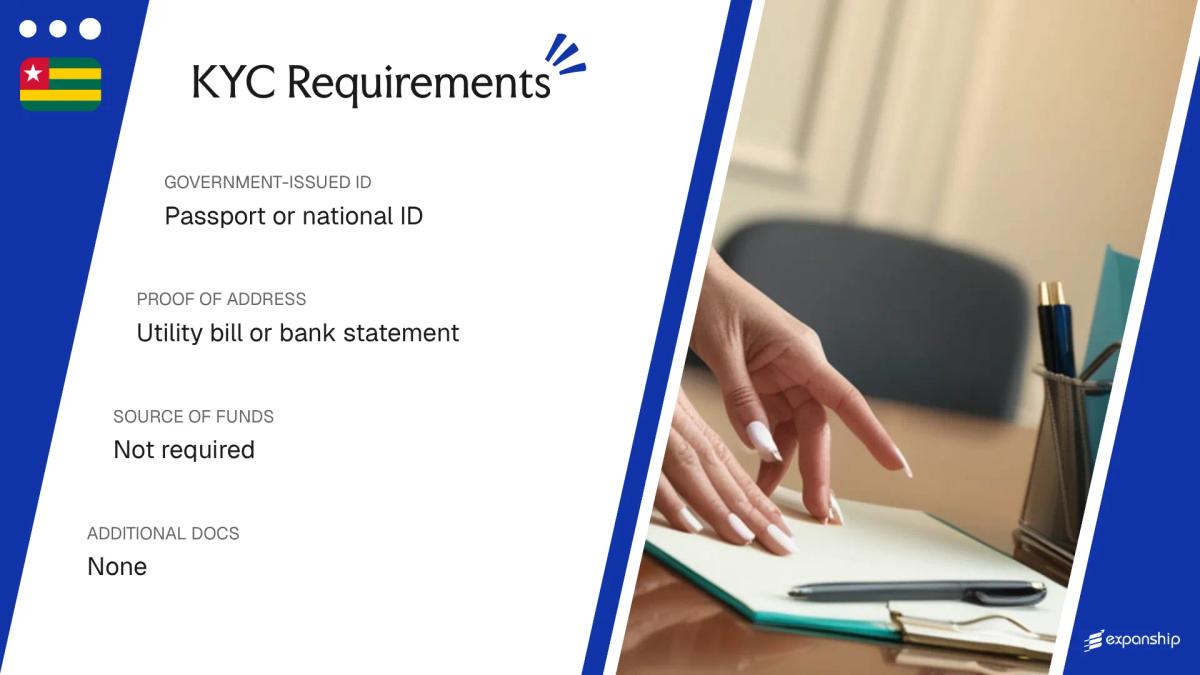
KYC document requirements Togo are governed by Law No. 2015-009 on anti-money laundering and combating the financing of terrorism, which obliges all incorporating parties to submit identity and ownership documentation to the CENTIF-Togo framework before registration is finalised.
Individual / Personal Documents
- Valid government-issued photo ID (passport or national identity card) for each director and shareholder
- Proof of residential address dated within three months, such as a utility bill or bank statement
- Specimen signature for each individual named in the incorporation file
- Recent passport-sized photographs may be required depending on the registered agent's internal compliance procedure
Corporate Documents
- Certificate of incorporation of the parent or shareholder entity, certified as current
- Constitutional documents (articles of association or equivalent) of the corporate shareholder
- Register of directors of the corporate entity
- Proof of the corporate entity's registered office address
Source of Funds Documentation
- Recent bank statements (typically covering the preceding three to six months) evidencing available capital
- Audited financial accounts where the entity has an established trading history
- A signed declaration of the origin of funds where bank statements are insufficient
Notarisation and Apostille Requirements
- Foreign documents must generally be apostilled under the Hague Convention or legalised through the Togolese consular network
- Official translations into French are required for all documents not originally in French
- Notarisation by a qualified notary is required for certified copies submitted to Togolese authorities
Untranslated foreign-language documents are the most frequent cause of registration delays at the Tribunal de Commerce de Lomé.
Company Name Requirements in Togo
Company name requirements in Togo are assessed during the incorporation process through a name availability check conducted at the point of registration. Your proposed denomination must be distinguishable from any existing registered entity and must not mislead the public as to the nature of the business.
Names must be expressed in French, the official administrative language. The legal form suffix, such as SARL or SA, is mandatory and must appear in the full denomination. No specific character limit is publicly codified, but names must be clear and unambiguous.
Certain words are restricted or prohibited outright. Terms implying governmental authority, banking, insurance, or affiliation with international bodies require prior approval from the relevant supervisory authority before registration will proceed.
Name reservation is available prior to formal incorporation. Once reserved, the name is held for a defined period, typically a short window of weeks, during which no other applicant may register the same denomination. The reservation request is submitted to the commercial registry as part of the pre-incorporation process.
Compliance Services for Companies in Togo
Ongoing compliance obligations in Togo include annual filings, beneficial ownership updates, and regulatory reporting. Our team manages these requirements on your behalf.
Conclusion
Meeting the incorporation requirements in Togo means operating within the OHADA Uniform Act on Commercial Companies, which governs entity formation across member states through a standardised legal framework. Among the requirements covered, the distinction between SARL and SA minimum capital thresholds and the mandatory physical registered office address within the country carry practical weight for foreign investors structuring their entry. Once these requirements are understood, the next step involves engaging with the RCCM and coordinating the necessary documentation for formal registration.
Expanship's Corporate Formation Services in Togo
Togo corporate formation services from Expanship are structured around the specific compliance requirements that govern entities under the OHADA Uniform Act, from registered office obligations to beneficial ownership disclosure with the RCCM. Our role is to reduce the operational burden these requirements place on foreign founders, particularly those without an existing presence in the country.
Expanship's company incorporation services in Togo cover the full formation process and beyond:
- We prepare and file all incorporation documents with the Tribunal de Commerce and relevant authorities.
- Our team provides a registered agent and local office address to satisfy Togo's physical presence requirements.
- We handle all government filings and liaise directly with regulatory bodies on your behalf.
- Post-incorporation compliance management keeps your entity in good standing over time.
- Banking introduction assistance connects your business with suitable local financial institutions.
- We coordinate tax registration and liaison with Togolese fiscal authorities.
To discuss your formation needs, contact Expanship Togo.
Frequently Asked Questions (FAQ)
Foreign nationals can hold all director positions in a Togolese company. OHADA law does not impose a local residency requirement for directors, though the SA structure requires a minimum of three directors if governed by a board. Appointing a local director is not mandatory but may be practical depending on the nature of the business and dealings with local authorities.
Non-compliance with beneficial ownership disclosure requirements under Togo's AML framework can result in administrative sanctions, fines, and potential suspension of the company's legal standing. The Cellule Nationale de Traitement des Informations Financières (CENTIF) oversees financial intelligence in Togo and can refer cases for prosecution. Repeated non-disclosure may expose both the entity and its officers to criminal liability.
No. A Togolese company must maintain a physical registered office address within Togo, as required under OHADA incorporation rules. This address serves as the official point of contact for legal correspondence and regulatory filings. A foreign address does not satisfy this requirement, and using one would render the registration application incomplete.
Togo does not impose a statutory requirement for a company secretary under the OHADA Uniform Act framework that applies to SARLs and SAs. The governance obligations that a company secretary typically handles in common law jurisdictions are generally managed by the manager (gérant) in a SARL or the board in an SA. There is no prescribed professional qualification attached to the role in Togolese law.
The baseline KYC requirements in Togo align with OHADA standards applied across member states, including certified identification, proof of address, and shareholder/director declarations. Togo's national AML regulations, informed by GIABA recommendations, may layer additional due diligence obligations on top of the OHADA baseline, particularly for regulated sectors. The practical burden of documentation is broadly comparable to neighbouring OHADA jurisdictions such as Benin and Senegal.
Yes. Company names in Togo must not imply a connection to government bodies, use protected designations without authorisation, or include terms that are misleading about the entity's activities. The Centre de Formalités des Entreprises (CFE) reviews proposed names during the registration process and can reject names that conflict with existing registrations or violate naming rules. Clearance should be confirmed before submitting incorporation documents.
Legal Disclaimer
The information provided in this article is for general informational purposes only and does not constitute legal, tax, or professional advice. While we strive to ensure the accuracy and timeliness of the content, laws and regulations are subject to change, and the application of laws can vary widely based on specific facts and circumstances.
Readers should not act upon this information without seeking professional counsel tailored to their individual situation. Expanship and its authors disclaim any liability for actions taken or not taken based on the content of this article.
For specific advice regarding your business setup, compliance requirements, or any legal matters, please consult with qualified legal and tax professionals in the relevant jurisdiction.