
Key Takeaways
- Togo's membership in the OHADA legal framework gives foreign investors access to standardized commercial law across 17 member states, reducing the legal uncertainty that typically accompanies cross-border business structuring in West Africa.
- Companies operating under Togo's free zone regime can access corporate tax holidays that substantially reduce the tax burden during early operational years, making it a structurally distinct option from standard onshore incorporation.
- The SARL structure permits full foreign ownership without mandatory local partnership requirements, allowing investors to retain complete control over equity and governance from the point of registration.
- Registration through the Centre de Formalités des Entreprises (CFE) consolidates the administrative steps required to establish a legal entity, reducing the procedural friction that often delays market entry in comparable West African jurisdictions.
Togo is an independent West African nation bordered by Ghana, Benin, and Burkina Faso, with Lomé serving as both its capital and its primary economic hub. For foreign businesses evaluating the benefits of incorporating in Togo, the country's general tax posture is territorial and treaty-informed, with specific incentive regimes available to qualifying entities. The Centre de Formalités des Entreprises (CFE) oversees business registration and serves as the primary administrative entry point for company formation.
Most foreign investors structure their presence through a Société à Responsabilité Limitée. Togo maintains an open stance toward foreign direct investment, with no general prohibition on full foreign ownership across most sectors. This article examines the key structural, regulatory, and commercial advantages that the country's corporate framework offers to businesses considering formal establishment here.
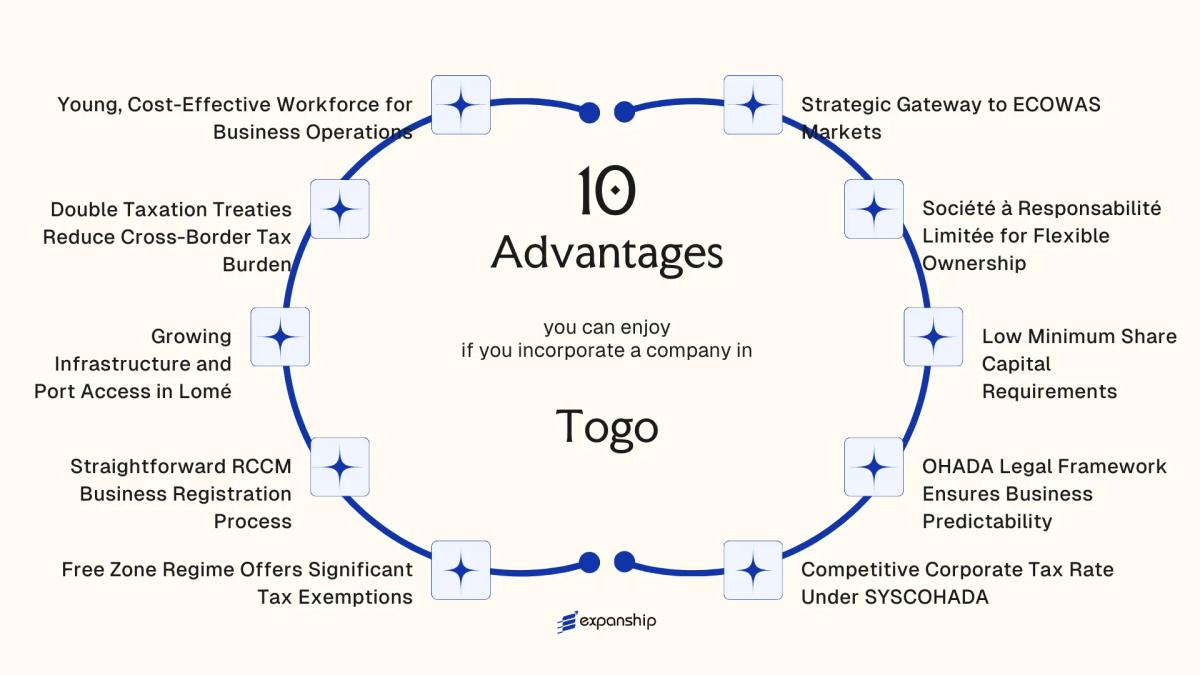
Strategic Gateway to ECOWAS Markets
Togo's membership in the Economic Community of West African States positions any company incorporated there as a participant in a regional market of approximately 400 million people. Accessing that market from a single point of incorporation is one of the more concrete Togo ECOWAS market access benefits available to foreign businesses today.
Free Movement of Goods Within the Bloc
Under the ECOWAS Trade Liberalisation Scheme (ETLS), goods produced or substantially transformed within member states can move across borders without customs duties. A company registered in Lomé and meeting ETLS origin criteria can distribute products across Nigeria, Ghana, Senegal, and 11 other member states under preferential conditions that would not apply to a firm incorporated outside the bloc.
Qualifying under the ETLS requires product registration with the ECOWAS Commission and certification that the goods meet the scheme's rules of origin. That administrative step is a one-time process, not a recurring barrier.
West Africa Regional Trade Advantages Through a Stable Entry Point
Lomé's position on the Atlantic coast makes it a functional transit corridor for landlocked neighbors including Burkina Faso, Mali, and Niger. Your business benefits from both the coastal access and the regional trade framework simultaneously, which reduces the structural overhead of serving multiple West African markets from separate legal entities.
A single Togo-registered entity can serve 15 ECOWAS member states under a unified trade framework without requiring separate incorporation in each country.
Société à Responsabilité Limitée for Flexible Ownership
The SARL structure under OHADA Uniform Act on Commercial Companies gives foreign investors a recognizable limited liability vehicle without the governance overhead of a public company. Your personal assets remain separate from the company's obligations, and that protection applies regardless of your nationality or country of residence.
Togo SARL flexible ownership advantages become clear when you examine how shares can be distributed. A single person can form an SARL, meaning you do not need a local partner to satisfy a minimum shareholder threshold. Ownership can be held by individuals, foreign corporations, or a mix of both, giving you genuine flexibility in how you structure the entity for your group or investment portfolio.
Profit distribution follows the shareholding structure defined in the company's statutes, which you draft at formation. This means you set the terms that govern how returns flow to each owner, rather than defaulting to a rigid statutory formula.
Why this structure favours foreign ownership:
- A sole foreign shareholder can hold 100% of the SARL without a local nominee requirement
- Shares are transferred by notarial deed, creating a documented chain of title
- The statutes can include specific approval clauses for future share transfers, protecting existing owners from unwanted third-party entry
- Non-resident shareholders face no mandatory local directorship requirement under the OHADA framework

Incorporate an SARL in Togo
Set up your Togolese SARL with the correct ownership structure, statutes, and RCCM registration handled end to end.
Low Minimum Share Capital Requirements
One of the practical Togo low share capital requirements benefits is the low threshold set under the OHADA Uniform Act on Commercial Companies. For a Société à Responsabilité Limitée, the minimum share capital requirement under OHADA rules is 100,000 XAF (approximately USD 165), with no minimum paid-up requirement at the point of registration in many standard formations. This removes a common barrier that forces founders in higher-threshold jurisdictions to lock up working capital before generating revenue.
| Entity Type | Minimum Share Capital (XAF) | Approx. USD | Paid-Up Requirement |
|---|---|---|---|
| SARL (single-member) | 100,000 | ~165 | Flexible on timeline |
| SARL (multi-member) | 100,000 | ~165 | Flexible on timeline |
| SA (public limited) | 10,000,000 | ~16,500 | Defined by OHADA UA |
For a foreign entrepreneur testing a West African market entry, a minimal capital to incorporate means your initial financial exposure is contained. Capital that would otherwise sit dormant in a statutory account can instead fund operations, staffing, or market development from day one.
The OHADA Uniform Act governs this threshold uniformly, so the rule is not subject to unilateral changes by local administrative bodies. Your entity's capital structure has a predictable legal foundation, which matters when reporting to foreign parent companies or satisfying international banking requirements during account opening.
OHADA Legal Framework Ensures Business Predictability
Togo's membership in OHADA (Organisation pour l'Harmonisation en Afrique des Affaires) is one of the most structurally significant advantages the jurisdiction offers foreign investors. Adopted through the OHADA Treaty, this supranational legal system governs commercial law across 17 member states, replacing fragmented national codes with uniform Actes Uniformes that apply directly and consistently in each country.
For your business, this uniformity has a concrete implication: the rules governing company formation, corporate governance, debt recovery, arbitration, and insolvency are not subject to unpredictable local legislative change. The Acte Uniforme relatif au Droit des Sociétés Commerciaux et du Groupement d'Intérêt Economique sets out shareholder rights, director duties, and capital structures in precise, codified terms.
Dispute resolution benefits from this structure as well. Commercial arbitration conducted under the OHADA Uniform Act on Arbitration is enforceable across all member states, which reduces the jurisdictional friction that foreign firms often encounter in non-OHADA markets.
Keep these points in mind:
- OHADA law takes precedence over conflicting national provisions
- Legal texts are available in French, the official language of Togolese commerce
- Arbitral awards issued under CCJA jurisdiction are directly enforceable in all member states
- Local procedural rules may still apply in courts alongside OHADA provisions
OHADA's Court of Justice and Arbitration (CCJA) in Abidjan can serve as both a cassation court and an arbitral institution, meaning one supranational body handles both final appeals and commercial arbitration for your disputes.
Competitive Corporate Tax Rate Under SYSCOHADA
Togo's standard corporate income tax rate sits at 27%, which positions the country competitively within the West African region, where rates in comparable economies frequently exceed 30%. Under the SYSCOHADA accounting framework, which governs financial reporting across OHADA member states, taxable income is calculated using standardized chart-of-accounts rules. This standardization gives your business a predictable basis for determining its tax obligations.
How the Rate Affects Your Net Returns
A 27% rate directly improves after-tax margins compared to what a similar business would retain in higher-rate jurisdictions. The SYSCOHADA framework's uniform depreciation and expense recognition rules mean fewer ambiguities when computing taxable profit, reducing the risk of unexpected adjustments during a tax audit.
Foreign entities operating through a locally incorporated subsidiary are subject to this rate on profits generated within the country. Dividend distributions to foreign shareholders may attract a withholding tax under domestic rules, though applicable tax treaties can modify that rate.
Statutory Basis and Administrative Clarity
The corporate tax obligations for companies registered under Togolese law are governed by the Code Général des Impôts. Tax administration falls under the Direction Générale des Impôts (DGI), which applies SYSCOHADA-compliant financial statements as the starting point for tax assessments. Because the same accounting framework applies across all OHADA member states, a regional group structure does not require your finance team to reconcile fundamentally different accounting bases when consolidating across borders.
Understand Your Tax Position Before Incorporating in Togo
Speak with an Expanship specialist to assess how Togo's corporate tax framework applies to your specific business structure and investor profile.
Free Zone Regime Offers Significant Tax Exemptions
Togo free zone tax exemption benefits are among the most structured in West Africa, governed by Law No. 89-14 of 1989, which established the free zone framework, and administered by SAZOF (Zone Franche Industrielle de Transformation pour l'Export). Entities operating under this regime are legally distinct from standard domestic companies and subject to a separate tax and regulatory structure.
- Companies granted free zone status are exempt from corporate income tax for the first ten years of operation. After this period, a reduced rate applies rather than the standard rate, which means your tax exposure remains below that of ordinarily incorporated businesses for the entity's early and mid-lifecycle.
- Free zone firms are exempt from import duties on raw materials, equipment, and inputs used in production destined for export. For manufacturers or processors sourcing materials internationally, this directly reduces landed costs.
- Dividends paid to foreign shareholders from free zone entities are exempt from withholding tax during the exemption period. This affects the net return on equity for non-resident investors in a measurable way.
- SAZOF-registered firms are not subject to VAT on goods and services used within the zone for export-oriented activities, removing a layer of recoverable but cash-flow-intensive taxation.
Eligibility requires that at least 70% of production be exported, which anchors the regime toward internationally oriented business models rather than domestic market entry.
Straightforward RCCM Business Registration Process
The Togo RCCM business registration advantages begin with the registry itself. The Registre du Commerce et du Crédit Mobilier, administered under the OHADA Uniform Act on General Commercial Law, serves as the central trade register through which all commercial entities obtain legal standing. Registration through the RCCM grants your company immediate legal personality, the right to open corporate bank accounts, and the ability to enter contracts — all prerequisites for operating commercially in the region.
Procedures are handled through the Centre de Formalités des Entreprises (CFE), a single-window mechanism that consolidates filings across multiple administrative bodies. This structure reduces the number of separate agencies your legal representative must engage, which directly shortens the time between document submission and certificate issuance.
A business incorporated via the RCCM in Togo can achieve full legal registration within approximately 24 to 72 hours through the CFE, compared to multi-week timelines common in several non-OHADA francophone jurisdictions where no equivalent single-window system exists.
For foreign investors, speed of registration has a direct cost implication. Shorter formation timelines reduce professional service fees, minimize the period during which capital is committed but inactive, and allow your entity to begin contracting sooner.
Growing Infrastructure and Port Access in Lomé
The Port of Lomé is the only deep-water port on the West African Atlantic coast capable of accommodating fully loaded post-Panamax vessels without lighterage. This structural advantage means your business can receive large-volume shipments directly, reducing per-unit freight costs that would otherwise apply at shallower competing ports.
Operated under the Port Autonome de Lomé, the facility handles container traffic, bulk cargo, and roll-on/roll-off freight. A company registered in Togo can position itself as a regional distribution hub, routing goods into landlocked neighboring countries including Burkina Faso, Niger, and Mali via established road and rail corridors.
The Plateforme Industrielle d'Adétikopé (PIA), located approximately 30 kilometers from the port, extends this logistical reach by offering integrated industrial and warehousing zones with direct port connectivity. For manufacturing or assembly operations, proximity to both the PIA and Port of Lomé meaningfully shortens supply chain cycles.
- Container dwell times have been a focus of port modernization investments, with terminal handling increasingly managed under concession agreements designed to improve throughput efficiency.
- Road infrastructure connecting the port to northern corridors supports multimodal freight movement toward Sahelian markets.
Port-adjacent operational benefits, particularly those tied to the PIA, are subject to specific eligibility criteria under Togo's investment and free zone regulations, which govern which business activities qualify for infrastructure access at preferential terms.
Double Taxation Treaties Reduce Cross-Border Tax Burden
Togo double taxation treaty benefits apply to businesses operating across borders where the country has concluded bilateral tax agreements. These treaties prevent the same income from being taxed twice — once in the country where it is earned and again in the jurisdiction where your company is resident. For a foreign investor receiving dividends, royalties, or service fees from a Togolese entity, that distinction directly affects net returns.
Treaty Network and Covered Income
Togo has concluded double taxation agreements with several countries, including France and other partner states, though its treaty network remains more limited than larger African economies. Where a treaty applies, reduced withholding tax rates typically govern cross-border payments, meaning your business retains a higher share of distributed profits. The General Tax Code of Togo (Code Général des Impôts) governs domestic tax obligations, and treaty provisions take precedence over domestic rates where a qualifying agreement exists.
Practical Advantage for Structuring Cross-Border Business
- Reduced withholding rates on dividends, interest, and royalties paid to treaty-country residents
- Elimination of dual taxation on business profits attributable to a permanent establishment
- Clearer tax residency rules that reduce the risk of disputed tax claims in multiple jurisdictions
For investors avoiding double taxation on a Togo company structure, the priority is confirming whether a treaty exists with your home jurisdiction before structuring cross-border payments. Tax treaty advantages for investors are contingent on meeting the residency and beneficial ownership conditions specified in each individual agreement.
Young, Cost-Effective Workforce for Business Operations
Togo cost-effective workforce advantages are among the most concrete operational benefits available to foreign businesses establishing a presence in the country. Over 60% of the population is under 25 years old, producing a steady pipeline of working-age candidates entering the labor market each year. For labor-intensive operations, this demographic structure translates directly into lower recruitment costs and reduced competition for entry-level talent.
Minimum wage rates in Togo are governed by the SMIG (Salaire Minimum Interprofessionnel Garanti), which remains substantially below wage floors in comparable markets across francophone West Africa. Your payroll costs for general operations, administrative roles, and light manufacturing can therefore be structured at a significantly lower baseline than you would encounter in more mature economies. This cost differential compounds over time for businesses with moderate to large headcounts.
The country's labor relations framework falls under the Labour Code (Code du Travail), which defines employment terms, working hours, and contract structures for both local and expatriate employees. Understanding this framework helps your entity plan workforce contracts with predictable legal parameters.
French is the official language of business and government, which matters for multinational firms operating regional offices. Employees trained in French-language educational institutions can integrate into francophone corporate environments without additional language onboarding costs.
Key workforce characteristics relevant to operational planning:
- Lomé hosts vocational training institutions that produce technically skilled graduates in logistics, trade, and administration
- French-language proficiency supports integration into regional francophone corporate structures
- The formal labor code provides structured contract types including fixed-term and open-ended arrangements
Why Togo Stands Out Among West African Jurisdictions
Comparing Togo's advantages over West African jurisdictions reveals a picture shaped by specific legal architecture and institutional alignment. The jurisdictions most relevant to this comparison are Ghana, Senegal, and Côte d'Ivoire — each targets a similar profile of foreign investor, operates within comparable regional trade frameworks, and presents itself as a hub for Sub-Saharan Africa entry. What separates the analysis is not incorporation cost alone, but the combination of legal predictability under OHADA, free zone tax treatment, and port infrastructure that together affect operational cost and market reach.
Senegal and Côte d'Ivoire share the OHADA framework, which reduces the legal differentiation at the entity level. Where Togo holds a distinct position is in its free zone regime, which offers extended income tax exemptions not matched in standard OHADA jurisdictions, and in the efficiency of the Lomé port corridor, which functions as a primary transit route for landlocked ECOWAS states. Ghana operates under a common law system and a separate investment authority structure, which introduces different compliance layers for foreign firms. The table below reflects parameters where the structural or regulatory position of this jurisdiction holds a neutral or favourable standing relative to these three peers.
| Parameter | Togo | Ghana | Senegal | Côte d'Ivoire |
|---|---|---|---|---|
| Legal Framework | OHADA | Common Law | OHADA | OHADA |
| Free Zone Income Tax Exemption | Up to 10 years | Available, varies | Limited | Limited |
| ECOWAS Market Access | Full member | Full member | Full member | Full member |
| Port Transit Role | Regional hub (Lomé) | Regional (Tema) | Regional (Dakar) | Regional (Abidjan) |
| Corporate Income Tax Rate | 27% | 25% | 30% | 25% |
| Minimum Share Capital (SARL) | Low / flexible | Moderate | Moderate | Moderate |
Compliance Services for Companies in Togo
Maintain your Togolese entity in good standing with RCCM filings, annual reporting, and ongoing regulatory support.
Conclusion
Togo's position as an OHADA-compliant jurisdiction with direct access to ECOWAS markets makes a clear case for incorporation, particularly for businesses targeting West Africa. The combination of the free zone regime's tax exemptions, the Registre du Commerce et du Crédit Mobilier's structured registration process, and the SARL's flexible ownership model gives foreign investors a defined legal and operational footing without excessive capital exposure.
Those advantages carry different weight depending on your sector and structure. A logistics firm benefits disproportionately from the Port of Lomé's deep-water access; a regional holding company may find the free zone's corporate tax holidays more relevant. The fit depends on what your business actually requires.
Getting the structure right from the outset, including entity type, tax regime election, and compliance obligations under OHADA's Uniform Acts, determines whether those statutory advantages translate into operational and financial outcomes.
Start Your Togo Company Formation With Expanship Today
Togo company formation with Expanship covers the full cycle of establishing and maintaining a legal presence under the OHADA Uniform Act, from structuring your Société à Responsabilité Limitée to meeting annual compliance obligations with the Registre du Commerce et du Crédit Mobilier. The process involves document preparation calibrated to Togolese notarial and administrative requirements, and Expanship manages each stage in direct coordination with the relevant authorities so that nothing is lost in translation between your home jurisdiction and Lomé.
Expanship's service scope for Togo incorporations includes:
- Preparation and legalization of incorporation documents in accordance with OHADA standards
- Registered agent and registered office provision within Togo
- Filing with the RCCM and liaison with the Centre de Formalités des Entreprises
- Post-incorporation compliance management, including annual returns and statutory recordkeeping
- Banking introduction assistance to support your operational account setup in Togo
Reach out to Expanship Togo to discuss your incorporation requirements.
Frequently Asked Questions (FAQ)
The minimum share capital for an SARL under the OHADA Uniform Act is set at a nominal figure, which has historically been low relative to other jurisdictions, allowing founders to register without committing significant capital upfront. The exact current threshold is governed by OHADA regulations rather than domestic Togolese statute, so confirming the operative figure with a local legal advisor at the time of registration is advisable. Share capital must be fully subscribed at incorporation, though it need not be fully paid in immediately depending on the applicable OHADA provisions.
Registration with the Registre du Commerce et du Crédit Mobilier in Togo can generally be completed within a matter of days when documentation is in order, though timelines vary depending on the nature of the business activity and the completeness of submitted materials. The RCCM is the official commercial registry through which all companies conducting business in Togo must be recorded. Delays typically arise from incomplete notarial documentation or pending tax identification number issuance from the Direction Générale des Impôts.
Companies operating under the free zone regime administered by the Autorité de la Zone Franche can benefit from an exemption on corporate income tax for an initial period following establishment, with a reduced rate applying thereafter. The regime is structured to attract export-oriented businesses and imposes conditions on the proportion of turnover generated outside the domestic market. Qualifying firms may also receive exemptions on certain customs duties and other indirect taxes, though the precise conditions are defined under the Zone Franche legislation and subject to the terms of each operator's agreement.
Togo has entered into a limited number of double taxation agreements, primarily with other member states of ECOWAS and certain francophone countries, which provide relief mechanisms to prevent the same income from being taxed in both jurisdictions. The treaties generally follow OECD or UN model conventions in their structure, addressing dividends, royalties, and business profits. Investors from countries without a bilateral treaty in force with Togo will need to rely on domestic unilateral relief provisions under Togolese tax law.
Contract enforcement in Togo is governed by the OHADA Uniform Act on General Commercial Law, which applies uniformly across all 17 OHADA member states and is interpreted by the Common Court of Justice and Arbitration (CCJA) based in Abidjan. This supranational structure reduces the risk of inconsistent domestic court interpretation and provides a regional arbitration mechanism that foreign investors often find more predictable than purely national judicial systems. The CCJA's rulings take precedence over national courts on matters of OHADA law, which adds a layer of consistency to dispute resolution.
OHADA company law does not universally require a locally resident director for an SARL, meaning the managing director (gérant) can be a foreign national residing abroad. However, certain regulated sectors and the free zone regime may impose additional conditions, and a registered office address within Togo is mandatory for all entities recorded with the RCCM. Practical compliance obligations, such as filing with the Direction Générale des Impôts and maintaining statutory records, are easier to manage with a local representative even when not legally mandated.
Legal Disclaimer
The information provided in this article is for general informational purposes only and does not constitute legal, tax, or professional advice. While we strive to ensure the accuracy and timeliness of the content, laws and regulations are subject to change, and the application of laws can vary widely based on specific facts and circumstances.
Readers should not act upon this information without seeking professional counsel tailored to their individual situation. Expanship and its authors disclaim any liability for actions taken or not taken based on the content of this article.
For specific advice regarding your business setup, compliance requirements, or any legal matters, please consult with qualified legal and tax professionals in the relevant jurisdiction.