
Key Takeaways
- Foreign investors forming a Société à Responsabilité Limitée (SARL) in Togo must meet mandatory minimum capital requirements, adding an upfront financial threshold that does not apply equally to all entity types under OHADA's Uniform Act on Commercial Companies.
- Judicial enforcement of contracts in Togo remains inconsistent, meaning dispute resolution timelines can extend considerably even for matters that fall within OHADA's harmonized commercial law framework.
- Sectors subject to restricted foreign ownership impose structural limits on equity participation, requiring investors to arrange local partnerships before obtaining regulatory clearance.
- The predominance of French-language legal documentation throughout the CEFORE registration process and subsequent compliance filings creates a substantive administrative burden for non-Francophone operators without qualified local legal counsel.
Togo operates under an evolving regulatory framework, shaped in part by its membership in the Organisation pour l'Harmonisation en Afrique du Droit des Affaires (OHADA), which standardizes commercial law across seventeen West and Central African member states. The OHADA Uniform Acts govern core areas of business formation and corporate conduct applicable to entities registered here.
The disadvantages of incorporating in Togo span several distinct categories, from institutional and financial constraints to sector-specific restrictions and operational risks.
These drawbacks do not affect all businesses equally. A small consulting firm faces a different risk profile than a manufacturing entity or a foreign-owned financial services company.
This article is most relevant to foreign investors and multinational firms considering a formal commercial presence through a Société à Responsabilité Limitée (SARL) or Société Anonyme (SA), particularly those operating in regulated industries or cross-border trade.
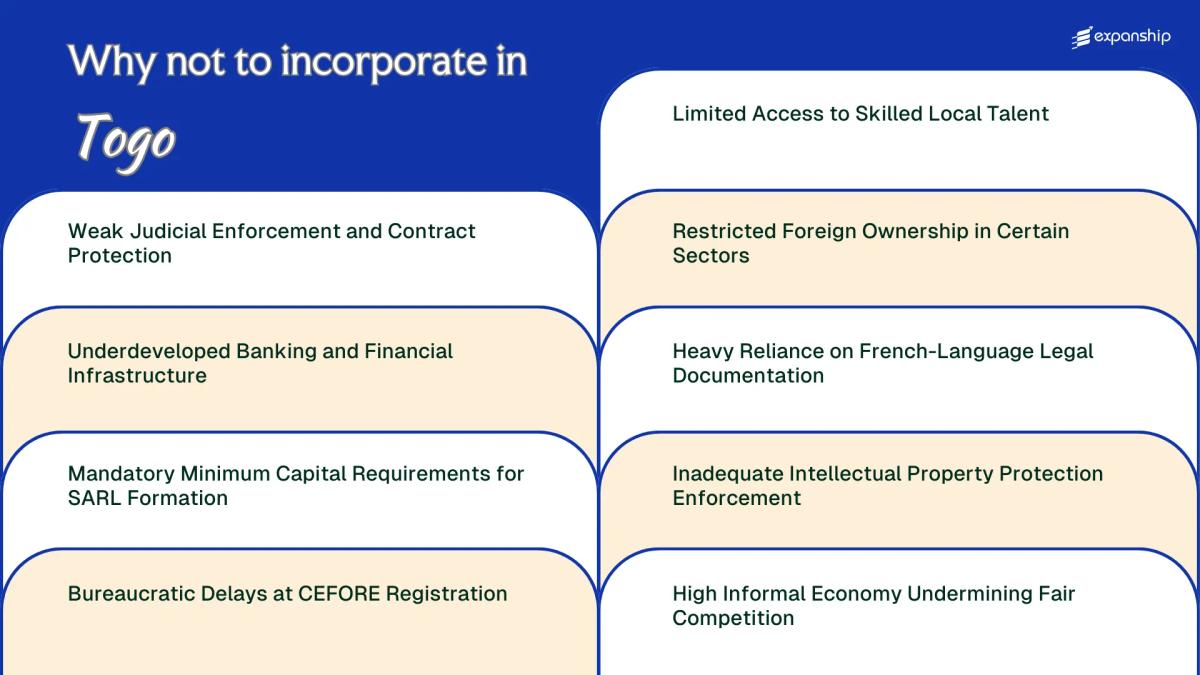
Weak Judicial Enforcement and Contract Protection
Togo judicial enforcement problems present a documented risk for foreign businesses operating under contract-dependent models. The country's formal legal system, while nominally governed by OHADA treaty law, operates within a judicial infrastructure that ranks poorly on enforcement reliability.
Contract Disputes Move Slowly Through Overburdened Courts
Commercial litigation in Togo is processed through the Tribunal de Commerce de Lomé, a court that handles high caseloads relative to its capacity. Delays of one to three years for contract dispute resolution are not uncommon, meaning that a breach of contract by a local counterparty can leave your business without remedy for extended periods.
OHADA's Uniform Act on General Commercial Law provides a regional legal framework, but local procedural backlogs limit its practical effectiveness within the national court system.
Enforcement of Arbitral Awards Faces Practical Gaps
Even when arbitration clauses are included in agreements, enforcing awards domestically can involve further judicial proceedings, adding cost and delay. Counterparties with limited assets or connections to informal economic structures may be practically judgment-proof.
Contract protection risks in Togo mean that even a legally valid ruling may not translate into recoverable damages, exposing your business to uncompensated financial loss.
Underdeveloped Banking and Financial Infrastructure
Togo banking infrastructure limitations affect foreign companies from the moment an entity attempts to open a corporate account. The banking sector is thin relative to regional peers, with a small number of licensed commercial banks operating under the oversight of the Central Bank of West African States (BCEAO), which sets monetary policy across WAEMU member states rather than addressing Togo-specific structural gaps.
Correspondent banking relationships with institutions outside West Africa are limited. This creates direct friction for firms receiving international wire transfers, settling foreign invoices, or repatriating profits, since transaction delays and compliance rejections are disproportionately common compared to more developed financial centres.
Credit access compounds the problem. Local banks apply conservative lending criteria to foreign-owned entities, often requiring collateral that a newly incorporated firm cannot immediately provide.
Practical burdens this creates for your business include:
- Delayed account opening timelines, sometimes stretching weeks beyond formal registration, stalling operations before they begin
- Restricted access to trade finance instruments like letters of credit, forcing reliance on advance payments
- High transaction fees on international transfers that erode margins on cross-border contracts
- Limited digital banking infrastructure, requiring physical branch visits for routine authorisations
Fintech alternatives remain nascent and are not yet regulated to accommodate corporate transactional accounts at scale.

Company Incorporation in Togo
Understand the structural requirements before registering your entity in Togo, including banking prerequisites and CEFORE obligations.
Mandatory Minimum Capital Requirements for SARL Formation
Under OHADA (Organisation pour l'Harmonisation en Afrique du Affaires) law, which governs commercial entities across Togo, a Société à Responsabilité Limitée requires a minimum share capital of XAF 100,000 at formation. While that figure appears modest in absolute terms, the Togo SARL minimum capital requirement must be fully subscribed and deposited before registration can proceed, creating an immediate liquidity obligation for founders who may still be testing market viability.
| Requirement | Detail | Burden for Foreign Incorporator |
|---|---|---|
| Minimum share capital | XAF 100,000 (~USD 160) | Must be fully paid up before CEFORE registration |
| Capital deposit method | Notarized bank deposit or notarial deed | Requires a local notary, adding cost and delay |
| Capital release condition | Funds locked until registration is complete | Capital is inaccessible during an uncertain registration timeline |
| OHADA governing act | Acte Uniforme sur les Sociétés Commerciales | Non-compliance invalidates incorporation |
The notarization requirement compounds this restriction. Your business must engage a local notary to certify the capital deposit, adding professional fees and scheduling dependencies before a single registration document reaches CEFORE.
Foreign-owned SARLs with a single associate face the same capital threshold as multi-partner structures. There is no tiered or reduced capital track for solo foreign incorporators, which means mandatory capital restrictions in Togo apply uniformly regardless of the firm's intended scale or revenue model.
Bureaucratic Delays at CEFORE Registration
CEFORE registration delays in Togo remain one of the most tangible operational friction points for foreign businesses entering the market. CEFORE, the Centre de Formalités des Entreprises, functions as the single-window registration mechanism under the OHADA framework, but the practical experience diverges significantly from that design intent.
Processing times frequently exceed the official target window. Incomplete document verification, inter-agency coordination gaps between CEFORE and bodies like the tax authority (OTR) and the social security office (CNSS), and manual processing at certain steps all extend the timeline in ways that affect your operational start date.
For a foreign business owner, delayed registration means delayed legal existence. You cannot open a corporate bank account, sign enforceable contracts, or hire staff under a formal payroll structure until the registration certificate is issued.
- Registration requires simultaneous clearance from OTR, CNSS, and the commercial court registry, any one of which can independently stall the process.
- Documents submitted in foreign languages must be notarized and translated into French before CEFORE will process them.
- The business activity code assigned at registration determines your tax classification, and errors require a formal correction procedure that restarts portions of the process.
- Your registered address must be legally confirmed before submission; a defective address document is grounds for rejection.
Togo's CEFORE portal provides the official submission checklist, though procedural requirements are subject to administrative updates without advance public notice.
Despite CEFORE operating as a single-window system designed to consolidate registrations, foreign companies often interact with four or more separate government bodies before receiving a final registration certificate.
Limited Access to Skilled Local Talent
Togo skilled labor shortage risks affect foreign companies most acutely at the mid-to-senior level, where demand for bilingual professionals with sector-specific technical expertise consistently outpaces local supply.
Structural Gaps in the Workforce
Togo's tertiary enrollment rates remain below the West African regional average, and the country's vocational training infrastructure has historically been underfunded relative to its economic ambitions under the government's Togo 2025 development roadmap. For a foreign firm establishing operations, this translates directly into higher recruitment costs and longer hiring timelines when filling roles that require financial, engineering, or technology-specific competencies.
Skilled professionals who do exist in the local market are often concentrated in Lomé, leaving businesses that operate outside the capital with even narrower recruitment pools.
Operational Consequences for Foreign Entities
Limited local talent challenges in Togo frequently push foreign employers toward expatriate hires, which triggers additional compliance obligations under the Labour Code of Togo, including work permit processing through the Ministry of Labour. Togo workforce limitations for foreign companies are compounded by salary expectations among qualified local candidates that reflect scarcity, not market equilibrium, raising payroll costs beyond initial projections. Companies operating in fintech, logistics, or light manufacturing tend to feel this constraint most sharply.
Addressing Workforce and Operational Challenges in Togo
Understand the compliance and structural constraints that affect foreign businesses in Togo, and get informed guidance before committing to incorporation.
Restricted Foreign Ownership in Certain Sectors
Togo foreign ownership restrictions present a direct structural barrier for foreign investors seeking full control over certain business activities in the country.
- Under the OHADA framework as applied locally and sector-specific regulations, foreign equity participation in areas such as land ownership, certain utilities, and media can be capped or conditioned, limiting your ability to hold a majority stake without a local partner.
- Entering a mandatory joint venture arrangement exposes your firm to governance disputes, profit-sharing obligations, and potential loss of operational control over key decisions.
- Restricted sectors for foreign investors in Togo are not always consolidated in a single public register, making pre-entry due diligence more resource-intensive and legally uncertain.
- Identifying a compliant local partner adds recruitment costs, legal structuring fees, and an ongoing dependency that does not exist in more open investment regimes.
- Sector-level restrictions may be enforced through ministry-level approvals rather than a single authority, creating inconsistent application of investment limitations by sector.
Heavy Reliance on French-Language Legal Documentation
Togo French language legal requirements extend across every stage of business operation, from the OHADA Uniform Acts governing company formation to filings submitted through CEFORE. All statutory documents, shareholder agreements, articles of association, and regulatory correspondence must be drafted in French, with no official accommodation for English or other languages.
For foreign founders who do not speak French, this creates a direct operational dependency on certified translators and bilingual legal counsel. Any mistranslation in foundational documents, such as the statuts constitutifs, can invalidate filings or trigger compliance disputes.
The burden compounds during ongoing compliance. Annual general meeting minutes, tax declarations submitted to the Office Togolais des Recettes (OTR), and labor contracts must all meet French-language standards to be legally valid.
- Errors in French-language filings can delay RCCM registration
- Engaging qualified bilingual legal counsel in Lomé adds recurring professional fees
- Document retranslation after amendments prolongs administrative timelines
A foreign-owned SARL with three shareholders requiring certified French translations of its articles of association, shareholders' agreement, and initial board resolutions could realistically incur between USD 1,500 and USD 3,000 in professional translation and notarization fees before a single business transaction takes place.
Inadequate Intellectual Property Protection Enforcement
Togo intellectual property protection risks are shaped largely by the country's membership in OAPI, the African Intellectual Property Organization, which handles trademark, patent, and copyright registration across 17 member states through a single filing system. While regional registration is procedurally accessible, enforcement of those rights at the national level remains the weak point.
OAPI registration does not translate into automatic local enforcement. Domestic courts in Lomé lack specialized IP divisions, meaning infringement cases are handled by general civil judges with limited technical familiarity with IP law.
Counterfeiting and trademark imitation are documented problems in West African markets, and your firm's registered marks offer limited deterrence when judicial proceedings are slow and penalties inconsistently applied. The practical cost of pursuing an infringement action, in time and legal fees, often exceeds the recoverable damages.
- IP registrations granted through OAPI carry no guarantee that local authorities will actively police violations
- Border enforcement against counterfeit goods is under-resourced
- Civil remedies are available in principle but rarely pursued to conclusion by foreign plaintiffs
Foreign businesses holding OAPI-registered rights should not assume those registrations will be proactively enforced by Togolese authorities; civil enforcement requires initiating and financing your own legal action through domestic courts.
High Informal Economy Undermining Fair Competition
Togo informal economy competition risks are a direct operational concern for registered firms. The informal sector accounts for an estimated 50 to 60 percent of economic activity, meaning a large share of your competitors operate outside the tax and regulatory obligations your entity must meet.
Informal operators avoid corporate income tax, CNSS social contribution obligations, and VAT compliance costs. That structural cost gap makes formal pricing consistently less competitive, particularly in retail, logistics, and trading.
Enforcement of OHADA commercial law against unregistered actors remains limited in practice. This means the legal protections your business pays to maintain offer little reciprocal advantage when competing against entities that ignore them entirely.
The unfair competition challenges in Togo are compounded by consumer price sensitivity. Buyers often default to informal suppliers offering lower prices, which directly pressures formal firms on margins without any regulatory remedy available.
Overcoming Incorporation Challenges in Togo
Overcoming incorporation challenges in Togo requires structural preparation rather than reactive problem-solving once operations have begun. The disadvantages covered in this blog point to systemic issues that demand deliberate planning before your business registers.
- Register through CEFORE to consolidate your administrative filings and reduce processing delays at the single-window registration centre.
- Verify that your SARL meets the minimum capital threshold under OHADA Uniform Act rules before submitting incorporation documents.
- Deposit capital with an approved Togolese bank prior to notarisation to satisfy the paid-up capital verification requirement.
- Confirm sector-specific foreign ownership restrictions under national investment law before finalising your shareholding structure.
- File all corporate documents in French and engage a locally qualified notary to ensure legal validity under Togolese civil procedure.
- Register any trademarks or intellectual property rights with the OAPI regional office to establish a formal protection record.
Togo operates within the OHADA legal framework, which provides a degree of supranational standardisation across commercial law, though domestic enforcement capacity remains uneven. Addressing each compliance layer systematically reduces exposure to the procedural and legal risks documented in this blog.
Togo's Overall Business Potential
Togo business potential despite risks is real, but it is conditional. The OHADA legal framework provides a recognized commercial foundation, and the country's position as a regional transit hub through the Port of Lomé adds genuine logistical value for certain business models. That said, the structural gaps documented across this blog are not minor friction points — they represent systemic constraints that affect day-to-day operations.
| Pros | Cons |
|---|---|
| OHADA membership provides a standardized commercial law framework shared across 17 member states | Judicial enforcement of contracts remains inconsistent, with limited practical recourse for foreign firms |
| The Port of Lomé offers direct deep-water access, supporting trade-oriented business models | CEFORE registration processes are subject to bureaucratic delays that extend setup timelines |
| SARL formation is available to foreign nationals without residency requirements | Minimum capital requirements for SARL formation create an upfront financial threshold |
| French as the official language aligns documentation with a broad Francophone legal network | All legal filings and regulatory correspondence must be conducted in French, limiting accessibility |
| Regional integration through ECOWAS expands the addressable market beyond domestic borders | Intellectual property protections exist under OAPI membership but enforcement remains limited in practice |
The informal economy's scale continues to distort competitive conditions, and restricted foreign ownership in certain sectors limits the range of viable structures available to incoming investors.
Compliance Services for Companies in Togo
Stay current with Togo's corporate compliance obligations, including annual filings, statutory reporting, and regulatory requirements under OHADA and local law.
Conclusion
Togo presents a viable but constrained environment for foreign incorporation, and the cons of incorporating in Togo deserve clear-eyed assessment before commitment. Judicial enforcement gaps leave commercial contracts exposed, while CEFORE registration delays extend timelines beyond what most investors anticipate. Structural barriers around banking access compound these operational difficulties. Sector-specific foreign ownership restrictions add a further layer of regulatory friction that due diligence alone cannot resolve. Engaging local legal counsel familiar with OHADA instruments and Togolese administrative procedures reduces exposure to the most predictable risks.
Expanship's Services for Your Togo Expansion
From registering your entity at CEFORE to meeting OHADA-compliant documentation requirements and managing ongoing obligations with Togo's tax authority (OTR), the administrative load of operating here is real. Expanship Togo company formation services are designed to reduce that operational burden by handling the procedural layers that slow most foreign businesses down during and after incorporation.
Our team supports your firm across the full setup and compliance cycle:
- We prepare and file all company registration documents with the relevant Togolese authorities on your behalf.
- A registered agent and local office address are provided to satisfy in-country presence requirements.
- We liaise directly with government bodies, including CEFORE and OTR, to manage filings and regulatory correspondence.
- Post-incorporation compliance, including annual obligations, is tracked and managed for your entity.
- We facilitate introductions to local banking institutions to support your account-opening process.
- Tax registration and coordination with local authorities are handled as part of your setup.
Reach out to Expanship Togo to discuss your incorporation requirements.
Frequently Asked Questions (FAQ)
The minimum capital requirement for an SARL under OHADA's Uniform Act on Commercial Companies is technically set at 1 FCFA, but Togo-specific banking and licensing requirements in regulated sectors can impose substantially higher thresholds. A micro-enterprise in retail faces different practical realities than a financial services firm seeking a sector-specific operating license from the relevant ministry.
Registration with the African Intellectual Property Organization (OAPI) gives you legal standing, but enforcement in Togo relies on local courts and customs authorities, both of which have limited technical capacity for IP matters. In practice, counterfeit goods and unauthorized use of protected marks persist with minimal state-led intervention, leaving rights holders to pursue costly private legal action.
Registration delays at CEFORE, Togo's business formalization center, have been a documented issue despite government reform efforts. Côte d'Ivoire and Senegal have both recorded faster average registration timelines in recent World Bank Doing Business assessments, suggesting Togo's processing bottlenecks place it behind several regional peers. Administrative backlogs and inconsistent document verification contribute directly to those delays.
Full foreign ownership is permitted in many sectors, but certain industries, including media, mining, and some agricultural activities, carry restrictions or require local partnership arrangements under Togolese sector-specific legislation. Before assuming full ownership is available, you need to verify the applicable sectoral law, since the general investment code does not override ministry-level regulations that govern specific industries.
A formally registered business in Togo bears the full burden of tax compliance, social security contributions to CNSS, and regulatory fees, while informal operators absorb none of those costs. That structural imbalance allows unregistered competitors to undercut formal pricing, particularly in retail, logistics, and small-scale manufacturing, without consequence. State enforcement against informal operators is inconsistent, so this is not a short-term condition your business should expect to resolve.
All statutory filings, shareholder agreements, and official correspondence with Togolese regulatory bodies must be in French, and any ambiguity introduced through poor translation can create material legal risk in a dispute. Unlike jurisdictions that permit bilingual filings, Togo offers no official allowance for English-language corporate documents, meaning errors in translated articles of association or shareholder resolutions could affect their legal validity before a Togolese court.
Togo's banking sector is underdeveloped relative to the transaction volumes that a mid-sized international business typically requires, with limited correspondent banking relationships and slower clearing processes than regional hubs like Côte d'Ivoire. Foreign exchange transactions can face delays and documentation requirements that disrupt payroll cycles and supplier payments. Businesses that depend on rapid cross-border capital movement regularly encounter friction that purely domestic operations do not face.
Legal Disclaimer
The information provided in this article is for general informational purposes only and does not constitute legal, tax, or professional advice. While we strive to ensure the accuracy and timeliness of the content, laws and regulations are subject to change, and the application of laws can vary widely based on specific facts and circumstances.
Readers should not act upon this information without seeking professional counsel tailored to their individual situation. Expanship and its authors disclaim any liability for actions taken or not taken based on the content of this article.
For specific advice regarding your business setup, compliance requirements, or any legal matters, please consult with qualified legal and tax professionals in the relevant jurisdiction.