
Key Takeaways
- All companies incorporated in Sint Maarten must register with the Chamber of Commerce of Sint Maarten as a condition of legal existence, with no exemption available based on foreign ownership or the nationality of shareholders.
- Under the Country Ordinance on Reporting Unusual Transactions, UBO disclosure is a mandatory compliance obligation that applies regardless of where the ultimate beneficial owner is resident or domiciled.
- Appointing a locally licensed registered agent is a structural requirement under Sint Maarten corporate law, not an optional administrative convenience, and must be satisfied before the company can lawfully operate.
- The Civil Code of Sint Maarten establishes the share capital thresholds that apply at the point of incorporation, and entities that fail to meet the applicable minimum cannot complete the registration process through the Chamber of Commerce.
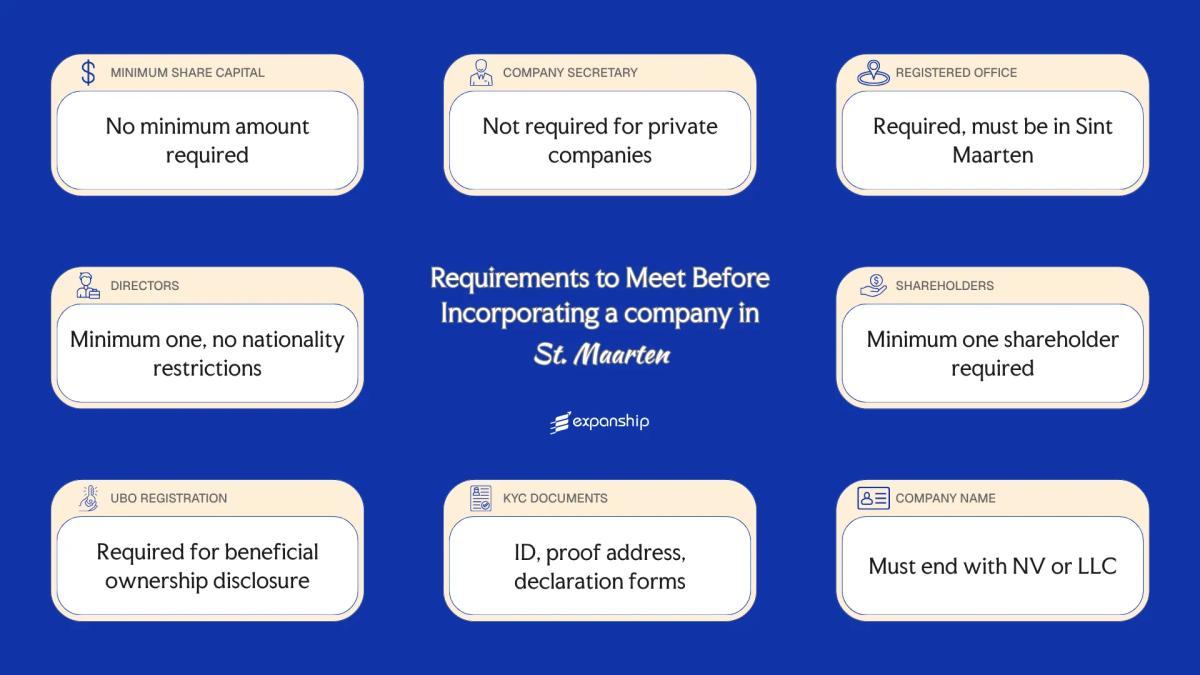
Incorporation in Sint Maarten is governed by the National Ordinance on Formal Legal Entities (Landsverordening Formeel Vreemdelingenrecht) and related corporate legislation, with entity registration administered through the Chamber of Commerce of Sint Maarten. Meeting the incorporation requirements Sint Maarten mandates is a prerequisite for legal existence; failure to satisfy them results in rejection of the application or the inability to lawfully conduct business.
This article covers the structural, documentary, and compliance requirements applicable to company formation under Sint Maarten law. Specific requirements differ depending on the entity type being formed, the industry in which the business operates, and the profile of the investor or shareholder involved.
The governing civil code provisions and ancillary ordinances define the legal baseline for all entities. Foreign investors and business owners intending to establish a legal presence in the jurisdiction will find this article most directly applicable to their situation.
Minimum Share Capital Requirements in Sint Maarten
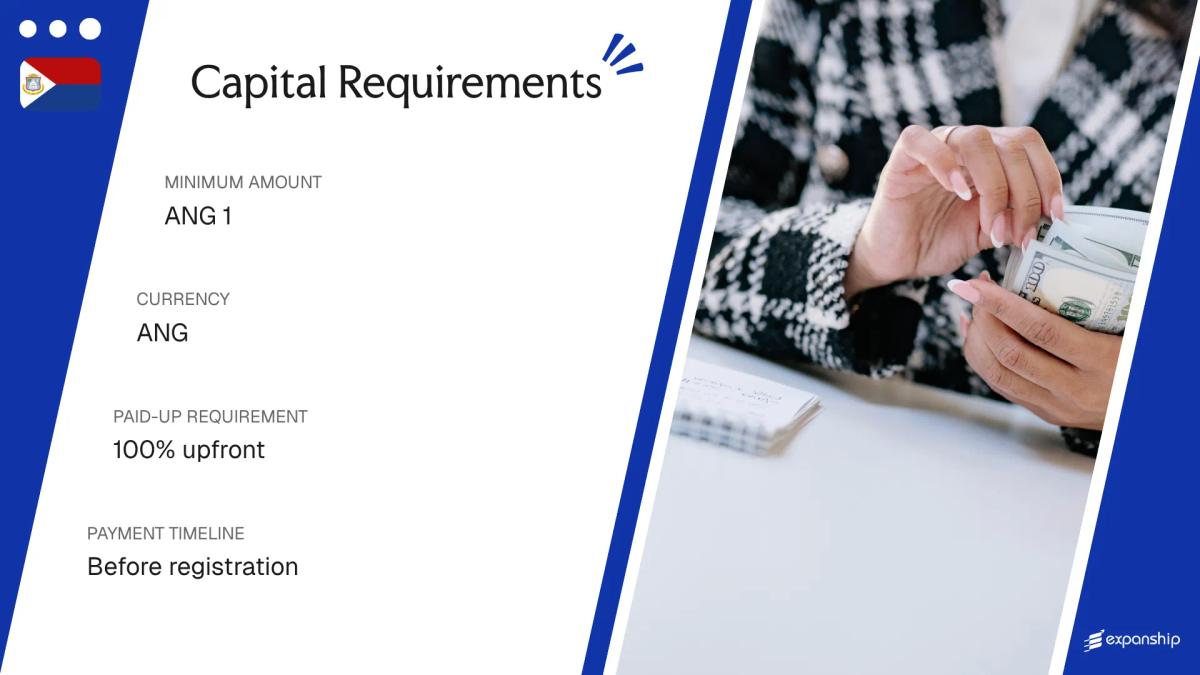
Sint Maarten share capital requirements are governed primarily by the Civil Code of Sint Maarten, which distinguishes between the Naamloze Vennootschap (NV) and the Besloten Vennootschap (BV) in terms of authorized and paid-up capital structures. Both entity types operate on a par value share system, meaning each share carries a nominal value stated in the articles of incorporation.
The Civil Registry of Sint Maarten, through the notarial deed process, is the point at which capital structure is formally established. Share capital requirements are primarily a one-time structural obligation at incorporation, though the articles of incorporation must continue to reflect the authorized capital accurately throughout the company's existence.
| Parameter | Detail |
|---|---|
| Minimum Authorized Share Capital | No statutory minimum for BV; NV requires a minimum authorized capital of ANG 50,000 |
| Maximum Authorized Share Capital | No statutory maximum |
| Minimum Paid-Up Capital | ANG 1 for BV; ANG 50,000 for NV (at least one-fifth must be paid up) |
| Paid-Up Requirement at Incorporation | Required prior to or at the moment the notarial deed of incorporation is executed |
| Accepted Currency | Netherlands Antillean Guilder (ANG); foreign currency permissible in practice |
| Accepted Forms of Contribution | Cash or non-cash contributions (in-kind assets subject to valuation) |
| Timeframe to Deposit Capital | At or before execution of the notarial deed of incorporation |
For an NV, at least one-fifth of the authorized share capital must be subscribed and paid up at incorporation — authorizing ANG 50,000 without meeting the paid-up threshold does not satisfy the statutory requirement.
Registered Agent Requirements in Sint Maarten
Under Sint Maarten registered agent requirements, entities formed under the National Ordinance on Formal Requirements for Businesses must appoint a local representative responsible for receiving official correspondence and maintaining certain statutory records on behalf of the company.
This representative acts as the formal point of contact for the Landsregister and regulatory authorities, ensuring the entity remains reachable for legal and administrative purposes within the jurisdiction.
Qualification criteria for serving as a registered agent in Sint Maarten include:
- The agent must be physically based in Sint Maarten and maintain a permanent local presence.
- Corporate service providers acting in this capacity are generally required to hold the appropriate licensing under local financial services regulations.
- Individuals may serve, provided they are residents of Sint Maarten with a verifiable local address.
- Law firms and licensed trust companies incorporated under Sint Maarten law are recognised eligible service providers.
- The agent bears statutory agent obligations including document retention and responding to notices from government authorities.

Incorporate a Company in Sint Maarten
Set up your business entity in Sint Maarten with full compliance support, from initial registration through to ongoing corporate maintenance.
Registered Office Requirements in Sint Maarten
Sint Maarten registered office requirements mandate that every company incorporated under the National Ordinance on Formal Requirements for Legal Entities maintains a registered address within the territory of Sint Maarten at all times. Failure to maintain a compliant legal address can result in administrative sanctions by the Civil Registry or complications with the Chamber of Commerce registration.
- A physical address within Sint Maarten is required; a P.O. Box alone does not satisfy this obligation.
- Virtual office arrangements may be used provided they supply a genuine, verifiable street address in Sint Maarten.
- The address must be locally based; a foreign address does not meet company domicile rules under Sint Maarten law.
- No ownership of the premises is required; a lease or service agreement confirming use of the address is generally acceptable.
- The registered office address is publicly listed in the Sint Maarten Chamber of Commerce trade register and is accessible to third parties.
- Any change to the registered address must be formally notified to the Chamber of Commerce; the amendment takes effect upon registration, not upon internal resolution.
Director Requirements in Sint Maarten
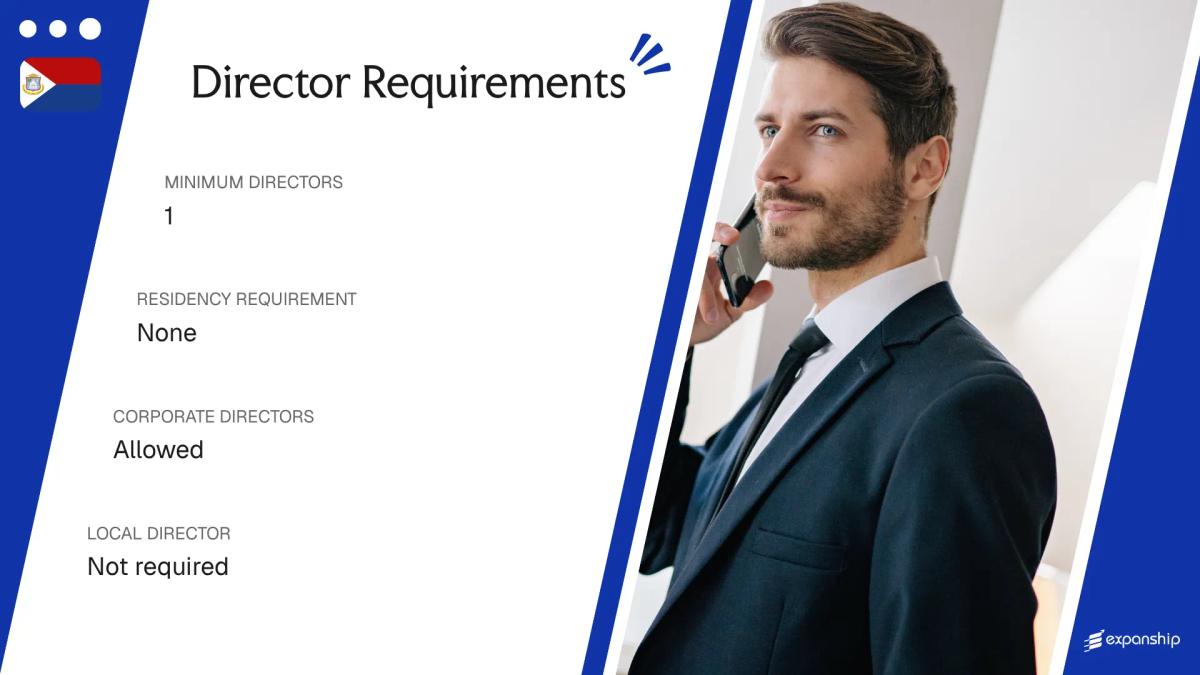
Under Sint Maarten director requirements, directors of a Naamloze Vennootschap (NV) or Besloten Vennootschap (BV) assume statutory duties of care and loyalty governed by the Civil Code of Sint Maarten, making them personally liable for mismanagement, wrongful acts, or failure to meet financial obligations of the entity.
| Parameter | Detail |
|---|---|
| Minimum Number of Directors | One director is required. |
| Maximum Number of Directors | No statutory maximum is prescribed. |
| Local/Resident Director Required | No local or resident director is required. |
| Nationality Restrictions | No nationality restrictions apply. |
| Minimum Age Requirement | Directors must be at least 18 years of age. |
| Corporate Directors Permitted | Corporate directors are permitted under Sint Maarten company law. |
| Director Must Be a Shareholder | No statutory requirement for a director to hold shares. |
| Publicly Listed on Registry | Director information is filed with the Chamber of Commerce of Sint Maarten but is accessible through the trade register. |
| Disqualification Conditions | A director may be disqualified following a court ruling related to fraud, bankruptcy misconduct, or breach of fiduciary duty under the Civil Code. |
Despite requiring no local director, Sint Maarten mandates that all director appointments be formally registered with the Chamber of Commerce before the individual can legally act on behalf of the company.
Shareholder Requirements in Sint Maarten
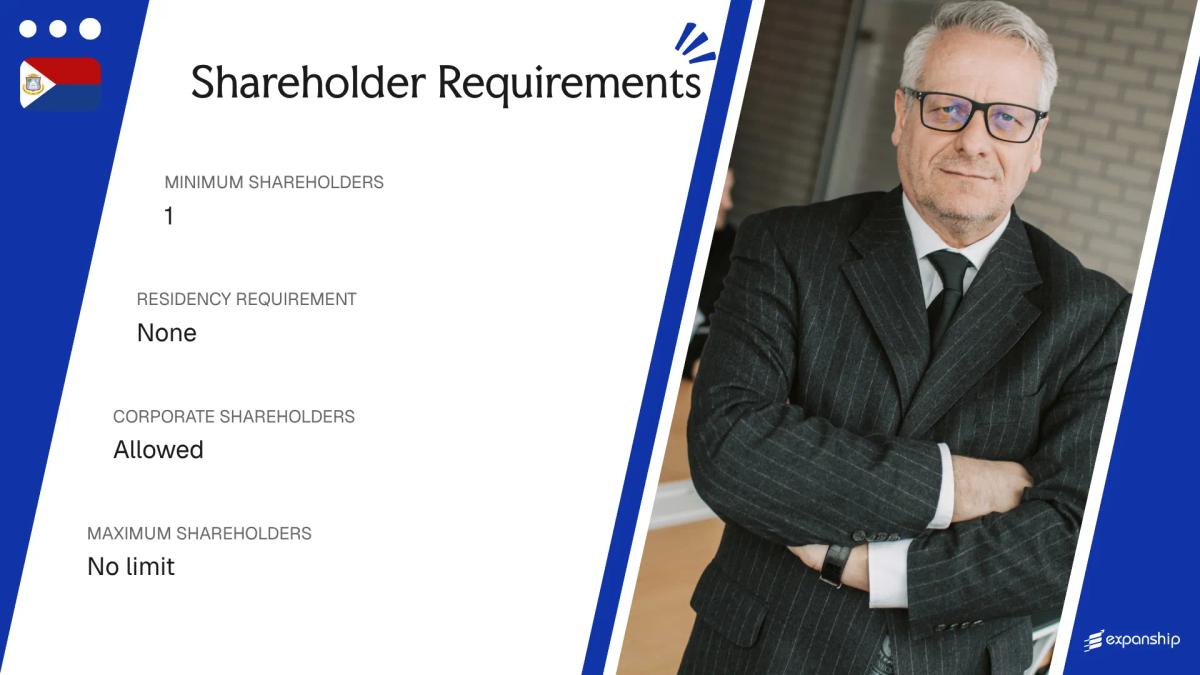
Sint Maarten shareholder requirements permit a minimum of one shareholder for a Naamloze Vennootschap (NV), making sole shareholder structures permissible. No statutory maximum applies, allowing for broadly held ownership structures.
Nationality and Residency Restrictions
Shareholders are not required to be residents or nationals of Sint Maarten. Foreign ownership is unrestricted, meaning 100% foreign shareholding is permitted under local company law.
Corporate Shareholders
Corporate entities may act as shareholders in a Sint Maarten company without restriction on their jurisdiction of incorporation. No additional conditions, such as local registration or presence, are imposed solely by reason of corporate shareholder status.
Shareholder Liability
Liability is generally limited to the amount unpaid on a shareholder's subscribed shares. Extended liability does not typically arise unless a court pierces the corporate veil in cases of fraud or improper conduct.
Register of Shareholders
A register of shareholders must be maintained at the company's registered office. This register is not publicly accessible, though updates are required to reflect any changes in ownership.
Structuring Your Ownership for Sint Maarten Incorporation
Get guidance on meeting shareholder criteria and ownership structuring requirements when forming a company in Sint Maarten.
UBO / Beneficial Ownership Registration Requirements in Sint Maarten
Sint Maarten UBO registration requirements are governed by the National Ordinance on the Identification of Clients (Landsverordening Identificatie bij Dienstverlening) and related AML/CFT legislation administered by the Central Bank of Curaçao and Sint Maarten (CBCS). A beneficial owner is generally defined as any natural person who directly or indirectly holds more than 25% of the shares, voting rights, or ownership interest in an entity, or who otherwise exercises ultimate effective control.
- Identify all natural persons who meet the beneficial ownership threshold prior to or at the time of incorporation.
- Disclose UBO information to your obliged service provider (such as a licensed corporate service provider or notary) as part of the client identification process.
- The service provider records and retains UBO data in accordance with CBCS supervision requirements.
- Update UBO records whenever a change in beneficial ownership occurs.
| Parameter | Detail |
|---|---|
| Ownership Threshold for UBO Status | 25% or more of shares, voting rights, or ownership interest |
| Filing Authority | Central Bank of Curaçao and Sint Maarten (CBCS) via obliged service providers |
| Disclosure Deadline at Incorporation | At the time of establishing the client relationship |
| Publicly Accessible Register | No |
| Penalties for Non-Disclosure | Administrative sanctions under applicable AML/CFT legislation |
| Ongoing Update Obligation | Yes; changes must be reported to the service provider promptly |
KYC / Document Requirements in Sint Maarten
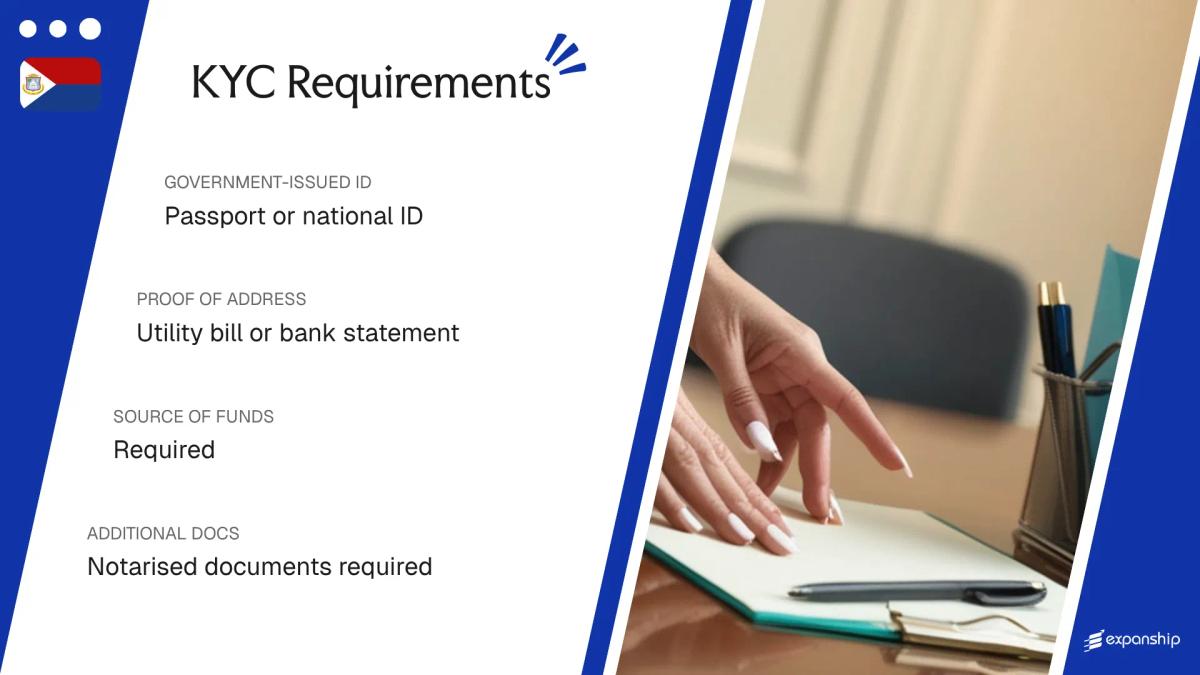
Sint Maarten KYC document requirements are governed by the National Ordinance on the Identification of Clients when Rendering Financial Services and the National Ordinance on the Reporting of Unusual Transactions, enforced under the supervision of the Financial Intelligence Unit Sint Maarten. All parties involved in a company formation must be identified and verified before the entity is registered.
Individual / Personal Documents
- Valid government-issued passport or national identity card
- Proof of residential address dated within three months (utility bill or bank statement)
- Completed and signed KYC declaration form
- Recent passport-sized photograph may be required by the registered agent
Corporate Documents
- Certificate of incorporation of the parent or shareholder entity
- Certified copy of the memorandum and articles of association
- Current register of directors and shareholders of the corporate entity
- Proof of registered office address of the corporate shareholder
Source of Funds Documentation
- Recent bank statements covering a minimum of three months
- Audited financial statements where the entity has an operating history
- A signed source of funds declaration letter from the beneficial owner
Notarisation and Apostille Requirements
- Foreign public documents generally require an apostille under the Hague Convention
- Certified translations into Dutch or English are required for documents in other languages
- Notarisation requirements depend on the issuing country's document standards
Incomplete or unverified source of funds documentation is the most common cause of incorporation delays in Sint Maarten.
Company Name Requirements in Sint Maarten
Proposed company names in Sint Maarten are assessed for availability and suitability before incorporation is confirmed. Sint Maarten company name requirements prohibit names that are identical or deceptively similar to existing registered entities.
Structural rules require that a Naamloze Vennootschap include the suffix "N.V." and a Besloten Vennootschap include "B.V." Names must be in Latin script, though no single official language is mandated.
Certain words implying government affiliation, financial licensing, or regulated activities require prior approval from the relevant supervisory authority before the name can be accepted.
Name reservation is generally available through the Chamber of Commerce of Sint Maarten, securing the proposed name for a limited period ahead of formal registration.
Corporate Compliance Services in Sint Maarten
Ongoing compliance support for companies registered in Sint Maarten, including annual filing, regulatory reporting, and name-related registry requirements.
Conclusion
Sint Maarten company registration requirements span several layers of statutory obligation, from share capital thresholds under the Civil Code of Sint Maarten to UBO disclosure under the Country Ordinance on Reporting Unusual Transactions. Two requirements tend to define the compliance profile most directly: the mandatory appointment of a locally licensed registered agent and the UBO registration obligation, which applies regardless of where the ultimate beneficial owner resides. Once these obligations are understood, a foreign investor moves from framework comprehension to execution, a phase that involves document preparation, local coordination, and ongoing compliance management.
Expanship's Company Formation Services in Sint Maarten
Expanship's Sint Maarten company formation services cover the full incorporation process, from preparing articles of incorporation under the Civil Code of Sint Maarten to coordinating with the Chamber of Commerce and Notarial Civil Law department. The UBO registration requirements, KYC documentation standards, and registered agent obligations discussed throughout this guide each carry their own administrative weight. Expanship's role is to manage that burden directly, so your business can meet these requirements without diverting internal resources.
Beyond initial registration, Expanship supports your entity across a broader scope of corporate needs:
- We prepare and file all company registration documentation with the relevant Sint Maarten authorities.
- A local registered agent and registered office address are provided to satisfy statutory requirements.
- We liaise with government bodies and regulatory offices on your behalf throughout the filing process.
- Post-incorporation compliance management keeps your firm in good standing on an ongoing basis.
- Banking introduction assistance is available to support your business in establishing local financial relationships.
- Tax registration and coordination with local authorities is handled as part of the incorporation process.
Reach out to Expanship Sint Maarten to discuss your incorporation requirements.
Frequently Asked Questions (FAQ)
The UBO registration requirement under Sint Maarten's beneficial ownership framework applies broadly across legal entities, including both NVs and BVs. Any natural person who directly or indirectly holds more than 25% of the shares, voting rights, or effective control over the entity must be registered. There are no exemptions based on company size or industry.
Failure to provide complete and accurate KYC documentation can result in the incorporation being refused or significantly delayed by the notary or licensed trust company handling the filing. Sint Maarten's financial integrity regulations, aligned with FATF standards, give authorities the basis to reject applications where identity or source-of-funds documentation is incomplete. In cases involving misrepresentation, criminal liability under local anti-money laundering statutes may also apply.
Sint Maarten requires that your proposed company name be reviewed for conflicts and approved before the deed of incorporation is executed before a civil-law notary. Unlike some Caribbean jurisdictions that operate a self-service name reservation registry, Sint Maarten's process runs through the notarial and Chamber of Commerce registration pathway, which adds a verification layer before the name is formally secured. Names that are identical or confusingly similar to existing registered entities will be rejected.
A foreign national can serve as the sole director of a Sint Maarten NV or BV; there is no statutory requirement for a locally resident director. However, if the entity is managed and controlled entirely from abroad, this may have implications for tax residency determinations and substance assessments under applicable regulations. Practical considerations around signing authority and notarial requirements may also influence how you structure the directorship.
Your entity is legally required to maintain a registered office at a physical address in Sint Maarten at all times, and any change must be updated with the Chamber of Commerce. Failure to maintain a valid registered address can result in the company falling out of good standing, which affects its ability to enter contracts, open bank accounts, and satisfy annual compliance obligations. The update must be formally registered to take legal effect.
A single individual can hold 100% of the shares in a Sint Maarten BV, as the law permits sole-shareholder structures for that entity type. For an NV, the requirements around shareholder composition should be confirmed against the current text of the Landsverordening op de Naamloze Vennootschappen, as NV structures were historically designed with a broader capital base in mind. Your notary will advise on how the shareholding structure must be reflected in the deed of incorporation.
Legal Disclaimer
The information provided in this article is for general informational purposes only and does not constitute legal, tax, or professional advice. While we strive to ensure the accuracy and timeliness of the content, laws and regulations are subject to change, and the application of laws can vary widely based on specific facts and circumstances.
Readers should not act upon this information without seeking professional counsel tailored to their individual situation. Expanship and its authors disclaim any liability for actions taken or not taken based on the content of this article.
For specific advice regarding your business setup, compliance requirements, or any legal matters, please consult with qualified legal and tax professionals in the relevant jurisdiction.