
Key Takeaways
- Businesses registering through the Instituto Nacional de Apoio às Empresas (INAE) face procedural delays that extend setup timelines beyond what is typical in more administratively efficient jurisdictions.
- The Commercial Code governs company formation under a framework that continues to develop incrementally, leaving gaps in areas such as intellectual property protection that can expose foreign investors to unmitigated commercial risk.
- São Tomé and Príncipe's heavy reliance on imported goods and materials structurally elevates operating costs for businesses across most sectors, compressing margins from the outset.
- Access to capital is materially constrained by an underdeveloped domestic banking sector and limited integration with international capital markets, which restricts financing options for both early-stage and established entities operating in the jurisdiction.
São Tomé and Príncipe operates under an evolving regulatory framework, where commercial law continues to develop incrementally rather than through consolidated reform. The primary keyword — disadvantages of incorporating in São Tomé and Príncipe — covers a range of structural, institutional, and operational challenges that this article addresses across its sections.
The drawbacks examined here span infrastructure, professional services, capital access, and administrative processes under the Instituto Nacional de Apoio às Empresas (INAE), the body responsible for business registration. Not all of these challenges will affect every entity equally; the impact varies significantly depending on business type, target market, and operational structure.
The Commercial Code governs the legal framework for company formation in the jurisdiction. Foreign investors considering a presence here — particularly those in financial services, technology, or import-dependent industries — are most likely to encounter the constraints this article examines.
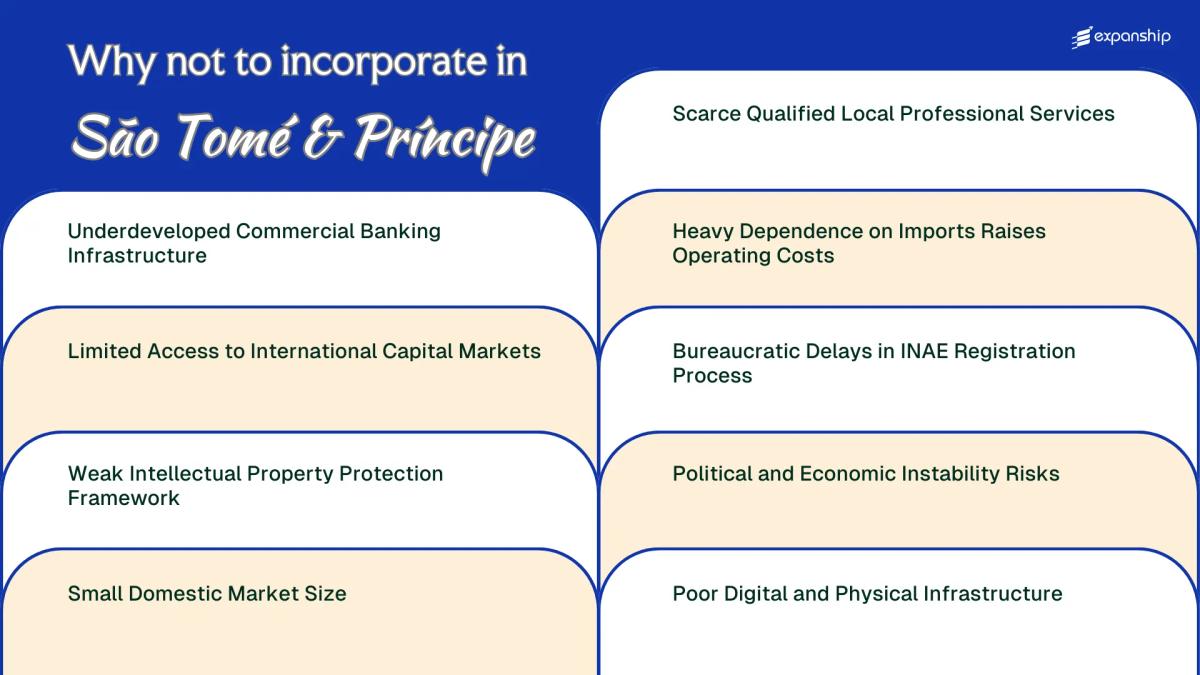
Underdeveloped Commercial Banking Infrastructure
São Tomé and Príncipe banking infrastructure problems affect foreign businesses from the moment they attempt to open a corporate account. The financial sector remains thin, with only a small number of licensed commercial banks operating in the country.
Limited Banking Services for Corporate Clients
Banco Internacional de São Tomé e Príncipe (BISTP) and a handful of other institutions constitute the entire commercial banking system, which means your firm has minimal choice in service providers. This concentration results in limited product offerings, slower transaction processing, and little competitive pressure to improve corporate banking terms.
Correspondent banking relationships between local banks and major international financial institutions are restricted, creating friction for cross-border payments and foreign currency transactions.
Currency and Transaction Constraints
The national currency, the dobra (STN), is pegged to the euro under a monetary agreement with Portugal, which provides exchange rate stability but does not resolve the underlying weakness in domestic banking capacity. Foreign businesses that require regular international wire transfers, multi-currency accounts, or trade finance facilities will find local institutions ill-equipped to deliver these services reliably.
Your business may face significant delays or outright inability to execute routine international transactions through locally licensed banks, directly disrupting supplier payments and revenue repatriation.
Limited Access to International Capital Markets
São Tomé and Príncipe capital markets restrictions stem from the absence of a functioning stock exchange and the near-total underdevelopment of domestic securities markets. Foreign businesses registered locally cannot raise equity capital through public offerings, which forces complete reliance on private funding or bank credit.
The country's monetary authority, the Banco Central de São Tomé e Príncipe (BCSTP), oversees foreign exchange operations under a currency peg to the euro through the escudo. While this peg provides nominal stability, foreign investors cannot repatriate profits or access capital instruments with the same procedural ease available in more financially integrated jurisdictions.
Practical consequences for your business include:
- Inability to issue bonds or equity instruments locally, forcing you to structure capital raises entirely offshore at added legal cost
- No domestic institutional investor base means venture or growth capital must come from international sources unfamiliar with the jurisdiction
- Foreign exchange approval requirements through BCSTP create delays when transferring capital across borders for operational needs
Accessing multilateral development finance, such as instruments offered by the African Development Bank, requires demonstrating project bankability that most small entities incorporated here cannot realistically satisfy.

Company Incorporation in São Tomé and Príncipe
Understand the full regulatory and structural requirements before registering a business in São Tomé and Príncipe.
Weak Intellectual Property Protection Framework
São Tomé and Príncipe intellectual property risks are a genuine concern for any foreign business bringing brands, software, or proprietary methods into the country. The national IP framework remains underdeveloped, with limited institutional capacity to register, monitor, or enforce intellectual property rights at the domestic level.
The country is a member of the African Intellectual Property Organization (OAPI) through its association with Lusophone African legal traditions, but practical enforcement mechanisms within the islands themselves are thin. Your registered trademark or patent may exist on paper, yet local courts lack the specialization and caseload experience to adjudicate infringement disputes effectively.
| IP Protection Factor | Situation in São Tomé and Príncipe |
|---|---|
| Dedicated IP tribunal | None; cases handled by general civil courts |
| Average IP dispute resolution time | Prolonged; no published benchmark timeframe |
| Trademark registration problems | Limited local registry capacity; reliance on OAPI |
| Customs IP enforcement | Minimal; counterfeit goods interception capacity is low |
Intellectual property law limitations mean that even a validly registered mark offers weaker real-world protection than in jurisdictions with dedicated IP registries and enforcement agencies. A competitor operating locally can reproduce branded materials or processes with limited risk of swift legal consequence.
Small market size reduces the financial incentive for attorneys to specialize in IP litigation, further compressing the available pool of competent legal counsel for disputes.
Small Domestic Market Size
São Tomé and Príncipe's small market size drawbacks are structural, not incidental. With a population of roughly 230,000 people spread across two islands, the addressable consumer base for any product or service is severely constrained from the outset.
Gross domestic product remains among the lowest in sub-Saharan Africa. For a foreign business that needs local revenue to offset setup and operating costs, that ceiling creates a direct return-on-investment problem that no operational efficiency can resolve.
Retail, financial services, and consumer goods sectors all face the same ceiling. Any entity pricing its products for a market of this scale cannot spread fixed costs — including compliance, staffing, and infrastructure — across a sufficient customer volume to achieve unit economics comparable to larger markets.
The limited domestic market challenges in São Tomé and Príncipe also affect B2B opportunities. The number of viable commercial counterparties, suppliers, and institutional clients is small, which limits contract diversity and concentrates revenue risk.
According to World Bank data, the country's GDP has hovered below USD 800 million for the past decade, a figure that contextualises the ceiling your business is working within.
- Revenue projections must account for a consumer base under 230,000 people
- Sector saturation can occur quickly; niche markets may already be served by one or two operators
- Foreign firms cannot rely on domestic sales alone to achieve financial sustainability
- B2B pipeline depth is limited by the number of active formal businesses registered with INAE
- Export-oriented models are a functional requirement, not an option, for most incorporated entities
Despite its small population, São Tomé and Príncipe has two separate legal and administrative jurisdictions — the main island and the autonomous region of Príncipe — meaning certain business activities may require separate regulatory engagement with the Regional Government of Príncipe.
Scarce Qualified Local Professional Services
São Tomé and Príncipe professional services limitations create measurable operational friction for foreign businesses, particularly in legal, accounting, and compliance functions where local expertise is not optional.
A Thin Pool of Credentialed Professionals
The island nation's small population, roughly 230,000 people, produces a correspondingly limited number of university-trained lawyers, chartered accountants, and corporate compliance specialists. Your business may find that the few qualified practitioners available are already at capacity serving government institutions or established domestic clients, leaving foreign-registered entities with limited, and often expensive, access to independent counsel.
Auditing and tax advisory services present a particular gap. Firms requiring IFRS-compliant financial reporting or specialized tax structuring under the country's fiscal code may struggle to source practitioners with that level of technical preparation locally.
Operational Consequences for Foreign Entities
Qualified workforce drawbacks in São Tomé and Príncipe translate directly into delayed filings, increased reliance on remote or regional advisers based in Lisbon or Luanda, and elevated service costs that erode the marginal benefits of lower incorporation fees. Regulatory submissions to bodies such as INAE or the tax authority can fall behind schedule when local professional capacity is unavailable. Companies operating in regulated sectors face the sharpest exposure, since sector-specific licensing typically requires in-country professional sign-off.
Professional Support for Operating in São Tomé and Príncipe
Expanship can connect your business with vetted advisers and compliance support to address the qualified professional services gap in São Tomé and Príncipe.
Heavy Dependence on Imports Raises Operating Costs
São Tomé and Príncipe high import dependency risks translate directly into elevated input costs that your business cannot easily absorb. The island state produces few manufactured goods domestically, meaning virtually all equipment, raw materials, and commercial supplies must be sourced from abroad.
- Shipping costs from primary trading partners, including Portugal and Angola, add a compulsory freight and logistics premium to nearly every procurement decision your firm makes.
- Port handling delays at the Port of São Tomé extend supplier lead times unpredictably, making inventory planning expensive and unreliable for any product-dependent operation.
- Import duties applied under the country's customs tariff schedule increase the landed cost of goods before they even enter your supply chain.
- Currency dependency on the dobra, pegged to the euro, means import invoice values fluctuate with exchange rate movements outside your control.
- No significant domestic manufacturing base exists to substitute foreign inputs, so supply chain limitations cannot be resolved through local sourcing as they might be in larger economies.
Bureaucratic Delays in INAE Registration Process
INAE registration delays in São Tomé and Príncipe represent one of the more immediate operational barriers for foreign investors attempting to establish a legal entity. The Instituto Nacional de Apoio às Empresas (INAE) serves as the central body overseeing business registration, but processing timelines frequently extend beyond published estimates due to staffing constraints and manual administrative procedures.
Document verification often requires physical presence or notarized submissions, which adds friction for foreign-based principals who cannot easily coordinate across time zones with a small island bureaucracy.
Even straightforward incorporations can stall when filings are returned for minor technical corrections. Each resubmission resets the queue position, extending the timeline further without any formal appeal mechanism to accelerate review.
- Registration steps may span multiple agencies, including notarial offices and the tax authority (DGCI)
- Incomplete interagency coordination means delays in one office cascade across the entire process
- No publicly documented expedited registration track exists for foreign investors
A foreign-owned limited liability company (Sociedade por Quotas) requiring notarization, tax registration, and INAE approval could realistically spend 8 to 12 weeks completing incorporation formalities, during which time no business activity can legally commence and any pre-signed commercial agreements remain unenforceable.
Political and Economic Instability Risks
São Tomé and Príncipe political instability business risks are structural, not cyclical. Since independence in 1975, the country has experienced frequent changes in government, with coalition politics producing repeated cabinet reshuffles that disrupt policy continuity across ministries, including those overseeing business registration, taxation, and investment approvals.
Regulatory decisions affecting your business can shift with each new administration. A policy in force when you incorporate may be revised or reversed within months, creating unpredictable compliance obligations and making long-term financial planning unreliable.
The country's fiscal position adds a separate layer of exposure. Heavy reliance on foreign aid and oil revenue expectations that did not materialize has contributed to recurring budget shortfalls, which historically pressure the government to adjust tax structures and public service delivery without advance notice to foreign entities.
Currency risk compounds the governance instability. The dobra (STN) is pegged to the euro through a monetary agreement with Portugal, but the underlying fiscal conditions that could strain that arrangement remain a live concern for investors holding dobra-denominated assets or revenue.
Foreign businesses operating under investment agreements or sector licenses should verify that any contractual protections are legally binding under current São Tomé and Príncipe law, as policy reversals between administrations have historically not been subject to automatic grandfathering.
Poor Digital and Physical Infrastructure
São Tomé and Príncipe infrastructure challenges for business begin with the island nation's limited road network, unreliable electricity supply, and constrained port capacity at the Port of São Tomé. Operational continuity becomes difficult when power outages are frequent enough to require generator backup as standard practice, adding to fixed operating costs.
Broadband penetration remains low, and internet connectivity depends heavily on undersea cable links that have historically suffered outages. For any business requiring consistent data transfer, cloud operations, or remote communication with international partners, this unreliability translates directly into productivity loss.
Air cargo and passenger connections are limited to a small number of routes through São Tomé International Airport, with no direct connections to major financial or logistics hubs outside West Africa. Supply chain delays caused by poor logistics and connectivity problems compound the already high import dependency that firms operating here face.
Overcoming Incorporation Challenges in São Tomé and Príncipe
Overcoming incorporation challenges in São Tomé and Príncipe requires structural preparation before engaging with local processes, not reactive adjustment afterward. The disadvantages covered in this blog are systemic, and addressing them starts with how your entity is structured at the outset.
- Register your company through the INAE portal to initiate the formal incorporation process and reduce administrative delays tied to in-person submission.
- Open a multi-currency account with a correspondent-banking-connected institution to reduce exposure to São Tomé and Príncipe's limited domestic banking network.
- Structure your firm under a holding entity in a jurisdiction with bilateral investment treaty coverage to address political and economic instability risks.
- Source qualified legal, accounting, and notarial professionals prior to incorporation, given the scarcity of credentialed local practitioners.
- Budget import-dependent operating costs into your financial model from incorporation, accounting for the country's reliance on external supply chains.
- Register any intellectual property in a recognized international framework before commencing operations, given the absence of a developed local IP enforcement regime.
Mitigating company formation risks here operates within a regulatory environment governed by the Código das Empresas Comerciais and overseen by INAE. Structural decisions made before registration carry more weight than post-incorporation adjustments.
São Tomé and Príncipe's Overall Investment Viability
São Tomé and Príncipe investment viability risks are real and well-documented, yet the country still functions as a legitimate incorporation destination for businesses with narrow operational requirements and a tolerance for frontier-market conditions. Offshore holding structures, niche hospitality ventures, and entities linked to regional trade corridors have found the jurisdiction workable, provided expectations are calibrated accordingly.
| Pros | Cons |
|---|---|
| Dobra-denominated accounts allow local operations without mandatory hard currency exposure | Commercial banking infrastructure is underdeveloped, limiting transaction options for foreign firms |
| The country maintains formal trade relationships within the ECCAS regional bloc | The domestic market is among the smallest globally, restricting local revenue potential |
| Political transitions have remained largely peaceful relative to the broader Central African region | Frequent government changes introduce policy uncertainty that affects long-term planning |
| INAE registration is a defined legal process with a statutory framework | Bureaucratic delays in that process extend timelines and raise setup costs |
| Geographic position in the Gulf of Guinea offers proximity to West and Central African markets | Heavy import dependence across most goods and services inflates ongoing operating costs |
Intellectual property protections remain structurally weak, and qualified local professional services are scarce. Digital and physical infrastructure gaps add friction to daily operations that businesses in more developed markets rarely encounter.
Compliance Services for Companies in São Tomé and Príncipe
Maintain your entity's good standing with ongoing compliance support covering statutory filings, regulatory reporting, and local obligations under São Tomé and Príncipe's corporate framework.
Conclusion
The São Tomé and Príncipe company formation drawbacks summary points to a jurisdiction where structural constraints carry real operational weight. Banking access remains thin, with correspondent relationships limited and international transfers subject to delays that affect day-to-day business functions. Dependence on imports compounds operating costs in ways that are difficult to offset locally. Professional services capacity is narrow, meaning external support becomes a practical requirement rather than an option. For any firm considering registration through INAE, understanding these conditions in advance shapes how incorporation is planned and resourced.
Expanship's São Tomé and Príncipe Expansion Services
Incorporating in São Tomé and Príncipe carries real operational weight — from INAE registration delays and underdeveloped banking infrastructure to the limited pool of qualified local professionals. Expanship's São Tomé and Príncipe business expansion services are structured to reduce that burden, helping your business meet its compliance obligations without losing momentum to procedural friction.
Beyond registration, our firm supports the full scope of your setup and ongoing obligations:
- We prepare and file all company registration documents with the relevant authorities on your behalf.
- Our team provides registered agent and office services to satisfy local presence requirements.
- We handle government filings and liaise directly with regulatory bodies including INAE.
- Post-incorporation compliance management keeps your entity in good standing over time.
- We offer banking introduction assistance to help you establish a functional local account.
- Tax registration and coordination with local authorities are managed as part of our service.
Reach out to Expanship São Tomé and Príncipe to discuss how we can support your expansion.
Frequently Asked Questions (FAQ)
Delays at the Instituto das Actividades Económicas (INAE) affect virtually all commercial entity registrations, not just specific structures. Processing times can extend well beyond official timelines due to understaffing, document backlogs, and coordination requirements with other agencies such as the tax authority (DNRE). Foreign applicants who submit documentation remotely face additional rounds of notarization and legalization that compound these delays.
The country has experienced frequent government changes and coalition instability, which directly affects regulatory consistency and the pace of economic reform. Compared to some small island jurisdictions in the Indian Ocean or Caribbean with more settled governance, São Tomé and Príncipe presents a higher degree of policy unpredictability. This creates a real risk that operating conditions, tax treatment, or sector-specific rules may shift without adequate notice.
With a population of roughly 230,000, the domestic consumer base is too small to sustain most businesses operating exclusively within the country. A firm incorporated here typically must generate revenue through export activity, regional trade, or offshore service models, which adds logistical and regulatory complexity. Companies that rely on local purchasing power alone will find growth options structurally limited from the outset.
São Tomé and Príncipe has limited domestic IP enforcement capacity, and the judicial system lacks the specialist resources to handle IP disputes efficiently. A foreign business holding trademarks, patents, or proprietary technology faces real risk of infringement without a credible local remedy. Enforcement typically requires costly international arbitration or reliance on bilateral treaty frameworks, neither of which provides the fast-track protection most businesses need.
Because the islands produce very little outside agriculture and fisheries, most equipment, office supplies, technology, and consumer goods must be imported, with shipping costs and customs duties adding substantially to base prices. Operational costs for a foreign entity can run significantly higher than on the African mainland, particularly for sectors requiring specialized equipment or reliable supply chains. There is no domestic manufacturing base to offer cost-competitive local sourcing alternatives.
Hiring expatriates is legally possible but comes with its own administrative burden, including work permit applications processed through the relevant labour authority and compliance with local labor law requirements under the Código do Trabalho. Permit processing timelines are inconsistent, and housing and relocation costs for expatriate employees in São Tomé city are high relative to the size of the economy. This means the talent gap is addressable, but at a cost that materially increases your total workforce expenditure.
Legal Disclaimer
The information provided in this article is for general informational purposes only and does not constitute legal, tax, or professional advice. While we strive to ensure the accuracy and timeliness of the content, laws and regulations are subject to change, and the application of laws can vary widely based on specific facts and circumstances.
Readers should not act upon this information without seeking professional counsel tailored to their individual situation. Expanship and its authors disclaim any liability for actions taken or not taken based on the content of this article.
For specific advice regarding your business setup, compliance requirements, or any legal matters, please consult with qualified legal and tax professionals in the relevant jurisdiction.