

Key Takeaways
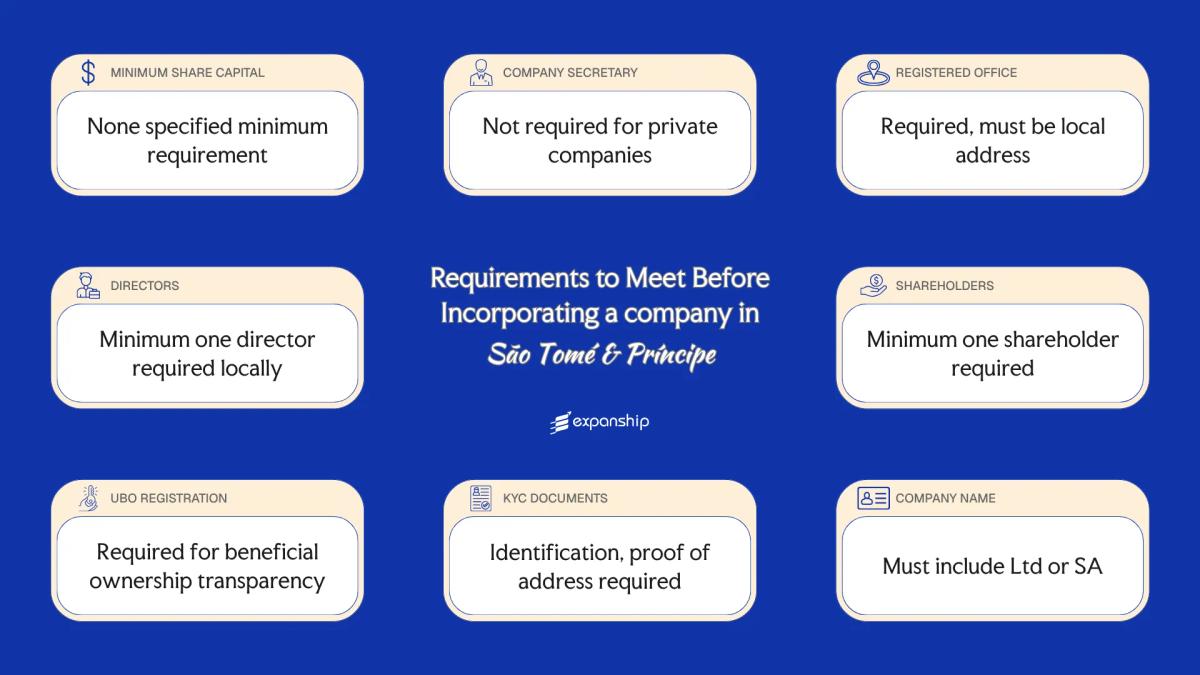
- Incorporation in São Tomé and Príncipe is governed by the Código Comercial and processed through the Conservatória do Registo Comercial, meaning all formation filings must comply with that legislative framework and be submitted to that specific registry body.
- Foreign investors are required to satisfy resident directorship obligations, a physical registered office address, and UBO disclosure to local authorities as conditions of valid company formation.
- Beneficial ownership information must be disclosed to São Tomé and Príncipe authorities, making this a mandatory structural consideration rather than an optional transparency measure when designing your entity's governance.
- The applicable capital, governance, and documentary requirements can vary depending on the legal form chosen, the sector of operation, and whether the investor is resident or foreign-domiciled, requiring confirmation of the specific rules before filing.
Company registration requirements in São Tomé and Príncipe are governed by the Código Comercial (Commercial Code), with entity formation overseen by the Conservatória do Registo Comercial, the body responsible for maintaining the commercial register. You can refer to the Commercial Code for the legislative framework that underpins the incorporation process.
This article addresses the structural and documentary requirements that apply across the formation process, from capital and governance to identity verification and naming rules.
Failure to satisfy these requirements results in the rejection of your registration application or, where an entity is already operating, exposure to administrative penalties and potential suspension of business activity.
Requirements may differ depending on the legal form of the entity, the sector in which it operates, and whether the investor is resident or foreign-domiciled. Confirming the applicable rules for your specific structure before proceeding is advisable.
Foreign entrepreneurs and non-resident investors intending to establish a presence in this jurisdiction will find this article most directly relevant to their situation.
Minimum Share Capital Requirements in São Tomé and Príncipe
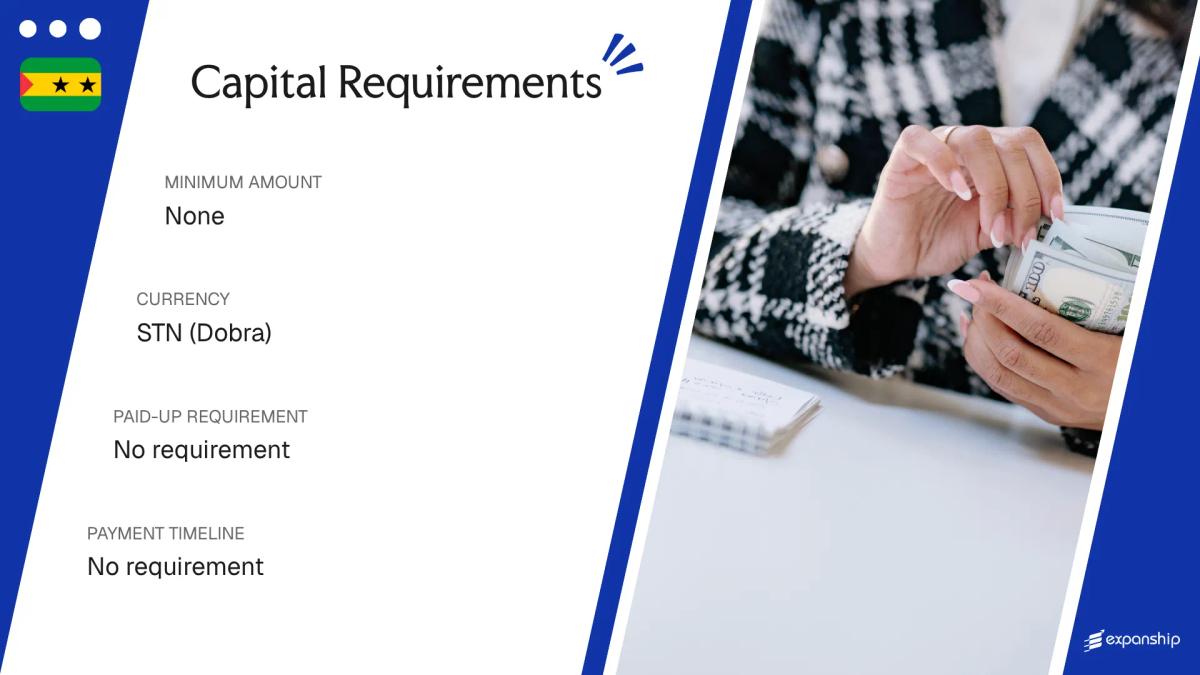
Minimum share capital requirements in São Tomé and Príncipe are governed under the country's commercial code framework, which establishes the par value share system applicable to locally registered entities. The Conservatória do Registo Comercial, the commercial registry authority, oversees entity registration and verifies capital declarations at the point of incorporation.
For a Sociedade por Quotas (Lda), the most common private business structure, capital obligations are defined at formation and treated as a one-time statutory declaration rather than a recurring annual obligation. Paid-up capital rules in São Tomé and Príncipe require that the subscribed capital be deposited before or at the time of registration, though specific thresholds may vary by entity type and activity sector.
| Parameter | Detail |
|---|---|
| Minimum Authorized Share Capital | No universally fixed statutory minimum for all entity types; sector-specific thresholds may apply |
| Maximum Authorized Share Capital | No statutory ceiling |
| Minimum Paid-Up Capital | No universal statutory minimum; determined by the articles of association |
| Paid-Up Requirement at Incorporation | Capital must be subscribed and declared at the point of registration |
| Accepted Currency | Dobra (STN) |
| Accepted Forms of Contribution | Cash contributions; in-kind contributions subject to valuation |
| Timeframe to Deposit Capital | At or prior to commercial registration |
The absence of a fixed statutory minimum does not exempt your company from declaring an authorized capital amount in its constitutive documents. The Conservatória do Registo Comercial requires this declaration as part of the registration filing.
Company Secretary Requirements in São Tomé and Príncipe
São Tomé and Príncipe does not impose a mandatory company secretary requirement under its commercial framework. However, the company secretary requirements São Tomé and Príncipe businesses encounter in practice relate to a designated responsible person or agent who maintains the entity's legal standing with the Conservatória do Registo Comercial, the body overseeing commercial registration.
This agent handles statutory obligations on behalf of the firm, including maintaining corporate records and ensuring filings are submitted to the relevant registry on time. São Tomé and Príncipe corporate secretary obligations generally include acting as the point of contact for regulatory correspondence and preserving internal governance documentation.
Qualification criteria for who may serve in this capacity:
- The individual or entity must be legally authorized to act on behalf of a commercial entity under local law.
- Corporate agents must hold valid registration with the Conservatória do Registo Comercial.
- Individual agents must have legal capacity under the Civil Code of São Tomé and Príncipe.
- Local residency or a physical presence within the jurisdiction is generally required.
- Foreign-incorporated service providers may be accepted if operating through a locally registered entity.

Incorporate a Company in São Tomé and Príncipe
Set up your business entity in São Tomé and Príncipe with guided support through the commercial registration process.
Registered Office Requirements in São Tomé and Príncipe
Registered office requirements in São Tomé and Príncipe follow the general framework of the Commercial Registry (Registo Comercial), which requires every registered company to maintain a sede social — a designated legal address — within the territory. Failure to maintain a compliant address can result in administrative penalties and may affect the company's standing with the Conservatória do Registo Comercial.
- A physical address within São Tomé and Príncipe is required; a post office box alone does not satisfy the sede social obligation.
- Virtual office arrangements are not formally recognised under current commercial law; the address must correspond to an actual physical premises.
- The registered address must be locally based; a foreign address cannot serve as the official sede social.
- Supporting documentation such as a lease agreement or proof of property ownership is required to establish the address at incorporation.
- The sede social is publicly listed on the commercial registry and forms part of the company's official public record.
- Any change to the registered address must be formally notified to the Conservatória do Registo Comercial and registered through an amendment filing before the change takes legal effect.
Director Requirements in São Tomé and Príncipe
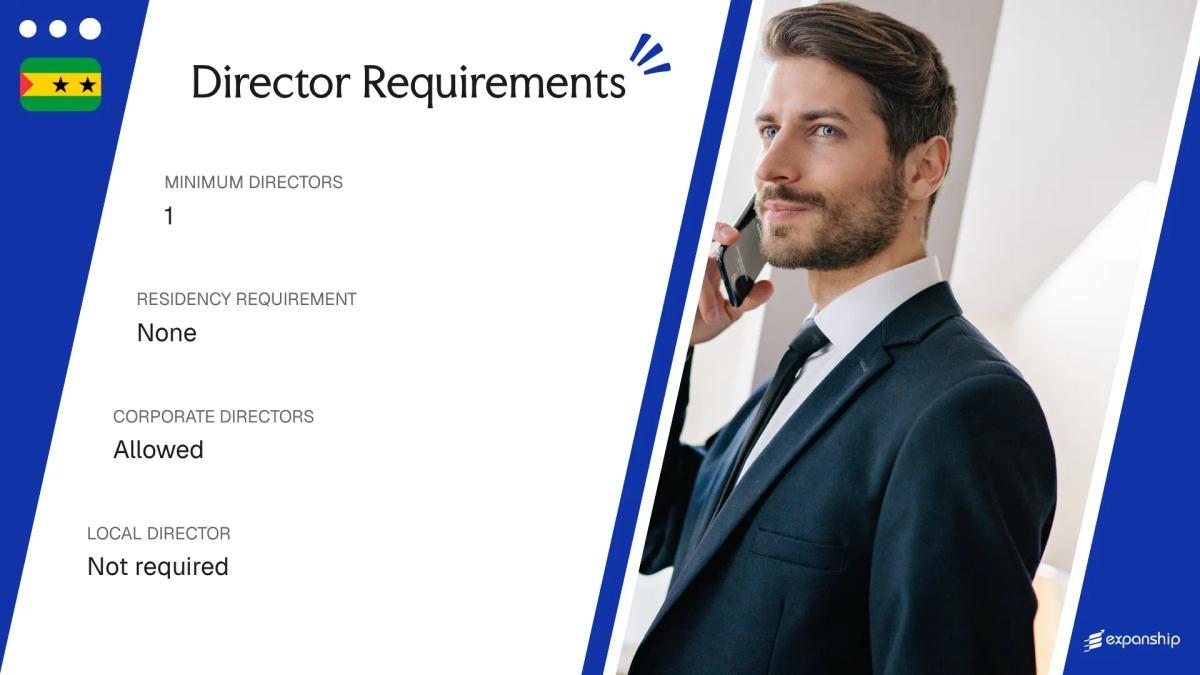
Under the director requirements São Tomé and Príncipe framework, appointed directors (known locally as gerentes in a Lda structure) assume statutory duties of loyalty and diligence toward the company, including obligations to act within the scope of their mandate and to avoid conflicts of interest. Personal liability can attach where a director acts outside authorised powers or causes damage to the entity through negligent or unlawful conduct.
| Parameter | Detail |
|---|---|
| Minimum Number of Directors | One director is required. |
| Maximum Number of Directors | No statutory maximum is prescribed. |
| Local/Resident Director Required | No residency requirement is imposed by statute. |
| Nationality Restrictions | No nationality restrictions apply. |
| Minimum Age Requirement | Directors must have reached the age of majority (18 years). |
| Corporate Directors Permitted | Generally not permitted; natural persons are required. |
| Director Must Be a Shareholder | No statutory requirement for a director to hold shares. |
| Publicly Listed on Registry | Director information is recorded with the commercial registry (Conservatória do Registo Comercial). |
| Disqualification Conditions | Persons with prior convictions for financial crimes or those declared legally incapacitated may be disqualified. |
Despite being a small island nation, São Tomé and Príncipe imposes no residency or nationality requirement on directors, meaning a company can be fully managed by non-resident foreign nationals without any local appointment obligation.
Shareholder Requirements in São Tomé and Príncipe
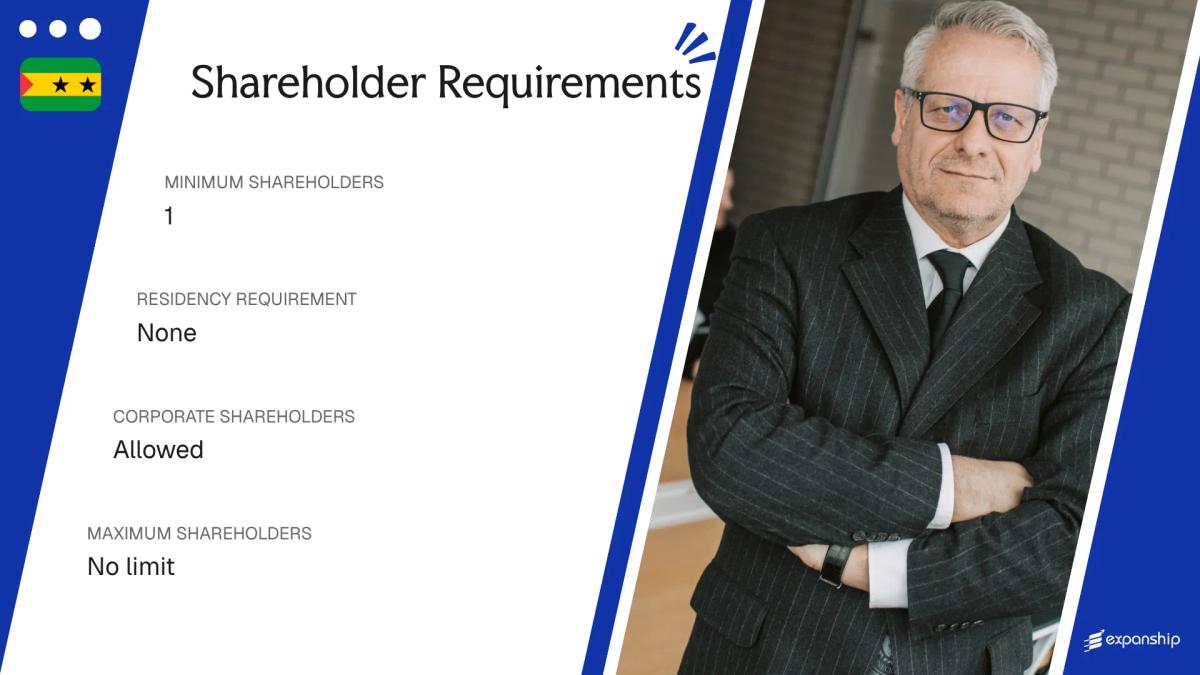
Under São Tomé and Príncipe's commercial law framework, a Sociedade por Quotas (Lda.) requires a minimum of two shareholders, known as sócios. A single-shareholder structure is not permitted for this entity type under the standard incorporation rules.
Nationality and Residency Restrictions
Shareholder requirements in São Tomé and Príncipe do not impose nationality or residency conditions on shareholders. Foreign nationals and non-resident individuals may hold ownership interests without restrictions on the percentage of foreign ownership.
Corporate Shareholders
Corporate entities are permitted to act as shareholders in a Santomean company. The corporate sócio must provide its constitutive documents and proof of legal standing in its jurisdiction of incorporation.
Shareholder Liability
Liability is limited to each sócio's capital contribution. Extended personal liability does not ordinarily apply unless piercing of the corporate veil is established through fraud or abuse of the legal entity.
Register of Shareholders
A register of sócios must be maintained at the company's registered office. Ownership information is filed with the Conservatória do Registo Comercial and reflects any changes to the firm's shareholding structure.
Shareholder Structure Guidance for Setting Up in São Tomé and Príncipe
Get tailored advice on meeting the ownership and sócio registration requirements for your incorporation in São Tomé and Príncipe.
UBO / Beneficial Ownership Disclosure Requirements in São Tomé and Príncipe
Beneficial ownership disclosure in São Tomé and Príncipe operates within a limited statutory framework, and formal UBO registration obligations are not clearly codified under a dedicated beneficial ownership law aligned with FATF standards.
No standalone transparency register or centralised UBO filing mechanism has been established by statute. Anti-money laundering obligations exist under general financial sector regulations, but a specific, enforceable UBO disclosure regime with defined thresholds and filing deadlines has not been confirmed.
| Parameter | Detail |
|---|---|
| Ownership Threshold for UBO Status | No statutory requirement |
| Filing Authority | No statutory requirement |
| Disclosure Deadline at Incorporation | No statutory requirement |
| Publicly Accessible Register | No statutory requirement |
| Penalties for Non-Disclosure | No statutory requirement |
| Ongoing Update Obligation | No statutory requirement |
KYC / Document Requirements in São Tomé and Príncipe
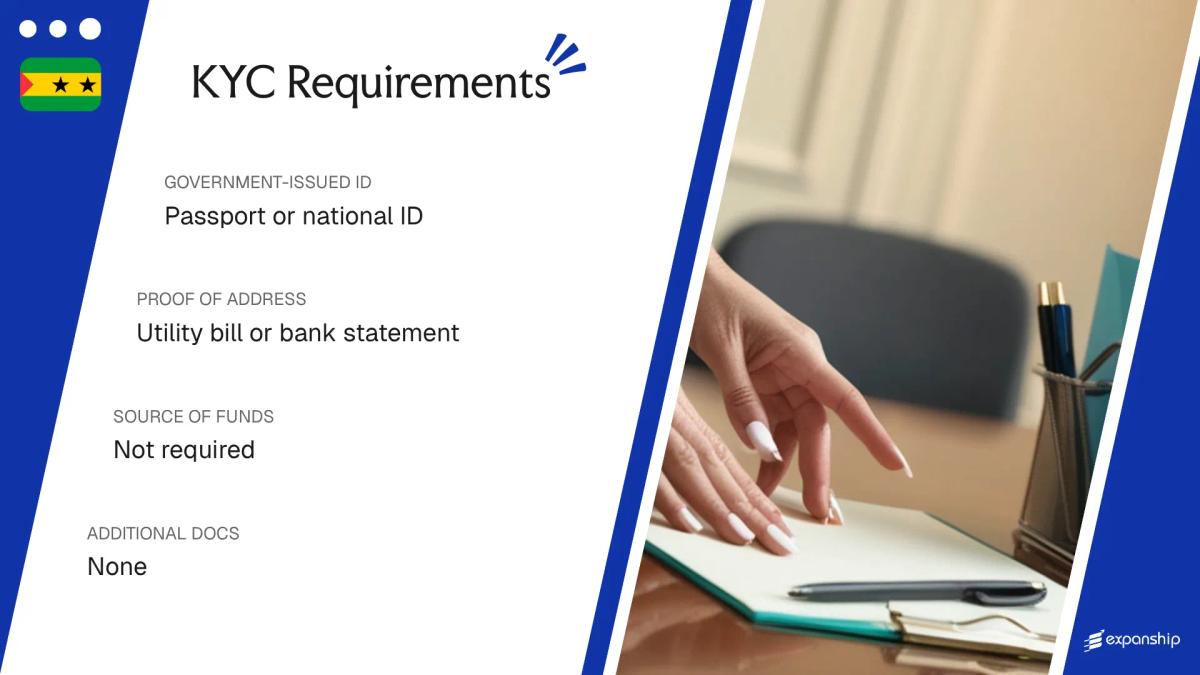
KYC document requirements São Tomé and Príncipe are governed by the country's anti-money laundering framework, including Law No. 6/2021, which establishes due diligence obligations applicable at the point of company formation. The UIAF, the national Financial Intelligence Unit, oversees compliance with these obligations.
Individual / Personal Documents
- Valid government-issued passport or national identity card for each individual director, shareholder, or beneficial owner
- Proof of residential address dated within three months, such as a utility bill or bank statement
- Completed KYC declaration form confirming personal details and role within the entity
- Signed specimen signature form where required by the registrar
Corporate Documents
- Certificate of incorporation or equivalent constitutional document for any corporate shareholder or director
- Register of directors issued by the relevant home jurisdiction authority
- Proof of the corporate entity's registered office address
- Certificate of good standing or equivalent, issued within the preceding six months
Source of Funds Documentation
- Recent bank statements covering a minimum of three months prior to incorporation
- Audited financial accounts where the investing entity is an established business
- Written declaration explaining the origin of capital contributed to the new company
Notarisation and Apostille Requirements
- Foreign-issued documents generally require apostille certification under the Hague Convention
- Documents not in Portuguese must be accompanied by a certified translation
- Notarisation by a locally recognised notary may be required for constitutional documents submitted to the Conservatória do Registo Comercial
Incorporation applications are commonly delayed when foreign corporate documents are submitted without a valid apostille or certified Portuguese translation.
Company Name Requirements in São Tomé and Príncipe
Company name requirements in São Tomé and Príncipe are assessed at the point of incorporation through the Conservatória do Registo Comercial, which verifies that proposed names do not conflict with existing registered entities. Names must be sufficiently distinct to avoid confusion in the commercial register.
Businesses must append a legal suffix corresponding to their entity type, such as Lda. for a Limitada or S.A. for a Sociedade Anónima. Portuguese is the required language for the denominação social.
Certain words implying governmental affiliation, financial institutions, or regulated professions are either prohibited outright or require prior authorisation from the relevant supervisory authority before registration proceeds.
Name reservation is available through the registry prior to formal incorporation. The reservation period is generally limited, and the application is submitted alongside or before the incorporation filing to secure the chosen name.
Compliance Services for Companies in São Tomé and Príncipe
Ongoing compliance support for registered entities in São Tomé and Príncipe, including annual filings, regulatory reporting, and registry maintenance.
Conclusion
Meeting the incorporation requirements São Tomé and Príncipe sets out involves engaging with a civil law framework rooted in Portuguese legal tradition, administered through the Registo Comercial. Resident directorship, a physical registered office address, and UBO disclosure to local authorities represent the requirements most likely to affect your operational structure. Once these obligations are understood, a foreign investor's attention typically shifts to the practical side of execution: document preparation, official filings, and maintaining ongoing company compliance obligations after registration is complete.
Expanship Services for São Tomé and Príncipe Expansion
Incorporating in São Tomé and Príncipe involves satisfying specific regulatory requirements — from physical registered office obligations to document authentication through the Cartório Notarial. Expanship's São Tomé and Príncipe company formation services are structured around these actual on-the-ground requirements, reducing the coordination burden that comes with working across Portuguese-language legal documentation, notarisation procedures, and COSSIL registration processes.
Beyond initial registration, Expanship supports your business across the full operational setup:
- Preparing and filing company registration documents with the relevant São Tomé and Príncipe commercial authorities.
- Providing a registered agent and a compliant local office address for your entity.
- Handling government filings and liaising directly with regulatory bodies on your behalf.
- Managing post-incorporation compliance obligations as they arise over time.
- Facilitating introductions to local and regional banking institutions suited to your business type.
- Registering your firm with tax authorities and coordinating with local administrative offices.
To discuss your São Tomé and Príncipe expansion requirements, contact Expanship São Tomé and Príncipe.
Frequently Asked Questions (FAQ)
A private limited company (Sociedade por Quotas) in São Tomé and Príncipe can be formed with a single shareholder, making it viable as a wholly owned subsidiary for foreign businesses. Corporate entities can also hold shares, so your holding company can be the registered owner without requiring an individual nominee.
Non-compliance with beneficial ownership disclosure obligations exposes the company to administrative penalties under the country's anti-money laundering framework. The obligation applies regardless of whether the ultimate beneficial owner is a resident or foreign national, and failure to maintain accurate records can result in regulatory sanctions affecting the company's standing.
No, the requirement differs between entity types. A Sociedade por Quotas and a Sociedade Anónima carry different minimum capital thresholds, with the latter requiring a higher amount to reflect its public shareholding structure.
Foreign shareholders are typically required to submit certified copies of their passport, proof of residential address, and source of funds documentation as part of the KYC process. If the shareholder is a corporate entity, additional documents such as a certificate of incorporation, register of directors, and ownership structure chart are generally required by the registering authority.
Yes, name availability must be confirmed with the relevant commercial registry before the incorporation process can advance. The name must not duplicate or closely resemble an existing registered entity, and certain terms may require regulatory pre-approval depending on the nature of the business activity.
Using a non-compliant registered address, particularly one that cannot receive official correspondence or legal notices, can create problems with regulatory filings and service of process. The registered office must be a physical address within São Tomé and Príncipe, and using a deficient address may affect the validity of official communications directed at the company.
Legal Disclaimer
The information provided in this article is for general informational purposes only and does not constitute legal, tax, or professional advice. While we strive to ensure the accuracy and timeliness of the content, laws and regulations are subject to change, and the application of laws can vary widely based on specific facts and circumstances.
Readers should not act upon this information without seeking professional counsel tailored to their individual situation. Expanship and its authors disclaim any liability for actions taken or not taken based on the content of this article.
For specific advice regarding your business setup, compliance requirements, or any legal matters, please consult with qualified legal and tax professionals in the relevant jurisdiction.