

Key Takeaways
- All formal business entities in Suriname must be established through a notarial deed under the Commercial Code (Wetboek van Koophandel), making engagement with a Civil Law Notary a mandatory step in the incorporation process.
- The N.V. (Naamloze Vennootschap) structure is subject to a minimum share capital requirement, which foreign investors must satisfy before registration with the Chamber of Commerce and Industry (Kamer van Koophandel en Fabrieken) can proceed.
- Beneficial ownership disclosure is a formal compliance obligation in Suriname, with UBO registration required under the country's anti-money laundering framework rather than treated as a voluntary disclosure.
- Foreign-owned entities conducting regulated activities must ensure their KYC documentation meets the standards set by the Central Bank of Suriname, a condition imposed independently of the Chamber of Commerce registration process.
Corporate entity formation in Suriname is governed by the Commercial Code (Wetboek van Koophandel), with oversight from the Chamber of Commerce and Industry (Kamer van Koophandel en Fabrieken). The Surinamese Civil Law Notary plays a central role in the formation process, as a notarial deed is required to establish most formal business entities.
This article covers the structural, documentary, and regulatory requirements a foreign investor must satisfy before and during the registration process.
Failure to meet these requirements will result in rejection of the registration application or, where an entity is already operating, potential administrative penalties and loss of legal standing.
Specific requirements differ depending on the entity type selected, the sector in which your business intends to operate, and whether foreign capital is involved.
This article is most relevant to foreign entrepreneurs and international firms evaluating company registration requirements in Suriname as a first step toward establishing a local legal presence.
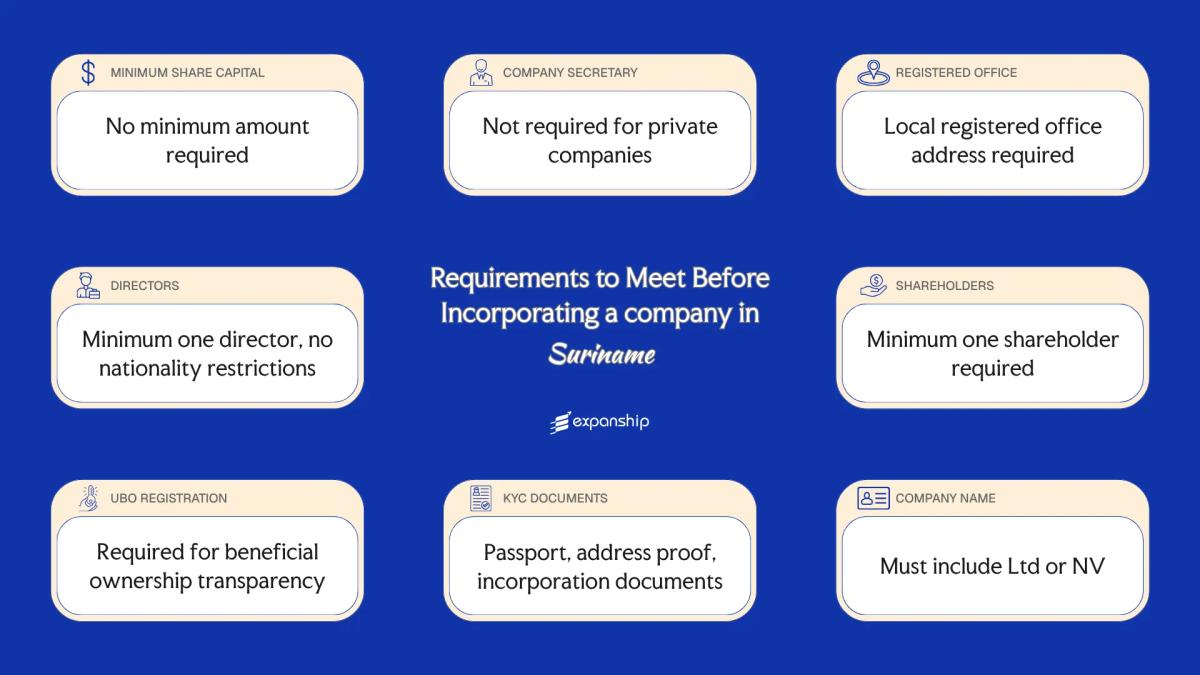
Minimum Share Capital Requirements in Suriname
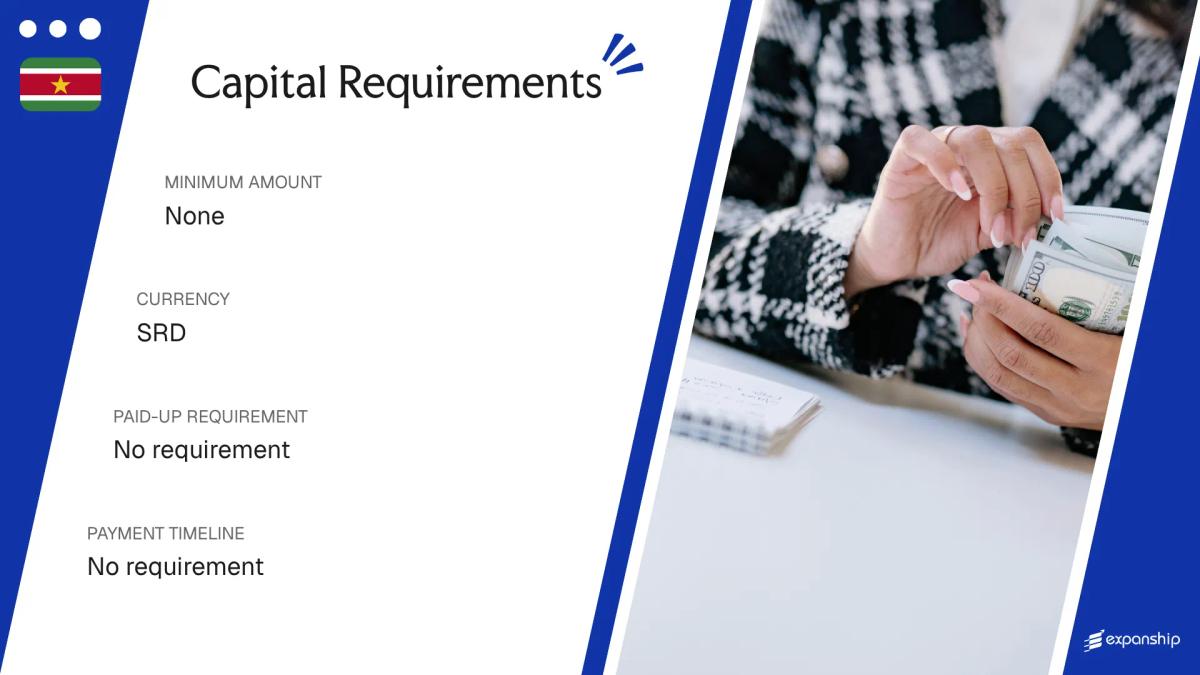
Minimum share capital requirements in Suriname depend on the legal form selected, with the Naamloze Vennootschap (NV) being the primary vehicle for larger commercial operations. The Commercial Code of Suriname governs capital structuring for NVs, and the Suriname Chamber of Commerce and Industry (KKF) oversees the registration process.
NV shares operate on a par value system, meaning each share carries a nominal value stated in the articles of incorporation. Capital requirements are verified at the point of registration rather than treated as a recurring statutory obligation.
| Parameter | Detail |
|---|---|
| Minimum Authorized Share Capital | No statutory minimum prescribed for NVs under the Commercial Code |
| Maximum Authorized Share Capital | No statutory maximum |
| Minimum Paid-Up Capital | No statutory minimum |
| Paid-Up Requirement at Incorporation | At least 20% of the subscribed share capital must be paid up at incorporation |
| Accepted Currency | Surinamese Dollar (SRD); foreign currency permitted where stated in the articles |
| Accepted Forms of Contribution | Cash contributions; in-kind contributions permissible if valued and specified in the deed of incorporation |
| Timeframe to Deposit Capital | At the time of incorporation, prior to notarial deed execution |
The absence of a statutory minimum does not eliminate the obligation to define an authorized capital structure in the notarial deed. The KKF will not process registration without a clearly stated share capital figure in the articles.
Company Secretary Requirements in Suriname
Under Surinamese corporate law, the company secretary requirements in Suriname are not codified as a distinct mandatory function for a Naamloze Vennootschap (NV) or a Commanditaire Vennootschap (CV) in the same way they are in common law jurisdictions. However, the Civil Code of Suriname does require that each company maintain proper administrative representation, and in practice a notary or qualified local representative fulfills the secretarial and compliance-related function during and after incorporation.
Your entity's representative is responsible for maintaining the statutory registers, ensuring timely filing with the Handelsregister at the Kamer van Koophandel en Fabrieken (KKF), and acting as the point of contact for regulatory correspondence.
Qualification criteria for serving in this representative or secretarial capacity:
- Must be a natural person or legal entity resident or domiciled in Suriname
- Corporate secretarial work is typically performed by a civil-law notary (notaris) licensed under Surinamese law
- No general prohibition prevents a foreign national from serving, provided they hold appropriate local authorization
- The appointed party must have legal capacity under Surinamese civil law

Incorporate a Company in Suriname
Set up your legal entity in Suriname with guidance on registration, documentation, and ongoing compliance obligations.
Registered Office Requirements in Suriname
Registered office requirements in Suriname are governed under the Civil Code (Burgerlijk Wetboek), which mandates that every legal entity maintain a statutory seat (statutaire zetel) within the country at all times. Failure to maintain a compliant address can result in the company being struck off the Commercial Register (Surinaamse Handelsregister), administered by the Chamber of Commerce and Industry (Kamer van Koophandel en Fabrieken).
- A physical address within Suriname is required; a post office box alone does not satisfy the statutory seat requirement.
- Virtual offices may be used only if they provide a verifiable physical street address on record with the Chamber of Commerce.
- The registered address must be locally based; a foreign address cannot serve as the legal seat of a Surinamese entity.
- A lease agreement or proof of ownership for the premises is generally required to substantiate the address during registration.
- The registered address is publicly listed in the Handelsregister and accessible to third parties upon request.
- Any change to the registered address must be formally notified to the Chamber of Commerce, with updated registration documents filed to reflect the new seat.
Director Requirements in Suriname

Under the Suriname Commercial Code (Wetboek van Koophandel), director requirements for a Suriname company apply to the Naamloze Vennootschap (NV) and govern how directors assume fiduciary duties, statutory liability for mismanagement, and obligations toward creditors upon appointment.
| Parameter | Detail |
|---|---|
| Minimum Number of Directors | One director is required. |
| Maximum Number of Directors | No statutory maximum is prescribed. |
| Local/Resident Director Required | No local or resident director is required. |
| Nationality Restrictions | No nationality restrictions apply under the Commercial Code. |
| Minimum Age Requirement | Directors must be of legal majority age (18 years). |
| Corporate Directors Permitted | Corporate directors are generally permitted under Surinamese law. |
| Director Must Be a Shareholder | No statutory requirement for a director to hold shares. |
| Publicly Listed on Registry | Director details are filed with the Suriname Chamber of Commerce and Industry (KKF) and are accessible on the commercial register. |
| Disqualification Conditions | Directors may be disqualified upon conviction for fraud, insolvency-related offences, or a court ruling establishing gross mismanagement. |
Despite having no residency requirement, directors of a Suriname NV bear personal liability for unpaid taxes and social contributions if the company fails to notify authorities of its inability to pay within the statutory period.
Shareholder Requirements in Suriname
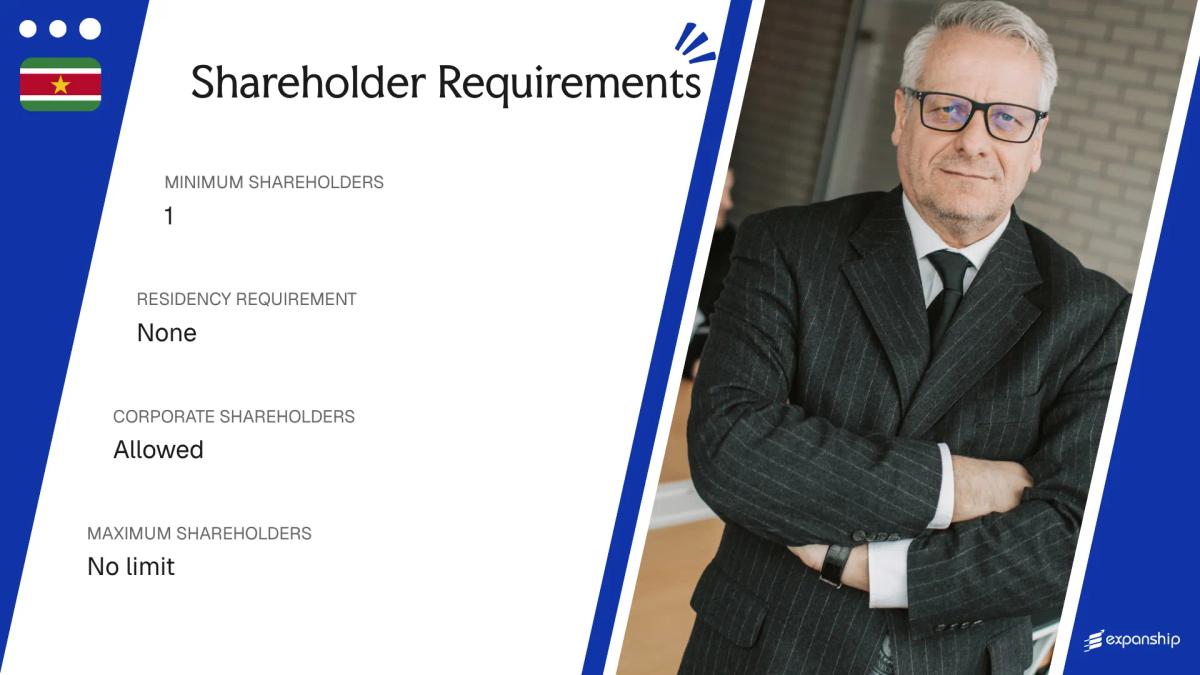
A Suriname company structured as a Naamloze Vennootschap (NV) requires a minimum of one shareholder, meaning a sole shareholder structure is permitted. No statutory maximum applies under the Commercial Code of Suriname.
Nationality and Residency Restrictions
Shareholders face no nationality or residency requirements, and foreign ownership is permitted up to 100%. Your business can be wholly owned by non-resident individuals without restriction.
Corporate Shareholders
Corporate entities may act as shareholders in an NV. No additional conditions specific to corporate shareholders are imposed beyond standard incorporation documentation.
Shareholder Liability
Shareholder liability is limited to the amount unpaid on their subscribed shares. Extended liability does not generally arise unless a court pierces the corporate veil in cases of fraud or abuse.
Register of Shareholders
An NV must maintain an internal register of shareholders. This register is not publicly accessible, though the entity is obligated to keep it current and accurate as a matter of ongoing compliance.
Setting Up Your Shareholding Structure in Suriname
Get guidance on structuring your ownership in a Surinamese NV, ensuring your shareholder arrangement meets local regulatory requirements from the outset.
UBO / Beneficial Ownership Disclosure Requirements in Suriname
Suriname does not currently operate a dedicated UBO registration regime with a centralised beneficial ownership register. Formal statutory UBO disclosure requirements, of the kind mandating filing with a public or government-held register, have not been enacted through stand-alone legislation.
Anti-money laundering obligations under the Wet Melding Ongebruikelijke Transacties and related financial supervision laws do require regulated entities, such as banks and notaries, to identify and verify the beneficial owners of corporate clients as part of customer due diligence. Those obligations, however, sit with the supervised institution rather than imposing a direct filing duty on the company itself.
| Parameter | Detail |
|---|---|
| Ownership Threshold for UBO Status | No statutory threshold defined in a dedicated UBO law |
| Filing Authority | No centralised UBO registry |
| Disclosure Deadline at Incorporation | No statutory requirement |
| Publicly Accessible Register | None |
| Penalties for Non-Disclosure | No dedicated UBO penalty framework |
| Ongoing Update Obligation | No statutory requirement |
KYC / Document Requirements in Suriname
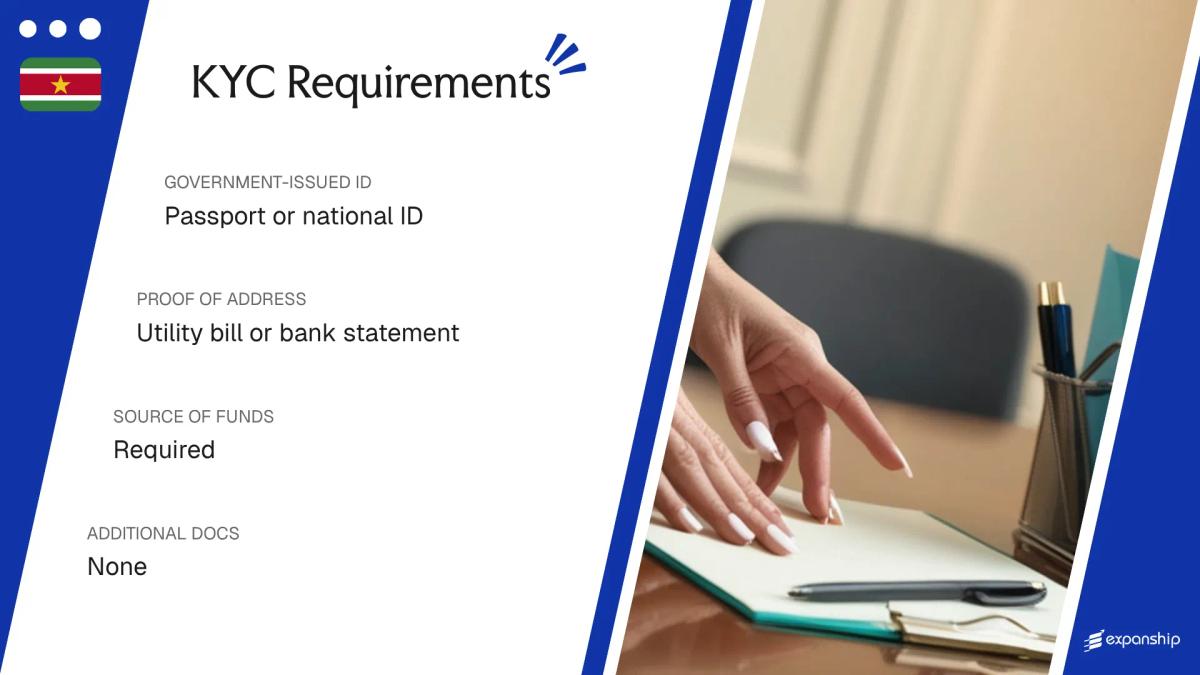
KYC requirements for Suriname company formation are governed by the Wet Melding Ongebruikelijke Transacties (MOT Act) and supervised by the FIU Suriname. All parties involved in the incorporation must be identified and verified before the notarial deed is executed.
Individual / Personal Documents
- Valid passport or national identity card for each director, shareholder, and beneficial owner
- Proof of residential address dated within three months, such as a utility bill or bank statement
- Completed KYC declaration form as required by the incorporating notary
- Recent passport-sized photograph may be requested by the civil law notary
Corporate Documents
- Certificate of incorporation of the corporate shareholder or director entity
- Constitutional documents, such as articles of association or equivalent founding instrument
- Register of directors and shareholders of the corporate entity
- Proof of the registered office address of the corporate entity
Source of Funds Documentation
- Recent bank statements covering a minimum of three months
- Audited financial statements where the entity has an established operating history
- A written declaration explaining the origin of capital if bank records are insufficient
Notarisation and Apostille Requirements
- Foreign documents must generally be apostilled under the Hague Convention before submission
- Official translations into Dutch are required for documents not originally in Dutch or English
- Notarisation by a locally recognised civil law notary is required for the deed of incorporation
Unsigned or untranslated foreign-language documents are the most common cause of rejection during the notarial verification stage.
Company Name Requirements in Suriname
Proposed company name requirements Suriname are assessed by the Surinamese civil-law notary handling the incorporation, who verifies that the name is not already in use before the deed of incorporation is executed and registered with the Chamber of Commerce and Industry.
Company names must be in Dutch, the official language, and include a legal suffix that reflects the chosen entity type, such as "N.V." for a Naamloze Vennootschap or "S.V." for a Stichting. No specific character or word-length limits are publicly codified, though the name must be clearly distinguishable from existing registrations.
Certain words are subject to restriction. Terms implying a state connection, banking activity, or regulated financial functions require prior approval from the relevant supervisory authority before the name can be accepted.
Name reservation is not a formally codified standalone procedure in Suriname; availability is typically confirmed at the point of notarial preparation rather than through a separate advance reservation system with a fixed validity period.
Compliance Services for Companies in Suriname
Maintain your entity's good standing in Suriname with ongoing compliance support, including annual filings, registered office maintenance, and regulatory monitoring.
Conclusion
Suriname company incorporation requirements span several distinct obligations governed primarily by the Commercial Code and overseen by the Chamber of Commerce and Industry. Among the more notable conditions covered here, the N.V. structure carries a minimum share capital threshold, and UBO disclosure now requires formal registration under the country's anti-money laundering framework. KYC documentation must meet standards set by the Central Bank of Suriname for regulated activities. Once these requirements are understood, a foreign investor's focus shifts to execution — assembling compliant documentation, appointing qualifying officers, and establishing a registered local presence.
Expanship's Corporate Services for Suriname Expansion
Suriname company formation services involve several jurisdiction-specific requirements, from registering with the Suriname Business Register at the Chamber of Commerce to meeting the Civil Code's structural obligations for an NV or SRLb. Expanship helps you manage the practical workload these requirements generate, including document preparation, notarial coordination, and regulatory filings with the relevant Surinamese authorities.
Beyond initial registration, our corporate services Suriname expansion support covers the full lifecycle of your entity:
- We prepare and coordinate all registration documents, including notarial deed drafting where required.
- Our team provides a registered agent and a compliant local office address for your Surinamese entity.
- We handle government filings and liaise directly with the Chamber of Commerce and other regulatory bodies on your behalf.
- Post-incorporation compliance management keeps your entity in good standing with local obligations.
- Where needed, we provide introductions to banking institutions operating in Suriname.
- We assist with tax registration and coordinate with local fiscal authorities as required.
Reach out to Expanship Suriname to discuss how we can support your incorporation process.
Frequently Asked Questions (FAQ)
Incorporation of a Naamloze Vennootschap or a Commanditaire Vennootschap in Suriname must be executed before a Surinamese civil-law notary; the deed of incorporation cannot be authenticated abroad and submitted remotely. The notarized deed is then registered with the Handelsregister at the KKF, which is the step that gives the company its legal existence. Without this notarial act, the entity has no standing under Surinamese commercial law.
Failure to disclose ultimate beneficial ownership in line with Suriname's Anti-Money Laundering and Counter-Terrorism Financing Act can result in administrative sanctions and, in serious cases, criminal liability for directors or controlling persons. The Financial Intelligence Unit Suriname (MOT) oversees compliance and has authority to investigate unreported ownership structures. Directors found to have knowingly concealed beneficial ownership face personal exposure, not just liability at the entity level.
Surinamese law does not impose a statutory requirement for at least one locally resident director, meaning a foreign national can serve as the sole director of an NV or other registered entity. However, in practice, the absence of a local director can complicate day-to-day banking, notarial dealings, and regulatory correspondence that require a physically present authorized signatory. Your operational setup should account for this even if the legal minimum is technically met.
Yes, every company registered with the KKF must maintain a physical registered office address in Suriname, regardless of where its shareholders are domiciled. A post office box does not satisfy this requirement; the address must be a genuine, locatable place of business or registered address where official correspondence and regulatory notices can be served. This obligation persists for the life of the company, not just at the point of registration.
For individual shareholders, KYC documentation typically includes a valid government-issued identity document and proof of residential address. Corporate shareholders must provide a full set of constitutional documents for the upstream entity, including its certificate of incorporation, articles of association, and beneficial ownership information tracing back to the natural persons who ultimately own or control the structure. The depth of documentation required for corporate shareholders reflects Suriname's obligations under its AML legislation, which demands transparency across the full ownership chain.
Name availability must be confirmed with the Suriname Chamber of Commerce and Industry before the notarial deed of incorporation is drafted, since the exact company name is embedded in the deed itself. Using a name already registered, or one that is misleadingly similar to an existing entity, will result in rejection. Certain words are also restricted by law and require prior ministerial approval before they can appear in a company name.
Legal Disclaimer
The information provided in this article is for general informational purposes only and does not constitute legal, tax, or professional advice. While we strive to ensure the accuracy and timeliness of the content, laws and regulations are subject to change, and the application of laws can vary widely based on specific facts and circumstances.
Readers should not act upon this information without seeking professional counsel tailored to their individual situation. Expanship and its authors disclaim any liability for actions taken or not taken based on the content of this article.
For specific advice regarding your business setup, compliance requirements, or any legal matters, please consult with qualified legal and tax professionals in the relevant jurisdiction.