

Key Takeaways
- Suriname's corporate income tax rate of 36%, combined with a territorial-leaning tax system and double taxation treaties with key trade partners, can reduce the effective cross-border tax burden for appropriately structured foreign entities.
- The absence of thin capitalization rules under Surinamese law gives businesses genuine latitude to optimize their debt-to-equity structure without statutory restrictions on intercompany lending arrangements.
- Incorporation through the Suriname Chamber of Commerce grants registered entities access to CARICOM and ACS trade frameworks, extending commercial reach across Caribbean and broader regional markets beyond Suriname's domestic economy.
- Both the NV (Naamloze Vennootschap) and BV corporate structures available under Surinamese company law offer distinct liability and governance configurations, allowing foreign investors to align their entity type with specific operational and ownership requirements.
Suriname is an independent sovereign nation on the northeastern coast of South America, bordered by Guyana, Brazil, and French Guiana. Company registration falls under the jurisdiction of the Suriname Chamber of Commerce, which maintains the commercial register and oversees the formal incorporation process. Foreign businesses entering the market most commonly do so through an NV (Naamloze Vennootschap).
The country operates a territorial-leaning tax system with treaty arrangements that can affect cross-border obligations. On the question of foreign ownership, the legal framework does not impose blanket restrictions on foreign nationals holding shares or directing a locally registered entity, which has contributed to measurable inflows of foreign direct investment, particularly in the extractive industries.
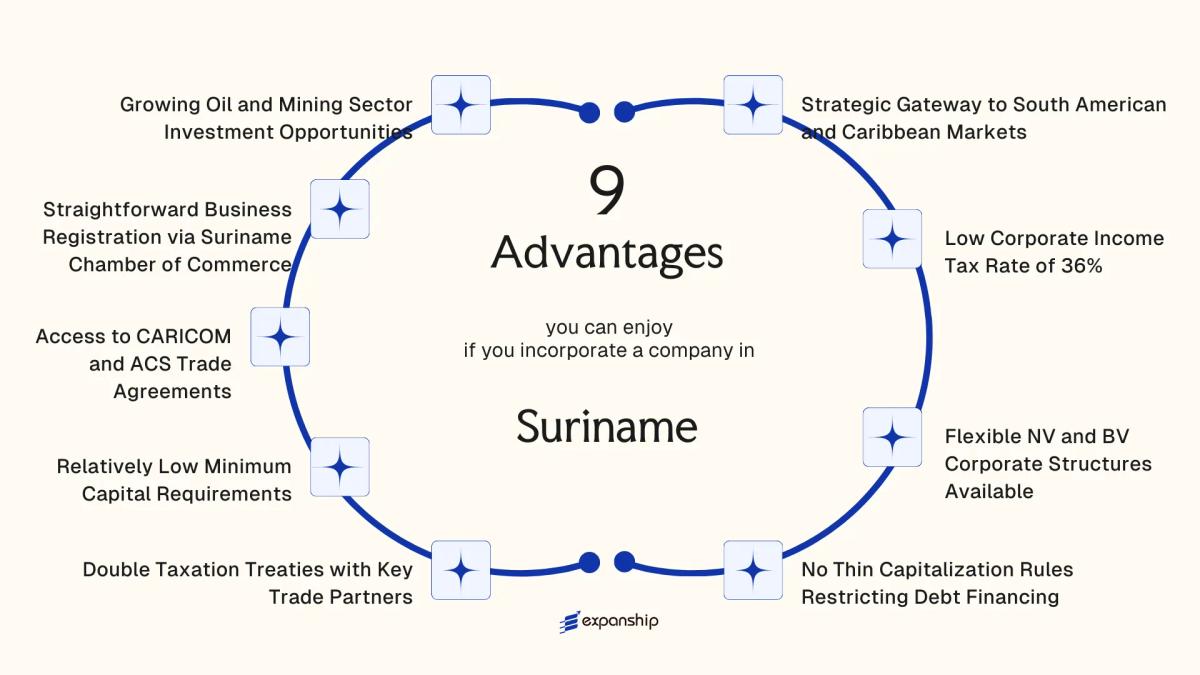
The benefits of incorporating in Suriname span regulatory, structural, and geographic dimensions. This article examines the concrete Suriname company formation advantages that make the jurisdiction worth evaluating for businesses seeking a registered presence in the region.
Strategic Gateway to South American and Caribbean Markets
Suriname's geographic position on the northeastern coast of South America places your business at the intersection of two economically significant regions. As a Suriname gateway to South American markets, a company incorporated here sits within practical reach of both the wider South American continent and the Caribbean basin.
Proximity to Multiple Regional Blocs
Suriname borders Brazil to the south and Guyana to the west, giving incorporated entities direct overland and maritime access into South America's largest economy. French Guiana lies to the east, providing a direct connection to an EU overseas territory and its associated regulatory environment.
A Unique Dual-Region Foothold
Suriname's strategic location for business stems from its simultaneous membership in both South American and Caribbean regional frameworks, an unusual combination among jurisdictions of its size. Operating from this position, your firm can service clients and supply chains across two distinct regional markets without establishing separate legal presences in each.
A single Surinamese entity can serve as your operational base for both Caribbean and South American commercial activities simultaneously.
Low Corporate Income Tax Rate of 36%
Suriname's corporate income tax rate sits at 36%, which, while not negligible in absolute terms, positions the country competitively within the South American and Caribbean region, where rates frequently exceed 30% and sometimes approach 40%. For a foreign investor structuring a business here, the rate applies to net taxable profit, meaning legitimate operating expenses reduce the base before tax is calculated.
The practical value of this rate depends significantly on how your entity's costs are structured. Deductible expenses under Surinamese tax law can meaningfully reduce the effective tax burden below the statutory figure.
Why this rate works in your favour as a foreign business owner:
- Tax is levied on net profit, not gross revenue, so cost-heavy operations benefit proportionally
- The rate is fixed and statutory, which supports reliable financial modelling across multi-year projections
- Unlike progressive corporate tax systems in several neighbouring jurisdictions, a single flat rate applies regardless of profit level
- The absence of additional surtaxes or profit distribution levies at the corporate level keeps the overall tax cost more predictable
Tax obligations are administered by the Suriname Tax Authority (Belastingdienst Suriname), and annual corporate tax filings are required for all registered entities conducting taxable activities within the jurisdiction.

Company Incorporation in Suriname
Register your company in Suriname with Expanship's end-to-end incorporation service, covering entity setup, compliance, and ongoing corporate maintenance.
Flexible NV and BV Corporate Structures Available
Suriname NV and BV corporate structures give foreign investors two legally distinct vehicles under the country's Civil Code, each suited to different ownership and operational needs. The Naamloze Vennootschap (NV) is a public limited liability company that allows share transferability without shareholder consent, making it appropriate for businesses expecting external investment or eventual ownership changes. The Besloten Vennootschap (BV) operates as a private limited liability company with restricted share transfers, which suits closely held businesses where ownership control matters.
| Feature | NV | BV |
|---|---|---|
| Share transferability | Freely transferable | Restricted by articles |
| Shareholder disclosure | Public | More limited |
| Typical use case | Larger or externally funded entities | Owner-managed or private firms |
| Liability | Limited to capital contribution | Limited to capital contribution |
Both structures confine shareholder liability to their capital contributions, which means personal assets remain outside the reach of corporate creditors. For a foreign business owner, this separation is a fundamental protection when entering a market carrying operational or contractual risk.
Each entity type is governed by its own articles of incorporation, registered with the Suriname Chamber of Commerce and Industry. The articles define governance, profit distribution rights, and the scope of director authority, giving shareholders meaningful flexibility to structure internal arrangements without defaulting to rigid statutory templates. That adaptability allows your firm to tailor decision-making thresholds, dividend mechanics, and management layers to fit its actual operating model rather than a generic legal default.
No Thin Capitalization Rules Restricting Debt Financing
Suriname's tax framework contains no thin capitalization rules, a direct Suriname no thin capitalization rules benefit for any foreign-owned entity financing its operations through intercompany loans. Without a statutory debt-to-equity ratio imposed by law, your business can determine its own capital structure based on commercial needs rather than regulatory ceilings.
In many jurisdictions, thin capitalization provisions cap the proportion of deductible interest payments relative to equity. Suriname imposes no such restriction, meaning interest paid on shareholder loans or third-party debt remains deductible under the general provisions of the Surinamese Income Tax Act, subject to standard income tax rules administered by the Suriname Tax Authority (Belastingdienst).
This has a concrete implication for holding structures and regional treasury functions. A firm channeling financing to subsidiaries through a Surinamese entity can do so without triggering mandatory equity top-ups or interest deduction disallowances that would otherwise erode the tax efficiency of the arrangement.
Keep these points in mind:
- Interest deductibility follows general income tax rules, not a separate thin cap regime
- No statutory debt-to-equity ratio applies to NV or BV structures
- The Belastingdienst remains the relevant authority for tax treatment queries
- Transfer pricing principles may still apply to intercompany transactions
Suriname has never introduced thin capitalization legislation, meaning this is a structural feature of the tax code rather than a temporary exemption or administrative concession.
Double Taxation Treaties with Key Trade Partners
Suriname's double taxation treaty benefits are modest in scope but meaningful in the right circumstances. The country maintains a limited network of tax treaties, and understanding which agreements are active helps your business structure cross-border income more efficiently from the outset.
Treaties Currently in Force
Suriname has signed double taxation agreements with the Netherlands and Norway, among others. The treaty with the Netherlands is particularly relevant given the historical commercial ties between the two countries and the volume of Dutch-linked investment flowing through the region. Under these agreements, withholding taxes on dividends, interest, and royalties paid between treaty-resident entities are reduced below standard domestic rates, which directly lowers the tax cost of repatriating profits to a parent company located in a treaty partner jurisdiction.
Practical Implications for Foreign-Owned Entities
For a holding or operating company incorporated locally, the Dutch treaty can reduce withholding tax exposure on dividend distributions, depending on the ownership threshold and residency conditions specified in the agreement. This matters most to businesses with European parent structures seeking to minimize leakage on income flows. Outside the treaty network, Suriname generally applies domestic withholding rates, so treaty eligibility should be confirmed before structuring any intercompany arrangements. The country's treaty network remains smaller than many Latin American and Caribbean peers, which means careful pre-incorporation planning determines whether treaty access is a usable advantage for your specific ownership chain.
Assess Your Treaty Position Before Incorporating in Suriname
Speak with our corporate services team to determine whether Suriname's existing tax treaties apply to your ownership structure and income flows.
Relatively Low Minimum Capital Requirements
Suriname low minimum capital requirements present a tangible entry point for foreign investors who want to establish a legal presence without committing substantial capital upfront. Under Surinamese corporate law, the Naamloze Vennootschap (NV) and the Besloten Vennootschap (BV) each carry minimum share capital thresholds that are modest relative to many comparable jurisdictions in the region.
- The NV requires a minimum issued share capital of SRD 500, with at least 20% paid up at incorporation. For a foreign investor, this means the statutory capital obligation does not function as a financial barrier to entry.
- Lower paid-in capital requirements reduce the amount of capital that must be locked into the entity at formation. Your business retains liquidity for operational use rather than holding funds in a statutory reserve with restricted utility.
- Capital structure decisions remain within your control from the outset. Because the minimum threshold is low, you can calibrate the actual authorized capital to reflect genuine business needs rather than regulatory minimums.
- The Chamber of Commerce and Factories (Kamer van Koophandel en Fabrieken) administers the registration process, and the capital requirement is verified at this stage. Meeting a low threshold simplifies documentation and reduces the administrative scope of the formation filing.
Access to CARICOM and ACS Trade Agreements
Suriname CARICOM trade agreement benefits apply directly to companies incorporated there. As a full CARICOM member, goods produced by a qualifying entity registered in Suriname can move tariff-free across 14 other Caribbean Community member states, covering a combined population of approximately 16 million consumers.
Membership in the Association of Caribbean States (ACS) extends that reach further. The ACS spans 35 member and associate member states across the Caribbean basin, including major economies such as Mexico, Colombia, and Venezuela. For a trading firm that needs regional distribution without establishing separate legal entities in each market, operating from a Suriname base provides genuine structural efficiency.
To benefit from CARICOM's preferential tariff treatment, goods must meet the Rules of Origin requirements set out under the Revised Treaty of Chaguaramas. Products generally need to achieve a specified level of regional value content or undergo sufficient transformation within a member state.
A manufacturer exporting USD 500,000 worth of goods annually to five CARICOM markets could eliminate import duties that, at a regional average of 10-20%, would otherwise represent USD 50,000-100,000 in added trade costs per year — costs that a non-CARICOM incorporated entity would absorb.
Straightforward Business Registration via Suriname Chamber of Commerce
Registration through the Suriname Chamber of Commerce (KKF) is a centralized process, and that centralization is the advantage. Foreign investors deal with a single statutory body rather than navigating multiple agencies before the business becomes legally operational.
The KKF maintains the Commercial Register (Handelsregister), which serves as the official record of all legally recognized businesses operating in the country. Registration in this register is a legal prerequisite for conducting commercial activity, meaning once your entity appears in it, its legal standing is formally established and verifiable by third parties, including banks and counterparties.
For foreign-owned entities, this matters because it shortens the credentialing process. Banks, suppliers, and government bodies use the Handelsregister as the primary reference for confirming a company's legal existence, so a single registration event triggers recognition across multiple institutional contexts.
- Documents are submitted directly to the KKF
- The firm receives a registration number upon approval
- That number is used across tax filings, licensing applications, and commercial contracts
This single-entry structure reduces administrative duplication compared to jurisdictions where corporate registration, tax enrollment, and trade licensing each involve separate agencies.
Registration with the KKF does not automatically fulfill sector-specific licensing requirements; businesses in regulated industries must obtain separate permits from the relevant ministry before commencing operations.
Growing Oil and Mining Sector Investment Opportunities
Suriname oil and mining investment opportunities have expanded considerably following major offshore discoveries by TotalEnergies and Apache Corporation in Block 58, located in the Surinamese portion of the Guiana Basin. Commercial oil production is anticipated to generate government revenues that will reshape the fiscal environment for businesses operating in the country. For foreign investors, early-stage entry into a pre-production oil economy carries structural advantages that diminish once infrastructure and competitive positioning are established.
The legal framework governing extractive industries is administered through the Staatsolie Maatschappij Suriname N.V., the state-owned oil company, which holds a central role in upstream licensing and joint venture arrangements. Petroleum agreements are governed by the Mining Act and sector-specific production sharing contracts, giving foreign entities a defined contractual basis for participation. This clarity reduces the jurisdictional ambiguity that often complicates entry into emerging resource economies.
Beyond oil, the mining sector presents distinct entry points:
- Gold mining operates under concessions regulated by the Ministry of Natural Resources, with both large-scale and small-scale licensing categories available
- Bauxite extraction has a long operational history in the country, supporting established supply chains and supporting infrastructure
- Mineral exploration licenses can be held by locally incorporated entities, making a Surinamese company formation a practical prerequisite for participation
Your business gains direct access to these licensing frameworks by establishing a locally registered entity, since many concession and contract structures require or favor domestic incorporation as a participation condition.
Why Suriname Stands Out Among Regional Incorporation Hubs
Assessed against its most realistic competitors, the Suriname advantages over regional incorporation hubs become clearer when you look at specific structural and fiscal parameters. The comparison jurisdictions below were selected because they share geographic proximity, target overlapping investor profiles, or are frequently evaluated alongside Suriname by businesses entering the northern South American and Caribbean corridor: Trinidad and Tobago, Guyana, and Barbados.
What the table reveals is a jurisdiction that holds a middle position on tax rate but offers distinct advantages in financing flexibility and trade access. The absence of thin capitalization rules, combined with dual membership in both CARICOM and the Association of Caribbean States, produces a profile that differs meaningfully from offshore-oriented Caribbean hubs and from resource-extraction-focused neighbors.
| Parameter | Suriname | Trinidad & Tobago | Guyana | Barbados |
|---|---|---|---|---|
| Standard Corporate Tax Rate | 36% | 30% (general); 50% (energy sector) | 25% | 9% (general) |
| Thin Capitalization Rules | None | Yes | Yes | Yes |
| CARICOM Membership | Yes | Yes | Yes | Yes |
| ACS Membership | Yes | Yes | Yes | No |
| NV/BV-Type Corporate Structures | Yes (Civil Code basis) | No (common law) | No (common law) | No (common law) |
| Civil Law Legal Framework | Yes (Dutch-derived) | No | No | No |
Compliance Services for Companies in Suriname
Maintain your Suriname entity in good standing with registered agent support, annual filing assistance, and regulatory monitoring.
Conclusion
Suriname presents a credible incorporation destination for foreign businesses based on a combination of structural, fiscal, and geographic factors that are not easily replicated in neighboring jurisdictions. The absence of thin capitalization rules gives businesses genuine flexibility in structuring their debt-to-equity ratio, while access to CARICOM trade arrangements extends commercial reach well beyond the domestic market.
Not every business will extract equal value from the available NV and BV corporate structures. A firm with significant intercompany financing will benefit differently than one focused on resource extraction or regional trade, and the overall case for incorporation here depends on how your specific operational model interacts with the local tax and regulatory framework.
Deciding where to register a company is ultimately a function of how well a jurisdiction's rules align with your intended activities. For businesses whose interests intersect with the Guiana Shield resource corridor, South American trade routes, or Caribbean market access, Suriname's regulatory environment warrants serious evaluation. The next step is translating that general fit into a correctly structured entity under Surinamese law.
Start Your Suriname Company Formation With Expanship Today
Suriname company formation with Expanship covers the full incorporation cycle, from selecting between the NV and BV structures to fulfilling ongoing obligations under Surinamese commercial law. Expanship coordinates directly with the Suriname Chamber of Commerce (Kamer van Koophandel en Fabrieken), the primary registration authority, to manage filings on your behalf.
Expanship's service scope for entities incorporated in Suriname includes:
- Document preparation, notarization, and legalization for Chamber of Commerce submission
- Registered agent and local office address provision
- Government filing and liaison with the Kamer van Koophandel en Fabrieken
- Post-incorporation compliance management, including annual obligations
- Banking introduction assistance for corporate account setup
Expanship Suriname is available to assist you in structuring and maintaining your corporate presence in the jurisdiction.
Frequently Asked Questions (FAQ)
Yes, foreign nationals can hold 100% ownership in both an NV (Naamloze Vennootschap) and a BV (Besloten Vennootschap) without a mandatory local shareholder requirement. Ownership rights are governed under the Surinamese Commercial Code, which does not impose nationality-based restrictions on equity stakes. Certain regulated sectors, such as mining or financial services, may carry separate licensing conditions that affect operational control rather than ownership structure itself.
The standard corporate income tax rate is 36%, applied to taxable profits as assessed under Surinamese tax law. Territorial scoping rules generally limit taxation to income derived from local sources, though the precise treatment of foreign-sourced income depends on the nature of the activity and applicable tax treaty provisions. Entities with cross-border operations should obtain a formal tax ruling from the Suriname Tax Authority (Belastingdienst) to confirm their specific liability position.
No statutory thin capitalization rules currently restrict the debt-to-equity ratio for companies registered in Suriname. This means an entity can structure its financing with a higher proportion of shareholder loans without facing automatic disallowance of interest deductions under a fixed ratio test. General anti-avoidance principles under Surinamese tax law may still apply if arrangements are deemed artificial.
Registration timelines at the Kamer van Koophandel en Fabrieken (Chamber of Commerce and Factories) typically range from several days to a few weeks, depending on document completeness and notarial processing requirements. An NV or BV must be established by notarial deed before registration can proceed, which adds preparation time relative to jurisdictions using online filing systems. Delays most commonly arise from outstanding notarization, translation requirements for foreign documents, or outstanding capital verification steps.
Suriname has concluded double taxation agreements with a limited number of partners, including the Netherlands and Norway. These treaties reduce or eliminate withholding tax on dividends, interest, and royalties paid between treaty-resident entities, with specific rates defined within each bilateral agreement. Outside of treaty coverage, withholding tax obligations revert to domestic rates as prescribed under Surinamese tax legislation.
Minimum capital requirements under Surinamese corporate law are comparatively low relative to many European jurisdictions, though the specific statutory floor differs between an NV and a BV. For an NV, a portion of the authorized capital must be issued and paid up at the time of incorporation as required under the Commercial Code. The BV structure generally carries more flexible paid-up requirements, making it the more common choice for smaller or closely-held foreign-owned businesses.
Suriname's membership in CARICOM entitles qualifying goods that meet the applicable rules of origin to preferential or zero-tariff treatment when exported to other member states under the Caribbean Community's common external tariff framework. To benefit, products must satisfy the origin criteria set out in the CARICOM rules of origin schedule, which typically require a defined level of local value addition or transformation. Companies operating purely as holding or trading entities without production activity in-country may not automatically qualify for these preferences.
Failure to fulfill annual registration renewal and filing obligations with the Kamer van Koophandel en Fabrieken can result in administrative penalties and, in more serious cases, deregistration of the entity. A deregistered company loses its legal standing to enter contracts, open bank accounts, or conduct regulated activity within Suriname. Reinstatement is possible but requires settling outstanding obligations and completing corrective filings, which may extend operational downtime for the affected business.
Legal Disclaimer
The information provided in this article is for general informational purposes only and does not constitute legal, tax, or professional advice. While we strive to ensure the accuracy and timeliness of the content, laws and regulations are subject to change, and the application of laws can vary widely based on specific facts and circumstances.
Readers should not act upon this information without seeking professional counsel tailored to their individual situation. Expanship and its authors disclaim any liability for actions taken or not taken based on the content of this article.
For specific advice regarding your business setup, compliance requirements, or any legal matters, please consult with qualified legal and tax professionals in the relevant jurisdiction.