
Key Takeaways
- Suriname's primary corporate legislation, the Wetboek van Koophandel, reflects an outdated civil law framework that lacks the modernized investor protections and structural flexibility found in comparable jurisdictions, creating material gaps for foreign entities structuring subsidiaries or joint ventures.
- All company formations require execution before a local notary in Dutch, meaning foreign investors without fluency in the language or access to qualified in-country legal counsel face compounded procedural and translation burdens before incorporation can be completed.
- Processing delays at the Surinamese Chamber of Commerce extend the timeline for company registration beyond what most developed jurisdictions require, adding operational uncertainty for businesses with time-sensitive market-entry schedules.
- The Surinamese dollar has experienced significant inflationary pressure and exchange rate volatility, exposing incorporated entities to currency risk that complicates financial planning, cross-border profit repatriation, and balance sheet reporting in harder currencies.
Suriname operates under an evolving regulatory framework, shaped largely by the Wetboek van Koophandel (Commercial Code) — the primary company law governing business formation and conduct. The disadvantages of incorporating in Suriname span legal, financial, operational, and structural dimensions, each of which this article examines in turn.
Not every drawback applies equally across all business types. A foreign holding company faces a different set of constraints than a trading firm or a service-based entity, and your exposure to specific risks depends on your industry, intended structure, and operational footprint.
This article is most relevant to foreign investors, international entrepreneurs, and multinational entities considering Suriname as a jurisdiction for a subsidiary, joint venture, or market-entry vehicle. Those accustomed to highly digitized, English-language regulatory environments are likely to find the cons of setting up a company here more pronounced than investors already familiar with Dutch-language civil law systems.
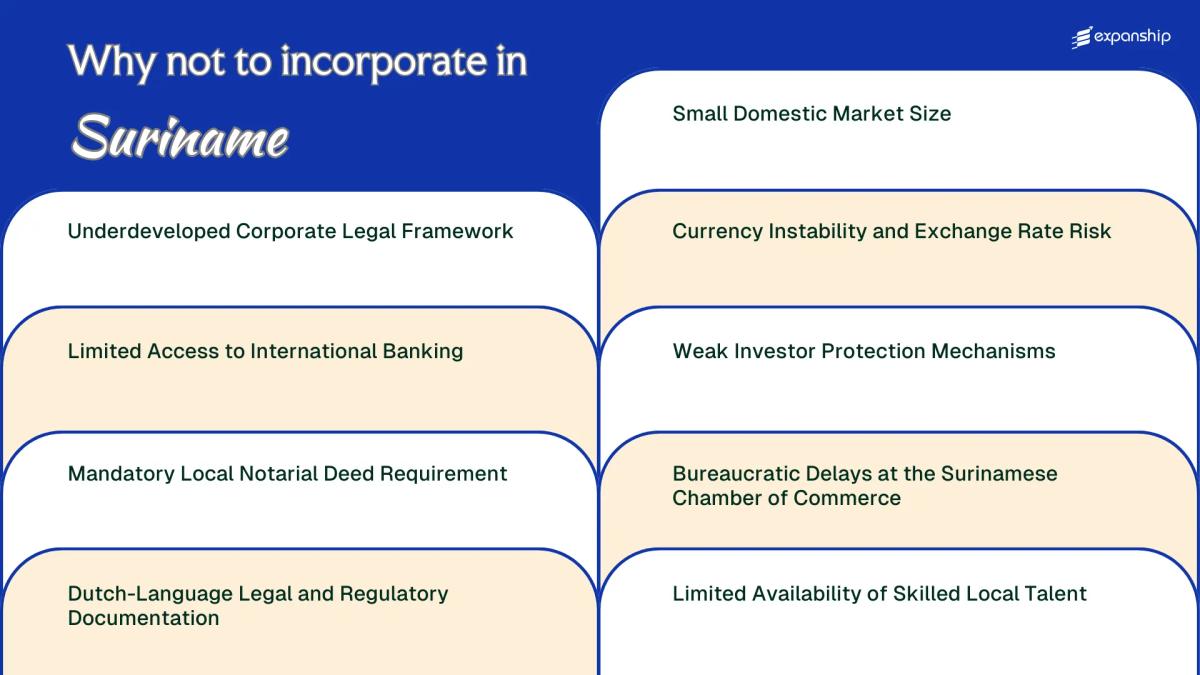
Underdeveloped Corporate Legal Framework
Suriname's corporate legal framework problems stem largely from legislation that has not kept pace with modern commercial practice. The primary statute governing companies, the Surinaamse Wetboek van Koophandel (Commercial Code), dates back to the colonial era and has received only limited updates since independence in 1975.
Outdated Statutory Foundation
The Commercial Code lacks provisions that jurisdictions with modern company law treat as standard, including statutory frameworks for single-member companies, minority shareholder protections, and clear rules on director fiduciary duties. For a foreign investor, this absence means your legal position in a dispute is often governed by broad civil law principles rather than specific corporate statutes, creating genuine uncertainty around outcomes.
Weak Corporate Governance Standards
Suriname company law limitations are particularly evident in the absence of mandatory corporate governance codes applicable to private entities. There is no independent regulatory body equivalent to a corporate affairs commission that monitors compliance or investigates shareholder grievances.
Weak corporate governance in Suriname means that contractual protections you negotiate privately carry more weight than statutory ones, which increases both drafting costs and legal exposure.
The absence of a modern corporate governance framework means that minority shareholders and foreign directors have limited statutory recourse if internal disputes arise, making robust private legal agreements essential but costly to enforce.
Limited Access to International Banking
Suriname international banking restrictions present a concrete operational problem for foreign-owned entities, not just an administrative inconvenience. The country's financial sector is small, dominated by a handful of local institutions including De Surinaamsche Bank and Hakrinbank, none of which maintain the correspondent banking relationships that multinational firms typically require.
Correspondent banking withdrawals across the Caribbean and Latin American region have hit Suriname harder than most. Foreign banks increasingly view Surinamese corporate accounts as high-risk due to the country's historical exposure to money laundering typologies flagged in FATF-related assessments.
For your business, this creates friction at multiple points:
- Receiving USD or EUR wire transfers from European clients may trigger manual review or outright rejection at the correspondent bank level, delaying settlement by weeks.
- Payment processors and fintech platforms routinely exclude Surinamese-registered entities from onboarding, limiting your access to digital payment infrastructure.
- Opening a multi-currency account for a Surinamese firm requires extensive due diligence documentation that local banks are not consistently equipped to process efficiently.
- Cross-border supplier payments may require manual workarounds that increase transaction costs significantly.
Businesses incorporated elsewhere with stronger banking corridors rarely face this volume of friction.

Company Incorporation in Suriname
Understand the full corporate setup process before committing to this jurisdiction.
Mandatory Local Notarial Deed Requirement
One of the more concrete Suriname notarial deed requirement challenges is that every Naamloze Vennootschap (NV) or Commanditaire Vennootschap op Aandelen must be established through a notarial deed executed by a locally licensed civil-law notary. This is not a formality you can satisfy remotely or through a foreign notary — physical presence in the jurisdiction, or a duly authorized local representative, is required.
The requirement stems from Suriname's civil law tradition, rooted in its historical Dutch legal framework. Because the pool of licensed notaries practicing in Paramaribo is limited, scheduling delays are common, and availability cannot be assumed during peak filing periods.
| Requirement | Practical Burden |
|---|---|
| Locally licensed notary only | Foreign notarization is not accepted, forcing engagement of a Surinamese professional |
| Deed must be executed in Dutch | Foreign founders require certified translation before signing, adding time and cost |
| No remote or digital execution | Physical presence or a locally granted power of attorney is mandatory |
| Articles of association embedded in deed | Any future amendment to company structure requires a new notarial act and associated fees |
Amending the company's articles of association — even for routine structural changes — requires a fresh notarial deed. Each amendment triggers additional notarial fees and scheduling constraints, meaning ongoing corporate maintenance carries recurring costs that many other jurisdictions do not impose at this level.
Dutch-Language Legal and Regulatory Documentation
Dutch-language legal barriers in Suriname affect foreign business owners from the moment of incorporation. All statutory documents, including the deed of incorporation, company bylaws, and regulatory filings, must be drafted in Dutch. If your working language is English, Mandarin, or Spanish, every document requires certified translation before it can be submitted to or interpreted from Surinamese authorities.
The Civil Code of Suriname governs corporate formation and operates exclusively in Dutch. This means your legal counsel, auditors, and compliance officers must either be Dutch-proficient or work through translators, which adds cost and time to each compliance cycle.
Dutch-language compliance requirements in Suriname extend beyond incorporation. Annual reporting to the Surinamese Chamber of Commerce (KKF) and tax filings submitted to the Belastingdienst Suriname must meet Dutch-language standards, creating an ongoing documentation burden rather than a one-time setup cost.
- All incorporation deeds and bylaws must be executed in Dutch
- Regulatory correspondence with the Belastingdienst Suriname requires Dutch-language submissions
- Certified Dutch translations of foreign-language source documents are mandatory
- Dutch-language proficiency is required from your appointed local notary
Suriname is the only sovereign nation in South America where Dutch is the sole official language, making it linguistically isolated from every neighboring country in the region.
Small Domestic Market Size
Suriname small market size limitations present a structural constraint that is difficult to offset through business strategy alone. With a population of roughly 620,000 people, the domestic consumer base is among the smallest in South America.
Scale Constraints on Revenue Potential
Most incorporated entities operating exclusively within the local market face a ceiling on revenues that reflects the country's limited consumer base. For businesses dependent on domestic sales volume, this means unit economics rarely reach the thresholds that would justify the overhead of formal incorporation and ongoing compliance costs.
Exposure to Concentrated Economic Sectors
The national economy remains heavily tied to mining, oil, and agriculture, leaving limited room for diversified domestic demand. A foreign business entering sectors outside these dominant industries will find that addressable market size further contracts, compressing margins and extending the timeline to profitability.
Suriname economic market constraints also affect B2B opportunities, since the pool of local corporate clients is shallow compared to larger regional economies such as Colombia or Peru.
Assessing Market Viability Before Incorporating in Suriname
Speak with our corporate services team about whether Suriname's domestic market scope aligns with your business objectives before committing to incorporation.
Currency Instability and Exchange Rate Risk
Suriname currency instability risks compound operational costs in ways that are difficult to hedge at the company level. The Surinamese dollar (SRD) has experienced severe devaluation, with the official rate collapsing from roughly SRD 7 per USD in 2020 to over SRD 36 per USD by 2023 following the country's IMF-supported adjustment program.
- Contracts denominated in SRD lose real value rapidly against hard currencies, directly eroding your firm's revenue when converted for repatriation or foreign supplier payments.
- The Central Bank of Suriname (CBvS) has historically imposed foreign exchange controls that restrict how and when businesses can convert SRD holdings into USD or EUR.
- Inflation, which peaked above 60% annually during 2022-2023, distorts local cost structures and makes multi-year financial planning unreliable for any foreign entity operating on SRD-based revenue.
- No developed local derivatives or forward contract market exists to hedge SRD exposure, leaving your business structurally unprotected against continued depreciation.
Weak Investor Protection Mechanisms
Weak investor protection in Suriname stems from gaps in the statutory framework governing shareholder rights, dispute resolution, and director accountability. The Commercial Code (Wetboek van Koophandel), which remains the primary legislation governing corporate conduct, does not contain modern provisions explicitly protecting minority shareholders from dilution, oppression, or self-dealing by controlling interests.
Minority investors holding non-controlling stakes have limited statutory recourse when majority shareholders act against their economic interests. No dedicated securities regulator or investor ombudsman exists to adjunct these claims outside of general civil litigation.
Foreign investors face particular exposure in closely held NV or NV structures where ownership is concentrated. Without enforceable minority buyout rights or statutory appraisal remedies, your exit options in a shareholder dispute depend almost entirely on what the articles of incorporation specify.
- Surinamese courts lack specialised commercial chambers with expertise in corporate disputes
- Enforcement of court judgments against local counterparties can be slow and unpredictable
Hypothetical scenario: A foreign investor holding a 30% stake in a Surinamese NV discovers the majority shareholder has transferred company assets to a related party at below-market value. Without statutory derivative action rights or a securities regulator to lodge a complaint with, the investor must pursue civil litigation through general courts, with legal proceedings potentially spanning several years and costing tens of thousands of USD in local counsel fees before any remedy is obtained.
Bureaucratic Delays at the Surinamese Chamber of Commerce
Suriname Chamber of Commerce bureaucratic delays are among the most cited operational friction points for foreign incorporators. The Kamer van Koophandel en Fabrieken (KKF), the body responsible for registering commercial entities, operates under administrative processes that can extend the registration timeline well beyond initial projections.
Processing times at the KKF are subject to document queues, manual verification steps, and coordination with the notarial system, which means delays compound across multiple dependencies rather than occurring in isolation. For a foreign business owner, this directly translates to a longer period before your entity can legally enter into contracts or open accounts.
Unlike jurisdictions where company registration is completed through a unified digital portal within days, KKF procedures remain largely paper-driven. Each stage requires physical documentation, and any deficiency triggers a restart of that stage's review cycle.
- Incomplete notarial deeds or missing certified translations can halt registration entirely
- KKF offices have limited operating windows for foreign applicant inquiries
- Post-registration filings, such as trade name approvals, follow separate queues
Cumulative delays across these stages can push your total incorporation timeline from weeks into months, deferring any revenue-generating activity in the jurisdiction.
Any amendment or correction required after initial submission to the KKF resets the document review process, meaning a single administrative error can double your total incorporation timeline.
Limited Availability of Skilled Local Talent
Suriname skilled labor shortage risks are a tangible operational concern for foreign firms, particularly in technical, financial, and legal disciplines. With a national population of approximately 600,000, the available professional workforce is structurally limited in scale.
Brain drain compounds this constraint. Educated Surinamese nationals frequently emigrate to the Netherlands, where language barriers are absent and compensation is higher, reducing the domestic pool of qualified candidates your business can realistically hire from.
Sectors requiring specialized expertise, such as mining engineering, corporate accounting, and financial compliance, face acute shortages. Sourcing these skills locally often proves impractical, leaving foreign entities dependent on expatriate hires.
Expatriate employment carries its own administrative weight. Work permits issued through the Ministry of Labour must be obtained for foreign nationals, a process that adds cost, processing time, and regulatory exposure before a single qualified employee can begin work.
Overcoming Suriname's Incorporation Challenges
Overcoming Suriname's incorporation challenges begins with a structural approach that addresses documentation, banking, and compliance requirements before committing to registration.
- Engage a civil-law notary (notaris) registered in Suriname to prepare the authentic deed of incorporation required under the Commercial Code.
- Open a corporate bank account at a De Surinaamsche Bank or Hakrinbank branch prior to completing Chamber of Commerce registration, as proof of capital deposit is typically required.
- Retain a certified Dutch-language translator or bilingual legal counsel to ensure all regulatory filings with the Surinaams Bedrijvenregister meet the statutory language requirements.
- Conduct foreign exchange planning through the Centrale Bank to account for SRD volatility and cross-border remittance restrictions before structuring profit repatriation.
- Source specialized or senior talent internationally from the outset where local skill gaps in technical or financial disciplines apply.
These steps address documented procedural and regulatory friction points without guaranteeing a frictionless outcome. The broader regulatory environment, including investor protection standards and banking access, remains subject to ongoing institutional limitations within the jurisdiction.
Suriname's Overall Business Viability
Suriname carries genuine Suriname business viability risks that make it a selective destination rather than a broadly accessible one. The structural constraints documented in this guide are real and measurable. That said, for businesses with specific regional interests, commodity sector exposure, or Dutch-language operational capacity, the jurisdiction offers a functional legal basis for incorporation under its commercial code.
| Pro | Con |
|---|---|
| Civil law framework provides a recognizable legal structure for Dutch and European-based businesses | Corporate legal framework lacks modern investor protection mechanisms aligned with international standards |
| Physical presence in a resource-rich, emerging South American economy | Persistent currency instability and SRD exchange rate volatility expose foreign capital to depreciation risk |
| Chamber of Commerce registration provides formal legal standing | Bureaucratic delays at the Surinamese Chamber of Commerce extend incorporation timelines unpredictably |
| Dutch-language proficiency is widespread among local professionals | All legal and regulatory documentation is conducted exclusively in Dutch, limiting accessibility for non-Dutch-speaking owners |
| Notarial deed requirement confirms legal formality of entity formation | Mandatory notarial deed process adds cost and procedural complexity with no remote alternative |
Domestic market size remains limited, and accessing international banking for a Surinamese entity continues to present real operational friction.
Compliance Services for Companies in Suriname
Maintain your Surinamese company's good standing with accurate, timely compliance filings under local regulatory requirements.
Conclusion
This Suriname incorporation drawbacks summary reflects a jurisdiction with genuine utility for certain regional strategies, but one where structural limitations carry real weight. Currency volatility tied to the Surinamese dollar, persistent delays at the Kamers van Koophandel en Fabrieken, and restricted access to correspondent banking collectively present material operational friction. Businesses that require predictable timelines, stable financial infrastructure, or Dutch-language capacity will encounter these constraints directly. Professional guidance with jurisdiction-specific experience remains the practical means of managing formation and ongoing compliance obligations.
Expanship's Suriname Corporate Services
From Dutch-language documentation requirements to the Surinamese Chamber of Commerce's slow processing timelines, incorporating in Suriname carries compliance burdens that quickly add up. Expanship's Suriname corporate services are designed to reduce the operational weight of those specific obligations, helping you manage notarial deed coordination, regulatory filings, and ongoing statutory requirements without building a local team from scratch.
Beyond incorporation itself, Expanship supports your business across the full setup process.
- Your company registration documents are prepared and filed accurately with the relevant Surinamese authorities.
- A registered agent and local office address are provided to satisfy residency requirements.
- Government filings and Chamber of Commerce liaisons are handled on your behalf.
- Post-incorporation compliance obligations are monitored and managed on an ongoing basis.
- Banking introduction support is provided to help open a corporate account in-country.
- Tax registration and local authority liaison are coordinated from the outset.
To discuss your requirements, contact Expanship Suriname.
Frequently Asked Questions (FAQ)
The notarial deed requirement applies to the formation of a Naamloze Vennootschap (NV) and other formal corporate structures under Surinamese law, making it a standard step rather than an edge case. A locally licensed civil-law notary must draft and authenticate the deed of incorporation before registration with the Surinamese Chamber of Commerce can proceed. This requirement adds both time and cost to the registration process that you would not face in jurisdictions with purely administrative incorporation systems.
Access to corporate banking in Suriname is more restricted than in most comparable regional jurisdictions, largely because international correspondent banking relationships with Surinamese institutions are limited. Foreign-owned entities face heightened due diligence requirements, and several international banks have reduced exposure to the country due to historical compliance concerns. This means you may struggle to open a functional multi-currency account tied to your Surinamese entity even after registration is complete.
Suriname's official language is Dutch, and the Chamber of Commerce requires that all corporate documentation, including the notarial deed and articles of incorporation, be submitted in Dutch. Documents in English or any other language will not be accepted without a certified translation, adding both cost and delay to the registration timeline. This is a hard procedural requirement, not a preference, and non-compliance results in rejection of the filing.
The direct financial cost of delays at the Chamber of Commerce is difficult to isolate, but extended registration timelines mean your entity cannot legally operate, open accounts, or sign contracts during that period, creating indirect losses that compound quickly. Registration processes that should take weeks can stretch into months due to administrative backlogs and manual processing. For businesses with time-sensitive market entry requirements or contractual obligations tied to a registration date, these delays carry real financial consequences.
Weak investor protection in Suriname affects foreign investors across sectors, but the impact is most acute in capital-intensive industries where dispute resolution timelines and enforcement of judgments matter most. Suriname's legal framework for protecting minority shareholders and foreign investors lacks the depth found in jurisdictions with modern commercial codes, meaning contractual protections must be negotiated and documented with greater precision. Investors relying on statutory protections rather than contractually defined rights are the most exposed.
Hiring expatriate workers in Suriname is possible but requires work permits issued through the relevant Surinamese immigration and labor authorities, a process that adds administrative layers and cost to your workforce planning. The permit process is not straightforward, and approval timelines can be unpredictable, which limits your ability to quickly staff a newly incorporated entity with qualified personnel. Depending on the role and sector, some positions may also face restrictions on foreign employment that further narrow your options.
Legal Disclaimer
The information provided in this article is for general informational purposes only and does not constitute legal, tax, or professional advice. While we strive to ensure the accuracy and timeliness of the content, laws and regulations are subject to change, and the application of laws can vary widely based on specific facts and circumstances.
Readers should not act upon this information without seeking professional counsel tailored to their individual situation. Expanship and its authors disclaim any liability for actions taken or not taken based on the content of this article.
For specific advice regarding your business setup, compliance requirements, or any legal matters, please consult with qualified legal and tax professionals in the relevant jurisdiction.