
Key Takeaways
- All companies incorporated in Slovakia must be registered in the Business Register (Obchodný register) administered by the relevant district courts, with filings processed through the Slovak Business Centre portal.
- Under the Commercial Code (Act No. 513/1991 Coll.), an s.r.o. is subject to a mandatory minimum share capital requirement that must be satisfied before registration is completed.
- Foreign investors are required to comply with UBO disclosure obligations under Slovakia's Anti-Money Laundering Act, with beneficial ownership information submitted to the Business Register as a condition of lawful operation.
- The legal form of the entity, the sector of activity, and the nationality of owners each determine which specific incorporation requirements apply under Slovak law.
Entity formation in Slovakia is governed by the Commercial Code (Act No. 513/1991 Coll.), with the Business Register (Obchodný register) administered by the relevant district courts serving as the official registry for company incorporation.
This article covers the structural, documentary, and compliance-related requirements that apply to the incorporation process under Slovak law.
Failure to satisfy these requirements results in rejection of the registration application or, where applicable, legal penalties for operating without proper authorisation.
Requirements differ depending on the legal form of the entity, the sector in which it operates, and whether the ownership structure involves foreign nationals or institutional investors.
This article is most relevant to foreign entrepreneurs and international businesses evaluating Slovakia company registration requirements ahead of establishing a local presence.
Minimum Share Capital Requirements in Slovakia
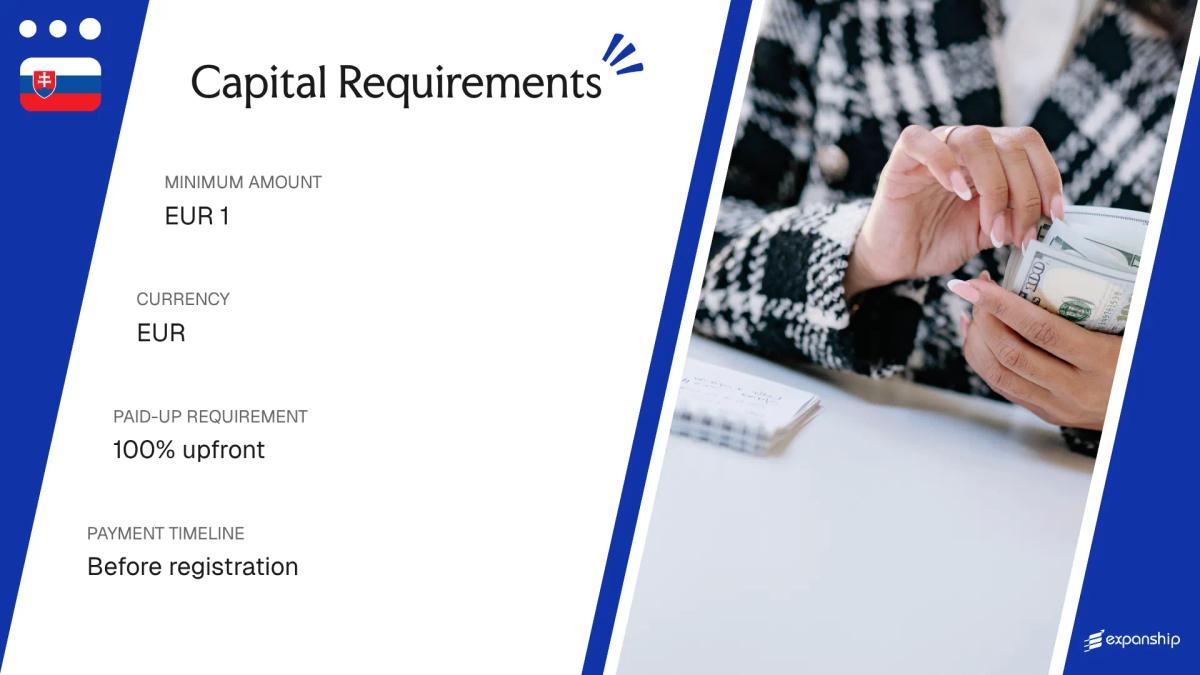
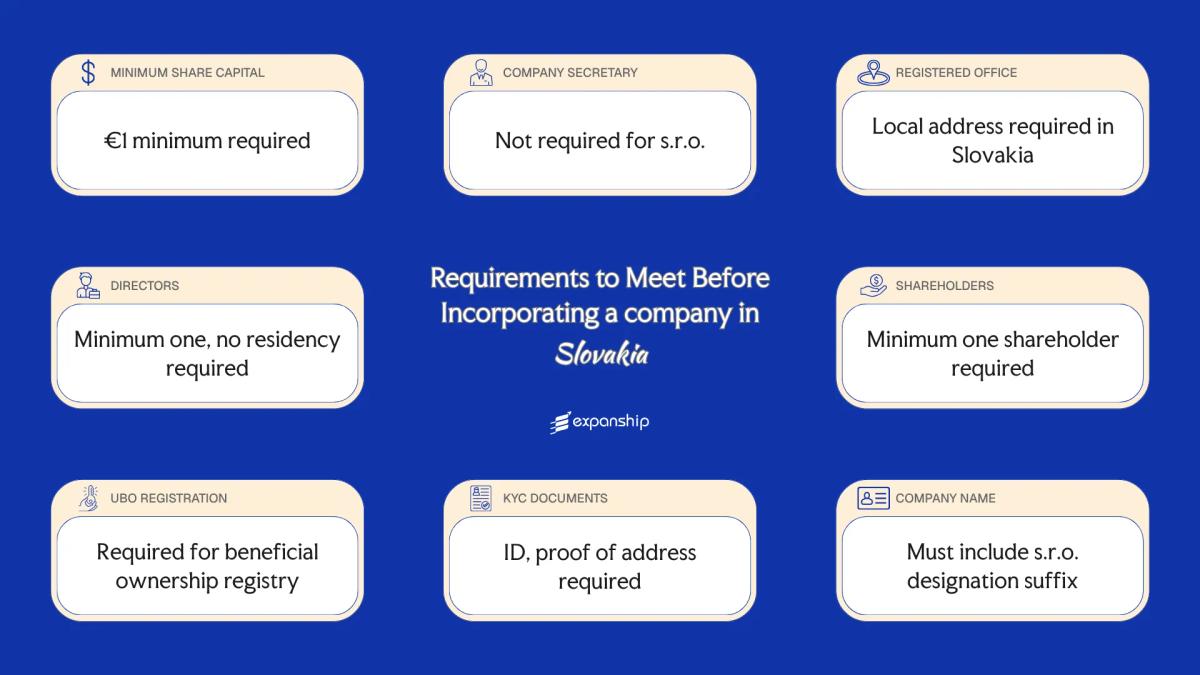
Slovakia minimum share capital requirements apply specifically to the chosen legal form, with the spoločnosť s ručením obmedzeným (s.r.o.) carrying a statutory minimum of EUR 5,000 under the Slovak Commercial Code (Act No. 513/1991 Coll.). Each individual shareholder must contribute a minimum of EUR 750 toward that total.
At incorporation, at least 30% of each cash contribution must be paid up, though the full amount must be deposited before the entity is registered. The responsible administrator of the deposit is typically a Slovak bank, which issues a confirmation letter submitted to the Obchodný register (Commercial Register) as part of the registration process.
| Parameter | Detail |
|---|---|
| Minimum Authorized Share Capital | EUR 5,000 (s.r.o.) |
| Maximum Authorized Share Capital | No statutory requirement |
| Minimum Paid-Up Capital at Incorporation | At least 30% of each cash contribution; full amount before registration |
| Paid-Up Requirement at Incorporation | Yes — bank confirmation required prior to Commercial Register filing |
| Accepted Currency | Euro (EUR) |
| Accepted Forms of Contribution | Cash and non-cash (in-kind) contributions |
| Timeframe to Deposit Capital | Prior to submission of the incorporation application |
The bank confirmation of deposit must be obtained before filing with the Obchodný register. Registration will not proceed without it, so the deposit is a prerequisite to incorporation, not a post-registration obligation.
Company Secretary Requirements in Slovakia
Slovak company law does not impose a mandatory company secretary requirement for a spoločnosť s ručením obmedzeným (s.r.o.), the most common private limited liability structure. Under the Commercial Code, the core governance roles are fulfilled by the statutory body, typically one or more konateľ (executive directors), who bear legal and compliance responsibilities.
Slovak corporate secretary obligations, where voluntarily adopted, generally involve maintaining statutory records, coordinating with the Obchodný register (Commercial Register), and supporting board-level administration. Your business may appoint a secretary as an internal function, but no statutory provision mandates this role for an s.r.o.
Qualification criteria for those serving in a voluntary corporate secretary capacity:
- No statutory licensing requirement applies to this role under Slovak law.
- Both natural persons and legal entities may serve in an administrative secretarial capacity.
- No residency requirement is prescribed for a voluntary secretary in a private limited company.
- The konateľ retains legal accountability regardless of any delegated secretarial function.

Incorporate a Company in Slovakia
Set up your Slovak s.r.o. with full compliance support, from Commercial Register filing to statutory documentation.
Registered Office Requirements in Slovakia
Registered office requirements in Slovakia are governed by the Commercial Code (Act No. 513/1991 Coll.), which mandates that every limited liability company (s.r.o.) and joint-stock company (a.s.) maintain a registered seat (sídlo) within Slovak territory at all times. Failure to maintain a compliant legal address can result in the company being struck from the Slovak Commercial Register by a court acting on its own initiative under Section 768s of the Commercial Code.
- A physical address located within Slovak territory is required; a post office box does not satisfy this requirement.
- Virtual office addresses are permitted provided the service provider can document the company's right to use the premises.
- The address must be a domestic Slovak address; foreign addresses are not accepted by the Slovak Commercial Register (Obchodný register).
- A lease agreement, owner's consent, or title document must support the registered seat; this proof is submitted to the registry at incorporation and upon any change.
- The registered seat is publicly listed in the Slovak Commercial Register, accessible at orsr.sk, and forms part of the mandatory public disclosure under the Commercial Code.
- Any change to the registered address must be formally notified to the relevant District Court registry office, accompanied by supporting documentation, within 30 days of the change taking effect.
Director Requirements in Slovakia
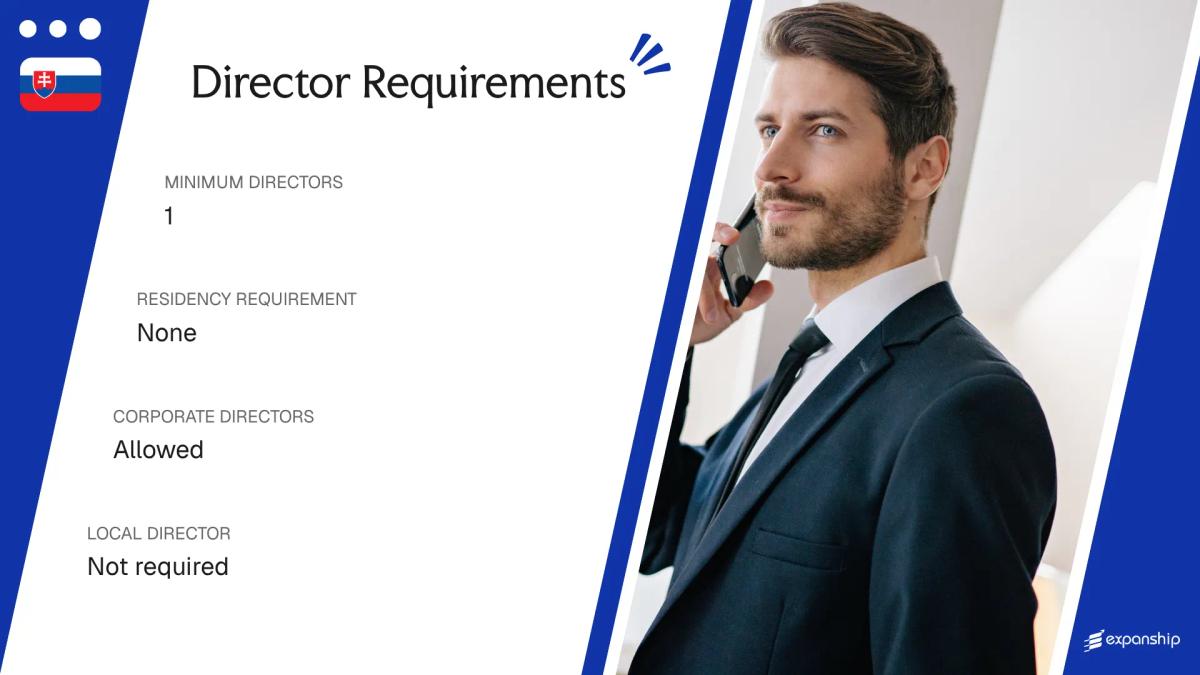
Upon appointment as a konateľ (statutory manager) of a Slovak s.r.o., director requirements in Slovakia impose direct personal liability for breaches of fiduciary duty, including obligations under the Obchodný zákonník (Commercial Code, Act No. 513/1991 Coll.) to act with due care, in the company's interests, and in compliance with shareholder resolutions.
| Parameter | Detail |
|---|---|
| Minimum Number of Directors | One director is required. |
| Maximum Number of Directors | No statutory maximum; the articles of association may set limits. |
| Local/Resident Director Required | No residency requirement exists under Slovak law. |
| Nationality Restrictions | No nationality restrictions apply to directors of a Slovak s.r.o. |
| Minimum Age Requirement | Directors must be at least 18 years of age. |
| Corporate Directors Permitted | Corporate directors are not permitted; only natural persons may serve. |
| Director Must Be a Shareholder | No statutory requirement for a director to hold shares in the company. |
| Publicly Listed on Registry | Directors are registered in the Obchodný register (Commercial Register) and are publicly visible. |
| Disqualification Conditions | A person with a prior criminal conviction for an economic offence, or subject to a court-imposed ban, is disqualified from serving. |
Despite no residency requirement, a director's entry in the Obchodný register must include a Slovak address for service of official documents, which in practice requires arranging a local correspondence address before registration is completed.
Shareholder Requirements in Slovakia
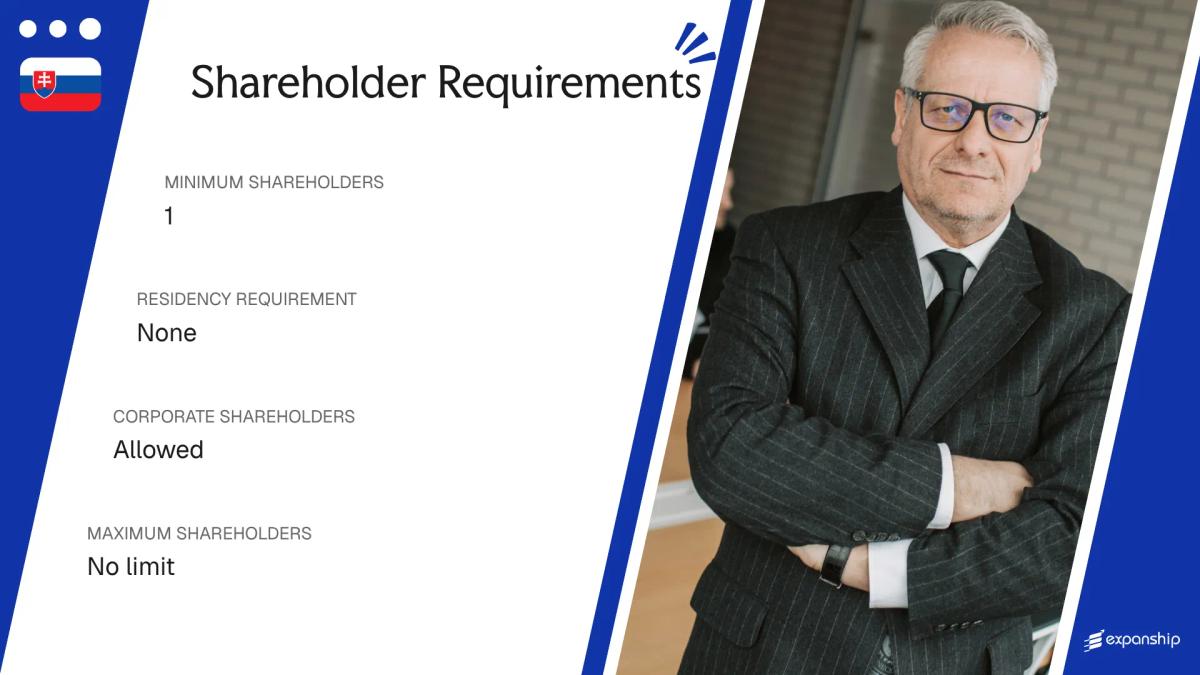
A Slovak spoločnosť s ručením obmedzeným (s.r.o.) requires a minimum of one shareholder. The maximum permitted is 50 shareholders.
Nationality and Residency Restrictions
Shareholder requirements in Slovakia impose no nationality or residency conditions on individuals. Foreign nationals and non-resident persons may hold shares without restriction on ownership percentage.
Corporate Shareholders
Legal entities are eligible to act as shareholders in an s.r.o. A single corporate entity may form and wholly own the company, provided the corporate shareholder itself is not solely owned by another single-member entity.
Shareholder Liability
Shareholder liability is limited to the unpaid portion of each shareholder's registered capital contribution. Once contributions are fully paid up, personal assets remain separate from company obligations under Slovak commercial law.
Register of Shareholders
An s.r.o. is required to maintain an internal register of shareholders. This register is not fully public, though shareholder information is disclosed through the Obchodný register, the official Slovak Commercial Register administered by the Ministry of Justice.
Shareholder Structure Guidance for Your Slovak Entity
Get clarity on shareholder eligibility, liability limits, and registration obligations when setting up a company in Slovakia.
UBO / Beneficial Ownership Registration Requirements in Slovakia
Beneficial ownership registration Slovakia is governed by Act No. 315/2016 Coll. on the Register of Public Sector Partners (RPVS), which defines a beneficial owner as any natural person holding direct or indirect ownership or control exceeding 25% of shares or voting rights in an entity.
- Identify all natural persons meeting the 25% ownership or control threshold within the corporate structure.
- Appoint an authorised person (typically a lawyer, notary, or auditor) to submit the registration on your behalf.
- File the beneficial ownership data with the Register of Public Sector Partners, administered by the District Court Žilina.
- Update the register within 30 days of any change in beneficial ownership.
| Parameter | Detail |
|---|---|
| Ownership Threshold for UBO Status | 25% of shares, voting rights, or equivalent control |
| Filing Authority | District Court Žilina via the RPVS |
| Disclosure Deadline at Incorporation | Prior to receiving public sector funds or entering public contracts |
| Publicly Accessible Register | Yes, the RPVS is publicly accessible |
| Penalties for Non-Disclosure | Deletion from the register; prohibition on receiving public funds |
| Ongoing Update Obligation | Within 30 days of any change |
KYC / Document Requirements in Slovakia
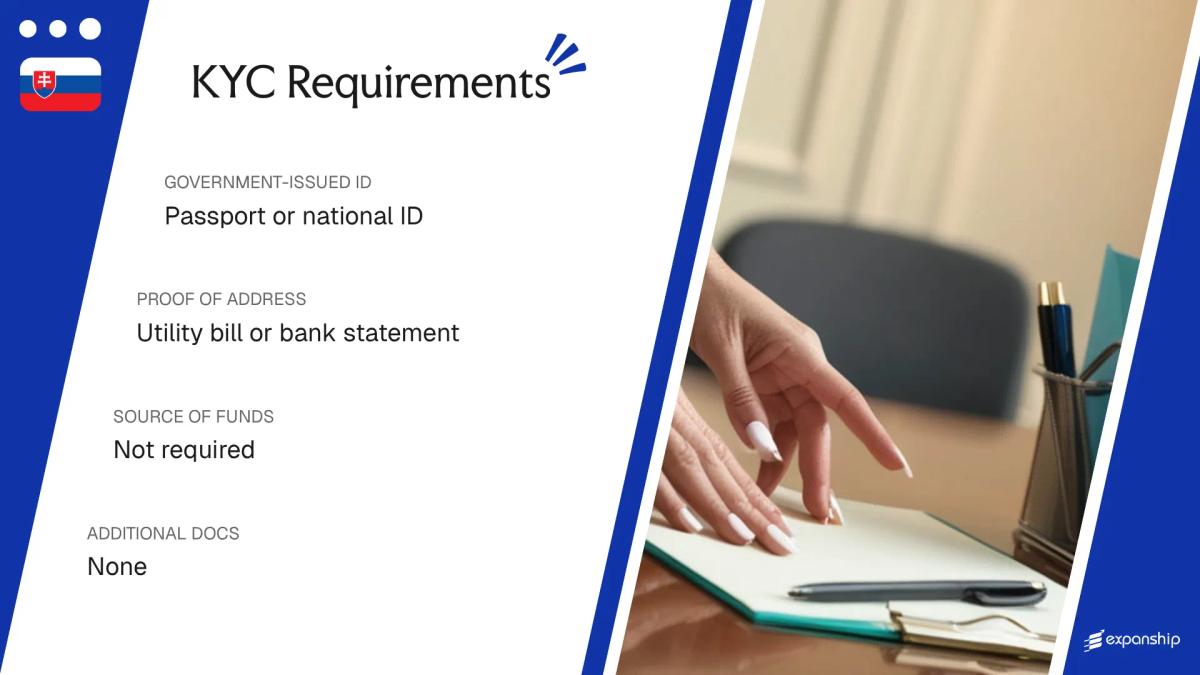
KYC document requirements Slovakia are governed primarily by Act No. 297/2008 Coll. on the Prevention of Legality of Proceeds of Criminal Activity, administered by the Financial Intelligence Unit (FIU) under the Financial Administration of the Slovak Republic. All documents must be submitted at the point of incorporation to the relevant formation agent or notary.
Individual / Personal Documents
- Valid government-issued photo ID (passport or national identity card) for each director, shareholder, and beneficial owner
- Proof of residential address dated within three months, such as a utility bill or official bank statement
- Completed and signed KYC/AML declaration form as required by the formation agent or notary
- Tax identification number or equivalent where the individual is a tax resident outside Slovakia
Corporate Documents
- Certificate of incorporation or equivalent constitutional document from the shareholder entity's home jurisdiction
- Current register of directors and shareholders of the corporate entity
- Proof of the corporate entity's registered address, such as an official utility bill or bank statement
- Certificate of good standing where the jurisdiction of incorporation issues such a document
Source of Funds Documentation
- Recent bank statements (typically covering the previous three to six months) evidencing available capital
- Audited financial statements where the introducing entity is an established business
- Written declaration of the origin of funds if bank statements alone are insufficient
Notarisation and Apostille Requirements
- Foreign public documents must carry an Apostille under the Hague Convention of 1961
- Official translations into Slovak are required for all foreign-language documents
- Notarisation by a local Slovak notary is required for the Memorandum of Association at the point of company registration
Incorporation applications are frequently delayed when foreign corporate documents are submitted without a certified Slovak translation or a valid Apostille.
Company Name Requirements in Slovakia
Company name requirements in Slovakia are assessed at the point of registration through the Commercial Register, which verifies that a proposed name is distinct from existing entries. The name must not be identical or confusingly similar to an already registered entity.
Your firm's name must be in Slovak or use Latin-script characters, and a limited liability company must include the suffix "spoločnosť s ručením obmedzeným" or its abbreviation "s.r.o." No prescribed minimum character length applies, but the name must be sufficiently distinctive.
Certain words are restricted by law. Terms implying state authority, national affiliation, or connection to regulated professions require prior approval from the relevant authority before registration is permitted.
Name reservation is available through the Commercial Register prior to formal incorporation. Reservations are time-limited, though the exact duration should be confirmed with the registry at the time of application.
Compliance Services for Companies in Slovakia
Maintain your Slovak entity's standing with ongoing compliance support, including annual filings, registered office maintenance, and regulatory reporting.
Conclusion
Incorporating a company in Slovakia involves meeting a defined set of legal requirements under the Commercial Code and related legislation. Registration is handled through the Business Register maintained by the district courts, with filings now largely processed via the Slovak Business Centre portal.
Among the requirements covered, the mandatory minimum share capital for an s.r.o. and the UBO registration obligations under the Anti-Money Laundering Act carry particular weight for foreign investors. Once these requirements are understood, the practical next step is engaging qualified local support to execute registration and maintain ongoing compliance.
Expanship's Corporate Services for Slovakia Expansion
Expanship's Slovakia company formation services cover the full scope of what incorporating a Slovak s.r.o. actually demands, from preparing notarially certified documents to coordinating with the Commercial Register at the competent District Court. Rather than replacing your judgment on structure or compliance, Expanship reduces the administrative load that comes with meeting Slovakia's specific formation and ongoing reporting requirements.
Beyond registration, Expanship supports your business across the entire setup process:
- Preparing and filing company registration documents with the relevant Slovak authorities
- Providing a registered agent and a compliant local office address
- Liaising with government bodies and the Commercial Register on your behalf
- Managing post-incorporation compliance obligations as they arise under Slovak law
- Introducing your entity to banking partners familiar with foreign-owned Slovak firms
- Handling tax registration and coordination with the Financial Administration of the Slovak Republic
To discuss how Expanship can support your entry into Slovakia, contact Expanship Slovakia.
Frequently Asked Questions (FAQ)
At least half of each shareholder's individual contribution must be paid up before the company is registered with the Slovak Commercial Register, and the total paid-up amount across all contributions must be at least €2,500. The remaining balance must be paid within five years of registration. This requirement is governed by the Slovak Commercial Code (Obchodný zákonník), specifically the provisions regulating s.r.o. formation.
Failure to maintain accurate and current beneficial ownership information in the Register of Partners of the Public Sector (where applicable) or the Beneficial Ownership Register can result in the company being struck from the relevant register, losing eligibility for public contracts, and facing fines. Courts may also refuse to record certain company changes in the Commercial Register if UBO data is non-compliant. Sanctions are administered through the district courts, which act as registration courts in Slovakia.
Under the Slovak Commercial Code, only natural persons may serve as directors (konatelia) of an s.r.o. Corporate directors are not permitted. Each director must also be free of any criminal record in relation to economic offences, and this is verified through a criminal record extract (výpis z registra trestov) submitted during the registration process.
Yes, obtaining the relevant trade licence from the District Office Trade Licensing Department (Okresný úrad, odbor živnostenského podnikania) is a prerequisite for Commercial Register registration for most business activities. The licence is applied for as part of the incorporation sequence, and the company cannot lawfully commence operations without it. Regulated professions and certain financial activities require additional sector-specific authorisations beyond the standard živnostenské oprávnenie.
A registered office address in Slovakia must be a real, verifiable address within Slovak territory, and the company must be able to demonstrate a legal right to use it, typically through a lease agreement or owner's consent. Virtual office addresses are used in practice, provided the service provider can supply documented proof of the right to use the premises. A post box address alone does not satisfy the requirement under Slovak law.
If the proposed name is deemed identical or confusingly similar to an already-registered entity, the registration court will issue a rejection notice specifying the grounds. You must then submit a corrected application with a revised name that satisfies the distinctiveness requirements of the Commercial Code. The prior application fee is generally not refunded, and the timeline for registration resets from the date the corrected submission is received by the court.
Foreign identity and corporate documents submitted during the Slovak incorporation process generally require official translation into Slovak by a certified court translator, and public documents issued abroad must carry an apostille under the Hague Convention or, where applicable, full legalisation. Notarised copies are typically required for constitutional documents of foreign corporate shareholders. The specific requirements can vary depending on the document type and the country of origin.
Legal Disclaimer
The information provided in this article is for general informational purposes only and does not constitute legal, tax, or professional advice. While we strive to ensure the accuracy and timeliness of the content, laws and regulations are subject to change, and the application of laws can vary widely based on specific facts and circumstances.
Readers should not act upon this information without seeking professional counsel tailored to their individual situation. Expanship and its authors disclaim any liability for actions taken or not taken based on the content of this article.
For specific advice regarding your business setup, compliance requirements, or any legal matters, please consult with qualified legal and tax professionals in the relevant jurisdiction.