
Key Takeaways
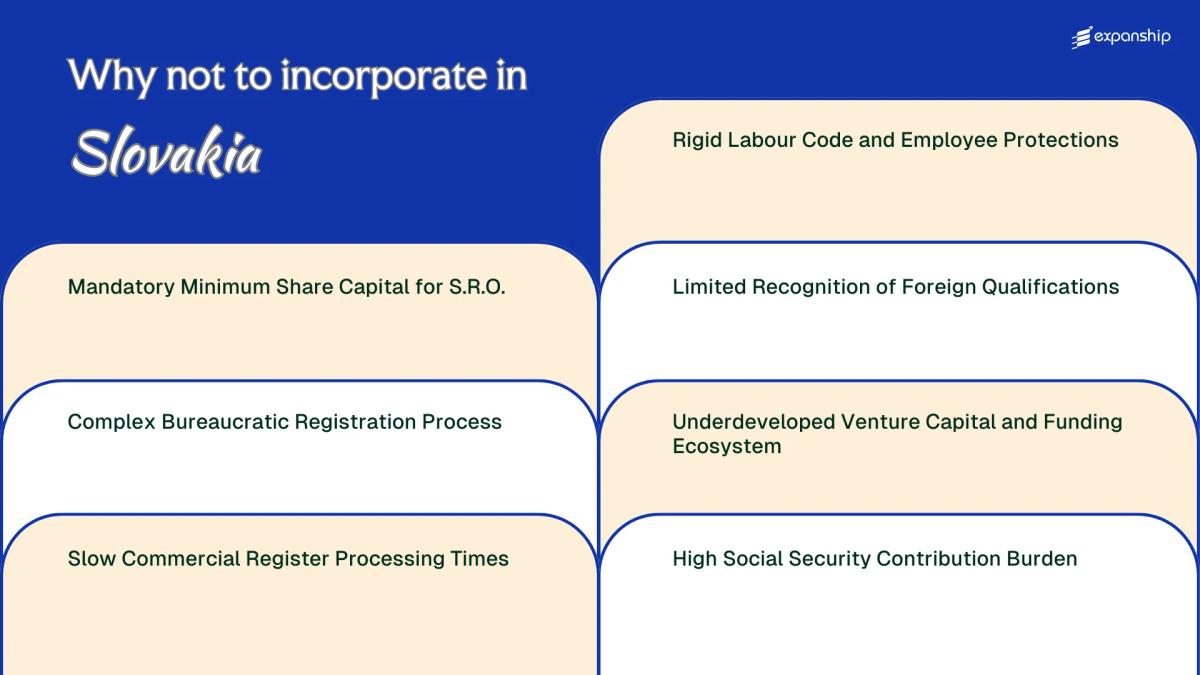
- Under Slovakia's Commercial Code (Zákon č. 513/1991 Zb.), foreign-owned s.r.o. entities must meet a mandatory minimum share capital requirement that adds an upfront financial threshold before operations can begin.
- Slovakia's Obchodný register processing times introduce meaningful delays into the incorporation timeline, creating a material gap between company formation and the ability to conduct business legally.
- The Slovak Labour Code imposes rigid employee protections and termination constraints that limit workforce flexibility for foreign firms unaccustomed to Central European employment regulation.
- Social security contribution obligations in Slovakia place a substantial recurring payroll burden on employers, increasing the true cost of local hiring beyond headline salary figures.
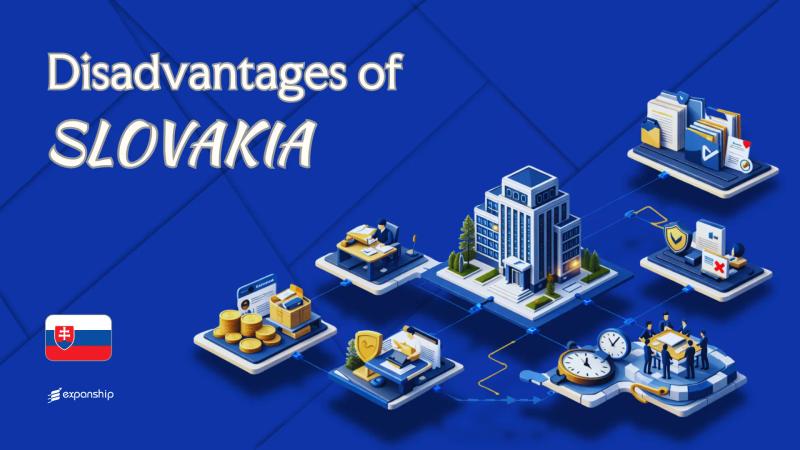
Slovakia operates under a heavily regulated commercial framework, governed primarily by the Commercial Code (Zákon č. 513/1991 Zb.). For foreign investors, the disadvantages of incorporating in Slovakia span procedural, financial, and labour-related categories.
These drawbacks are not uniform across all business types. A sole trader registering under the živnostenský zákon faces a different set of friction points than a foreign-owned s.r.o. seeking to hire locally or access growth capital.
This article is most relevant to non-EU entrepreneurs and mid-market foreign firms establishing a first operational presence in Central Europe, particularly those unfamiliar with Slovak administrative procedures and the requirements of the Obchodný register.
Mandatory Minimum Share Capital for S.R.O.
Slovakia S.R.O. share capital requirements sit at a statutory minimum of €5,000 for the entire company, with each individual founder required to contribute at least €750.
Capital Is Locked, Not Liquid
Under the Obchodný zákonník (Commercial Code), the full minimum share capital must be deposited before registration with the Obchodný register (Commercial Register) is completed. This upfront obligation means your capital is committed at the point of formation, before the business generates any revenue.
For foreign investors accustomed to jurisdictions with nominal or zero paid-in capital requirements, this creates an immediate liquidity constraint at the entity's most vulnerable stage.
Contribution Rules Limit Structural Flexibility
Single-member S.R.O. formation capital restrictions in Slovakia require that the sole founder pay the entire €5,000 before incorporation, whereas multi-member structures allow phased payment of up to 50% at registration. That flexibility disappears entirely when you are the sole shareholder, disproportionately affecting individual foreign entrepreneurs over corporate groups.
Your entire minimum capital contribution must be deposited and verified by a Slovak bank before the Commercial Register will process your application, leaving you with no operational funds during the registration period.
Complex Bureaucratic Registration Process
Slovakia company registration bureaucracy challenges are not incidental friction. They reflect a multi-agency structure that requires sequential approvals before a business can legally operate.
Incorporating a spoločnosť s ručením obmedzeným (s.r.o.) requires submissions to several bodies: the Trade Licensing Office (živnostenský úrad), the Commercial Register held by the relevant District Court, and the Tax Authority (Finančná správa). Each institution has its own documentation requirements, timelines, and communication channels.
For a foreign founder, this fragmentation creates compounding delays. A rejected document at one stage does not pause the others, meaning you may receive conflicting status updates across agencies simultaneously.
Specific burdens this structure places on foreign business owners include:
- Notarised documents from outside Slovakia must be apostilled, then officially translated into Slovak, adding cost and delay before any filing can begin
- Court-administered registration means procedural errors result in formal rejections rather than simple corrections, requiring full resubmission
- Remote or digital management of the process is limited, often requiring a local representative or in-person attendance at specific stages
Digital tools under the slovensko.sk portal exist but do not eliminate the dependency on physical document handling entirely.

Company Incorporation in Slovakia
Understand what the registration process involves for foreign founders and where administrative friction is most likely to occur.
Slow Commercial Register Processing Times
Slovakia commercial register processing delays represent one of the more operationally disruptive obstacles for foreign investors attempting to establish a presence there. Registration of a new s.r.o. runs through the Obchodný register, administered by the district courts, and the statutory processing window can extend to several business days under standard procedures. In practice, however, actual wait times frequently exceed these statutory benchmarks, particularly when documentation corrections are required.
| Stage | Statutory Timeframe | Common Delay Trigger |
|---|---|---|
| Court review of incorporation documents | Up to 2 business days (expedited) | Incomplete notarial deed or missing attachments |
| Standard registration processing | Up to 5 business days | High submission volume or court backlog |
| Post-rejection resubmission cycle | Restarts full timeline | Any defect in founding documents |
| Tax authority registration follow-on | Additional 30 days | Dependent on successful register entry |
Each resubmission restarts the processing clock entirely. For a foreign business owner operating under time-sensitive contracts or investor deadlines, a single documentation error can extend the total incorporation timeline by weeks.
The slow obchodný register Slovakia processing also creates a cascading effect on downstream registrations. Your entity cannot obtain a tax identification number, open a Slovak bank account, or execute binding commercial agreements under its registered name until the court formally confirms the entry.
Rigid Labour Code and Employee Protections
Slovakia Labour Code restrictions for employers are codified under Act No. 311/2001 Coll. (Zákonník práce), which imposes obligations that can substantially increase the cost and inflexibility of maintaining a workforce. For a foreign firm entering the market, these constraints are not abstract compliance items — they directly affect hiring decisions, restructuring options, and operational budgets.
Termination procedures are particularly restrictive. Dismissal on grounds of redundancy requires advance written notice periods and, in many cases, severance pay calculated on the employee's average monthly earnings, multiplied by the number of qualifying service years.
Collective agreements can extend statutory minimums further. If your entity falls within the scope of a higher-level collective agreement, obligations may bind you even without direct negotiation.
- Severance entitlements are legally prescribed and cannot be contracted below the statutory floor
- Notice periods vary by grounds for termination and cannot be unilaterally shortened
- Probationary periods are capped at three months (six months for senior managers)
- Overtime compensation and rest period requirements are mandatory under Zákonník práce
- Works council consultation may be required before certain workforce changes
Slovakia's Labour Code prohibits a mutual agreement termination from waiving the employee's right to statutory severance in certain redundancy scenarios, even when both parties sign the exit document voluntarily.
Limited Recognition of Foreign Qualifications
Foreign qualifications recognition problems Slovakia create a concrete staffing obstacle: credentials earned outside the country do not automatically carry legal weight, and the path to acceptance is inconsistent across regulated professions.
Regulated Professions and the Recognition Framework
Slovakia's recognition of foreign professional qualifications falls under Act No. 422/2015 Coll. on the Recognition of Professional Qualifications, which implements EU Directive 2005/36/EC. For regulated professions, your hire must obtain formal recognition from the relevant sectoral authority before practising legally, and assessors may impose compensation measures such as aptitude tests or adaptation periods. This adds both time and administrative cost before a foreign-qualified employee can contribute in their designated role.
Practical Consequences for Foreign-Staffed Businesses
Recognition timelines and requirements vary by profession and competent authority, with no single processing standard across sectors. A business that depends on foreign-qualified specialists in fields such as law, engineering, medicine, or construction faces delayed deployment and potential gaps in operational capacity. Credentials from non-EU countries face additional scrutiny, as the automatic EU mutual recognition rules do not apply, making Slovakia professional recognition restrictions considerably heavier for globally recruited talent.
Professional Guidance on Hiring Foreign Talent in Slovakia
If credential recognition requirements are affecting your hiring plans or operational timelines in Slovakia, our team can help you assess the applicable regulatory pathway for your workforce.
Underdeveloped Venture Capital and Funding Ecosystem
Slovakia's venture capital ecosystem limitations present a structural funding gap that disproportionately affects foreign-founded startups and growth-stage companies with no local investor networks.
- Early-stage equity funding is thin relative to Western European peers, meaning your business may exhaust seed capital before reaching the revenue milestones required to attract institutional interest.
- The Slovak Business Agency (SBA) administers public grant schemes, but these are predominantly accessible to locally established entities with documented Slovak operational history, restricting newer foreign entrants.
- EU structural funds channelled through Slovak intermediaries carry administrative conditions and co-financing requirements that increase the capital burden on applicants.
- The absence of a deep angel investor community means underdeveloped startup funding Slovakia creates a reliance on bank debt at commercial rates rather than dilutive but flexible equity arrangements.
- Slovak investment funding drawbacks extend to exit options, as a limited domestic M&A market reduces the liquidity events that international VC funds typically require before committing capital.
High Social Security Contribution Burden
Slovakia's social security contribution burden sits among the higher-cost payroll environments in Central Europe, creating a tangible cost disadvantage for foreign employers from the moment they hire locally.
Contributions are administered by Sociálna poisťovňa, the national social insurance agency, and are split between employer and employee. The employer's share alone reaches approximately 35.2% of gross salary, covering sickness, pension, unemployment, accident, guarantee, and reserve fund contributions.
For a foreign-owned s.r.o. scaling a team, this structure means every 1,000 EUR in gross wages carries an additional ~352 EUR in mandatory employer levies before any other staffing cost is counted. That compound effect limits how quickly your firm can grow headcount without disproportionate payroll exposure.
Self-employed contractors (SZČO) face their own mandatory contribution floors tied to the average wage, which can limit the cost savings some businesses expect from engaging freelancers rather than employees.
A foreign business paying five employees at Slovakia's average monthly gross wage of approximately 1,400 EUR would incur employer social contributions of roughly 2,464 EUR per month — nearly 29,568 EUR annually — solely in Sociálna poisťovňa levies, before health insurance contributions are factored in.
Navigating These Incorporation Challenges
Overcoming Slovakia incorporation challenges requires a structured approach built around the country's specific legal and administrative requirements rather than assumptions drawn from other EU jurisdictions.
- Prepare the minimum share capital of EUR 5,000 for an s.r.o. and document its deposit with a Slovak bank before submitting registration materials to the Obchodný register.
- Use the unified registration form (JRF) to consolidate filings across the Commercial Register, tax authority, and social insurance agency where the business structure qualifies.
- Audit all foreign professional qualifications against Slovak recognition requirements under Act No. 422/2015 Coll. before appointing directors or key personnel in regulated roles.
- Review employment contracts against the Labour Code (Zákonník práce) to ensure termination clauses, notice periods, and working time provisions meet statutory minimums from the outset.
- Map social security contribution obligations under Sociálna poisťovňa for both the entity and any employees before finalising payroll structures.
These steps address procedural and compliance requirements embedded across multiple Slovak regulatory bodies. None eliminates the structural friction discussed in this blog, but each reduces exposure to avoidable registration delays or post-incorporation penalties.
Slovakia Still a Viable Business Destination
Slovakia business destination despite drawbacks is a fair framing for any foreign investor running a serious cost-benefit analysis. The disadvantages documented across this blog are real and operational, not theoretical, yet the jurisdiction retains structural attributes that keep it on the shortlist for European market entry.
| Pros | Cons |
|---|---|
| EU and Eurozone membership provides access to the single market and eliminates currency conversion risk. | The S.R.O. requires a minimum share capital of €5,000, which must be subscribed before registration. |
| Corporate income tax is applied at a flat rate, which simplifies tax planning for foreign-owned entities. | Commercial Register processing can extend weeks beyond the statutory deadline, delaying operational launch. |
| Slovakia's geographic position gives logistical access to Central and Eastern European supply chains. | Social security contribution rates create a significant fixed cost burden on the employer side of payroll. |
| Eurozone membership removes exchange rate exposure for businesses trading primarily in EUR. | The Labour Code limits flexibility in termination and working time arrangements compared to other EU jurisdictions. |
| Skilled technical and engineering graduates are available through the domestic university system. | Foreign professional qualifications face a fragmented and slow recognition process across regulated sectors. |
Compliance Services for Companies in Slovakia
Maintain your Slovak entity's legal standing with ongoing compliance support covering statutory filings, registered office requirements, and annual reporting obligations under Slovak law.
Conclusion
The Slovakia incorporation disadvantages summary points to a jurisdiction that presents genuine structural friction for foreign investors. Social security contribution rates that substantially increase employment costs, a labour code that constrains workforce flexibility, and a commercial register process that can delay operational readiness are among the most consequential friction points covered here. These are not incidental issues — they are embedded in Slovak statutory and administrative frameworks. Knowing where these pressures fall within your business model allows for more accurate cost and timeline projections before committing to formation.
Expanship's Support for Your Slovakia Expansion
Expanship Slovakia company formation support covers the specific compliance obligations that make Slovak incorporation demanding for foreign businesses. From coordinating with the Obchodný register (Commercial Register) to managing Social Insurance Agency filings and Labour Code requirements, Expanship helps reduce the operational load these processes place on your team without overstating what any external service can change about Slovak regulatory realities.
Beyond incorporation, Expanship offers structured support across the full setup and maintenance cycle:
- Your company registration and all required document preparation are handled with accuracy and attention to Slovak filing standards.
- A registered agent and official business address in Slovakia are provided to satisfy statutory requirements.
- Government submissions and liaison with relevant Slovak authorities are managed on your behalf.
- Post-incorporation compliance obligations, including annual filings, are tracked and maintained.
- Banking introductions to Slovak financial institutions are facilitated.
- Tax registration and coordination with the Slovak financial administration are carried out as part of your setup.
Reach out to Expanship Slovakia to discuss your specific incorporation requirements.
Frequently Asked Questions (FAQ)
Slovakia's Labour Code (Zákonník práce) applies broadly, covering full-time, part-time, and fixed-term employment relationships. Fixed-term contracts can only be renewed twice within a two-year period before the arrangement must convert to open-ended employment, which limits workforce flexibility for growing companies that need time to assess staff performance.
Slovak employers currently pay social and health insurance contributions equivalent to roughly 35% of an employee's gross salary on top of the wage itself. This is a significant payroll cost, and it applies from the first hire with no threshold-based relief for small businesses during early-stage growth.
Compared to the Czech Republic and Poland, Slovakia's private venture capital market is considerably thinner, with fewer active domestic funds and a narrower base of angel investors. Early-stage tech and growth-oriented firms frequently find they must look to cross-border EU funding mechanisms or foreign investors, which adds time and transactional complexity to the fundraising process.
If a foreign qualification is not recognised, the individual cannot legally perform regulated activities under Slovak law until the recognition process is completed through the relevant authority, which varies by profession. This can delay hiring decisions or force your business to recruit locally for roles that require regulated credentials, even when a qualified foreign candidate is already available.
Processing times at Slovakia's Commercial Register (Obchodný register) can extend beyond the statutory periods in practice, particularly during high-volume periods, meaning your entity may not be officially incorporated for several weeks after submission. Until registration is complete, the s.r.o. has no legal standing to sign binding commercial contracts or open a full business bank account, which directly delays revenue generation.
Shelf companies are available in Slovakia, but purchasing one does not eliminate all regulatory obligations. The new owner must still file director changes, update registered information with the Commercial Register, and in some cases re-register for tax purposes with the Finančná správa, meaning the administrative burden is deferred rather than avoided entirely.
Legal Disclaimer
The information provided in this article is for general informational purposes only and does not constitute legal, tax, or professional advice. While we strive to ensure the accuracy and timeliness of the content, laws and regulations are subject to change, and the application of laws can vary widely based on specific facts and circumstances.
Readers should not act upon this information without seeking professional counsel tailored to their individual situation. Expanship and its authors disclaim any liability for actions taken or not taken based on the content of this article.
For specific advice regarding your business setup, compliance requirements, or any legal matters, please consult with qualified legal and tax professionals in the relevant jurisdiction.