
Key Takeaways
- Foreign-sourced income earned by a Marshall Islands IBC is fully exempt from corporate tax under the Business Corporations Act 1990, eliminating a recurring cost that accumulates materially over multi-year operational cycles.
- With no minimum capital requirement, investors can incorporate and maintain an entity without the capital lock-up obligations imposed by higher-burden jurisdictions, preserving liquidity from day one.
- The absence of capital gains, withholding, and inheritance tax creates a structurally clean environment for holding companies and asset vehicles where multiple tax leakage points would otherwise apply.
- Oversight of company registration sits with the Registrar of Corporations under a legislative framework specifically drafted for international commercial activity, meaning the compliance architecture reflects the operational reality of cross-border structures rather than adapting domestic rules to foreign investors.
Located in the central Pacific Ocean, the Marshall Islands is an independent sovereign nation in free association with the United States. Company registration falls under the authority of the Registrar of Corporations, operating within the framework established by the Business Corporations Act 1990. Foreign investors most commonly establish an International Business Company when structuring operations through this jurisdiction.
The tax posture is broadly zero-tax on income sourced outside the country, which shapes much of its appeal for cross-border structuring. There are no restrictions on foreign ownership of locally registered entities, and non-resident investors may hold 100% of shares without requiring a local partner or nominee arrangement. This openness to foreign direct investment is reflected directly in the Business Corporations Act 1990, which was drafted with international commercial activity in mind.
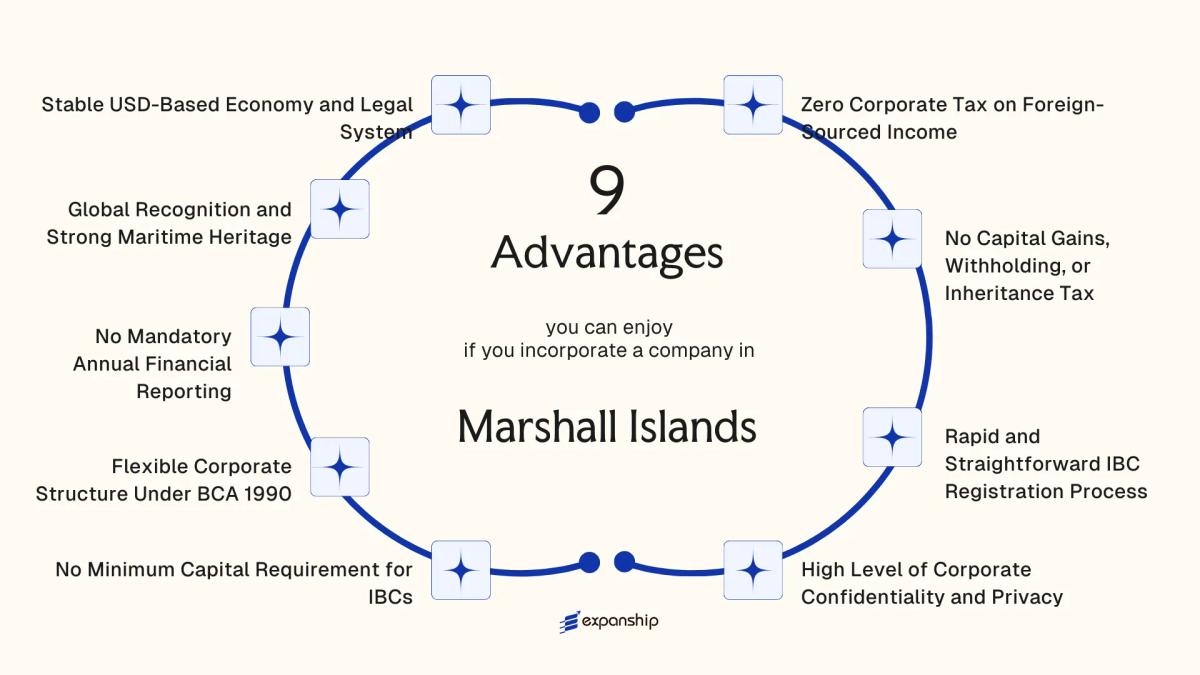
The benefits of incorporating in Marshall Islands span taxation, privacy, structural flexibility, and administrative simplicity. This article examines the key advantages your business stands to gain by registering a company here.
Zero Corporate Tax on Foreign-Sourced Income
Marshall Islands zero tax on foreign income is the defining fiscal feature of its International Business Company structure. Under the Business Corporations Act 1990 (BCA 1990), IBCs are fully exempt from corporate income tax on all earnings generated outside the Republic.
What the Exemption Covers
Income sourced abroad — including fees, royalties, dividends received, and trading profits from international contracts — is not subject to any Marshall Islands corporate tax. This means your company retains its full pre-tax margin on foreign operations, with no domestic tax liability eroding returns at the entity level.
Why This Matters Structurally
The exemption is not a preferential rate or a time-limited incentive; it is a structural feature of IBC status under the BCA 1990. For a business billing international clients or holding foreign investments through a Marshall Islands entity, the effective corporate tax rate on that income is zero, regardless of the volume or frequency of transactions.
Your eligibility depends on maintaining IBC status and ensuring that income is genuinely foreign-sourced, with no taxable nexus inside the Republic.
Foreign-sourced profits flow to your IBC without a corporate tax deduction at the Marshall Islands level.
No Capital Gains, Withholding, or Inheritance Tax
Under the Marshall Islands Business Corporations Act 1990 (BCA 1990), IBCs with no Marshall Islands-sourced income are not subject to capital gains tax, withholding tax on dividends or interest, or inheritance tax. The Marshall Islands no capital gains or withholding tax position applies broadly to foreign-sourced income, meaning profits from investments, asset disposals, or cross-border transactions flow without a layer of local taxation reducing the return.
For investors, this has a direct effect on after-tax yield. Dividend distributions from an IBC to foreign shareholders are not subject to a local withholding deduction, so the full declared amount reaches the recipient without requiring treaty access or tax reclaim procedures.
The inheritance tax exemption under the BCA 1990 also extends to ownership transfers of IBC shares upon death. This gives estate planners a degree of certainty that a change in beneficial ownership does not trigger a local tax charge at the point of transfer.
Why this matters in practical terms:
- No withholding tax means distributions to non-resident shareholders require no local tax filings to recover deducted amounts
- Capital gains realized on share disposals or asset sales fall outside the local tax base entirely
- Inheritance tax exemption removes the need for complex pre-death restructuring solely to avoid a transfer charge
- The absence of these taxes applies by statute, not administrative discretion, giving foreign owners a stable, legally grounded position
The exemptions apply only to income and gains with no domestic source connection.
 Marshall Is.
 Incorporate a Company in the Marshall Islands
Set up a Marshall Islands IBC under the BCA 1990 with no capital gains, withholding, or inheritance tax on foreign-sourced income.
Rapid and Straightforward IBC Registration Process
Marshall Islands fast IBC registration benefits are well-documented among offshore practitioners, and the speed of formation is a concrete, measurable advantage. Under the Republic of Marshall Islands Business Corporations Act 1990 (BCA 1990), an International Business Company can typically be registered within 24 hours of submitting the required documentation to the Registrar of Corporations. For a foreign business owner, that timeline means your entity can be legally constituted before most jurisdictions have finished processing an initial application review.
The documentation threshold is low by design. No residency requirement applies to directors or shareholders, and no government approval process precedes registration. The Registrar of Corporations accepts filings through registered agents, which removes the need for the applicant to appear in-person or engage directly with local authorities.
| Parameter | Detail |
|---|---|
| Typical Formation Timeline | 24 hours |
| Governing Legislation | Business Corporations Act 1990 |
| Filing Authority | Registrar of Corporations |
| Registered Agent Requirement | Yes, local agent required |
| In-Person Appearance Required | No |
| Residency Requirement for Directors | No |
Because the BCA 1990 does not mandate pre-incorporation approval from government ministries or sector-specific regulators for standard IBCs, the formation process avoids the multi-week delays common in jurisdictions where such clearances are required. For a business owner who needs an operational corporate structure quickly, this structural efficiency translates directly into reduced time-to-market and lower professional fees during the formation phase.
High Level of Corporate Confidentiality and Privacy
Marshall Islands corporate confidentiality benefits are grounded in statute, not convention. Under the Business Corporations Act 1990 (BCA 1990), International Business Companies are not required to file shareholder registers or director details with the Registrar of Corporations. That means ownership information does not enter any publicly searchable record.
The practical consequence for a foreign business owner is significant. A competitor, litigant, or counterparty conducting a public registry search will find only the company name and its registered agent — nothing more.
Nominee shareholder arrangements are fully permissible under the BCA 1990. When combined with nominee director services, the identity of the beneficial owner can be entirely absent from any filed documentation. This structure is used routinely by founders seeking operational privacy for holding companies, IP vehicles, and investment entities.
Keep the following in mind to preserve your privacy position:
- Beneficial ownership records are maintained by your registered agent, not submitted to any public authority
- Nominee agreements should be supported by undated resignation letters and power of attorney documents
- No shareholder meeting minutes or resolutions are required to be filed publicly
- Internal records must still be maintained; the privacy protection applies to public disclosure, not internal recordkeeping obligations
Unlike many offshore jurisdictions that introduced public registers under international pressure, the Marshall Islands has not enacted public beneficial ownership registry legislation as of the current regulatory period.
No Minimum Capital Requirement for IBCs
Under the Marshall Islands no minimum capital requirement IBC framework, founders can register a company without committing any paid-up capital at formation. This rule is codified under the Business Corporations Act 1990 (BCA 1990), which governs International Business Companies registered through the Registrar of Corporations. For a foreign business owner, the practical effect is straightforward: capital can be deployed where it generates returns, rather than held idle in a corporate account to satisfy a statutory threshold.
Capital Structure on Your Terms
Authorized share capital can be set at any amount, and shares may be issued without par value. Your entity can begin operations without transferring funds into a dedicated account simply to meet a legal formation requirement. That absence of a mandatory minimum removes a friction point that, in many European jurisdictions, requires verified bank deposits before a company receives its certificate of incorporation.
Structural Efficiency for Early-Stage and Lean Operations
Businesses structured for asset protection, holding arrangements, or international trading often carry no need for large standing balances at the entity level. Because the BCA 1990 places no floor on paid-up capital, the share structure can be tailored precisely to the operational and ownership model your business requires. A single share or millions can be authorized, and the par value, if any, is a decision left entirely to the incorporators rather than dictated by statute.
Marshall Is. Structure Your Marshall Islands IBC Capital the Right Way
Speak with an Expanship advisor to configure your share capital and corporate structure in line with your business objectives.
Flexible Corporate Structure Under BCA 1990
The Marshall Islands BCA 1990 flexible corporate structure is codified under the Business Corporations Act of 1990, which was modeled in part on Delaware corporate law. This legislative foundation gives incorporators a degree of structural freedom that more heavily regulated onshore jurisdictions do not permit.
- Share classes are not restricted to a single type. A company can issue common shares, preference shares, redeemable shares, or shares with no par value, allowing capital structures to be tailored to investor agreements, joint ventures, or multi-tier ownership arrangements without requiring legislative approval.
- Shareholder and director meetings carry no residency requirement and no obligation to be held within the jurisdiction. This means your board can convene wherever operationally convenient.
- A single individual may simultaneously serve as sole director and sole shareholder. For small or founder-led entities, this eliminates the need to appoint nominal officers purely to satisfy statutory minimums.
- Corporate directors are permitted under the BCA 1990. A legal entity, rather than a natural person, can hold a directorship, which supports certain holding structures and intermediary arrangements.
- Quorum and voting thresholds in the articles of incorporation can be customized beyond the statutory defaults. This gives founding shareholders direct control over governance mechanics from the outset.
No Mandatory Annual Financial Reporting
Marshall Islands no annual financial reporting requirement stands as one of the more operationally significant features of the IBC framework. Under the Business Corporations Act 1990 (BCA 1990), IBCs are not required to prepare, file, or submit audited financial statements to any government authority. No accounts need to be lodged with the Registrar of Corporations.
For a foreign business owner, this removes a recurring compliance cost that jurisdictions like the UK or Singapore impose annually. Audit fees, accounting retainers, and regulatory filing charges can run into thousands of dollars per year for mid-sized entities. The Marshall Islands IBC reduced compliance burden means those resources remain with the business.
Your firm is still expected to maintain internal records sufficient to reflect its financial position, but there is no prescribed format, no statutory audit requirement, and no public disclosure obligation. This distinction matters: record-keeping for internal governance is not the same as mandatory external reporting to a regulator.
A foreign-owned IBC operating exclusively outside the Marshall Islands pays no corporate tax and files no financial statements with the Registrar, meaning its annual government compliance costs can be limited to the flat registered agent and renewal fees, often under USD 650 per year.
Global Recognition and Strong Maritime Heritage
Marshall Islands global recognition as an offshore company domicile is directly linked to its status as the world's second-largest ship registry. Administered by the International Registries, Inc. under authority delegated by the government, the registry operates under the Maritime Act 1990 and maintains compliance with IMO conventions. This record of international regulatory acceptance signals institutional credibility that extends beyond shipping into general corporate contexts.
Foreign banks, counterparties, and institutional partners routinely encounter Marshall Islands entities through shipping and finance transactions. That familiarity reduces friction when your IBC opens accounts, signs contracts, or enters financing arrangements, since the jurisdiction is not an unknown quantity to compliance departments.
Recognized by the OECD and FATF as a cooperative jurisdiction, the republic has also committed to international standards on transparency and information exchange. Membership in the United Nations since 1991 further supports the standing of entities incorporated under the Business Corporations Act 1990 in cross-border dealings.
- The ship registry's global footprint spans over 5,000 vessels.
- IBCs benefit indirectly from the maritime sector's established due diligence frameworks.
- Recognition in major financial centers reduces correspondent banking complications.
Marshall Islands IBCs that conduct shipping-related activities may be subject to additional regulatory requirements under the Maritime Act 1990 beyond standard corporate compliance.
Stable USD-Based Economy and Legal System
The Marshall Islands USD-based economy business advantage is straightforward: the US dollar is the official currency by agreement with the United States, eliminating any foreign exchange risk for companies conducting business in USD-denominated markets. For a foreign business owner operating across borders, this removes an entire layer of financial exposure that entities incorporated in countries with volatile local currencies must manage continuously.
Operating without a domestic central bank means monetary policy cannot introduce currency devaluation or capital controls. Your firm holds, transfers, and contracts in USD without conversion requirements or currency repatriation restrictions that complicate treasury management in other offshore jurisdictions.
Common Law Legal Framework
The legal system draws from US common law, which governs contract interpretation, commercial disputes, and corporate governance. Courts apply precedent-based reasoning familiar to attorneys and business owners operating in the United States, the United Kingdom, or any Commonwealth-origin jurisdiction. This reduces legal uncertainty when drafting agreements or enforcing contractual obligations.
The Business Corporations Act 1990 (BCA 1990) established the statutory framework for International Business Corporations and operates within this common law environment. Foreign investors benefit from a body of jurisprudence that is well-documented and professionally understood across major financial centers.
- Contracts denominated in USD require no currency conversion clauses
- US common law precedents apply to corporate dispute resolution
- No capital controls restrict the movement of funds in or out of a registered entity
- Legal documentation prepared under BCA 1990 is recognizable to US and UK counsel
How Marshall Islands Stacks Up Against Other Offshore Jurisdictions
Comparing Marshall Islands vs other offshore jurisdictions reveals a consistent pattern: where competing centres have added reporting layers, beneficial ownership registers, or substance requirements in response to international pressure, the Marshall Islands framework under the Business Corporations Act 1990 has retained its structural simplicity. The jurisdictions selected below, BVI, Cayman Islands, and Seychelles, are the ones a foreign investor would most plausibly weigh against an IBC formed in the Pacific registry, given their shared target market of international holding and trading structures.
What the table makes visible is not just individual features but cumulative positioning. BVI now maintains a beneficial ownership register accessible to competent authorities, and Cayman entities face increasing Economic Substance requirements under domestic legislation. Seychelles remains competitive on cost but carries a lower international recognition profile than the Marshall Islands, whose registry underpins one of the world's largest ship registries and enjoys broad credibility with counterparties and financial institutions.
| Parameter | Marshall Islands | BVI | Cayman Islands | Seychelles |
|---|---|---|---|---|
| Corporate Tax on Foreign Income | 0% | 0% | 0% | 0% |
| Beneficial Ownership Register | Non-public | Restricted access (competent authorities) | Non-public | Non-public |
| Annual Financial Reporting | Not required for IBCs | Not required | Required for certain entities | Not required |
| Minimum Share Capital | None | None | None | None |
| Governing Legislation | BCA 1990 | BVI Business Companies Act 2004 | Companies Law (2023 revision) | International Business Companies Act 2016 |
| USD-Based Economy | Yes | No (USD used, not official) | No | No |
| International Registry Recognition | High (shipping/maritime) | High | High | Moderate |
Marshall Is. Compliance Services for Marshall Islands Companies
Maintain good standing for your Marshall Islands IBC with ongoing compliance support, including registered agent obligations, annual fees, and regulatory filings under the Business Corporations Act 1990.
Conclusion
The benefits of incorporating in Marshall Islands rest on a coherent structural logic: the Business Corporations Act 1990 creates a legal environment where foreign-owned entities operate outside the domestic tax base entirely, face no mandatory audit obligations, and can be constituted with governance arrangements that most onshore jurisdictions would not permit.
Two features carry particular weight for foreign investors. The complete exemption from corporate tax on foreign-sourced income removes a recurring cost variable that compounds across years of operation. Combined with the absence of minimum capital requirements, this means your firm can be incorporated and maintained without the capital lock-up or tax provisioning that would apply in higher-burden jurisdictions.
Your specific structure, whether a trading entity, a holding company, or an asset vehicle, will determine how fully these provisions apply to your situation. The BCA 1990 framework accommodates a range of configurations, but the fit between that framework and your operational model is a factual question, not a presumption. Confirming that alignment at the outset is what converts jurisdictional advantages on paper into material benefits in practice.
Start Your Marshall Islands Company With Expanship Today
Expanship assists foreign business owners with Marshall Islands company formation, handling the end-to-end registration process under the Business Corporations Act 1990 (BCA 1990) and coordinating directly with the Registrar of Corporations. From structuring your International Business Company to managing post-incorporation obligations, Expanship's service scope covers the practical steps that tend to create delays when managed independently.
Services available through Expanship include:
- IBC document preparation and notarization in accordance with BCA 1990 requirements
- Registered agent and registered office provision, as mandated for all IBCs
- Government filing and liaison with the Registrar of Corporations
- Post-incorporation compliance management, including annual fee tracking
- Corporate document legalization and apostille processing
- Banking introduction assistance for newly incorporated entities
To discuss your requirements or begin the incorporation process, contact Expanship Marshall Islands.
Frequently Asked Questions (FAQ)
IBCs registered under the BCA 1990 are exempt from corporate income tax, capital gains tax, withholding tax, and stamp duty on all income derived from outside the jurisdiction. The exemption is structural, meaning it applies by virtue of the company's IBC status rather than requiring a separate tax ruling or annual application. Income sourced domestically, however, falls outside this exemption framework.
No mandatory annual financial reporting or audit requirement applies to Marshall Islands IBCs under the BCA 1990. Companies are not required to file financial statements with the Registrar of Corporations. Maintaining internal accounting records is advisable for compliance purposes in the owner's home jurisdiction, but no public disclosure obligation exists locally.
Beneficial ownership details and shareholder information are not held in a publicly accessible registry under the BCA 1990. The Registrar of Corporations maintains incorporation records, but these do not include shareholder registers or details of beneficial owners. Nominee arrangements are permissible, and the identities of those involved remain outside public view.
Incorporation can generally be completed within one to two business days once all required documentation is submitted to the Registrar of Corporations. The BCA 1990 does not impose a statutory waiting period, and no government pre-approval is required before the entity is formed. Processing times may vary slightly depending on the registered agent handling the filing.
Both jurisdictions offer tax-neutral treatment for foreign-sourced income and strong privacy frameworks, but there are structural differences. The Marshall Islands imposes no minimum capital requirement and has no mandatory annual return filing for IBCs, whereas the BVI requires an annual return to be filed with the Financial Services Commission. The Marshall Islands also benefits from its USD-denominated economy, which eliminates currency conversion exposure for USD-denominated business activity.
If a registered agent ceases operations, the IBC is required under the BCA 1990 to appoint a replacement registered agent to maintain its good standing. Failure to maintain a registered agent in the jurisdiction can result in the company being struck from the register. The transition process involves filing the updated agent details with the Registrar of Corporations, and the company itself remains legally intact during a properly managed transition.
Legal Disclaimer
The information provided in this article is for general informational purposes only and does not constitute legal, tax, or professional advice. While we strive to ensure the accuracy and timeliness of the content, laws and regulations are subject to change, and the application of laws can vary widely based on specific facts and circumstances.
Readers should not act upon this information without seeking professional counsel tailored to their individual situation. Expanship and its authors disclaim any liability for actions taken or not taken based on the content of this article.
For specific advice regarding your business setup, compliance requirements, or any legal matters, please consult with qualified legal and tax professionals in the relevant jurisdiction.