

Key Takeaways
- Under the Commercial Act (상법), foreign investors must select an appropriate entity type — such as a Jusik Hoesa or Yuhan Hoesa — before registration, as structural requirements including capital, governance, and director composition differ materially between the two forms.
- Companies incorporating in South Korea are required to maintain a verifiable physical registered office address within the jurisdiction as a condition of registration through the Supreme Court Registry system.
- Beneficial ownership information must be disclosed in compliance with the Act on Real Name Financial Transactions and Confidentiality, an obligation that persists beyond the initial incorporation stage and carries ongoing reporting weight.
- Director residency rules, which historically mandated at least one Korean resident director for foreign-owned entities, have been subject to relaxation under certain conditions, making it necessary to confirm the applicable standard at the time of registration.
Entity formation in South Korea is governed by the Commercial Act (상법), with the Supreme Court Registry Office overseeing company registration through the Court Registry system administered by the Ministry of Justice. Foreign investors pursuing South Korea incorporation requirements must understand that compliance begins at the registration stage, not after it.
This article addresses the structural and documentary requirements that apply across the formation process, from capital and governance to identity verification and naming conventions. Failure to meet these conditions results in rejection of the registration application or, in cases of post-incorporation non-compliance, potential administrative penalties or forced dissolution.
Requirements differ depending on the entity type selected, such as a Jusik Hoesa (stock company) versus a Yuhan Hoesa (limited liability company), and may also vary by industry sector or the investor's residency status. The governing legislation is available directly in the Commercial Act.
This article is most relevant to foreign entrepreneurs, institutional investors, and multinational firms establishing a legal presence in the Korean market for the first time.
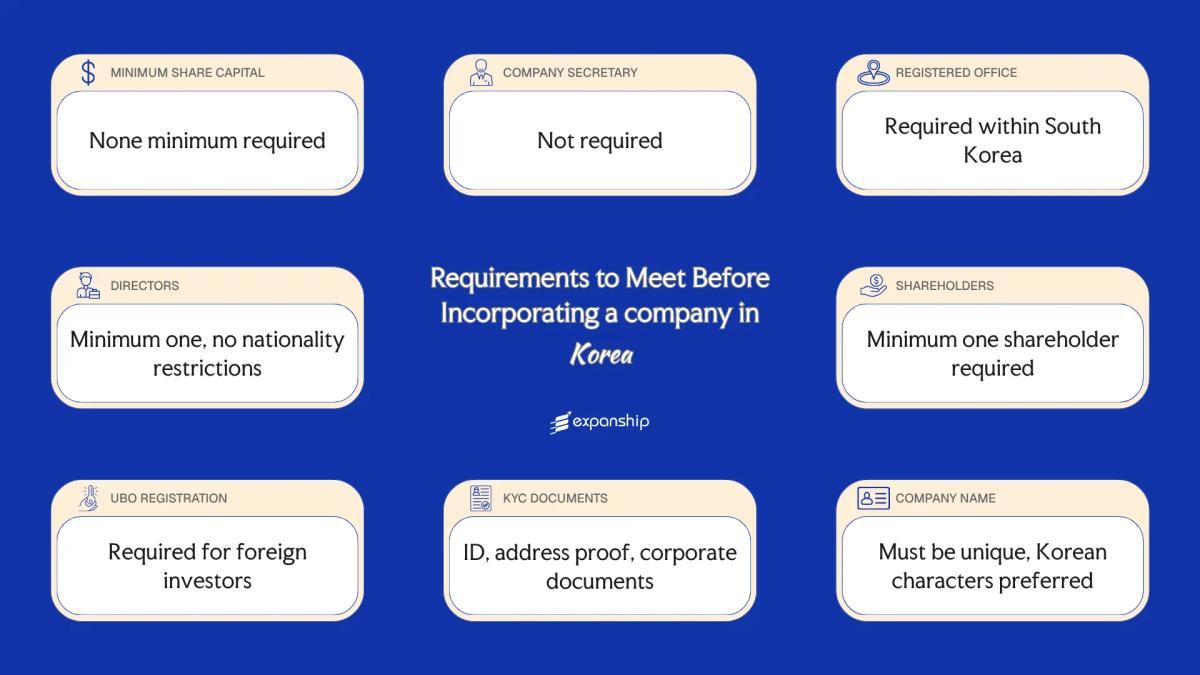
Minimum Share Capital Requirements in South Korea
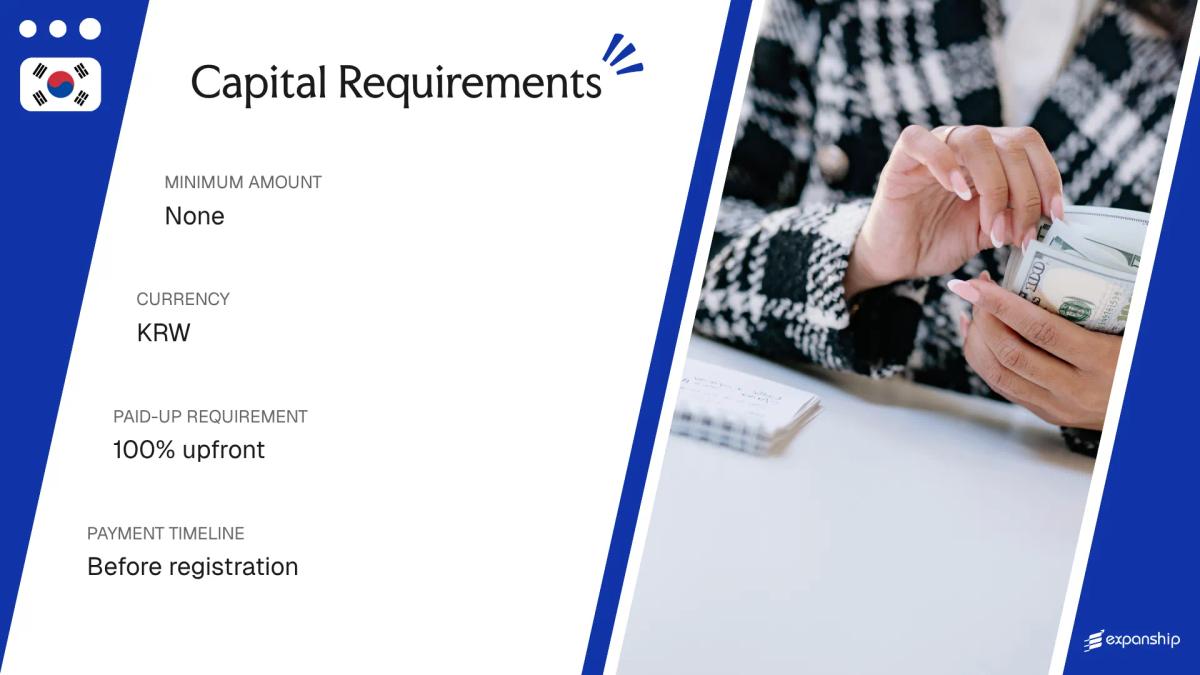
| Parameter | Detail |
|---|---|
| Minimum Authorized Share Capital | No statutory minimum |
| Maximum Authorized Share Capital | No statutory maximum |
| Minimum Paid-Up Capital | No statutory minimum |
| Paid-Up Requirement at Incorporation | At least 25% of the total issued share value must be paid up at the time of incorporation under the Korean Commercial Act |
| Accepted Currency | Korean Won (KRW) |
| Accepted Forms of Contribution | Cash and non-cash contributions (property, intellectual property, and other transferable assets subject to court-appointed appraiser verification) |
| Timeframe to Deposit Capital | Prior to incorporation registration with the Court Registry |
South Korea minimum share capital requirements under the Korean Commercial Act impose no fixed floor for a Jusik Hoesa. Your company's share structure must still comply with par value rules, as Korean law requires shares to carry a minimum par value of KRW 100 per share.
Capital is deposited into a designated bank account before the entity is registered with the competent District Court Registry, which verifies the deposit through a bank balance certificate submitted as part of the registration filing.
No statutory minimum does not mean capital structure is optional. A Jusik Hoesa must still issue shares at or above the KRW 100 par value threshold, and the deposit must be confirmed before registration is accepted.
Company Secretary Requirements in South Korea
Under the Commercial Act, South Korea does not impose a statutory company secretary requirement equivalent to those found in common law jurisdictions such as the United Kingdom or Singapore. South Korea company secretary requirements, as a formal corporate office, are not mandated for most business structures, including the Jusik Hoesa (stock corporation).
That said, larger corporations governed by the Act on External Audit of Stock Companies may be required to maintain internal compliance officers or audit committee members depending on their size and listing status. These roles carry defined obligations, including maintaining accurate corporate records, supporting the board of directors, and ensuring timely statutory filings with the Financial Supervisory Service or the court registry.
Qualification criteria for individuals serving in compliance or corporate governance roles include:
- No statutory nationality or residency requirement applies to general compliance personnel
- Audit committee members in larger firms must meet independence criteria under the Commercial Act
- Listed companies must appoint at least one outside director with relevant qualifications set by the Korea Exchange
- Individuals subject to criminal convictions relating to financial crimes may be disqualified from serving

Incorporate a Company in South Korea
Set up your legal entity in South Korea with structured support across documentation, registration, and ongoing compliance obligations.
Registered Office Requirements in South Korea
South Korea registered office requirements mandate that every company maintain a physical address within the country, recorded in the commercial registry maintained by the Supreme Court's Registry Office (Deunggiseo), where official correspondence and legal notices can be directed.
- A physical address is required; P.O. boxes do not satisfy the registered office condition.
- The address must be located within South Korea; foreign addresses are not accepted by the registry.
- Virtual offices may be used provided they supply a verifiable, physical street address at that location.
- Proof of occupancy, such as a lease agreement or property ownership document, is generally required to support the address registration.
- The registered address is publicly listed in the corporate registry and accessible through the Supreme Court Registry's online portal (Internet Registry).
- Any change to the registered office address must be reported to the relevant District Court Registry within three weeks, as required under the Commercial Act.
- Failure to maintain a valid registered address or to notify the registry of a change can result in administrative penalties and may affect the entity's legal standing with authorities such as the National Tax Service.
Director Requirements in South Korea
Under the Commercial Act (Sangbeop), directors of a Jusik Hoesa assume full fiduciary duties to the company upon appointment, including the duty of care and the duty of loyalty. Liability for breach of these obligations extends to third parties where directors act in violation of statutes or the articles of incorporation.
| Parameter | Detail |
|---|---|
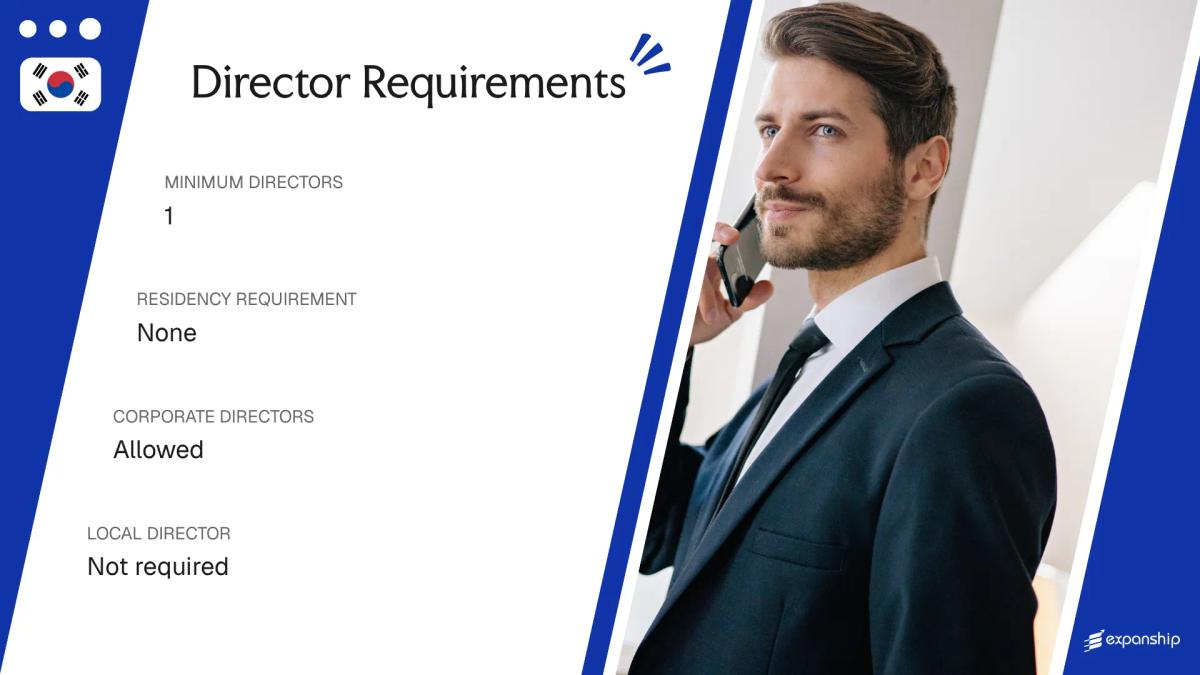
| Minimum Number of Directors | A Jusik Hoesa requires a minimum of 1 director; companies with paid-in capital of KRW 1 billion or more must have at least 3 directors. |
| Maximum Number of Directors | No statutory maximum is prescribed under the Commercial Act. |
| Local/Resident Director Required | No statutory requirement for a locally resident director. |
| Nationality Restrictions | No nationality restrictions apply to director appointments. |
| Minimum Age Requirement | Directors must be of legal adult age, which is 19 years under Korean civil law. |
| Corporate Directors Permitted | Corporate entities are not permitted to serve as directors of a Jusik Hoesa. |
| Director Must Be a Shareholder | No requirement for directors to hold shares in the company. |
| Publicly Listed on Registry | Directors are registered with the applicable district court's commercial registry and are publicly accessible. |
| Disqualification Conditions | Persons who are bankrupt and not yet reinstated, or who have been sentenced to imprisonment for violations of the Commercial Act, are disqualified from serving as directors. |
Unlike many jurisdictions that require at least one local resident director by default, South Korea imposes no such residency condition — but the threshold that triggers a mandatory three-director board is determined by paid-in capital, not by company size or employee count.
Shareholder Requirements in South Korea
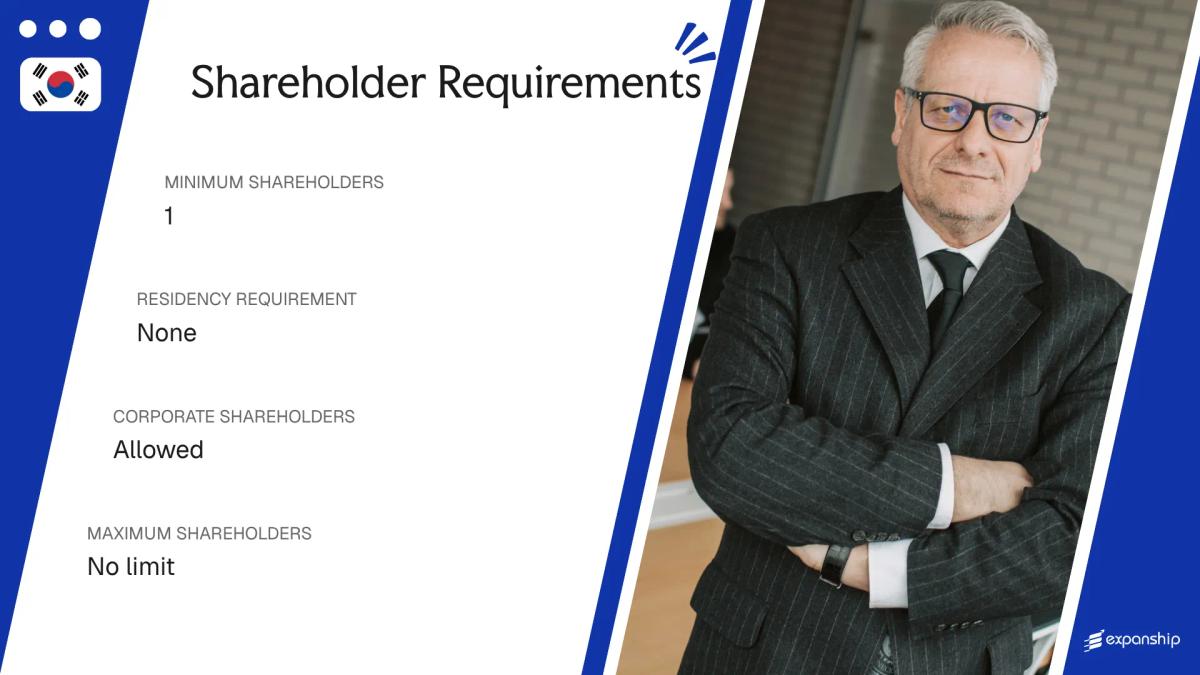
Under the Commercial Act of Korea, a Jusik Hoesa (joint-stock company) requires a minimum of one shareholder, meaning a sole shareholder structure is permitted. There is no statutory maximum on the number of shareholders.
Nationality and Residency Restrictions
South Korea shareholder requirements for incorporation impose no nationality or residency conditions on shareholders. Foreign nationals and non-resident individuals may hold shares without restriction under the Foreign Investment Promotion Act.
Corporate Shareholders
Corporate entities, including foreign companies, are permitted to act as shareholders in a Korean firm. No special conditions are attached solely by virtue of the shareholder being a corporate body rather than an individual.
Shareholder Liability
In a Jusik Hoesa, shareholder liability is limited to the amount of each shareholder's capital contribution. Piercing of the corporate veil remains possible under Korean case law in cases of fraud or abuse of the corporate form.
Register of Shareholders
Your business is required to maintain a register of shareholders (주주명부) under the Commercial Act. This register is not publicly accessible but must be kept at the registered office and updated to reflect any changes in share ownership.
Set Up Your Shareholder Structure in Korea
Get guidance on structuring your shareholder arrangements to meet Korean incorporation requirements, whether you are a sole founder or a multi-party corporate group.
UBO / Beneficial Ownership Disclosure Requirements in South Korea
Under South Korea's beneficial ownership disclosure requirements, a beneficial owner is generally defined as a natural person who ultimately owns or controls 25% or more of a company's shares or voting rights, in line with frameworks established under the Act on Reporting and Using Specified Financial Transaction Information and related anti-money laundering regulations enforced by the Korea Financial Intelligence Unit (KoFIU).
- Identify all natural persons holding 25% or more of shares or voting rights in the entity.
- Report beneficial ownership information to the financial institution handling the company's account, as KoFIU-regulated entities collect this data at the customer due diligence stage.
- Submit any changes to beneficial ownership to the relevant financial institution when ownership structure is altered.
| Parameter | Detail |
|---|---|
| Ownership Threshold for UBO Status | 25% of shares or voting rights |
| Filing Authority | Korea Financial Intelligence Unit (KoFIU) via obliged financial institutions |
| Disclosure Deadline at Incorporation | At account opening or customer due diligence stage |
| Publicly Accessible Register | No |
| Penalties for Non-Disclosure | Administrative sanctions under the Act on Reporting and Using Specified Financial Transaction Information |
| Ongoing Update Obligation | Yes; changes must be reported to the relevant obliged institution |
KYC / Document Requirements in South Korea
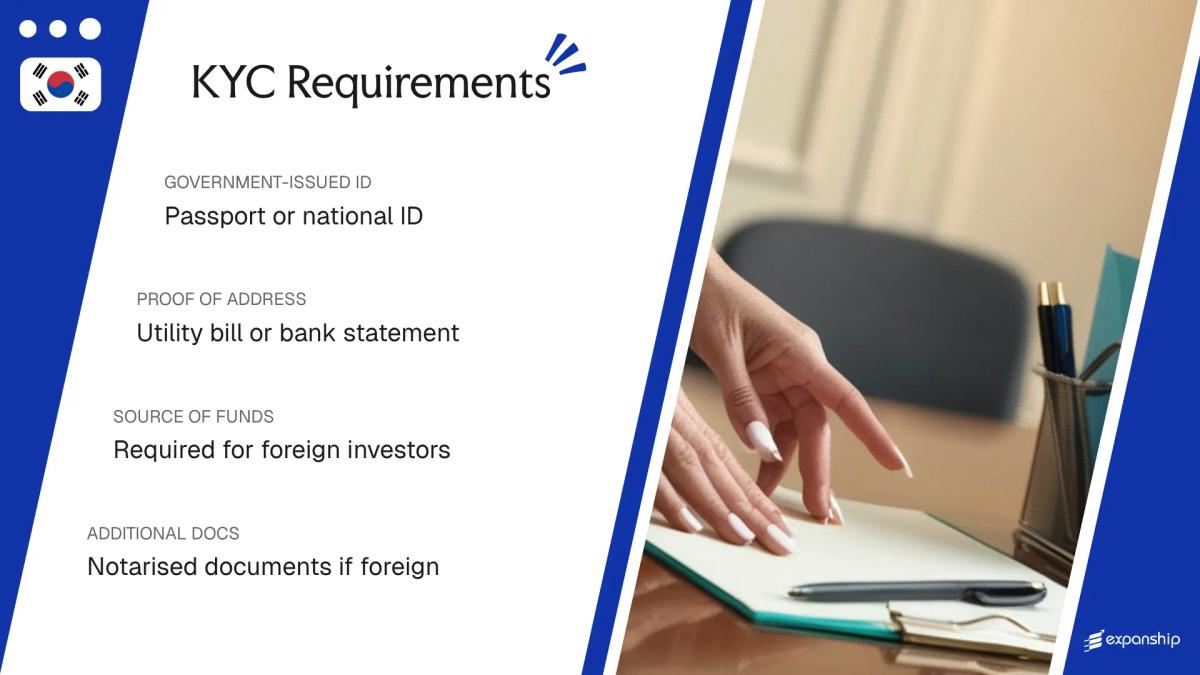
South Korea KYC document requirements incorporation obligations are governed by the Act on Reporting and Using Specified Financial Transaction Information (AMLCFT Act), administered by the Korea FIU. All parties involved in the incorporation of a Korean entity must be identified and verified before the registration process is completed.
Individual / Personal Documents
- Valid government-issued passport or national identification card for each individual director, shareholder, or beneficial owner
- Proof of residential address dated within three months, such as a utility bill or bank statement
- Completed personal information consent form, as required under the Personal Information Protection Act
- Specimen signature or signature card where required by the incorporating bank or notary
Corporate Documents
- Certificate of incorporation or equivalent from the entity's home jurisdiction
- Articles of association or constitutional document, translated into Korean where the original is not in Korean
- Register of directors and register of shareholders from the corporate shareholder's home jurisdiction
- Proof of registered address for the corporate shareholder, such as an official utility bill or government-issued notice
Source of Funds Documentation
- Recent bank statements covering a minimum of three months prior to incorporation
- Audited financial statements or equivalent where the subscribing entity is an established corporate body
- Written declaration of the source of capital if documentary evidence alone is insufficient
Notarisation and Apostille Requirements
- Foreign-issued documents generally require notarisation by a qualified notary in the country of origin
- Documents from non-Hague Convention countries must be legalised through the relevant Korean consulate or embassy
- Korean-language translations must be certified by a registered translator or a notary in Korea
Uncertified foreign corporate documents submitted without apostille or consular legalisation are among the most common causes of registration delays at the Korean Commercial Registry.
Company Name Requirements in South Korea
South Korea company name requirements are assessed during the incorporation registration process, where proposed names undergo a uniqueness check against existing registrations. Names that are identical or confusingly similar to registered entities are rejected.
All company names must be written in Korean (Hangul), though foreign-language names may be registered alongside the Korean name as a secondary designation. The legal entity suffix, such as 주식회사 for a joint-stock company, is mandatory and must appear in the registered name.
Certain words are prohibited outright, including terms that imply government affiliation or regulated industries such as banking, insurance, or securities without the appropriate authorization from the relevant supervisory authority.
Name reservation is available prior to full incorporation filing. A reserved name is typically held for a limited period, during which no other applicant may register an identical name, and the application is submitted through the Supreme Court's registry system.
Compliance Services for Companies in South Korea
Stay compliant with South Korea's corporate regulations, from annual filings to ongoing statutory obligations.
Conclusion
South Korea incorporation requirements span multiple legal obligations governed primarily by the Commercial Act and administered through the Supreme Court Registry and the Ministry of Justice. Among the most significant are the director residency rules, which previously required at least one Korean resident director and have since been relaxed under certain conditions, and the registered office requirement, which mandates a verifiable physical address within the jurisdiction. Beneficial ownership disclosure, reported under the Act on Real Name Financial Transactions and Confidentiality, also carries ongoing compliance weight. Once these requirements are understood, the practical work of structuring and registering your entity begins.
Expanship's Support for Your South Korea Expansion
Expanship's South Korea company formation compliance support covers the specific requirements you've encountered throughout this guide, from satisfying the FSS-monitored capital deposit procedures to coordinating with the relevant government bodies for proper entity registration. South Korea's layered regulatory environment, which involves the Court Registry Office, the National Tax Service, and multiple local authorities, places real administrative demands on foreign incorporators. Expanship's role is to reduce that operational burden, not remove the obligations themselves.
Our services across the incorporation and post-formation lifecycle include:
- Preparing and filing incorporation documents with the competent registry authority
- Providing a registered agent and local office address to satisfy residency requirements
- Liaising with government bodies and regulatory agencies on your behalf throughout the filing process
- Managing ongoing compliance obligations after your entity is established
- Facilitating introductions to banking institutions suited to your business structure
- Handling tax registration and coordination with the National Tax Service and local authorities
To discuss your requirements, contact Expanship South Korea.
Frequently Asked Questions (FAQ)
Yes, the capital thresholds differ between these two entity types under the Korean Commercial Act. A Jusik Hoesa (stock company) has no statutory minimum capital requirement following legislative reforms, though a Yuhan Hoesa (limited liability company) similarly carries no fixed floor in practice. However, foreign-invested entities seeking registration under FIPA must invest a minimum of KRW 100 million to qualify for foreign investment status and the protections that come with it.
Failure to comply with beneficial ownership disclosure obligations under the Act on Real Name Financial Transactions and Confidentiality and related anti-money laundering regulations can result in administrative penalties and potential criminal liability. The Financial Intelligence Unit (KoFIU) oversees enforcement, and non-disclosure or misrepresentation of ultimate beneficial owners is treated as a serious compliance breach. Penalties may include fines and restrictions on financial account operations.
A foreign national can serve as a director of a Korean company, but at least one director must hold a Korean address for service of legal documents, depending on the entity structure. Under the Korean Commercial Act, a Jusik Hoesa requires a minimum of three directors for a full board structure, though smaller companies may qualify for a simplified single-director arrangement if certain capital thresholds are met. The director's residential address in Korea is required for official registration purposes.
South Korea does not impose a statutory company secretary requirement comparable to jurisdictions such as Hong Kong or Singapore. The Korean Commercial Act does not mandate the appointment of a dedicated company secretary role, so your entity does not need to designate one for compliance purposes. Administrative and statutory filing obligations are typically handled by the registered representative director or an appointed legal agent.
A registered office address must remain valid and reachable at all times, as it is the address of record with the Korean Registry Court and used for official correspondence and service of process. If the address lapses or becomes uncontactable, the company risks procedural complications with court filings and regulatory notices, and may be required to update its registration immediately to avoid penalties. Any change of address must be formally registered as an amendment with the relevant district court registry.
Individual shareholders typically need to provide government-issued identification and proof of address, while corporate shareholders must submit certified constitutional documents, including articles of incorporation, a certificate of good standing, and details of their own beneficial owners. Korean authorities apply additional scrutiny to multi-layered corporate structures, particularly where the ultimate ownership chain involves offshore entities, in line with KoFIU's anti-money laundering guidelines. All foreign-language documents must be accompanied by a certified Korean translation.
Legal Disclaimer
The information provided in this article is for general informational purposes only and does not constitute legal, tax, or professional advice. While we strive to ensure the accuracy and timeliness of the content, laws and regulations are subject to change, and the application of laws can vary widely based on specific facts and circumstances.
Readers should not act upon this information without seeking professional counsel tailored to their individual situation. Expanship and its authors disclaim any liability for actions taken or not taken based on the content of this article.
For specific advice regarding your business setup, compliance requirements, or any legal matters, please consult with qualified legal and tax professionals in the relevant jurisdiction.