
Key Takeaways
- Foreign investors incorporating in South Korea must navigate the Commercial Act's multi-step registration process, which involves notarization, court filings, and tax registration across separate agencies before a legal entity can operate.
- Companies operating in restricted sectors such as broadcasting, telecommunications, and agriculture face statutory foreign ownership caps that can prevent full equity control by an overseas parent.
- South Korea's corporate income tax rate, combined with the local income surtax, produces an effective top-tier rate that exceeds many competing jurisdictions in the Asia-Pacific region, increasing the overall cost of doing business through a locally incorporated entity.
- Certain entity types are subject to mandatory external audit requirements under Korean accounting standards, creating recurring compliance costs that persist regardless of whether the company is generating profit.
South Korea operates under a heavily regulated corporate framework, and the disadvantages of incorporating in South Korea span procedural, financial, and operational dimensions. The primary legislation governing company formation is the Commercial Act, which establishes the foundational requirements for all business entities registered in the country.
The specific drawbacks covered in this article fall across several distinct categories, from registration mechanics to ongoing compliance obligations.
How significantly these disadvantages affect your business depends on the entity type you choose, the industry you operate in, and your ownership structure. A sole foreign-owned subsidiary faces a different set of friction points than a joint venture or a branch office.
This article is most relevant to foreign investors and overseas-headquartered firms considering direct market entry through a locally incorporated entity.
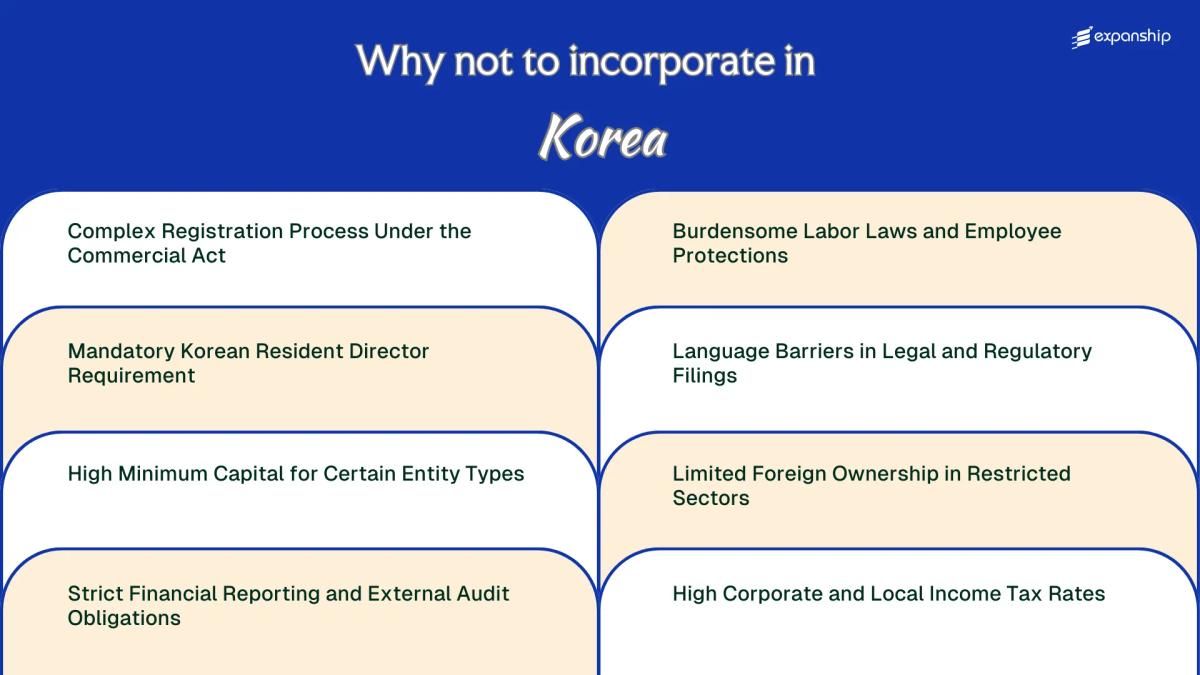
Complex Registration Process Under the Commercial Act
Registering a company under the South Korea Commercial Act involves multiple sequential approval and filing stages. These procedural demands create real delays and costs that firms incorporated elsewhere rarely encounter.
Notarization and Court Registry Requirements
Before a yuhan hoesa (limited liability company) or jusik hoesa (stock company) can begin operating, its articles of incorporation must be notarized by a Korean notary public, then submitted to the competent district court registry. For a foreign-founded firm without existing Korean legal counsel, sourcing a qualified notary and submitting compliant documentation in Korean adds both time and professional fees before the business generates a single won.
Pre-Registration Capital Verification
Proof of paid-in capital must be confirmed by a licensed Korean accountant prior to registration acceptance. This capital verification step is a formal procedural gate, not a background check, meaning any discrepancy between submitted documents and the accountant's report restarts the filing cycle.
A single document inconsistency in the capital verification stage can invalidate the entire registration filing, forcing foreign applicants to restart the process and incur duplicate professional fees.
Mandatory Korean Resident Director Requirement
The South Korea resident director requirement is one of the more operationally disruptive obligations for foreign founders. Under the Commercial Act, a Jusik Hoesa (stock company) must appoint at least one director who is a Korean resident, meaning a person with a registered domestic address, not merely a Korean national living abroad.
Finding a qualified resident willing to accept legal directorship carries real cost. Directors bear personal liability exposure under Korean corporate law, so legitimate candidates typically require compensation, indemnification agreements, or both.
The practical friction this creates for a foreign business owner includes:
- Paying ongoing fees or retainer arrangements to a nominee director service, adding a recurring operational cost with no business function attached
- Facing delays in incorporation timelines when a suitable resident director cannot be identified before the registration deadline
- Accepting a structural dependency where a third party holds statutory authority over your entity by law, not by choice
- Potential complications if the resident director resigns or becomes unavailable, requiring a replacement before certain regulatory filings can proceed
This obligation applies regardless of the foreign owner's own qualifications or management capacity. There is no exemption based on business size or sector.

Company Incorporation in South Korea
Understand the legal requirements and director obligations before setting up your entity in South Korea.
High Minimum Capital for Certain Entity Types
One of the tangible South Korea minimum capital requirements drawbacks is the financial threshold tied to specific entity structures under the Commercial Act. A Chusik Hoesa, the Korean joint-stock company equivalent to a public corporation, formally has no statutory minimum capital floor following 2009 reforms. However, certain regulated industries, including financial services, insurance, and fund management, impose sector-specific capital thresholds that can reach hundreds of millions of Korean Won, creating a steep entry barrier before your business generates a single transaction.
| Entity / Sector | Minimum Capital Requirement | Practical Burden |
|---|---|---|
| Chusik Hoesa (general) | No statutory minimum | Low nominal barrier, but banking/finance sectors override this |
| Securities firm (Financial Services Commission) | KRW 5 billion (~USD 3.8M) | Prohibitive for smaller foreign entrants |
| Insurance company | KRW 30 billion (~USD 22.5M) | Effectively restricts entry to large multinationals |
| Yuhan Hoesa (LLC equivalent) | No statutory minimum | Sector rules still apply regardless of entity choice |
For foreign firms targeting regulated sectors, the capital lock-in is a structural constraint, not just an upfront cost. Capital committed to meet licensing thresholds is typically required to remain within the entity, limiting how freely your group can redeploy funds across other markets.
The high share capital requirements South Korea imposes on regulated businesses are set and enforced by the Financial Services Commission under sector-specific licensing laws, not the Commercial Act itself. This means the burden exists independently of your chosen entity type, and switching from a Chusik Hoesa to a Yuhan Hoesa does not reduce it.
Strict Financial Reporting and External Audit Obligations
South Korea financial reporting obligations burdens are among the more demanding in the Asia-Pacific region, governed primarily by the Act on External Audit of Stock Companies. Under this law, companies meeting certain thresholds — including asset size, revenue, or employee count — are required to undergo mandatory independent audits conducted by a licensed Korean Certified Public Accountant firm registered with the Financial Supervisory Service (FSS).
Foreign-owned entities must prepare financial statements under K-IFRS or Korean GAAP, neither of which maps neatly onto IFRS or US GAAP without significant reclassification work. This creates a direct cost: your finance team either requires retraining or you must engage local Korean accounting firms, adding recurring annual expenditure.
The external audit thresholds set by the FSS mean that even mid-sized foreign subsidiaries can fall within mandatory audit scope, leaving limited room to avoid this obligation through structural adjustments.
- Annual financial statements must be filed with the FSS and the Korea Customs Service where applicable
- Audit must be conducted by a firm registered with the Korean Institute of Certified Public Accountants (KICPA)
- K-IFRS or Korean GAAP compliance is mandatory; parallel reporting to a foreign parent adds additional reconciliation work
- Non-compliance with audit obligations can result in criminal penalties under the External Audit Act
Companies in South Korea can be assigned an auditor by the FSS against their preference, removing the client's freedom to select their own audit firm.
Burdensome Labor Laws and Employee Protections
South Korea labor law compliance challenges extend well beyond standard OECD norms, creating measurable cost and operational friction for foreign-owned firms from the moment they hire their first local employee.
Statutory Protections Under the Labor Standards Act
The Labor Standards Act (근로기준법) mandates severance pay equivalent to at least 30 days' average wages per year of service for all employees who have worked one year or more. This obligation applies regardless of the reason for termination, meaning even performance-based dismissals trigger a statutory payout that many foreign employers do not anticipate in their initial cost modeling.
Dismissal itself carries additional procedural constraints. Employers must demonstrate "justifiable cause" under Article 23, and wrongful termination claims filed with the Labor Relations Commission expose the business to reinstatement orders or additional compensation.
Practical Consequences for Foreign Employers
Restructuring a workforce during an economic downturn is significantly harder than in jurisdictions where at-will employment is standard. The statutory notice periods, mandatory consultation requirements, and severance accrual combine to make headcount reductions both expensive and time-consuming for foreign entities operating in Korea.
Firms with ten or more employees face further obligations under rules governing written employment contracts, work rules filings, and working-hour documentation, each of which requires Korean-language compliance.
Addressing Labor Law Compliance Challenges in South Korea
Understand the employment obligations your business will face before hiring in South Korea, including severance rules, dismissal procedures, and workforce documentation requirements.
Language Barriers in Legal and Regulatory Filings
South Korea language barrier regulatory filings present a concrete operational obstacle: virtually all submissions to the Korean Registry Court, the National Tax Service, and the Financial Supervisory Service must be completed in Korean. Foreign business owners cannot submit English-language documents independently and must rely on certified translators or local legal counsel for every filing.
- All corporate registration documents submitted to the Korean Registry Court must be prepared in Korean, making independent filing by non-Korean-speaking founders effectively impossible without professional translation services.
- Contracts, articles of incorporation, and shareholder resolutions must be rendered in Korean to hold legal standing, creating an additional layer of cost and dependency on local intermediaries.
- Tax filings submitted to the National Tax Service require Korean-language documentation, meaning any error in translation directly exposes your business to compliance risk.
- Regulatory correspondence from government bodies arrives exclusively in Korean, leaving foreign directors reliant on third parties to interpret and respond within statutory deadlines.
Limited Foreign Ownership in Restricted Sectors
South Korea foreign ownership restrictions span several industries that are otherwise open in comparable OECD economies. Under the Foreign Investment Promotion Act (FIPA) and sector-specific statutes, certain industries either cap foreign equity below 50% or prohibit foreign participation entirely.
Restricted sectors include:
- Broadcasting and media (foreign equity capped at 49% for general programming channels)
- Telecommunications (foreign ownership limits apply to facilities-based carriers under the Telecommunications Business Act)
- Airline and airport ground handling services
- Nuclear energy and certain defense-related industries
- Publishing and news agencies
These caps are not administrative formalities. A foreign investor holding a minority stake cannot exercise operational control, set strategic direction, or protect its commercial interests without majority Korean ownership on the other side of the cap.
Restrictions are administered through pre-screening procedures coordinated by the Ministry of Trade, Industry and Energy (MOTIE) and sector regulators, creating an additional approval layer beyond standard incorporation.
A foreign media group seeking to establish a general programming channel in South Korea can hold no more than 49% equity, meaning it must cede majority control to a local partner as a structural condition of market entry, regardless of its capital contribution or operational expertise.
High Corporate and Local Income Tax Rates
South Korea corporate tax rate drawbacks are a material concern for any foreign business establishing a presence there. Under the Corporate Tax Act, the headline corporate tax rates are tiered: 9% on taxable income up to KRW 200 million, 19% up to KRW 20 billion, 21% up to KRW 300 billion, and 24% above that threshold.
For larger foreign firms, that 24% rate already places the burden above many competing Asian jurisdictions, including Singapore's 17% flat rate and Hong Kong's 16.5%.
A separate local income tax, levied at 10% of the corporate tax liability, applies on top of the national rate. This surtax is not a minor rounding figure — it effectively raises the maximum combined rate to approximately 26.4%, compounding the cost of profitable operations.
The tiered structure also means that mid-sized foreign entities growing into higher revenue brackets face a step-change in their effective tax rate, making financial forecasting less predictable during scaling periods.
- Applicable tax rates are assessed on worldwide income for resident corporations, not just Korea-sourced revenue
- The local income tax is filed separately with the municipal authority, adding an administrative layer beyond the national filing with the National Tax Service
If your foreign company is deemed a domestic corporation under the Corporate Tax Act due to its place of effective management being located in South Korea, it becomes subject to tax on its entire global income, not solely Korean-sourced earnings.
Overcoming These Incorporation Challenges
Overcoming these incorporation challenges in South Korea requires structural preparation before you engage with the Korea Registry Service or file under the Commercial Act.
- Appoint a qualified Korean resident as a local director prior to submitting incorporation documents to the district court registry.
- Select a Yuhan Hoesa (LLC) structure to avoid the higher minimum capital thresholds associated with a Jusik Hoesa.
- Engage a certified public accountant registered with the Korean Institute of Certified Public Accountants to satisfy external audit obligations from the outset.
- Draft all constitutional documents, articles of incorporation, and regulatory filings in Korean to meet the language requirements of the Commercial Act.
- Review the Foreign Investment Promotion Act before entering any restricted sector to confirm permissible foreign ownership thresholds.
- Register with the National Tax Service and account for both corporate income tax and local income tax in your initial financial planning.
The measures above operate within a tightly regulated statutory framework, and compliance gaps at the formation stage can carry forward into ongoing reporting obligations. Korea's regulatory bodies enforce these requirements consistently, leaving limited room for retrospective correction.
South Korea's Overall Business Appeal
South Korea's business environment risks and appeal are best understood as a balance sheet. The disadvantages covered in this blog are real, structural, and in several cases, codified in law. At the same time, the country's economic scale, export infrastructure, and position as a technology and manufacturing hub make it a credible destination for foreign incorporation.
| Pros | Cons |
|---|---|
| Access to one of Asia's largest consumer economies with high purchasing power | Corporate tax rates reach up to 24%, with local income surtax adding to the effective burden |
| Strong intellectual property protections under Korean IP law | At least one Korean-resident director is required for most entity structures |
| Well-developed banking and financial infrastructure | External audit obligations apply broadly, creating ongoing compliance costs |
| Active bilateral investment treaties reducing withholding tax exposure | Foreign ownership is restricted or prohibited in sectors including broadcasting and certain utilities |
| Highly educated, skilled domestic workforce | Labor law under the Labor Standards Act imposes significant constraints on workforce adjustments |
| Seoul's position as a regional headquarters location for multinational firms | All regulatory and court filings must be submitted in Korean, raising operational costs for foreign-run entities |
Corporate Compliance Services in South Korea
Maintain good standing with the Financial Services Commission, meet audit thresholds, and manage ongoing statutory obligations for your Korean entity.
Conclusion
South Korea company formation cons summary points to a jurisdiction that is economically significant but structurally demanding for foreign investors. The resident director requirement under the Commercial Act, combined with corporate tax rates reaching 24% on income above KRW 20 billion, creates a cost structure that warrants careful planning. Mandatory external audits under the Act on External Audit of Stock Companies add further compliance weight. Structural preparation before registration reduces exposure to these constraints considerably.
Expanship's South Korea Incorporation Support
Registering a company in South Korea involves a sequence of obligations that extend well beyond initial incorporation. From the Commercial Court filings under the Commercial Act to the ongoing external audit requirements imposed by the Act on External Audit of Stock Companies, the compliance burden on foreign investors is real and persistent. Expanship's South Korea incorporation support services are structured to reduce the operational weight of these specific requirements, giving your business a structured path through each stage without absorbing the full administrative load internally.
Our team supports clients across the full incorporation and post-registration cycle. Services include:
- Preparing and filing all company registration documents with the Korean court registry
- Providing a registered office address and acting as your registered agent in-country
- Liaising directly with the National Tax Service and other relevant regulatory authorities on your behalf
- Managing post-incorporation compliance obligations to keep your entity in good standing
- Introducing your business to local banking partners familiar with foreign-owned entities
- Handling tax registration and coordinating with local government offices
Reach out to Expanship South Korea to discuss your incorporation requirements.
Frequently Asked Questions (FAQ)
Companies that fail to appoint a qualifying external auditor or submit audited financial statements face administrative fines and can be referred to the Financial Supervisory Service (FSS) for further sanctions. Under the Act on External Audit of Stock Companies, Etc. (fully revised in 2018), non-compliant firms may also face restrictions on dividend distributions and, in serious cases, criminal liability for responsible officers. The FSS actively monitors compliance, particularly for entities meeting the mandatory audit thresholds on assets or headcount.
It applies to jusik hoesa (stock companies) that meet certain size thresholds, not to every entity. A yuhan hoesa is generally exempt unless it converts to a stock company structure or voluntarily opts in. The thresholds trigger based on total assets, annual revenue, or employee count, so smaller foreign-owned stock companies may still fall within scope sooner than expected as they grow.
South Korea's corporate tax rates are substantially higher. The current progressive rates run from 9% on taxable income up to KRW 200 million, 19% up to KRW 20 billion, 21% up to KRW 300 billion, and 24% above that, before adding the 10% local income surtax on top of each tier. Singapore's headline rate is a flat 17% with extensive exemptions, and Hong Kong's is capped at 16.5%, making South Korea materially less competitive on tax cost for profitable businesses.
You cannot submit filings in a language other than Korean to the Supreme Court Registry (which administers corporate registration) or the National Tax Service. All constitutional documents, board resolutions, and regulatory submissions must be in Korean or accompanied by certified Korean translations. Engaging a licensed Korean attorney (byeonhosa) or a certified judicial scrivener (beommu-sa) is not optional for most filings — it is a practical necessity that adds cost and time to the process.
The Foreign Investment Promotion Act (FIPA) designates certain sectors as restricted or prohibited for foreign ownership, including broadcasting, telecommunications, air transport, and specific agricultural activities. In restricted sectors, foreign equity is capped — often at 49% — meaning a foreign investor cannot hold a controlling stake. Prohibited sectors bar foreign investment entirely, and attempting to structure around these limits through nominee arrangements carries legal risk under both FIPA and related sector-specific statutes.
Non-compliance with the Labor Standards Act can result in criminal penalties for the company's representative director, including fines and imprisonment of up to two years for serious violations such as unpaid wages or unlawful dismissal. The Ministry of Employment and Labor conducts workplace inspections and can order back-payment of wages with interest. Wrongful dismissal claims are adjudicated by the National Labor Relations Commission, which can mandate reinstatement — a remedy that carries significant operational consequences for small foreign-owned firms.
South Korea formally abolished its statutory minimum capital requirement for a jusik hoesa, so there is no legally mandated floor in most cases. However, industry-specific licenses — in finance, insurance, and certain professional services — impose their own capital thresholds that can run into the hundreds of millions of Korean won. The absence of a general minimum does not eliminate capital concerns; it shifts the burden to sector regulators whose requirements are often less transparent and harder to research without local legal counsel.
Legal Disclaimer
The information provided in this article is for general informational purposes only and does not constitute legal, tax, or professional advice. While we strive to ensure the accuracy and timeliness of the content, laws and regulations are subject to change, and the application of laws can vary widely based on specific facts and circumstances.
Readers should not act upon this information without seeking professional counsel tailored to their individual situation. Expanship and its authors disclaim any liability for actions taken or not taken based on the content of this article.
For specific advice regarding your business setup, compliance requirements, or any legal matters, please consult with qualified legal and tax professionals in the relevant jurisdiction.