
Key Takeaways
- South Korea's Corporate Income Tax Law establishes a tiered rate structure that keeps the headline burden competitive against other developed-economy peers in the region, directly reducing the tax cost of operating through a locally incorporated entity.
- With over 90 bilateral tax treaties in force, foreign-owned companies structured in South Korea can systematically lower withholding tax exposure on dividends, royalties, and interest flowing across borders.
- The Foreign Investment Promotion Act provides a documented legal basis for overseas investors to establish and own a Jusik Hoesa, giving foreign-controlled entities a defined regulatory standing rather than operating in an ambiguous framework.
- Intellectual property assets held by a Korean entity benefit from active enforcement mechanisms administered by the Korea Intellectual Property Office, providing commercial holdings with substantive legal protection rather than nominal registration.
Incorporating a business in South Korea places your entity within an independent sovereign republic on the Korean Peninsula, operating under a constitutional government with a mature regulatory environment. The Korea Corporate Registration Office, administered under the Supreme Court's registry system, handles company formation across the country. Foreign businesses most commonly establish a Jusik Hoesa when entering the Korean market.
South Korea operates a corporate tax system with a territorial dimension, supplemented by an extensive network of bilateral tax treaties that governs how cross-border income is treated. The country maintains a generally open posture toward foreign direct investment, with most sectors accessible to overseas investors under the Foreign Investment Promotion Act — though a small number of industries remain subject to ownership restrictions.
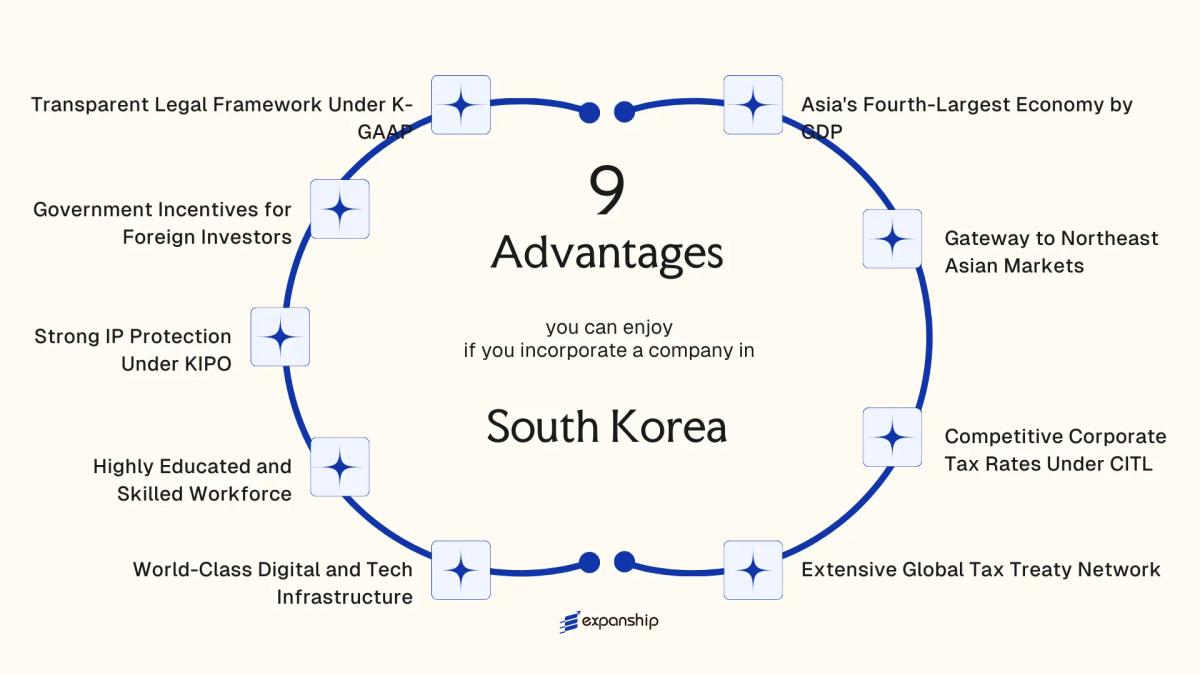
This article examines the key advantages your business gains by choosing South Korea as its incorporation destination. Understanding those advantages requires looking at factors ranging from tax policy and workforce quality to government incentives and legal infrastructure.
Asia's Fourth-Largest Economy by GDP
South Korea's GDP reached approximately USD 1.67 trillion in 2023, positioning the country as Asia's fourth-largest economy. That scale creates a market density and institutional depth that directly affects what your business can access from day one.
Economic Scale as Operational Infrastructure
Gross domestic product figures alone don't explain the advantage. What matters is that this economic mass supports mature capital markets, established banking relationships, and a supplier base across nearly every industrial sector. For a foreign-owned entity registered under the Foreign Investment Promotion Act, this means operational dependencies — financing, procurement, logistics — can be resolved domestically rather than across borders.
Stability as a Risk Variable
Measured by sovereign credit ratings, the Korean economy carries an AA rating from S&P, which signals low default risk and monetary predictability. That rating influences the cost and availability of credit for locally incorporated firms.
South Korea's economic stability for foreign investors is further reinforced by its membership in the OECD and G20, both of which impose transparency and governance standards that reduce regulatory unpredictability. Your business benefits not from size alone, but from the institutional discipline that accompanies it.
An AA-rated, OECD-member economy reduces the sovereign risk premium embedded in your Korean operations.
Gateway to Northeast Asian Markets
South Korea's position as a gateway to Northeast Asian markets is a structural advantage grounded in geography and trade architecture. Sitting between China, Japan, and Russia — with direct sea and air access to all three — Seoul functions as a natural distribution and operational anchor for companies targeting the broader region.
Within a 1,000-kilometre radius of Seoul, you can reach Beijing, Tokyo, Shanghai, and Vladivostok. That proximity is not incidental; it directly affects supply chain logistics, executive travel time, and the feasibility of managing multi-country operations from a single registered entity.
The practical implications extend into trade policy. South Korea has signed free trade agreements with over 50 countries and trading blocs, including the EU, the United States, ASEAN, and China. Goods produced or processed through a Korean-registered company may qualify for preferential tariff treatment under these agreements, which can materially reduce the landed cost of exports.
Incorporating a local entity gives your business access to these treaty benefits in ways that a foreign-registered holding structure typically cannot replicate. Consider why this matters structurally:
- FTA coverage across major economies means tariff advantages apply to a wide product and sector range
- Korean origin status can unlock preferential rates unavailable to companies routing through less-connected jurisdictions
- The country's bilateral investment treaties provide a defined legal basis for cross-border capital flows into the region

Incorporate Your Company in South Korea
Set up a compliant legal entity in South Korea and access Northeast Asian markets through one of the region's most connected jurisdictions.
Competitive Corporate Tax Rates Under CITL
South Korea's corporate tax structure offers measurable advantages under the Corporate Income Tax Law (CITL), which applies a tiered rate system based on taxable income brackets rather than a single flat rate.
For fiscal year 2023 onward, the CITL tax brackets are as follows:
| Taxable Income Bracket (KRW) | Tax Rate |
|---|---|
| Up to 200 million | 9% |
| 200 million to 20 billion | 19% |
| 20 billion to 300 billion | 21% |
| Over 300 billion | 24% |
This graduated structure means early-stage foreign entities with modest taxable income face an effective rate of 9%, which is materially lower than the OECD average corporate rate of approximately 23%. For a foreign investor establishing a subsidiary or a newly incorporated firm during the growth phase, that differential translates directly into retained capital available for reinvestment.
The South Korea corporate tax rate advantages under CITL extend to how the brackets are applied. Each rate applies only to the income within its respective band, not to the total. A company earning KRW 500 million does not pay 19% on the full amount, only on the portion exceeding KRW 200 million. This mechanics-based benefit reduces the effective tax burden relative to single-rate jurisdictions where the highest applicable rate applies to all taxable income. Local surcharges such as the resident surtax add 10% on top of the CITL liability, so the actual rates are marginally higher, a condition foreign investors should factor into projections.
Extensive Global Tax Treaty Network
South Korea's tax treaty network benefits foreign businesses through one of Asia's most expansive bilateral frameworks. As of 2024, the country has concluded over 100 tax treaties with jurisdictions across every major continent, administered under the National Tax Service (NTS). Each treaty operates to eliminate the same income being taxed twice, once at source and once in your home country.
Withholding tax rates on dividends, interest, and royalties paid to foreign recipients are typically reduced under these agreements. Standard domestic withholding on dividends can reach 22% (including local surtax), but treaty provisions frequently reduce this to 5-15% depending on shareholding thresholds and the counterpart jurisdiction. For firms repatriating profits to treaty countries, that reduction directly improves after-tax returns.
The treaties also define permanent establishment rules, which determine whether your entity triggers a taxable presence in a partner country. Clear definitions reduce the risk of unintended tax exposure when operating across borders.
Keep these points in mind:
- Treaty benefits apply only to tax residents; verify your entity's residency status under Korean law
- Some treaties include limitation-on-benefits clauses that restrict access for holding structures
- Confirm the applicable treaty version, as protocols amend rates periodically
- Treaty provisions override domestic law only where explicitly stated; always confirm scope
South Korea's tax treaty with the United States was one of the first such agreements Korea signed with a Western nation, entering into force in 1979, predating many of its current Asian treaty partners.
World-Class Digital and Tech Infrastructure
South Korea digital infrastructure advantages for business are grounded in measurable, policy-backed investment rather than general reputation. The country consistently ranks among the top globally for internet speed and connectivity density, with the Ministry of Science and ICT overseeing a national ICT policy framework that has driven 5G network coverage across all major metropolitan areas since commercial rollout began in 2019.
Connectivity That Reduces Operational Friction
Fixed broadband and mobile networks here operate at speeds that directly reduce latency-sensitive costs for tech firms, financial services companies, and logistics platforms. For a foreign entity running distributed operations across Asia, having a Korean base with near-zero downtime infrastructure means fewer redundancy costs compared to operating out of markets with less developed backbone networks.
Korea's public and private cloud infrastructure is supported by major domestic providers alongside global hyperscalers operating local availability zones. This means your business can meet data residency requirements under the Personal Information Protection Act (PIPA) without sacrificing processing speed or scalability.
A Tech Ecosystem With Commercial Depth
Beyond connectivity, the ICT infrastructure here is embedded in a functioning commercial ecosystem. Giro-based payment rails, fintech licensing under the Financial Services Commission, and government-supported digital clusters like the Pangyo Techno Valley give incorporated firms direct access to clients, vendors, and partners already operating in digitally advanced environments.
Foreign companies in sectors like SaaS, semiconductors, or e-commerce benefit from co-locating with domestic firms that have already built their processes around high-throughput digital infrastructure, compressing the time needed to integrate local supply chains and distribution channels.
Set Up Your Company in South Korea the Right Way
Speak with our Korea incorporation specialists to understand how the country's digital and ICT infrastructure can be structured to your business advantage from day one.
Highly Educated and Skilled Workforce
South Korea's skilled workforce advantages for investors are grounded in measurable outcomes. The country's tertiary education enrollment rate consistently ranks among the highest in the OECD, and a significant share of graduates concentrate in STEM disciplines, engineering, and applied sciences. This produces a technically proficient labor pool that is directly relevant to manufacturing, semiconductors, biotechnology, and software development.
- Tertiary graduation rates in South Korea exceed 70% among younger age cohorts, according to OECD Education at a Glance data, meaning your firm gains access to candidates who hold formal qualifications rather than relying on on-the-job training to fill technical gaps.
- English proficiency, while variable, is embedded in the national curriculum from primary school, reducing communication friction for foreign-managed entities operating in professional and technical sectors.
- The country's vocational training infrastructure, overseen partly through the Human Resources Development Service of Korea (HRD Korea), produces certified technicians in fields such as precision manufacturing and industrial electronics, giving companies a pipeline beyond university graduates.
- Average labor productivity in South Korea has grown steadily over the past decade, which means the cost-per-output calculation often compares favorably against higher-wage markets in Western Europe or North America.
- Corporate investment in employee upskilling is incentivized under the Employment Insurance Act, allowing eligible firms to reclaim a portion of training expenditures, directly reducing your operational cost of maintaining workforce competency.
Strong IP Protection Under KIPO
South Korea IP protection benefits under KIPO are grounded in a formal institutional structure. The Korean Intellectual Property Office (KIPO) administers patents, trademarks, utility models, and industrial designs under a unified national framework. For foreign-owned businesses, this means a single, clearly defined authority handles registration, enforcement referrals, and dispute coordination.
Patent applications filed with KIPO are examined under the Patent Act, which aligns with international standards set by the Patent Cooperation Treaty (PCT). Your business can file a PCT international application and designate Korea, preserving your priority date while the local examination proceeds. Trademark protection follows a similar path through the Madrid Protocol, reducing the administrative cost of registering across multiple jurisdictions.
KIPO also operates the Intellectual Property Dispute Mediation Center, which offers an alternative to litigation for infringement matters. Faster resolution protects your commercial position without the cost of full court proceedings.
Korea's membership in the Agreement on Trade-Related Aspects of Intellectual Property Rights (TRIPS) sets the minimum enforcement floor, while domestic law often exceeds those minimums.
According to the World Intellectual Property Organization (WIPO) IP Statistics Data Center, South Korea consistently ranks among the top five countries globally by PCT patent application filings, reflecting a high-activity IP environment where enforcement infrastructure is regularly tested and maintained.
Government Incentives for Foreign Investors
South Korea government incentives for foreign investors are administered primarily through the Foreign Investment Promotion Act (FIPA) and coordinated by KOTRA (Korea Trade-Investment Promotion Agency) and Invest Korea, its dedicated FDI arm. These frameworks give foreign-owned entities access to structured financial and operational support that domestic firms do not always qualify for.
Under the Invest Korea system, qualifying foreign-invested companies in designated industries can receive:
- Cash grants toward facility investment and employment costs
- Reduced or waived acquisition, property, and registration taxes at the local government level
- Access to foreign investment zones (FIZs) and free economic zones (FEZs), where land can be leased at preferential rates
Eligibility depends on the sector, investment amount, and whether the business falls within an industry the government has identified as a strategic priority, such as advanced manufacturing, biotech, or high-value services.
For companies that clear these thresholds, the combined value of tax reductions and cash support can materially reduce the cost base during the establishment and early operating phases. This is particularly relevant for capital-intensive operations where site and infrastructure costs are front-loaded.
Incentive eligibility under FIPA is conditional on meeting minimum investment thresholds and operating within approved industry categories, so confirm your sector classification with Invest Korea before structuring your entry.
Transparent Legal Framework Under K-GAAP
South Korea's K-GAAP transparent legal framework benefits foreign businesses by providing a structured, predictable accounting environment governed by the Act on External Audit of Stock Companies. Listed corporations follow Korean International Financial Reporting Standards (K-IFRS), while unlisted entities generally apply General K-GAAP, administered by the Korea Accounting Standards Board (KASB). This separation gives your business a defined reporting path from the moment of incorporation.
K-GAAP aligns closely with IFRS principles, which means that financial statements prepared under Korean standards are broadly interpretable by international auditors, banks, and institutional investors. For foreign-owned subsidiaries reporting to a parent company abroad, this structural compatibility reduces the cost and complexity of financial reconciliation across jurisdictions.
The Financial Supervisory Service (FSS) oversees audit quality and disclosure obligations, creating an external check on financial reporting. Mandatory external audits apply once a company crosses defined thresholds, such as total assets exceeding KRW 5 billion, which means smaller entities operate with less regulatory burden in early stages.
South Korea accounting standards advantages for investors become tangible at the due diligence stage. When financials follow a recognized, rules-based framework with government oversight, third-party verification is faster and investor confidence in the reported figures is better grounded.
Consistent disclosure requirements also reduce information asymmetry between local partners and foreign shareholders. Rather than relying on voluntary disclosures, Korean corporate law requires standardized financial statements, giving your business a clear basis for internal governance and external accountability.
Why South Korea Stands Out Against Regional Rivals
Businesses evaluating South Korea's incorporation profile against regional alternatives tend to weigh it against Japan, China, and Singapore — three markets that attract similar foreign investor profiles and serve overlapping strategic functions in Northeast and Southeast Asia. The comparison matters because these jurisdictions differ significantly in cost structure, regulatory openness, and treaty access, and those differences have direct consequences for how a foreign entity operates, reports, and repatriates capital.
What the comparison reveals is that South Korea vs regional rivals business advantages are not confined to any single metric. Japan imposes a combined effective corporate tax rate that has historically exceeded 30%, and China's regulatory environment subjects foreign-invested enterprises to additional approval layers under its Foreign Investment Law. Singapore offers a lower headline tax rate, but its geographic remove from the Northeast Asian manufacturing and consumption corridor means higher logistical costs for firms targeting that region. Korea's CITL framework applies a standard rate of 9% to 24% depending on taxable income bracket, with no exchange controls blocking dividend repatriation for compliant entities registered under the Foreign Investment Promotion Act.
| Parameter | South Korea | Japan | China | Singapore |
|---|---|---|---|---|
| Standard Corporate Tax Rate | 9% – 24% (CITL) | ~23.2% national (plus local levies) | 25% standard | 17% |
| Foreign Ownership (General Cases) | 100% permitted | 100% permitted | Restricted in certain sectors | 100% permitted |
| Active Tax Treaties | 100+ | 80+ | 110+ | 90+ |
| IP Protection Body | KIPO | JPO | CNIPA | IPOS |
| FTAs with Major Economies | US, EU, ASEAN, UK | Limited (no US FTA) | ASEAN, RCEP | US, EU, ASEAN |
| OECD Membership | Yes | Yes | No | No |
Compliance Services for Companies in South Korea
Stay aligned with Korean regulatory requirements, including CITL filings, K-GAAP reporting obligations, and ongoing corporate maintenance for foreign-invested entities.
Conclusion
South Korea's case as an incorporation destination rests on a combination of structural advantages that are difficult to replicate elsewhere in the region. The Corporate Income Tax Law sets headline rates that remain competitive against developed-economy peers, and the country's network of over 90 bilateral tax treaties directly reduces the cost of cross-border income flows for foreign-owned entities. Add to that the Korea Intellectual Property Office's established enforcement mechanisms, and you have a jurisdiction where commercial assets carry genuine legal protection.
Not every business will extract equal value from these features. A technology firm with significant IP holdings benefits differently than a trading company using South Korea as a distribution gateway into Northeast Asia. Your industry, ownership structure, and target markets all shape which advantages are most material to your situation.
For those whose business profile aligns with what this jurisdiction offers, the foundational work of company formation under the Foreign Investment Promotion Act and ongoing compliance under K-GAAP represents a defined, documented process. Understanding that process in detail is the logical next step before committing to a structure.
Let Expanship Handle Your Korean Company Setup
Expanship's South Korea company setup service covers the full formation process for foreign nationals and overseas entities, from selecting the appropriate structure — whether a Yuhan Hoesa, Jusik Hoesa, or liaison office — through to registration with the Korea Corporate Registry under the jurisdiction of district courts. The compliance obligations discussed throughout this blog, including K-GAAP reporting, KIPO filings, and foreign investment notification under the Foreign Investment Promotion Act, are all areas our team handles directly.
Working with Expanship means you have professional South Korea incorporation assistance at each stage, without coordinating across multiple local providers. Our services include:
- Document preparation, notarization, and apostille legalization for Korean regulatory submission
- Registered agent and local office address provision for statutory compliance
- Government filing and liaison with the district court registry and the Korea Customs Service where applicable
- Foreign investment declaration and KOTRA registration support
- Post-incorporation compliance management, including K-GAAP bookkeeping and annual reporting
- Banking introduction assistance with domestic and international financial institutions operating in Korea
Setting up a Korean company with Expanship gives foreign investors a structured point of contact for every regulatory interaction from day one.
Reach out to Expanship Korea to discuss your incorporation requirements.
Frequently Asked Questions (FAQ)
Neither the Yuhan Hoesa nor the Jusik Hoesa carries a statutory minimum capital requirement under current Korean commercial law. That said, some business license applications, particularly in financial services or regulated sectors, may impose sector-specific capital thresholds. In practice, sufficient working capital to cover initial operations and registration fees should be planned regardless of the absence of a statutory floor.
Registration with the Korean Commercial Registry generally takes between one and two weeks once all required documents are properly prepared and submitted. The timeline can extend if the articles of incorporation require notarization, or if your business activity requires a separate operating license from a sectoral regulator. Pre-clearance of your company name through the registry is advisable, as name conflicts can cause delays.
Under the Corporate Income Tax Law (CITL), tax rates are applied on a tiered basis according to taxable income, with rates ranging from 9% on income up to KRW 200 million, up to 24% on income exceeding KRW 200 billion, as of the most recently published rate schedule. Foreign-owned entities incorporated in South Korea are subject to the same domestic CITL rates as locally owned companies. Permanent establishments of foreign entities are taxed differently, which is a separate consideration from a fully incorporated subsidiary.
South Korea maintains tax treaties with over 90 countries, and these treaties frequently reduce the standard withholding tax rate on dividends paid to foreign parent companies. The applicable reduced rate depends on the specific treaty between Korea and the parent company's country of residence, as well as the ownership percentage held. You should review the relevant bilateral treaty text or consult the National Tax Service (NTS) treaty schedules to determine the rate applicable to your specific structure.
The Korean Intellectual Property Office (KIPO) administers trademark, patent, utility model, and design registrations under Korean IP law, and protections granted apply equally to foreign-owned entities incorporated in Korea. Korea is a member of the Patent Cooperation Treaty (PCT) and the Madrid Protocol, which means IP protections secured through KIPO can be extended internationally through these frameworks. Once registered, enforcement is available through the Korean courts and, in certain cases, through KIPO's own dispute resolution mechanisms.
Invest Korea, operated under the Korea Trade-Investment Promotion Agency (KOTRA), is the primary body that administers incentive programs for foreign investors. Available incentives include cash grants for investments in certain industries or regions, tax reductions under the Restriction of Special Taxation Act, and support for Foreign Investment Zones (FIZs) and Free Economic Zones (FEZs). Eligibility conditions vary by investment size, industry classification, and location, and formal applications must be submitted through the relevant authorities before the investment is made to qualify.
Companies that fail to meet their accounting and reporting obligations under Korean Generally Accepted Accounting Principles (K-GAAP) may face penalties, including fines and administrative sanctions imposed by the relevant authorities. Listed companies are subject to oversight by the Financial Supervisory Service (FSS), while unlisted entities face scrutiny primarily through tax audits conducted by the National Tax Service (NTS). Persistent non-compliance can affect the company's good standing with the Korean Commercial Registry, which may complicate future licensing, financing, or restructuring activities.
Legal Disclaimer
The information provided in this article is for general informational purposes only and does not constitute legal, tax, or professional advice. While we strive to ensure the accuracy and timeliness of the content, laws and regulations are subject to change, and the application of laws can vary widely based on specific facts and circumstances.
Readers should not act upon this information without seeking professional counsel tailored to their individual situation. Expanship and its authors disclaim any liability for actions taken or not taken based on the content of this article.
For specific advice regarding your business setup, compliance requirements, or any legal matters, please consult with qualified legal and tax professionals in the relevant jurisdiction.