
Key Takeaways
- Foreign investors must register their commercial entity with the Centre National du Registre de Commerce (CNRC) under the Algerian Commercial Code (Code de commerce), with the applicable capital thresholds and procedural requirements varying according to the chosen legal form, such as SARL or SPA.
- Beneficial ownership disclosure is a mandatory compliance obligation introduced through Algeria's anti-money laundering legislation, requiring foreign investors to account for this layer before submitting their CNRC registration filing.
- The residency status of directors carries direct legal weight in Algeria, as the distinction between resident and non-resident directors affects eligibility and procedural requirements at the point of registration.
- Algeria's company name must satisfy CNRC approval criteria as part of the registration process, making pre-clearance of the proposed name a necessary step before other incorporation filings can be completed.
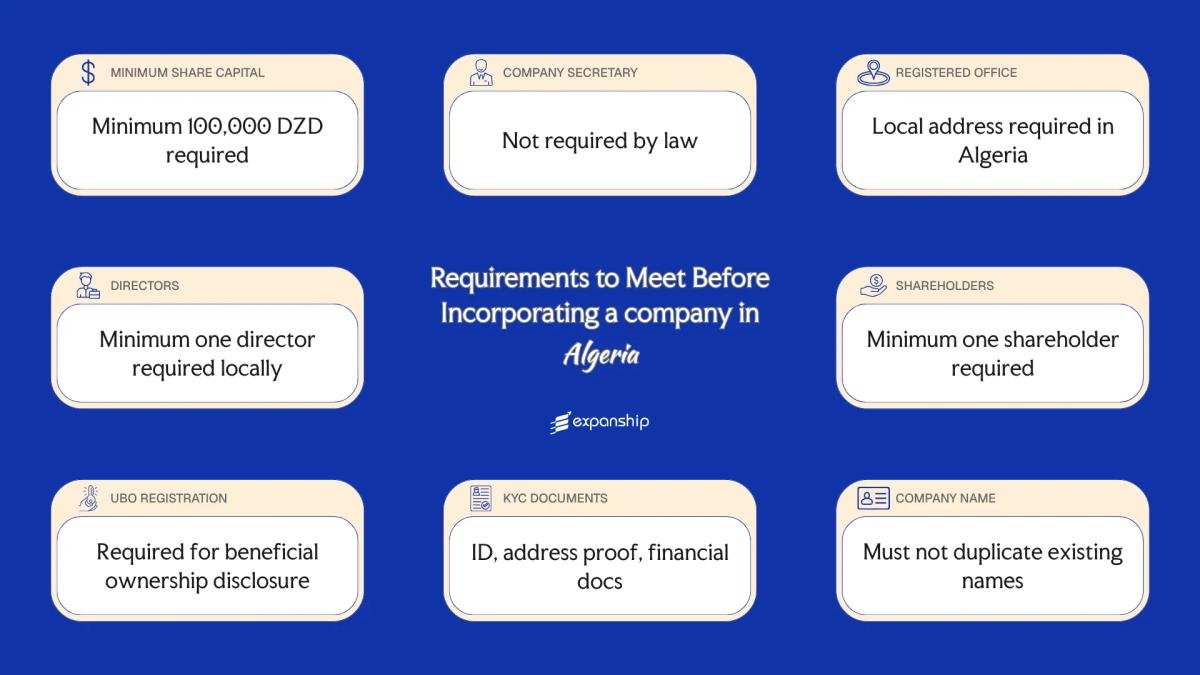
Entity formation in Algeria operates under a structured legal framework, and understanding the incorporation requirements in Algeria is the starting point for any foreign investor or business owner entering this market. The primary legislation governing commercial entities is the Algerian Commercial Code (Code de commerce), with oversight exercised by the Centre National du Registre de Commerce (CNRC), the body responsible for company registration and commercial registry management.
This article covers the categories of requirements applicable to entities registering through the CNRC, from capital thresholds to documentation and naming rules. Failure to satisfy these requirements results in rejection of the registration application or, where a business is already operating, exposure to administrative penalties and potential suspension of commercial activity.
Specific requirements differ depending on the legal form of the entity, the sector of activity, and whether the investor is a foreign national or resident. Algeria company registration requirements applicable to a Société par Actions (SPA) differ from those governing a Société à Responsabilité Limitée (SARL), for instance. Readers should treat this article as a general reference and verify current obligations against the Code de commerce.
This article is most relevant to foreign investors and non-resident business owners seeking to establish a commercial presence through a locally registered entity.
Minimum Share Capital Requirements in Algeria
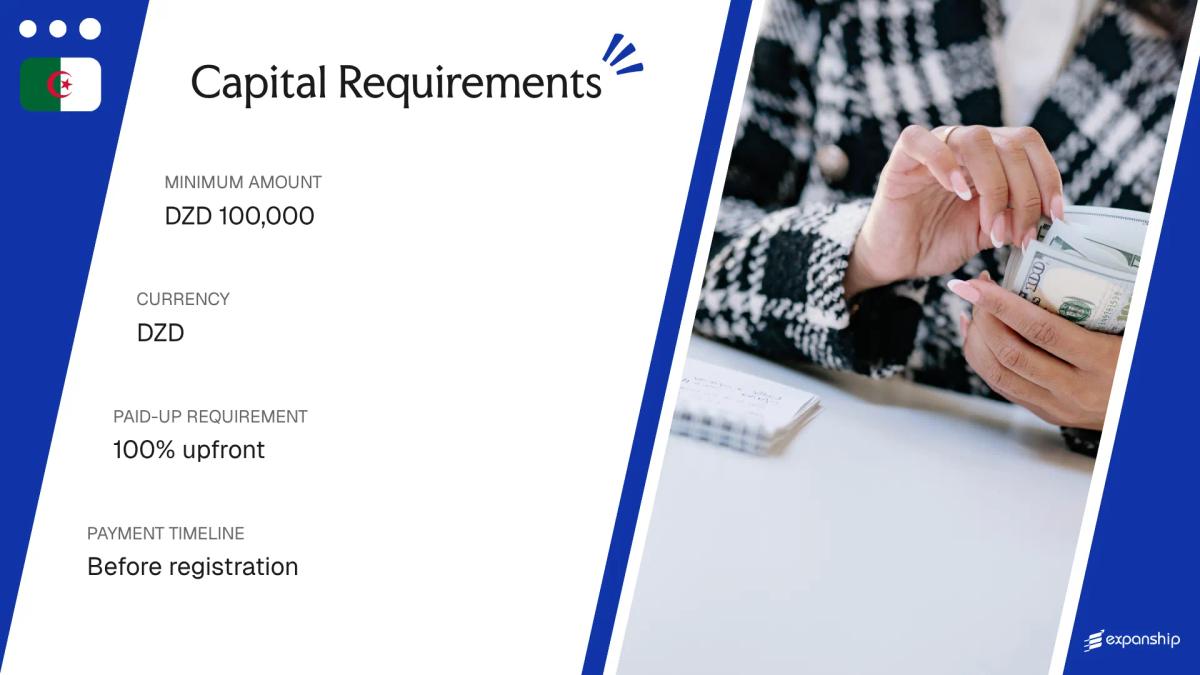
Minimum share capital requirements in Algeria vary by legal entity type and are governed by the Commercial Code. The Centre National du Registre de Commerce (CNRC) oversees incorporation filings, while a licensed Algerian bank receives and certifies the capital deposit before registration can proceed.
Algeria operates on a par value share system, meaning each share carries a fixed nominal value. Capital deposited at incorporation is a statutory pre-condition, not merely a formality that can be deferred post-registration.
| Parameter | Detail |
|---|---|
| Minimum Authorized Share Capital | DZD 100,000 for SARL; DZD 1,000,000 for SPA |
| Maximum Authorized Share Capital | No statutory maximum |
| Minimum Paid-Up Capital | Full amount required at incorporation for SARL; 25% of subscribed capital at incorporation for SPA |
| Paid-Up Requirement at Incorporation | 100% for SARL; minimum 25% for SPA, remainder within 5 years |
| Accepted Currency | Algerian Dinar (DZD) |
| Accepted Forms of Contribution | Cash contributions; in-kind contributions subject to independent valuation |
| Timeframe to Deposit Capital | Prior to submission of incorporation dossier to CNRC |
The bank certificate confirming capital deposit must be obtained before submitting the incorporation dossier to the CNRC. Registration cannot proceed without this document in hand.
Company Secretary Requirements in Algeria
Algerian commercial law does not impose a standalone company secretary requirement equivalent to those found in common law systems. Under the framework governing the société par actions (SPA) and société à responsabilité limitée (SARL), corporate governance functions are distributed among statutory organs rather than assigned to a dedicated secretary role. Meeting company secretary requirements in Algeria therefore means understanding how these internal governance duties are allocated.
A legal representative or gérant fulfills many of the administrative functions associated with a corporate secretary, including maintaining statutory registers, acting as the point of contact with the Centre National du Registre du Commerce (CNRC), and ensuring filings remain current.
Qualification criteria for those fulfilling this governance function include:
- No formal licensing or professional certification is required under general commercial rules for this role
- The individual must have legal capacity and not be subject to a court-ordered prohibition on managing a commercial entity
- Both Algerian nationals and foreign nationals may serve, subject to applicable residency and work authorization conditions
- A legal entity may serve in certain representative capacities, depending on the company structure

Incorporate a Company in Algeria
Set up your legal entity in Algeria with guidance on structure selection, CNRC registration, and statutory compliance from incorporation through to ongoing maintenance.
Registered Office Requirements in Algeria
Registered office requirements in Algeria mandate that every company maintain a physical siege social (registered address) within the country, declared at the time of incorporation before the Centre National du Registre de Commerce (CNRC). Failure to maintain a compliant legal address can result in administrative sanctions, potential deregistration, or refusal to process official correspondence from tax and regulatory authorities.
- A physical address within Algerian territory is required; post office boxes do not qualify as a siege social.
- Virtual offices are not formally recognized under Algerian commercial law as a compliant registered address.
- The address must be located in Algeria; foreign addresses are not accepted for domestic entity registration.
- Proof of occupancy is required, either through property ownership documents or a valid lease agreement submitted to the CNRC.
- The registered address is publicly listed on the commercial register extract (extrait du registre de commerce), accessible to third parties.
- Any change to the registered address must be formally notified to the CNRC and updated in the commercial register through an official modification procedure.
Director Requirements in Algeria
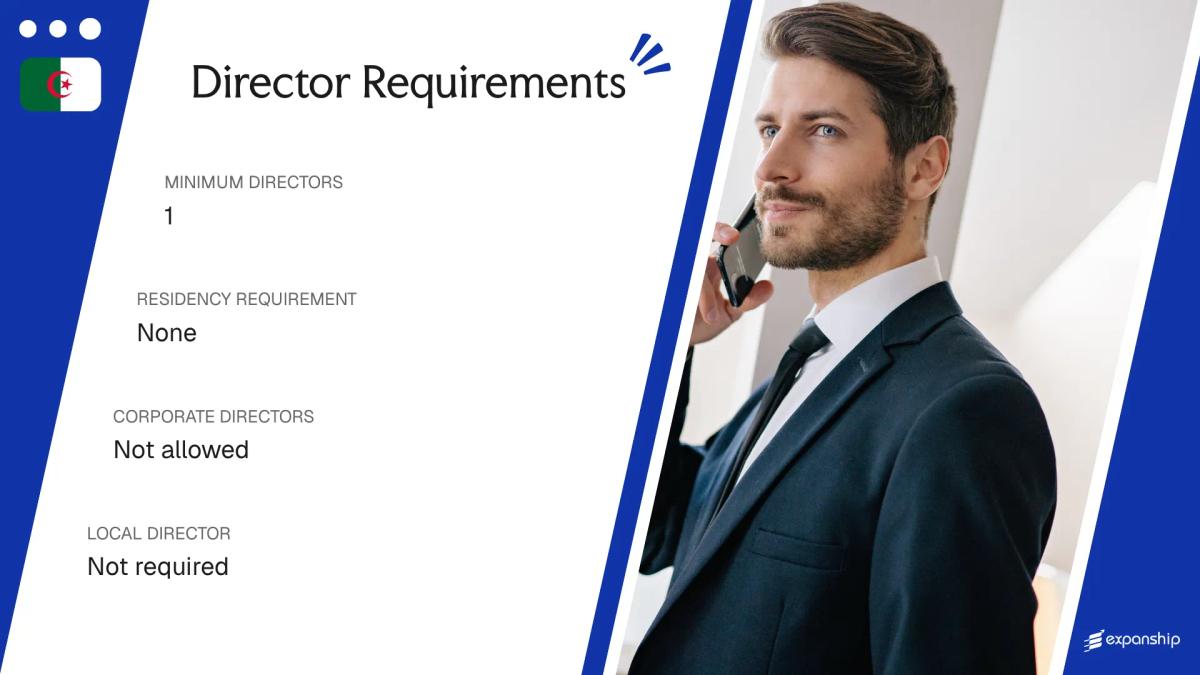
Under Algerian commercial law, directors (gérants) of a SARL or administrators of a société par actions assume personal liability for breaches of statutory duties, including mismanagement, failure to maintain proper accounts, and non-compliance with obligations set out in the Code de Commerce. Meeting director requirements Algeria company regulations demand is a foundational step before any incorporation can proceed.
| Parameter | Detail |
|---|---|
| Minimum Number of Directors | One gérant is required for a SARL; a société par actions requires a board of at least three members. |
| Maximum Number of Directors | No statutory maximum for a SARL gérant; a société par actions board is generally capped at twelve members. |
| Local/Resident Director Required | No statutory requirement for a resident director. |
| Nationality Restrictions | Foreign nationals may serve as directors, though they must hold a valid residence permit and business visa if residing in Algeria. |
| Minimum Age Requirement | Directors must be at least 19 years of age, consistent with the general civil majority standard under Algerian law. |
| Corporate Directors Permitted | No; only natural persons may serve as gérants or board members under the Code de Commerce. |
| Director Must Be a Shareholder | Not required for a société par actions; a gérant of a SARL may be a non-associate (gérant non-associé). |
| Publicly Listed on Registry | Directors are registered with the Centre National du Registre de Commerce (CNRC) and appear on the commercial register. |
| Disqualification Conditions | Prior convictions for financial crimes, bankruptcy, or breach of fiduciary duty can result in disqualification under Algerian commercial legislation. |
Despite requiring no resident director, Algeria mandates that any foreign national acting as a gérant who resides in the country must obtain a carte de résident commerçant, a specific commercial residency card distinct from a standard residence permit.
Shareholder Requirements in Algeria
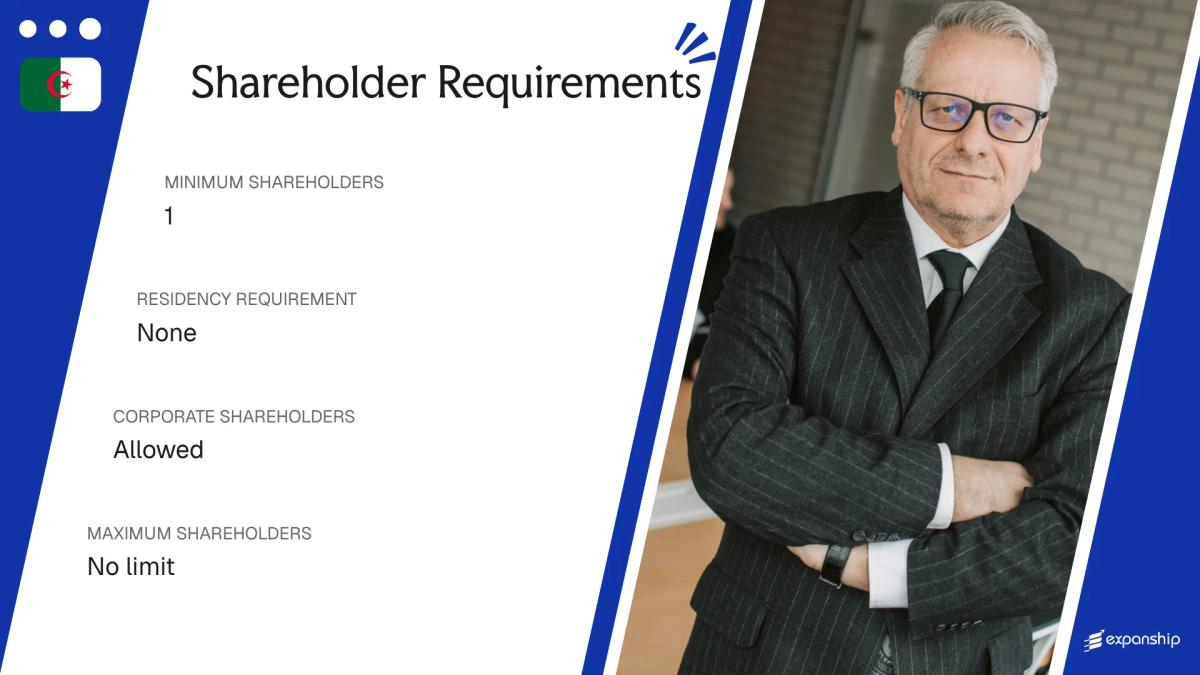
Under Algeria's Commercial Code, a Société à Responsabilité Limitée (SARL) requires a minimum of one shareholder, permitting a sole-associate structure known as the EURL. A Société par Actions Simplifiée (SAS) also accommodates a single shareholder, while a Société par Actions (SpA) requires at least seven.
Nationality and Residency Restrictions
Meeting shareholder requirements Algeria incorporation rules impose no blanket residency obligation on shareholders. Foreign ownership is permitted, though investments in certain regulated sectors remain subject to the 49/51 rule, which caps foreign equity participation at 49 percent.
Corporate Shareholders
Corporate entities may act as shareholders under Algeria associé rules applicable to most company forms. No general prohibition exists against foreign corporate shareholders, though sector-specific restrictions may apply.
Shareholder Liability
In a SARL or EURL, each associate's liability is confined to their capital contribution. Extended personal liability does not arise under ordinary circumstances.
Register of Shareholders
A register of associates must be maintained at the company's registered seat. Filing obligations arise upon formation through the Centre National du Registre de Commerce (CNRC), and updates are required following any transfer of shares.
Shareholder Structuring Support for Your Algerian Entity
Get guidance on structuring your shareholding in line with Algeria's Commercial Code and sector-specific ownership rules.
UBO / Beneficial Ownership Disclosure Requirements in Algeria
Beneficial ownership disclosure Algeria is governed by Ordinance No. 12-02 of 2012 and reinforced through AML legislation under Law No. 05-01, which defines a beneficial owner as any natural person who ultimately owns or controls a legal entity, generally applied at thresholds consistent with FATF guidance.
- Identify all natural persons who exercise ultimate ownership or control over the entity prior to registration.
- Submit beneficial ownership information to the Centre National du Registre de Commerce (CNRC) as part of the incorporation dossier.
- Declare any changes to beneficial ownership to the CNRC within the period specified under applicable AML regulations.
- Financial institutions and designated non-financial businesses must separately collect and retain UBO data under Law No. 05-01 obligations.
| Parameter | Detail |
|---|---|
| Ownership Threshold for UBO Status | No specific statutory threshold published; FATF-aligned principles applied in practice |
| Filing Authority | Centre National du Registre de Commerce (CNRC) |
| Disclosure Deadline at Incorporation | At time of incorporation filing |
| Publicly Accessible Register | No statutory public register established |
| Penalties for Non-Disclosure | Sanctions applicable under Law No. 05-01; specific penalties subject to regulatory determination |
| Ongoing Update Obligation | Required upon material change in ownership or control |
KYC / Document Requirements in Algeria
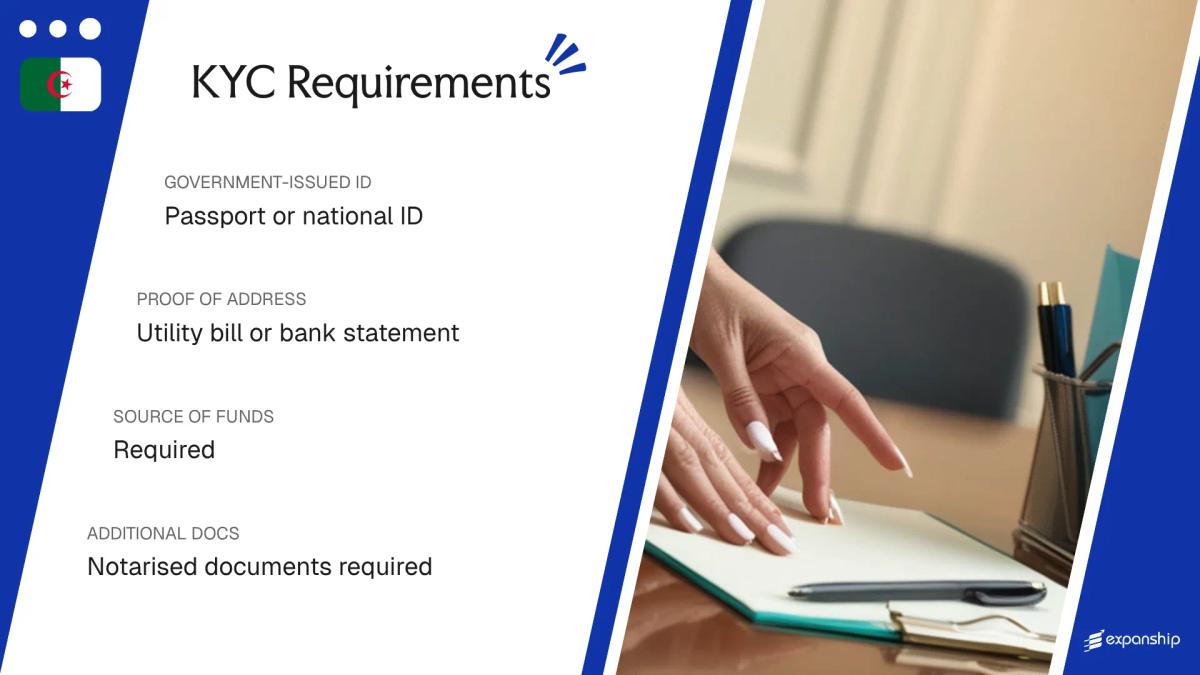
KYC document requirements Algeria are governed primarily by Law No. 06-01 of February 2006 on the prevention and fight against money laundering and terrorist financing, administered by the Cellule de Traitement du Renseignement Financier (CTRF).
Individual / Personal Documents
- Valid national identity card or passport for each individual director, shareholder, or beneficial owner
- Proof of residential address dated within three months, such as a utility bill or bank statement
- Specimen signature authenticated before a notary
- Tax identification number (Numéro d'Identification Fiscale) where the individual is an Algerian resident
Corporate Documents
- Certificate of incorporation or equivalent constitutional document for any corporate shareholder or director
- Current register of directors issued by the relevant home-jurisdiction authority
- Proof of the corporate entity's registered address
- Certified copy of the articles of association or equivalent constitutional instrument
Source of Funds Documentation
- Recent bank statements covering a minimum of three months prior to incorporation
- Audited financial statements where the subscribing entity has trading history
- Written declaration of the origin of capital contributed, signed by the subscriber
Notarisation and Apostille Requirements
- Foreign documents must be legalised through the Algerian consular network or apostilled under the Hague Convention where applicable
- All non-Arabic documents require certified translation by a sworn translator accredited in Algeria
- Notarisation of identity documents is required before submission to the Centre National du Registre de Commerce (CNRC)
Uncertified translations of foreign corporate documents are the most frequent cause of registration rejection at the CNRC.
Company Name Requirements in Algeria
Proposed company name requirements Algeria are assessed by the National Centre of the Commercial Register (CNRC) at the point of incorporation. The CNRC verifies that a proposed name is distinct from existing registered entities and does not conflict with protected designations.
The business name, known in French as the dénomination sociale, must be expressed in Arabic or accompanied by an Arabic transliteration. All commercial entities are required to append a legal suffix reflecting their corporate form, such as SARL or SPA.
Certain words are restricted. Terms implying state affiliation, banking activity, or professional status require prior authorisation from the relevant supervisory authority before the CNRC will accept the name.
Name reservation is available through the CNRC prior to completing incorporation. The reservation period is generally limited, and the application is submitted directly to the CNRC, either at a regional office or through its online portal.
Compliance Services for Companies in Algeria
Maintain your Algerian entity's good standing with ongoing compliance support, including annual filings, regulatory reporting, and CNRC obligations.
Conclusion
Meeting the incorporation requirements in Algeria means engaging with a defined legal framework governed primarily by the Commercial Code and the National Centre of the Commercial Register (CNRC). Capital thresholds vary by entity type, and the distinction between resident and non-resident directors carries practical weight during registration. Beneficial ownership disclosure obligations, introduced through anti-money laundering legislation, add a further compliance layer that foreign investors must account for before filing. Once these requirements are understood, the next step is coordinating the documentation, notarisation, and CNRC filings within the prescribed timelines.
Expanship's Corporate Formation Services in Algeria
Expanship's Algeria corporate formation services are built around the specific requirements that govern entity setup under Algerian commercial law, from capital structuring and notarised documentation to CNRC registration and post-incorporation filings. Working with local authorities, notaries, and regulatory bodies involves procedural steps that can extend timelines if not managed carefully. Expanship's role is to reduce the administrative burden those steps place on your business, not remove the requirements themselves.
Our service scope covers the full formation cycle and beyond:
- We prepare and file all company registration documents with the relevant Algerian authorities.
- Registered agent and office provision is arranged to satisfy local domiciliation requirements.
- We handle government filings and liaise directly with bodies including the CNRC and tax authorities.
- Ongoing compliance obligations are managed to keep your entity in good standing.
- Banking introduction assistance is provided to support account opening in Algeria.
- Tax registration and coordination with local authorities is included as part of the setup process.
To discuss your requirements, contact Expanship Algeria.
Frequently Asked Questions (FAQ)
An SARL (Société à Responsabilité Limitée) requires a minimum share capital of DZD 100,000, divided into equal shares with a minimum par value of DZD 1,000 each. The capital must be fully subscribed at the time of incorporation, though only a portion may need to be paid up immediately depending on the contribution type. An SPA (Société par Actions) carries a significantly higher threshold of DZD 5,000,000.
Beneficial ownership disclosure obligations under Algeria's anti-money laundering framework apply broadly across legal entities, not just to specific structures. Any natural person who ultimately owns or controls 25% or more of the company's shares or voting rights must be declared to the relevant authorities. Failure to disclose accurate beneficial ownership information carries legal consequences under Algeria's financial crime legislation.
Operating without a valid registered office address in Algeria can result in the company's registration being considered invalid or subject to administrative sanctions by the Centre National du Registre de Commerce (CNRC). The registered address is a mandatory element of the commercial registration process, and any change must be formally updated with the CNRC. Using a non-compliant or fictitious address can expose directors to personal liability.
Algerian commercial law prohibits company names that are identical or deceptively similar to an already-registered business name in the CNRC database. Names that imply a government affiliation, use protected terms, or are contrary to public order are also rejected. Before finalising a name, availability must be verified directly through the CNRC, as reservation is part of the formal incorporation procedure.
There is no statutory requirement under Algerian company law for at least one director to be an Algerian resident, but the 51/49 ownership rule means that majority control effectively rests with Algerian partners, who typically take management positions. In practice, the gérant of an SARL is often the majority Algerian shareholder. Foreign nationals can be appointed as co-managers, though their role and authority may be commercially constrained by the shareholding structure.
Foreign shareholders must provide certified copies of their passport or national identity document, proof of residential address, and, for corporate shareholders, certified constitutional documents from their home jurisdiction. All foreign-language documents must be translated into Arabic by a sworn translator and legalised or apostilled depending on the country of origin. The CNRC and notary overseeing the incorporation process both review these documents before registration proceeds.
Legal Disclaimer
The information provided in this article is for general informational purposes only and does not constitute legal, tax, or professional advice. While we strive to ensure the accuracy and timeliness of the content, laws and regulations are subject to change, and the application of laws can vary widely based on specific facts and circumstances.
Readers should not act upon this information without seeking professional counsel tailored to their individual situation. Expanship and its authors disclaim any liability for actions taken or not taken based on the content of this article.
For specific advice regarding your business setup, compliance requirements, or any legal matters, please consult with qualified legal and tax professionals in the relevant jurisdiction.