
Key Takeaways
- Foreign investors in most sectors outside hydrocarbons remain bound by the 51/49 rule, which structurally limits majority ownership and requires a local Algerian partner to hold the controlling stake in any joint venture.
- Company formation under the Code de Commerce involves sequential registration procedures at the CNRC that routinely extend timelines beyond what comparable jurisdictions require, adding operational lag before a business can legally trade.
- Algeria's foreign exchange controls restrict the ability to freely repatriate profits and dividends, meaning capital mobility is subject to Central Bank approval processes rather than straightforward transfer.
- Tax compliance obligations administered by the Direction Générale des Impôts (DGI) impose layered reporting requirements that increase the administrative burden on foreign-owned entities relative to more streamlined fiscal regimes elsewhere.
Algeria operates under a heavily regulated commercial framework, where foreign business activity is subject to multiple layers of institutional oversight. The disadvantages of incorporating in Algeria span areas including capital requirements, ownership restrictions, foreign exchange controls, and administrative procedures — each covered in detail throughout this article.
The degree to which these drawbacks affect your business depends significantly on the sector, entity type, and the extent of foreign participation involved. A small services firm faces a different compliance burden than a joint venture operating in hydrocarbons or telecommunications.
This article is most relevant to foreign investors and multinational firms considering direct establishment of a legal entity under the Code de Commerce or related commercial legislation. The cons of Algeria company formation discussed here are grounded in the regulatory and procedural realities that non-resident investors are most likely to encounter during setup and ongoing operations.
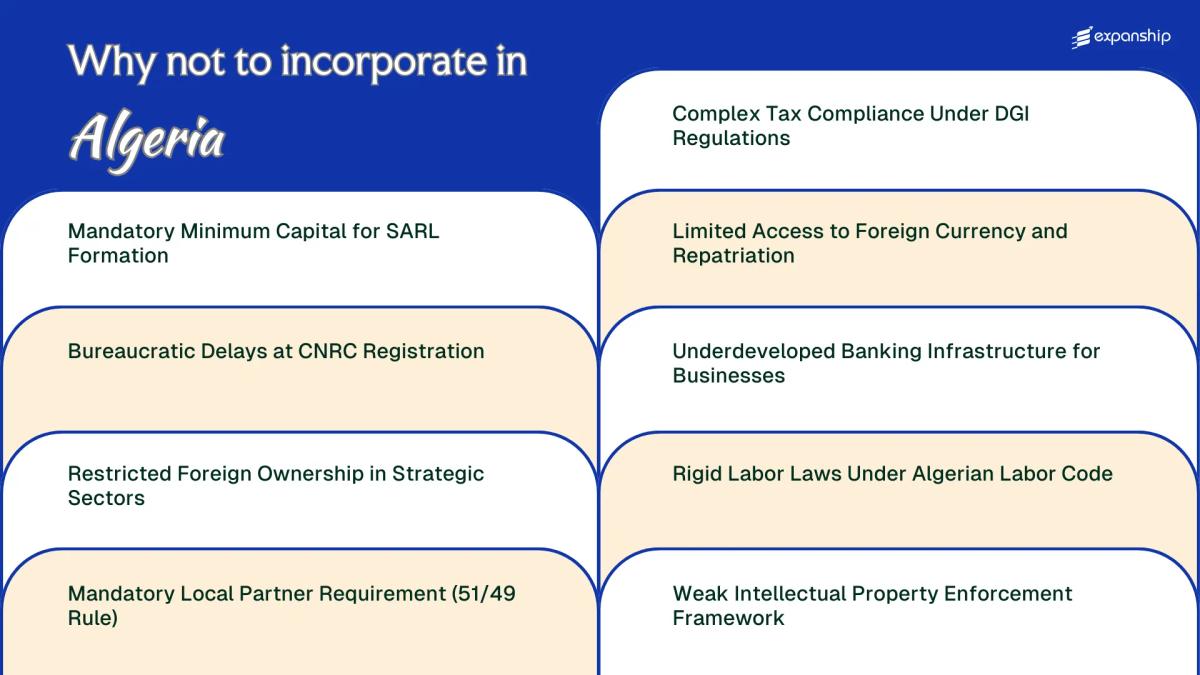
Mandatory Minimum Capital for SARL Formation
Algeria SARL minimum capital requirements present one of the first financial barriers a foreign investor encounters. Under the Code de Commerce, forming a Société à Responsabilité Limitée requires a minimum share capital of DZD 100,000 (approximately USD 740), which must be fully subscribed at incorporation.
Capital Must Be Deposited Before Registration
Full capital deposit is required prior to filing with the Centre National du Registre du Commerce (CNRC). Your funds are effectively frozen in a blocked account until the registration process concludes, which can take weeks given administrative backlogs at the CNRC.
This capital lock-up delays your ability to use working capital for actual business operations from day one. For a lean startup or a foreign entity testing the market, the timing mismatch between deposit and operational access creates a genuine liquidity constraint.
The Threshold Understates the Real Burden
While DZD 100,000 appears modest, notarization fees, administrative charges, and professional service costs substantially increase the effective cost of formation. These surrounding obligations make the mandatory capital drawbacks in Algeria business formation more expensive in practice than the statutory figure suggests.
Your subscribed capital remains inaccessible throughout the CNRC registration period, meaning you cannot deploy those funds operationally until incorporation is fully completed.
Bureaucratic Delays at CNRC Registration
CNRC registration delays in Algeria represent one of the most immediate operational barriers a foreign investor encounters. The Centre National du Registre du Commerce processes all commercial registrations, but the procedural sequence involves multiple agencies before registration is even submitted, including notarization, bank deposit confirmation, and publication in the BOAL (Bulletin Officiel des Annonces Légales).
Each agency operates on its own timeline. Delays at any single point — the notary, the bank, or the tax registration with the DGI — push back the entire process without any coordinated mechanism for follow-up.
For a foreign business owner, this creates specific operational friction:
- Your registered address and banking access remain blocked until the CNRC issues the final extract, delaying contract execution with local partners
- Legal fees and local agent retainers accumulate during extended waiting periods outside your control
- Staff recruitment and visa sponsorship cannot begin until the entity holds valid commercial registration
- Remote management of the process is difficult, as in-person attendance or a locally present representative is often required at multiple steps
Online registration pathways exist in limited form, but physical document submission remains standard practice for most foreign-structured entities.

Company Incorporation in Algeria
Set up your Algerian entity with structured guidance through CNRC registration and multi-agency compliance requirements.
Restricted Foreign Ownership in Strategic Sectors
Foreign ownership restrictions in Algeria's strategic sectors represent one of the most significant structural barriers for international investors seeking to establish a presence in the country. Under the Investment Law (Law No. 22-18 of 2022) and its predecessors, the Algerian government classifies certain industries as strategically sensitive, subjecting them to ownership caps that foreign firms cannot negotiate around.
| Sector | Foreign Ownership Cap | Practical Restriction |
|---|---|---|
| Hydrocarbons (upstream) | Minority position required | Sonatrach retains majority control by law |
| Mining and strategic minerals | Subject to state participation rights | Foreign operator cannot hold controlling stake |
| Defense and security-related industries | Effectively closed to foreign private ownership | No viable entry structure available |
| Pharmaceutical manufacturing | Subject to local partner obligations | Foreign firm bears R&D costs without control |
Sectors tied to natural resources are structurally off-limits for majority foreign control. Sonatrach, the state energy company, exercises mandatory participation rights in hydrocarbon projects, meaning your firm absorbs investment risk without holding a controlling position.
Even in sectors not explicitly listed as restricted, the Ministry of Industry applies discretionary review powers that can reclassify activities as strategic during the registration process. This ambiguity makes pre-investment planning unreliable, since the applicable ownership threshold may shift before your entity is formally approved.
The limitations on foreign ownership in strategic sectors extend beyond equity percentages. Decision-making authority, board composition, and veto rights on key operational matters are often structured to favor the Algerian state partner, further reducing the practical influence a foreign investor holds even within its permitted ownership share.
Mandatory Local Partner Requirement (51/49 Rule)
The Algeria 51/49 rule requires that foreign investors hold no more than 49% of shares in any Algerian commercial entity, with the remaining 51% reserved for Algerian nationals or resident partners. This structural cap, originally codified under the Investment Law and reinforced through successive Finance Laws, means you cannot hold a controlling stake in your own business.
Control over day-to-day decisions, profit distribution, and strategic direction legally rests with your local partner. Even if your capital, expertise, and operational infrastructure drive the business, voting rights follow shareholding proportions.
The mandatory local shareholder restrictions extend to dividend allocation. A foreign investor contributing the majority of capital is entitled to less than half of the returns. This misalignment between capital contribution and profit entitlement is a structural cost with no contractual workaround that overrides the statutory requirement.
Under Algerian investment law, the 51/49 rule historically applied across most sectors, though post-2022 reforms have narrowed its application to specific strategic industries. The distinction between regulated and non-regulated sectors is not always clearly demarcated in practice.
- Foreign equity is capped at 49%; majority ownership is not legally available to non-resident investors in covered sectors
- The local partner holds statutory voting control regardless of capital contribution ratios
- Profit distribution must reflect shareholding structure, not investment proportions
- The requirement applies at the time of incorporation and cannot be restructured post-registration without regulatory approval
- Identifying a compliant Algerian majority shareholder is a prerequisite before company formation can proceed
Algeria is one of the few countries where the 51/49 ownership restriction historically applied to virtually all foreign investment sectors, not just defense or utilities, making it an outlier even among MENA jurisdictions with ownership controls.
Complex Tax Compliance Under DGI Regulations
Algeria DGI tax compliance challenges extend well beyond filing deadlines. The Direction Générale des Impôts administers a multi-layered tax regime that places disproportionate administrative pressure on foreign-owned entities.
Structural Complexity Within the DGI Tax Regime
Corporate tax obligations in Algeria include the Impôt sur les Bénéfices des Sociétés (IBS), the Taxe sur l'Activité Professionnelle (TAP), and VAT filings, each governed by distinct schedules and reporting formats under the Code des Impôts Directs et Taxes Assimilées. Managing concurrent compliance across these separate instruments requires dedicated local tax expertise, which adds recurring operational cost to your firm's annual budget.
Practical Burden on Foreign Business Owners
DGI audits can be triggered by inconsistencies across filings, and the burden of documentation falls entirely on the registered entity, meaning a foreign director unfamiliar with Algerian fiscal procedure faces real legal exposure if records are incomplete. Algeria DGI tax compliance challenges are compounded by the fact that the DGI's digital infrastructure remains inconsistent, requiring many declarations to be submitted in person at local tax centers. Complex tax regulations Algeria business operators face include transfer pricing scrutiny applied to transactions with foreign parent companies, which can produce disputed assessments with limited formal appeal efficiency.
Managing Tax Compliance Challenges in Algeria
Understand the full scope of DGI obligations before you incorporate. Our specialists can walk you through the tax filing requirements specific to your business structure in Algeria.
Limited Access to Foreign Currency and Repatriation
Algeria foreign currency repatriation restrictions create one of the most significant financial obstacles for foreign investors operating in the country. Transferring profits abroad requires navigating approval processes under the Bank of Algeria and compliance with the Foreign Exchange Code.
- The Bank of Algeria controls all outward foreign currency transfers, meaning your profits cannot leave the country without prior regulatory authorization.
- Repatriation is legally permitted only when the original investment was registered and made through official banking channels in convertible currency, creating a documentation burden that begins at the point of entry.
- Chronic foreign exchange shortages within the domestic banking system mean that even approved transfers face significant delays in execution.
- Algeria foreign exchange limitations on business operations restrict your ability to hold foreign currency accounts locally, forcing reliance on dinar-denominated accounts that expose your firm to exchange rate risk.
- The 51/49 ownership structure compounds profit repatriation problems in Algeria, since a foreign partner legally controls only a minority share of distributable profits.
Underdeveloped Banking Infrastructure for Businesses
Algeria banking infrastructure limitations for business are well-documented among foreign investors who have attempted to establish operational accounts and access credit facilities locally. The banking sector remains dominated by six state-owned banks, including Banque Nationale d'Algérie (BNA) and Crédit Populaire d'Algérie (CPA), which collectively hold the majority of deposits and lending activity.
Private and foreign banks operate under significant constraints, limiting your firm's options for competitive financing or specialized business services.
Account opening for newly formed entities can take weeks or months, with documentation requirements that are inconsistently applied across branches. For a foreign-owned business, this creates direct operational delays before any commercial activity can begin.
Corporate credit access is a separate obstacle. Lending decisions at state banks are often collateral-heavy and biased toward established local firms, leaving foreign-incorporated entities with limited financing options.
- Online and digital banking services for businesses remain underdeveloped relative to comparable emerging markets.
- International payment processing through local banks can involve extended clearing times and compliance reviews under Banque d'Algérie oversight.
A foreign-owned SARL requiring a DZD 5,000,000 short-term credit facility may find that state-owned banks request immovable property collateral equivalent to 150% of the loan value, effectively making bank financing inaccessible for asset-light or newly registered businesses.
Rigid Labor Laws Under Algerian Labor Code
Algeria Labor Code restrictions on businesses begin with Law No. 90-11, which governs employment contracts, working hours, termination procedures, and collective bargaining. Foreign employers cannot simply apply the workforce management practices common in their home jurisdictions — the code imposes obligations that structurally limit operational flexibility.
Terminating an employee requires documented justification and, in many cases, prior approval through an internal conciliation process. This creates a practical cost: slow headcount reduction when business conditions change, with legal exposure if the procedural steps are not followed precisely.
Algerian employment regulation challenges extend to mandatory benefits, including profit-sharing obligations and specific leave entitlements, which increase total labor costs beyond base salary. For a foreign firm accustomed to leaner employment frameworks, budgeting for these statutory additions is often underestimated at the incorporation stage.
Collective agreements negotiated under the framework of trade union bodies can impose additional conditions on top of statutory minimums. Your firm may inherit obligations from sector-level agreements without having negotiated them directly.
The Inspection du Travail holds authority to audit employment practices and impose penalties for non-compliance. Algerian labor law compliance risks are therefore not only legal but reputational, given that inspections can lead to operational disruptions during active audits.
Law No. 90-11 applies to all employees working within Algeria regardless of the nationality of the employing entity or the employee's country of origin, meaning foreign firms cannot contract out of these protections through offshore employment arrangements.
Weak Intellectual Property Enforcement Framework
Algeria intellectual property enforcement problems stem primarily from institutional capacity gaps rather than an absence of law. The country has ratified the Paris Convention and is a member of WIPO, yet registration and enforcement are administered through the National Institute of Industrial Property (INAPI), which operates with limited resources.
Trademark and patent registration through INAPI can take considerably longer than in comparable North African markets. For your business, delayed registration means a window of exposure during which competitors can use similar marks without a clear legal remedy.
Counterfeiting persists in consumer goods sectors, and civil litigation to address infringement is slow. Customs enforcement against infringing imports lacks the systematic coordination seen in jurisdictions with dedicated IP border measures. Judicial unfamiliarity with complex patent disputes further reduces the practical value of registered rights.
For IP-intensive firms, including software, pharmaceutical, or branded goods companies, these Algeria trademark patent risks represent a structural deterrent that registered rights alone do not resolve.
Strategies to Overcome These Obstacles
Overcoming Algeria business incorporation challenges requires structural preparation rather than reactive problem-solving. The disadvantages covered in this blog are systemic, and addressing them begins before the entity is formed.
- Structure your investment through sectors not subject to the 51/49 foreign ownership rule to retain full equity control.
- Pre-verify minimum capital requirements with the Centre National du Registre de Commerce (CNRC) before initiating SARL formation.
- Register for tax obligations under the Direction Générale des Impôts (DGI) at incorporation to avoid penalties for late compliance.
- Open a capital importation account through an approved local bank prior to any fund transfers to satisfy repatriation documentation requirements.
- File trademark and patent protections internationally before entering the market, given the weak domestic enforcement framework.
- Draft employment contracts in strict conformity with the Algerian Labour Code from the outset to limit exposure under rigid termination provisions.
These steps address the most structurally significant barriers identified across this blog, but they operate within a regulatory environment that remains subject to administrative discretion. Monitoring updates through the CNRC portal is advisable given the frequency of procedural changes.
Algeria's Overall Investment Potential
Algeria presents genuine Algeria investment risks and opportunities that sit in tension with each other. The structural barriers documented throughout this blog — from the 51/49 foreign ownership rule to currency repatriation constraints — are not incidental friction but embedded features of the regulatory framework. For the right business profile, the country's scale, hydrocarbon wealth, and demographic base still make it a credible destination.
| Pros | Cons |
|---|---|
| Large domestic market with a population exceeding 45 million | Foreign investors are capped at 49% equity in most sectors under the 51/49 rule |
| Hydrocarbon revenues fund significant public infrastructure spending | Access to foreign currency and profit repatriation remains administratively constrained |
| Strategic geographic position linking Sub-Saharan Africa and Mediterranean markets | CNRC registration processes involve multi-agency delays that extend setup timelines |
| Preferential trade access under certain regional agreements | Intellectual property rights lack consistent judicial enforcement |
| Sectors outside strategic designations permit broader operational scope | Labor code provisions restrict workforce flexibility, including termination procedures |
Corporate Compliance Services in Algeria
Maintain your Algerian entity in good standing with DGI filings, CNRC obligations, and ongoing regulatory requirements.
Conclusion
Algeria presents a market with genuine structural constraints for foreign investors. The cons of forming a company in Algeria — particularly the 51/49 foreign ownership rule, restrictions on foreign currency repatriation enforced through the Banque d'Algérie, and procedural delays at the CNRC — collectively create a high-friction operating environment. These are not incidental barriers; they reflect deliberate policy positions embedded in national legislation. Firms that proceed without a clear understanding of these constraints face compliance exposure from the outset. Specialist guidance on entity structuring and regulatory positioning reduces that exposure materially.
Expanship's Algeria Company Formation Support
Incorporating in Algeria carries real operational weight, from satisfying the CNRC's registration requirements to managing the 51/49 ownership rule and maintaining compliance under DGI tax obligations. Expanship's Algeria company formation support services are built around reducing the administrative burden these specific frameworks place on foreign investors, particularly during the early stages when documentation, filings, and authority liaisons consume significant time.
Our service scope covers the full incorporation and post-setup cycle:
- Your company registration and all required document preparation are handled end to end.
- A registered agent and local office address are provided to meet Algerian residency requirements.
- We manage government filings and liaise directly with the relevant regulatory authorities on your behalf.
- Post-incorporation compliance obligations are monitored and managed on an ongoing basis.
- Banking introductions are facilitated to help your business establish a local account.
- Tax registration and coordination with DGI and local authorities are included in the process.
Reach out to Expanship Algeria to discuss how we can support your incorporation process.
Frequently Asked Questions (FAQ)
The minimum capital requirement for an SARL applies broadly across activities, though the threshold can vary depending on the sector your entity operates in. Certain regulated industries impose higher capital thresholds beyond the standard SARL floor. You cannot substitute assets or future revenue projections in place of paid-up capital at registration.
The Direction Générale des Impôts enforces penalties that include financial surcharges, interest on late payments, and in persistent cases, the suspension of your firm's operating license. Tax infractions in Algeria are not treated leniently, and the absence of clear procedural guidance in English compounds the compliance risk for foreign operators. Errors in VAT reporting or corporate tax filings can trigger audits that delay your business activity significantly.
Both factors are at play, but they are distinct problems. Repatriation is governed by Algeria's exchange control regulations, which impose formal legal restrictions on transferring profits abroad, requiring prior authorization from the Banque d'Algérie. Beyond the legal framework, the underdeveloped correspondent banking relationships of Algerian commercial banks create additional processing delays that compound the legal restrictions.
Algeria's IP enforcement is weaker in practice than Morocco and Tunisia, both of which have made more measurable progress in aligning their IP regimes with international standards. Algeria is a signatory to major IP conventions, but the domestic enforcement mechanism — particularly against counterfeit goods and trademark infringement — lacks the judicial speed and institutional capacity seen in comparable regional markets. Foreign businesses holding patents or proprietary technology face meaningful exposure without robust contractual protections written into local agreements.
Your entity cannot legally operate, open a bank account, or execute commercial contracts until CNRC registration is complete, so any delay directly suspends your go-to-market timeline. Registration delays at the Centre National du Registre de Commerce are common and can extend several weeks beyond the estimated processing window due to document verification backlogs. There is no provisional trading status available while registration is pending.
The Algerian Labor Code applies to all employees working within Algerian territory, regardless of their nationality or where they were recruited. Foreign hires working locally are subject to the same protections around termination, working hours, and social contributions as Algerian nationals, and dismissing an employee without following the prescribed procedural steps exposes your firm to reinstatement orders or financial compensation claims. Work permit requirements for foreign nationals add a separate administrative layer on top of standard labor obligations.
Legal Disclaimer
The information provided in this article is for general informational purposes only and does not constitute legal, tax, or professional advice. While we strive to ensure the accuracy and timeliness of the content, laws and regulations are subject to change, and the application of laws can vary widely based on specific facts and circumstances.
Readers should not act upon this information without seeking professional counsel tailored to their individual situation. Expanship and its authors disclaim any liability for actions taken or not taken based on the content of this article.
For specific advice regarding your business setup, compliance requirements, or any legal matters, please consult with qualified legal and tax professionals in the relevant jurisdiction.