
Key Takeaways
- Algeria's Investment Code 2022 establishes defined exemption periods that directly reduce the tax burden during the capital-intensive startup phase, giving foreign investors a measurable cost advantage in early operational years.
- Reinvested profits benefit from a reduced corporate tax rate under Algerian tax law, allowing businesses to channel more after-tax capital back into local operations rather than remitting it as taxable income.
- Membership in the African Continental Free Trade Area converts Algeria's geographic position — as the largest country on the African continent — into actionable preferential trade terms across participating member states.
- ANDI's one-stop shop mechanism consolidates administrative approval pathways into a single point of contact, reducing the procedural friction that typically extends incorporation and incentive-eligibility timelines for non-resident investors.
Situated in North Africa and bordering the Mediterranean Sea, Algeria is a sovereign republic and the largest country on the African continent by land area. Company registration falls under the oversight of the Centre National du Registre de Commerce, the national body responsible for commercial registration and business formalization. Foreign investors typically establish a Société par Actions Simplifiée or a Société à Responsabilité Limitée as their preferred legal vehicle when entering the market.
Algeria operates a territorial-based tax system with treaty arrangements in place across multiple jurisdictions. The government has progressively opened sectors to foreign direct investment, though certain strategic industries retain restrictions on foreign ownership percentages under the national investment framework.
The benefits of incorporating in Algeria extend across tax policy, geographic positioning, and sectoral opportunity. This article examines the substantive advantages that make Algeria company formation a credible option for businesses pursuing expansion into African and Arab markets.
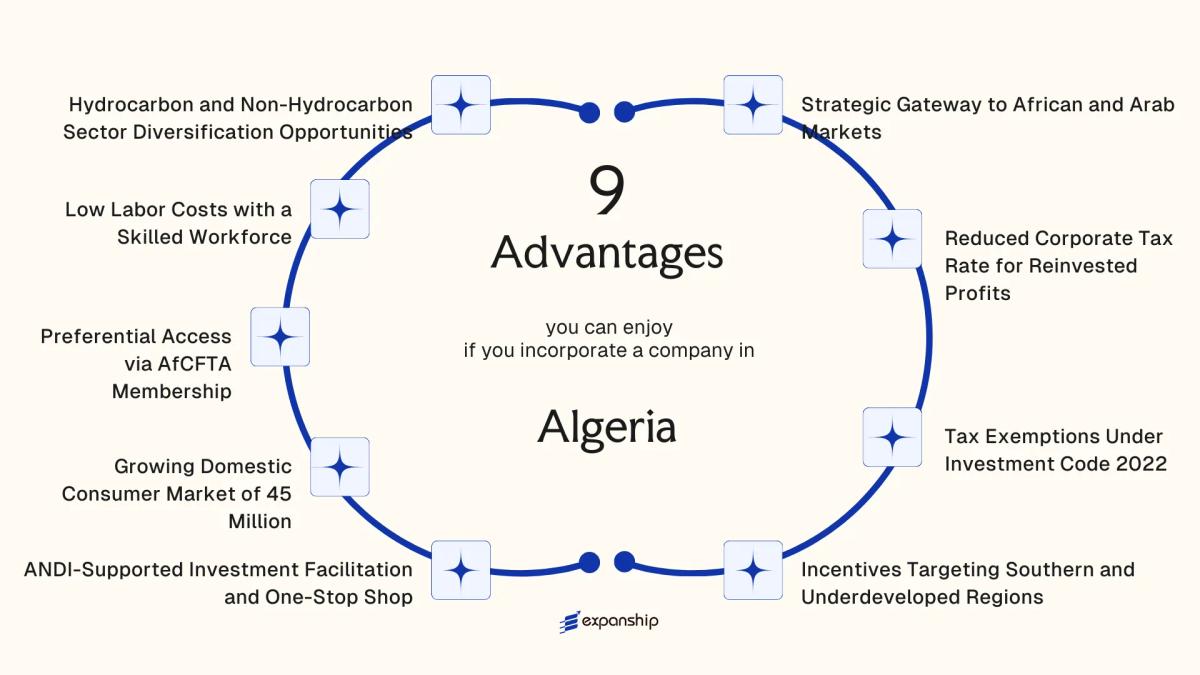
Strategic Gateway to African and Arab Markets
Algeria sits at the geographic intersection of Sub-Saharan Africa, the Arab world, and the Mediterranean basin, making it a natural base for firms targeting multi-regional markets. That physical positioning translates directly into commercial access that few North African jurisdictions can replicate.
Proximity to Arab League and African Union Trade Corridors
Algeria is a member of the Arab League and the African Union, giving incorporated entities a recognized institutional footing in both blocs. A company registered in Algiers can conduct business relationships across 21 Arab League member states without the friction that a European or Asian-registered firm would typically face in those markets.
Land Borders as a Distribution Advantage
Sharing land borders with six countries — Tunisia, Libya, Niger, Mali, Mauritania, and Morocco — your business gains potential overland access to markets across the Sahel and Maghreb regions. Cross-border trade along these corridors is governed by bilateral agreements that Algerian-registered entities can draw upon, reducing the logistical and regulatory barriers associated with market entry from outside the continent.
An Algerian-registered entity positions you inside both the Arab and African institutional frameworks simultaneously, reducing the jurisdictional distance to two of the world's fastest-growing consumer regions.
Reduced Corporate Tax Rate for Reinvested Profits
Algeria's standard corporate income tax, known locally as the Impôt sur les Bénéfices des Sociétés (IBS), applies at rates that vary by sector. For reinvested profits, however, the tax code creates a meaningful distinction. Businesses that commit a defined portion of their net profits to reinvestment within the company can qualify for a reduced IBS rate, lowering the effective tax burden on earnings that are cycled back into operations or capital assets. This Algeria reduced corporate tax on reinvested profits functions as a structural incentive to retain and deploy capital locally rather than distribute it.
For a foreign-owned entity, this distinction has direct financial consequences. Profits reinvested in qualifying activities are taxed at a lower rate than distributed dividends, which means your firm retains more working capital for expansion without an immediate full-rate tax event.
Several features make the reinvestment condition accessible in practice:
- The qualifying threshold does not require total profit reinvestment, only a defined allocation
- Reinvestment can apply to fixed assets, which are standard capital expenditures most operating businesses make regardless
- The reduced rate applies under the general IBS framework, meaning no separate special-regime application is required
- Eligibility is not restricted to specific sectors under the base reinvestment provision
Confirmation of applicable rates and current thresholds should be verified against the most recent Finance Law, as Algeria adjusts IBS parameters through annual fiscal legislation.

Company Incorporation in Algeria
Set up your Algerian company with full compliance support across legal, tax, and registration requirements.
Tax Exemptions Under Investment Code 2022
Algeria Investment Code 2022 tax exemptions represent one of the more structured fiscal incentive frameworks in North Africa, codified under Ordinance No. 22-18 of July 2022. The law replaced the previous 2016 investment framework and expanded the scope of exemptions available to both domestic and foreign investors, making it directly relevant to how your entity structures its tax position from the outset.
Under the 2022 Code, qualifying investments benefit from a temporary exemption on corporate income tax (IBS) and the business activity tax (TAP) during the operational phase. The duration of these exemptions depends on which regime your project qualifies under: the conventional regime, the exceptional regime for high-priority sectors, or the regime applicable to underdeveloped zones.
| Regime | IBS Exemption Period | Key Eligibility Basis |
|---|---|---|
| Conventional | 3 years (operational phase) | General qualifying investment |
| Exceptional | Up to 10 years | Strategic or high-priority sector |
| Underdeveloped Zones | Extended beyond standard periods | Geographic location criteria |
Exemption from customs duties on imported capital goods directly tied to the investment also applies during the construction or establishment phase. For foreign-owned firms, this reduces upfront capital expenditure before the business generates revenue. Eligibility is confirmed through ANDI, the National Agency for Investment Development, which issues the approval that formally activates these benefits under the Algeria Code de l'Investissement 2022.
Incentives Targeting Southern and Underdeveloped Regions
Algeria southern regions investment incentives are among the most substantial place-based fiscal privileges available under the country's current investment framework. Ordinance No. 22-18, the Investment Code of 2022, codifies a tiered geographic incentive system that grants materially different treatment to businesses operating in the Hauts Plateaux and the far south compared to those established in the northern coastal zones.
Projects located in these designated areas qualify for extended exemptions from corporate income tax, tax on professional activity (TAP), and property transfer duties during both the construction and operational phases. The operational exemption period can extend considerably beyond what applies in standard zones, reducing your effective tax burden during the years when cash flow is most constrained.
For companies in extractive, agribusiness, or logistics sectors, these zones represent geographic access to underserved markets and resource-rich territories that competitors have not yet entered at scale.
Keep these points in mind:
- Eligibility is tied to the registered location and actual activity site, not just the stated address
- Exemption periods are confirmed through ANDI (Agence Nationale de Développement de l'Investissement) upon project registration
- Investment Code 2022 governs the specific duration and scope of each exemption tier
- Some benefits require proof of job creation or technology transfer commitments
- Relocating operations after approval may void the geographic incentive status
The Hauts Plateaux zone covers a larger land area than many entire European countries, yet accounts for a disproportionately small share of registered investment projects, meaning early entrants face substantially less competitive density.
ANDI-Supported Investment Facilitation and One-Stop Shop
ANDI Algeria investment facilitation benefits center on a structural administrative advantage: the Agence Nationale de Développement de l'Investissement operates a guichet unique, a single-window processing system where foreign investors complete registration, licensing, and administrative formalities under one roof. This consolidation directly reduces the time and legal coordination costs that would otherwise fall on your firm when dealing with multiple government bodies independently.
Centralized Registration with Legal Authority
Under Ordinance No. 01-03 and its subsequent amendments, including the Investment Law of 2022, ANDI holds delegated authority from multiple ministries. This means the agency can issue required approvals on behalf of bodies such as the tax authority, commercial registry, and relevant sectoral ministries without requiring you to initiate separate procedures with each. For a foreign entity establishing operations, that delegation eliminates duplication of filings and reduces procedural lag between administrative stages.
Practical Value of the One-Stop Shop Format
The Algeria one-stop shop advantages for investors become concrete at the point of project declaration. Your business submits a single investment declaration through ANDI, which then coordinates interagency responses internally. Time-sensitive projects benefit because the agency is bound by defined response deadlines under the 2022 framework, meaning approval timelines are regulated rather than open-ended. That regulatory clock provides a degree of predictability that unstructured multi-agency processes typically do not.
Get Guidance on Maximizing Your Investment Benefits in Algeria
Understand how ANDI registration, one-stop shop procedures, and the 2022 Investment Law apply to your specific business structure and sector.
Growing Domestic Consumer Market of 45 Million
Algeria's large domestic consumer market advantage is rarely quantified in practical terms for foreign firms. With a population of approximately 45 million, the country represents the largest consumer base in North Africa by headcount, ahead of Morocco and Tunisia. That scale directly reduces the revenue risk for businesses entering the market, since a sufficiently large local demand can sustain operations without relying on export performance.
- Household consumption has grown alongside a young, urbanizing population, with more than 70% of Algerians living in urban centers. For businesses in fast-moving consumer goods, retail, food processing, or services, urban concentration reduces distribution costs and simplifies market entry.
- The 2022 Investment Law (Law No. 22-18) explicitly targets sectors supplying domestic demand, including agri-food, pharmaceuticals, and consumer manufacturing. Firms operating in these categories may qualify for tax exemptions and customs duty reductions, which improves unit economics when serving local buyers.
- Import substitution remains a stated policy priority of the Algerian government, meaning businesses that produce locally for domestic consumption receive regulatory preference over pure importers. Your entity benefits from that structural bias simply by establishing local production or assembly.
- Currency controls on imports create a pricing advantage for locally incorporated businesses, as they avoid the foreign exchange conversion costs that burden cross-border suppliers competing in the same consumer segments.
Preferential Access via AfCFTA Membership
Algeria AfCFTA preferential trade access benefits stem from the country's ratification of the African Continental Free Trade Area agreement, which came into force in 2021. The AfCFTA covers a market of over 1.3 billion people across 54 member states, with a combined GDP exceeding $3.4 trillion. A company incorporated in Algeria can use that legal presence as a base for exporting goods and services into this network under progressively reduced tariff schedules.
Under the AfCFTA framework, member states are committed to eliminating tariffs on 90% of goods over time. For manufacturers or distributors operating through an Algerian entity, this translates into lower trade costs when selling into sub-Saharan or East African markets that would otherwise apply standard third-country duties.
Eligibility for preferential rates requires that goods meet the AfCFTA Rules of Origin criteria, meaning sufficient local processing or content must occur within Algeria.
A manufacturer exporting $500,000 worth of processed goods annually to AfCFTA member markets could avoid tariff costs that, at an average rate of 6.1% (the pre-AfCFTA Africa average per UNCTAD data), would amount to approximately $30,500 per year, costs that compound significantly at higher export volumes.
Low Labor Costs with a Skilled Workforce
Algeria's low labor costs represent a concrete, measurable advantage. The monthly minimum wage (SNMG) is set at 20,000 Algerian dinars, which translates to roughly USD 148, placing the country well below regional peers such as Morocco and Tunisia in terms of base wage obligations.
Beyond cost, the workforce profile matters to foreign investors. Algeria's public university system produces over 300,000 graduates annually across engineering, science, economics, and law faculties. This means your firm can recruit technically trained staff at a fraction of what equivalent profiles cost in European or Gulf markets.
Sectors that benefit most from this combination include:
- Manufacturing and light industrial assembly
- IT services and software development
- Professional services requiring bilingual (Arabic/French) capacity
Labor relations are governed by Law No. 90-11 on labor relations, which establishes employment contracts, working hours, and termination procedures. Understanding this framework allows a foreign employer to structure staffing arrangements with predictable cost obligations from the outset.
Labor agreements in Algeria must comply with sector-specific collective conventions, which can impose wage floors and conditions above the statutory SNMG minimum, depending on the industry your entity operates in.
Hydrocarbon and Non-Hydrocarbon Sector Diversification Opportunities
Algeria non-hydrocarbon sector diversification opportunities have expanded considerably since the government enacted Investment Law No. 22-18 in 2022, which explicitly prioritizes sectors outside the energy industry for preferential treatment. This legislative shift signals a structural commitment to broadening the economy, giving foreign businesses a clearer entry point into sectors that previously received less institutional support.
Hydrocarbons: A Mature but Accessible Sector
Sonatrach, the state energy company, operates under a partnership model governed by the Hydrocarbon Law (Law No. 19-13). Foreign firms can enter through production-sharing arrangements or service contracts, with Sonatrach holding a statutory minimum stake. This structure allows your business to access one of Africa's largest proven gas reserves without bearing full exploration risk independently.
Non-Hydrocarbon Sectors Open to Foreign Capital
Targeted sectors under current diversification policy include:
- Agri-food processing and agribusiness
- Pharmaceutical manufacturing
- Renewable energy (solar, wind)
- Mining and mineral processing
- Information and communication technology
- Tourism infrastructure
Each of these sectors qualifies for investment incentives under the 2022 code, administered through ANDI (National Agency for Investment Development). Reduced import duties on capital equipment are available for qualifying projects in designated sectors.
Why Sector Breadth Matters for Incorporation Strategy
Registering a company across multiple eligible sectors is permitted at incorporation, which allows your entity to operate in both primary and adjacent industries under a single legal structure. This reduces the administrative overhead of maintaining separate subsidiaries for different business lines within the same jurisdiction.
Why Algeria Stands Out Among North African Business Destinations
Morocco and Tunisia are the jurisdictions most frequently evaluated alongside Algeria by foreign investors considering North Africa. Both have established incorporation frameworks and active investment promotion agencies, yet a direct comparison across key structural parameters reveals meaningful differences in market size, sectoral incentive depth, and regional trade positioning — factors that are often underweighted in initial market assessments.
Where Algeria holds a distinct position is in the combination of domestic demand scale and the incentive architecture introduced under Investment Law No. 22-18. A consumer base of 45 million, paired with reduced corporate tax rates on reinvested profits and ANDI's one-stop-shop facilitation, produces a structural environment that differs materially from what Tunisia or Egypt offer smaller export-oriented firms. The AfCFTA membership adds a trade dimension that Morocco, despite its own bilateral agreements, does not currently share in the same continental framework.
| Parameter | Algeria | Morocco | Tunisia | Egypt |
|---|---|---|---|---|
| Domestic Market Size | ~45 million | ~37 million | ~12 million | ~105 million |
| Investment Law Framework | Law No. 22-18 (2022) | Investment Charter 2022 | Investment Law 2016 | Investment Law No. 72 of 2017 |
| AfCFTA Membership | Yes | No | Yes | Yes |
| Corporate Tax Rate (Standard) | 19–26% (sector-dependent) | 20–35% | 15–25% | 22.5% |
| Investment Promotion Body | ANDI | AMDIE | FIPA | GAFI |
| Regional Development Incentives | Yes (southern wilayas) | Yes (specific zones) | Yes (regional zones) | Yes (special zones) |
Compliance Services for Companies in Algeria
Maintain your Algerian entity in good standing with ongoing regulatory, tax, and statutory filing support.
Conclusion
Algeria's investment framework offers a structured combination of fiscal incentives, market access, and sector-level opportunity that few North African jurisdictions replicate in the same configuration. The reduced corporate tax rate on reinvested profits and the exemption periods established under Investment Code 2022 directly reduce the tax burden during the years when foreign businesses are most exposed to startup risk. For firms targeting the African continent, AfCFTA membership translates treaty obligations into actionable preferential trade terms.
These benefits of incorporating in Algeria do not apply uniformly. The Tax Exemptions, ANDI facilitation support, and regional incentives targeting southern wilayas each carry eligibility conditions tied to sector classification, investment volume, or geographic placement. Your business structure and operational focus will determine which instruments are accessible from the outset.
What makes this jurisdiction a coherent case for foreign incorporation is the convergence of a large domestic consumer base, competitive labor costs, and a legal framework that has been formally updated to attract non-resident capital. The specifics of how those advantages apply to your entity depend on factors including legal form, industry classification, and the regions where you intend to operate. Engaging with ANDI's one-stop shop mechanism early in the formation process gives foreign investors direct access to the administrative pathways that govern both approval timelines and incentive eligibility.
Start Your Algeria Company Formation with Expanship Today
Starting an Algeria company formation with Expanship means your incorporation is handled by specialists who understand the Société à Responsabilité Limitée (SARL) and Société par Actions Simplifiée (SAS) structures, the filing requirements under Algeria's Commercial Registry (CNRC), and the investment incentives available through Ordonnance 22-18, the Investment Code of 2022. Rather than interpreting these obligations in isolation, your setup is managed with direct knowledge of the local regulatory environment.
Expanship's scope of service covers the full formation and post-incorporation cycle:
- Preparation and legalization of incorporation documents, including notarized statutes and CNRC registration filings
- Registered agent and registered office provision for companies without a physical presence
- Liaison with the CNRC, ANDI, and relevant tax authorities during and after incorporation
- Ongoing compliance management, including annual filings and corporate record maintenance
- Banking introduction assistance to support corporate account opening with Algerian financial institutions
Each of these services addresses a distinct administrative layer that foreign business owners commonly encounter when establishing a legal entity in North Africa, particularly given Algeria's Arabic and French documentation requirements and public notary involvement in company formation.
Expanship Algeria is available to assist with your incorporation inquiry.
Frequently Asked Questions (FAQ)
The Investment Law 22-18 provides phased tax exemptions during both the establishment and operational periods of a qualifying investment. Exemptions can cover corporate income tax, the tax on professional activity (TAP), and certain customs duties on imported equipment, with durations varying based on the investment zone and sector. Projects located in southern or underdeveloped regions generally qualify for extended exemption periods beyond those granted to investments in northern zones.
The National Agency for Investment Development (ANDI) operates a one-stop shop that consolidates administrative procedures across multiple government bodies into a single point of contact. Rather than filing separately with the Centre National du Registre du Commerce (CNRC), tax authorities, and other agencies, you submit documentation through ANDI, which coordinates the process internally. This mechanism applies specifically to investment projects that meet the eligibility thresholds defined under the 2022 Investment Code.
As a signatory to the African Continental Free Trade Area agreement, Algeria provides incorporated businesses with a legal basis to access preferential tariff treatment across participating African markets. The practical benefit depends on the specific goods traded and the applicable schedules negotiated under the agreement, as tariff reductions are being phased in progressively rather than applied immediately. A firm registered in Algeria can use this membership to position itself as a regional trading or distribution entity under the AfCFTA framework.
Profits reinvested within a qualifying Algerian entity are subject to a reduced corporate income tax rate rather than the standard rate. The standard corporate tax rate varies by sector, with commercial activities generally taxed at 26% and production activities at a lower rate, while reinvested profits benefit from a further reduction under applicable fiscal provisions. The reinvestment must meet defined conditions, including commitment periods and documentation requirements verified by the tax administration (Direction Générale des Impôts).
Algerian company law does not universally mandate a resident director for all entity types, but certain administrative and fiscal registration requirements create practical dependencies on a local presence. The gérant (manager) of a SARL, for example, must be identifiable to Algerian authorities and capable of signing official documents within the jurisdiction. Foreign investors frequently appoint a local representative to fulfill registration, notarization, and ongoing compliance obligations, even when not strictly required by statute.
Consumer-facing sectors such as retail distribution, agri-food processing, pharmaceuticals, and construction materials have historically attracted investment tied to domestic demand. The 2022 Investment Code identifies priority sectors that receive enhanced incentives, and consumer goods industries serving the local population are included within that scope. Your entity's sector classification under the Algerian industrial nomenclature directly determines which incentive tier and customs regime applies.
Legal Disclaimer
The information provided in this article is for general informational purposes only and does not constitute legal, tax, or professional advice. While we strive to ensure the accuracy and timeliness of the content, laws and regulations are subject to change, and the application of laws can vary widely based on specific facts and circumstances.
Readers should not act upon this information without seeking professional counsel tailored to their individual situation. Expanship and its authors disclaim any liability for actions taken or not taken based on the content of this article.
For specific advice regarding your business setup, compliance requirements, or any legal matters, please consult with qualified legal and tax professionals in the relevant jurisdiction.