
Key Takeaways
- The SARL is Algeria's most widely used entity type, favored for its limited liability structure and registration process administered through the Centre National du Registre de Commerce (CNRC).
- Algeria's commercial activity is governed by the Code de Commerce algérien, with the CNRC serving as the central body responsible for registering and maintaining records of all commercial entities.
- Foreign firms can operate in Algeria through a branch, representative, or liaison office before committing to a locally incorporated structure such as an SPA or SARL.
- Ordinance 22-18 signals a regulatory shift in Algeria's investment framework, potentially expanding the scope of permissible foreign participation in locally registered entities.
Introduction to Entity Types in Algeria
Algeria is a sovereign republic in North Africa, bordered by Tunisia, Libya, Niger, Mali, Mauritania, Morocco, and the Mediterranean Sea to the north. As the largest country on the African continent by land area, it operates under a civil law system with commercial activity governed primarily by the Code de Commerce algérien. Company registration falls under the jurisdiction of the Centre National du Registre de Commerce (CNRC), the body responsible for registering and maintaining records of commercial entities.
The tax regime is resident-based, with corporate profits subject to national taxation at rates that vary by sector and activity type.
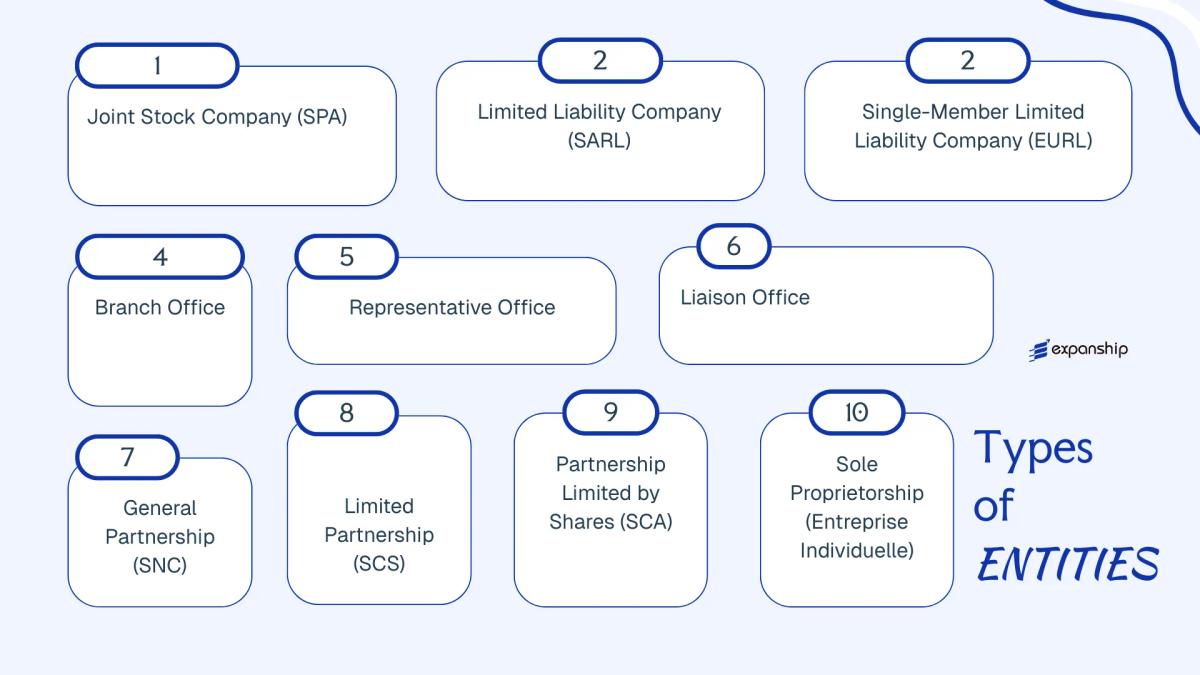
Several distinct legal structures are available for businesses operating in Algeria:
- Société par Actions (SPA)
- Société à Responsabilité Limitée (SARL)
- Entreprise Unipersonnelle à Responsabilité Limitée (EURL)
- Société en Nom Collectif (SNC)
- Société en Commandite Simple (SCS)
- Société en Commandite par Actions (SCA)
- Branch Office
- Representative Office
- Liaison Office
- Entreprise Individuelle (Sole Proprietorship)
Each structure carries distinct requirements around capital, liability, ownership, and permitted activities. The sections that follow examine each form in detail.
An Overview of Business Structures in Algeria
Algerian corporate structures are governed primarily by the Code de Commerce, with supplementary provisions under Law No. 08-04 and subsequent amendments that regulate capital requirements, governance, and foreign participation. Seven principal entity types are available to investors and entrepreneurs operating under this framework. Each form carries distinct rules on liability, capital, membership, and permitted activities.
Business Structures at a Glance
| Entity Type | Legal Form | Liability | Tax Status | Local Trading | Minimum Members | Regulatory Authority | Governing Act |
|---|---|---|---|---|---|---|---|
| SPA | Joint Stock Company | Limited to shares | Taxable | Permitted | 7 shareholders | CNRC / ANDI | Code de Commerce |
| SARL | Limited Liability Company | Limited to capital | Taxable | Permitted | 1–50 associates | CNRC | Code de Commerce |
| EURL | Single-Member LLC | Limited to capital | Taxable | Permitted | 1 sole member | CNRC | Code de Commerce |
| Branch Office | Foreign branch | Parent liable | Taxable | Permitted | Parent company | CNRC / ANDI | Law No. 16-09 |
| Representative Office | Non-trading entity | Parent liable | Exempt | Not permitted | Parent company | CNRC | Law No. 16-09 |
| SNC | General Partnership | Unlimited | Taxable | Permitted | 2+ partners | CNRC | Code de Commerce |
| SCS | Limited Partnership | Mixed | Taxable | Permitted | 1 general + 1 limited | CNRC | Code de Commerce |
| SCA | Partnership Limited by Shares | Mixed | Taxable | Permitted | 4 members minimum | CNRC | Code de Commerce |
| Sole Proprietorship | Individual enterprise | Unlimited | Taxable | Permitted | 1 individual | CNRC | Code de Commerce |
Each of these structures is examined in full in the sections below.
Société par Actions (SPA) — Joint Stock Company
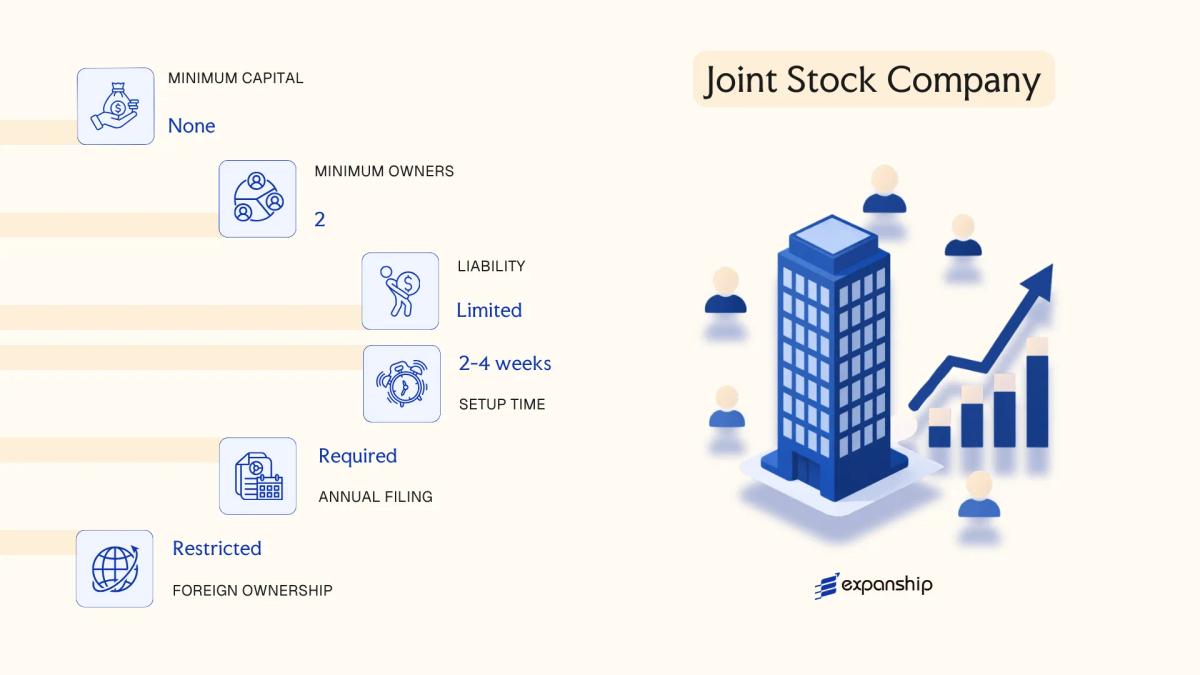
The Société par Actions Algeria SPA is governed primarily by the Algerian Commercial Code (Code de Commerce), with founding provisions established under Ordinance No. 75-59 of 1975 and subsequently amended. As a distinct legal entity, the SPA carries separate legal personality from its shareholders, meaning the firm can hold assets, enter contracts, and bear liabilities in its own name.
Shareholders' exposure is capped at the value of their subscribed shares. This liability structure, combined with the entity's capacity to issue tradeable securities, makes the SPA the standard vehicle for large-scale commercial operations and public offerings.
Key Characteristics
| Requirement | Detail | Notes |
|---|---|---|
| Legal Form | Joint Stock Company (Société par Actions) | Separate legal personality; can issue shares |
| Members | Shareholders; minimum 7 | No statutory maximum; referred to as actionnaires |
| Management | Board of Directors (Conseil d'Administration) or a two-tier structure (Directoire + Conseil de Surveillance) | Minimum 3, maximum 12 board members |
| Local Presence | Registered office in Algeria required | Physical address; not a P.O. Box |
| Share Capital | Minimum DZD 1,000,000 (private); DZD 5,000,000 if making public offerings | Must be fully subscribed at incorporation; 25% paid up at formation |
| Privacy | Shareholder register maintained; financial statements subject to audit and filing | Limited privacy for significant shareholders |
Focus Points
- Taxation: Corporate income tax applies at the standard rate; VAT obligations arise on taxable supplies; withholding tax applies to dividends, royalties, and interest paid to non-residents — consult the Direction Générale des Impôts for current rates and thresholds.
- Annual Compliance: Mandatory statutory audit by a registered commissaire aux comptes; annual general meeting and financial statement filing required.
- Foreign Ownership: The 49/51 rule historically restricted foreign equity to 49%, though reforms have adjusted applicability by sector — verify current rules before structuring.
- Treaty Access: Algeria maintains a network of double taxation treaties; SPA status generally qualifies for treaty benefits subject to substance requirements.
- Conversion: An SPA can be converted to a SARL or other legal form by shareholder resolution, subject to Commercial Court registration.
Closing
The SPA suits large trading operations, joint ventures with institutional partners, and businesses intending to raise capital through share issuance. Its principal advantage is the ability to offer transferable securities; the corresponding drawback is the administrative burden — a statutory auditor is mandatory regardless of turnover, and the minimum shareholder threshold of seven can complicate closely held structures.
The SPA is most appropriate for large enterprises, foreign investors entering through joint ventures, and businesses with long-term plans for capital markets access.

Company Incorporation in Algeria
Incorporate an SPA or other business entity in Algeria with end-to-end support from Expanship's corporate services team.
Société à Responsabilité Limitée (SARL) — Limited Liability Company
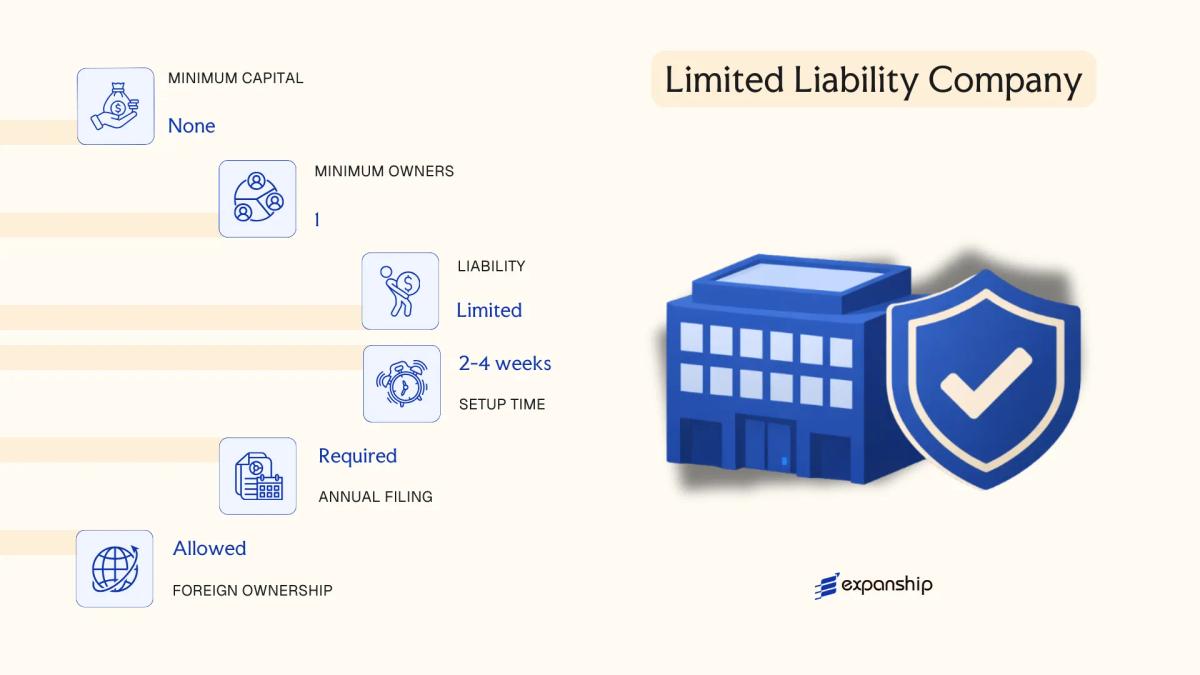
The SARL is governed by the Algerian Commercial Code, as amended, and remains the most commonly chosen structure for SARL company formation Algeria. It carries separate legal personality from the moment of registration, meaning the entity's liabilities are distinct from those of its members. Liability exposure for each member is capped at their contribution to the share capital.
Structurally, the SARL occupies a middle ground: it applies corporate-style limited liability while operating under governance rules less demanding than those imposed on joint stock companies. This makes it accessible for small to mid-sized businesses without sacrificing the protections of a formally incorporated body.
Key Characteristics
| Requirement | Detail | Notes |
|---|---|---|
| Legal Form | Société à Responsabilité Limitée | Separate legal personality upon registration |
| Members | 2 to 50 associates (associés) | Managed by one or more gérants (managers); managers need not be members |
| Local Presence | Registered office address in Algeria required | A physical or legally recognised address; no mandatory resident agent under general rules |
| Share Capital | No statutory minimum under current rules; contributions must be fully subscribed at formation | Capital divided into parts sociales, not publicly tradeable shares |
| Privacy | Members' names appear in the commercial register | Register is publicly accessible; no nominee framework available |
Focus Points
- Taxation: Subject to corporate income tax (currently 19% for production activities, 23% for trading/services), VAT at 19%, and withholding tax on dividends distributed to non-resident associates.
- Annual Compliance: Mandatory filing of annual financial statements with the Centre National du Registre de Commerce (CNRC); statutory audit required when thresholds on turnover or headcount are met.
- Foreign Ownership: Foreign participation is subject to the 51/49 rule under investment regulations, requiring an Algerian partner to hold majority ownership in most sectors.
- Conversion: An SARL may be converted to an SPA if membership or capital conditions require it, following procedures set out in the Commercial Code.
- Treaty Access: Algeria maintains a network of double taxation treaties; SARL entities resident in Algeria may access treaty benefits subject to applicable conditions.
Closing
The SARL suits trading operations, service businesses, and domestic joint ventures where partners seek liability protection without the administrative burden of a publicly structured company. Its transferability restrictions on parts sociales, however, limit flexibility for investors who may need to exit or restructure quickly.
The SARL is most appropriate for small to mid-sized businesses and foreign investors entering Algeria through a local joint venture arrangement.
Entreprise Unipersonnelle à Responsabilité Limitée (EURL) — Single-Member LLC
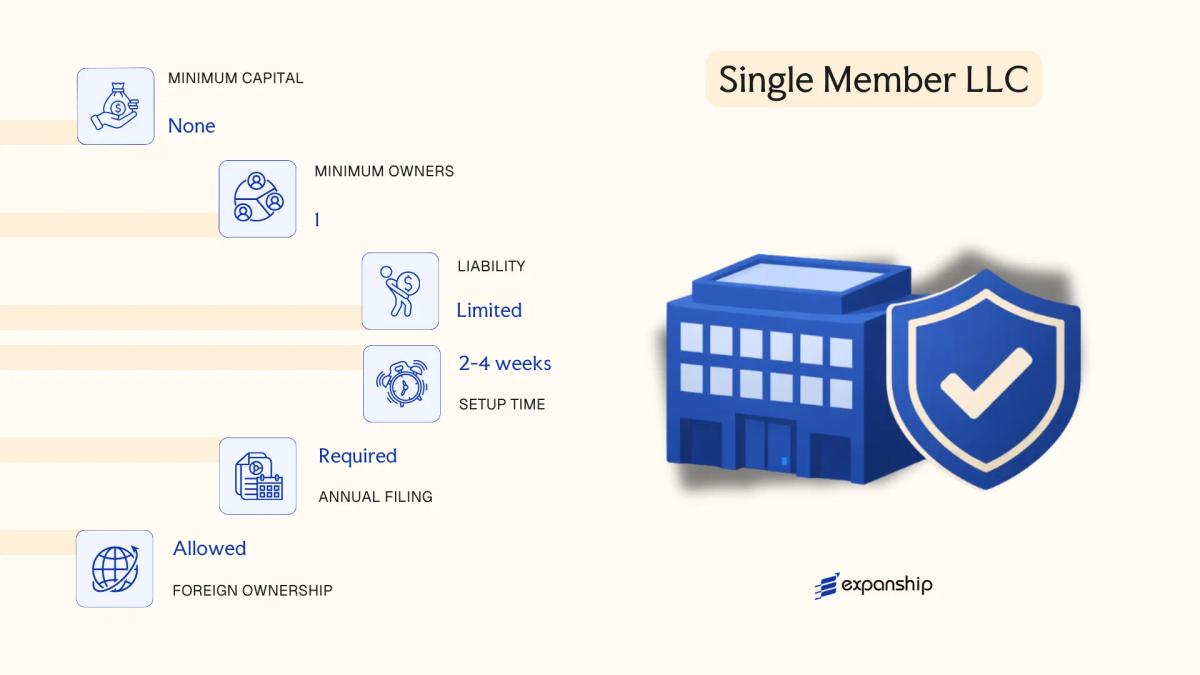
The EURL single member company Algeria framework derives from the same foundational legislation as the SARL — the Algerian Commercial Code, as amended. Structurally, the EURL is a single-member variant of the SARL, carrying full separate legal personality and limiting the sole member's liability to their capital contribution.
Governed under provisions that permit one natural or legal person to hold the entire share capital, this entity suits founders who require sole ownership without exposing personal assets to business liabilities. The Entreprise Unipersonnelle à Responsabilité Limitée Algeria classification reflects a hybrid character: partnership-derived in structure, yet corporate in liability treatment.
Key Characteristics
| Requirement | Detail | Notes |
|---|---|---|
| Legal Form | Single-member limited liability company | Operates as a distinct legal person from its sole member |
| Members | 1 sole member (associé unique); natural or legal person | No minimum/maximum complexity — strictly one member only |
| Management | One or more gérants (managers) | The sole member may also act as gérant |
| Local Presence | Registered office in Algeria required | Must be a physical address; domiciliation at a commercial centre is permitted |
| Share Capital | No statutory minimum under current regulations | Capital must be stated in the articles of association (statuts) |
| Privacy | Statuts filed with CNRC (Centre National du Registre du Commerce) | Financial statements are not broadly publicised but are filed administratively |
Focus Points
- Taxation: Subject to corporate income tax (IBS) at the standard rate; VAT applies to taxable supplies; withholding tax applies to dividends distributed to the sole member, particularly where that member is a non-resident entity.
- Annual Compliance: Annual financial statements must be filed; the gérant must convene a formal sole-member decision (décision de l'associé unique) in lieu of a general meeting.
- Conversion: An EURL automatically converts to a SARL if a second member is admitted, triggering updated statuts and re-registration with the CNRC.
- Foreign Ownership: A non-resident natural or legal person may hold the single membership, subject to the foreign investment rules applicable under Algerian law, including any sector-specific restrictions.
- Economic Activity: The entity must conduct genuine commercial activity from its registered Algerian address; dormant or shell usage carries administrative and tax compliance risks.
Closing
The EURL suits entrepreneurs and foreign parent companies establishing a wholly owned operational or holding vehicle without sharing equity. Its single-member structure provides complete ownership control, though the absence of a co-member means all governance decisions and potential liabilities for misconduct rest solely with the associé unique or appointed gérant.
The EURL is most appropriate for a sole founder or a foreign parent entity seeking full ownership of an Algerian operating subsidiary with contained personal liability.
Foreign Business Structures in Algeria [Branch Office, Representative Office, Liaison Office]
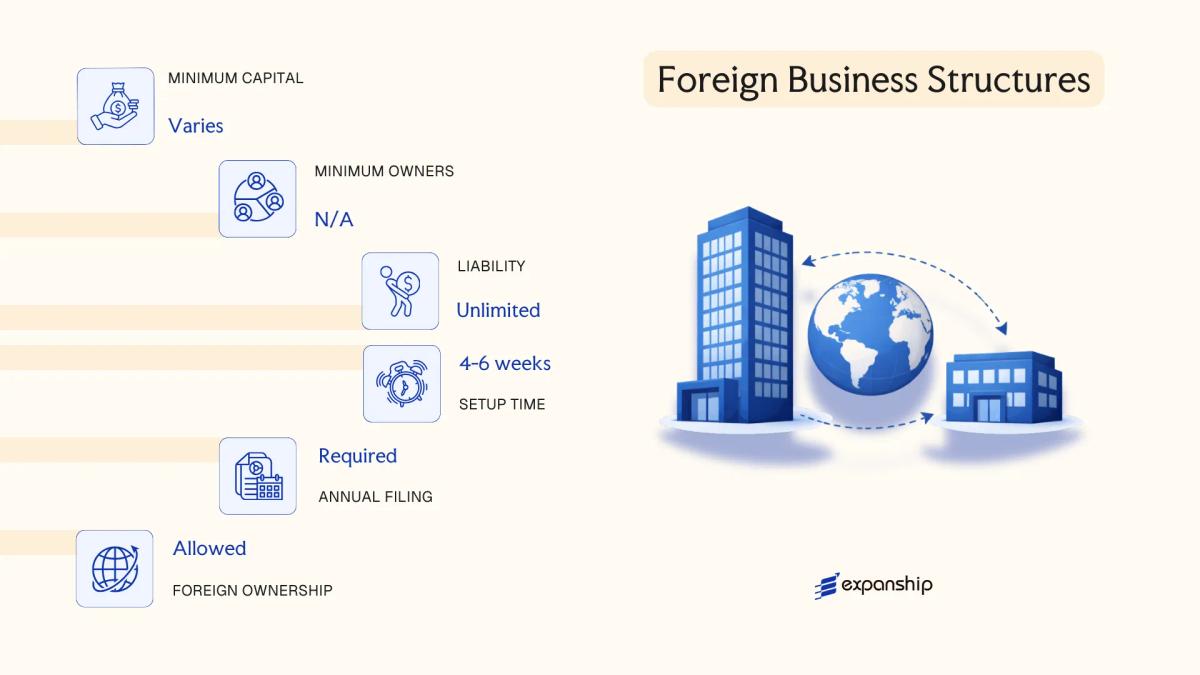
Foreign companies seeking a presence without incorporating a locally domiciled entity have three recognised options under Algerian law: the branch office, the representative office, and the liaison office. Establishing a foreign company branch office in Algeria is governed primarily by the Commercial Code and supplementary provisions under the Investment Law (Law No. 22-18 of 2022), which consolidated earlier foreign investment rules. Registration in all three cases is processed through the Centre National du Registre de Commerce (CNRC).
A branch carries no separate legal personality; it remains an extension of the parent company, which bears full liability for its obligations. Representative and liaison offices operate under even stricter limitations, confined to non-commercial activities.
Key Characteristics
| Requirement | Branch Office | Representative / Liaison Office |
|---|---|---|
| Legal Personality | None — extension of parent | None — extension of parent |
| Commercial Activity | Permitted | Not permitted |
| Local Representative | Mandatory (resident manager) | Mandatory (resident contact person) |
| Capital Requirement | No statutory minimum | None |
| Registration Body | CNRC | CNRC |
| Privacy | Parent company details publicly filed | Parent company details publicly filed |
Focus Points
- Taxation: Branch profits are subject to the standard corporate tax rate (19% general rate); VAT at 19% applies to taxable supplies; withholding tax applies to payments remitted to the foreign parent.
- Treaty access: Algeria maintains a network of double taxation treaties, but treaty benefits for branches depend on the specific convention and may be restricted.
- Annual compliance: Branches must file audited accounts and a tax return with the Direction des Impôts; liaison offices have lighter filing obligations but must renew registration periodically.
- Restrictions: Liaison and representative offices cannot invoice clients, generate revenue, or sign commercial contracts in their own name.
- Conversion: A branch can be converted into a locally incorporated entity (such as an SARL or SPA), though the process requires fresh incorporation steps rather than a direct statutory conversion.
Sub-Types
Branch Office
Registered at the CNRC and authorised to conduct commercial and industrial activities, the branch is the most operationally capable foreign structure. It can enter contracts, employ staff, and generate local revenue, all under the parent's legal identity.
Representative Office
Limited to market research, promotion, and coordination functions on behalf of the parent, a representative office cannot generate revenue from Algerian clients. Algeria's representative office registration process requires submission of the parent's constitutive documents, translated into Arabic and legalised.
Liaison Office
Functionally similar to a representative office, the liaison office in Algeria is typically used for administrative coordination between the foreign parent and local counterparts. It is the most restricted structure and suited only to businesses that require a minimal, non-revenue-generating foothold.
Branches suit foreign firms that need operational capacity without full local incorporation, though the parent's unlimited liability exposure is a meaningful drawback for higher-risk activities.
Foreign businesses testing the Algerian market or managing project-specific contracts before committing to full local incorporation.
Partnership Structures in Algeria [Société en Nom Collectif (SNC), Société en Commandite Simple (SCS), Société en Commandite par Actions (SCA)]
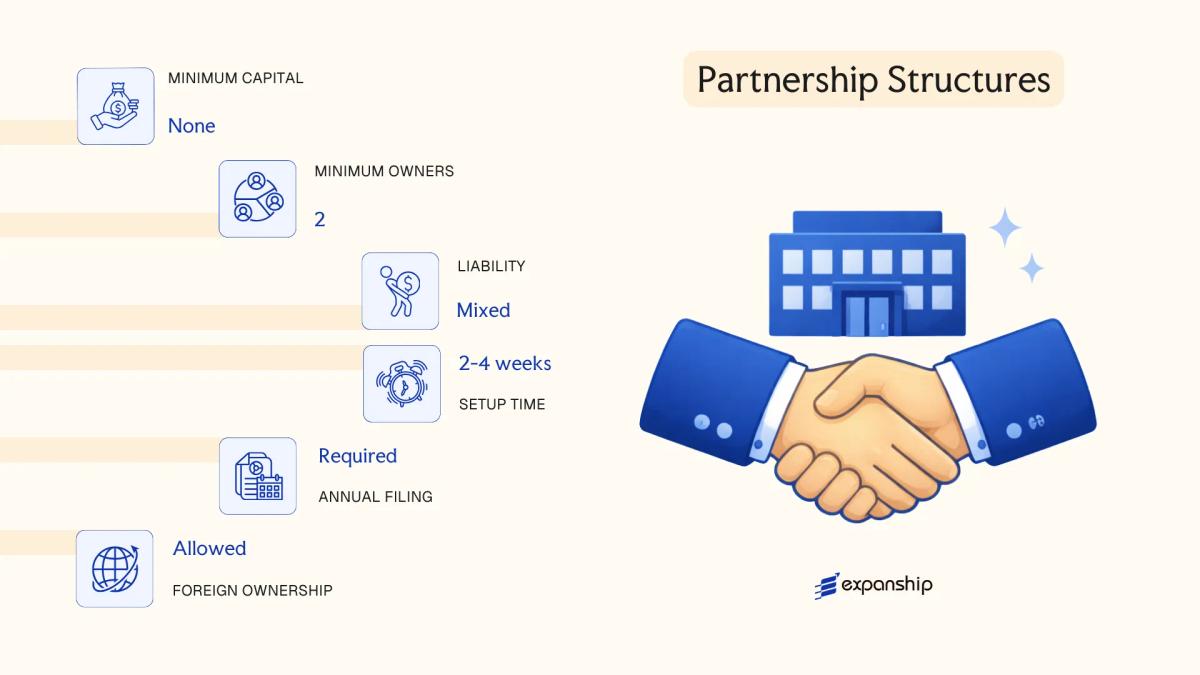
Partnership structures in Algeria SNC SCS are governed by the Code de Commerce (Ordinance No. 75-59 of 26 September 1975), as amended. Algerian law recognises three distinct partnership forms, each carrying different liability profiles and governance arrangements.
All three structures acquire separate legal personality upon registration with the Centre National du Registre de Commerce (CNRC). The liability exposure varies significantly across forms, making the choice of structure consequential for partners who commit personal assets to the business.
Key Characteristics
| Requirement | SNC | SCS | SCA |
|---|---|---|---|
| Legal Form | General partnership; unlimited joint liability for all partners | Limited partnership; unlimited liability for gérants, limited for commanditaires | Partnership limited by shares; hybrid of partnership and joint stock structure |
| Members | Referred to as associés; minimum 2, no maximum; all bear unlimited liability | Two categories: at least 1 gérant (unlimited) and at least 1 commanditaire (limited) | Minimum 1 gérant (unlimited liability) and at least 3 actionnaires commanditaires |
| Capital | No statutory minimum; contributions may be in cash or kind | No statutory minimum for the commandite portion | Share capital divided into negotiable shares; minimum varies by articles |
| Local Presence | Registered office in Algeria required; CNRC registration mandatory | Registered office in Algeria required | Registered office in Algeria required |
| Privacy | Partner names filed publicly with CNRC | Partner categories disclosed; commanditaires' liability status on public record | Gérant identity publicly filed; shareholder register maintained internally |
Focus Points
- Taxation: All three structures are subject to the Impôt sur les Bénéfices des Sociétés (IBS) at the standard corporate rate; VAT applies to taxable supplies, and withholding taxes apply to dividends and royalties paid to non-residents under applicable double tax treaties.
- Partner liability: SNC partners bear unlimited, joint, and several liability — personal assets remain fully exposed to business creditors.
- Annual compliance: Each entity must file annual financial statements with the CNRC and submit tax returns to the Direction des Impôts.
- Conversion: An SNC may be converted to an SARL or SPA subject to unanimous partner consent and CNRC re-registration procedures.
- Foreign participation: Foreign partners in an SNC or SCS must comply with the 49/51 foreign investment rule applicable to commercial activities under the Investment Law.
Sub-Types
Société en Nom Collectif (SNC)
All partners carry unlimited personal liability and are collectively responsible for the firm's debts. The SNC is used primarily by professional partnerships and family-owned trading businesses where partners accept full mutual accountability.
Société en Commandite Simple (SCS)
The SCS separates active managing partners (commandités) who bear unlimited liability from passive investors (commanditaires) whose exposure is capped at their capital contribution. Commanditaires cannot participate in management without losing their limited liability status.
Société en Commandite par Actions (SCA)
The SCA issues negotiable shares to commanditaires, giving the business access to capital markets while retaining at least one gérant with unlimited liability. This structure suits larger enterprises seeking investor capital without fully converting to a joint stock model.
Partnership structures suit closely held trading or professional firms where partners accept personal liability in exchange for simplified governance. The absence of a statutory capital minimum in the SNC and SCS reduces the initial funding barrier, though unlimited liability represents a significant exposure for individual partners.
These structures are best suited for small family businesses or professional firms where all partners know each other and are prepared to accept personal liability for the entity's obligations.
Sole Proprietorship (Entreprise Individuelle)
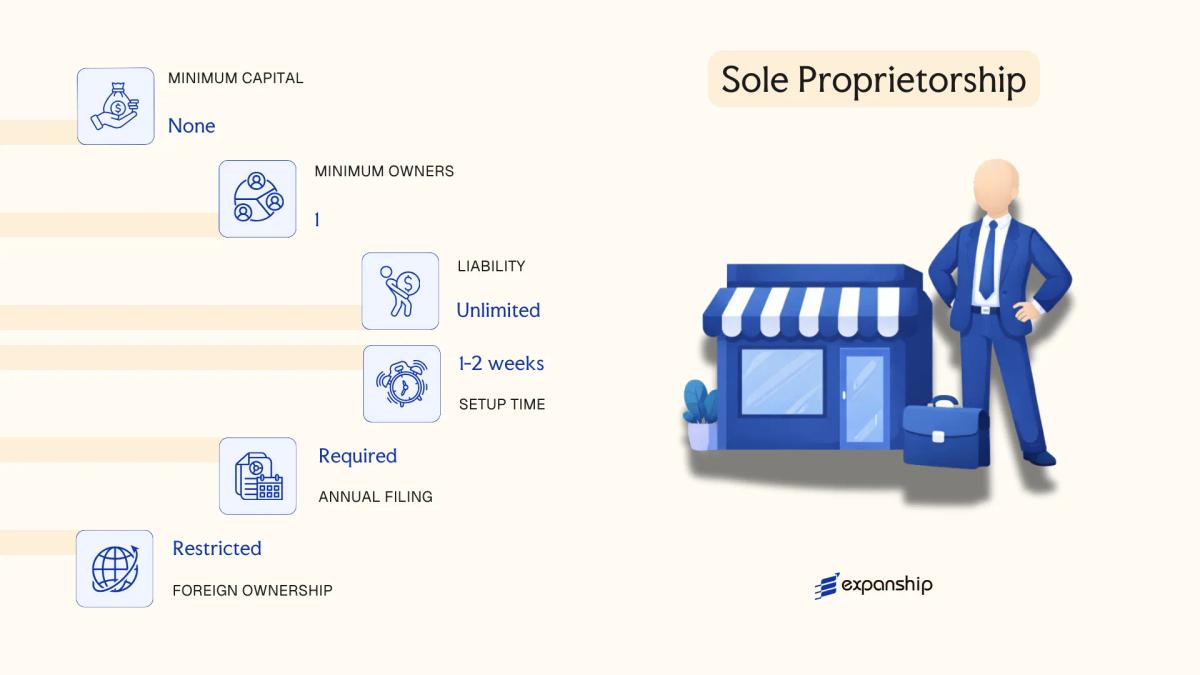
The sole proprietorship Algeria Entreprise Individuelle operates under the Commercial Code (Code de Commerce), which governs its registration and ongoing obligations. Unlike capital-based entities, it carries no separate legal personality — the business and its owner are treated as a single legal subject, meaning the proprietor bears unlimited personal liability for all debts and obligations.
Registration is handled through the Centre National du Registre du Commerce (CNRC), where the individual must obtain a commercial register entry (Registre du Commerce) before commencing activity. Depending on the nature of the trade, registration with the relevant professional body or sector authority may also be required.
Key Characteristics
| Requirement | Detail | Notes |
|---|---|---|
| Legal Form | Sole Proprietorship (Unincorporated) | No separate legal personality from the owner |
| Member Designation | Proprietor (Exploitant Individuel) | Single natural person only; legal entities cannot hold this status |
| Liability | Unlimited personal liability | Personal assets are exposed to business creditors |
| Local Presence | Registered business address in Algeria | Required for CNRC registration |
| Capital | No minimum capital requirement | No paid-up capital formality at incorporation |
| Privacy | Owner's identity publicly registered via CNRC | Commercial register entries are accessible to third parties |
Focus Points
- Taxation: Subject to the Impôt sur le Revenu Global (IRG) on business income; VAT applies where applicable turnover thresholds are met; no corporate income tax applies as the entity is not a separate legal person.
- Annual Compliance: Annual tax declarations must be filed with the Direction des Impôts; commercial register renewal is required periodically through the CNRC.
- Treaty Access: As an unincorporated structure, access to Algeria's double tax treaty network is limited; treaty benefits generally apply to resident individuals, not business entities as such.
- Conversion: The proprietor may convert the business into a capital company (such as an EURL or SARL) if operational growth requires a more formal structure, though this involves a new registration process.
- Restrictions: Foreign nationals face significant restrictions on self-employment registration in Algeria; this structure is in practice accessible primarily to Algerian nationals and permanent residents.
Closing Paragraph
The Entreprise Individuelle suits low-capital, locally operated trades and service activities where administrative overhead must be kept minimal. Its primary constraint is unlimited liability, which exposes the proprietor's personal estate to full business risk without any protective corporate veil.
Best suited for Algerian nationals operating small-scale commercial or artisanal activities who do not require liability separation or external investment capacity.
How to Choose the Right Entity Type in Algeria
Choosing the right company type in Algeria requires matching the legal form to your operational, fiscal, and ownership profile — not selecting the most familiar structure.
Why Your Entity Choice Matters
The structure you register has binding legal and financial consequences that are not easily reversed.
- Forming a Branch Office to conduct ongoing commercial activity exposes the parent company to unlimited liability for all Algerian operations, since a branch has no separate legal personality under the Algerian Commercial Code.
- Registering a Representative Office when your activities include sales or contracting puts you in breach of its permitted scope, which can result in administrative sanctions by the Centre National du Registre de Commerce (CNRC).
- Selecting a structure without accounting for Algeria's requirement to register with the tax authority (Direction des Impôts) means your entity may default into an unfavorable tax regime with no treaty benefit access.
- Incorporating a multi-shareholder SARL when a single-member EURL would suffice creates ongoing governance obligations — including mandatory associate decisions — that are unnecessary for a sole operator.
Key Factors to Consider
- Business Activity: Active trading, regulated sectors such as banking or insurance, and passive asset-holding each require distinct legal forms under Algerian commercial legislation, available in full via the official Algerian legal database.
- Ownership Structure: A sole operator should evaluate the EURL before defaulting to a SARL, since the latter imposes multi-party decision requirements.
- Liability Exposure: Unlimited liability structures like the SNC bind partners personally, which is material if the business carries operational or contractual risk.
- Foreign Ownership Rules: Algeria's foreign investment rules historically imposed constraints on equity thresholds; your ownership configuration must be verified against current Investment Law provisions before formation.
- Tax Regime Eligibility: Certain fiscal incentives administered by the Agence Algérienne de Promotion de l'Investissement (AAPI) are entity-specific and activity-specific — confirming eligibility before incorporation prevents costly restructuring.
- Exit and Redomiciliation: Not all Algerian entity types support straightforward conversion or dissolution; your anticipated exit path should be factored into the initial structure selection.
Corporate Compliance Services in Algeria
Maintain good standing with Algerian regulatory and tax authorities — from CNRC filings to annual reporting obligations.
Conclusion
Starting a business in Algeria requires matching your operational model to the correct legal form under the Commercial Code. The SARL remains the most commonly registered entity, preferred by resident entrepreneurs and foreign investors alike for its bounded liability and relatively straightforward formation through the Centre National du Registre du Commerce (CNRC). The SPA suits larger ventures requiring capital markets access or multiple institutional shareholders. For solo operators, the EURL provides single-member limited liability without partnership obligations. Branch and representative offices serve foreign firms testing the market before committing to a locally incorporated structure.
Algeria's regulatory posture has been shifting toward greater foreign participation, with revisions to the investment law under Ordinance 22-18 signaling a more open framework. Your choice of entity will shape tax treatment, ownership permissibility under the applicable rules, and your reporting obligations from the outset.
How Expanship Can Assist You
Expanship Algeria company formation services are structured around the specific entity types and regulatory requirements covered in this blog. From registering an SPA with the Centre National du Registre de Commerce (CNRC) to establishing a SARL or EURL for smaller operations, our team works directly with the relevant Algerian authorities to manage each step on your behalf.
Here is what that support covers in practice:
- Document preparation and notarization for statutory filings
- Registered agent and legal address provision in Algeria
- Government filing and CNRC liaison for commercial registration
- Post-incorporation compliance management, including annual reporting obligations
- Banking introduction assistance with local financial institutions
- Coordination with tax authorities for registration under the Direction Générale des Impôts
Ready to move forward? Contact Expanship Algeria to discuss your incorporation requirements.
Frequently Asked Questions (FAQ)
The Société à Responsabilité Limitée (SARL) is the most frequently incorporated structure. Its combination of limited liability, a relatively low minimum capital threshold, and a manageable compliance framework makes it the default choice for small to medium-sized commercial operations.
A Branch Office has no separate legal personality and remains an extension of its foreign parent, while a SARL is an independent legal entity incorporated under Algerian law. For tax purposes, both are subject to local corporate income tax on Algerian-sourced income, but the SARL carries full compliance obligations including annual accounts filed with the Centre National du Registre de Commerce (CNRC).
The EURL (Entreprise Unipersonnelle à Responsabilité Limitée) involves a single member whose identity is recorded in the CNRC register, meaning full public anonymity is not available. Nominee arrangements are not formally recognised under Algerian corporate law, so beneficial ownership remains traceable through registration records.
No. The SPA requires a minimum of seven shareholders, and partnership structures such as the Société en Nom Collectif (SNC) require at least two partners. Only the EURL is specifically designed for single-person formation.
Foreign nationals may form or participate in a SARL, SPA, or EURL. However, under the historic 49/51 ownership rule, foreign equity participation in most sectors was capped at 49 percent, with the Algerian partner holding majority control. Regulatory reforms in recent years have adjusted these restrictions in specific sectors, so current eligibility depends on the applicable investment framework at the time of registration.
Conversion is legally possible under the Algerian Commercial Code. A SARL may be converted into an SPA if it meets the applicable capital and shareholder requirements, and the process requires notarial documentation, updated statutes, and re-registration with the CNRC.
No. A Sole Proprietorship (Entreprise Individuelle) does not create a legal entity distinct from its owner, leaving personal assets exposed to business liabilities. The SARL, EURL, SPA, SNC, SCS, and SCA all carry separate legal personality under the Commercial Code, though liability exposure varies by structure.
Legal Disclaimer
The information provided in this article is for general informational purposes only and does not constitute legal, tax, or professional advice. While we strive to ensure the accuracy and timeliness of the content, laws and regulations are subject to change, and the application of laws can vary widely based on specific facts and circumstances.
Readers should not act upon this information without seeking professional counsel tailored to their individual situation. Expanship and its authors disclaim any liability for actions taken or not taken based on the content of this article.
For specific advice regarding your business setup, compliance requirements, or any legal matters, please consult with qualified legal and tax professionals in the relevant jurisdiction.