

Key Takeaways
- Companies incorporating as an AG (Aktiengesellschaft) in Switzerland must deposit a minimum share capital of CHF 100,000, with at least CHF 50,000 paid up at the time of registration.
- At least one member of the board of directors must be domiciled in Switzerland, a residency condition established under the Swiss Code of Obligations (OR/CO) that applies regardless of whether the company is foreign-owned.
- Beneficial ownership disclosure is a mandatory compliance obligation under Switzerland's Anti-Money Laundering Act, requiring shareholders holding qualifying stakes to be identified and reported before and after incorporation.
- Every Swiss company must maintain a registered office address within Switzerland, as this serves as the legal domicile through which the cantonal commercial register processes and approves the registration.
Incorporation requirements in Switzerland are governed by the Swiss Code of Obligations (OR/CO), which establishes the legal basis for entity formation and ongoing corporate compliance. The commercial register, maintained at the cantonal level and overseen federally by the Swiss Federal Commercial Registry Office (EHRA), is the body responsible for processing and approving registrations.
This article addresses the structural, capital, personnel, and documentation requirements applicable to companies formed under Swiss law.
Failure to satisfy these requirements results in rejection of the registration application or, where non-compliance occurs post-incorporation, potential deregistration or legal liability under Swiss corporate law.
Requirements can differ depending on the entity type selected, the industry in which your business operates, and whether foreign ownership is involved. Cantonal variations may also affect certain procedural obligations.
This article is most relevant to foreign entrepreneurs, institutional investors, and multinational firms evaluating a Swiss subsidiary or branch establishment for the first time.
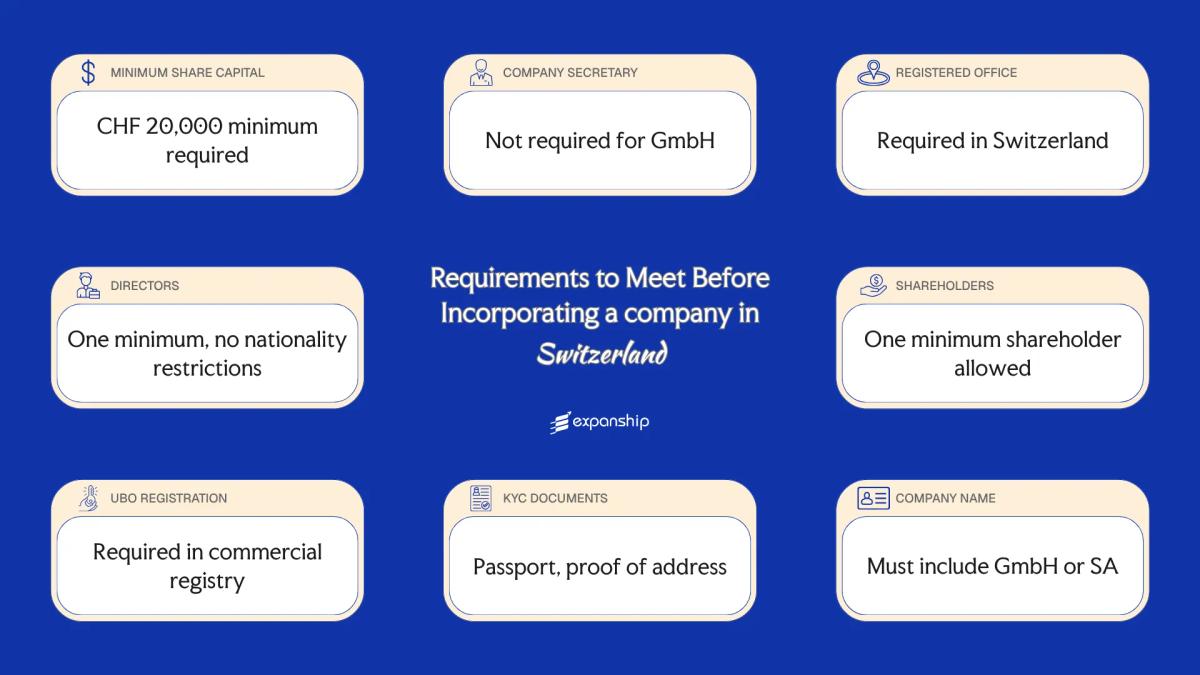
Minimum Share Capital Requirements in Switzerland
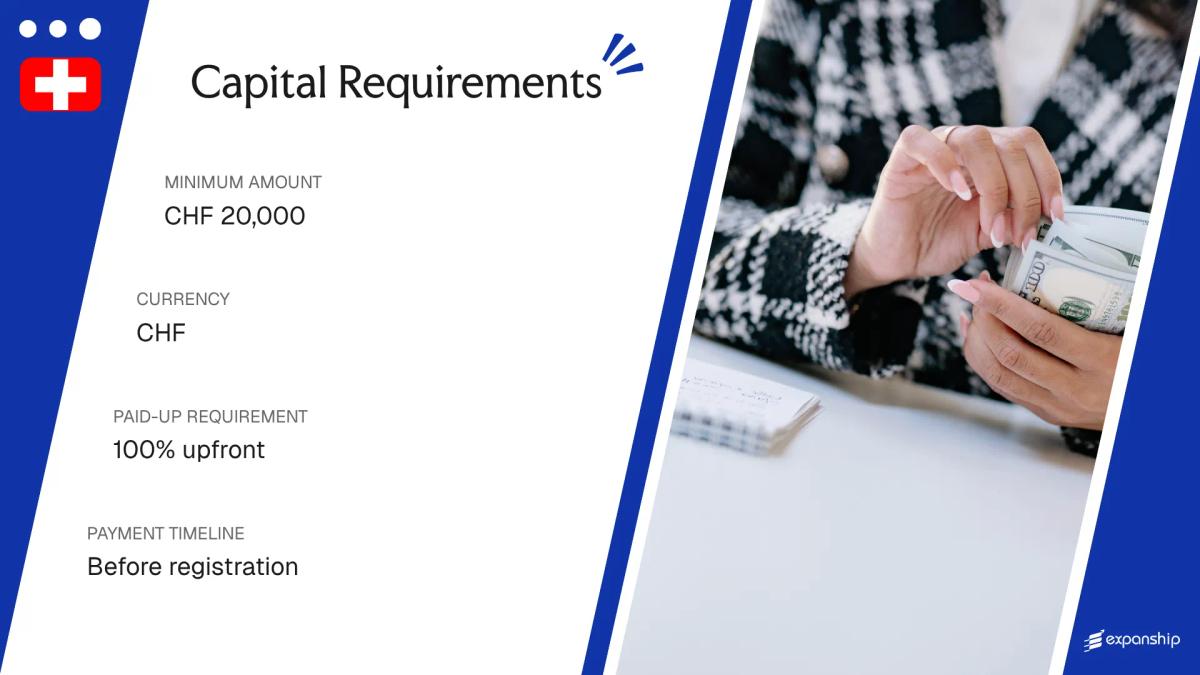
Switzerland minimum share capital requirements differ by entity type and are governed under the Swiss Code of Obligations (CO). Capital must be deposited into a blocked bank account before the notarial deed of incorporation is executed, and the Commercial Registry (Handelsregister) verifies proof of deposit as part of the registration process.
Both the AG (Aktiengesellschaft) and GmbH (Gesellschaft mit beschränkter Haftung) operate on a par value share system. Once registered, the capital requirement functions as an ongoing statutory minimum, not solely a one-time threshold — the CO requires the entity to maintain minimum equity or initiate restructuring procedures if net assets fall below half of the aggregate share capital and legal reserves.
| Parameter | Detail |
|---|---|
| Minimum Authorized Share Capital | CHF 100,000 for an AG; CHF 20,000 for a GmbH |
| Maximum Authorized Share Capital | No statutory maximum |
| Minimum Paid-Up Capital | CHF 50,000 for an AG (50% of authorized); CHF 20,000 for a GmbH (100% of authorized) |
| Paid-Up Requirement at Incorporation | 20% per share, with a minimum of CHF 50,000 paid up for an AG; full CHF 20,000 for a GmbH |
| Accepted Currency | Swiss Francs (CHF); foreign currency permitted if share capital is denominated accordingly |
| Accepted Forms of Contribution | Cash contributions; contributions in kind (subject to independent audit and notarial verification) |
| Timeframe to Deposit Capital | Prior to execution of the notarial deed of incorporation |
Funds deposited into the blocked bank account remain frozen until the Commercial Registry confirms registration. Only upon receipt of the registration confirmation does the bank release the capital to the company.
Company Secretary Requirements in Switzerland
Swiss corporate law does not impose a mandatory company secretary requirement for GmbH or AG entities. Under the Code of Obligations, neither the Gesellschaft mit beschränkter Haftung nor the Aktiengesellschaft must appoint a dedicated corporate secretary as a formal organ of the company.
That said, company secretary requirements Switzerland businesses encounter in practice often arise through articles of association or board resolutions, where a secretary is appointed to handle meeting minutes, statutory records, and Handelsregister filings. These duties carry legal weight, as Swiss law requires accurate maintenance of shareholder registers and board minutes.
Qualification criteria for those serving in a secretarial or equivalent administrative capacity:
- No statutory licensing requirement exists at the federal level for corporate secretaries.
- Natural persons or legal entities may be appointed, depending on the firm's internal governance rules.
- Non-residents are not prohibited from serving, though practical access to cantonal authorities may be a consideration.
- Board members may simultaneously act as secretary unless the articles of association restrict this.
- No minimum age or professional qualification is prescribed under the Code of Obligations.

Incorporate a Company in Switzerland
Set up your Swiss GmbH or AG with full compliance support, from Handelsregister registration to post-incorporation governance.
Registered Office Requirements in Switzerland
Registered office requirements in Switzerland are governed by the Swiss Code of Obligations (OR), which mandates that every AG and GmbH maintain a registered address, known as the Sitz, within Swiss territory. Failure to maintain a compliant domicile can result in the Commercial Registry (Handelsregisteramt) initiating ex officio dissolution proceedings against the entity.
- A physical, functional address in Switzerland is required; a post office box alone does not satisfy the Sitz requirement.
- Virtual office addresses are generally accepted provided a physical presence at that location can be demonstrated to the cantonal Commercial Registry.
- The address must be located in Switzerland; foreign addresses are not permitted under Swiss corporate law.
- No ownership of premises is required, but a valid lease or domiciliation agreement with the address provider must exist.
- The registered address is publicly listed in the Federal Commercial Register (Zefix) and is accessible to third parties.
- Any change to the registered domicile must be formally notified to the relevant cantonal Commercial Registry and updated in the Federal Register.
Director Requirements in Switzerland
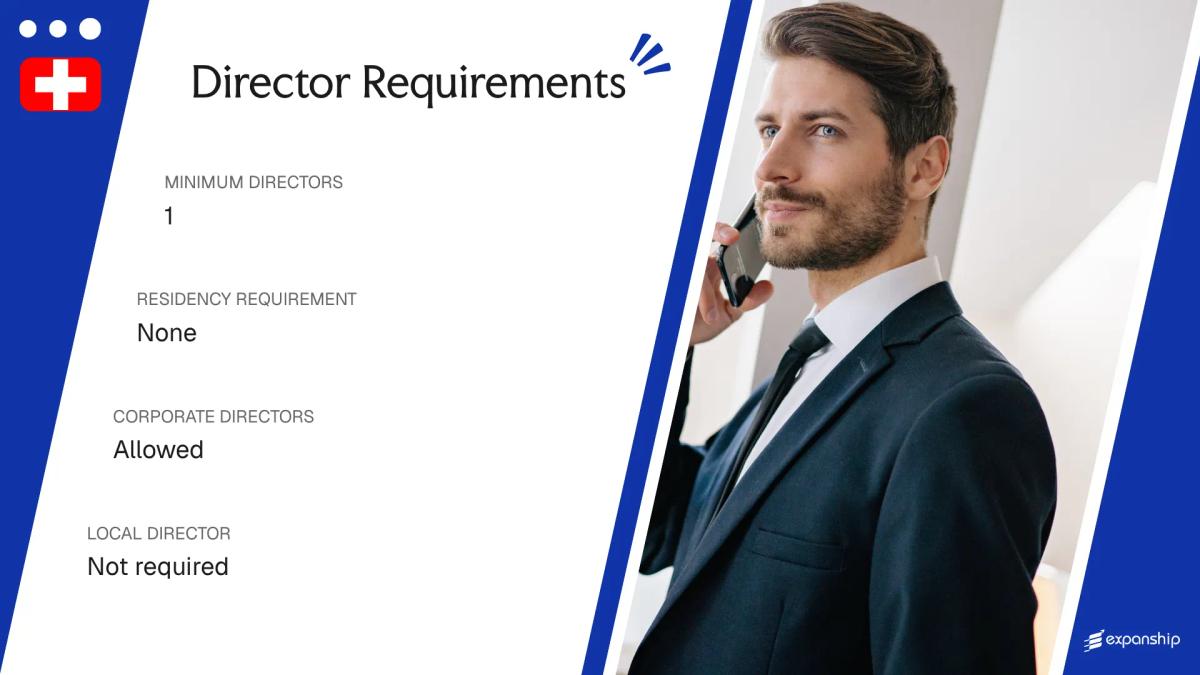
Under Swiss corporate law, directors of an Aktiengesellschaft (AG) assume personal liability for the firm's compliance with the Code of Obligations, including duties of due care, loyalty, and the obligation to notify a judge if the entity becomes over-indebted under Article 725 OR. Director requirements in Switzerland are governed primarily by the Swiss Code of Obligations (OR), with the Commercial Register Authority (Handelsregisteramt) overseeing public disclosure of appointed directors.
| Parameter | Detail |
|---|---|
| Minimum Number of Directors | At least one director is required for an AG. |
| Maximum Number of Directors | No statutory maximum is prescribed under the OR. |
| Local/Resident Director Required | At least one director or an authorised signatory must be resident in Switzerland and hold individual or joint signatory authority. |
| Nationality Restrictions | No nationality restrictions apply, provided the residency condition is met. |
| Minimum Age Requirement | Directors must have reached the age of majority, which is 18 years under Swiss civil law. |
| Corporate Directors Permitted | Corporate directors are not permitted; only natural persons may serve on the board of an AG. |
| Director Must Be a Shareholder | No statutory requirement exists for directors to hold shares in the company. |
| Publicly Listed on Registry | Yes, all directors are publicly listed in the cantonal Commercial Register (Handelsregister). |
| Disqualification Conditions | Persons declared legally incapacitated or subject to a court-imposed prohibition on holding directorial office are disqualified. |
Unlike many jurisdictions where a nominee resident director suffices on paper, Switzerland requires the resident director or authorised signatory to hold actual, enforceable signing authority over the company, meaning a purely passive nominee arrangement does not satisfy the OR residency rule.
Shareholder Requirements in Switzerland
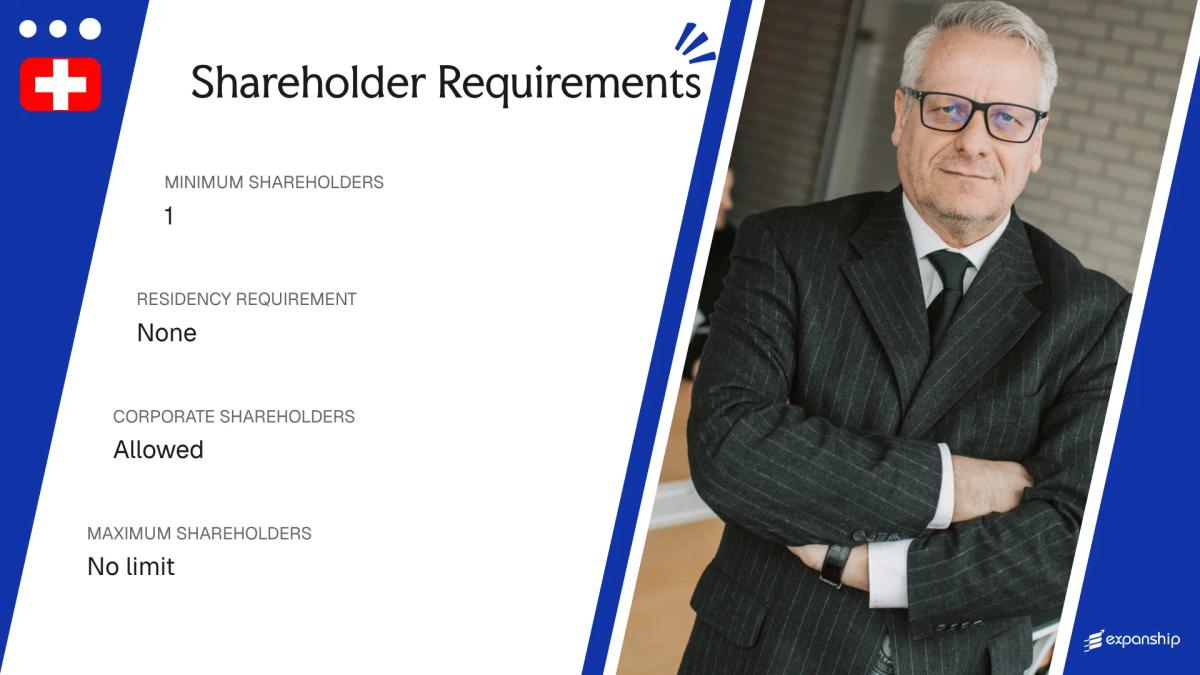
Both the Aktiengesellschaft (AG) and the Gesellschaft mit beschränkter Haftung (GmbH) can be formed by a single shareholder. Swiss law sets no statutory maximum on the number of shareholders for either entity type.
Nationality and Residency Restrictions
Shareholder requirements in Switzerland impose no nationality or residency conditions on individuals or entities holding shares. Foreign nationals may own 100% of a Swiss AG or GmbH without restriction.
Corporate Shareholders
Corporate entities are permitted to act as shareholders in both the AG and GmbH. No special conditions apply solely by virtue of the shareholder being a legal entity rather than a natural person.
Shareholder Liability
Under the Swiss Code of Obligations, shareholders in an AG and GmbH bear liability limited to their capital contribution. No general mechanism exists to extend personal liability beyond the subscribed share amount.
Register of Shareholders
An AG is required to maintain an internal share register (Aktienbuch) recording registered shareholders. For Swiss GmbH shareholder compliance, the Canton's commercial register (Handelsregister) publicly records the identity of all quota holders, and any transfer of quotas must be reflected through a formal update filing.
Guidance on Shareholder Structuring for Your Swiss Entity
Speak with our corporate specialists to understand how shareholder rules apply to your specific structure when setting up in Switzerland.
UBO / Beneficial Ownership Disclosure Requirements in Switzerland
Under beneficial ownership disclosure Switzerland law, a beneficial owner is any natural person who ultimately owns or controls 25% or more of a company's shares or voting rights, as governed by the Anti-Money Laundering Act (AMLA) and the Swiss Code of Obligations.
- Identify all natural persons holding 25% or more of shares or voting rights in the entity.
- Record this information in the company's internal shareholder register, maintained at the registered office.
- Notify the company in writing of beneficial ownership status within one month of acquiring the qualifying threshold.
- Update the internal register promptly whenever ownership or control structures change.
| Parameter | Detail |
|---|---|
| Ownership Threshold for UBO Status | 25% of shares or voting rights |
| Filing Authority | Internal company register; no central public registry |
| Disclosure Deadline at Incorporation | Within one month of share acquisition |
| Publicly Accessible Register | No |
| Penalties for Non-Disclosure | Criminal sanctions under the AMLA |
| Ongoing Update Obligation | Yes; updates required upon any change in qualifying ownership |
KYC / Document Requirements in Switzerland
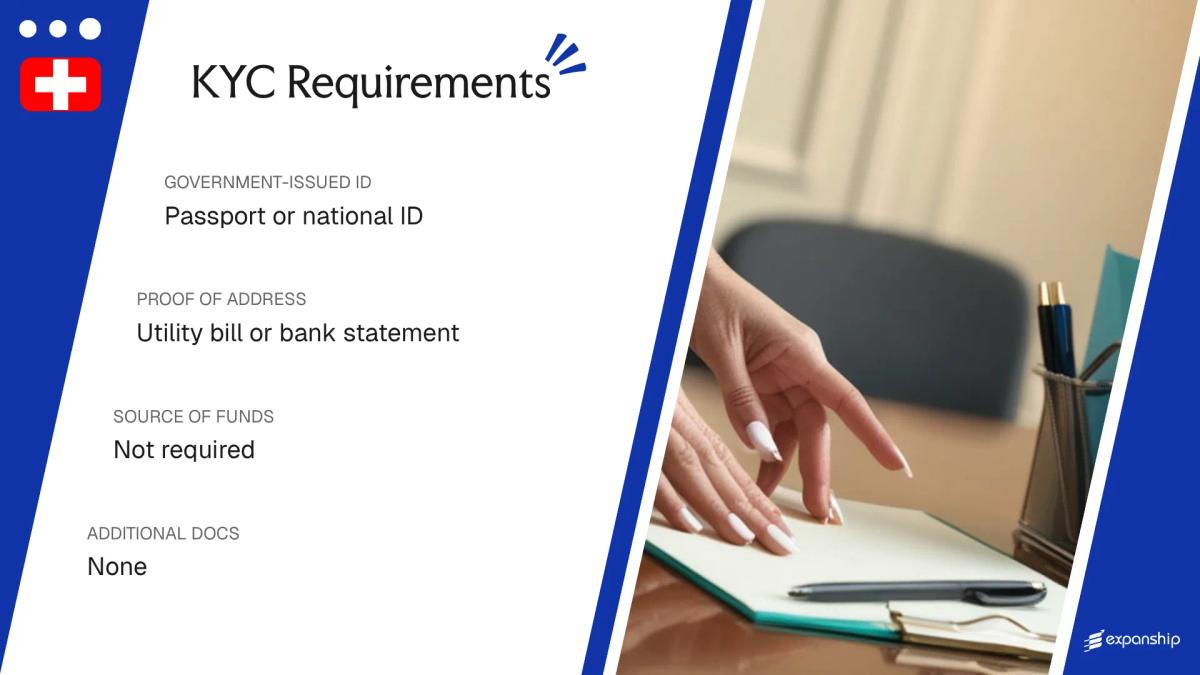
KYC requirements for a Switzerland company formation are governed by the Anti-Money Laundering Act (AMLA), enforced at the federal level through the MROS, Switzerland's Money Laundering Reporting Office.
Individual / Personal Documents
- Valid government-issued passport or national identity card for each individual director, shareholder, or beneficial owner
- Proof of residential address dated within the last three months, such as a utility bill or bank statement
- Signed declaration confirming the individual's capacity (director, shareholder, or UBO)
- In some cases, a curriculum vitae may be requested to establish professional background
Corporate Documents
- Certificate of incorporation or equivalent constitutional document for any corporate shareholder or director
- Current register of directors and shareholders for the corporate entity
- Proof of registered office address for the corporate entity
- Certified copy of the corporate entity's articles of association or equivalent governance document
Source of Funds Documentation
- Recent bank statements covering a minimum of three to six months
- Audited financial statements where the entity is an established operating business
- Written explanation of the origin of the capital being introduced
Notarisation and Apostille Requirements
- Foreign public documents generally require an apostille under the Hague Convention before submission
- Non-German, non-French, and non-Italian documents must be accompanied by a certified translation
- Notarisation requirements vary by canton and document type; confirm with the relevant cantonal commercial registry
Incomplete or uncertified source of funds documentation is the most frequent cause of incorporation delays at Swiss cantonal commercial registries.
Company Name Requirements in Switzerland
Company name requirements Switzerland are assessed by the Commercial Register (Handelsregister) at the point of incorporation. Each proposed name is reviewed for uniqueness against existing registered entities, and identical or confusingly similar names are rejected.
Your firm's name must be in a national language or Latin characters, and the legal form must appear as a suffix — "AG" for an Aktiengesellschaft or "GmbH" for a Gesellschaft mit beschränkter Haftung. No statutory minimum or maximum character length applies, but the name must be distinct and not misleading.
Certain words require prior regulatory approval before use — terms implying banking, insurance, or government affiliation fall into this category. Words deemed contrary to public interest or that misrepresent the business activity are prohibited outright.
Name reservation is available through the Handelsregister prior to formal incorporation. The reservation period is generally limited, and the application is submitted directly to the relevant cantonal register office.
Compliance Services for Companies in Switzerland
Ongoing compliance support for Swiss entities, including annual filings, register updates, and regulatory monitoring across all cantonal jurisdictions.
Conclusion
Switzerland company incorporation requirements span several distinct obligations set out primarily under the Swiss Code of Obligations. Among the most consequential are the share capital thresholds — particularly the CHF 100,000 minimum for an AG — and the residency conditions that apply to directors, which require at least one board member to be domiciled in Switzerland. Beneficial ownership disclosure under the Anti-Money Laundering Act adds a further compliance layer that foreign investors must account for before and after registration. Once these structural and regulatory requirements are understood, the practical work of entity formation, ongoing filings, and in-country representation can begin.
Expanship's Corporate Services for Switzerland Expansion
Expanship's Switzerland corporate services are structured around the specific requirements that Swiss incorporation imposes — from fulfilling the CHF 20,000 minimum paid-in capital threshold for a GmbH to coordinating with the relevant Cantonal Commercial Registry. Rather than replacing the obligations your business must meet, Expanship reduces the operational weight of managing them across Swiss federal and cantonal frameworks.
Beyond the formation process, your entity needs ongoing support across several areas:
- We handle company registration and prepare the statutory documentation required under Swiss law.
- Registered agent and office provision is arranged to satisfy cantonal domicile requirements.
- Our team liaises directly with the Handelsregisteramt and other relevant regulatory bodies on your behalf.
- Post-incorporation compliance management keeps your firm aligned with annual reporting obligations.
- Banking introduction assistance connects your business with Swiss financial institutions familiar with foreign-owned entities.
- Tax registration and coordination with the Swiss Federal Tax Administration and cantonal authorities are handled as part of your setup.
To discuss your requirements, contact Expanship Switzerland.
Frequently Asked Questions (FAQ)
A valid registered office must be a physical address in Switzerland where the company can be officially reached and where legal correspondence can be served. A post office box alone does not satisfy the requirement under the Swiss Code of Obligations. The address must correspond to the canton in which the company is registered with the cantonal Commercial Registry.
A nominee director used to fulfil the Swiss residency requirement must hold formal authority to represent the company before the Commercial Registry, but the scope of their operational authority, including bank account signing rights, is governed by your internal corporate arrangements. Swiss law does not mandate that the locally domiciled representative control company finances. The authority granted should be clearly defined in the company's organisational regulations to avoid ambiguity.
Failure to properly disclose a beneficial owner holding 25% or more of shares or voting rights is a violation of the Swiss Anti-Money Laundering Act (AMLA) and can result in the company being reported to FINMA or referred to cantonal authorities. The obligation falls on both the shareholder to notify the company and the company to maintain an accurate internal register. Non-compliance can expose the company and its officers to administrative sanctions and, in serious cases, criminal liability.
Yes, the two structures differ significantly. An AG requires a minimum share capital of CHF 100,000, of which at least CHF 50,000 must be paid up at incorporation, while a GmbH requires a minimum of CHF 20,000, which must be fully paid up at the time of registration. Both amounts must be deposited into a blocked Swiss bank account before the notarial deed of incorporation can be executed.
A foreign national can hold 100% of the shares in a Swiss AG or GmbH without restriction, as Swiss law imposes no nationality or residency requirements on shareholders. The residency obligation applies only at the director or managing officer level, not at the ownership level. Your company must still meet the requirement that at least one authorised signatory is domiciled in Switzerland, but that person does not need to be a shareholder.
The Commercial Registry itself does not directly collect KYC documents from individuals; that process is handled by the notary public who certifies the incorporation deed and by any Swiss bank used for the capital deposit. Foreign directors and shareholders are typically required to provide certified copies of a valid passport, proof of residential address, and, where relevant, documentation establishing the source of funds. Requirements can vary slightly by canton, as each cantonal registry operates with some procedural discretion.
Legal Disclaimer
The information provided in this article is for general informational purposes only and does not constitute legal, tax, or professional advice. While we strive to ensure the accuracy and timeliness of the content, laws and regulations are subject to change, and the application of laws can vary widely based on specific facts and circumstances.
Readers should not act upon this information without seeking professional counsel tailored to their individual situation. Expanship and its authors disclaim any liability for actions taken or not taken based on the content of this article.
For specific advice regarding your business setup, compliance requirements, or any legal matters, please consult with qualified legal and tax professionals in the relevant jurisdiction.