
Key Takeaways
- All commercial entities in Bolivia must register with SEPREC (Servicio Plurinacional de Registro de Comercio) under the Código de Comercio before conducting business, and operating without that registration exposes the entity to administrative sanctions under Bolivian commercial law.
- Sociedades de Responsabilidad Limitada (SRLs) are not subject to a statutory minimum share capital threshold, though all other structural compliance obligations — including director, shareholder, and registered office requirements — remain fully applicable.
- Foreign shareholders and beneficial owners are subject to UBO disclosure obligations tied to Bolivia's AML regulatory framework, and failure to satisfy those requirements will result in rejection of the SEPREC registration application.
- Every company registered in Bolivia must maintain a physical registered office address within the country, as this serves as the official address for correspondence with SEPREC and other government authorities.
Company formation in Bolivia is governed by the Código de Comercio, with entity registration administered through SEPREC (Servicio Plurinacional de Registro de Comercio), the national commercial registry under the Ministry of Productive Development and Plural Economy.
This article covers the structural and documentary requirements that apply across the formation process, from capital thresholds to identity verification obligations.
Failure to satisfy these conditions results in rejection of the registration application or, where an entity operates without proper registration, exposure to administrative sanctions under Bolivian commercial law.
Requirements can differ depending on the legal structure chosen, the sector in which the business operates, and whether the applicant is a foreign national or foreign legal entity.
This article is most relevant to foreign entrepreneurs and international companies seeking to establish a formal legal presence in Bolivia through a locally registered entity.
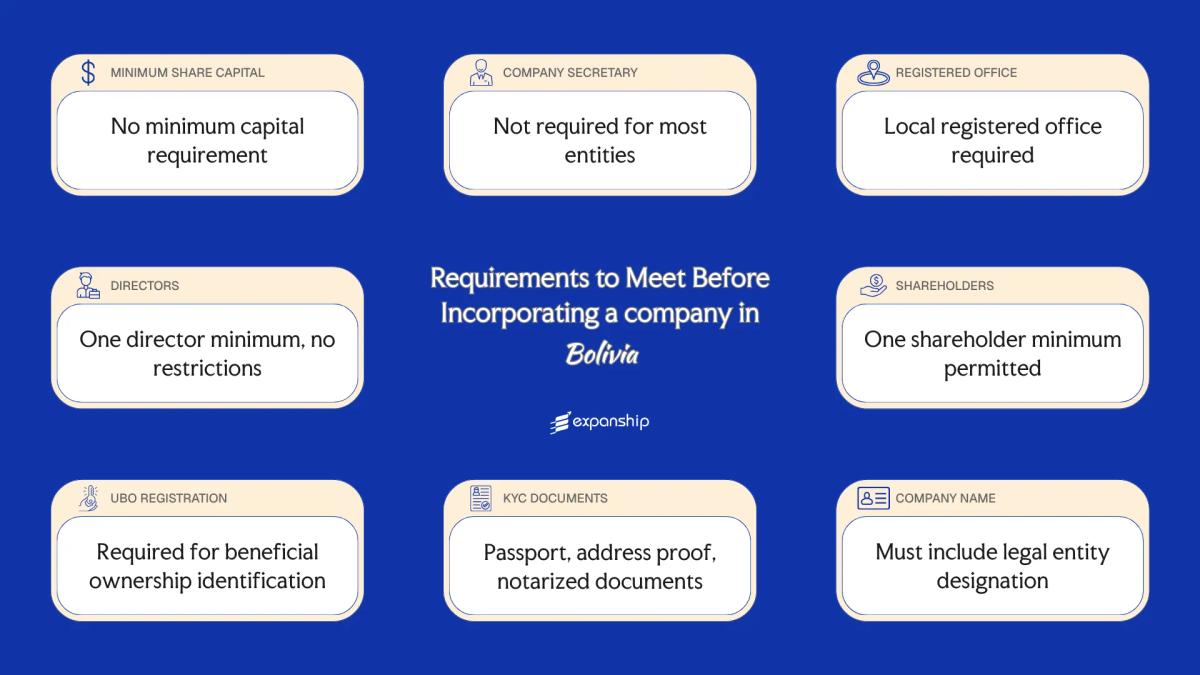
Minimum Share Capital Requirements in Bolivia
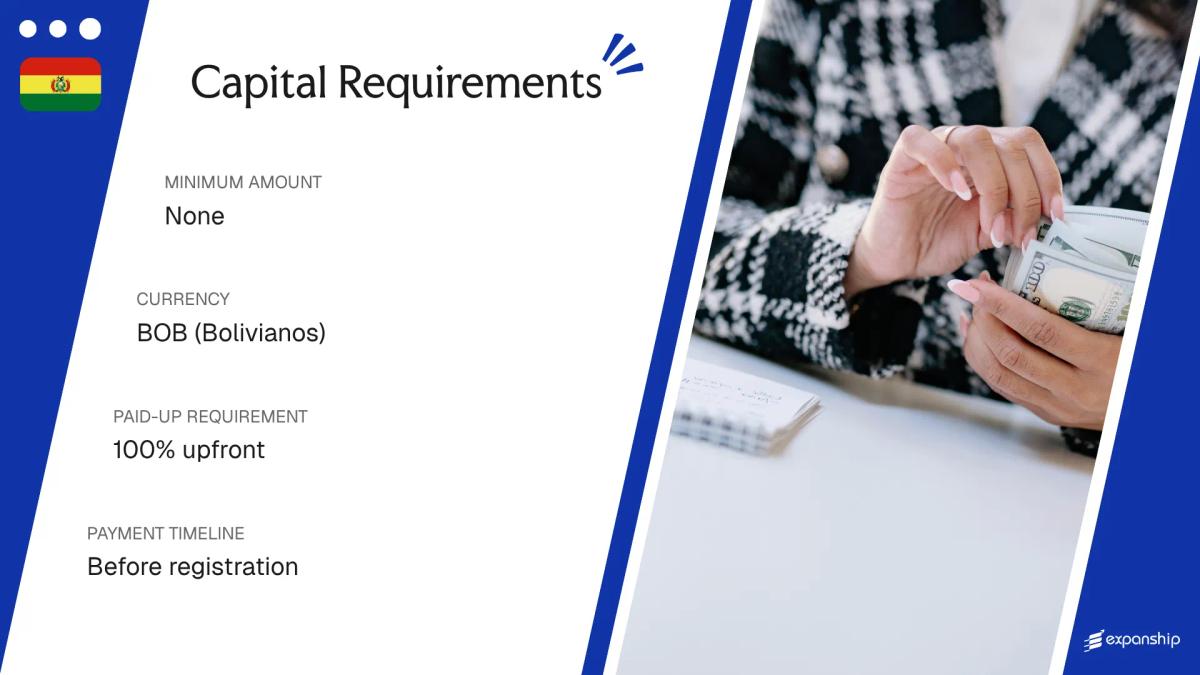
Bolivia minimum share capital requirements vary by entity type and are governed by the Código de Comercio (Commercial Code). The Fundempresa registry, which operates under the authority of the Ministerio de Desarrollo Productivo y Economía Plural, oversees company registration and verifies capital declarations at the point of incorporation.
Bolivia operates on a par value share system. Share capital obligations are assessed as a one-time incorporation requirement rather than an ongoing statutory minimum that must be maintained post-registration, though the declared capital must be accurately reflected in the company's constitutive documents.
| Parameter | Detail |
|---|---|
| Minimum Authorized Share Capital | No statutory minimum for SRL; SA requires a minimum of BOB 1,000,000 |
| Maximum Authorized Share Capital | No statutory maximum |
| Minimum Paid-Up Capital | No statutory minimum for SRL; SA requires at least 25% paid up at incorporation |
| Paid-Up Requirement at Incorporation | 25% for SA; no specific requirement for SRL |
| Accepted Currency | Boliviano (BOB) |
| Accepted Forms of Contribution | Cash or in-kind contributions (valued and documented at incorporation) |
| Timeframe to Deposit Capital | At the time of incorporation; no deferred payment period established by statute |
The BOB 1,000,000 minimum for a Sociedad Anónima applies to the authorized capital, not the fully paid-up amount — only 25% must be paid at incorporation, with the remainder callable by the board.
Company Secretary Requirements in Bolivia
Under Bolivian commercial law, there is no standalone "company secretary" role that mirrors the corporate secretary position found in common law systems. The equivalent function is fulfilled through the formal structure required during registration with Fundempresa, the national business registry.
A designated legal representative — typically called the representante legal — carries out the administrative and compliance duties associated with this role. This individual acts as the official point of contact with public authorities and holds signing authority for statutory filings.
Bolivia corporate secretary obligations assigned to the representante legal generally include:
- Signing and submitting annual financial statements and compliance documents to Fundempresa
- Acting as the authorized signatory in dealings with tax authority AGIT and the national tax service SIN
- Maintaining the company's statutory records and internal corporate books
- Ensuring timely renewal of the empresa unipersonal or sociedad de responsabilidad limitada registration
Qualification criteria for who may serve in this capacity:
- Must be a natural person; a legal entity cannot hold this role
- No formal licensing requirement applies, but full legal capacity is required
- Foreign nationals may serve if they hold valid Bolivian residency documentation

Incorporate a Company in Bolivia
Set up your legal entity in Bolivia with accurate registration through Fundempresa and full statutory compliance from the outset.
Registered Office Requirements in Bolivia
Bolivia registered office requirements are governed by the Commercial Code (Código de Comercio), which mandates that every company maintain a registered legal domicile (domicilio legal) corresponding to its actual place of business operations within the country. Non-compliance can result in administrative sanctions from SEPREC (Fundempresa), including the suspension of commercial registration.
- A physical address is required; a P.O. box alone does not satisfy Bolivia company domicilio legal rules.
- Virtual offices are not formally recognised as compliant registered addresses under current commercial regulations.
- The address must be located within Bolivian territory and correspond to the jurisdiction where the entity operates.
- Supporting documentation such as a lease agreement or proof of property ownership must be held on record to substantiate the address.
- The registered address is publicly listed in the Commercial Registry (Registro de Comercio) and is accessible to third parties.
- Any change to the Bolivia registered address obligations must be formally notified to SEPREC through an amendment filing to update the commercial registration record.
Director Requirements in Bolivia
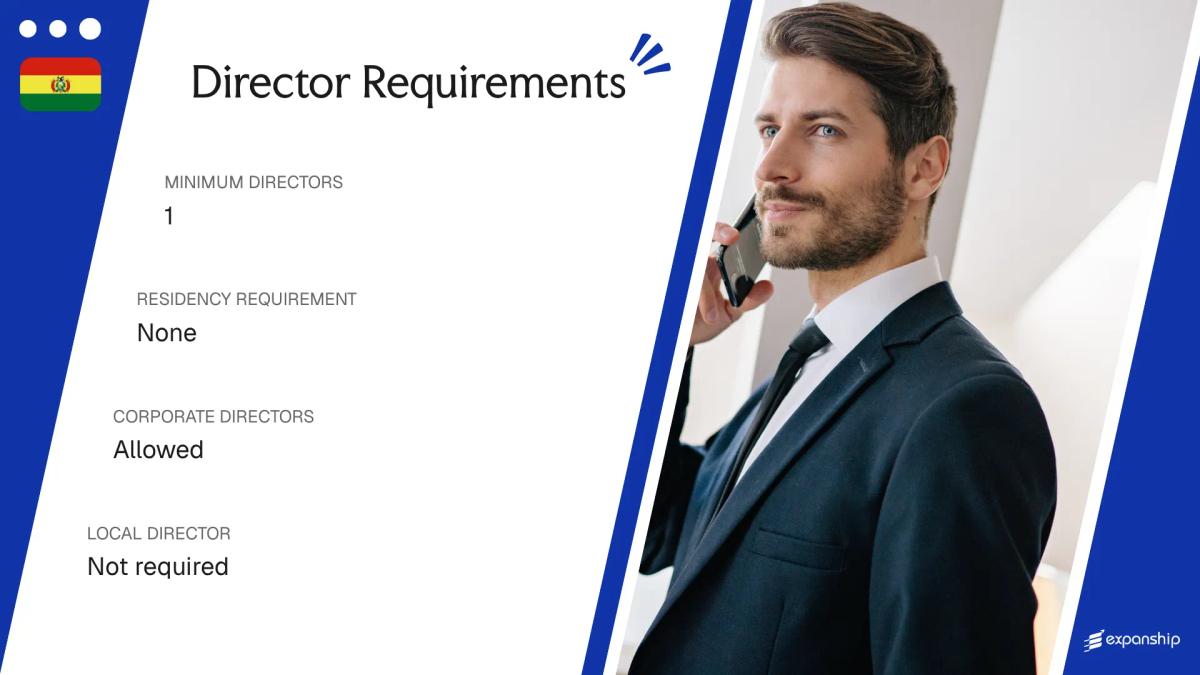
Under Bolivia director requirements incorporation rules, directors of a Sociedad de Responsabilidad Limitada (SRL) or Sociedad Anónima (SA) assume statutory duties governed by the Código de Comercio (Commercial Code), including fiduciary obligations toward the company and personal liability for acts that breach the law or the entity's constitutive documents.
| Parameter | Detail |
|---|---|
| Minimum Number of Directors | One director is required for an SRL; an SA requires a board of at least three directors. |
| Maximum Number of Directors | No statutory maximum is prescribed under the Código de Comercio. |
| Local/Resident Director Required | No statutory residency requirement exists for directors. |
| Nationality Restrictions | No nationality restrictions apply under Bolivian commercial law. |
| Minimum Age Requirement | Directors must have full legal capacity, which is attained at 18 years of age. |
| Corporate Directors Permitted | Corporate directors are generally not recognized; a natural person must hold the directorial role. |
| Director Must Be a Shareholder | No statutory requirement for a director to hold shares in the company. |
| Publicly Listed on Registry | Director appointments are registered with SEPREC (Servicio Plurinacional de Registro de Comercio) and form part of the public commercial record. |
| Disqualification Conditions | Persons declared bankrupt, criminally convicted of commercial offenses, or subject to civil incapacity orders are disqualified from serving. |
Despite having no residency requirement, all director appointments in Bolivia must be formally registered with SEPREC, making directorial information publicly accessible in a jurisdiction that many assume maintains minimal disclosure standards.
Shareholder Requirements in Bolivia
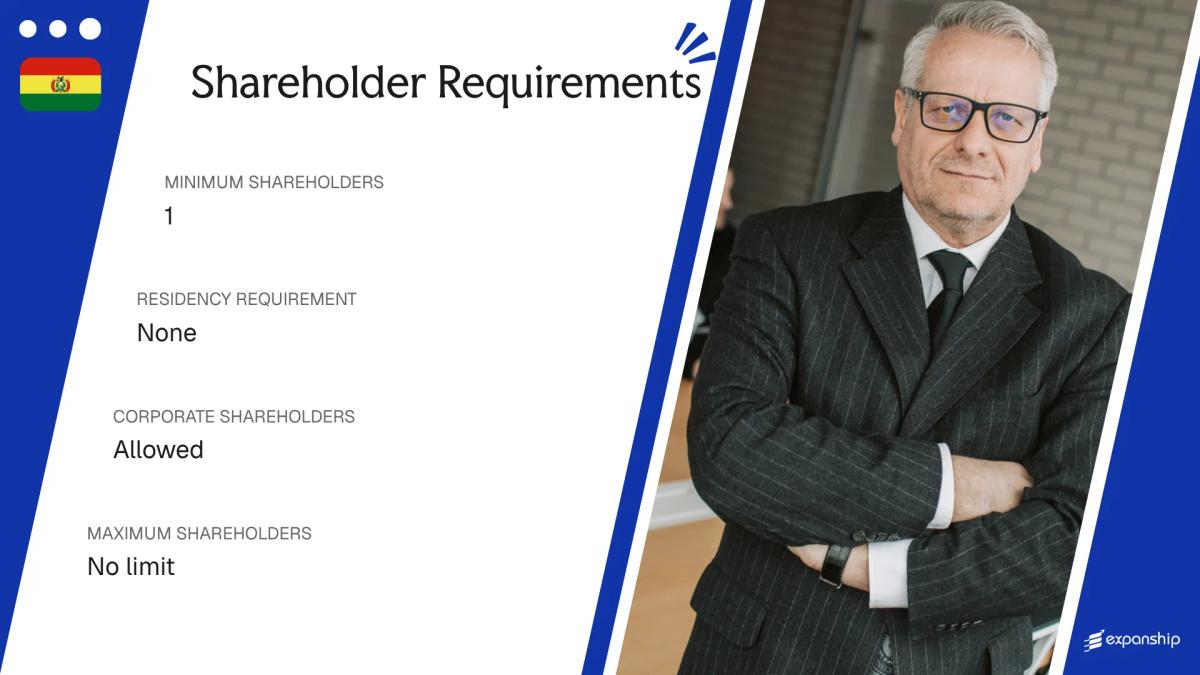
Bolivia's Sociedad de Responsabilidad Limitada (SRL) requires a minimum of two shareholders and permits a maximum of twenty-five. No sole-shareholder structure is available under this entity type.
Nationality and Residency Restrictions
Meeting Bolivia shareholder requirements for incorporation does not depend on nationality or local residency. Foreign nationals may hold shares in a Bolivian SRL without restrictions on ownership percentage under the Código de Comercio.
Corporate Shareholders
Corporate entities are permitted to act as shareholders in a Bolivian company. No special conditions specific to corporate participation are imposed beyond standard KYC and registration obligations.
Shareholder Liability
Bolivia SRL shareholder obligations include liability that is strictly limited to each member's capital contribution. Extended personal liability does not arise under ordinary circumstances.
Register of Shareholders
A register of shareholders must be maintained internally by the entity. Filing with the Registro de Comercio administered by SEPREC is required, though the register is not broadly accessible to the general public.
Guidance on Shareholder Structuring for Your Bolivia Incorporation
Get tailored support on meeting shareholder requirements when setting up a company in Bolivia.
UBO / Beneficial Ownership Disclosure Requirements in Bolivia
Bolivia beneficial ownership disclosure requirements are established under the Anti-Money Laundering and Counter-Terrorism Financing Law (Law No. 170 of 2011) and reinforced through regulations issued by the Financial Investigations Unit (UIF), which oversees compliance obligations for legal entities registered in the country.
- Identify all natural persons who ultimately own or exercise control over the entity, applying the UIF's qualifying ownership threshold.
- Compile UBO information as part of the entity's due diligence documentation at the time of formation.
- Submit the required beneficial ownership data to the UIF, in accordance with the reporting obligations applicable to your business sector.
- Retain and update records whenever a change in ownership or control occurs.
| Parameter | Detail |
|---|---|
| Ownership Threshold for UBO Status | 25% or more of ownership or control (general FATF-aligned principle; confirm exact threshold with UIF) |
| Filing Authority | Financial Investigations Unit (UIF) |
| Disclosure Deadline at Incorporation | At the time of registration and onboarding with regulated entities |
| Publicly Accessible Register | No public register; records held by the UIF |
| Penalties for Non-Disclosure | Administrative sanctions under Law No. 170; specific fines subject to UIF determination |
| Ongoing Update Obligation | Yes; updates required upon material changes in ownership or control |
KYC / Document Requirements in Bolivia
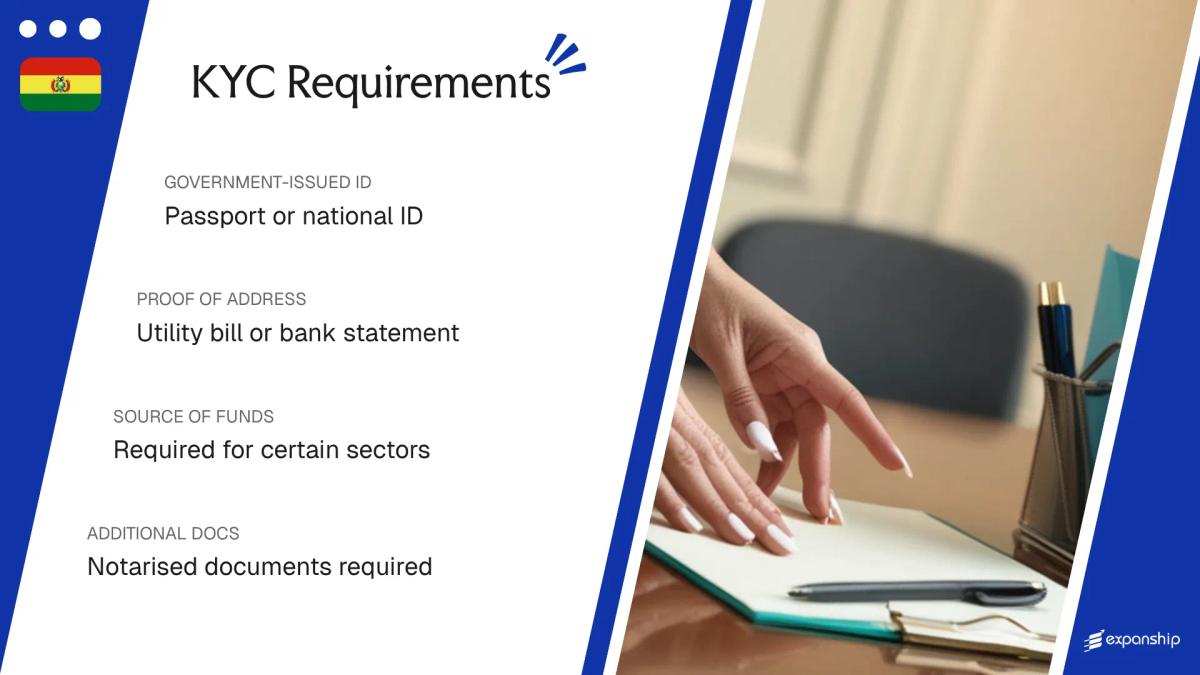
Bolivia KYC requirements company registration are governed primarily by Law No. 170 (Anti-Money Laundering and Counter-Terrorism Financing Law) and supervised by the Unidad de Investigaciones Financieras, the national Financial Intelligence Unit. All parties involved in the incorporation must undergo identity verification before the Fundempresa registry will process the application.
Individual / Personal Documents
- Valid government-issued passport or national identity document for each individual director, shareholder, or beneficial owner
- Proof of residential address dated within 90 days, such as a utility bill or official bank statement
- Completed KYC declaration form as required by the notary or registered agent handling the incorporation
- Recent passport-sized photograph may be requested depending on the notary's internal compliance procedure
Corporate Documents
- Certificate of incorporation or equivalent constitutional document for each corporate shareholder or director
- Current register of directors and register of shareholders from the corporate entity's home jurisdiction
- Proof of registered office address for the corporate entity, issued within 90 days
Source of Funds Documentation
- Bank statements covering a minimum of three months evidencing the origin of capital being introduced
- Audited financial accounts or accountant's letter where the business has an established operating history
- Written declaration of the source of funds signed by the contributing party
Notarisation and Apostille Requirements
- Foreign documents must generally be apostilled under the 1961 Hague Convention if issued in a signatory country
- Non-Spanish documents require certified translation into Spanish by a sworn translator recognised in Bolivia
- Notarisation of identity documents may be required by the receiving notary public prior to submission to Fundempresa
Incorporation applications are frequently delayed when foreign corporate documents are submitted without a valid apostille or a sworn Spanish translation.
Company Name Requirements in Bolivia
Bolivia company name requirements are assessed by the Fundempresa registry, which verifies proposed names for uniqueness and compliance before incorporation proceeds. A name that duplicates or closely resembles an existing registered entity will be rejected.
The business must include a legal suffix denoting its structure, such as "S.R.L." for a limited liability company or "S.A." for a corporation. Names must be in Spanish, as Bolivia's official language governs all commercial registration.
Certain words implying government affiliation, financial institutions, or regulated professions are either prohibited or require prior authorization from the relevant supervisory authority. Names that are misleading or contrary to public order are also refused.
Name reservation is available through Fundempresa prior to formal incorporation. Reservations are temporary and hold the proposed denomination for a defined period while the remaining registration steps are completed.
Compliance Services for Companies in Bolivia
Manage your ongoing statutory obligations in Bolivia, from annual filings to regulatory reporting, with support from Expanship's corporate services team.
Conclusion
Bolivia company incorporation requirements are governed primarily by the Commercial Code (Código de Comercio) and administered through SEPREC, the national business registry. Meeting those requirements involves satisfying distinct obligations across share capital, corporate officers, registered address, and ownership disclosure.
Among the most consequential obligations covered, foreign shareholders must account for SEPREC's registration procedures and the UBO disclosure framework tied to Bolivia's AML regulations. The absence of a minimum capital threshold for SRLs offers structural flexibility, though compliance duties remain fixed.
Once these requirements are understood, the practical work of preparing documentation, engaging local representation, and filing with SEPREC begins.
Expanship's Corporate Services for Bolivia Expansion
Expanship's Bolivia corporate services incorporation support is structured around the specific requirements set by Fundempresa and SEPREC, covering everything from document notarisation to ongoing regulatory filings. Bolivia's layered compliance obligations, particularly around UBO disclosure and registered office maintenance, place a consistent administrative load on foreign-owned entities. Expanship's role is to reduce that operational burden so your team can focus on the business itself.
Our services span the full incorporation and post-formation cycle:
- We prepare and file all company registration documentation with the relevant Bolivian authorities.
- Our team provides registered agent and office solutions to satisfy local presence requirements.
- We manage government filings and liaise directly with regulatory bodies on your behalf.
- Post-incorporation compliance, including annual obligations, is handled on an ongoing basis.
- We offer banking introduction support to help your entity establish a local account.
- Tax registration and coordination with Bolivia's SIN is also part of our scope.
To discuss your requirements, contact Expanship Bolivia.
Frequently Asked Questions (FAQ)
Your company must update its registered address with SEPREC (Servicio Plurinacional de Registro de Comercio) promptly, as the registered office is the official point of contact for legal notices and regulatory correspondence. Operating with an invalid or unregistered address can result in administrative penalties and may affect the entity's good standing with tax authorities, including the Servicio de Impuestos Nacionales.
A foreign national can serve as a director, but must hold a valid Bolivian tax identification number (NIT) and, depending on residency status, may need to fulfill additional registration requirements with SEPREC. Bolivia does not mandate that a director be a resident citizen, but the tax registration obligation is non-negotiable for anyone holding a formal directorial position.
Beneficial ownership information is reported to SEPREC as part of Bolivia's compliance framework for corporate transparency. The obligation applies to entities where natural persons exercise ultimate control, directly or through a chain of ownership, and non-disclosure can trigger sanctions under anti-money laundering regulations administered by the Unidad de Investigaciones Financieras (UIF).
Submitting false or incomplete documentation to SEPREC can result in rejection of the incorporation filing, delays in obtaining legal personality, and potential referral to regulatory authorities if fraud is suspected. Bolivia's Commercial Code and related administrative regulations allow SEPREC to suspend processing until compliant documents are resubmitted, which directly extends your formation timeline.
Bolivia does not outright prohibit foreign-language words in a company name, but the name must be registrable with SEPREC and cannot duplicate or closely resemble an already-registered entity. Names that suggest government affiliation or regulated activities without authorization are rejected, and SEPREC conducts a name availability search before approving any registration.
Legal Disclaimer
The information provided in this article is for general informational purposes only and does not constitute legal, tax, or professional advice. While we strive to ensure the accuracy and timeliness of the content, laws and regulations are subject to change, and the application of laws can vary widely based on specific facts and circumstances.
Readers should not act upon this information without seeking professional counsel tailored to their individual situation. Expanship and its authors disclaim any liability for actions taken or not taken based on the content of this article.
For specific advice regarding your business setup, compliance requirements, or any legal matters, please consult with qualified legal and tax professionals in the relevant jurisdiction.