
Key Takeaways
- Bolivia's territorial tax system, governed by the Ley de Impuesto sobre las Utilidades de las Empresas, means foreign-sourced income is generally excluded from domestic corporate taxation, reducing the overall tax burden for internationally active entities.
- Foreign entrepreneurs benefit from a predictable liability structure through the SRL formation process administered by SEPREC, which applies the same baseline registration requirements to both domestic and foreign founders.
- Investors operating in Bolivia gain legal protection through its network of bilateral investment treaties, which establish enforceable standards for foreign-owned entities across covered jurisdictions.
- Bolivia's landlocked position at the center of South America, bordered by five countries, provides incorporated entities with practical access to regional trade corridors that pure market-size metrics do not capture.
Bolivia is an independent republic in central South America, bordered by five countries and governed under the 2009 Political Constitution of the State. Company registration falls under the authority of SEPREC (Servicio Plurinacional de Registro de Comercio), the national body responsible for commercial registration and corporate compliance. Foreign businesses incorporating here most commonly use the Sociedad de Responsabilidad Limitada as their preferred legal vehicle.
The country operates a territorial-based tax system, meaning income sourced outside its borders is generally not subject to domestic taxation. Foreign ownership of Bolivian entities is permitted across most sectors, and the legal framework does not impose a general restriction on foreign direct investment at the point of incorporation. Specific regulated industries carry their own conditions, but the baseline registration process applies equally to domestic and foreign founders.
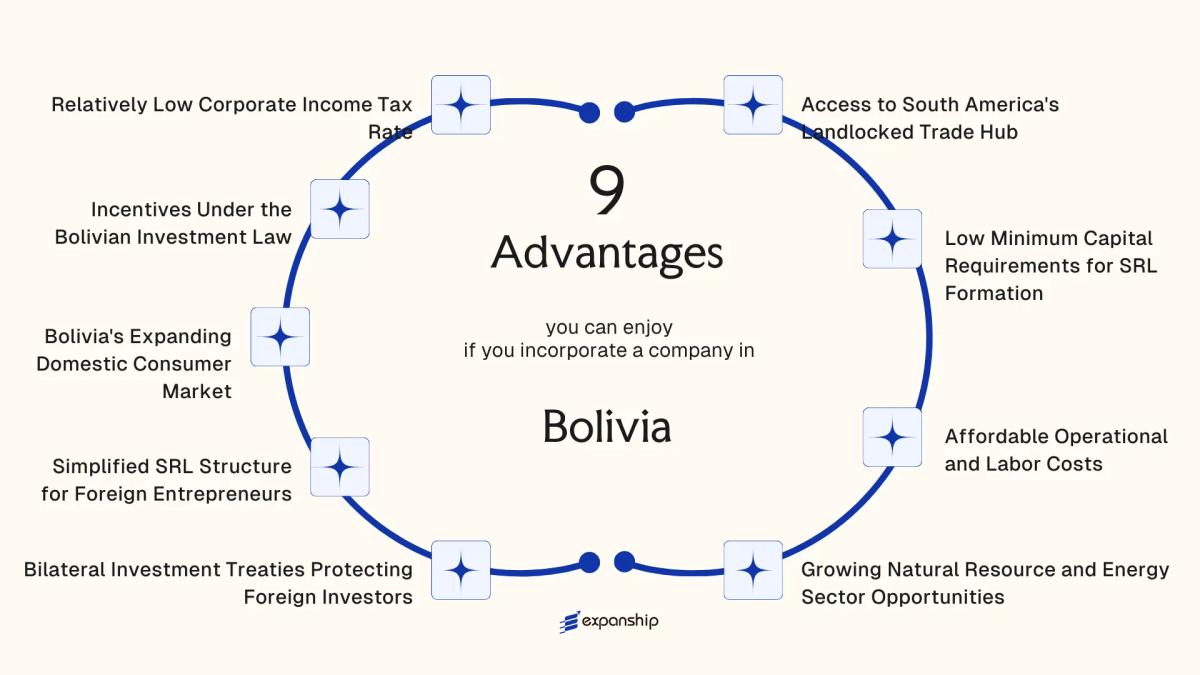
The benefits of incorporating in Bolivia span regulatory, financial, and geographic dimensions. This article examines the key advantages your business gains by establishing a formal presence through Bolivia company formation.
Access to South America's Landlocked Trade Hub
Bolivia's landlocked trade hub advantages stem directly from its geography: the country shares borders with five nations — Brazil, Argentina, Peru, Chile, and Paraguay — placing your business within reach of the continent's two largest economies simultaneously.
Central Position Within Regional Trade Agreements
Bolivia holds associate member status in Mercosur and is a full member of the Andean Community (CAN), granting preferential tariff access to markets across multiple South American countries. For a company incorporated in Bolivia, this dual positioning translates into reduced import duties when trading with member states under the CAN's liberalization framework.
Infrastructure Corridors Connecting Multiple Markets
The country connects to Atlantic and Pacific trade corridors through road and rail networks linking Brazilian ports and Chilean coastal access points. A firm operating from Santa Cruz de la Sierra, the commercial capital, sits at the intersection of these transit routes, which lowers logistics costs when distributing goods regionally.
Your Bolivian entity can access preferential tariff treatment across multiple South American markets without establishing separate legal presences in each country.
Low Minimum Capital Requirements for SRL Formation
Forming a Sociedad de Responsabilidad Limitada (SRL) in Bolivia carries one of the more accessible capital entry points in South America. The Bolivia SRL minimum capital requirements benefits are largely structural: the statutory minimum is set at a level that does not require significant upfront financial commitment, allowing smaller operations and early-stage ventures to establish a legal entity without tying up working capital.
Under Bolivian commercial law, the capital of an SRL is divided into quotas rather than shares, and the minimum threshold is modest relative to regional peers. This means your initial registration costs stay low, and available funds remain deployed in actual business operations rather than held as locked statutory reserves.
Several features explain why the capital framework works in your favour:
- Quota-based division allows flexible ownership distribution without complex share issuance procedures
- No requirement for a local bank account to hold statutory capital prior to registration
- The structure accommodates between two and twenty-five quota holders, giving smaller partnerships room to operate without inflated formation costs
- Capital contributions can be made in cash or in kind, reducing immediate liquidity demands
Regulated under the Código de Comercio and supervised by SEPREC (Servicio Plurinacional de Registro de Comercio), the formation process ties capital requirements to a straightforward documentation framework rather than a notarised valuation process typical in some European civil law systems.

Incorporate Your SRL in Bolivia
Set up your Sociedad de Responsabilidad Limitada with professional support across registration, compliance, and documentation.
Affordable Operational and Labor Costs
Bolivia affordable labor costs for businesses translate directly into lower fixed overheads for a foreign company operating in the country. The national minimum wage, known as the Salario Mínimo Nacional, is set by annual government decree and has historically remained well below the regional average for South America. For labor-intensive operations, this gap between Bolivian wage floors and those in neighboring markets can represent a meaningful reduction in monthly payroll expenditure.
| Cost Category | General Range | Regulatory Basis |
|---|---|---|
| National Minimum Wage | Approx. USD 350–380/month | Annual Supreme Decree |
| Employer Social Security Contribution | Approx. 16.71% of gross salary | Bolivian Social Security Law |
| Professional / Skilled Labor | Varies by sector and seniority | Ley General del Trabajo |
Beyond wages, office and commercial leasing rates in cities like Cochabamba and Santa Cruz remain accessible compared to capital cities in more developed South American economies. Your firm's cost base benefits from this without requiring special licensing or preferential zone registration.
Employment relationships are governed by the Ley General del Trabajo, which establishes clear parameters around contracts, working hours, and statutory benefits. The predictability of this framework means you can model staffing costs with reasonable accuracy from the outset, reducing financial uncertainty during the formation and early operational phases of your entity.
Growing Natural Resource and Energy Sector Opportunities
Bolivia natural resource sector investment opportunities are among the most structurally significant in South America, shaped directly by state ownership frameworks and targeted foreign participation rules. The country holds the world's largest known lithium reserves, concentrated in the Salar de Uyuni. Under Law 928 and the broader framework governing YACIMIENTOS DE LITIO BOLIVIANOS (YLB), the state entity overseeing lithium, foreign firms can enter through joint ventures or technology contracts rather than direct extraction concessions.
For the natural gas sector, YPFB (Yacimientos Petrolíferos Fiscales Bolivianos) operates as the state counterpart for upstream contracts. Foreign companies participate through shared risk contracts, which define cost recovery terms and production splits. This structure gives your firm a defined contractual position without requiring full operational control, reducing capital exposure at the entry point.
Keep the following in mind:
- Joint ventures with YLB are the primary entry route for lithium-related activity
- YPFB shared risk contracts govern upstream gas participation
- Foreign equity limits and approval requirements vary by subsector
- The Hydrocarbons Law (Law 3058) remains the governing statute for gas operations
- Direct mineral concessions are not available to private foreign entities under current law
Bolivia's lithium industrialization strategy requires foreign partners to support in-country processing, meaning your entity must engage at the value-added stage, not just extraction.
Bilateral Investment Treaties Protecting Foreign Investors
Bolivia bilateral investment treaties for foreign investors provide a layer of legal protection that sits above domestic law, meaning treaty obligations cannot simply be overridden by internal regulatory changes. These agreements establish enforceable rights that travel with your investment, not with the political climate of the moment.
Treaty Coverage and What It Guarantees
Bolivia has signed bilateral investment treaties with over 20 countries, including Germany, France, the Netherlands, Spain, and China. Each treaty typically guarantees fair and equitable treatment, protection against expropriation without compensation, and the right to freely transfer profits and capital out of the country. For a foreign entity operating in a resource-sensitive economy, the expropriation clause carries particular weight: compensation must be prompt, adequate, and effective under standard BIT language.
Dispute resolution provisions allow qualifying investors to bring claims before international arbitration bodies such as ICSID or UNCITRAL, bypassing local courts entirely. That access to neutral arbitration is a concrete structural safeguard, not a procedural formality.
Nationality and Treaty Eligibility
Your eligibility to invoke BIT protections depends on the nationality of your holding entity, not just the ultimate beneficial owner. Structuring your investment through a jurisdiction that holds a favorable BIT with Bolivia can determine whether these protections apply to your specific situation. The applicable treaty, combined with Bolivia's domestic framework under Law No. 516 (Investment Law), defines the full scope of investor rights available to your business.
Structure Your Investment in Bolivia With the Right Protections
Get guidance on which bilateral investment treaties apply to your business structure and how to position your entity to benefit from available legal protections in Bolivia.
Simplified SRL Structure for Foreign Entrepreneurs
The Bolivia SRL structure benefits for foreign entrepreneurs stem largely from how the entity type is designed under Bolivian commercial law. The Sociedad de Responsabilidad Limitada, governed by the Código de Comercio (Commercial Code), permits full foreign ownership without requiring a local partner. Your liability exposure is capped at the value of your capital contribution, keeping personal assets separate from business obligations.
- Foreign nationals can hold 100% of the participation quotas in an SRL, with no mandatory local shareholding requirement under Bolivian law.
- The entity requires a minimum of two and a maximum of twenty-five quota holders, giving small investor groups a clear structural fit without the compliance overhead of a corporation.
- Registration is processed through SEPREC (Servicio Plurinacional de Registro con Personalidad Jurídica), the national business registry, which centralizes the incorporation process for foreign applicants.
- An SRL does not issue publicly tradeable shares, which reduces ongoing disclosure obligations and administrative costs compared to a Sociedad Anónima.
- Management can be vested in a single appointed manager, who need not be a Bolivian national, allowing you to retain direct operational control from abroad without establishing a local board structure.
Bolivia's Expanding Domestic Consumer Market
Bolivia growing consumer market advantages stem partly from a structural shift in household income distribution. Over the past two decades, sustained GDP growth and targeted social spending under frameworks like the Plan de Desarrollo Económico y Social reduced extreme poverty significantly, expanding the segment of households with discretionary spending capacity. For a foreign business selling consumer goods or services, this means a domestic addressable market that did not exist at scale a generation ago.
Urban centers — particularly Santa Cruz, La Paz, and Cochabamba — account for a disproportionate share of this consumption growth. Santa Cruz alone functions as the country's commercial engine, with retail, food processing, and light manufacturing all concentrated there.
According to the World Bank, Bolivia's urban population share has grown from roughly 62% in 2000 to over 70% by the early 2020s, concentrating purchasing power in cities where distribution infrastructure is more accessible to foreign-owned firms.
Rising middle class business opportunities are most pronounced in sectors such as packaged food, telecommunications, financial services, and construction materials. Consumer credit penetration remains relatively low compared to regional peers, which signals room for financial product expansion. Your firm can enter a market where demand is present but formal supply channels remain underdeveloped.
Incentives Under the Bolivian Investment Law
Bolivia Investment Law incentives for businesses are codified primarily under Law No. 516 (Ley de Promoción de Inversiones), enacted in 2014. This framework extends equal legal treatment to foreign and domestic investors, meaning your firm cannot be subjected to discriminatory conditions based on nationality of ownership.
Under this law, foreign investors are entitled to:
- Free repatriation of profits, dividends, and capital in any convertible currency
- Legal stability guarantees that protect against adverse changes in tax or regulatory conditions after an investment is registered
- Access to international arbitration mechanisms for dispute resolution, without being compelled to exhaust domestic courts first
The legal stability provision carries particular weight. If the regulatory environment shifts after your investment is formalized, the conditions in force at registration continue to apply to your entity for the duration of the agreement.
Investments in priority sectors, including hydrocarbons, mining, and manufacturing, may qualify for additional promotional treatment under sector-specific regulations administered by the relevant ministry.
Legal stability guarantees under Law No. 516 are not automatic; your investment must be formally registered with the relevant Bolivian authority to activate these protections.
Relatively Low Corporate Income Tax Rate
Bolivia's corporate income tax, known as the Impuesto sobre las Utilidades de las Empresas (IUE), is levied at a flat rate of 25% on net profits. While this figure is not the lowest globally, it sits below the corporate tax rates applied in several neighboring economies, and the IUE's structure offers meaningful advantages that go beyond the headline rate.
How the IUE Base Is Calculated
Net profit under the IUE is calculated after deducting allowable business expenses, which can include operational costs, depreciation, and certain reinvested amounts. This deduction framework means your effective tax burden may be considerably lower than the statutory 25% suggests, depending on the firm's expense structure and sector.
The IUE as a Credit Against the Transaction Tax
One of the more consequential features of Bolivia's tax regime is that IUE payments can be credited against the Impuesto a las Transacciones (IT), a 3% gross transactions tax. In practice, this offset prevents double taxation on the same economic activity, reducing the combined tax load on a profitable business.
Sector-Specific Considerations
Certain industries, including mining and hydrocarbons, are subject to supplementary levies administered under separate regimes. For most commercial and service-sector entities, however, the standard IUE applies without additional surcharges, giving you a predictable tax liability that supports financial planning from the early stages of incorporation.
- Flat 25% rate on net profits under the IUE
- Allowable deductions reduce the effective rate below the statutory figure
- IUE payments offset against the 3% Impuesto a las Transacciones
- Standard rate applies to most commercial entities outside extractive sectors
Why Bolivia Stands Out Among South American Incorporation Destinations
Among Bolivia vs South America incorporation destinations comparisons, three jurisdictions come up most frequently as alternatives: Peru, Colombia, and Paraguay. All four countries target similar foreign investor profiles, share regional trade connections, and offer SRL-equivalent structures. The comparison is useful precisely because the differences are not obvious from headline figures alone.
Where Bolivia holds a measurable position is in statutory tax rate, minimum capital thresholds for SRL formation, and the cost base for operations. Paraguay's flat 10% corporate rate is lower, but Bolivia's Ley de Inversiones framework and its network of bilateral investment treaties provide a layer of investor protection that Paraguay's thinner treaty network does not replicate. Peru and Colombia carry higher effective compliance costs and more complex labour regulation for foreign-owned entities. The tax regime applicable under Bolivia's Código Tributario applies uniformly, without the tiered structures that add administrative burden in Colombia.
| Parameter | Bolivia | Peru | Colombia | Paraguay |
|---|---|---|---|---|
| Standard Corporate Income Tax Rate | 25% | 29.5% | 35% | 10% |
| SRL Minimum Capital Requirement | No statutory minimum | No statutory minimum | No statutory minimum | No statutory minimum |
| Bilateral Investment Treaties (approx.) | 20+ | 30+ | 15+ | 15+ |
| Foreign Ownership in SRL | 100% permitted | 100% permitted | 100% permitted | 100% permitted |
| Ley de Inversiones Protections | Yes (Law No. 516) | Partial equivalents | Partial equivalents | Limited |
Compliance Services for Companies in Bolivia
Maintain your Bolivian entity in good standing with accounting, reporting, and regulatory filing support tailored to local requirements.
Conclusion
Bolivia offers a combination of structural and legal features that make it a credible incorporation destination for foreign investors entering South America. The benefits of incorporating in Bolivia are most apparent in three areas: the protection afforded by its network of bilateral investment treaties, the cost efficiency of operating under an SRL structure, and the favorable corporate income tax rate governed by the Ley de Impuesto sobre las Utilidades de las Empresas. Together, these factors create a predictable legal and financial environment for a foreign-owned entity.
That said, the relevance of these advantages depends on your business model, industry exposure, and intended market. A firm targeting Bolivia's natural resource sector faces a different regulatory context than one focused on domestic consumer services or regional distribution through the country's landlocked trade corridors.
The underlying case for Bolivia company formation rests on its accessibility for foreign entrepreneurs, a point reinforced by its relatively low barriers to entry compared to more established South American markets. For businesses where those specific conditions align with operational goals, the advantages of Bolivia business registration are substantive rather than incidental. The next step is translating that alignment into a properly structured entity under Bolivian law.
Start Your Bolivian Company Formation With Expanship Today
Bolivia company formation with Expanship covers the full arc of what foreign entrepreneurs encounter when establishing a Sociedad de Responsabilidad Limitada under Bolivian law. From document legalization through SEPREC, the commercial registry authority, to ongoing compliance with the Servicio de Impuestos Nacionales, Expanship coordinates each stage so your business structure remains valid and current from day one.
Expanship's service scope for Bolivia includes:
- Preparation and notarization of incorporation documents, including the escritura de constitución
- Document legalization and apostille coordination for foreign-issued materials
- Registered agent and local office address provision to satisfy SEPREC requirements
- Filing liaison with SEPREC and post-registration enrollment with tax and municipal authorities
- Ongoing compliance management, including annual reporting and capital record maintenance
- Banking introduction assistance to support initial account opening with Bolivian financial institutions
Each service addresses a specific procedural requirement under Bolivian corporate and tax law, reducing the administrative exposure that typically accompanies foreign-directed incorporations in civil law jurisdictions.
Reach out to Expanship Bolivia to discuss your incorporation requirements.
Frequently Asked Questions (FAQ)
There is no statutory minimum capital requirement for an SRL under Bolivian company law, which makes the structure accessible to small and mid-sized foreign enterprises. Capital contributions are defined in the company's articles of incorporation and registered with SEPREC (Servicio Plurinacional de Registro con Personalidad Jurídica). The capital is divided into quotas rather than shares, and liability is limited to each partner's contribution.
Companies operating in Bolivia are subject to the Impuesto sobre las Utilidades de las Empresas (IUE) at a flat rate of 25% on net profits. A surcharge of 12.5% applies to profits remitted abroad as dividends, effectively raising the total rate on distributed foreign earnings. Specific sectors, including mining and hydrocarbons, may face additional fiscal obligations under separate regulatory frameworks.
Law No. 516 (Investment Law) grants foreign investors the same legal protections as domestic investors, including guarantees against arbitrary expropriation without compensation. The law establishes the right to transfer capital and returns abroad, subject to applicable tax obligations. These protections operate alongside Bolivia's network of bilateral investment treaties, which may provide additional arbitration mechanisms depending on the investor's home country.
Registration of an SRL with SEPREC generally takes several weeks, though the total timeline depends on document completeness and notarization requirements. Prior to SEPREC registration, the company must complete trade name reservation and publication steps. Foreign-sourced documents typically require apostille certification and official translation into Spanish before submission.
Bolivia's population of approximately 12 million presents a modest but growing consumer base, particularly in urban centers such as Santa Cruz de la Sierra, La Paz, and Cochabamba. For foreign SMEs targeting regional distribution rather than local retail, the country's position as a transit point between MERCOSUR and Andean Community member states may offer more commercial relevance than domestic consumption alone. The decision depends on whether the business model relies on local sales volume or cross-border logistics and trade facilitation.
Failure to meet annual filing and tax compliance requirements with the Servicio de Impuestos Nacionales (SIN) can result in penalties, fines, and potential suspension of the company's tax registration. Prolonged non-compliance may lead to administrative dissolution under Bolivian commercial law. Foreign partners remain liable for outstanding obligations tied to their quota contributions up to the value of those contributions.
Legal Disclaimer
The information provided in this article is for general informational purposes only and does not constitute legal, tax, or professional advice. While we strive to ensure the accuracy and timeliness of the content, laws and regulations are subject to change, and the application of laws can vary widely based on specific facts and circumstances.
Readers should not act upon this information without seeking professional counsel tailored to their individual situation. Expanship and its authors disclaim any liability for actions taken or not taken based on the content of this article.
For specific advice regarding your business setup, compliance requirements, or any legal matters, please consult with qualified legal and tax professionals in the relevant jurisdiction.