
Key Takeaways
- Bolivia's Código de Comercio imposes a multi-agency registration process that requires sequential approvals across institutions including SEPREC, the tax authority (SIN), and municipal bodies, adding procedural layers that extend formation timelines well beyond what comparable Latin American jurisdictions require.
- Foreign investors face sector-specific ownership restrictions that can limit or entirely prohibit majority foreign equity stakes in strategic industries, constraining the range of viable corporate structures available to multinational entrants.
- Registered entities must satisfy ongoing SEPREC compliance obligations — including annual balance sheet filings and board resolutions — that carry administrative and financial costs disproportionate to the scale of many early-stage operations in the country.
- Bolivia's limited network of bilateral investment treaties and its historically strained relationships with international financial institutions reduce the practical banking options available to foreign-owned companies operating from within the jurisdiction.
Bolivia operates under a heavily regulated corporate framework, and the disadvantages of incorporating in Bolivia span procedural, financial, and operational dimensions that foreign investors must account with care. The country's primary commercial legislation, the Código de Comercio, governs company formation and ongoing compliance obligations for registered entities.
The cons of forming a company in Bolivia discussed across this article cover a range of structural, regulatory, and practical barriers — from capital requirements to enforcement gaps. These disadvantages do not apply uniformly; the impact varies significantly depending on whether your business is structured as a local subsidiary, a branch, or a joint venture, and the sector in which it operates.
This article is most relevant to foreign entrepreneurs and multinational firms seeking to establish a physical commercial presence in the country for the first time.
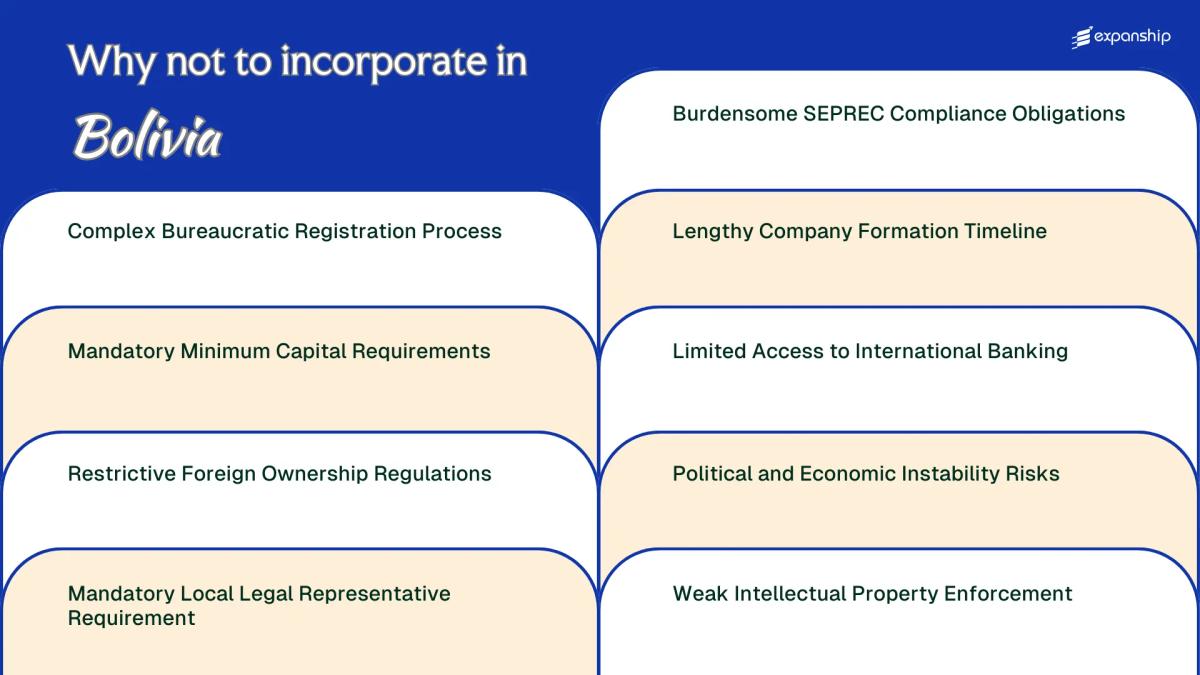
Complex Bureaucratic Registration Process
Bolivia company registration bureaucracy begins before your business even opens its doors. Registering a company requires engaging with multiple government bodies in sequence, and delays at any single stage stall the entire process.
Fragmented Multi-Agency Registration
FUNDEMPRESA, the entity historically responsible for commercial registration, operated within a framework that required applicants to first obtain tax registration from the Servicio de Impuestos Nacionales (SIN), then register with FUNDEMPRESA, and subsequently register with local municipal authorities. Each body has its own documentation standards, processing timelines, and procedural requirements. For a foreign business owner without local administrative knowledge, satisfying these parallel requirements simultaneously is operationally difficult and costly in professional fees.
Document Authentication Burdens
Foreign-sourced documents must be apostilled or notarized and formally translated into Spanish before submission. This requirement applies to constitutional documents, identity records, and power of attorney instruments. The Bolivia business registration challenges compound when authentication delays in your home country directly postpone your registration window here, as agencies will not process incomplete submissions. No single registry accepts partial documentation pending supplementary filings.
If any authenticated document expires during processing delays, the entire submission package may require re-authentication before the registration can proceed.
Mandatory Minimum Capital Requirements
Bolivia's minimum capital requirements drawbacks become apparent as soon as you compare the upfront costs against what peer markets in Latin America demand. Under the Bolivian Commercial Code, both the Sociedad de Responsabilidad Limitada (SRL) and the Sociedad Anónima (SA) carry statutory minimum capital thresholds that must be subscribed and, in certain cases, partially paid in before registration is complete.
For an SA specifically, the Bolivia SA minimum share capital problems are structural. The law requires a minimum capital of BOB 1,000,000 (approximately USD 145,000), a figure that significantly constrains entry for small and mid-sized foreign firms that might otherwise opt for a corporation structure.
The Bolivia SRL capital restrictions create a separate set of frictions:
- Capital must be divided into quotas with minimum values set by law, restricting how flexibly you can structure ownership or bring in additional investors later without amending foundational documents.
- Partially paid capital must be fully subscribed at incorporation, meaning your funds are committed on paper from day one regardless of actual operational readiness.
- Capital reductions require notarial procedures and SEPREC approval, creating delays and costs if your business needs to restructure its financial base.
- Foreign shareholders cannot easily offset this capital against contributions made in other jurisdictions, since Bolivia treats each entity's capitalization independently under domestic law.
Mandatory capital requirements in Bolivia ultimately lock up working capital that a foreign operator could otherwise deploy operationally, particularly during early-stage market entry.

Company Incorporation in Bolivia
Set up your business entity in Bolivia with full compliance support, from capital structuring to SEPREC registration.
Restrictive Foreign Ownership Regulations
Bolivia foreign ownership restrictions are codified across multiple legal instruments, most significantly through the Political Constitution of the State (2009) and sector-specific nationalization decrees issued under Supreme Decree authority. Foreign investors do not receive automatic equal treatment — certain strategic sectors explicitly exclude or severely limit non-national participation.
The 2009 Constitution reserves direct state control over hydrocarbons, telecommunications infrastructure, electricity generation, and natural resources. If your intended business touches any of these sectors, foreign equity participation is either prohibited or subject to joint-venture arrangements with state entities such as YPFB (hydrocarbons) or ENDE (electricity), where the Bolivian state retains majority control by law.
| Sector | Foreign Ownership Cap | Controlling State Entity |
|---|---|---|
| Hydrocarbons exploration & production | Minority participation only | YPFB |
| Electricity generation | Majority state ownership required | ENDE |
| Strategic natural resources | State ownership mandatory | Various ministries |
| General commercial sectors | Up to 100% permitted | N/A |
Even outside restricted sectors, Bolivia nationalization risks remain a structural concern given the government's track record of renationalizing previously privatized firms between 2006 and 2012. This history creates measurable uncertainty for foreign investors with capital-intensive assets on the ground.
Bolivia company foreign shareholder drawbacks extend to profit remittance as well. While no blanket prohibition exists, foreign exchange controls and currency conversion restrictions imposed by the Banco Central de Bolivia can delay or limit dividend repatriation in practice.
Mandatory Local Legal Representative Requirement
The Bolivia local legal representative requirement forces foreign companies to appoint a designated legal representative, known as an apoderado, before the firm can operate or hold legal standing within the country. This individual must be a resident of Bolivia, which immediately restricts your options if you have no existing local contacts or subsidiary infrastructure.
Under the Bolivian Commercial Code (Código de Comercio), the apoderado bears personal legal liability for the entity's actions and obligations. That exposure makes it genuinely difficult to find qualified professionals willing to accept the role, and those who do typically command significant fees.
The apoderado framework also ties your entity's legal domicile to a physical address in Bolivia, creating ongoing obligations around address maintenance and document service.
- The appointed representative must hold legal residency in Bolivia, not merely a local address.
- The apoderado can be held personally liable for regulatory and legal breaches of the entity.
- Terminating or replacing the representative requires formal notarized procedures and registration updates.
- The legal domicile registered through the representative cannot be a virtual or informal address.
This requirement applies equally to branches and to newly incorporated entities, with no exemption for small-scale or temporary operations.
The apoderado's personal liability exposure under Bolivian law is not limited to actions they directly authorized, meaning a representative can face legal consequences for decisions made entirely by overseas management.
Burdensome SEPREC Compliance Obligations
Bolivia SEPREC compliance obligations extend well beyond the initial registration phase, creating recurring administrative costs that foreign-owned companies often underestimate.
Scope of Annual Reporting Demands
SEPREC (Servicio Plurinacional de Registro de Comercio), administered by FUNDEMPRESA under state oversight, requires registered companies to submit annual financial statements, updated shareholder records, and director information within defined deadlines. Missing these filings triggers fines and can result in the suspension of your company's commercial registration, directly halting legal operations.
Practical Cost for Foreign Operators
Your firm must engage locally qualified accountants and legal professionals to prepare SEPREC submissions in the format and language prescribed by Bolivian commercial regulations, since remote or self-managed compliance is effectively not viable. This creates a fixed annual overhead that exists regardless of whether the entity generates revenue. Companies with no local staff face particular exposure, as Bolivia SEPREC reporting burdens require on-the-ground administrative capacity that most foreign operators must outsource at continuous expense.
Support for Managing Compliance Obligations in Bolivia
Get guidance on meeting SEPREC reporting requirements and maintaining your company's good standing under Bolivian commercial regulations.
Lengthy Company Formation Timeline
Bolivia company formation timeline problems are a consistent source of operational delay for foreign investors, with registration periods frequently extending well beyond initial estimates.
- Incorporating a Sociedades de Responsabilidad Limitada (SRL) or Sociedad Anónima (SA) requires sequential approvals across multiple bodies, including SEPREC, the tax authority (SIN), and municipal licensing offices, meaning a single stalled step halts the entire process.
- SEPREC's document review and publication requirements add weeks to the timeline before your entity is legally recognized.
- Obtaining an NIT (Número de Identificación Tributaria) from SIN cannot begin until SEPREC registration is complete, creating a mandatory waiting period before your firm can operate commercially.
- Municipal operating licenses (Licencia de Funcionamiento) are issued independently by each municipality, so timelines vary and are not standardized at the national level.
- Practical incorporation waiting periods of three to six months are commonly reported, compared to single-digit business days in jurisdictions such as Estonia or Singapore.
- Any documentation error or apostille discrepancy triggers a restart of the affected stage, extending your total incorporation waiting period with no guaranteed resolution date.
Limited Access to International Banking
Bolivia international banking limitations present one of the more concrete operational barriers for foreign-owned companies. The country's financial system operates under tight foreign exchange controls enforced by the Banco Central de Bolivia, which restricts the free movement of capital across borders.
Foreign firms incorporated locally often struggle to open correspondent banking relationships with institutions outside the country. International banks frequently classify Bolivian entities as high-risk due to the country's history of nationalization policies and its limited integration with global financial networks.
Your business may find that multi-currency accounts, trade finance instruments, and cross-border payment rails are either unavailable through local banks or carry prohibitive conditions. This creates direct friction for companies that need to pay foreign suppliers, repatriate profits, or receive payments in hard currency.
- Local banks offer restricted access to USD-denominated accounts
- Cross-border wire transfers face compliance scrutiny and processing delays
- Foreign company banking restrictions in Bolivia make it difficult to maintain banking relationships in parallel jurisdictions
A foreign-owned SRL incorporated in Bolivia attempting to receive a USD 50,000 supplier payment from a European counterpart may face delays of two to four weeks due to mandatory central bank authorization processes, plus conversion losses under managed exchange rate policies applied by the Banco Central de Bolivia.
Political and Economic Instability Risks
Bolivia political instability business risks are not incidental; they reflect structural patterns in how the state intervenes in commercial activity. Since the nationalization of the hydrocarbons sector under Supreme Decree 28701 in 2006, foreign investors have faced a credible precedent for state expropriation across strategically classified industries.
The government retains broad authority to designate sectors as strategic national interests, which exposes your company to operational disruption without the protections that bilateral investment treaties would ordinarily provide. Bolivia withdrew from the International Centre for Settlement of Investment Disputes (ICSID) in 2007, eliminating a key arbitration mechanism that foreign firms in most jurisdictions rely on for dispute resolution.
Currency controls and recurring fiscal pressures have periodically restricted dollar access through the Banco Central de Bolivia, creating real liquidity risk for firms holding or repatriating profits. Political transitions have also produced abrupt regulatory reversals, where licensing conditions, tax obligations, or sector rules change between administrations with limited notice.
- Foreign exchange shortages have strained import-dependent businesses since 2023
- Sector reclassification as "strategic" can trigger state intervention without judicial review
- Policy continuity between administrations is structurally low
Bolivia's withdrawal from ICSID means your business has no access to international investment arbitration if the state expropriates assets or breaches investment protections, leaving domestic courts as the primary recourse.
Weak Intellectual Property Enforcement
Bolivia intellectual property enforcement problems stem largely from institutional gaps within the National Intellectual Property Service (SENAPI), the body responsible for trademark registration, patent protection, and copyright oversight. Filing a trademark with SENAPI does not guarantee protection in practice, since enforcement against infringement depends on civil and criminal proceedings that are slow and unpredictable.
Counterfeit goods and unauthorized use of registered marks circulate with limited legal consequence. For foreign firms in consumer goods, software, or pharmaceuticals, this creates direct exposure to brand dilution and revenue loss.
Bolivia's IP framework operates under Law No. 1322 (Copyright Law) and related industrial property regulations, but these instruments lack the teeth of enforcement mechanisms found in more developed IP regimes. Your registered rights may exist on paper while infringers operate without meaningful deterrent.
Judicial processes for IP disputes are lengthy, and specialized IP courts do not exist, meaning cases are handled by general civil courts with no particular IP expertise.
Strategies to Overcome These Challenges
Overcoming Bolivia incorporation challenges requires a structural approach rather than reactive adjustments after problems arise. The regulatory environment, governed by bodies such as SEPREC and administered through the Plurinational State's legal framework, demands advance preparation across multiple compliance layers.
- Appoint a Bolivian-resident legal representative before initiating registration, satisfying the mandatory local representative requirement under Bolivian commercial law.
- Verify current minimum capital thresholds with SEPREC prior to incorporation, as requirements vary by entity type and sector.
- Structure ownership arrangements in advance to account for foreign equity restrictions in constitutionally protected industries.
- Build a realistic formation timeline of 30 to 60 days into your project schedule to account for sequential public deed and registration steps.
- Establish banking relationships through institutions with correspondent bank networks to address Bolivia's limited international transaction infrastructure.
- Register intellectual property with SENAPI at incorporation rather than retroactively, given the country's limited enforcement mechanisms.
These steps address procedural and structural risks, but they do not eliminate the underlying regulatory complexity built into Bolivia's commercial code and constitutional framework. Foreign firms should treat compliance as an ongoing obligation, not a one-time entry requirement.
Bolivia's Overall Business Viability
Bolivia's overall position as an incorporation destination is defined by a combination of genuine market opportunity and structural friction that affects foreign operators disproportionately. The bolivia business viability risks covered across this blog are not theoretical — they reflect documented regulatory, political, and institutional realities that shape day-to-day business operations.
| Pro | Con |
|---|---|
| Access to a domestic consumer market with growing demand in key sectors | Bureaucratic registration involves multiple agencies and redundant procedural steps |
| Bolivia's natural resource base creates supply-chain opportunities for relevant industries | Foreign ownership faces sector-specific restrictions that can limit control over your entity |
| Relatively low formal minimum capital thresholds in certain structures compared to regional peers | SEPREC imposes ongoing annual compliance obligations with limited digital processing |
| Geographic positioning within South America connects to neighboring markets | Company formation timelines routinely extend beyond initial estimates due to institutional delays |
| Bolivia maintains a codified commercial legal framework under the Código de Comercio | Intellectual property enforcement remains weak relative to international treaty obligations |
| Political and monetary instability introduce unpredictable operating conditions for foreign firms |
Sustained commitment to a Bolivian entity requires tolerance for administrative delays and regulatory opacity that most developed-market operators are unaccustomed to. For a business whose model genuinely requires local presence in the Andean market, the friction is manageable — but it is not negligible.
Compliance Services for Companies in Bolivia
Meet your ongoing SEPREC obligations, annual filings, and regulatory requirements as a foreign-owned entity operating under Bolivia's Código de Comercio.
Conclusion
Bolivia's overall position as an incorporation destination reflects a set of structural constraints that require careful consideration. The Bolivia company incorporation drawbacks summary points to three particularly significant friction points: the multi-agency registration process involving SEPREC and FUNDEMPRESA, the political and economic instability that directly affects currency controls and operational planning, and the limited access to correspondent banking that restricts cross-border financial activity. These are not marginal concerns. Structured professional support reduces exposure to procedural delays and compliance gaps that would otherwise accumulate over time.
Expanship's Bolivia Expansion Support
Expanship's Bolivia business expansion support services are structured around the specific operational realities this blog has outlined, from SEPREC compliance obligations and minimum capital requirements to the challenges of securing local banking relationships. Expanship works alongside your business to reduce the administrative weight of these obligations, not to replace the legal and regulatory processes Bolivia requires.
Our service scope covers the core formation and ongoing compliance needs of foreign-owned entities operating in Bolivia:
- We prepare and file your company registration documents in accordance with SEPREC requirements.
- A registered agent and local office address are provided to satisfy Bolivia's legal presence obligations.
- Our team liaises directly with government bodies and regulatory authorities on your behalf.
- Post-incorporation compliance management keeps your entity in good standing with Bolivian authorities.
- We provide introductions to banking institutions familiar with foreign-owned corporate structures.
- Tax registration and coordination with the Servicio de Impuestos Nacionales (SIN) are handled as part of our service.
Reach out to Expanship Bolivia to discuss your specific requirements.
Frequently Asked Questions (FAQ)
The requirement varies by entity type. A Sociedad de Responsabilidad Limitada (SRL) and a Sociedad Anónima (SA) both carry minimum capital thresholds, but the SA structure demands a higher paid-in capital at the time of incorporation. These amounts must be deposited and verified before SEPREC processes the registration, which ties up working capital before your business has generated a single sale.
Non-compliance with SEPREC's annual filing and renewal requirements can result in the suspension of your company's legal standing. A suspended entity cannot execute contracts, open bank accounts, or operate formally until the outstanding obligations are resolved, and restoring active status typically requires back payments and administrative processing time measured in weeks, not days.
Yes, enforcement is materially weaker than in countries like Chile, Colombia, or Peru, which have invested in dedicated IP tribunals and bilateral enforcement mechanisms. Bolivia's SENAPI registers trademarks and patents, but translating a registration into actual enforcement against infringers requires civil litigation that is slow, costly, and produces inconsistent outcomes.
A foreign investor can hold 100% ownership in many sectors, but Bolivia's constitution reserves certain strategic sectors for majority state participation or outright state control. Hydrocarbons, mining, and utilities are the clearest examples. Even in sectors that appear open, regulatory authorities retain broad discretion to impose conditions on foreign-controlled entities.
A foreign director can serve as legal representative only if they hold a valid Bolivian residency permit, which is a separate and time-consuming process. In practice, most foreign-owned businesses engage a local professional, with costs ranging depending on the service provider, but the arrangement creates a structural dependency because this individual holds significant legal authority over the entity under Bolivian corporate law.
Operating without formal SEPREC registration exposes the business to fines, forced closure orders, and the inability to issue legally valid invoices through the SIN tax system. Because Bolivia's tax authority requires a registered NIT number linked to a formally incorporated entity, unregistered operations cannot comply with VAT obligations, which compounds the legal exposure significantly.
Legal Disclaimer
The information provided in this article is for general informational purposes only and does not constitute legal, tax, or professional advice. While we strive to ensure the accuracy and timeliness of the content, laws and regulations are subject to change, and the application of laws can vary widely based on specific facts and circumstances.
Readers should not act upon this information without seeking professional counsel tailored to their individual situation. Expanship and its authors disclaim any liability for actions taken or not taken based on the content of this article.
For specific advice regarding your business setup, compliance requirements, or any legal matters, please consult with qualified legal and tax professionals in the relevant jurisdiction.