

Key Takeaways
- Foreign and domestic entities incorporating in Benin must register with the Registre du Commerce et du Crédit Mobilier (RCCM) under the OHADA Uniform Act on Commercial Companies and Economic Interest Groups, with non-compliance exposing the entity to legal penalties under OHADA provisions.
- Selecting an SA structure rather than an SARL triggers a higher minimum share capital threshold, making the choice of entity type a capital-planning decision with direct regulatory consequences.
- Beneficial ownership disclosure obligations imposed by applicable national authorities in Benin constitute ongoing compliance requirements that extend beyond the initial incorporation filing.
- KYC and documentary submissions must meet the standards required for registry acceptance, as incomplete or non-conforming documentation results in rejection of the registration application by the RCCM.
Company formation in Benin is governed by the OHADA Uniform Act on Commercial Companies and Economic Interest Groups, which Benin adopted as a member state of the Organisation for the Harmonisation of Business Law in Africa. The Registre du Commerce et du Crédit Mobilier (RCCM), administered through the national courts, serves as the primary registry for entity formation. You can access the governing legislation directly via the OHADA legal portal.
This article covers the structural, documentary, and compliance-related formation requirements applicable to businesses registering in Benin.
Failure to satisfy these requirements results in rejection of the registration application or, where an entity operates without proper registration, exposure to legal penalties under OHADA provisions.
Specific requirements differ depending on the entity type selected, the sector in which your business intends to operate, and the ownership structure involved.
Foreign investors, non-resident entrepreneurs, and multinational entities establishing a local presence will find this article most directly relevant to their situation.
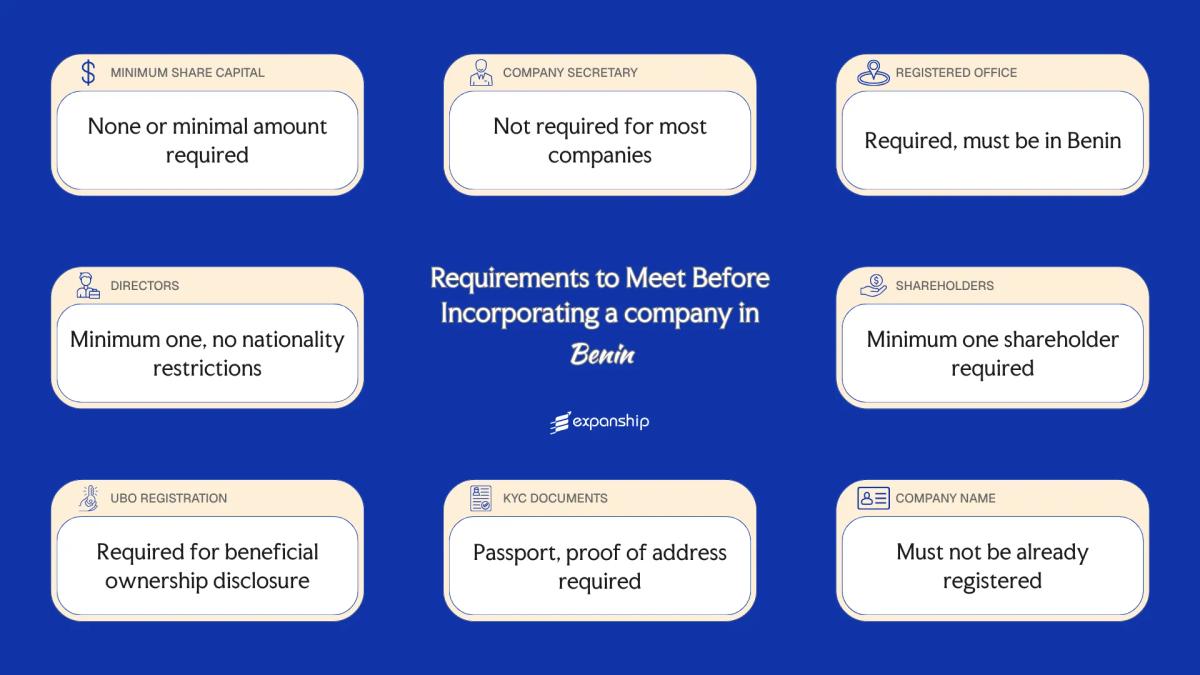
Minimum Share Capital Requirements in Benin
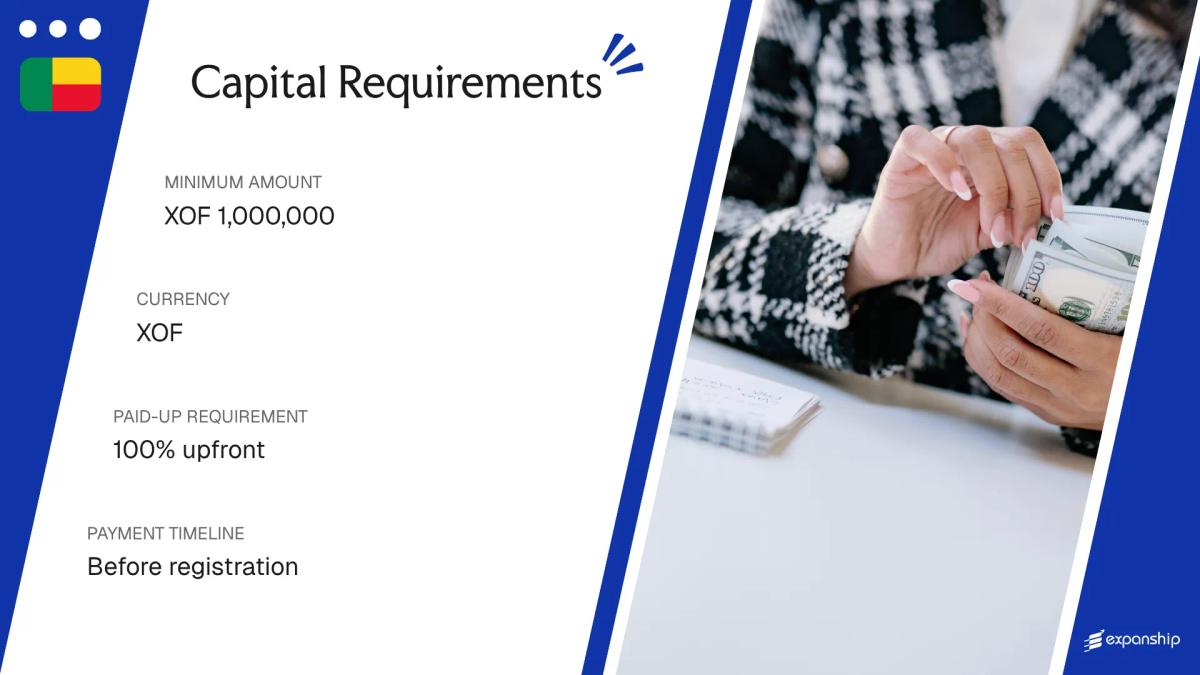
Minimum share capital requirements in Benin are governed by the OHADA Uniform Act on Commercial Companies and Economic Interest Groups, which applies uniformly across all OHADA member states including Benin. The Registre du Commerce et du Crédit Mobilier (RCCM) oversees company registration and verifies capital compliance at the point of incorporation.
Under this framework, Benin operates on a par value share system, meaning each share must carry a stated nominal value. Capital deposit requirements vary by entity type and are verified through a licensed bank or notary before the RCCM issues a registration certificate, making this an incorporation-stage obligation rather than an ongoing statutory requirement.
| Parameter | Detail |
|---|---|
| Minimum Authorized Share Capital | XOF 100,000 for SARL; XOF 10,000,000 for SA |
| Maximum Authorized Share Capital | No statutory requirement |
| Minimum Paid-Up Capital | XOF 100,000 for SARL; XOF 2,500,000 for SA at incorporation |
| Paid-Up Requirement at Incorporation | 100% for SARL; 25% of each share's nominal value for SA |
| Accepted Currency | West African CFA franc (XOF) |
| Accepted Forms of Contribution | Cash contributions; contributions in kind (subject to auditor valuation) |
| Timeframe to Deposit Capital | Prior to filing for registration with the RCCM |
Capital must be deposited before submitting your incorporation dossier to the RCCM. Registration will not proceed without proof of deposit from a licensed bank or notary.
Company Secretary Requirements in Benin
Under the OHADA Uniform Act on Commercial Companies, which governs corporate law in Benin, there is no statutory requirement for a company secretary in the traditional common law sense. Instead, the framework assigns comparable administrative and compliance functions to the managing director or a designated legal representative of the entity.
That said, certain corporate maintenance obligations still apply. A responsible officer must ensure that shareholder meetings are properly convened, minutes are recorded and retained, and statutory filings are submitted to the Centre de Formalités des Entreprises (CFE). These Benin corporate secretary obligations fall on whoever is formally appointed to manage the company's legal affairs.
Qualification criteria for who may serve in this administrative capacity:
- The role may be fulfilled by a natural person or a duly authorized legal representative of the company.
- No professional licensing or certification is required under the OHADA framework for this function.
- Residency in Benin is not a mandatory condition for the designated officer.
- The person must have legal capacity to act on behalf of the entity under OHADA rules.
- Corporate entities may designate an internal officer to carry out these duties.

Incorporate a Company in Benin
Set up your business entity in Benin under the OHADA framework with support from Expanship's corporate formation team.
Registered Office Requirements in Benin
Registered office requirements in Benin are governed by the OHADA Uniform Act on Commercial Companies and Economic Interest Groups, which mandates that every company registered in the country maintains a permanent, physical siège social on Beninese territory. Failure to maintain a compliant legal address can result in administrative sanctions, including the potential for a court to declare the company's acts irregular or to order its dissolution.
- A physical address is required; a P.O. box alone does not satisfy the siège social obligation.
- The address must be located within Benin; a foreign address is not acceptable for domestic registration purposes.
- Virtual offices may be used provided they supply a genuine, staffed physical premises that can receive official correspondence and inspections.
- Supporting documentation, such as a title deed or a lease agreement, must be held by the entity to substantiate its occupation of the premises.
- The registered address is recorded in the Registre du Commerce et du Crédit Mobilier (RCCM) and is publicly accessible.
- Any change of address must be formally declared to the RCCM through an amending registration filing; operating from an undeclared address without updating the registry constitutes a compliance breach.
Director Requirements in Benin
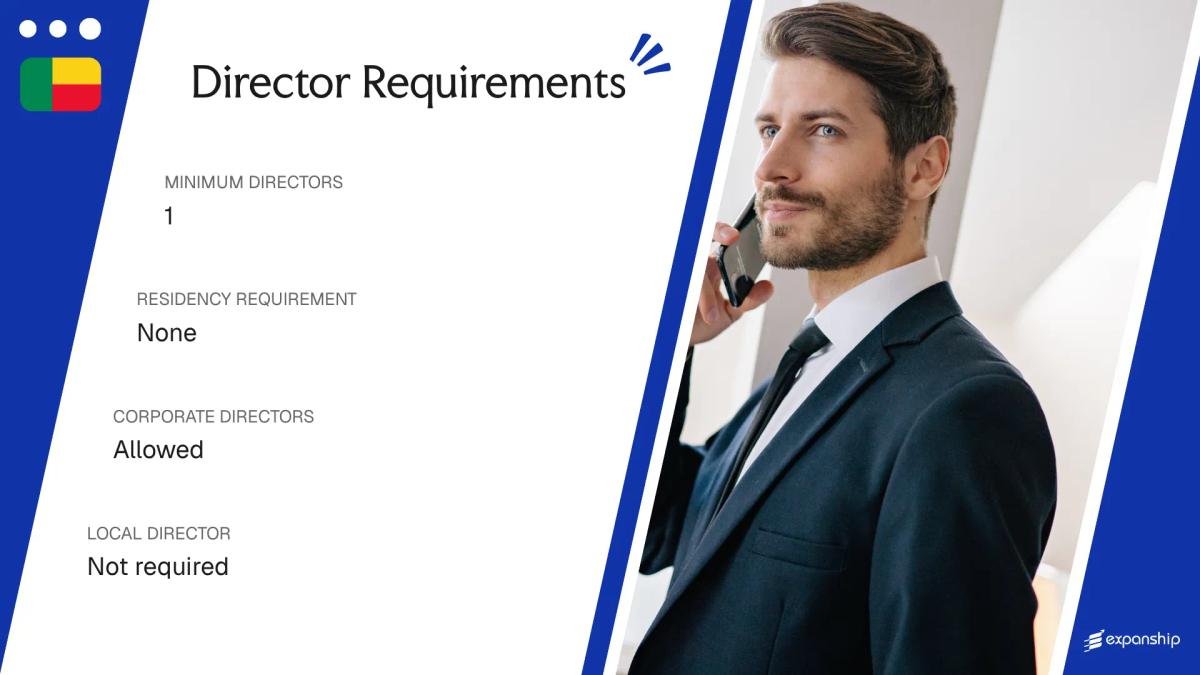
Upon appointment, directors in Benin assume statutory duties under the OHADA Uniform Act on Commercial Companies (AUSCGIE), including obligations of loyalty, diligence, and acting within the scope of authority granted by the company's statutes. Liability exposure is both civil and criminal where a director causes harm to the company, its shareholders, or third parties through mismanagement or breach of fiduciary duty.
| Parameter | Detail |
|---|---|
| Minimum Number of Directors | A SARL requires at least one gérant; an SA requires a board of at least three directors. |
| Maximum Number of Directors | An SA may have up to twelve board members under the AUSCGIE. |
| Local/Resident Director Required | No statutory requirement for a resident or locally domiciled director. |
| Nationality Restrictions | No nationality restrictions are imposed under the AUSCGIE. |
| Minimum Age Requirement | Directors must have reached the age of legal majority, which is 18 years. |
| Corporate Directors Permitted | Corporate directors are permitted, provided a permanent representative is designated. |
| Director Must Be a Shareholder | No statutory requirement for a director to hold shares, unless the company's statutes specify otherwise. |
| Publicly Listed on Registry | Directors are recorded in the RCCM (Registre du Commerce et du Crédit Mobilier) and are publicly accessible. |
| Disqualification Conditions | A person subject to a court-ordered prohibition from managing a commercial entity cannot serve as a director. |
Despite no residency requirement under OHADA rules, a gérant of a Beninese SARL can be both the sole director and sole shareholder simultaneously, concentrating full legal and managerial authority in one individual.
Shareholder Requirements in Benin
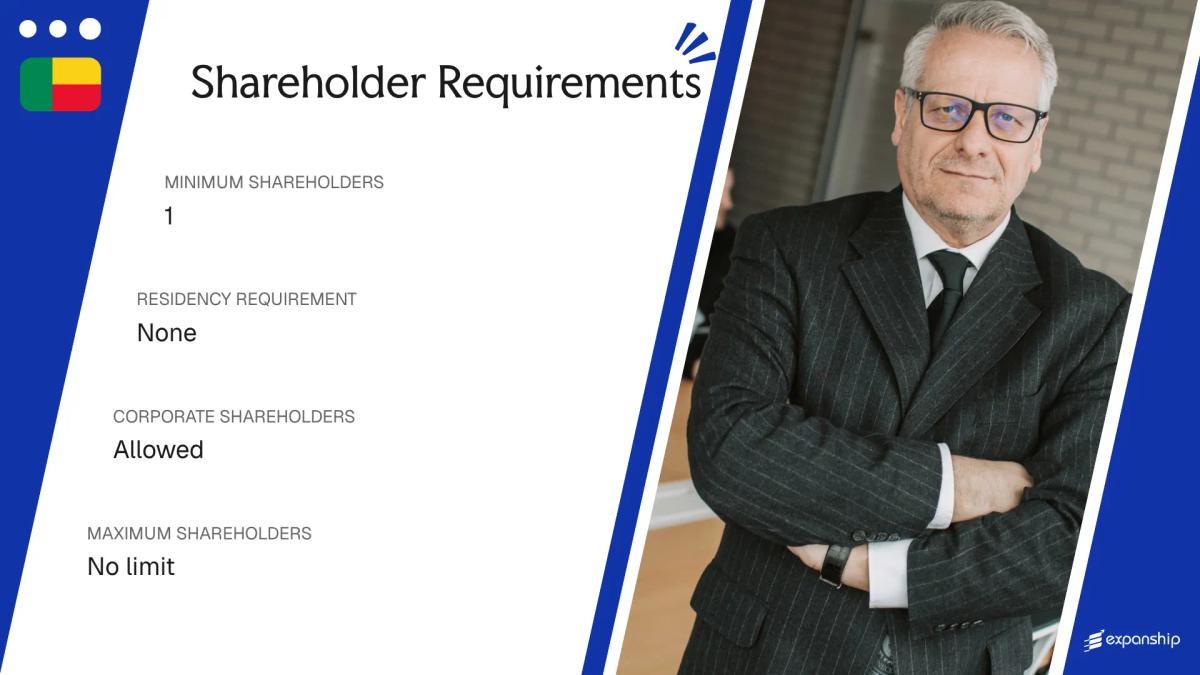
Under the OHADA Uniform Act on Commercial Companies, a Société à Responsabilité Limitée (SARL) requires a minimum of one shareholder, permitting a sole-associate structure. No statutory maximum applies to the number of associés in a SARL, though a Société Anonyme (SA) requires at least one shareholder.
Nationality and Residency Restrictions
Shareholders in Beninese companies face no nationality or residency requirements under OHADA rules. Foreign nationals may hold 100% of shares without restriction.
Corporate Shareholders
Legal entities are permitted to act as shareholders in both SARLs and SAs. No additional conditions specific to corporate associés are imposed at the incorporation stage beyond standard KYC documentation.
Shareholder Liability
In a SARL, each associé's liability is limited to their capital contribution. An SA shareholder is similarly protected, with no personal exposure to company debts beyond the subscribed share amount.
Register of Shareholders
A register of associés must be maintained at the company's registered office. This record is not publicly accessible, but the firm must update it to reflect any transfer of shares or change in ownership.
Shareholder Structure Guidance for Your Benin Incorporation
Get expert support in structuring your shareholding arrangements to meet OHADA requirements and complete your company formation in Benin.
UBO / Beneficial Ownership Disclosure Requirements in Benin
Beneficial ownership disclosure Benin is governed by the OHADA Uniform Act on Commercial Companies and the national AML/CFT framework transposing FATF recommendations into domestic law. A beneficial owner is generally defined as any natural person who ultimately owns or controls 25% or more of a company's shares or voting rights.
- Identify all natural persons holding 25% or more of shares or voting rights in the entity.
- Prepare a declaration of beneficial owners, including full name, date of birth, nationality, and nature of the controlling interest.
- Submit the declaration to the Centre de Formalités des Entreprises (CFE) at the time of incorporation.
- File any updates with the CFE within 30 days of a change in beneficial ownership.
| Parameter | Detail |
|---|---|
| Ownership Threshold for UBO Status | 25% of shares or voting rights |
| Filing Authority | Centre de Formalités des Entreprises (CFE) |
| Disclosure Deadline at Incorporation | At the time of incorporation |
| Publicly Accessible Register | No statutory public access confirmed |
| Penalties for Non-Disclosure | Sanctions under the national AML/CFT framework; specific fines not publicly codified |
| Ongoing Update Obligation | Within 30 days of any change in beneficial ownership |
KYC / Document Requirements in Benin
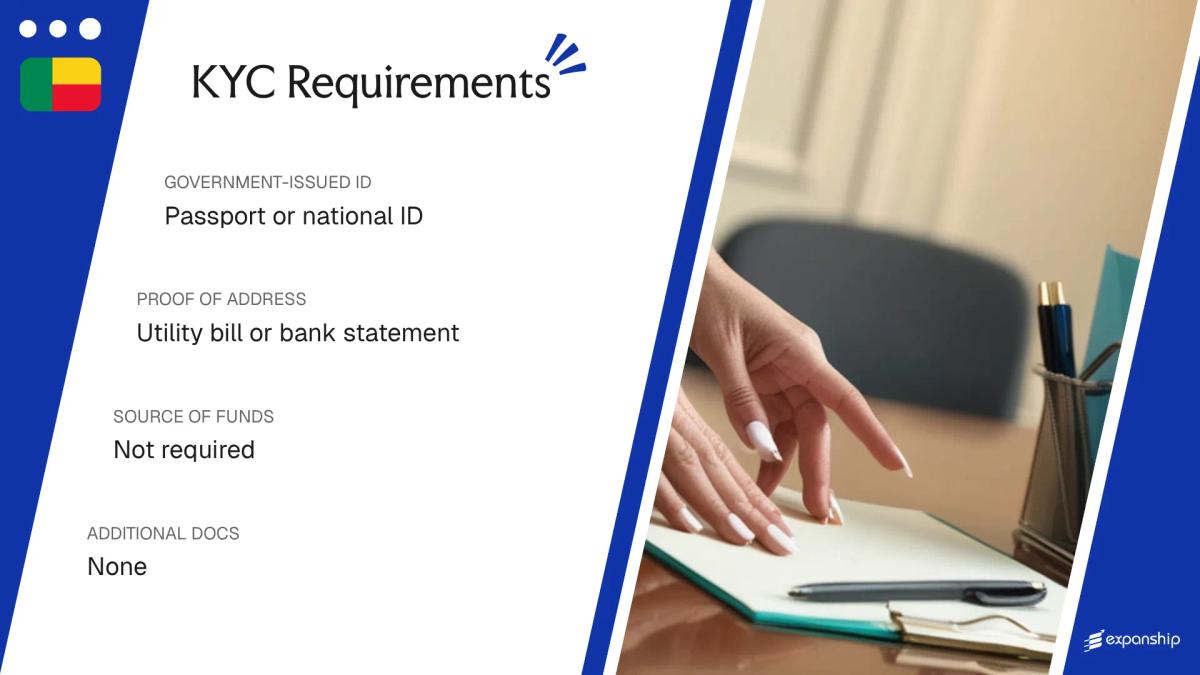
KYC document requirements in Benin are governed by the WAEMU AML/CFT framework, transposed into national law through Loi n° 2018-17 portant lutte contre le blanchiment de capitaux, which obliges the CENTIF Bénin to oversee financial intelligence and compliance obligations at the incorporation stage.
Individual / Personal Documents
- Valid government-issued passport or national identity card for each individual director, shareholder, or beneficial owner
- Recent proof of residential address dated within three months, such as a utility bill or bank statement
- Completed Know Your Customer form confirming personal details and role within the entity
- Specimen signature from each individual with a signatory function
Corporate Documents
- Certificate of incorporation or equivalent constitutive document for the corporate shareholder or director
- Certified copy of the articles of association or statutes of the parent entity
- Current register of directors of the corporate entity
- Official proof of registered address for the corporate shareholder
Source of Funds Documentation
- Recent bank statements covering a minimum of three months prior to incorporation
- Audited financial statements where the subscribing entity has been operational for over one year
- Written declaration explaining the origin of capital contributed to the new entity
Notarisation and Apostille Requirements
- Foreign documents must generally be apostilled under the Hague Convention before submission to the RCCM
- Official translations into French are required for any document issued in another language
- Notarisation by a locally recognised notary may be required for constitutional documents of foreign corporate shareholders
Incomplete or untranslated foreign-issued documents are the most frequent cause of RCCM registration delays in Benin.
Company Name Requirements in Benin
Company name requirements in Benin are assessed during the incorporation process through the Centre de Formalités des Entreprises (CFE), which verifies that a proposed name meets legal standards before registration is confirmed.
Your chosen name must include the appropriate legal suffix corresponding to the entity type, such as "SA" for a Société Anonyme or "SARL" for a Société à Responsabilité Limitée. French is the required language for the dénomination sociale.
Certain words are prohibited or restricted. Terms implying state affiliation, banking activity, or regulated professions require prior authorisation from the relevant supervisory authority before the name can be accepted.
Name reservation is available through the CFE prior to full registration. The reservation period is limited, and the application is submitted as part of the pre-incorporation procedure.
Compliance Services for Companies in Benin
Maintain good standing with local regulatory requirements, including annual filings, renewals, and ongoing statutory obligations.
Conclusion
Benin company incorporation requirements fall under the OHADA Uniform Act on Commercial Companies, which establishes a defined set of obligations that apply uniformly across member states, including those specific to local implementation. Among the requirements covered, the distinction between SA and SARL share capital thresholds carries practical weight for foreign investors structuring their entry. Beneficial ownership disclosure obligations, administered through applicable national authorities, also carry compliance consequences that persist well beyond the initial registration. Once these requirements are understood, the immediate next step involves engaging qualified local counsel and preparing the documentation required for filing with the CRIET-adjacent commercial registry.
Expanship's Company Formation Services in Benin
Expanship's company formation services in Benin are structured around the specific requirements imposed by OHADA law and Benin's national regulatory framework, including share capital structuring, UBO disclosure obligations, and registered office compliance. Your business carries the responsibility of meeting these obligations; Expanship reduces the administrative weight of doing so across an unfamiliar system.
Beyond incorporation, Expanship supports your entity through each stage of establishment and ongoing compliance:
- Preparation of incorporation documents and filing with the Centre de Formalités des Entreprises
- Provision of a registered agent and compliant local office address
- Direct liaison with government bodies and regulatory authorities on your behalf
- Post-incorporation compliance management to keep your entity in good standing
- Introductions to local banking institutions to support account opening
- Tax registration and coordination with Beninese fiscal authorities
To discuss your incorporation requirements, contact Expanship Benin.
Frequently Asked Questions (FAQ)
Yes. Benin is a member state of OHADA, which means the Acte Uniforme relatif au droit des sociétés commerciales et du groupement d'intérêt économique governs the formation and structure of commercial companies. Your founding documents, including the statuts (articles of association), must comply with OHADA requirements rather than purely domestic Beninese company law.
A foreign national can serve as a director without a residency requirement under OHADA-based rules applicable in Benin. However, depending on the business activity, certain regulated sectors may impose additional conditions on foreign directors, such as obtaining specific professional authorizations before assuming the role.
Non-compliance with beneficial ownership disclosure obligations can result in administrative sanctions and fines imposed under Benin's anti-money laundering framework, which aligns with WAEMU (UEMOA) directives on financial transparency. The company's registration status may also be affected if disclosure obligations remain unresolved, and directors can face personal liability in cases of deliberate concealment.
All commercial entities incorporated in Benin, regardless of type, must maintain a registered office address on Beninese territory. This address is recorded with the RCCM (Registre du Commerce et du Crédit Mobilier) and serves as the official point of contact for regulatory and legal correspondence. A virtual or non-physical address is not sufficient to meet this requirement.
Once all required documents are submitted to the GUFE (Guichet Unique de Formalisation des Entreprises), registration can be completed within a few business days under normal processing conditions. Delays typically occur when documents are incomplete, notarization requirements have not been met, or the proposed company name requires additional review. Having a fully compliant document package prepared in advance reduces processing time significantly.
Yes, corporate shareholders must provide additional documentation beyond what is required for individual shareholders. For a corporate shareholder, you will typically need to submit certified constitutional documents, proof of the entity's legal existence in its home jurisdiction, and identification of the individuals who control that entity. Individual shareholders are generally required to provide government-issued identification and proof of address, consistent with WAEMU-aligned due diligence standards.
Legal Disclaimer
The information provided in this article is for general informational purposes only and does not constitute legal, tax, or professional advice. While we strive to ensure the accuracy and timeliness of the content, laws and regulations are subject to change, and the application of laws can vary widely based on specific facts and circumstances.
Readers should not act upon this information without seeking professional counsel tailored to their individual situation. Expanship and its authors disclaim any liability for actions taken or not taken based on the content of this article.
For specific advice regarding your business setup, compliance requirements, or any legal matters, please consult with qualified legal and tax professionals in the relevant jurisdiction.