

Key Takeaways
- Benin's company registration process under the RCCM framework remains slow and bureaucratic, imposing meaningful delays on foreign investors seeking to establish a formal legal presence in-country.
- Under the OHADA Uniform Act on Commercial Companies and Economic Interest Groups (AUSCGIE), mandatory minimum share capital requirements apply to certain entity types, creating an upfront financial threshold that can constrain early-stage or capital-light business models.
- Persistent weaknesses in judicial consistency and contract enforcement increase the legal risk exposure of foreign entities operating through subsidiaries, branches, or joint ventures in Benin's formal economy.
- A large informal economy operating outside regulatory oversight creates an uneven competitive environment for formally incorporated businesses, which must absorb compliance costs that informal operators routinely avoid.
Benin operates under an evolving regulatory framework, shaped largely by its membership in the Organisation pour l'Harmonisation en Afrique du Droit des Affaires (OHADA), which standardises commercial law across seventeen member states. The primary legislation governing company formation is the OHADA Uniform Act on Commercial Companies and Economic Interest Groups (AUSCGIE).
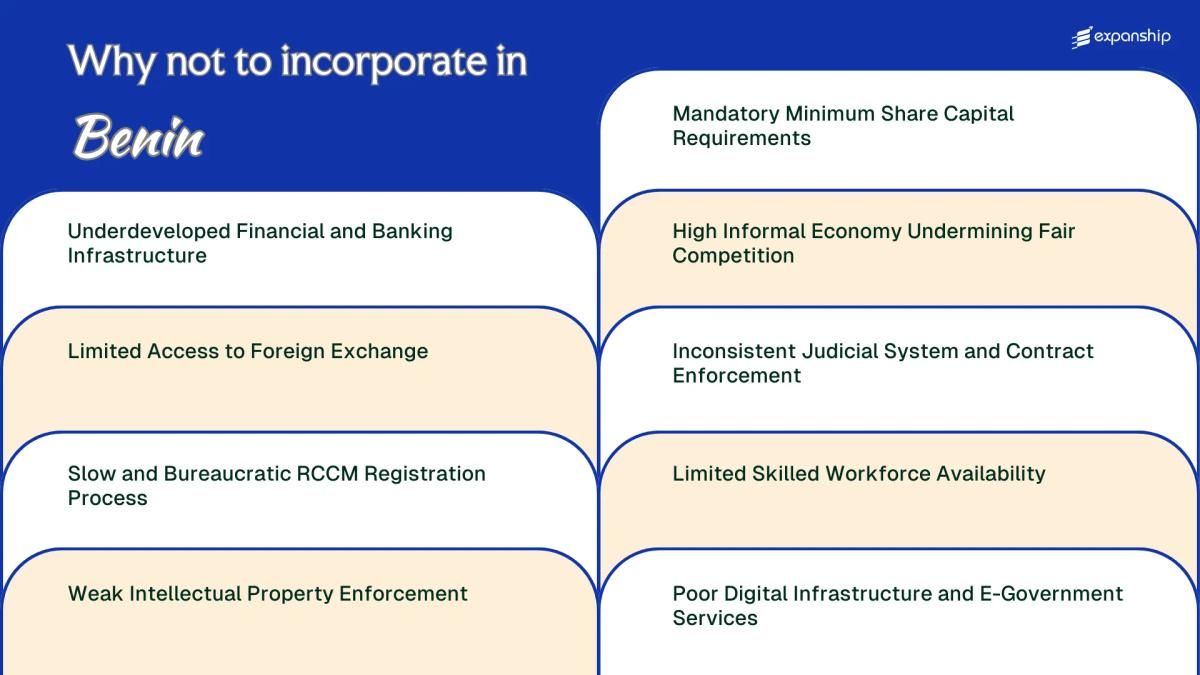
The disadvantages of incorporating in Benin span several operational, financial, and institutional categories. How severely these affect your business depends significantly on the sector you operate in, the structure of your entity, and the scale of your intended operations.
This article is most relevant to foreign investors and internationally incorporated firms seeking to establish a subsidiary, branch, or joint venture in Benin's formal economy.
Underdeveloped Financial and Banking Infrastructure
Benin banking infrastructure limitations affect foreign businesses from the moment they attempt to open a corporate account. The financial system operates within the West African Economic and Monetary Union (WAEMU) framework, governed regionally by the Banque Centrale des États de l'Afrique de l'Ouest (BCEAO), yet local implementation gaps create persistent friction for incorporated entities.
Limited Commercial Banking Capacity
The country's commercial banking sector remains shallow relative to its peer economies, with credit to the private sector consistently below 30% of GDP. For your business, this translates to constrained access to working capital, trade finance instruments, and short-term credit facilities that most foreign firms treat as standard operational tools.
Correspondent banking relationships with international institutions are limited, which slows cross-border transaction processing and raises intermediary costs. A firm dependent on frequent international transfers will encounter delays that affect supplier payment timelines and cash flow management.
Structural Gaps in Payment and Settlement Systems
Mobile money adoption is growing under BCEAO-supervised platforms, but interoperability between providers remains inconsistent, reducing reliability for business-to-business transactions. Corporate treasury functions that require same-day settlement or multi-currency accounts are poorly served by the current infrastructure.
Digital payment integration with formal accounting and ERP systems is not standardized across local banks, creating reconciliation burdens for foreign-owned entities maintaining group-level financial reporting.
Foreign businesses relying on routine cross-border payments should expect processing delays and elevated transaction costs due to the limited correspondent banking network available through local financial institutions.
Limited Access to Foreign Exchange
Foreign exchange restrictions in Benin stem from its membership in the West African Economic and Monetary Union (WAEMU), where monetary policy is controlled by the Banque Centrale des États de l'Afrique de l'Ouest (BCEAO). Your business does not operate under an independent central bank, which means currency decisions affecting your operations are made at a supranational level with limited responsiveness to local commercial needs.
The CFA franc is pegged to the euro at a fixed rate, but convertibility outside the WAEMU zone requires regulatory approval. Repatriating profits or transferring capital abroad involves documentation requirements and prior authorization from the BCEAO, adding friction to routine treasury operations.
For foreign-owned entities, these constraints create specific operational burdens:
- Delays in BCEAO approval for outward transfers can hold up dividend distributions to parent companies for weeks or longer
- Your firm may face limits on maintaining foreign currency accounts locally, forcing reliance on correspondent banking arrangements
- Cross-border supplier payments require supporting documentation that local banks are not always equipped to process efficiently
Businesses operating in sectors with high import dependency are particularly exposed, as forex access challenges in Benin can disrupt procurement timelines. The convertibility guarantee applies within the franc zone, but transactions outside it remain subject to controls that add cost and unpredictability.

Company Incorporation in Benin
Understand the regulatory and financial environment before establishing your entity in Benin.
Slow and Bureaucratic RCCM Registration Process
RCCM registration problems in Benin present a concrete operational delay for foreign businesses attempting to establish a legal presence. The RCCM, or Registre du Commerce et du Crédit Mobilier, is the commercial registry through which all new entities must be formally registered before conducting business, and processing timelines frequently exceed official estimates.
Under the OHADA Uniform Act on Commercial Companies, registration through the RCCM is a mandatory precondition for legal existence. Your firm cannot open a corporate bank account, sign binding commercial contracts as a registered entity, or obtain a taxpayer identification number before this step is complete.
| Burden Factor | Detail | Implication |
|---|---|---|
| Estimated registration window | 7 to 14 business days officially; often longer in practice | Delays corporate bank account opening and tax registration |
| In-person notarization required | Articles of association must be notarized before filing | Remote or non-resident founders face added logistical costs |
| Physical document submission | No fully electronic RCCM filing available | Requires local representation or courier handling |
| Registry office concentration | Centralized processing in Cotonou | Firms outside the capital face additional transit delays |
Reliance on physical document submission adds friction that is particularly acute for non-resident founders. A single missing document, a notarial error, or a registry backlog can restart portions of the process, extending your pre-operational period by weeks.
The Centre de Formalités des Entreprises was introduced to reduce procedural fragmentation, but coordination gaps between agencies still produce delays. Each additional day without a registered entity extends your exposure to operational and contractual risk.
Weak Intellectual Property Enforcement
Intellectual property risks in Benin stem from a structural gap between registration and enforcement. Benin is a member of the African Intellectual Property Organization (OAPI), which means trademark, patent, and copyright registrations are processed at the regional level under the Bangui Agreement rather than through a domestic IP office.
OAPI registration grants protection across all 17 member states simultaneously. However, that regional certificate carries limited practical weight if local courts lack the capacity or precedent to act on infringement claims.
Judicial proceedings for IP violations are slow, and specialized IP tribunals do not exist within the Beninese court system. A foreign firm discovering unauthorized use of its brand or technology faces civil litigation that can extend for years without a definitive resolution.
Counterfeit goods circulate openly in informal markets, and customs authorities have constrained resources to intercept infringing products at the border. This creates a direct commercial exposure for any foreign entity selling branded goods or licensed products locally.
- IP rights must be registered through OAPI under the Bangui Agreement, not through a national registry
- Enforcement actions require initiating civil proceedings in Beninese courts, where IP case precedent is thin
- No specialized IP enforcement body or tribunal exists at the national level
- Border seizure of counterfeit goods depends on customs capacity, which is operationally limited
- Criminal IP enforcement exists in statute but is rarely pursued in practice
Despite being part of a 17-country IP registration system, a single OAPI registration does not trigger any automatic enforcement mechanism in any member state, including Benin.
Mandatory Minimum Share Capital Requirements
Benin operates under the OHADA Uniform Act on Commercial Companies, which sets minimum share capital thresholds that can restrict how foreign investors structure their entry. Meeting minimum share capital requirements in Benin is a binding obligation, not a discretionary one.
Capital Thresholds by Entity Type
Under OHADA rules applicable in Benin, a Société Anonyme (SA) requires a minimum share capital of XOF 10,000,000, with at least one-quarter paid up at incorporation. For smaller ventures, the Société à Responsabilité Limitée (SARL) carries no statutory minimum under the revised OHADA framework, but this does not eliminate capital planning obligations, since banks and public procurement bodies often impose their own informal thresholds when assessing business credibility.
Practical Consequences for Foreign Investors
The SA capital requirement is a concrete upfront cost that must be committed before the entity can legally operate, which ties up working capital during a period when the business may not yet generate revenue. For capital-intensive sectors, this front-loading of funds compounds with RCCM registration delays, creating a window where money is locked but operations cannot begin.
Resolving Incorporation Barriers in Benin
Get structured guidance on capital obligations, entity selection, and regulatory compliance when setting up a company in Benin.
High Informal Economy Undermining Fair Competition
Informal economy problems Benin business owners face are largely structural: unregistered traders operate outside the tax system, avoid social charges under the CNSS (Caisse Nationale de Sécurité Sociale), and undercut formally incorporated firms on price.
- Your registered entity bears full corporate tax obligations under the Direction Générale des Impôts, while informal competitors absorb no equivalent fiscal burden, directly eroding your price competitiveness.
- Unregistered operators face no RCCM filing requirements, meaning your firm carries compliance costs that grey market actors simply bypass.
- Procurement and distribution channels in sectors such as retail and agriculture are often dominated by informal networks that exclude formally structured foreign entities.
- Consumer price sensitivity in the local market is calibrated against informal sector pricing, making margin preservation genuinely difficult for compliant foreign-owned firms.
- Enforcement against unregistered operators by the Direction Générale du Commerce Intérieur remains inconsistent, offering no reliable regulatory correction to this competitive imbalance.
Inconsistent Judicial System and Contract Enforcement
Contract enforcement risks in Benin stem from a court system that is structurally under-resourced and prone to procedural delays. Civil and commercial disputes can take years to resolve, which exposes your business to prolonged uncertainty over unpaid receivables, broken supplier agreements, or lease violations.
Benin operates under the OHADA treaty framework, which governs commercial law across 17 member states through uniform acts. While OHADA provides a standardized legal text, its application depends on national courts, and inconsistent judicial interpretations at the tribunal de commerce level create unpredictable outcomes for foreign firms.
Judicial corruption remains a documented concern. Transparency International's 2023 Corruption Perceptions Index ranked Benin 72nd out of 180 countries, reflecting persistent integrity risks within public institutions, including the judiciary.
Enforcement of arbitral awards also presents friction. Even where a contract includes an arbitration clause referencing the CCJA (Common Court of Justice and Arbitration), converting an award into an enforceable judgment through Beninese national courts can introduce additional delays.
A foreign supplier owed $45,000 under a breach of contract claim could realistically wait 24 to 36 months for a first-instance judgment in a Beninese tribunal de commerce, accruing legal fees exceeding $8,000 over that period with no guarantee of asset recovery even after a favorable ruling.
Limited Skilled Workforce Availability
Skilled workforce limitations in Benin stem directly from structural gaps in the education system. Tertiary enrollment rates remain low relative to regional peers, and technical and vocational training institutions lack the capacity to meet private sector demand at scale.
For foreign firms operating in sectors such as financial services, technology, or advanced manufacturing, locally sourced talent at the mid-to-senior level is scarce. Recruiting qualified professionals often requires either importing expatriate staff or funding internal training programs, both of which increase your operational costs before the business generates revenue.
The labor market drawbacks compound for firms requiring French-language professionals with international certifications or domain-specific expertise. Qualified candidates frequently migrate to Côte d'Ivoire, Togo, or francophone West African hubs offering higher compensation, narrowing the available talent pool further.
Human capital constraints also affect management continuity. High attrition among skilled employees means your firm may face repeated recruitment cycles, each carrying both direct hiring costs and productivity losses during transition periods.
If your business model depends on locally hired technical or specialized staff, Benin's Labor Code permits fixed-term contracts but does not remove your obligation to pay statutory severance and benefits, meaning frequent rehiring cycles carry cumulative legal and financial exposure regardless of contract type.
Poor Digital Infrastructure and E-Government Services
Digital infrastructure challenges in Benin directly affect how efficiently your business can operate after incorporation. Internet penetration remains low by regional standards, and connection reliability outside Cotonou is inconsistent, meaning routine administrative tasks can face delays simply due to connectivity gaps.
The Guichet Unique de Formalisation des Entreprises (GUFE) was introduced to centralize business registration, but digital submission capabilities remain limited in practice. Foreign business owners accustomed to fully online incorporation processes will find that physical presence or local representation is often still required.
Administrative filings with the Centre de Formalités des Entreprises (CFE) and tax registration with the Direction Générale des Impôts depend partly on manual workflows. This reliance on paper-based processing extends turnaround times and increases the risk of document loss or procedural errors that your firm cannot easily resolve remotely.
Overcoming Incorporation Challenges in Benin
Overcoming incorporation challenges in Benin requires structural preparation before the company formation process begins, not adjustments made after problems arise. The disadvantages covered in this blog are systemic, and addressing them depends on how your business is set up from the outset.
- Register your entity through the GUFE (Guichet Unique de Formalités des Entreprises) to reduce delays associated with the RCCM registration process.
- Open a corporate account with a BCEAO-regulated bank prior to capital deposit to satisfy minimum share capital requirements under OHADA Uniform Acts.
- File IP registrations through the OAPI (Organisation Africaine de la Propriété Intellectuelle) before commencing operations in-country.
- Structure contracts under OHADA arbitration clauses to reduce exposure to inconsistent domestic court enforcement.
- Allocate budget for private digital infrastructure to offset gaps in public e-government service delivery.
These steps operate within the OHADA legal framework that governs commercial law across the jurisdiction. Mitigating incorporation risks in Benin depends on understanding that several of these challenges fall outside the direct control of any individual business.
Benin's Overall Investment Potential
Benin investment risks and potential are real on both sides of the ledger. The structural barriers documented throughout this blog are genuine constraints, not minor frictions. At the same time, the country's position within the ECOWAS trade bloc, its membership in the OHADA legal framework, and its Port of Cotonou transit corridor give it a measurable commercial footprint that keeps it on the radar of regional investors.
| Pros | Cons |
|---|---|
| OHADA membership provides a standardised legal framework shared across 17 African states | Judicial enforcement of contracts remains inconsistent, limiting the practical value of written agreements |
| The Port of Cotonou offers established transit access to landlocked Sahelian markets | The RCCM registration process is slow and subject to administrative delays |
| CFA franc membership removes currency conversion risk within the WAEMU zone | Access to foreign exchange outside the zone is structurally limited |
| Formal minimum share capital requirements are defined and predictable | The high volume of informal market activity creates an uneven competitive environment |
| Regional trade access through ECOWAS expands potential market reach | Weak IP enforcement offers little practical protection for proprietary assets |
Skilled labour constraints and underdeveloped digital infrastructure add operational friction that compounds the regulatory challenges. These factors together mean the cost of doing business here often exceeds initial projections.
Compliance Services for Companies in Benin
Maintain your Benin entity in good standing with ongoing compliance support covering statutory filings, registered agent obligations, and regulatory reporting requirements.
Conclusion
The cons of company formation in Benin reflect structural conditions that predate any single business decision. Among the most operationally significant are the slow RCCM registration process, restricted foreign exchange access through the BCEAO framework, and inconsistent contract enforcement through the OHADA-aligned court system. These are not isolated frictions but interconnected realities that affect day-to-day business function. Structural reform moves incrementally, and your firm's planning must account for that pace. Professional guidance on entity structuring, compliance timelines, and banking arrangements remains the most direct way to reduce exposure to these documented drawbacks.
Expanship's Services for Your Benin Expansion
Incorporating in Benin involves real procedural weight: RCCM registration delays, minimum share capital requirements, banking access constraints, and an inconsistent judicial environment all create friction that compounds quickly for foreign businesses. Expanship's Benin company incorporation support services are designed to reduce that operational burden by managing the administrative and compliance obligations on your behalf, so your business can move forward without being stalled by procedural gaps.
From initial formation through ongoing compliance, our team handles the full scope of entity setup and maintenance:
- We prepare and file all company registration documents required by the RCCM and relevant Beninese authorities.
- A registered agent and local office address are provided to satisfy legal presence requirements.
- We liaise directly with government bodies and regulatory agencies on your behalf.
- Post-incorporation compliance obligations are monitored and managed on a continuing basis.
- We facilitate introductions to local banking partners to support your account opening process.
- Tax registration with the Direction Générale des Impôts and local authority liaison are handled as part of our service.
Reach out to Expanship Benin to discuss how we can support your entity setup.
Frequently Asked Questions (FAQ)
The requirement varies by legal form. A Société à Responsabilité Limitée (SARL) under OHADA's Uniform Act on Commercial Companies requires no statutory minimum share capital as of the 2014 reforms, but a Société Anonyme (SA) requires a minimum of XOF 10,000,000. If your planned activities fall under a regulated sector — banking, insurance, or telecommunications — sector-specific regulators impose their own, significantly higher capital thresholds on top of the general corporate law requirements.
Benin is a member of the Organisation Africaine de la Propriété Intellectuelle (OAPI), which provides a regional registration framework, but enforcement at the national level remains weak relative to most West African peers with larger commercial courts. Local judicial capacity to handle IP disputes is limited, and case resolution timelines are long. Businesses relying on brand protection or proprietary technology face a material risk that infringement will go unaddressed even when OAPI registration is in place.
Benin operates within the UEMOA (West African Economic and Monetary Union) franc zone, which imposes foreign exchange regulations through the BCEAO (Banque Centrale des États de l'Afrique de l'Ouest). Repatriating dividends or profits in hard currency requires prior authorization and compliance with BCEAO transfer rules, and processing times at local correspondent banks are frequently unpredictable. For businesses with tight treasury cycles or parent companies expecting regular distributions, this adds both administrative cost and financial uncertainty.
A large share of commercial activity in Benin operates outside the formal tax and regulatory system, meaning formally registered companies bear the full cost of corporate tax, social security contributions, and compliance fees that informal competitors avoid entirely. This creates a structural pricing disadvantage in sectors such as retail, logistics, and construction where informal operators dominate. The Direction Générale des Impôts (DGI) has increased audit activity on formal entities, which intensifies the compliance burden without meaningfully leveling the competitive field.
Benin's civil courts operate under a legal framework influenced by OHADA commercial law, which provides a reasonably clear set of rules on paper, but judicial delays and inconsistent application mean enforcement outcomes are unpredictable in practice. Arbitration through the OHADA Common Court of Justice and Arbitration (CCJA) is available and is generally more reliable for cross-border commercial disputes. Including a binding CCJA arbitration clause in contracts with Beninese counterparties is a standard risk-mitigation measure, though it does not eliminate the risk entirely.
The gap is meaningful for technical, managerial, and specialized roles. Benin's tertiary education system produces graduates, but the supply of professionals with experience in finance, engineering, or technology is limited relative to demand from both local and international employers. Expatriate hiring is permitted but triggers additional compliance obligations under the Labour Code, including work permit approvals and quotas on the ratio of foreign to local staff, which adds cost and administrative complexity to workforce planning.
Yes, directly. Many administrative filings — including tax declarations to the DGI and social security submissions to the CNSS (Caisse Nationale de Sécurité Sociale) — require in-person attendance or rely on digital platforms that experience frequent downtime. Missed deadlines due to system failures are not automatically excused, and penalties for late submission can accumulate before your local representative becomes aware of the problem. Companies without a reliable in-country agent who can attend in person when digital channels fail are particularly exposed.
Legal Disclaimer
The information provided in this article is for general informational purposes only and does not constitute legal, tax, or professional advice. While we strive to ensure the accuracy and timeliness of the content, laws and regulations are subject to change, and the application of laws can vary widely based on specific facts and circumstances.
Readers should not act upon this information without seeking professional counsel tailored to their individual situation. Expanship and its authors disclaim any liability for actions taken or not taken based on the content of this article.
For specific advice regarding your business setup, compliance requirements, or any legal matters, please consult with qualified legal and tax professionals in the relevant jurisdiction.