
Key Takeaways
- Benin's company law is governed by the OHADA Uniform Act on Commercial Companies, placing it within a regional legal framework shared across member states rather than a purely domestic corporate code.
- The SARL is the most widely registered entity in Benin, favoured for its limited liability structure and comparatively accessible capital requirements for both resident and foreign investors.
- Company registration in Benin is administered through the Centre de Formalités des Entreprises (CFE), which operates under the Agence de Promotion des Investissements et des Exportations (APIEx).
- Foreign entities seeking a presence in Benin without incorporating a standalone local company may do so through a branch office or representative office structure.
Introduction to Entity Types in Benin
Benin is a West African nation bordered by Togo, Nigeria, Burkina Faso, and Niger, with its southern coastline opening onto the Gulf of Guinea. An independent republic, the country operates under a civil law framework heavily influenced by French legal tradition, which shapes how corporate structures are defined and governed.
Company registration falls under the purview of the Centre de Formalités des Entreprises (CFE), which operates as part of the Agence de Promotion des Investissements et des Exportations (APIEx). Benin applies a standard territorial tax system, with corporate income tax levied on profits generated within its borders.
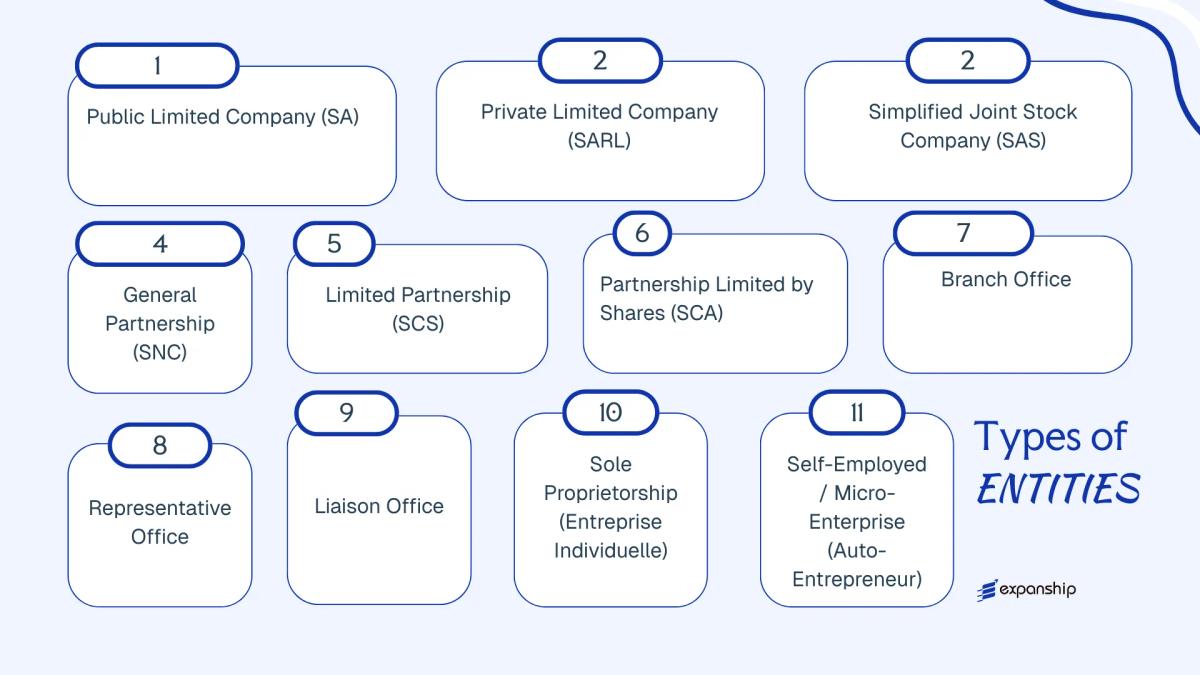
The types of business entities in Benin include the Société Anonyme (SA), Société à Responsabilité Limitée (SARL), Société par Actions Simplifiée (SAS), Société en Nom Collectif (SNC), Société en Commandite Simple (SCS), Société en Commandite par Actions (SCA), branch offices, representative offices, and sole proprietorship structures such as the Entreprise Individuelle and the Auto-Entrepreneur regime.
Each of these structures carries distinct requirements around capital, liability, governance, and regulatory compliance — all of which are examined in the sections that follow.
An Overview of Business Structures in Benin
Under the OHADA Uniform Act on Commercial Companies and Economic Interest Groups (AUDSCGIE), adopted in 1997 and revised in 2014, several distinct legal forms are available to those seeking to establish a business structure in Benin. The Act applies uniformly across all 17 OHADA member states, including Benin, and is enforced domestically through the Centre de Formalités des Entreprises (CFE). Each legal form carries different implications for liability, governance, capital requirements, and permissible activities.
Business Structures at a Glance
| Entity Type | Legal Form | Liability | Tax Status | Local Trading | Minimum Members | Regulatory Authority | Governing Act |
|---|---|---|---|---|---|---|---|
| Société Anonyme (SA) | Corporation | Limited to shares | Taxable | Permitted | 1 shareholder | CFE / RCCM | AUDSCGIE 2014 |
| Société à Responsabilité Limitée (SARL) | Private LLC | Limited to contribution | Taxable | Permitted | 1 member | CFE / RCCM | AUDSCGIE 2014 |
| Société par Actions Simplifiée (SAS) | Simplified joint stock | Limited to shares | Taxable | Permitted | 1 shareholder | CFE / RCCM | AUDSCGIE 2014 |
| Société en Nom Collectif (SNC) | General partnership | Unlimited, joint | Taxable | Permitted | 2 partners | CFE / RCCM | AUDSCGIE 2014 |
| Société en Commandite Simple (SCS) | Limited partnership | Mixed | Taxable | Permitted | 2 partners | CFE / RCCM | AUDSCGIE 2014 |
| Société en Commandite par Actions (SCA) | Partnership by shares | Mixed | Taxable | Permitted | 4 partners | CFE / RCCM | AUDSCGIE 2014 |
| Branch Office | Non-incorporated | Parent liable | Taxable | Permitted | N/A | CFE / RCCM | AUDSCGIE 2014 |
| Representative Office | Non-trading presence | Parent liable | Generally exempt | Not permitted | N/A | CFE | Local regulations |
| Entreprise Individuelle | Sole proprietorship | Unlimited | Taxable | Permitted | 1 individual | CFE / RCCM | AUDSCGIE / Local law |
| Auto-Entrepreneur | Simplified sole trader | Unlimited | Simplified regime | Permitted | 1 individual | CFE | Local regulations |
Each of these structures is examined in full in the sections below.
Société Anonyme (SA) — Public Limited Company
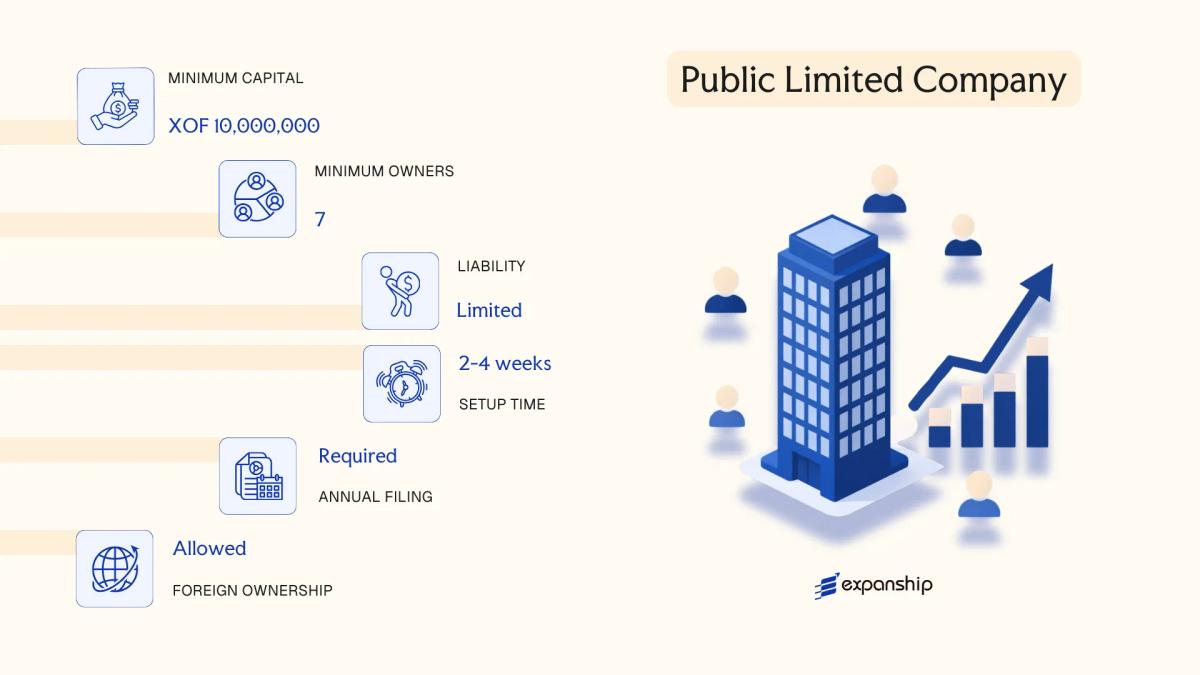
Société Anonyme SA formation in Benin is governed by the OHADA Uniform Act on Commercial Companies and Economic Interest Groups (AUSCGIE), most recently revised in 2014. The SA is a capital-based structure with full separate legal personality, meaning the company bears its own rights and obligations independently of its shareholders.
Liability is capped at each shareholder's contribution. This structure suits ventures requiring external capital, institutional investors, or eventual public listing on a stock exchange.
Key Characteristics
| Requirement | Detail | Notes |
|---|---|---|
| Legal Form | Société Anonyme (SA) | Capital company under OHADA AUSCGIE |
| Members | Shareholders (actionnaires); minimum 1 shareholder | Single-shareholder SA permitted under revised AUSCGIE 2014 |
| Governance | Board of Directors (minimum 3, maximum 12) or a single administrator if one shareholder | A Managing Director (Directeur Général) handles day-to-day operations |
| Registered Office | Physical address in Benin required | Must be declared with the RCCM (Trade and Personal Property Credit Register) |
| Share Capital | Minimum XOF 10,000,000 (approx. USD 16,500) | At least 50% paid up at incorporation; remainder within 2 years |
| Share Transfers | Freely transferable unless restricted by bylaws | Restrictions must be explicitly stated in the statuts |
| Privacy | Shareholder names filed with RCCM; publicly accessible | Beneficial ownership disclosure required under OHADA and WAEMU regulations |
Focus Points
- Taxation: Corporate income tax applies at the standard rate; VAT registration is mandatory above the applicable turnover threshold; withholding taxes apply to dividends, interest, and service fees paid to non-residents — refer to Direction Générale des Impôts (DGI) for current rates.
- Annual Compliance: Audited financial statements required; statutory auditor (commissaire aux comptes) mandatory regardless of size.
- Treaty Access: Benin is a member of WAEMU and ECOWAS; access to applicable multilateral tax arrangements but bilateral double tax treaties are limited.
- Economic Substance: No formal substance regime, but registered office and governance activity must be genuine and documented.
- Conversion: An SA may be converted to an SARL or SAS by shareholder resolution, subject to AUSCGIE procedures and creditor notification requirements.
Closing
The SA suits large trading operations, holding structures, and businesses intending to raise equity from multiple investors or access regional capital markets. The freely transferable share structure facilitates investor entry and exit, though the minimum capital threshold and mandatory statutory audit increase both setup costs and ongoing compliance obligations.
Best suited for large-scale enterprises, joint ventures with institutional partners, or businesses planning to seek external investment or eventual public listing.

Company Incorporation in Benin
Incorporate an SA or other business entity in Benin with end-to-end support from Expanship.
Société à Responsabilité Limitée (SARL) — Private Limited Company
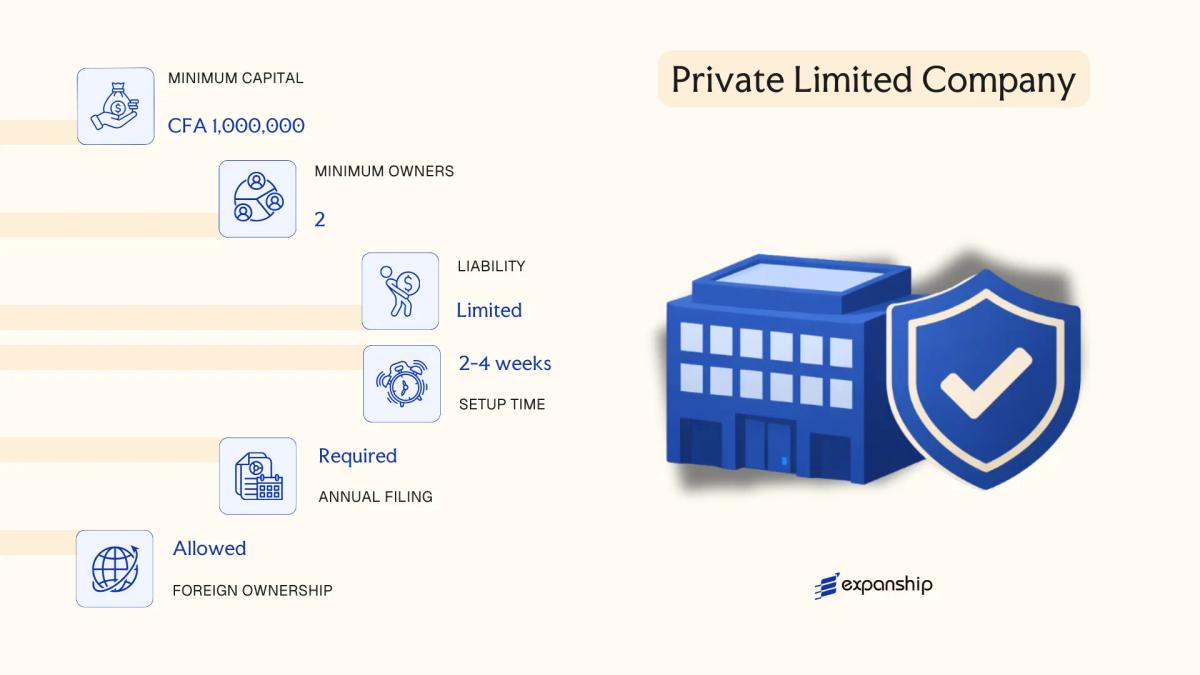
The Société à Responsabilité Limitée SARL Benin businesses most frequently adopt is governed by the OHADA Uniform Act on Commercial Companies and Economic Interest Groups, most recently revised in 2014. As a member state of OHADA, Benin applies this supranational framework directly, meaning the SARL's legal structure is defined at the regional treaty level rather than by domestic statute alone.
The SARL carries separate legal personality from the moment of registration at the Centre de Formalités des Entreprises (CFE). Liability for each associate is capped at their capital contribution, making this a hybrid structure that combines the organisational flexibility of a partnership with the liability protection of a share-based company.
Key Characteristics
| Requirement | Detail | Notes |
|---|---|---|
| Legal Form | Société à Responsabilité Limitée | Separate legal personality upon registration |
| Members | 1 to 50 associates | Single-associate variant is called SARL Unipersonnelle |
| Management | One or more gérants (managers) | Need not be associates; foreign nationals may serve |
| Capital | No statutory minimum under revised OHADA 2014 Act | Capital must be fully subscribed; amount fixed in articles |
| Local Presence | Registered office address in Benin required | No mandatory resident gérant, but registered address is obligatory |
| Privacy | Associate names filed with the RCCM | Register is publicly accessible |
Focus Points
- Taxation: Subject to corporate income tax (currently 30% standard rate under Beninese fiscal law), VAT at 18%, and withholding taxes on dividends, interest, and royalties paid to non-residents; stamp duties apply on certain instruments.
- Annual Compliance: Annual general meeting of associates required; financial statements must be filed with the Registre du Commerce et du Crédit Mobilier (RCCM).
- Economic Substance: No OHADA-specific substance test, but Beninese tax authorities may apply permanent establishment analysis to foreign-managed entities.
- Conversion: A SARL may be converted to an SA once it meets the relevant threshold conditions under the OHADA Uniform Act.
- Restrictions: Associate count cannot exceed 50; shares are not freely transferable and require associate approval for third-party transfers.
Closing
The SARL suits small to mid-sized trading operations, family-held businesses, and joint ventures where the parties want defined liability without the administrative weight of a public company structure. Its principal constraint is the restriction on share transferability, which limits exit options for investors seeking liquidity.
Best suited for small to medium enterprises, family businesses, and foreign investors entering Benin with a defined local partner or operational base.
Société par Actions Simplifiée (SAS) — Simplified Joint Stock Company
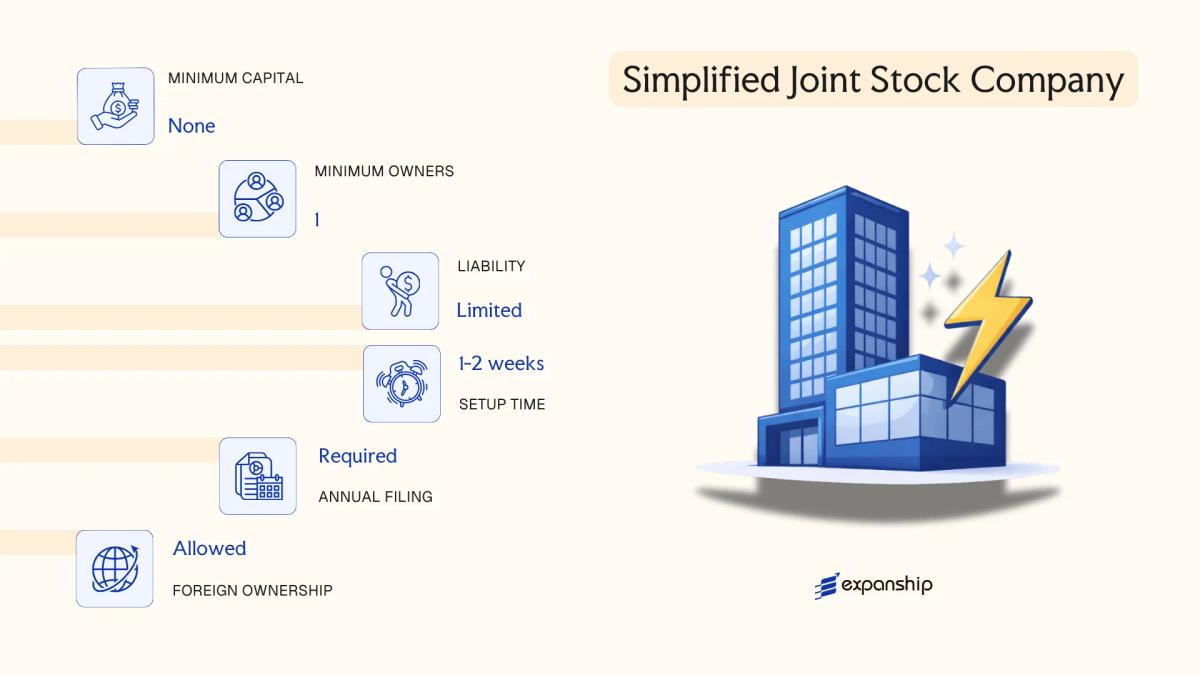
The Société par Actions Simplifiée SAS Benin is governed by the OHADA Uniform Act on Commercial Companies and Economic Interest Groups, most recently revised in 2014. As with other share-capital structures under OHADA, the SAS carries separate legal personality distinct from its shareholders, with liability confined to capital contributions.
What distinguishes this structure from others under the same framework is its contractual flexibility. The articles of association can define governance arrangements that the law leaves largely to the parties, making it a hybrid between a capital company and a contractually structured vehicle.
Key Characteristics
| Requirement | Detail | Notes |
|---|---|---|
| Legal Form | Société par Actions Simplifiée | Share-based entity with flexible governance |
| Members | Shareholders (associés); minimum 1, no statutory maximum | Single-shareholder variant (SASU) is permitted under OHADA |
| Management | President (mandatory); other governance bodies defined by statutes | No board requirement unless statutes provide for one |
| Local Presence | Registered office in Benin required | Must be a physical address within the jurisdiction |
| Share Capital | No statutory minimum under the revised OHADA Act | Capital amount and structure defined in the articles |
| Privacy | Shareholders not publicly listed in most cases | Beneficial ownership disclosure rules apply under OHADA |
Focus Points
- Taxation: Subject to corporate income tax at the standard rate applicable in Benin; VAT obligations apply to qualifying activities; withholding tax applies on dividends, interest, and royalties paid to non-residents under domestic rules and applicable tax treaties.
- Annual Compliance: Filing of annual financial statements with the RCCM (Registre du Commerce et du Crédit Mobilier) is required; audit requirements depend on company size thresholds.
- Economic Substance: No specific economic substance regime applies, but commercial activities must be genuinely conducted through the registered office to maintain good standing.
- Treaty Access: Benin is a member of OHADA and participates in limited bilateral tax treaty arrangements; treaty eligibility depends on the entity's tax residency status.
- Conversion: An SAS may be converted to another OHADA-recognised form, subject to shareholder resolution and regulatory filings at the RCCM.
Closing
The SAS suits holding structures, joint ventures, and businesses requiring bespoke governance arrangements that a more prescriptive form cannot accommodate. Its primary advantage is statutory freedom in organising internal rules; the principal limitation is that this same flexibility demands carefully drafted articles, and poorly structured statutes can create governance disputes.
The SAS is best suited for sophisticated investors, multi-party joint ventures, or holding entities where customised governance and share structures are a priority over administrative simplicity.
Partnerships [Société en Nom Collectif (SNC), Société en Commandite Simple (SCS), Société en Commandite par Actions (SCA)]
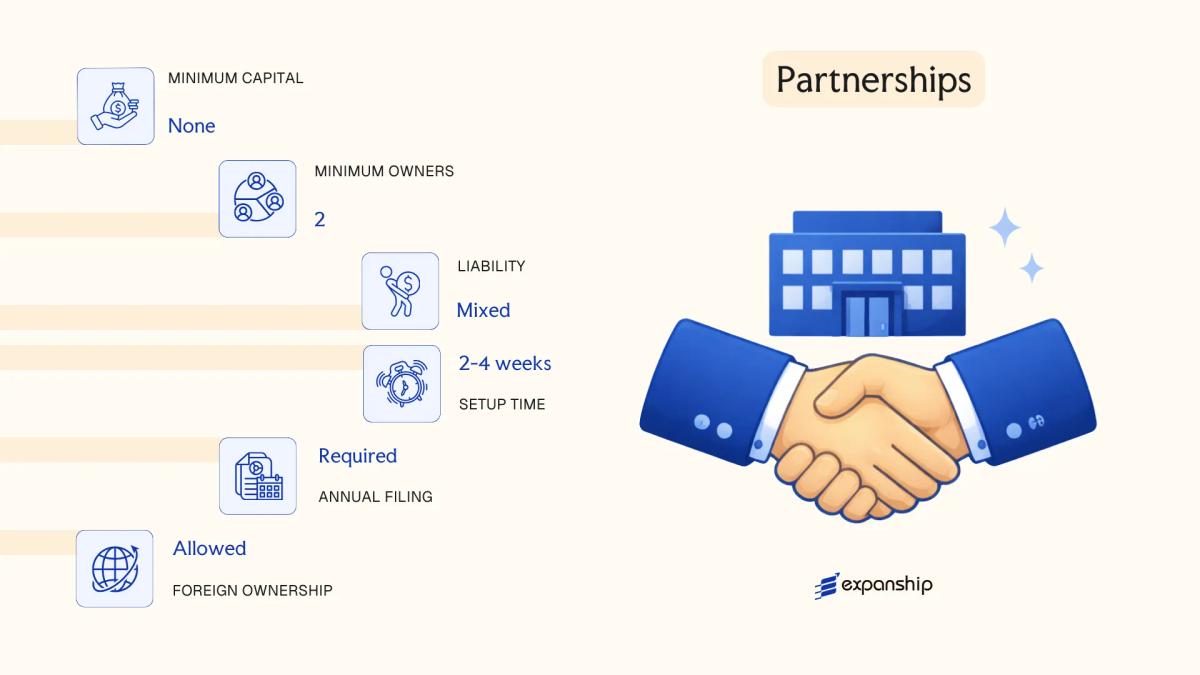
Among the partnership company types in Benin, three distinct structures exist under the OHADA Uniform Act on Commercial Companies and Economic Interest Groups (AUDSCGIE), originally adopted in 1997 and revised in 2014. Each form carries its own liability and governance profile, making the choice between them consequential rather than cosmetic.
All three structures are recognised legal persons under OHADA law. What separates them is how liability is distributed among partners and whether transferable shares or non-transferable interests are used to represent ownership.
Key Characteristics
| Requirement | Detail | Notes |
|---|---|---|
| Legal Form | Partnership with legal personality | Governed by AUDSCGIE; registered with the Centre de Formalités des Entreprises (CFE) |
| Members | SNC: minimum 2 general partners, no maximum. SCS: minimum 1 general + 1 limited partner. SCA: minimum 1 general partner + 3 shareholder-partners | SNC partners are called "associés"; SCA shareholders hold transferable shares |
| Liability | SNC: all partners bear unlimited joint liability. SCS: general partners unlimited, limited partners capped at contribution. SCA: general partners unlimited, shareholders limited | Unlimited liability in SNC and for general partners in SCS/SCA is a defining structural constraint |
| Capital | No statutory minimum for SNC or SCS. SCA requires share capital divided into negotiable shares; minimum not fixed by AUDSCGIE | Capital currency is the West African CFA franc (XOF) |
| Local Presence | Registered office in Benin required for all three forms | A legal domiciliation address satisfies this requirement |
| Privacy | Partner identity disclosed in the articles of association, which are filed publicly at the RCCM (Registre du Commerce et du Crédit Mobilier) | No anonymous ownership available |
Focus Points
- Taxation: Partnerships are generally subject to corporate income tax in Benin at the standard rate; profits distributed to partners may attract withholding tax, and VAT obligations apply where applicable to the entity's activities.
- Annual Compliance: Annual financial statements must be filed with the RCCM; accounting follows OHADA's SYSCOHADA revised accounting system.
- Treaty Access: Benin's tax treaty network is limited; partnership entities may face restricted access to treaty benefits depending on treaty provisions and partner residency.
- Transfer Restrictions: SNC interests are non-transferable without unanimous partner consent; SCA shares are freely negotiable, which is a material structural difference.
- Conversion: An SNC or SCS may be converted into a capital company (SARL or SA) by unanimous decision of the partners, subject to AUDSCGIE procedural requirements.
Sub-Types
Société en Nom Collectif (SNC)
All partners hold the status of trader and bear unlimited, joint, and several liability for company debts. This structure suits closely held professional or family-run trading businesses where partners accept mutual exposure.
Société en Commandite Simple (SCS)
Two classes of partner coexist: general partners with unlimited liability who manage the firm, and silent partners (commanditaires) whose liability is limited to their capital contribution and who may not participate in management.
Société en Commandite par Actions (SCA)
The SCA grafts a share capital structure onto the commandite framework. Shareholder-partners hold freely transferable shares while general partners retain management control with unlimited liability — a format used in investment vehicles and family holding structures where ownership transfer must remain fluid.
Closing
Partnership structures in Benin are suited to closely held businesses, family holdings, and arrangements where the partners intentionally accept defined liability positions. The SCA's transferable share capital offers flexibility absent in the SNC, while the SNC's unlimited mutual liability limits its appeal outside tightly trusted arrangements.
SNC and SCS structures are best suited for small, trust-based partnerships; the SCA is more appropriate for structured investment or holding arrangements requiring transferable equity.
Foreign Business Presence [Branch Office, Representative Office, Liaison Office]
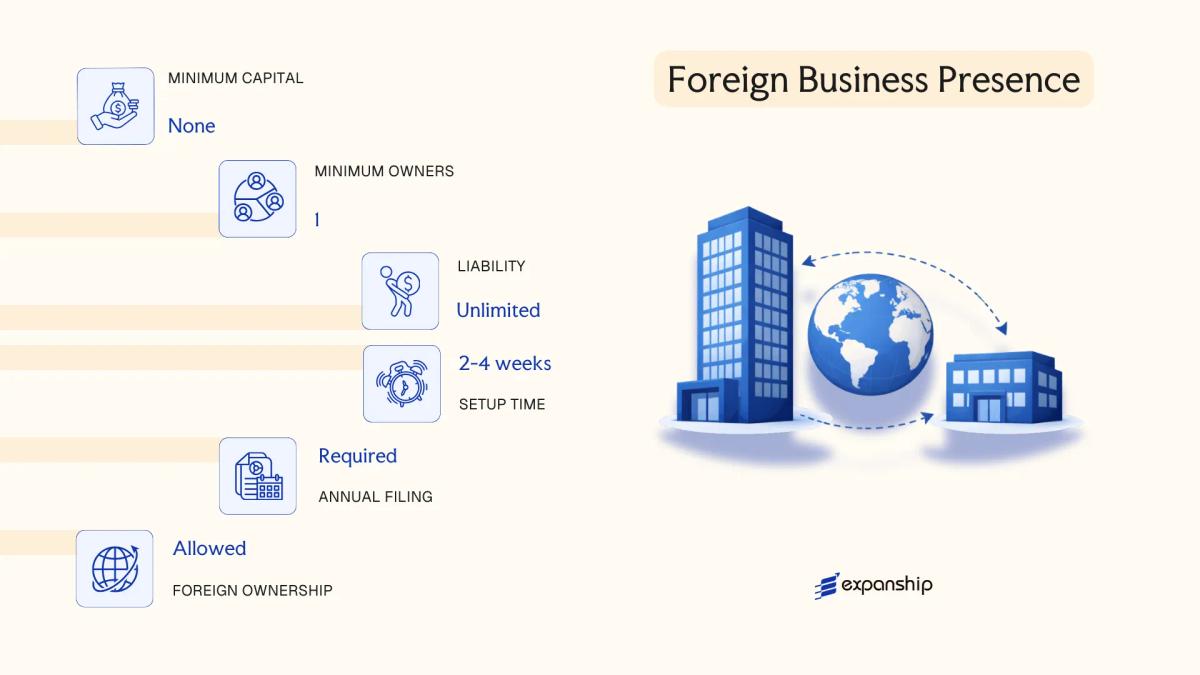
Establishing a foreign company branch office in Benin is governed by the OHADA Uniform Act on Commercial Companies and Economic Interest Groups (AUSCGIE), most recently revised in 2014. Under OHADA rules applicable across member states including Benin, a branch has no separate legal personality — it remains an extension of the parent entity, which retains full liability for its operations.
Registration of any foreign business presence is handled through the Centre de Formalités des Entreprises (CFE) and recorded in the Registre du Commerce et du Crédit Mobilier (RCCM). The scope of permitted activities determines which structure applies.
Key Characteristics
| Requirement | Detail | Notes |
|---|---|---|
| Legal Form | Branch / Representative / Liaison Office | No separate legal personality; parent bears all liability |
| Parent Entity | Foreign incorporated company | Must provide notarised, apostilled incorporation documents |
| Local Representative | Mandatory resident representative | Must be appointed and registered with the RCCM |
| Registered Address | Physical office address required | P.O. Box alone is not accepted |
| Capital Requirement | None formally required | Parent company's capital is referenced in registration |
| Privacy | Parent entity details are publicly disclosed | No shareholder-level anonymity |
Focus Points
- Taxation: Branch profits are subject to corporate income tax at the standard rate; VAT obligations apply to taxable supplies; withholding tax applies on remittances to the parent, and no separate tax treaty access exists independent of the parent's home jurisdiction treaty network.
- Economic Substance: A branch conducting active operations must demonstrate genuine local activity; a representative or liaison office must not generate direct revenue.
- Annual Compliance: Annual accounts must be filed with the RCCM; the parent's audited financial statements may be required to support the branch filing.
- Restrictions: Representative and liaison offices are legally restricted to non-commercial activities such as market research, promotion, and coordination — any revenue-generating activity requires conversion to a branch or incorporated entity.
- Conversion: Conversion from a branch to an incorporated structure such as a SARL or SA is possible but requires a fresh incorporation process rather than a simple reclassification.
Sub-Types
Branch Office (Succursale)
A branch may conduct full commercial operations in Benin on behalf of the parent and can enter contracts, generate revenue, and employ staff locally. It is the appropriate structure when the foreign firm intends to trade or provide services directly.
Representative Office (Bureau de Représentation)
Permitted activities are limited to promotional, liaison, and preparatory functions. This structure suits firms assessing market entry without committing to full commercial operations, but it cannot invoice local clients or earn revenue.
Liaison Office
Functionally similar to a representative office, a liaison office serves primarily as a coordination point between the parent and local counterparts. The distinction from a representative office is narrow under OHADA practice and largely operational in character.
Closing
Foreign business presence structures suit multinationals testing the market or managing projects without incorporating a standalone entity, though the absence of limited liability at the local level and restrictions on permitted activities for non-branch structures are significant constraints.
Foreign firms with an existing parent entity seeking temporary market entry, project execution, or pre-incorporation market assessment in Benin.
Sole Proprietorship [Entreprise Individuelle, Auto-Entrepreneur]
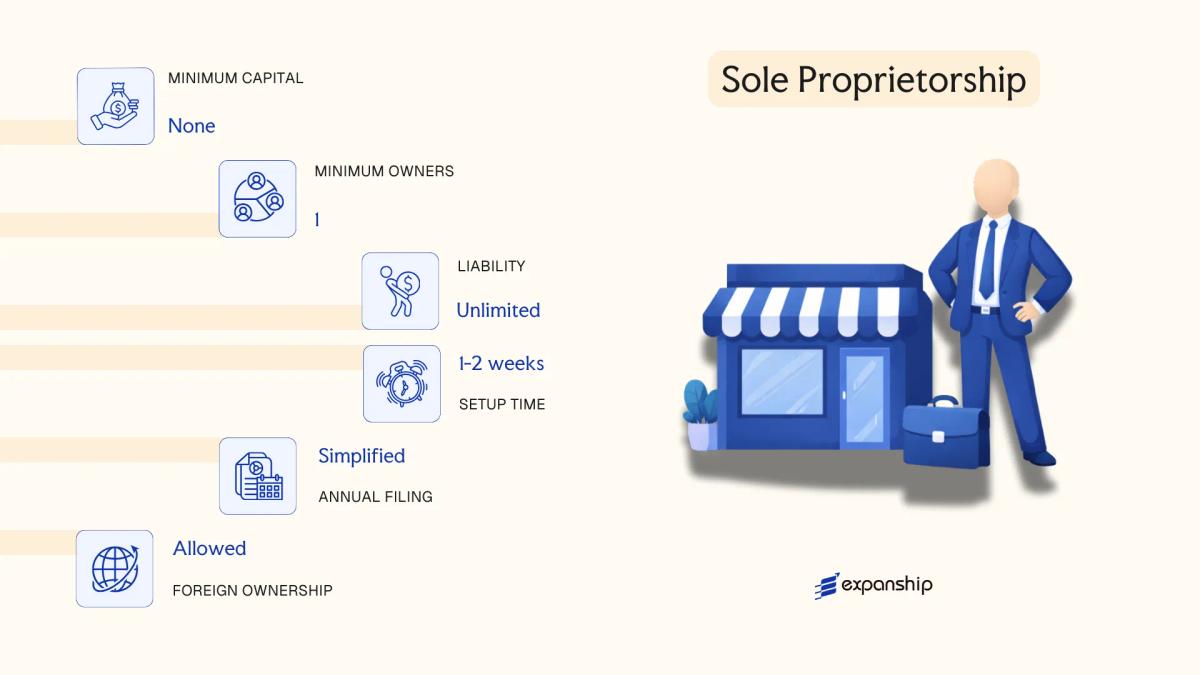
Benin recognises the Entreprise Individuelle (sole proprietorship) as the most accessible form of individual business registration, governed primarily by the OHADA Uniform Act on General Commercial Law (Acte Uniforme relatif au Droit Commercial Général), most recently revised in 2010. Unlike capital companies, this structure carries no separate legal personality — the proprietor and the business are legally the same person, meaning personal assets remain fully exposed to business liabilities.
Registration is handled through the Centre de Formalités des Entreprises (CFE), which operates as the single window for formalities. Traders must also register with the Registre du Commerce et du Crédit Mobilier (RCCM) to obtain legal standing.
Key Characteristics
| Requirement | Detail | Notes |
|---|---|---|
| Legal Form | Entreprise Individuelle / Auto-Entrepreneur | No separate legal personality |
| Members | Single proprietor | No partners or shareholders permitted |
| Local Presence | Registered business address required | Must be declared at RCCM |
| Capital | No statutory minimum | No paid-up capital requirement |
| Liability | Unlimited personal liability | Personal and business assets are merged |
| Privacy | Proprietor's name appears on public register | No confidentiality mechanism available |
Focus Points
- Taxation: Subject to personal income tax (Impôt sur le Revenu des Personnes Physiques); VAT registration required once turnover thresholds are exceeded; no corporate income tax applies.
- Annual Compliance: Annual declaration of activity and turnover to the tax authority (Direction Générale des Impôts) is required.
- Treaty Access: Cannot access double taxation treaties, which are available only to corporate entities.
- Conversion: Can be converted into a capital company (SARL or SAS) through a formal restructuring process before the RCCM.
- Restrictions: Foreign nationals face additional administrative requirements and may encounter restrictions on sole trader registration under national investment rules.
Sub-Types
Auto-Entrepreneur
The auto-entrepreneur status, introduced to formalise micro-activity, applies to individuals operating below defined annual turnover thresholds. It offers a simplified declaration regime and reduced administrative obligations compared to a standard Entreprise Individuelle, making it suited for freelancers and small-scale traders rather than commercially active businesses with growth ambitions.
Recommendations
The Entreprise Individuelle suits resident individuals testing a local market or operating a low-revenue service activity where simplicity outweighs the need for liability protection. The absence of a minimum capital requirement is a practical advantage, but unlimited personal liability is a significant structural drawback for any business carrying financial or contractual risk.
Resident sole traders and micro-entrepreneurs seeking the lowest-cost entry into formal commercial activity in Benin.
How to Choose the Right Entity Type in Benin
Knowing how to choose a company type in Benin requires more than comparing formation costs — the wrong choice produces concrete legal and financial consequences that are difficult to reverse once the entity is registered and operational.
Why Your Entity Choice Matters
The OHADA Uniform Act on Commercial Companies governs company formation across Benin and its OHADA member counterparts. Misalignment between your chosen structure and your actual operations can trigger the following outcomes:
- Forming a structure without the capacity to hold a valid trade register registration when your activity requires local trading can result in administrative sanctions or forced dissolution by the CRIET (Commercial Court of Cotonou).
- Selecting a structure that sits outside Benin's tax treaty eligibility criteria means you cannot claim reduced withholding tax rates under double taxation agreements with France or other treaty partners.
- Choosing an entity that mandates statutory audits — such as an SA — when your business is a single-person consultancy imposes recurring auditor fees that a SARL or SAS would not require at the same revenue threshold.
- Registering a structure that lacks recognized legal personality, such as a simple liaison office, while conducting revenue-generating activities exposes you to reclassification as a permanent establishment by the Direction Générale des Impôts.
Key Factors to Consider
- Business Activity: Active trading, regulated sectors such as banking or insurance, and passive asset holding each point toward a different legal form under the OHADA framework.
- Ownership Structure: A single founder can operate efficiently under an SARL or SAS, while multi-investor arrangements with share transfer mechanisms favor an SA.
- Tax Objectives: Your eligibility for Benin's Investment Charter incentives or treaty benefits depends on the entity type and whether it constitutes a taxable presence.
- Audit and Reporting Requirements: The SA mandates a statutory auditor regardless of size; the SARL and SAS trigger that requirement only above specific thresholds set by OHADA rules.
- Exit and Redomiciliation: Not all structures permit conversion or redomiciliation — confirm whether your chosen form allows transformation into another entity type without dissolution and re-registration.
- Foreign Ownership: Verify whether your activity sector imposes local shareholding requirements before selecting a structure, as certain regulated industries carry restrictions enforced by sectoral ministries.
Corporate Compliance Services in Benin
Maintain good standing with Benin's regulatory and tax authorities across your entity's lifecycle.
Conclusion
Benin's company law, governed by the OHADA Uniform Act on Commercial Companies, defines a structured set of entity options suited to different ownership profiles and operational scales. This incorporating a company in Benin guide has covered each form in full — but a brief orientation across them helps clarify where each one fits.
The SARL remains the most widely registered structure, favoured by resident and foreign investors alike for its manageable capital requirements and limited liability. The SA suits larger enterprises requiring capital market access or multi-shareholder governance. An SAS offers contractual flexibility in shareholder arrangements, while the SNC and SCS carry joint personal liability and serve closely held commercial relationships. Branch and representative offices give foreign entities a controlled presence without incorporating a separate local company.
Benin's continued alignment with OHADA reforms and its membership in the West African Economic and Monetary Union position the country within an evolving regional regulatory framework. Professional guidance on entity selection and RCCM registration remains relevant given the procedural specifics involved.
How Expanship Can Assist You
Expanship provides company registration services in Benin across the full range of structures covered in this blog — from the SARL and SA through to the SAS and branch offices. Every engagement involves direct liaison with the Agence de Promotion des Investissements et des Exportations (APIEx) and the Centre de Formalités des Entreprises (CFE), which sit at the center of Benin's incorporation process.
From document preparation to post-incorporation filings, our service scope covers each stage of setup and ongoing compliance:
- Document preparation, notarization, and legalization
- Registered agent and registered office provision
- Government filing and CFE registrar liaison
- OHADA-compliant corporate record maintenance
- Post-incorporation tax and regulatory compliance management
- Banking introduction assistance
Ready to move forward? Reach out to Expanship Benin to discuss your specific requirements.
Frequently Asked Questions (FAQ)
The Société à Responsabilité Limitée (SARL) is the most frequently registered entity. Its lower capital threshold and simplified governance structure make it accessible to small and medium-sized businesses operating under the OHADA Uniform Act on Commercial Companies.
An SA requires a minimum share capital of XOF 10,000,000 and can offer shares publicly, while a SARL has a lower threshold and restricts share transfers to existing members. Compliance obligations for an SA are more extensive, including mandatory statutory auditors and a board of directors.
The SAS provides the greatest structural flexibility, and its bylaws — including shareholder arrangements — are not fully disclosed in public registries. Nominee arrangements are permissible under OHADA rules, though ultimate beneficial ownership may still be subject to regulatory disclosure requirements.
A SARL and SAS can each be formed by a single associate or shareholder. Partnerships such as the SNC and SCS require at least two partners, as joint liability or mixed liability structures are definitionally multi-party arrangements under the OHADA framework.
Foreign nationals may incorporate a SARL, SA, or SAS without restriction on nationality. Under the OHADA treaty framework, foreign investors hold the same incorporation rights as nationals, though certain regulated sectors may require additional licensing from the relevant Beninese ministry.
Conversion between entity types is permitted under the OHADA Uniform Act. A SARL may be converted into an SA once it meets the capital and shareholder thresholds, and the process requires a notarial deed and registration with the Centre de Formalités des Entreprises (CFE).
The SA, SARL, and SAS each hold separate legal personality distinct from their shareholders. General partnerships (SNC) also acquire legal personality upon registration, though partners retain joint and unlimited liability for the firm's obligations under OHADA commercial law.
The Auto-Entrepreneur regime carries the lightest compliance burden, with simplified tax declarations and no mandatory audit requirements. For incorporated entities, the SAS generally involves fewer statutory formalities than the SA, which mandates a board structure and independent auditors regardless of size.
Legal Disclaimer
The information provided in this article is for general informational purposes only and does not constitute legal, tax, or professional advice. While we strive to ensure the accuracy and timeliness of the content, laws and regulations are subject to change, and the application of laws can vary widely based on specific facts and circumstances.
Readers should not act upon this information without seeking professional counsel tailored to their individual situation. Expanship and its authors disclaim any liability for actions taken or not taken based on the content of this article.
For specific advice regarding your business setup, compliance requirements, or any legal matters, please consult with qualified legal and tax professionals in the relevant jurisdiction.