

Key Takeaways
- Benin's membership in OHADA means your company's contracts, governance structure, and dispute resolution are governed by uniform commercial law recognized across 17 member states, eliminating the legal unpredictability common in single-jurisdiction frameworks.
- Operating through a Société à Responsabilité Limitée registered via the Centre de Formalités des Entreprises (CFE) gives foreign investors full ownership rights with no sector-wide minimum capital requirement standing between formation and operation.
- WAEMU-aligned corporate tax standards and access to ECOWAS markets through a single registered entity mean the cost of initial incorporation translates into a broader regional commercial footprint than the domestic market alone would justify.
- Physical proximity to the Port of Cotonou, combined with APIEX-administered investment incentives, creates measurable logistical and financial advantages for businesses oriented around trade, manufacturing, or regional distribution into landlocked West African neighbors.
Benin is an independent West African nation bordered by Togo, Nigeria, Burkina Faso, and Niger, with a coastline on the Gulf of Guinea that positions it as a transit hub for landlocked neighbors. The primary regulatory body overseeing business registration is the APIEX (Agence de Promotion des Investissements et des Exportations), which operates under the authority of the Beninese government to facilitate both domestic and foreign investment. Foreign nationals are broadly permitted to establish and wholly own companies, and there are no general restrictions on full foreign ownership across most sectors. The country operates a territorial-leaning tax system with rates governed under the West African Economic and Monetary Union (WAEMU) framework.
Most foreign businesses entering the market do so through a Société à Responsabilité Limitée. Corporate registration is handled through the Centre de Formalités des Entreprises (CFE), which functions as a single window for business formalization. The benefits of incorporating in Benin are examined across the sections that follow.
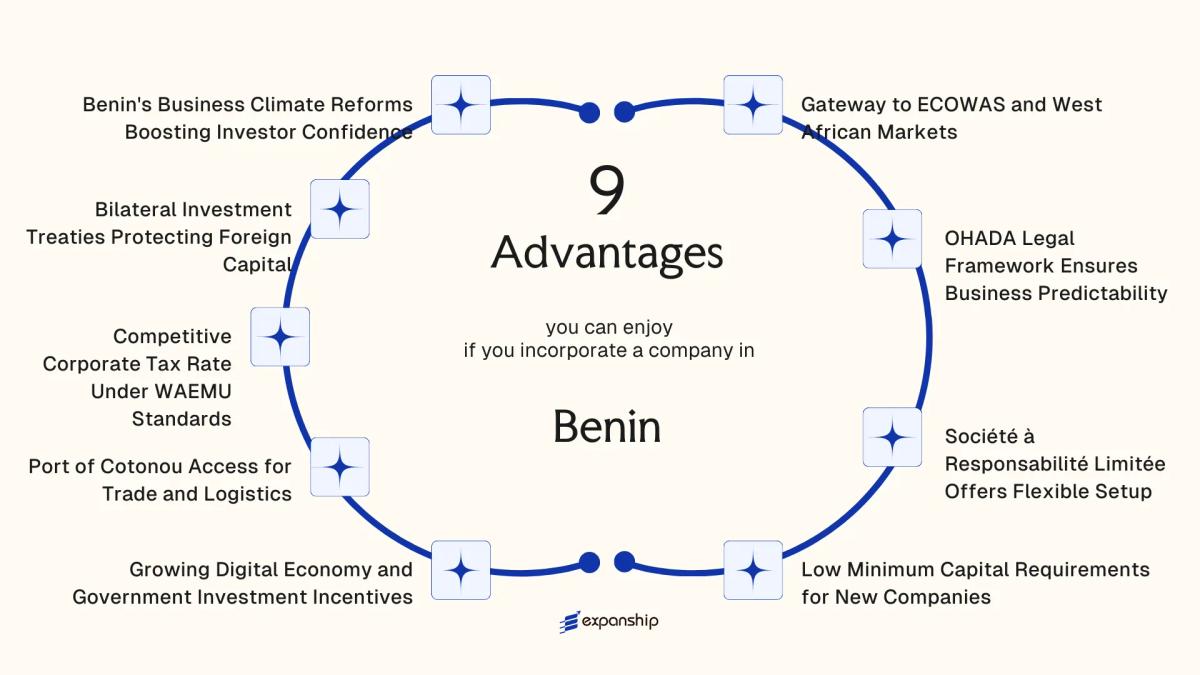
Gateway to ECOWAS and West African Markets
Incorporating in Benin positions your business as a direct participant in the ECOWAS free trade area, which spans 15 member states and a combined population exceeding 400 million people. A company registered here holds the same market access rights as entities from any other member state under the ECOWAS Trade Liberalisation Scheme (ETLS).
Preferential Access Under ECOWAS Rules
Under the ETLS, approved goods manufactured by registered ECOWAS companies move across member state borders free of import duties and quotas. Your firm can apply for ETLS approval, allowing products to circulate through Nigeria, Ghana, Côte d'Ivoire, and 11 other economies without the tariff burden that non-member companies face.
Regional Integration Through WAEMU Membership
Benin also sits within the West African Economic and Monetary Union (WAEMU), a deeper integration bloc sharing the CFA franc. This monetary union eliminates currency conversion costs on transactions with seven neighboring member states, which directly reduces operational expenses for businesses trading regionally.
WAEMU's common external tariff further means that goods entering the bloc face a single, predictable tariff schedule rather than varying national rates.
An ETLS-approved Benin entity can supply goods duty-free across 14 other ECOWAS markets without establishing separate legal presences in each country.
OHADA Legal Framework Ensures Business Predictability
Benin is a member of OHADA, the Organisation pour l'Harmonisation en Afrique du Droit des Affaires, a treaty-based legal system that unifies commercial law across 17 member states. For a foreign business owner, the primary OHADA legal framework benefit in Benin is that your company operates under a codified, supranational body of law rather than a fragmented national system. Courts cannot reinterpret foundational commercial rules in ways that diverge from the shared OHADA Uniform Acts.
The CCJA, OHADA's Common Court of Justice and Arbitration, serves as the final appellate authority on commercial disputes. This means your contractual rights and shareholder protections are ultimately enforced at a regional judicial level, insulating them from shifts in domestic judicial practice.
Predictability under OHADA translates into concrete structural advantages:
- Contract enforcement follows the Uniform Act on General Commercial Law, which applies identically across all member states
- Corporate governance obligations are defined by the Uniform Act on Commercial Companies, leaving little room for local regulatory ambiguity
- Arbitration clauses referencing the CCJA give foreign investors access to a specialized tribunal without requiring separate bilateral arbitration agreements
The Uniform Insolvency Act also governs creditor protections, so lending arrangements and security interests follow standardized rules that financiers operating across West Africa already recognize.

Company Incorporation in Benin
Register your business in Benin under the OHADA legal framework with full compliance support from Expanship.
Société à Responsabilité Limitée Offers Flexible Setup
The SARL (Société à Responsabilité Limitée) is the most widely used corporate vehicle in Benin, and its structural characteristics make it a practical choice when establishing a foreign-owned operation. Governed by the OHADA Uniform Act on Commercial Companies and Economic Interest Groups, the SARL limits each shareholder's liability to their capital contribution. Personal assets remain separate from business obligations, which reduces financial exposure for foreign founders who may not be physically present in the country.
| Feature | Detail |
|---|---|
| Minimum shareholders | 1 |
| Maximum shareholders | 50 |
| Liability | Limited to capital contribution |
| Management structure | One or more gérants (managers) |
| Share transferability | Restricted; subject to shareholder approval |
A single person can form an SARL, which means you can establish a wholly foreign-owned entity without a local co-founder. The gérant, who manages the firm, does not need to be a Beninese national, giving foreign operators direct control over day-to-day decisions. Share transfers to third parties require approval from shareholders holding at least three-quarters of the share capital, a rule that protects your ownership position against unwanted dilution. Because the SARL structure is standardised across all OHADA member states, legal counsel familiar with the uniform act can advise on your entity regardless of where they are based.
Low Minimum Capital Requirements for New Companies
Under the OHADA Uniform Act on Commercial Companies, a Société à Responsabilité Limitée (SARL) can be incorporated with a minimum share capital of XOF 100,000, which is roughly USD 165. That threshold is among the lowest in the OHADA zone, and it means you can establish a legally recognized, liability-limiting entity without committing significant capital before your business generates local revenue.
This matters practically. A foreign entrepreneur testing a West African market does not need to lock up operating funds inside a statutory capital account. The Benin low minimum capital requirements advantage is not just about affordability; it separates the cost of legal establishment from the cost of business operations, giving your firm more financial flexibility from day one.
Under OHADA rules, capital must be fully subscribed at incorporation, though not necessarily fully paid in at that moment for certain contribution types. That distinction is relevant when planning your initial cash flow.
Keep these points in mind:
- XOF 100,000 is the statutory minimum for a SARL; higher-risk sectors may require additional capital under Beninese sectoral regulations
- Capital must be deposited in a local bank account before the notary finalizes the deed
- The low startup capital requirements in a Benin SARL do not affect director liability protections, which remain intact regardless of capital size
- Contributions can be in cash or in kind, subject to independent valuation for non-cash assets
A Benin SARL can legally operate with a single shareholder and a capital base smaller than many countries' notarial filing fees alone.
Growing Digital Economy and Government Investment Incentives
Benin digital economy investment incentives have expanded meaningfully since the government launched its Digital Benin strategy, a national agenda aimed at positioning the country as a technology and services hub within the ECOWAS region. For foreign-owned businesses, this creates a policy environment where digital activity is treated as an economic priority, not an afterthought.
Investment Code Protections for Qualifying Businesses
Under Benin's Investment Code, companies operating in priority sectors, which include digital services and technology infrastructure, may qualify for tax exemptions and customs duty relief during an establishment phase. The Agency for the Promotion of Investments and Major Works (APIEx) administers these incentives and serves as the single entry point for investment approvals. Having a centralized agency reduces procedural fragmentation, so your entity is not bouncing between multiple ministries to access the same benefit.
Eligibility typically depends on job creation thresholds, minimum capital commitments, or sector classification. A business that structures its activities to meet those criteria can secure legally codified protections rather than discretionary concessions.
Digital Infrastructure and Free Zone Access
The government has developed Cotonou's digital infrastructure as part of its broader modernization program, with improvements to broadband connectivity and e-government services. Foreign firms establishing in designated economic zones can access additional fiscal benefits tied to the digital and export services sector. These zone-based advantages are governed by specific legislative instruments separate from the general Investment Code, which means the protections are structural and not subject to ordinary administrative revision.
Maximize Your Investment Benefits in Benin
Speak with our corporate specialists to understand which investment incentives apply to your business structure and sector under Benin's regulatory framework.
Port of Cotonou Access for Trade and Logistics
The Port of Cotonou trade advantages for businesses incorporating in Benin stem directly from geography and infrastructure. Cotonou sits on the Gulf of Guinea and functions as the primary deep-water port serving not only Benin but also landlocked neighbors including Niger, Burkina Faso, and Mali. For a company registered here, that reach translates into a structurally embedded position within regional supply chains.
- The port handles both containerized and bulk cargo, giving importers and exporters operational flexibility across commodity types without routing through a secondary hub.
- Under the ECOWAS Trade Liberalization Scheme, goods transiting through Cotonou toward member states move under a framework that reduces tariff friction, which directly affects landed cost calculations for your business.
- The Port Autonome de Cotonou (PAC) is the regulatory authority overseeing port operations, and its ongoing infrastructure investment programs have expanded terminal capacity, reducing bottleneck risk for time-sensitive shipments.
- Benin's transit corridor agreements with landlocked neighbors mean a company registered here can structure itself as a distribution or logistics intermediary, capturing margin on re-export trade that a firm registered inland cannot efficiently access.
- For businesses in commodity trading, agricultural exports, or manufactured goods distribution, physical proximity to this port eliminates the intermediary handling fees that erode margins when goods must transit through Lomé or Abidjan first.
Competitive Corporate Tax Rate Under WAEMU Standards
Benin applies a standard corporate income tax rate of 30%, which sits within the range harmonized under the West African Economic and Monetary Union (WAEMU) tax directives. For foreign investors, alignment with WAEMU standards means the rate is set within a regional framework, reducing the risk of arbitrary unilateral changes that can affect tax planning in non-member jurisdictions.
Businesses operating under Benin's Investment Charter may qualify for partial or full corporate tax exemptions during an initial operating period, depending on the investment amount and sector. This directly reduces the effective tax burden during the years when a new entity is most capital-intensive.
WAEMU member states also apply a common withholding tax framework, which can reduce double taxation friction for intra-regional transactions. For a firm with supply chains or clients across Côte d'Ivoire, Senegal, or Togo, operating from a WAEMU-compliant jurisdiction simplifies cross-border tax treatment.
Hypothetical scenario: A foreign-owned SARL generating XOF 50,000,000 in annual net profit and qualifying for a 5-year tax holiday under Benin's Investment Charter would defer approximately XOF 15,000,000 in corporate tax obligations during that period, preserving capital for reinvestment in operations.
Bilateral Investment Treaties Protecting Foreign Capital
Benin bilateral investment treaties foreign capital protection extends across a network of signed BITs with partners including France, Germany, the Netherlands, Switzerland, and several other capital-exporting nations. These treaties grant your foreign investment formal legal standing under international law, independent of domestic political changes.
Under most of these agreements, your business benefits from protections that include:
- Fair and equitable treatment standards
- Protection against expropriation without compensation
- Most-favoured-nation treatment
- Access to international arbitration in the event of a dispute
Dispute resolution under these treaties typically allows investors to bypass domestic courts entirely, submitting claims to ICSID or UNCITRAL arbitration instead. For a foreign entity operating in West Africa, this is a material structural protection, not a procedural formality.
Benin is also a signatory to the MIGA Convention, which provides political risk insurance for qualifying investments through the World Bank Group. This adds a second layer of protection against non-commercial risks such as currency transfer restrictions or civil disturbance.
BIT protections generally apply to investments made by nationals or companies of the other contracting state, so confirm your entity's nationality qualifies under the specific treaty before relying on its protections.
Benin's Business Climate Reforms Boosting Investor Confidence
Benin business climate reforms have measurably reduced the administrative friction that historically discouraged foreign direct investment. The government's Programme d'Action du Gouvernement (PAG), initiated under President Patrice Talon, set structural reform targets across business registration, tax administration, and public procurement. These are not aspirational goals — several have translated into concrete regulatory changes that affect how and how quickly a foreign entity can operate.
Accelerated Business Registration
The Guichet Unique de Formalisation des Entreprises (GUFE) now serves as a centralized registration point, reducing the steps required to formalize a company. What previously required multiple agency visits can be completed through a single window, which shortens the time between incorporation and legal operability. For a foreign investor managing timelines across jurisdictions, this reduction in registration friction has a direct effect on project launch schedules.
Reforms to Tax Administration
The Direction Générale des Impôts has implemented measures to simplify tax filing procedures for registered businesses. Improved procedural clarity reduces the compliance burden placed on your finance and legal teams, particularly during the early operational phase when administrative capacity may be limited.
Investor-Focused Regulatory Improvements
Reforms tracked under ease of doing business improvements include stronger creditor protections and updated commercial dispute procedures under the OHADA framework:
- Streamlined contract enforcement timelines through commercial courts
- Updated insolvency procedures aligned with OHADA Uniform Act revisions
- Clearer property registration processes reducing title uncertainty for investors
Why Benin Stands Out Among West African Jurisdictions
Comparing Benin's advantages over other West African jurisdictions requires selecting realistic alternatives. Nigeria, Côte d'Ivoire, and Ghana are the most relevant benchmarks: each attracts foreign investment at scale, operates within overlapping regional frameworks, and represents the kind of market a foreign investor would evaluate alongside a Beninese incorporation.
What the comparison reveals is structural rather than promotional. All four jurisdictions participate in ECOWAS, but the depth of legal harmonisation differs. Benin and Côte d'Ivoire both operate under the OHADA Uniform Acts, which standardise commercial law across member states in ways that Ghana and Nigeria, as common law jurisdictions, do not replicate. For a foreign investor, that distinction affects contract enforceability, insolvency procedures, and corporate governance from the moment of incorporation.
| Parameter | Benin | Côte d'Ivoire | Ghana | Nigeria |
|---|---|---|---|---|
| Legal framework | OHADA (civil law) | OHADA (civil law) | Common law | Common law |
| Standard corporate tax rate | 30% | 25% | 25% | 30% |
| WAEMU membership | Yes | Yes | No | No |
| Minimum share capital (SARL/equivalent) | No statutory minimum (OHADA reform) | CFA 1,000,000 | GHS 500 (approx.) | No minimum (private) |
| Port-based trade infrastructure | Port of Cotonou | Port of Abidjan | Port of Tema | Port of Lagos (Apapa) |
| Free zone regime | Available | Available | Available | Available |
Compliance Services for Companies in Benin
Maintain good standing with Beninese regulatory requirements, including annual filings, tax obligations, and statutory reporting under OHADA and local law.
Conclusion
Incorporating under the OHADA Uniform Acts, operating through a Société à Responsabilité Limitée with no sector-specific minimum capital barrier, and accessing the Port of Cotonou as a regional trade corridor together form a coherent case for why the benefits of incorporating in Benin extend beyond paper registration into genuine commercial utility.
Two structural features make the jurisdiction particularly relevant for foreign capital. The OHADA framework removes legal uncertainty by standardizing commercial law across 17 member states, meaning your contracts, corporate governance, and dispute resolution mechanisms are governed by predictable, regionally recognized rules. Access to ECOWAS markets through a single registered entity amplifies the return on your initial setup investment.
Fit matters, however. An entity oriented around manufacturing may weight port access and investment incentives differently than a services firm focused on digital trade or regional distribution. The suitability of this jurisdiction depends on how your business structure, tax position, and sector align with what the regulatory environment here actually supports. For those whose operations do align, the path from formation through compliance is defined by specific, established rules rather than administrative ambiguity. Knowing precisely which rules apply to your structure is where the process of formalizing your presence begins.
Start Your Benin Company with Expanship Today
Incorporating in Benin with Expanship means working with a team that understands the full scope of what this market demands — from registering a Société à Responsabilité Limitée under the OHADA Uniform Act to maintaining annual compliance filings with the Centre de Formalités des Entreprises. The benefits covered in this blog, from WAEMU tax positioning to bilateral investment treaty protections, require precise execution at each stage to be genuinely useful to your business.
Expanship Benin company formation services cover every procedural step between your decision to incorporate and the moment your entity is operational:
- Preparation and legalization of constitutional documents in accordance with OHADA requirements
- Registered agent and registered office provision within Cotonou
- Government filing and direct liaison with the Centre de Formalités des Entreprises
- Post-incorporation compliance management, including annual reporting obligations
- Corporate tax registration with the Direction Générale des Impôts
- Banking introduction assistance to support account opening for your new entity
Each service addresses a distinct requirement in the formation process, reducing the administrative burden on foreign principals who are managing operations from outside the country.
To discuss your incorporation requirements, contact Expanship Benin directly.
Frequently Asked Questions (FAQ)
Yes, foreign nationals can hold 100% ownership of a company incorporated in Benin. The OHADA Uniform Act on Commercial Companies does not impose local ownership requirements on private limited companies (Sociétés à Responsabilité Limitée) or other standard commercial structures. No mandatory local partner or resident shareholder is required under the general incorporation framework.
Under the revised OHADA Uniform Act on Commercial Companies, the minimum share capital for an SARL was reduced to 1 XOF (one CFA franc), effectively eliminating a capital barrier that previously deterred small business formation. Capital must be fully subscribed at incorporation, though the low threshold means this is rarely a practical constraint for foreign investors.
Benin has signed bilateral investment treaties (BITs) with several countries, which provide protections including guarantees against expropriation without compensation and access to international arbitration mechanisms. The specific protections available to your business depend on whether your home country has a BIT in force with Benin. Investors from countries without a BIT may still access protections under applicable WAEMU or ECOWAS frameworks.
The standard corporate income tax rate in Benin is 30%, which is within the range applied across WAEMU member states. Companies operating under approved investment incentive regimes may qualify for reduced rates or temporary exemptions during an initial operating period, subject to conditions set by the Agence de Promotion des Investissements et des Exportations (APIEx).
The OHADA framework gives foreign investors access to the Common Court of Justice and Arbitration (CCJA), which functions as both a supranational arbitration center and a court of final appeal for commercial disputes across member states. This removes reliance solely on domestic courts and provides a neutral, treaty-based forum governed by uniform procedural rules. Arbitral awards issued under the CCJA are enforceable across all 17 OHADA member states.
A company registered in Benin gains access to the ECOWAS trade area, which covers 15 member states and a combined population exceeding 400 million people. Under the ECOWAS Trade Liberalization Scheme (ETLS), qualifying goods of ECOWAS origin can move between member states with reduced or eliminated tariffs. Eligibility for ETLS benefits requires registration of both the company and its products with the relevant national ETLS authority.
For service-based businesses, the Port of Cotonou has limited direct operational relevance. Its significance is primarily for firms involved in import, export, transit logistics, or supply chain operations serving landlocked neighboring countries such as Niger, Burkina Faso, and Mali. Companies in those sectors benefit from Benin's established position as a regional transit corridor, which reduces logistics costs compared to routing through more distant ports.
The Agence de Promotion des Investissements et des Exportations, known as APIEx, is the primary public body responsible for investment facilitation and incentive administration in Benin. APIEx serves as a single-window interface for investors seeking approvals, information on incentive eligibility, and assistance with regulatory procedures. Applications for benefits under the national investment code are processed through this agency.
Legal Disclaimer
The information provided in this article is for general informational purposes only and does not constitute legal, tax, or professional advice. While we strive to ensure the accuracy and timeliness of the content, laws and regulations are subject to change, and the application of laws can vary widely based on specific facts and circumstances.
Readers should not act upon this information without seeking professional counsel tailored to their individual situation. Expanship and its authors disclaim any liability for actions taken or not taken based on the content of this article.
For specific advice regarding your business setup, compliance requirements, or any legal matters, please consult with qualified legal and tax professionals in the relevant jurisdiction.