

Key Takeaways
- All companies incorporated in Bahrain must be registered through the Sijilat commercial registration portal under the authority of the Ministry of Industry and Commerce, with the legal framework for this process set out in Commercial Companies Law (Legislative Decree No. 21 of 2001, as amended).
- Share capital requirements differ by entity type, meaning founders must confirm the applicable minimum threshold for their chosen legal structure before submitting a registration application.
- Foreign ownership eligibility is sector-dependent, and investors must establish whether their intended business activity permits full or partial foreign ownership prior to structuring the entity.
- Beneficial ownership information must be disclosed and registered in accordance with Bahrain's UBO regulations, with non-compliance carrying exposure to administrative penalties or deregistration.
Company formation in Bahrain is governed by the Commercial Companies Law (Legislative Decree No. 21 of 2001, as amended), with oversight and registration handled by the Ministry of Industry and Commerce through the Sijilat commercial registration portal. The Commercial Companies Law sets out the legal framework within which all entities must be established.
This article covers the structural, documentary, and compliance requirements you must satisfy to register a business entity in Bahrain.
Failure to meet these requirements results in rejection of the registration application or, where non-compliance is identified post-incorporation, exposure to administrative penalties and potential deregistration.
Requirements vary depending on the type of entity you are forming, the sector your business operates in, and whether foreign ownership is involved.
This article is most relevant to foreign investors, non-resident entrepreneurs, and multinational firms evaluating direct incorporation in Bahrain as a base for regional or domestic operations.
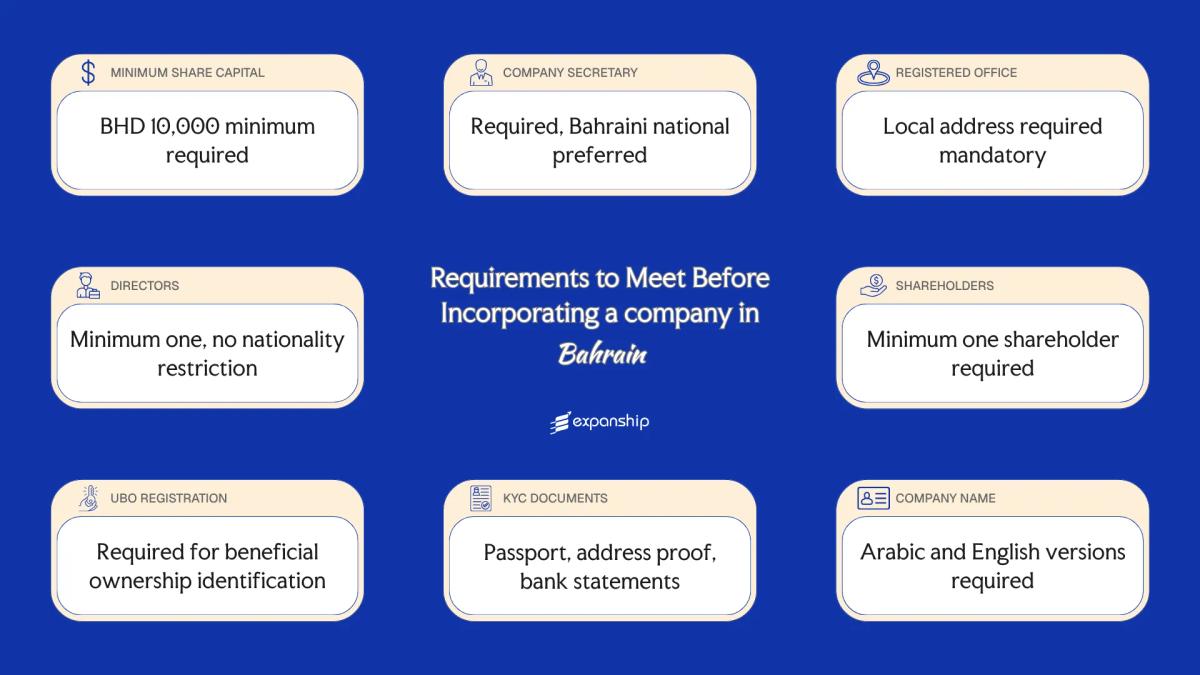
Minimum Share Capital Requirements in Bahrain
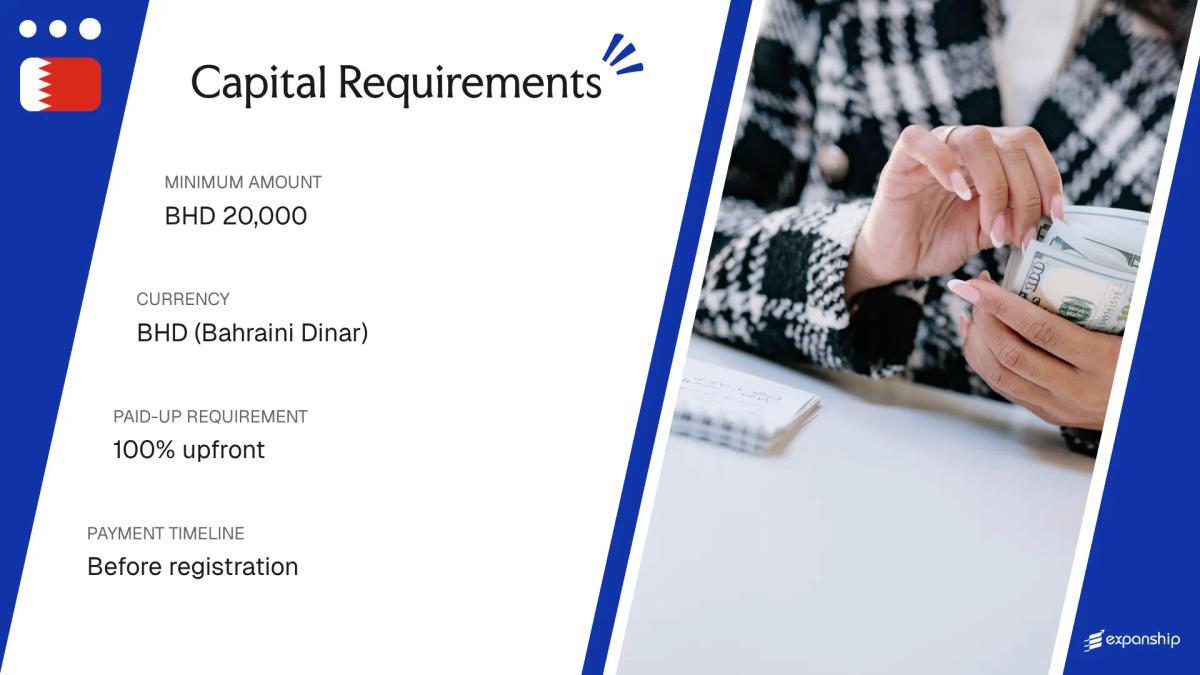
Bahrain minimum share capital requirements vary by legal entity type and are governed under the Commercial Companies Law (Legislative Decree No. 21 of 2001, as amended). The Ministry of Industry and Commerce (MOIC) oversees incorporation filings, and capital declarations form part of the formal registration process.
Shares in Bahraini companies are issued at par value. Capital deposited at incorporation is verified through a licensed local bank, which issues a deposit certificate submitted alongside the MOIC registration application. Once the entity is registered, there is no ongoing statutory obligation to maintain a minimum capital balance in that account.
| Parameter | Detail |
|---|---|
| Minimum Authorized Share Capital | BHD 20,000 for a With Limited Liability (WLL) company; varies for other entity types |
| Maximum Authorized Share Capital | No statutory maximum |
| Minimum Paid-Up Capital | BHD 20,000 for a WLL at incorporation |
| Paid-Up Requirement at Incorporation | Full paid-up capital must be deposited before registration is completed |
| Accepted Currency | Bahraini Dinar (BHD) |
| Accepted Forms of Contribution | Cash; in-kind contributions permitted subject to independent valuation |
| Timeframe to Deposit Capital | Prior to submission of incorporation documents to MOIC |
The bank deposit certificate confirming paid-up capital must be obtained before submitting your incorporation file to the MOIC. Registration will not proceed without it.
Company Secretary Requirements in Bahrain
Under Bahrain's commercial regulations, company secretary requirements in Bahrain are not framed around a traditional "company secretary" role as seen in common law jurisdictions. The Ministry of Industry and Commerce (MOIC) does not mandate a separately appointed company secretary for most entity types, including the widely used With Limited Liability (WLL) company structure.
That said, corporate governance obligations do fall on designated individuals within the entity. A manager or director registered with MOIC typically carries responsibility for maintaining statutory records, filing annual returns, and ensuring regulatory correspondence is handled accurately.
Qualification criteria for who may serve in this governance capacity include:
- Natural persons are generally eligible; corporate entities may serve in certain structures depending on the company type.
- No mandatory professional licensing requirement applies specifically to the secretary or governance role.
- Residency in Bahrain is not a statutory requirement for this position.
- Foreign nationals may serve, subject to the broader director and manager eligibility rules under commercial registration regulations.
- The appointed individual must have legal capacity under Bahraini civil law.

Incorporate a Company in Bahrain
Set up your business entity in Bahrain with accurate filings, regulatory alignment, and end-to-end support from experienced corporate specialists.
Registered Office Requirements in Bahrain
Registered office requirements in Bahrain are governed under the Commercial Companies Law (Legislative Decree No. 21 of 2001, as amended) and enforced by the Ministry of Industry and Commerce (MOIC), which mandates that every registered entity maintain a physical address within the Kingdom at all times.
- A physical address is required; P.O. Box numbers alone do not satisfy the legal address requirements for a Bahrain company.
- The address must be located within Bahrain; overseas or foreign addresses are not accepted for commercial registration purposes.
- Virtual offices are not formally recognised as compliant registered addresses under MOIC criteria.
- Supporting documentation, such as a tenancy contract or title deed, must be submitted to verify the premises at the time of commercial registration.
- The registered address is publicly listed on the commercial registration certificate issued by the MOIC.
- Any change to the registered address must be formally notified to the MOIC, and failure to update records can result in administrative penalties or suspension of the commercial registration.
Director Requirements in Bahrain
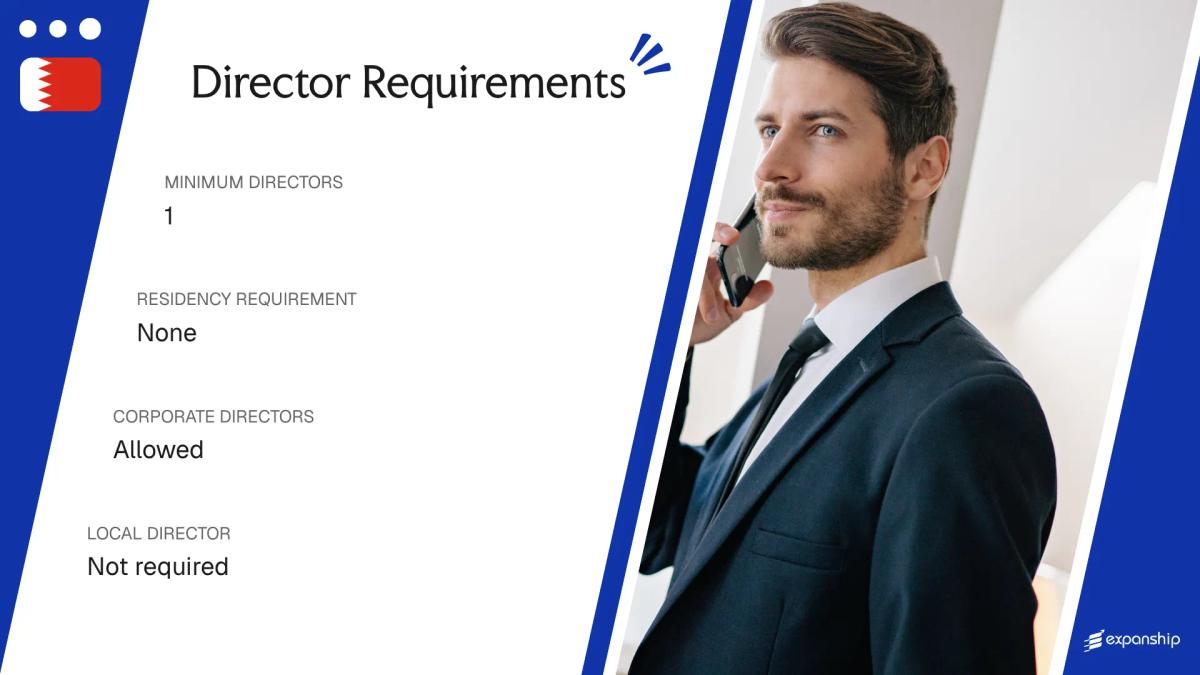
Under the Commercial Companies Law (Legislative Decree No. 21 of 2001, as amended), director requirements in Bahrain establish clear obligations around fiduciary duty, statutory compliance, and personal liability for decisions made on behalf of the entity. Upon appointment, directors assume responsibility for ensuring the company meets its obligations to the Ministry of Industry and Commerce (MOIC) and any relevant sector-specific regulator.
| Parameter | Detail |
|---|---|
| Minimum Number of Directors | A minimum of one director is required for most company types, including the With Limited Liability (WLL) structure. |
| Maximum Number of Directors | No statutory maximum applies to most private company structures, though specific articles of association may impose a cap. |
| Local/Resident Director Required | No statutory requirement for a local or resident director exists under the Commercial Companies Law. |
| Nationality Restrictions | No nationality restrictions apply; foreign nationals may serve as directors. |
| Minimum Age Requirement | Directors must be at least 18 years of age. |
| Corporate Directors Permitted | Corporate directors are not generally permitted; directorship is typically held by natural persons. |
| Director Must Be a Shareholder | No statutory requirement for a director to hold shares in the company. |
| Publicly Listed on Registry | Director information is filed with the MOIC and forms part of the commercial registration record. |
| Disqualification Conditions | Individuals who have been declared bankrupt or convicted of financial crimes may be disqualified from serving as a director. |
Foreign nationals can hold 100% of director positions in a Bahrain WLL company without any requirement to appoint a local director — a feature that is far less common across the wider Gulf Cooperation Council region.
Shareholder Requirements in Bahrain
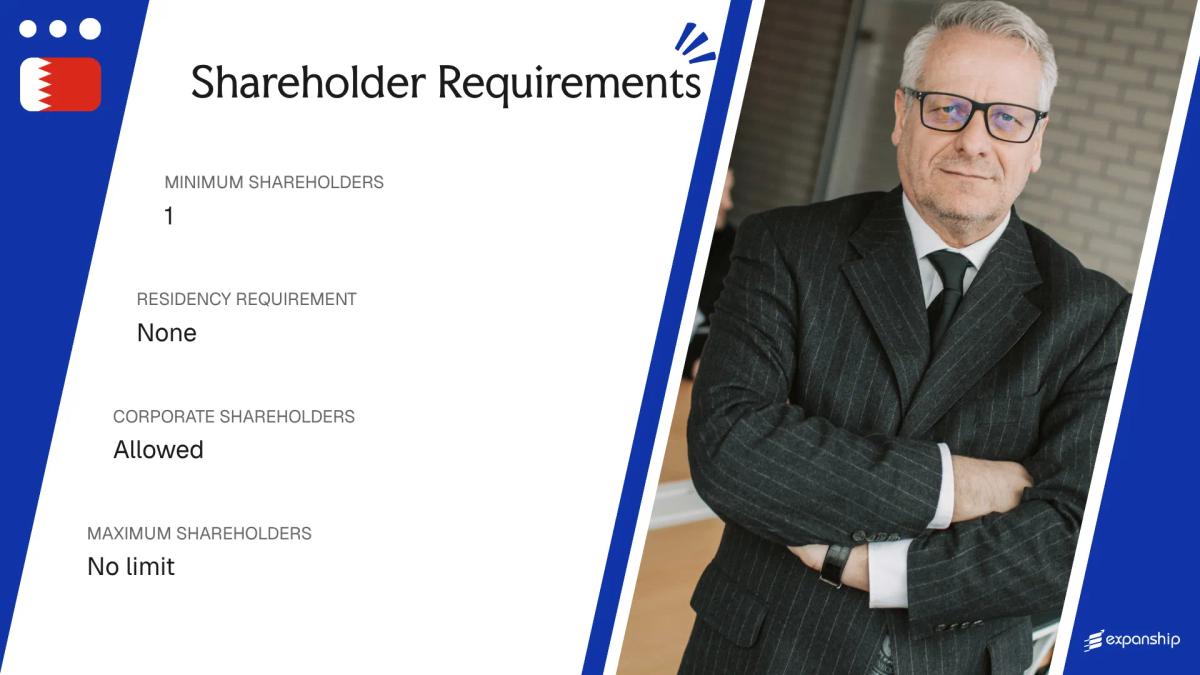
Shareholder requirements in Bahrain vary by entity type. A With Limited Liability company (WLL) requires a minimum of two shareholders and permits up to fifty, while a Single Person Company (SPC) accommodates a sole shareholder structure under the Commercial Companies Law.
Nationality and Residency Restrictions
Foreign shareholder regulations in Bahrain have been substantially liberalised, with 100% foreign ownership now permitted in most commercial activities following amendments under Law No. 1 of 2020. Certain sectors, including oil and gas extraction and real estate, retain restrictions that limit foreign equity participation.
Corporate Shareholders
Corporate entities may act as shareholders in a Bahrain-registered company. No residency requirement applies to the corporate shareholder, though the entity must be a legally recognised body in its jurisdiction of incorporation.
Shareholder Liability
Under a WLL structure, Bahrain company ownership rules confine each shareholder's liability to their subscribed capital contribution. Extended personal liability does not arise under ordinary circumstances.
Register of Shareholders
A register of shareholders must be maintained and filed with the Ministry of Industry and Commerce (MOIC) through the Sijilat commercial registry. Updates reflecting ownership changes are required, and the register is accessible to regulatory authorities.
Structure Your Ownership Correctly Before You Incorporate in Bahrain
Our team can help you assess shareholder eligibility, ownership thresholds, and entity structure before your application is submitted.
UBO / Beneficial Ownership Registration Requirements in Bahrain
Beneficial ownership registration in Bahrain is governed by the Central Bank of Bahrain (CBB) rulebooks and the Ministry of Industry and Commerce (MOIC) under Legislative Decree No. 21 of 2001 and subsequent AML regulations. A beneficial owner is generally defined as any natural person who ultimately owns or controls 10% or more of a company's shares or voting rights.
- Identify all natural persons meeting the 10% ownership or control threshold at the time of incorporation.
- Submit beneficial ownership details to the MOIC through the Sijilat commercial registration portal during the incorporation process.
- Provide supporting documentation confirming ownership structure to the registering authority.
- Report any changes to the beneficial ownership structure to the MOIC within the prescribed timeframe following the change.
| Parameter | Detail |
|---|---|
| Ownership Threshold for UBO Status | 10% or more of shares or voting rights |
| Filing Authority | Ministry of Industry and Commerce (MOIC) via Sijilat portal |
| Disclosure Deadline at Incorporation | At the time of commercial registration |
| Publicly Accessible Register | No statutory public access |
| Penalties for Non-Disclosure | Subject to administrative penalties under AML/CFT regulations |
| Ongoing Update Obligation | Required upon any change in beneficial ownership |
KYC / Document Requirements in Bahrain
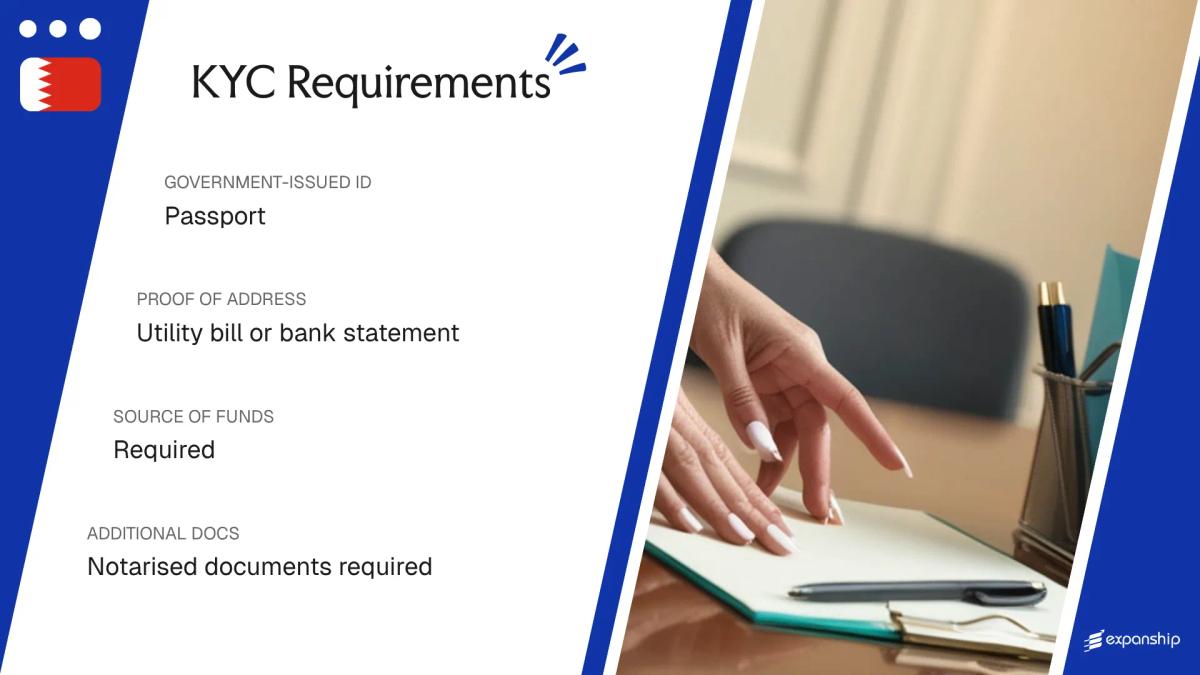
KYC requirements for Bahrain company formation are governed by Decree Law No. 4 of 2001 on Anti-Money Laundering and its subsequent amendments, administered by the Financial Intelligence Unit.
Individual / Personal Documents
- Valid passport copy for each individual director, shareholder, or beneficial owner
- Proof of residential address dated within three months, such as a utility bill or bank statement
- Curriculum vitae or professional profile may be requested for regulated or licensed structures
- Completed KYC form as prescribed by the registering authority or licensed corporate services provider
Corporate Documents
- Certificate of incorporation or equivalent registration document from the entity's home jurisdiction
- Memorandum and Articles of Association or constitutional equivalent
- Register of directors and register of shareholders
- Proof of registered office address for the corporate entity
Source of Funds Documentation
- Recent bank statements covering a minimum of three to six months
- Audited financial statements where the introducing entity is an established business
- A written source of funds declaration may be required if statements are insufficient
Notarisation and Apostille Requirements
- Foreign documents must generally be notarised and apostilled under the Hague Convention
- Arabic translation by a certified translator is required for documents not originally in Arabic
- Corporate documents from non-Hague member states require consular legalisation
Incomplete or unverified source of funds documentation is among the most common grounds for delayed or rejected incorporation filings in Bahrain.
Company Name Requirements in Bahrain
Company name requirements in Bahrain are assessed by the Ministry of Industry and Commerce (MOIC) through the Sijilat commercial registration portal. Each proposed name is reviewed against an existing database of registered trade names to confirm it is distinguishable from current entries.
Names must be submitted in Arabic, though a transliterated or translated English version may accompany the application. The legal form of the entity must appear in the name as a suffix, such as W.L.L. or B.S.C.
Certain terms are prohibited or restricted, including words implying government affiliation, royal or official patronage, or regulated activities such as banking and insurance without the appropriate licence. Names considered offensive or contrary to public order are rejected outright.
Name reservation is available through Sijilat prior to full registration. Reserved names are held for a defined period, after which the reservation lapses if the incorporation process has not been completed.
Compliance Services for Companies in Bahrain
Stay current with Bahrain's regulatory obligations, from annual filings to trade name renewals and ongoing MOIC requirements.
Conclusion
Bahrain company incorporation requirements are governed by a defined framework under the Commercial Companies Law and administered through the Ministry of Industry and Commerce and the Sijilat national registry. The rules covering capital thresholds, director eligibility, and UBO disclosure under the beneficial ownership regulations each carry distinct implications depending on the chosen entity type and the nationality of the founding shareholders.
Foreign ownership permissions, in particular, vary by sector and legal structure. Once these requirements are understood, the practical work of preparing compliant documentation and engaging with the relevant authorities begins.
Expanship's Company Formation Services in Bahrain
Expanship's Bahrain company formation services are structured around the practical requirements that this jurisdiction imposes, from SIJILAT portal registration and MOICT approvals to sector-specific licensing and beneficial ownership disclosure under Decree-Law No. 37 of 2018. Your operational burden doesn't disappear, but having experienced support at each stage reduces the risk of delays caused by incomplete documentation or missed regulatory steps.
Expanship handles the formation process end-to-end and provides ongoing support once your entity is established.
- Preparing and filing all incorporation documents with the relevant Bahraini authorities
- Providing a registered office address and acting as your registered agent in Bahrain
- Managing government filings and liaising with bodies such as MOICT and the NPRA
- Supporting post-incorporation obligations including annual compliance and licence renewals
- Facilitating introductions to local banking institutions
- Registering your business for tax purposes and coordinating with local authorities
To discuss your requirements, contact Expanship Bahrain.
Frequently Asked Questions (FAQ)
The requirement depends on the company type. A With Limited Liability company (WLL) has no statutory minimum share capital under the Companies Law (Legislative Decree No. 21 of 2001, as amended), while a Bahraini Shareholding Company (BSC) is subject to a significantly higher capital threshold. Foreign investors should confirm the applicable requirement for their chosen structure before proceeding, as the distinction directly affects how your entity is registered.
A foreign national can serve as a director of a Bahraini WLL, but sole directorship by a non-Bahraini may be subject to restrictions depending on the business activity and ownership structure. Certain regulated sectors require a Bahraini partner or co-director. The MOICT and the relevant sector regulator will assess the application accordingly.
Failure to register beneficial ownership information as required under Bahrain's anti-money laundering framework can result in administrative penalties and suspension of the company's commercial registration. The Central Bank of Bahrain and MOICT both enforce disclosure obligations, and non-compliant entities risk delays in renewing their CR. Repeated non-compliance can escalate to criminal liability under Bahrain's AML legislation.
A physical registered address in Bahrain is mandatory for obtaining and maintaining a commercial registration (CR) with MOICT. Whether a virtual office arrangement satisfies this requirement depends on the business activity licence; some activities require demonstrable physical premises, while others may accept a flexi-desk or serviced office arrangement. You should confirm the applicable standard with MOICT or the relevant free zone authority before committing to an office solution.
Bahrain's MOICT applies specific naming rules that prohibit names identical or confusingly similar to existing registered entities, names that reference government bodies without authorisation, and names considered contrary to public order or morals. Names must also reflect the company's activity in certain cases, particularly for professional firms. Foreign investors accustomed to more permissive naming regimes in other jurisdictions should conduct a name availability check through the Sijilat commercial registration portal before finalising their entity name.
Yes. Where a corporate entity holds shares in a Bahraini company, the UBO disclosure obligation extends to the natural persons who ultimately own or control that corporate shareholder. Bahrain follows the FATF standard, requiring disclosure of individuals who hold 10% or more of ownership or voting rights, directly or indirectly. The information must be submitted at incorporation and updated whenever a change in beneficial ownership occurs.
Legal Disclaimer
The information provided in this article is for general informational purposes only and does not constitute legal, tax, or professional advice. While we strive to ensure the accuracy and timeliness of the content, laws and regulations are subject to change, and the application of laws can vary widely based on specific facts and circumstances.
Readers should not act upon this information without seeking professional counsel tailored to their individual situation. Expanship and its authors disclaim any liability for actions taken or not taken based on the content of this article.
For specific advice regarding your business setup, compliance requirements, or any legal matters, please consult with qualified legal and tax professionals in the relevant jurisdiction.