
Key Takeaways
- Foreign investors entering most mainland commercial activities in Bahrain are structurally required to bring in a Bahraini national or entity as a shareholder, a constraint rooted in the Commercial Companies Law (Legislative Decree No. 21 of 2001) that limits full ownership control outside designated free zones.
- Sectors classified as protected under Bahrain's foreign investment framework remain entirely or partially closed to non-GCC nationals, meaning certain business models cannot be executed without a local majority partner regardless of capital commitment.
- Ongoing compliance with MOICT licensing and renewal requirements imposes a recurring administrative burden on incorporated entities, as lapses in renewal can affect a company's legal standing and ability to operate.
- Bahrain's relatively small domestic population creates a ceiling on addressable market size that makes the jurisdiction less viable as a standalone consumer market, requiring businesses to factor in regional expansion costs from the outset.
Bahrain operates under a structured regulatory framework governed primarily by the Commercial Companies Law (Legislative Decree No. 21 of 2001, as amended) and overseen by the Ministry of Industry and Commerce and Tourism (MOICT). The disadvantages of incorporating in Bahrain span ownership restrictions, licensing obligations, market limitations, and sector-specific constraints.
Not all of these drawbacks apply equally across business types. A sole foreign-owned entity in a permitted free zone activity faces a materially different set of constraints than a company seeking to operate in a protected domestic sector.
This article is most relevant to foreign investors and non-GCC nationals planning to establish a mainland commercial presence or enter regulated industries. For a full reading of the applicable company law, consulting the official Bahrain legislation portal is advisable before drawing structural conclusions.
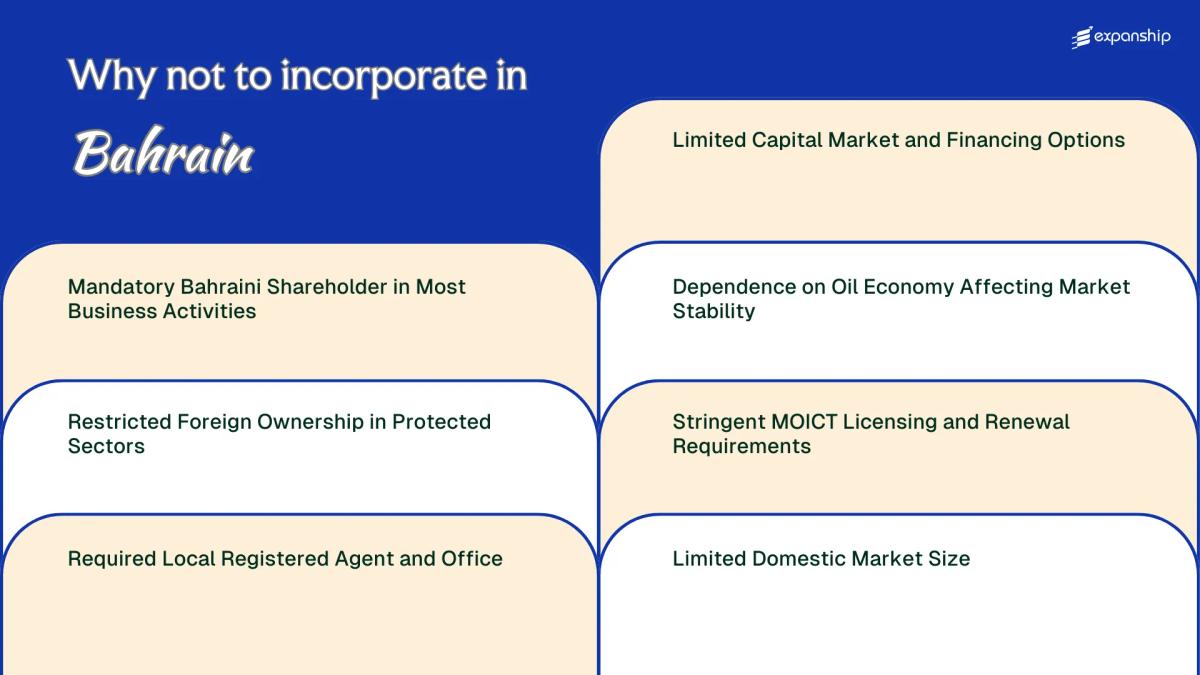
Mandatory Bahraini Shareholder in Most Business Activities
The Bahrain mandatory local shareholder requirement applies to most commercial activities conducted under a With Limited Liability (WLL) structure, meaning foreign investors typically cannot hold 100% equity without specific regulatory approval.
Structural Equity Restrictions Under Bahraini Law
Under the Commercial Companies Law (Legislative Decree No. 21 of 2001, as amended), a Bahraini national or locally owned entity must hold at least 51% of shares in most WLL companies. Your business, in practice, operates under a majority stake held by a party whose interests may not align with yours.
This arrangement creates real governance risk. The local partner retains decisive voting weight over key business decisions, and without a carefully structured shareholder agreement, your operational authority is structurally limited from the outset.
Cost and Dependency of Maintaining a Local Partner
Securing a compliant Bahraini national partner involves ongoing financial arrangements, often structured as annual fees or profit-sharing agreements regardless of actual business performance. That recurring cost reduces net returns and introduces a dependency that affects long-term strategic planning.
Certain activities under the Bahrain Investors Center's approved foreign ownership list are exempt, but these exemptions are sector-specific and not broadly available to general trading or service businesses.
A Bahraini national holding 51% equity retains legal majority control, and without a binding shareholder agreement governed by a neutral jurisdiction, you have limited enforceable protection against decisions made without your consent.
Restricted Foreign Ownership in Protected Sectors
Restricted foreign ownership sectors in Bahrain are defined through a formal negative list maintained under the Commercial Companies Law and administered by the Ministry of Industry, Commerce and Tourism (MOICT). Several industries remain fully or partially closed to foreign capital, and operating in these sectors without the required local equity stake is not legally permissible.
Sectors including retail trade, real estate brokerage, and certain professional services impose a Bahraini ownership threshold that directly limits how much of your firm you can control. For a foreign investor, minority ownership means limited decision-making authority and reduced profit entitlements, even when your capital and expertise drive the business.
The practical friction this creates includes:
- Profit distributions are capped by your ownership percentage, reducing returns even in high-revenue years
- Dividend negotiations with a mandated local partner can delay or complicate financial planning
- Exit from a restricted-sector business requires the local partner's consent, limiting your liquidity options
- Sector reclassification by MOICT can retroactively affect your ownership structure without prior notice
Free zones like Bahrain Investment Wharf offer full foreign ownership, but these zones exclude many service categories covered by the negative list. That carve-out does not resolve the restriction for businesses that must operate in the domestic market.

Company Incorporation in Bahrain
Understand the ownership structures, sector restrictions, and licensing requirements before registering your business in Bahrain.
Required Local Registered Agent and Office
Satisfying the Bahrain local registered agent requirement adds a recurring operational cost that foreign business owners cannot avoid. Under the Commercial Companies Law (Legislative Decree No. 21 of 2001) and related Ministry of Industry, Commerce and Tourism (MOICT) regulations, every registered entity must maintain a physical commercial address within the Kingdom and, depending on the structure, appoint a local agent or sponsor.
| Obligation | Requirement | Burden on Foreign Entity |
|---|---|---|
| Commercial address | Physical Bahraini address mandatory for MOICT registration | Ongoing lease or service contract cost even before operations begin |
| Registered agent (foreign company branch) | Local agent appointment required for branch registration | Agent fees payable regardless of trading activity |
| CR (Commercial Registration) address validity | Address must remain active and current with MOICT | Any lapse triggers CR suspension risk |
| Virtual office status | Not universally accepted as a compliant registered address | Forces costlier physical office arrangements |
The address registered with MOICT must be kept current at all times. A lapse or discrepancy can result in suspension of the Commercial Registration, which effectively halts the firm's legal ability to operate or renew licenses.
For a foreign investor testing the market or operating a lean structure, maintaining a physical Bahraini address generates fixed costs that accrue from day one. Agents also carry contractual leverage, since terminating or replacing an agent requires formal MOICT procedures that take time and generate additional fees.
Limited Capital Market and Financing Options
Bahrain capital market financing limitations are a structural constraint that foreign businesses often underestimate before incorporation. The Bahrain Bourse, regulated by the Central Bank of Bahrain (CBB) under the Financial Institutions Law, lists a relatively small number of publicly traded companies, which means exit via public markets is not a realistic option for most foreign-owned entities.
Accessing debt financing through local banks typically requires established credit history within the kingdom, collateral held locally, and often a Bahraini co-shareholder structure. For a newly incorporated foreign firm, this creates a funding gap that equity markets cannot fill either.
Private capital sources are limited compared to financial hubs like Singapore or the UAE, where venture capital ecosystems are significantly more developed. Your business will likely depend on international financing arranged outside the jurisdiction, adding cost and complexity to capital structuring.
- CBB licensing governs all capital-raising activities; unlicensed public offerings are prohibited under the CBB Rulebook
- Foreign firms cannot list on the Bahrain Bourse without meeting specific residency and financial thresholds
- Local bank lending to foreign-owned companies is subject to CBB credit exposure limits
- Private placements require CBB approval if directed at Bahraini residents
Bahrain has no domestic stock options or warrants market, meaning equity-based employee compensation structures common in Western jurisdictions have no local exchange mechanism to support them.
Dependence on Oil Economy Affecting Market Stability
Bahrain's oil economy dependence creates business risks that extend well beyond the energy sector itself. Because hydrocarbons still account for a significant share of government revenue, fiscal policy, public spending, and domestic demand all shift in response to global crude prices.
Structural Vulnerability to Oil Price Cycles
When oil revenues contract, the government's capacity to fund infrastructure projects, public salaries, and subsidies tightens, which reduces consumer purchasing power across the economy. Foreign businesses operating in construction, retail, or professional services feel that contraction directly, not as a downstream effect but as reduced client budgets and deferred contracts.
Implications for Business Planning and Revenue Predictability
Economic volatility risks incorporating in Bahrain are not theoretical. The 2014 to 2016 oil price decline forced a substantial fiscal deficit, demonstrating how quickly private sector conditions can deteriorate when hydrocarbon receipts fall short. Bahrain's relatively limited non-oil revenue base, compared to Gulf neighbors with larger sovereign wealth funds, means the buffer against such cycles is structurally thinner, making long-term revenue forecasting for your business considerably less reliable.
Assessing Market Risks Before Incorporating in Bahrain
Speak with our specialists about the economic and structural factors that may affect your business setup in Bahrain.
Stringent MOICT Licensing and Renewal Requirements
Bahrain MOICT licensing requirements challenges extend beyond initial registration — the Ministry of Industry, Commerce and Tourism imposes ongoing renewal obligations that create recurring administrative and financial burdens for foreign-owned firms.
- Your commercial registration must be renewed annually through the Sijilaat portal, and any lapse in renewal triggers suspension of your firm's legal standing to operate.
- Each licensed activity under your CR requires separate MOICT approval, meaning a multi-activity business accumulates multiple compliance obligations rather than a single consolidated license.
- Certain regulated activities require sector-specific approvals from additional bodies before MOICT will issue or renew a license, extending your timeline and cost unpredictably.
- Failure to maintain a valid CR simultaneously invalidates your ability to sponsor work visas, blocking your workforce continuity during any renewal delay.
- MOICT renewal fees vary by activity classification and paid-up capital tier, so as your entity grows, your annual compliance cost scales upward without a fixed ceiling.
Limited Domestic Market Size
Bahrain small domestic market limitations present a structural ceiling for businesses that depend on local consumer volume to reach profitability. With a population of approximately 1.5 million people, the addressable resident market is narrow by any regional standard, and a significant portion of that figure consists of expatriate workers whose spending patterns and long-term residency are tied to employment conditions rather than permanent settlement.
For product-based businesses or retail-oriented firms, unit economics that work in markets of 10 to 30 million consumers often fail to scale in this environment. Fixed operational costs — licensing fees under the Ministry of Industry, Commerce and Tourism (MOICT), commercial registration, and office lease obligations — remain constant regardless of sales volume.
Service firms targeting B2B clients face a concentrated pool of potential buyers. Most industries are dominated by a limited number of large state-linked entities or family-owned conglomerates, which reduces competition-driven demand and limits client diversification.
A consumer goods company requiring a minimum of 500,000 active buyers to cover its annual fixed operating costs of BHD 80,000 would find that less than 35% of Bahrain's resident population falls within a typical target demographic, leaving the firm structurally dependent on export revenue or GCC market access from day one.
Overcoming Incorporation Challenges in Bahrain
Overcoming Bahrain incorporation challenges requires a structured approach built on understanding the specific legal and regulatory obligations that apply before you commit to a structure. The constraints covered in this blog are institutional, not incidental, and addressing them demands deliberate pre-incorporation planning.
- Identify whether your intended business activity appears on the 100% foreign ownership list published by the Ministry of Industry and Commerce, as this determines whether a Bahraini partner is legally required.
- Establish a compliant registered office address and appoint a licensed local registered agent before submitting your Commercial Registration application.
- Structure your entity type to match financing options available through the Bahrain Bourse or licensed local banks, given the limited capital market depth.
- Plan licensing timelines around MOICT's renewal cycles to avoid lapses that can suspend commercial operations.
- Conduct sector-specific foreign ownership checks against the Foreign Investment Law (Legislative Decree No. 50 of 2014) before finalising your shareholder structure.
Each of these steps operates within a framework governed by the MOIC and related statutory bodies. The degree of difficulty varies by sector, and the protections embedded in Bahraini commercial law are not procedural formalities that can be bypassed through structural workarounds.
Bahrain's Overall Business Appeal
Bahrain's position as a GCC financial hub with zero corporate tax on most activities and a convertible currency gives it credibility as a foreign incorporation destination. The disadvantages covered in this blog are real structural constraints, not administrative inconveniences, yet they do not apply uniformly across every business type or activity.
| Pros | Cons |
|---|---|
| No corporate income tax on most business activities outside the oil sector | Most commercial activities require a Bahraini national or entity to hold a majority stake |
| 100% foreign ownership permitted in certain free zone and approved activities | Foreign ownership is prohibited or capped in sectors designated as protected under Bahraini commercial law |
| No personal income tax and full repatriation of profits | A licensed local registered agent and a physical office address are mandatory for company registration |
| Access to GCC markets through bilateral and regional trade agreements | The domestic consumer market is small, limiting revenue potential for businesses targeting local demand |
| Established regulatory framework under MOICT with defined licensing procedures | Licensing renewal requirements and MOICT compliance obligations add recurring administrative burden |
| Developed banking sector relative to regional peers | Heavy dependence on oil revenues creates macroeconomic sensitivity that affects broader investment conditions |
Fiscal advantages and GCC market access make Bahrain a structurally sound choice for specific business models. For companies where ownership flexibility, market scale, or sector access are central to the business case, the constraints outlined here carry material weight.
Company Compliance Services in Bahrain
Ongoing compliance in Bahrain involves MOICT license renewals, commercial registration maintenance, and adherence to sector-specific regulatory requirements. This service covers the procedural obligations your entity must meet to remain in good standing.
Conclusion
A Bahrain company incorporation drawbacks summary must account for the structural constraints that affect day-to-day operations and long-term planning. Foreign ownership restrictions under the Commercial Companies Law, the requirement to appoint a local registered agent, and the economy's continued dependence on hydrocarbon revenues each present material considerations for any entity establishing a presence here.
Knowing these limitations in advance allows your business to structure its entry more precisely. Specialist guidance on licensing requirements, ownership arrangements, and ongoing compliance obligations can determine whether the chosen structure remains viable over time.
Expanship's Bahrain Incorporation Services
Bahrain's incorporation requirements, from MOICT licensing to Bahraini shareholder obligations and registered office mandates, create a layered compliance burden that can slow down your market entry if not managed carefully. Expanship's Bahrain incorporation services are structured around these specific obligations, helping your business meet each requirement without losing time to procedural back-and-forth.
From initial registration through to ongoing compliance, Expanship supports your firm across the full incorporation lifecycle.
- We prepare and file all company registration documents with the relevant Bahraini authorities on your behalf.
- A local registered agent and office address are provided to satisfy MOICT requirements.
- Our team handles government filings and liaises directly with regulatory bodies throughout the process.
- Post-incorporation compliance management keeps your entity in good standing as licensing renewal cycles arise.
- We facilitate introductions to local banking institutions to support your account opening process.
- Tax registration and coordination with local authorities are handled as part of your setup.
Reach out to Expanship Bahrain to discuss how we can support your incorporation.
Frequently Asked Questions (FAQ)
The requirement applies broadly to most standard commercial activities, but exceptions exist for entities established in the Bahrain International Investment Park, the Bahrain Logistics Zone, and certain financial services licensed through the Central Bank of Bahrain. Companies operating under specific bilateral investment treaties or in approved free zone structures may qualify for higher foreign ownership, but these are not blanket exemptions and require separate regulatory approval.
Protected sectors carry additional foreign ownership caps or outright exclusions, as defined under Bahrain's Negative List, which restricts foreign participation in activities deemed sensitive to national interests. Attempting to structure around these restrictions through nominee arrangements is legally risky and can result in licence refusal or cancellation by the Ministry of Industry, Commerce and Tourism. The consequences extend beyond fines and can include the forced dissolution of the entity.
Costs vary depending on the service provider, but annual registered agent fees in Bahrain typically range from BHD 500 to BHD 2,000, with office address services adding further expense if your business has no physical presence. These are non-optional costs, as the Commercial Companies Law requires every registered company to maintain a physical address and a designated local contact for regulatory correspondence. Failing to maintain these can trigger compliance flags during your annual MOICT licence renewal.
Yes, it is more complex when your activity falls under the remit of additional regulators. A financial services firm, for instance, must obtain authorisation from the Central Bank of Bahrain on top of standard MOICT registration, and a healthcare entity faces approval from the National Health Regulatory Authority. Each regulator has its own documentation requirements, timelines, and capital thresholds, which means the incorporation process can extend well beyond the standard two-to-four week window advertised for straightforward activities.
A failure to renew on time results in the suspension of your commercial registration, which legally prohibits your business from operating and entering into contracts until the registration is reinstated. Reinstatement typically requires settling outstanding fees along with applicable late penalties, and a prolonged lapse can prompt the MOICT to initiate deregistration proceedings. This has a knock-on effect on any visas or work permits sponsored by the company, which can also be suspended during the period of non-compliance.
Bahrain's government finances remain heavily tied to oil receipts and GCC fiscal transfers, making public spending, infrastructure investment, and broader market confidence susceptible to global energy price cycles. During periods of low oil prices, government procurement slows and consumer spending contracts, which directly affects businesses serving the domestic market or government-linked entities. Unlike larger Gulf economies, Bahrain has less fiscal buffer to absorb prolonged downturns, amplifying the economic volatility your business is exposed to.
For most foreign-owned SMEs, yes. The Bahrain Bourse is small relative to the Abu Dhabi Securities Exchange or the Saudi Exchange (Tadawul), offering limited opportunity to raise equity through public markets, and local bank financing is generally reserved for businesses with established Bahraini ownership or substantial collateral. Foreign firms without a Bahraini partner or significant local assets often find themselves excluded from the primary lending channels available to domestically owned competitors, which pushes financing costs higher or requires funding from outside Bahrain entirely.
Legal Disclaimer
The information provided in this article is for general informational purposes only and does not constitute legal, tax, or professional advice. While we strive to ensure the accuracy and timeliness of the content, laws and regulations are subject to change, and the application of laws can vary widely based on specific facts and circumstances.
Readers should not act upon this information without seeking professional counsel tailored to their individual situation. Expanship and its authors disclaim any liability for actions taken or not taken based on the content of this article.
For specific advice regarding your business setup, compliance requirements, or any legal matters, please consult with qualified legal and tax professionals in the relevant jurisdiction.