
Key Takeaways
- Bahrain imposes no corporate income tax on the majority of commercial activities, making it one of the few GCC jurisdictions where entity-level profits are retained in full rather than partially surrendered to the state.
- Under the Commercial Companies Law, foreign investors can hold 100% ownership across a wide range of sectors, eliminating the structural dependency on local partners that characterises many comparable regional jurisdictions.
- The Ministry of Industry and Commerce administers company registration through the Sijilaat platform, reducing formation friction and allowing businesses to establish a legal presence without navigating fragmented, multi-agency processes.
- Because Bahrain sits within the GCC customs union and has concluded free trade agreements with major economies, a company incorporated here can access a substantially larger consumer and commercial market than its domestic population alone would suggest.
Bahrain is an independent island nation in the Arabian Gulf, situated between Saudi Arabia and Qatar, and governed under a constitutional monarchy. Company registration falls under the authority of the Ministry of Industry and Commerce, which administers business licensing and corporate compliance through its Sijilaat platform. Foreign businesses incorporating here most commonly do so through a With Limited Liability company.
The benefits of incorporating in Bahrain are directly tied to its zero-tax posture on the majority of commercial activities, a position that distinguishes it from many other jurisdictions in the region. Foreign direct investment is broadly welcomed, with full foreign ownership permitted across a wide range of sectors under the Commercial Companies Law.
This article examines the key advantages your business gains by establishing a presence here — from the tax environment and ownership rights to market access and operational costs.
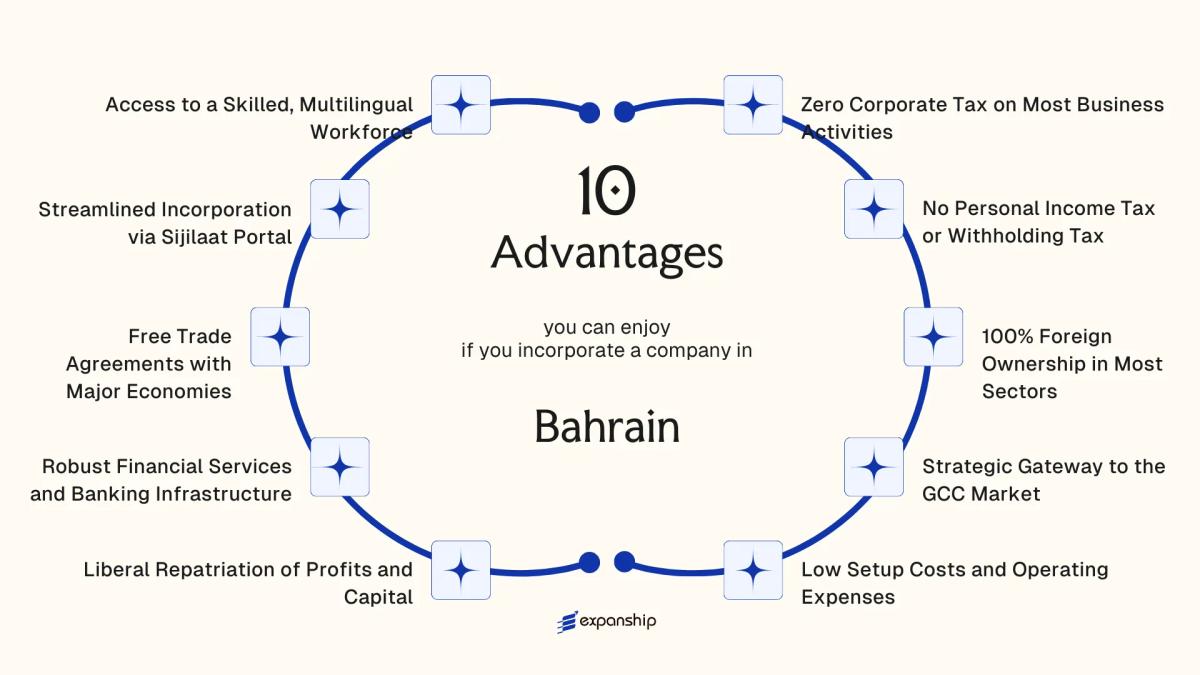
Zero Corporate Tax on Most Business Activities
Bahrain's zero corporate tax advantage is one of the most structurally significant features of its business environment. For the majority of commercial activities, no corporate income tax applies at the entity level.
What the Tax Position Actually Covers
Under Bahrain's general tax framework, companies engaged in most sectors, including trading, manufacturing, consulting, and financial services, are not subject to corporate income tax. This absence is not a temporary incentive or a special zone carve-out; it is the default legal position for entities registered under the Commercial Companies Law. For a foreign business owner, this means retained earnings remain within the company rather than being reduced at source before any distribution decision is made.
The One Carve-Out Worth Knowing
The exception applies to oil, gas, and hydrocarbon extraction companies, which are subject to a separate tax regime. Outside that sector, your Bahrain WLL or any other registered entity operates under no corporate tax obligation on its profits. Compared to the global average corporate tax rate of approximately 23%, the financial difference on annual profits can be material, particularly for businesses that reinvest earnings into operations or regional expansion.
Profits generated through your Bahrain entity are not reduced by a corporate tax charge before you decide how to deploy them.
No Personal Income Tax or Withholding Tax
There is no personal income tax in Bahrain. Salaries, dividends, and investment returns paid to individuals are not subject to any national income levy, which means employees and shareholders retain the full value of what they earn. For businesses, this directly reduces the total cost of compensation packages: you do not need to gross up salaries to offset an income tax burden that simply does not exist.
Withholding tax is equally absent. Payments made to non-resident contractors, foreign parent companies, or offshore shareholders — whether as dividends, royalties, or service fees — are not subject to deduction at source. This structure keeps cross-border cash flows intact without requiring treaty planning to recover withheld amounts.
Payroll obligations are comparatively contained. Social insurance contributions apply under the Social Insurance Organisation (SIO), but they are defined, predictable, and limited in scope. That matters for forecasting your employment costs accurately from the outset.
Why this structure works in practice:
- SIO contribution rates are fixed and published, making labour cost modelling straightforward
- No annual income tax filings are required for individual employees, reducing HR compliance overhead
- Foreign shareholders receiving dividends face no deduction at the source, eliminating a common repatriation friction point
- The absence of withholding obligations removes the need for double taxation treaty analysis on routine intercompany payments

Incorporate Your Company in Bahrain
Set up your Bahrain entity with full compliance support, from commercial registration through the Sijilaat portal to ongoing regulatory maintenance.
100% Foreign Ownership in Most Sectors
100% foreign ownership in Bahrain is permitted across most commercial and industrial sectors under the Commercial Companies Law (Legislative Decree No. 21 of 2001, as amended). Foreign nationals can hold the entirety of shares in a With Limited Liability company (WLL) or a Single Person Company (SPC) without requiring a local Bahraini sponsor or partner. This structural freedom has a direct consequence: your business retains full decision-making authority and undivided profit entitlement from day one.
| Entity Type | Foreign Ownership Permitted | Minimum Capital Requirement |
|---|---|---|
| WLL (With Limited Liability) | Up to 100% | BHD 20,000 (general commercial) |
| Single Person Company (SPC) | 100% | BHD 50 (varies by activity) |
| Branch of Foreign Company | 100% (parent ownership) | None (activity-dependent) |
| Joint Stock Company (BSC) | Up to 100% in most sectors | BHD 250,000 (closed) |
Certain regulated activities, including those in specific areas of media and real estate, may carry ownership conditions or licensing requirements set by relevant sector authorities. Outside those defined categories, the Bahrain WLL 100 percent foreign ownership benefit applies without a mandatory local equity stake, which removes a structural cost that exists in several neighboring markets where a national partner must hold a minimum share. For a foreign investor, this means the entity's ownership structure does not impose an involuntary profit-sharing arrangement on its own.
Strategic Gateway to the GCC Market
Bahrain's position as a Bahrain gateway to GCC market is structural, not incidental. Sitting at the northern tip of the Arabian Gulf, the island is physically connected to Saudi Arabia via the King Fahd Causeway, allowing commercial vehicles to transport goods overland into the world's largest Arab economy without sea freight delays or port congestion.
Under the GCC Customs Union, goods manufactured or substantially transformed in Bahrain can circulate across all six member states under a unified external tariff, which currently sits at 5% for most product categories. For a business targeting regional distribution, this means a single Bahraini entity can serve Saudi Arabia, the UAE, Kuwait, Qatar, and Oman without establishing separate legal presences in each country.
Saudi Arabia alone represents a consumer market of over 35 million people. Physical proximity to Dammam and the Eastern Province industrial corridor reduces logistics costs and transit times significantly for firms with regional supply chains.
Keep these structural points in mind:
- GCC Customs Union membership applies to goods meeting local content or transformation rules
- The King Fahd Causeway handles commercial freight directly into Saudi Arabia
- A single Bahraini CR (Commercial Registration) can support regional operations
- Rules of origin must be satisfied for preferential tariff treatment across member states
Bahrain was the first GCC state to sign a Free Trade Agreement with the United States, giving US-origin goods preferential access through a Bahraini entity into the wider Gulf region.
Low Setup Costs and Operating Expenses
Bahrain low business operating costs are among the most concrete financial advantages available to foreign investors in the Gulf. Government registration fees through the Sijilaat portal are modest, and the absence of minimum paid-up capital requirements for most company structures means you can launch with capital matched to your actual operational needs rather than a regulatory threshold.
Office and Physical Establishment Costs
Commercial office rents across Manama and secondary business districts are materially lower than equivalent Grade A space in Dubai or Riyadh, giving cost-conscious businesses a realistic path to maintaining a physical presence. Flexible desk and co-working arrangements are legally permissible for entities that do not require a dedicated premises under their CR (Commercial Registration) conditions, reducing fixed overhead during early-stage operations.
Bahrain's free zones, including the Bahrain International Investment Park and Bahrain Logistics Zone, offer subsidized land leases and pre-built units at below-market rates. For businesses in manufacturing, logistics, or distribution, this directly reduces the capital tied up in physical infrastructure.
Labor and Operational Expenditure
The Wages Protection System (WPS), administered by the Labour Market Regulatory Authority (LMRA), governs payroll compliance but does not impose sector-wide minimum wage floors for expatriate workers in most industries, preserving flexibility in compensation structuring. Employer social insurance contributions apply at a fixed rate for non-Bahraini employees, and at a higher rate for Bahraini nationals under the Social Insurance Organization (SIO) framework. Both rates remain below comparable employer contribution burdens across several OECD jurisdictions.
Structure Your Bahrain Business for Maximum Cost Efficiency
Speak with our corporate services team about registration fees, capital requirements, and operational cost planning for your Bahrain entity.
Liberal Repatriation of Profits and Capital
Bahrain profit repatriation advantages are grounded in statute, not discretionary policy. Under the Foreign Capital Investment Law, foreign investors are entitled to transfer profits, dividends, and capital out of the country without restriction. No approval from a central authority is required, and there is no mandated retention of earnings within the entity.
- There is no cap on the percentage of profits that can be remitted abroad. A foreign shareholder can repatriate 100% of net earnings in any given period.
- The Bahraini dinar is pegged to the US dollar at a fixed rate of BD 0.376 per USD, a peg maintained since 1987. This eliminates currency conversion risk on transfers denominated in US dollars.
- No foreign exchange controls restrict outbound fund transfers, meaning your treasury team can move capital without navigating a licensing or approval queue.
- Repatriation applies equally to the return of original invested capital, not just profits. An investor exiting the market can recover their principal without regulatory holdback.
- These protections apply to entities incorporated across the main legal structures available to foreign investors, including WLLs and Single Person Companies registered under the Commercial Companies Law.
Robust Financial Services and Banking Infrastructure
Bahrain financial services infrastructure advantages are most visible in the Central Bank of Bahrain (CBB), which serves as the single regulator for all financial institutions operating in the Kingdom. Established under the Central Bank of Bahrain and Financial Institutions Law (Decree Law No. 64 of 2006), the CBB oversees banks, insurance firms, investment companies, and capital markets under one unified framework. For a foreign business, this consolidated oversight means fewer regulatory bodies to engage with when setting up financial operations.
Your firm gains access to both conventional and Islamic banking products through institutions licensed by the CBB. This dual-system availability is operationally significant for businesses serving clients or partners across the GCC, where Sharia-compliant financing structures are frequently required.
Bahrain also hosts the Arab Banking Corporation, Arab Financial Services, and regional treasury centers for several multinational firms, reflecting the depth of correspondent banking relationships available to businesses incorporated here.
A hypothetical scenario: A manufacturing company incorporated in Bahrain requiring a Murabaha trade finance facility of USD 2 million can access this product domestically through CBB-licensed Islamic banks, without routing the transaction through a third-country financial institution, reducing transaction costs and processing time.
Free Trade Agreements with Major Economies
Bahrain free trade agreements benefits are most visible through the country's bilateral Free Trade Agreement with the United States, which entered into force in August 2006. Under this agreement, qualifying goods exported from a Bahraini entity to the US market enter at zero or reduced tariff rates, giving your business a cost advantage that manufacturers and distributors operating from non-FTA jurisdictions simply do not have.
Beyond the US FTA, the Kingdom's membership in the Greater Arab Free Trade Area (GAFTA) extends preferential tariff treatment across a bloc of 18 Arab states, significantly expanding duty-free market reach without additional trade negotiations.
Exporters in manufacturing, textiles, and processed goods stand to gain the most from these arrangements:
- US FTA eliminates tariffs on most industrial and consumer goods meeting rules-of-origin requirements
- GAFTA membership provides tariff-free access across Arab League member states
- GCC membership adds a customs union framework covering Saudi Arabia, UAE, Kuwait, Oman, and Qatar
The rules-of-origin criteria under the US FTA generally require that goods undergo sufficient processing or meet a set value-added threshold within the jurisdiction to qualify for preferential rates.
US FTA preferential tariff treatment applies only to goods that satisfy the specific rules-of-origin requirements defined in the agreement; not all products or production arrangements automatically qualify.
Streamlined Incorporation via Sijilaat Portal
The Bahrain Sijilaat portal company registration benefits begin with speed. The Ministry of Industry and Commerce (MOIC) operates Sijilaat as the official digital platform for commercial registration, and most standard company types can be registered entirely online without requiring a physical visit to a government office.
For a foreign business owner, this has a direct operational consequence: you can establish a legal entity in the country without being present in-country during the formation process. That removes the cost and delay associated with travel, in-person signatories, and manual document submission.
Bahrain online business incorporation advantages through Sijilaat include the ability to:
- Reserve a trade name electronically before committing to full registration
- Submit incorporation documents and pay government fees through a single portal
- Receive the Commercial Registration (CR) certificate digitally upon approval
- Link the CR to other government services, including labor market and municipal approvals
The Sijilaat streamlined company formation benefits extend to processing timelines. For straightforward structures such as a With Limited Liability (WLL) company or a Single Person Company (SPC), registration can be completed within a matter of days once documentation is in order. That speed directly reduces your pre-revenue holding period, meaning your entity is legally operational sooner.
Bahrain MOIC digital registration efficiency also connects to the Investor Protection unit and the Bahrain Investors Center, where additional licensing for regulated activities can be handled through coordinated government service points rather than separate agency visits.
Access to a Skilled, Multilingual Workforce
Bahrain's skilled workforce advantages for businesses stem partly from a demographic structure that distinguishes it from most Gulf states. Nationals and expatriates operate side by side across finance, technology, logistics, and professional services, creating a talent pool that is accustomed to cross-border business norms. A significant share of the working population holds university-level qualifications, and English functions as a practical business language across most commercial sectors.
The Bahrain Economic Development Board and the Labour Market Regulatory Authority (LMRA) jointly shape workforce policy, including the Flexi Permit system, which allows businesses to hire workers outside the traditional sponsorship model. For foreign firms that need staffing flexibility during early-stage operations, this reduces administrative friction when building a team.
Arabic-English bilingualism is common among educated Bahraini nationals, and many expatriate professionals bring additional language capabilities, including Hindi, Urdu, Tagalog, and various European languages. Your business can reach GCC clients in Arabic while managing internal operations and international correspondence in English without needing separate translation infrastructure.
Tamkeen, the Labour Fund established under Law No. 23 of 2006, provides co-funding for employee training and wage support for firms that hire Bahraini nationals. This directly reduces your payroll expenditure during the period when staff are being trained to your firm's operational standards.
Key workforce advantages relevant to employers include:
- English used as a standard commercial and legal language, reducing documentation barriers
- LMRA Flexi Permit enabling non-traditional hiring arrangements for expatriate workers
- Tamkeen subsidies applicable to training costs across a range of industry sectors
- A resident expatriate population that supplies mid-to-senior level talent in financial services and technology
Why Bahrain Stands Out Against Regional Rivals
Comparing Bahrain against its GCC neighbours is useful precisely because the region competes for the same pool of foreign investors. The UAE, Saudi Arabia, and Qatar all offer incorporation options to international businesses, so the differences between them carry practical weight rather than being merely academic.
What the comparison reveals is not a sweeping gap but a consistent pattern: Bahrain's regulatory and cost structures tend to favour businesses that want full operational control without the added layer of free zone restrictions or elevated overhead. For foreign firms evaluating where to anchor a GCC presence, setup costs, ownership rules, and tax treatment across onshore and offshore activities are the parameters that most directly affect structure and returns.
| Parameter | Bahrain | UAE (Mainland) | Saudi Arabia |
|---|---|---|---|
| Corporate Tax Rate | 0% (non-oil sectors) | 9% (from June 2023, profits above AED 375,000) | 20% on foreign entity share of profits |
| 100% Foreign Ownership | Yes, most onshore sectors | Yes, following 2021 reforms, but sector restrictions apply | Limited; many sectors require a Saudi national partner or agent |
| Personal Income Tax | None | None | None |
| Free Zone Requirement for Full Ownership | Not required | Historically required; mainland rules vary by sector | Not applicable in the same structure |
| Minimum Share Capital (standard LLC) | No statutory minimum in most cases | Varies by emirate and activity | SAR 500,000 for foreign-owned companies in many cases |
| Profit Repatriation | Unrestricted | Unrestricted | Unrestricted, subject to Zakat and tax clearance |
Compliance Services for Companies in Bahrain
Maintain your Bahrain entity's good standing with filing, reporting, and regulatory obligations managed end-to-end.
Conclusion
Bahrain's position as a GCC-based jurisdiction with no corporate income tax on most activities, unrestricted profit repatriation, and full foreign ownership in the majority of commercial sectors presents a structurally distinct proposition for internationally mobile businesses. These are not incidental features; they reflect deliberate policy choices embedded in the Commercial Companies Law and administered through bodies like the Ministry of Industry and Commerce.
That said, the benefits of incorporating in Bahrain apply with varying degrees of relevance depending on your business model. A financial services firm will weigh the Central Bank of Bahrain's regulatory framework differently than a trading company accessing the GCC's broader consumer market under the customs union arrangement. The Bahrain company formation advantages most relevant to your entity depend on sector classification, intended operational scope, and treaty exposure.
What makes this jurisdiction coherent as a choice is the combination of a tax-neutral environment at the entity level, low barriers to foreign capital control, and a physical location that enables genuine market access rather than nominal registration. For businesses that require both operational presence and structural efficiency, the conditions here are materially supportive. Confirming how those conditions interact with your specific legal structure and home jurisdiction obligations is the logical next step before any formation decision.
Start Your Bahrain Company with Expanship Today
Incorporating in Bahrain with Expanship means working with a team that understands the specific entity structures available under Bahraini commercial law, from the With Limited Liability Company (W.L.L.) to the Single Person Company (S.P.C.), and the compliance obligations each carries. Expanship manages the registration process directly with the Ministry of Industry and Commerce (MOIC) through the Sijilaat portal, coordinating every procedural step on your behalf.
For each engagement, the scope of services covers the full formation and post-incorporation cycle:
- Preparation and legalization of constitutional documents, including Memorandum of Association drafts
- Registered agent and registered office provision to satisfy MOIC address requirements
- Government filing and direct liaison with the Sijilaat portal and relevant licensing authorities
- Post-incorporation compliance management, including annual CR renewal and regulatory reporting
- Banking introduction assistance to support account opening with Bahrain-based financial institutions
- Coordination with the Labour Market Regulatory Authority (LMRA) where workforce registration is required
To discuss your company formation requirements, contact Expanship Bahrain directly.
Frequently Asked Questions (FAQ)
A standard trading or holding company registered in the jurisdiction pays zero corporate income tax on its profits. The only sector subject to corporate tax is the upstream oil and gas industry, where a 46% rate applies under the relevant fiscal regime. All other commercial activities, including financial services, manufacturing, and professional services, fall outside the scope of corporate taxation entirely.
Sijilaat is the national commercial registration portal operated by MOIC, and it allows investors to submit incorporation documents, obtain a commercial registration (CR), and complete several post-registration procedures online without visiting a government office in person. For straightforward structures, the commercial registration process can be completed within a few working days, though obtaining sector-specific licences from bodies such as the Central Bank of Bahrain (CBB) or the relevant ministry adds time depending on the activity. The actual timeline varies based on the legal structure chosen and whether all submitted documents meet the portal's requirements on first submission.
There are no exchange controls restricting the repatriation of profits, dividends, or capital by foreign-owned entities registered in the country. This framework is supported by Bahrain's longstanding position as an open financial centre, and it applies to both Free Zone and mainland-registered companies. The absence of withholding tax on dividends paid to foreign shareholders reinforces this, meaning distributions can be remitted abroad without a deduction at source.
Yes, a company registered in Bahrain can access preferential trade terms under agreements that include the United States-Bahrain Free Trade Agreement, which came into force in 2006, as well as the GCC's collective trade arrangements with several partner economies. For businesses exporting goods or services to the United States, the bilateral FTA eliminates tariffs on a broad range of qualifying products. The practical benefit depends on the origin rules and qualifying criteria specific to each agreement, which are determined by the product or service category.
A local director is not universally required for all company structures in Bahrain, though certain legal forms and regulated activities may require at least one resident manager or an authorised representative registered with MOIC. A registered address in the country is a mandatory requirement for maintaining a valid commercial registration, and this cannot be satisfied by a virtual address alone in all cases. For regulated entities supervised by the CBB, the physical presence requirements are more stringent and include minimum staffing and office space obligations.
Both jurisdictions offer zero personal income tax and access to the broader GCC market, but there are structural differences worth examining. Bahrain generally has lower minimum share capital requirements and more affordable commercial office costs than comparable mainland UAE structures, and it does not impose a federal corporate tax equivalent to the UAE's 9% Corporate Tax introduced in 2023. However, the UAE offers a significantly larger domestic consumer market and a wider range of free zone options with specific regulatory frameworks tailored to industries such as technology, media, and financial services.
Failure to renew a commercial registration or relevant operating licence through Sijilaat within the prescribed period can result in administrative suspension of the CR, which restricts the entity's ability to conduct business, open or operate bank accounts, and enter into contracts as a registered legal person. MOIC can impose financial penalties for late renewal, and prolonged non-compliance may lead to deregistration of the entity. Reinstating a suspended or lapsed registration typically requires settling outstanding fees, penalties, and submitting updated documentation before the CR is restored to active status.
Legal Disclaimer
The information provided in this article is for general informational purposes only and does not constitute legal, tax, or professional advice. While we strive to ensure the accuracy and timeliness of the content, laws and regulations are subject to change, and the application of laws can vary widely based on specific facts and circumstances.
Readers should not act upon this information without seeking professional counsel tailored to their individual situation. Expanship and its authors disclaim any liability for actions taken or not taken based on the content of this article.
For specific advice regarding your business setup, compliance requirements, or any legal matters, please consult with qualified legal and tax professionals in the relevant jurisdiction.