

Key Takeaways
- All companies incorporated in Belgium must be formed through a notarial deed and registered with the Crossroads Bank for Enterprises (CBE), which serves as the official commercial registry under the Code of Companies and Associations (CSA) of 2019.
- Minimum share capital thresholds differ by entity type, with the SRL and NV structures subject to distinct requirements that directly influence which legal form is viable for a given investment.
- Beneficial ownership information must be filed with Belgium's UBO register, an obligation that carries particular procedural weight for foreign investors and non-resident founders.
- Sector of operation and the residency status of founders both affect which specific compliance layers apply beyond the baseline framework established by the Belgian CSA.
Entity formation in Belgium is governed by the Code of Companies and Associations (CSA), introduced in 2019 and enforced through the Crossroads Bank for Enterprises (CBE), which maintains the official register of all commercial entities. Meeting the incorporation requirements in Belgium is a condition of legal registration, and non-compliance results in outright rejection of the application or the inability to operate as a recognised legal entity. This article addresses structural, administrative, and compliance-related requirements that apply at the point of formation.
Specific obligations vary depending on the chosen entity type, the sector in which your business operates, and whether the investor is resident or non-resident. The Belgian CSA establishes the baseline framework, but sector-specific regulators may impose additional layers of scrutiny.
This article is most relevant to non-resident founders and foreign-owned companies evaluating Belgium company formation requirements before committing to a legal structure.
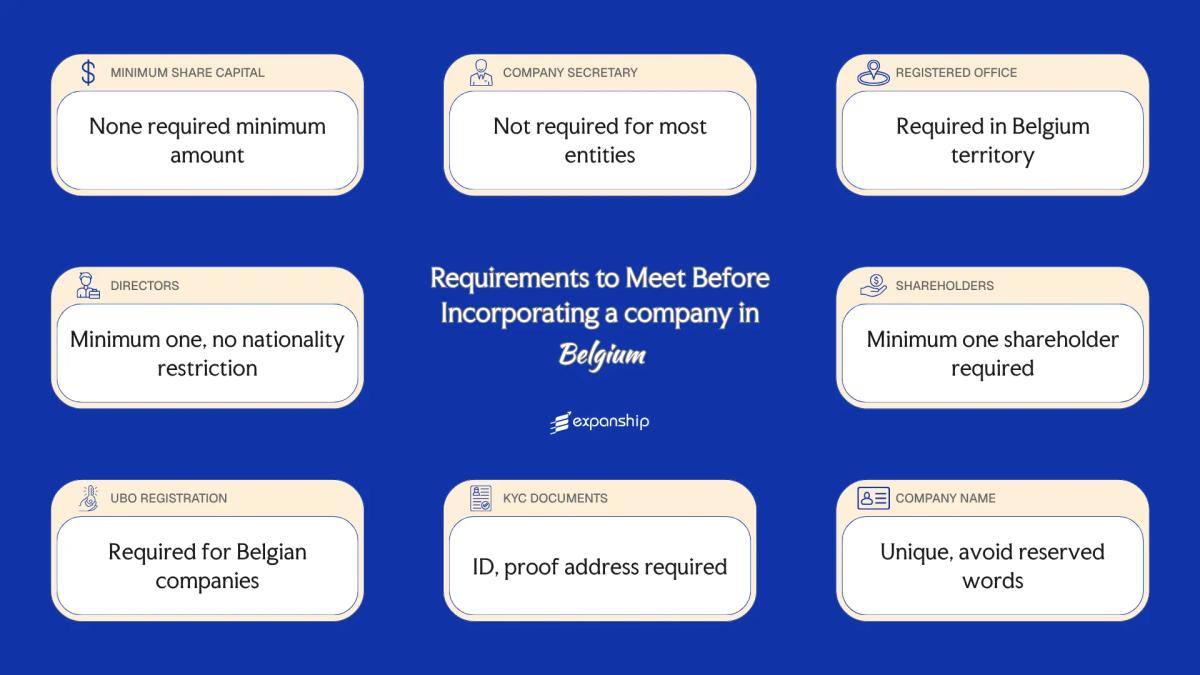
Minimum Share Capital Requirements in Belgium
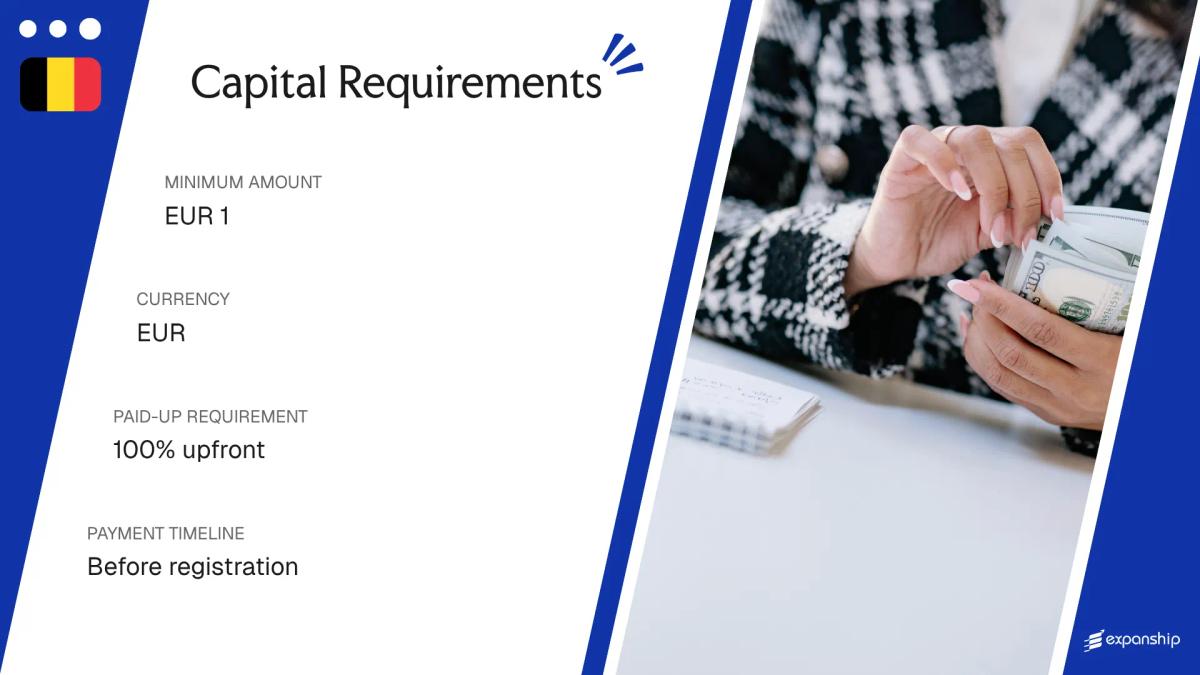
Belgium minimum share capital requirements differ by entity type and are governed by the Companies and Associations Code (Wetboek van vennootschappen en verenigingen), which came into force in May 2019. Under this framework, the besloten vennootschap (BV) operates without a fixed statutory minimum, while the naamloze vennootschap (NV) carries a prescribed minimum capital threshold.
Capital is verified at the point of incorporation by the notary executing the deed of incorporation, who confirms sufficiency based on a financial plan submitted by the founders. The Crossroads Bank for Enterprises (CBE) registers the entity, but the notary bears responsibility for capital adequacy review.
| Parameter | Detail |
|---|---|
| Minimum Authorized Share Capital | None for BV; EUR 61,500 for NV |
| Maximum Authorized Share Capital | No statutory requirement |
| Minimum Paid-Up Capital | None for BV; EUR 61,500 for NV |
| Paid-Up Requirement at Incorporation | BV: fully paid-up on subscribed amount; NV: full amount at incorporation |
| Accepted Currency | Euro (EUR) |
| Accepted Forms of Contribution | Cash contributions and contributions in kind |
| Timeframe to Deposit Capital | Prior to execution of the notarial deed of incorporation |
The absence of a minimum for the BV does not remove the obligation to demonstrate adequate starting capital. Founders must submit a detailed financial plan to the notary; if the company becomes insolvent within three years, underfunded capital can expose founders to personal liability.
Company Secretary Requirements in Belgium
Under Belgian corporate law, there is no statutory requirement for companies to appoint a company secretary. The company secretary requirements Belgium follows differ from jurisdictions where such a role carries formal legal standing — no equivalent mandatory officer position exists under the Code of Companies and Associations (WVV/CSA).
That said, a natural or legal person responsible for administrative and compliance functions may be designated internally. This person typically manages filings with the Crossroads Bank for Enterprises (CBE), maintains statutory registers, and coordinates submissions to the Belgian Official Gazette (Belgisch Staatsblad/Moniteur belge).
Qualification criteria for anyone fulfilling this administrative role include:
- No mandatory residency requirement applies; the role can be held by a non-Belgian resident.
- Both natural persons and legal entities may serve in this capacity.
- No licensing or professional certification is required under Belgian company law.
- Directors may assume this function directly, as no separation between the two roles is legally mandated.
- Appointment is governed by the company's articles of association, not by a regulatory authority.

Incorporate a Company in Belgium
Set up your Belgian entity with full support for registration, documentation, and compliance with the Code of Companies and Associations.
Registered Office Requirements in Belgium
The registered office requirements Belgium imposes on companies are set out primarily under the Belgian Companies and Associations Code (CAC) of 2019, which requires every company to designate a siège social that serves as its official legal domicile within Belgium. Failure to maintain a compliant registered seat can result in third-party legal notices being deemed validly served at the last recorded address, and persistent non-compliance may attract administrative sanctions from the Crossroads Bank for Enterprises (CBE).
- A physical street address in Belgium is required; a P.O. box alone does not satisfy the siège social requirement.
- Virtual office addresses are permitted, provided the service supplier can demonstrate a genuine, stable physical presence at that location.
- The address must be situated in Belgium; a foreign address does not qualify under the CAC.
- No ownership of the premises is required, but a lease agreement or written authorisation from the property holder is standard practice to evidence occupancy rights.
- The registered address is publicly listed in the CBE register and accessible through the official BCE/KBO database.
- Any change to the registered office address must be formally recorded by notarial deed or, for certain entity types, by a decision of the governing body, and subsequently filed with the CBE.
Director Requirements in Belgium

Under the Wetboek van vennootschappen en verenigingen (WVV), directors of a Belgian besloten vennootschap (BV) assume personal liability for management errors, violations of the WVV, and breaches of the company's articles of association. The director requirements Belgium company law establishes are deliberately flexible compared to older frameworks, removing mandatory nationality or residency conditions.
| Parameter | Detail |
|---|---|
| Minimum Number of Directors | One director is sufficient for a BV. |
| Maximum Number of Directors | No statutory maximum; the articles of association govern this. |
| Local/Resident Director Required | No statutory requirement for a Belgian-resident director. |
| Nationality Restrictions | None; directors of any nationality are permitted. |
| Minimum Age Requirement | Directors must have reached the age of majority (18 years). |
| Corporate Directors Permitted | Yes, legal entities may serve as directors, but must appoint a permanent natural person representative. |
| Director Must Be a Shareholder | No statutory requirement to hold shares. |
| Publicly Listed on Registry | Yes, director details are filed with and published via the Banque-Carrefour des Entreprises (BCE). |
| Disqualification Conditions | Persons subject to a judicial prohibition, bankruptcy-related disqualification, or professional ban under Belgian law cannot serve. |
Unlike many EU jurisdictions, a Belgian BV can be validly managed by a single director who is a foreign national with no physical presence or ties to Belgium whatsoever.
Shareholder Requirements in Belgium
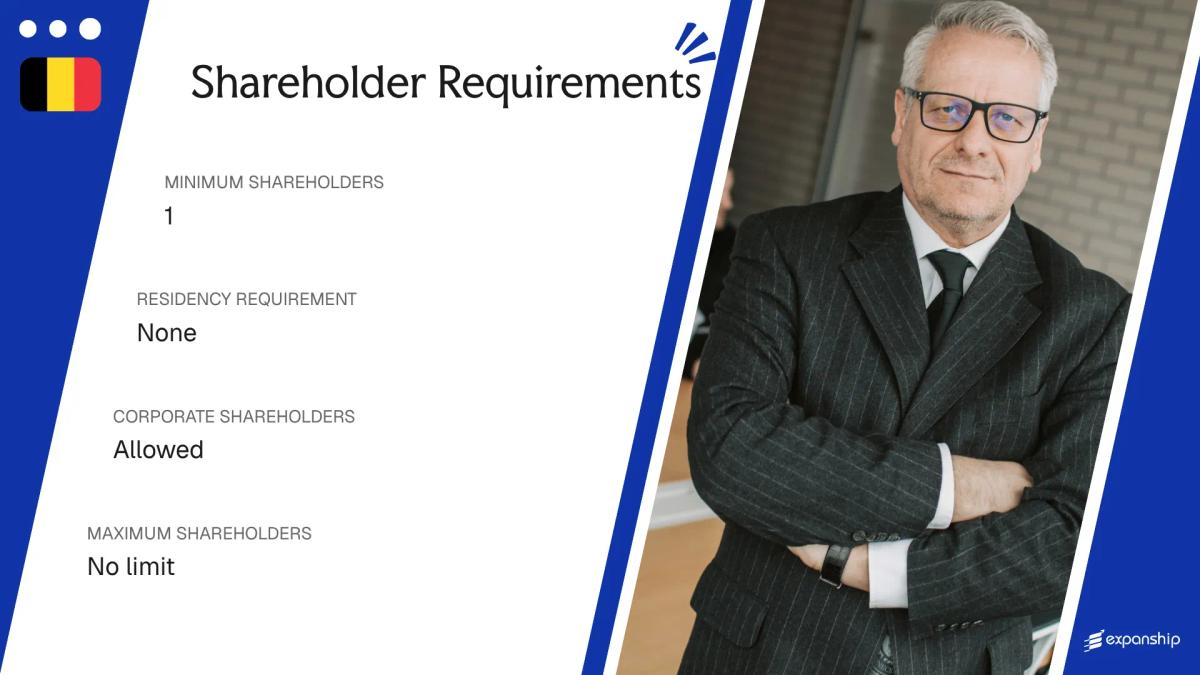
A Belgian besloten vennootschap (BV) can be formed by a single shareholder, making a sole shareholder structure fully permissible under the Code of Companies and Associations (WVV). There is no statutory maximum on the number of shareholders a BV may have.
Nationality and Residency Restrictions
Shareholder requirements in Belgium impose no nationality or residency conditions on individuals holding shares in a BV. Foreign nationals and non-residents may hold any percentage of the share capital without restriction.
Corporate Shareholders
Legal entities, including foreign-incorporated companies, are permitted to act as shareholders in a Belgian BV. No additional conditions specific to corporate shareholders are imposed beyond standard KYC obligations.
Shareholder Liability
Shareholder liability is generally limited to the amount contributed to the share capital. Under the WVV, courts may extend liability in cases of fraud or serious fault contributing to the company's insolvency.
Register of Shareholders
A BV must maintain an internal shareholder register, which records all share transfers and ownership details. This register is not publicly accessible but must be kept at the company's registered office and updated upon any change in shareholding.
Guidance on Shareholder Structuring for Your Belgian Entity
Get tailored advice on structuring your shareholding arrangement in accordance with Belgian corporate law before incorporation.
UBO / Beneficial Ownership Registration Requirements in Belgium
UBO registration requirements Belgium are governed by the Law of 18 September 2017 on the Prevention of Money Laundering and Terrorist Financing, which transposed the EU's Fourth Anti-Money Laundering Directive into national law. A beneficial owner is any natural person who directly or indirectly holds 25% or more of the voting rights or shares in a legal entity.
- Identify all natural persons meeting the 25% ownership or control threshold prior to registration.
- Submit UBO data through the MyMinfin portal, managed by the FPS Finance (Federale Overheidsdienst Financiën).
- Complete the initial filing within one month of incorporation.
- Update the register within one month of any change to the beneficial ownership structure.
- Confirm the accuracy of registered UBO information annually via the portal.
| Parameter | Detail |
|---|---|
| Ownership Threshold for UBO Status | 25% of shares, voting rights, or ownership interest |
| Filing Authority | FPS Finance via the MyMinfin portal |
| Disclosure Deadline at Incorporation | Within one month of incorporation |
| Publicly Accessible Register | Yes, partially; third parties may access name, month/year of birth, nationality, country of residence, and nature of interest |
| Penalties for Non-Disclosure | Administrative fines ranging from €250 to €50,000 per violation |
| Ongoing Update Obligation | Within one month of any change; annual confirmation required |
KYC / Document Requirements in Belgium
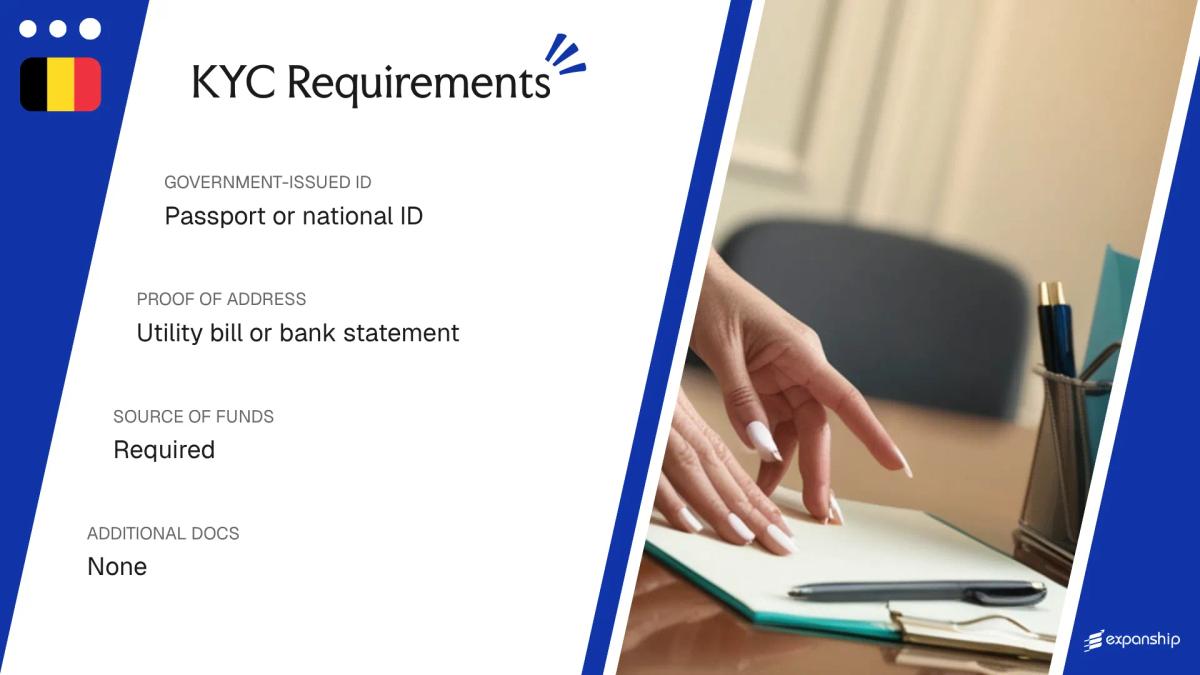
Satisfying KYC requirements for Belgium company registration falls under the Anti-Money Laundering Law of 18 January 2017, which transposes the EU's Fourth AML Directive into Belgian law and is enforced by the CTIF-CFI, Belgium's Financial Intelligence Processing Unit. All identity and source-of-funds documentation must be collected and verified before the notarial deed of incorporation is executed.
Individual / Personal Documents
- Valid government-issued photo ID (passport or national identity card) for each director, shareholder, and UBO
- Proof of residential address dated within three months, such as a utility bill or official bank correspondence
- Completed and signed UBO declaration form for submission to the Belgian UBO Register
- A recent curriculum vitae may be requested by the notary or formation agent to establish professional background
Corporate Documents
- Certificate of incorporation or equivalent constitutive document for the corporate shareholder or director
- Articles of association or equivalent constitutional document in its current form
- Official register of directors confirming the authorised signatories of the corporate entity
- Proof of registered office address of the corporate entity, such as a utility bill or official correspondence
Source of Funds Documentation
- Recent bank statements (typically covering the last three to six months) evidencing the origin of subscribed capital
- Audited financial statements where the shareholder is a corporate entity
- A written declaration explaining the commercial or personal origin of funds introduced
Notarisation and Apostille Requirements
- Foreign public documents must be apostilled under the Hague Convention of 1961 before submission
- Documents not in French, Dutch, or German must be accompanied by a certified translation into one of Belgium's official languages
- Notarisation by a Belgian notary (notaire/notaris) is required for the deed of incorporation itself
Unsigned or uncertified translations of foreign corporate documents are among the most frequent causes of incorporation delays at the notarial stage.
Company Name Requirements in Belgium
Your business name is assessed against both availability and suitability criteria when you incorporate in Belgium. Company name requirements in Belgium are evaluated at the point of registration, and any name that conflicts with an existing entity or violates public order standards will be rejected.
Each legal form carries a mandatory suffix. A besloten vennootschap must include "BV" or its full Dutch equivalent, while a naamloze vennootschap uses "NV." French equivalents apply where the firm operates in a French-language region.
Certain words are restricted by law. Terms implying a royal connection, state affiliation, or regulated professional activity — such as "bank" or "insurance" — require prior authorisation from the relevant supervisory authority before use.
Name reservation is available through the Crossroads Bank for Enterprises (CBE) prior to formal incorporation. The reservation window is limited, and the name must be used within that period or the reservation lapses.
Compliance Services for Companies in Belgium
Maintain your Belgian entity in good standing with ongoing compliance support, from annual filing obligations to regulatory reporting.
Conclusion
Meeting the incorporation requirements in Belgium means working within a framework defined by the Companies and Associations Code of 2019, coordinated oversight from the Crossroads Bank for Enterprises, and mandatory filings through a notarial deed. Among the requirements covered, the UBO register obligations and the deed-based formation process carry particular procedural weight for foreign investors. Minimum share capital thresholds, which differ between the SRL and NV structures, also directly shape entity selection decisions. Once these requirements are understood, the practical next step is securing local representation, registered office arrangements, and filing coordination to move from planning to active registration.
Expanship's Corporate Services for Belgium Expansion
Expanship supports businesses working through Belgium company incorporation services by handling the administrative groundwork tied to Belgian-specific requirements, from UBO registration with the National Register to coordinating with the Banque-Carrefour des Entreprises. Your operational focus stays intact while the procedural side is managed with local knowledge.
Beyond initial formation, Expanship's company formation support in Belgium spans the full incorporation lifecycle.
- We prepare and file your company registration documents in accordance with Belgian corporate law requirements.
- A registered office address and agent are provided to satisfy the mandatory Belgian presence rules.
- We liaise directly with government bodies including the BCE and relevant notarial authorities on your behalf.
- Post-incorporation obligations, including ongoing compliance filings, are managed to keep your entity in good standing.
- Banking introduction assistance is available to help your business establish a local account.
- Tax registration and coordination with the Belgian Federal Public Service Finance are handled as part of your setup.
To discuss your requirements, contact Expanship Belgium.
Frequently Asked Questions (FAQ)
A non-Belgian resident can serve as a director of a Belgian entity without any requirement to hold Belgian nationality or residency. There are no prescribed director residency requirements under the CAC 2019, though the director must be able to fulfill their legal duties, which include attending to filings with the Crossroads Bank for Enterprises (CBE). Directors also bear personal liability for certain statutory obligations, regardless of where they are based.
Failure to register beneficial ownership information in the Belgian UBO register, maintained under the Anti-Money Laundering Law of 18 September 2017, can result in administrative fines ranging from EUR 250 to EUR 50,000 per violation. The obligation applies to all Belgian companies, foundations, and trusts, with no exemption for small or dormant entities. Repeated non-compliance can also trigger regulatory scrutiny from the Financial Intelligence Processing Unit (CTIF-CFI).
The financial plan is not publicly accessible. It is submitted exclusively to the notary at the time of incorporation and retained in their records, but it is not filed with the CBE or published in the Belgian Official Gazette (Belgisch Staatsblad). However, it becomes relevant if insolvency proceedings are initiated, at which point a court can request it to assess whether the founders met their obligations under Article 5:4 of the CAC 2019.
Belgian law does not impose a mandatory company secretary role for private limited companies (BV) or public limited companies (NV). Corporate governance obligations are instead allocated to the board of directors or the sole director, who bear direct statutory responsibility for filings, record-keeping, and regulatory compliance. Some larger NVs operating under a dual-board structure may appoint administrative staff for governance support, but this is an internal decision rather than a legal requirement.
If the registered office address on file with the CBE is found to be invalid or no longer operational, the company risks having official correspondence and legal notices go undelivered, which can result in missed regulatory deadlines and default judgments in legal proceedings. Belgian authorities and courts use the CBE address as the official point of contact, so any change must be formally updated through a notarial deed or board resolution depending on whether the address is written into the articles of association. Failure to maintain a valid registered office can also trigger administrative sanctions under the CAC 2019.
Belgium does not operate a formal pre-reservation system for company names in the way some jurisdictions do. Availability is checked at the point of incorporation through the CBE, and the name is secured only once the deed of incorporation is published in the Belgian Official Gazette. Because no prior reservation is possible, a name that appears available during preparation can be registered by another entity before your incorporation deed is published.
Legal Disclaimer
The information provided in this article is for general informational purposes only and does not constitute legal, tax, or professional advice. While we strive to ensure the accuracy and timeliness of the content, laws and regulations are subject to change, and the application of laws can vary widely based on specific facts and circumstances.
Readers should not act upon this information without seeking professional counsel tailored to their individual situation. Expanship and its authors disclaim any liability for actions taken or not taken based on the content of this article.
For specific advice regarding your business setup, compliance requirements, or any legal matters, please consult with qualified legal and tax professionals in the relevant jurisdiction.