

Key Takeaways
- Belgium's standard corporate income tax rate, combined with mandatory surcharges for insufficient advance payments, creates a heavier-than-average fiscal burden relative to many competing EU incorporation jurisdictions.
- Under the Code of Companies and Associations, forming an NV requires meeting a mandatory minimum capital threshold and completing notarised deed requirements that add both cost and procedural delay not present in simpler jurisdictions.
- Founders operating through a BV or NV face substantial ongoing obligations to the National Bank of Belgium (NBB) and the FSMA, with compliance failures carrying enforceable penalties under Belgian federal law.
- Social security contributions for company directors and employees in Belgium are structured at rates that materially increase the true cost of labour beyond gross salary figures, a burden that compounds as headcount grows.
Belgium operates under a heavily regulated corporate framework, shaped by the Code of Companies and Associations (wetboek.be) and enforced by multiple federal authorities. The disadvantages of incorporating in Belgium span tax structure, formation requirements, labour obligations, and ongoing compliance costs.
Not every constraint applies equally across all business types. The weight of specific obligations shifts depending on whether your entity is a private limited company (BV), a public limited company (NV), or a regulated financial firm.
This article is most relevant to foreign investors and non-resident founders considering a physical operational presence in Belgium, particularly those unfamiliar with Belgian federal and regional regulatory requirements. The drawbacks of Belgium company formation discussed here reflect the structural realities that commonly surface during and after incorporation, across multiple dimensions of corporate life.
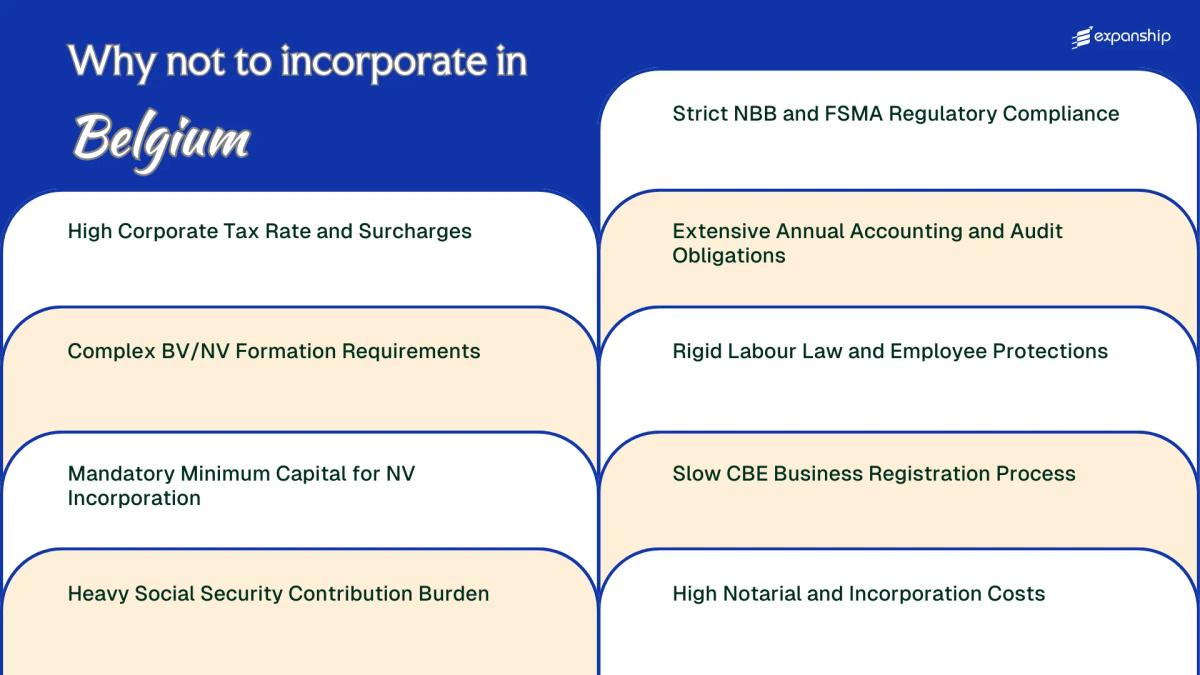
High Corporate Tax Rate and Surcharges
Belgium corporate tax rate drawbacks extend beyond the headline figure, creating a layered cost structure that affects your bottom line from the first profitable year.
The Standard Rate and Surcharge Mechanism
The standard corporate income tax rate sits at 25%, applicable under the Income Tax Code 1992 (WIB92/CIR92). A crisis surcharge of 2% is applied on top of the calculated tax, bringing the effective rate slightly above the nominal figure. For a foreign-owned entity without Belgian tax optimisation structures already in place, this combined burden lands materially higher than the EU average of approximately 21.3%.
Small companies may qualify for a reduced 20% rate on the first EUR 100,000 of taxable income, but this threshold is restrictive and tied to conditions including minimum director remuneration requirements.
Why the Belgian Corporate Tax Surcharges Create Practical Problems
The crisis surcharge is not a temporary measure. It has persisted long enough to function as a structural cost rather than an exceptional levy, which distorts net return projections for incoming investors.
Foreign businesses that underestimate the high business tax burden during financial modelling often find that anticipated post-tax margins are significantly compressed once the surcharge and non-deductible expense rules under WIB92 are applied.
If your entry-level financial model assumes a flat 25% rate without accounting for the crisis surcharge and non-deductible cost adjustments under WIB92, your projected net returns will be overstated before operations begin.
Complex BV/NV Formation Requirements
Belgium BV NV formation challenges begin before your company is even registered. Both the besloten vennootschap (BV) and the naamloze vennootschap (NV) require a notarial deed of incorporation, meaning a Belgian civil-law notary must authenticate the founding documents. This is not a formality you can delegate remotely without additional legal coordination.
Under the Companies and Associations Code (CAC), introduced in 2019, founders of a BV must prepare a detailed financial plan demonstrating the entity has sufficient starting capital for at least two years of projected activity. If the company becomes insolvent within three years of incorporation and the financial plan is found inadequate, founders face personal liability.
That liability exposure creates real consequences for foreign directors unfamiliar with Belgian drafting standards. A financial plan rejected or later challenged by a court is not a procedural inconvenience — it is a direct threat to your personal assets.
Practical burdens this structure creates for foreign incorporators include:
- Engaging a Belgian notary whose fees are regulated but non-negotiable adds a fixed cost layer that does not exist in jurisdictions using standard registration filings
- Preparing a two-year financial plan to Belgian statutory standards requires local accounting input, which means hiring a Belgian-qualified professional before the business generates any revenue
- Notarial authentication must occur in person or through a Belgian-authorised representative, complicating incorporation for founders based outside the EU
- The CAC imposes specific mandatory clauses in the articles of association; omitting or incorrectly drafting these provisions can result in the notary refusing to authenticate the deed
NV formation carries additional structural requirements, including a minimum of one shareholder and specific governance rules around board composition under the CAC.

Company Incorporation in Belgium
Set up your BV or NV in Belgium with full compliance across notarial, financial plan, and CAC requirements.
Mandatory Minimum Capital for NV Incorporation
Belgium NV minimum capital requirements set a significant financial threshold before your company can even begin operating. Under the Companies and Associations Code (Wetboek van vennootschappen en verenigingen), the Naamloze Vennootschap requires a minimum share capital of €61,500, with at least 25% of each share's value paid up at incorporation.
That upfront capital commitment is not a deposit you can freely draw down for operational expenses. A portion must remain allocated to statutory capital on the balance sheet, restricting your liquidity from day one.
| Requirement | Threshold | Practical Burden |
|---|---|---|
| Minimum share capital | €61,500 | Locked as statutory capital, limiting liquidity |
| Minimum paid-up at incorporation | 25% per share | Immediate cash outflow before any revenue |
| Financial plan obligation | Mandated at notarial deed | Must project 2 years of forecasted activity |
| Capital adequacy trigger | Net assets below €30,750 | Triggers mandatory extraordinary general meeting |
The two-year financial plan required at incorporation must demonstrate the entity's viability. If it is deemed inadequate and the business subsequently fails within three years, founders can face personal liability under Article 5:4 of the code.
For foreign investors who had intended to use the BV structure, the NV's capital burden reflects a deliberate legal design for larger enterprises. Your financial exposure here begins before a single transaction occurs.
Heavy Social Security Contribution Burden
The Belgium social security contributions burden ranks among the steepest in the European Union. Employer contributions to the RSZ (Rijksdienst voor Sociale Zekerheid) currently stand at approximately 25% of gross salary, pushing total payroll costs substantially above the gross wage you agree to pay each employee.
For a foreign business hiring locally, this gap between net salary and total employment cost is an immediate structural problem. A mid-level hire with a €50,000 gross salary can cost your firm well over €60,000 once RSZ contributions are factored in.
Reduced employer contribution rates exist for specific categories, such as first hires or low-wage workers, but these apply under defined conditions and do not reduce the baseline obligation across your general workforce.
Belgian employer social charges are collected quarterly, and late or incorrect filings trigger automatic penalties under the RSZ regulations.
- Employer RSZ contributions are approximately 25% on top of gross salary
- Employee social security contributions add a further 13.07% withheld from gross pay
- Quarterly declarations to RSZ are mandatory, with strict filing deadlines
- Sector-specific joint committees (paritaire comités) may impose additional contribution obligations
- Certain exemptions apply only to qualifying hire categories and cannot be applied broadly
Belgium's total employer and employee social security contribution rate, combined, can exceed 38% of gross salary, making it one of the highest combined rates in the entire OECD.
Strict NBB and FSMA Regulatory Compliance
Belgium NBB FSMA compliance challenges are among the most operationally demanding aspects of running a regulated entity in the country. Foreign businesses operating in financial services, payment processing, or investment activities face a dual supervisory structure that few EU jurisdictions replicate at the same level of intensity.
Scope of Dual Supervision
The National Bank of Belgium (NBB) oversees prudential requirements, while the Financial Services and Markets Authority (FSMA) governs conduct-of-business rules, product oversight, and investor protection. If your firm touches both areas, you are accountable to two separate regulators, each with distinct reporting cycles, licensing thresholds, and enforcement powers.
Compliance Burden on Foreign Operators
Obtaining FSMA authorisation typically requires submitting detailed governance documentation, fit-and-proper assessments for directors, and ongoing disclosure obligations under Belgian financial legislation. The FSMA compliance burden on Belgium companies extends to mandatory product approval processes and marketing restrictions that add lead time and legal costs before a firm can operate commercially. Firms outside the financial sector are not subject to NBB or FSMA oversight, but any ancillary financial activity, such as offering credit or holding client funds, can trigger regulatory scope unexpectedly.
Support for Meeting Belgian Regulatory Requirements
Get specialist guidance on managing NBB and FSMA compliance obligations when incorporating or operating in Belgium.
Extensive Annual Accounting and Audit Obligations
Belgium annual accounting obligations drawbacks extend well beyond basic bookkeeping, placing a structured and costly compliance load on foreign-owned entities from the first financial year.
- All Belgian companies must prepare annual accounts under the Belgian Generally Accepted Accounting Principles (Belgian GAAP) and file them with the National Bank of Belgium (NBB), creating an ongoing professional cost that cannot be delegated without licensed local accountants.
- Companies exceeding two of three thresholds — balance sheet total of EUR 4.5 million, net turnover of EUR 9 million, or 50 full-time employees — must appoint a statutory auditor (réviseur d'entreprises), adding a mandatory audit fee on top of existing accounting costs.
- The Belgian audit requirements burden falls disproportionately on mid-sized foreign subsidiaries that would not trigger audit obligations in their home jurisdiction.
- Failure to file annual accounts on time with the NBB results in automatic financial penalties, compounding the Belgian company reporting restrictions on operational flexibility.
Rigid Labour Law and Employee Protections
Belgium labour law restrictions on businesses are among the most structurally demanding in the EU. Once you hire an employee, the legal obligations that attach to that relationship are extensive and difficult to reverse.
Termination is heavily regulated under the Act of 3 July 2012, which reformed notice periods but did not reduce the underlying protection afforded to workers. Notice periods are calculated on the basis of seniority, and for a worker with several years of service, these can extend to many months of paid notice or equivalent severance.
Collective dismissal triggers additional obligations under the Renault Act (Act of 13 February 1998), requiring mandatory information and consultation procedures with employee representatives before any restructuring. This process can delay operational decisions by weeks or months, which directly affects your ability to respond to changing business conditions.
Sector-level collective agreements (CAOs/CCTs), negotiated within the Joint Committees, impose wage floors, working conditions, and benefits that apply on top of statutory minimums. Your firm has no individual capacity to negotiate below these sectoral standards.
According to the OECD Employment Protection Legislation indicators, Belgium consistently scores above the OECD average on restrictions against individual and collective dismissals, reflecting one of the more restrictive employment frameworks among developed economies.
Slow CBE Business Registration Process
Belgium CBE business registration problems stem from a structural bottleneck: every new company must be registered with the Crossroads Bank for Enterprises (CBE) before it can legally operate, and that process sits downstream of several prior obligations that each consume time independently.
Before the CBE registration can even begin, you must complete notarial deed execution, obtain a bank certificate confirming deposited capital, and register with a social secretariat. Each step depends on the previous one, so a delay at any stage cascades forward.
The CBE does not accept direct applications from founders. Registration must be submitted through a recognised business counter (ondernemingsloket/guichet d'entreprises), adding an intermediary layer that foreign business owners must identify, engage, and coordinate with before the entity receives its enterprise number.
For foreign directors or shareholders without Belgian identification numbers, additional verification steps through the CBE or municipal authorities can extend timelines further. This is a common friction point for non-resident incorporators that is easy to underestimate at the planning stage.
The Belgian Crossroads Bank registration delays compound when a company's activities require prior licensing or sector-specific authorisations, since the enterprise number alone does not confer the right to operate in regulated activities.
If any director or authorised representative lacks a Belgian national register number or BIS number, the CBE registration cannot be completed until that identification is obtained from the relevant municipal or SPF Finance authority, which can independently delay activation by several weeks.
High Notarial and Incorporation Costs
The Belgium notarial incorporation costs burden is a structural feature of the legal system, not an administrative anomaly. Both the BV and NV require a notarial deed of incorporation executed before a civil-law notary, and the notary's fees are regulated but not trivial.
Notarial fees for a standard BV incorporation typically range from EUR 1,200 to EUR 2,500 or more, depending on the complexity of the articles of association. This cost applies before your firm has earned a single euro of revenue.
Beyond the notary fee itself, additional charges accumulate:
- Registration duties payable on the deed
- Publication fees in the Belgian Official Gazette (Belgisch Staatsblad)
- CBE registration costs
For foreign founders unfamiliar with civil law systems, the mandatory notarial requirement also introduces a logistical constraint. Remote incorporation is limited, often requiring a power of attorney authenticated abroad, which adds both time and translation costs to the process.
Overcoming Belgium's Key Incorporation Challenges
Overcoming Belgium's Key Incorporation Challenges
Overcoming Belgium incorporation challenges requires structural preparation before registration begins, not reactive adjustments after problems arise. The Belgian regulatory environment rewards entities that enter with a clear legal form decision, a finalised financial plan, and an understanding of which obligations activate at incorporation.
- Opt for a BV structure over an NV to avoid the EUR 61,500 minimum capital requirement and reduce upfront notarial costs.
- Prepare a detailed financial plan covering at least two years, as required under the Companies and Associations Code for BV formation.
- Register with the Crossroads Bank for Enterprises before commencing any commercial activity to avoid CBE compliance delays.
- Engage a certified accountant accredited under the Institute of Registered Auditors framework to meet statutory audit and annual accounts obligations.
- Confirm social security classification with the INSS early, as director status determines contribution rates and billing cycles.
Each of these steps addresses specific statutory requirements under Belgian law. The obligations involved are fixed by legislation, and no structural choice eliminates them entirely.
Belgium's Value Despite Its Drawbacks
Belgium's administrative and financial burdens are real, and the Belgium business drawbacks vs advantages calculation does not resolve in the same direction for every business. That said, the country retains substantive commercial credibility: its position at the geographic centre of the EU, its treaty network, and its access to the single market remain structurally significant for internationally oriented businesses.
| Pros | Cons |
|---|---|
| Central EU location with access to major markets via Brussels and Antwerp | Corporate tax rate of 25% plus the 3% crisis surcharge increases the effective rate |
| Extensive double tax treaty network reduces cross-border withholding exposure | Employer social security contributions represent a substantial payroll cost |
| BV structure offers flexible share capital arrangements without a statutory minimum | NV formation requires minimum capital of EUR 61,500, restricting its accessibility |
| Developed financial sector regulated under NBB and FSMA oversight | Mandatory notarial involvement in company formation adds procedural cost and delay |
| Recognised legal framework under the Companies and Associations Code | Annual audit obligations and National Bank filing requirements create ongoing compliance overhead |
Weighing the cons of incorporating in Belgium comes down to whether the structural benefits justify the compliance load your business will carry. For firms with cross-border operations or EU-facing strategies, the trade-offs may be acceptable; for others, the cost and procedural weight may outpace the benefits.
Corporate Compliance Services in Belgium
Manage your Belgian entity's ongoing obligations under the Companies and Associations Code, including annual filings, accounting requirements, and regulatory reporting.
Conclusion
A Belgium company formation disadvantages summary points to a jurisdiction that carries genuine structural weight: meaningful market access and legal stability, offset by documented compliance costs and administrative friction. Social security contributions that reach well above 30% of gross salary, a notarial deed requirement tied to measurable upfront fees, and the CBE's procedural timelines each impose real constraints on how quickly and economically you can establish and operate a firm here. Structural preparation, rather than assumption, determines whether the entity functions as intended from the outset.
Expanship's Belgium Incorporation Support
Addressing Belgium incorporation support challenges requires working within a defined compliance architecture, from CBE registration timelines to notarial deed requirements for the NV and BV structures. Expanship's role is to reduce the administrative weight of meeting these obligations, including FSMA and NBB regulatory liaison, annual accounting duties, and social security registration, so your team spends less time on procedural bottlenecks.
Beyond entity formation, Expanship supports your business across the full incorporation cycle.
- Your company registration and corporate document preparation are handled end to end.
- A registered agent and Belgian office address are provided to satisfy local presence requirements.
- Filings with the CBE and relevant regulatory authorities are managed on your behalf.
- Post-incorporation compliance, including annual returns and accounting deadlines, is tracked and coordinated.
- Banking introduction assistance connects your entity with appropriate Belgian financial institutions.
- Tax registration with the FPS Finance and local authority liaison are included in the process.
Reach out to Expanship Belgium to discuss your incorporation requirements.
Frequently Asked Questions (FAQ)
Yes, all BVs, including single-member entities, must submit a financial plan to the notary at incorporation under the Companies and Associations Code. The plan must demonstrate that the initial capital is sufficient for the business to operate for at least two years. If the company becomes insolvent within three years and the plan is found to have been inadequate, founding shareholders can be held personally liable for the deficit.
Breaches of National Bank of Belgium or FSMA requirements can result in administrative fines, suspension of activities, or criminal prosecution depending on the severity and the regulated activity involved. The FSMA has authority to impose fines of up to €2.5 million for certain regulatory violations under the Financial Supervision Act. In cases involving fraud or deliberate non-disclosure, personal liability for directors is a realistic outcome, not merely a theoretical risk.
Notarial fees for a standard BV incorporation generally range between €1,200 and €2,500 excluding VAT, though an NV or a more complex structure can push costs considerably higher. These fees are set partly by regulated tariffs and partly by the complexity of the deed, the firm's equity structure, and the number of shareholders involved. That expense is incurred before the entity is registered with the Crossroads Bank for Enterprises, so the upfront cost of formation in Belgium exceeds what founders typically encounter in jurisdictions like Estonia or the Netherlands.
Yes, the full €61,500 must be paid up at the time of incorporation for an NV, with no option to commit a portion and pay the remainder later as some jurisdictions permit. This distinguishes the NV from the BV, which has no statutory minimum capital requirement but instead relies on the adequacy test established through the mandatory financial plan. For businesses that prefer the NV structure due to its shareholder transferability and listing potential, the upfront capital commitment is non-negotiable.
Not reliably. Under Belgian social security law, self-employed persons, including active company directors, are subject to contributions to the INASTI/RSVZ system, which can reach approximately 20.5% on professional income up to a certain threshold. A genuinely non-executive role with no active management function may reduce exposure, but Belgian social security authorities scrutinise these arrangements closely. If the structure is recharacterised, back contributions and penalties can be assessed retroactively.
Companies that fail to file their annual accounts within seven months of the financial year-end face automatic late filing surcharges under the Companies and Associations Code, starting at €400 and increasing to €600 if the delay persists. Persistent non-filing can trigger a formal dissolution procedure initiated by the public prosecutor. Directors of the defaulting company may also face personal liability for damages suffered by third parties as a result of the non-disclosure.
In practice, yes. While the Crossroads Bank for Enterprises is the official registration point, the prior requirement for notarial deed execution for a BV or NV means the full process typically takes two to four weeks, compared to same-day or next-day registration available in countries such as the Netherlands or the United Kingdom. Delays in obtaining a bank certificate confirming capital deposit, scheduling the notary appointment, and receiving the enterprise number can each add days independently. Businesses requiring an immediate operational start often find this sequencing restrictive.
Legal Disclaimer
The information provided in this article is for general informational purposes only and does not constitute legal, tax, or professional advice. While we strive to ensure the accuracy and timeliness of the content, laws and regulations are subject to change, and the application of laws can vary widely based on specific facts and circumstances.
Readers should not act upon this information without seeking professional counsel tailored to their individual situation. Expanship and its authors disclaim any liability for actions taken or not taken based on the content of this article.
For specific advice regarding your business setup, compliance requirements, or any legal matters, please consult with qualified legal and tax professionals in the relevant jurisdiction.