

Key Takeaways
- Belgium's Innovation Income Deduction under Article 205/1 of the Income Tax Code 1992 reduces the effective tax rate on qualifying IP income to 3.75%, making it one of the most structurally competitive IP regimes available within the EU.
- The notional interest deduction lowers the taxable base for equity-financed companies by allowing a deduction on adjusted net equity, reducing the effective corporate tax burden below the standard 25% rate without requiring debt financing.
- Incorporating as a BV/SRL under the Companies and Associations Code requires no minimum share capital, allowing foreign businesses to establish a fully operational Belgian entity without committing upfront capital to satisfy a statutory threshold.
- With over 100 bilateral tax treaties in force, Belgian-registered entities can distribute profits and repatriate income across most major trading partners under terms that limit withholding tax exposure and reduce the risk of double taxation.
Incorporating a business in Belgium offers access to one of Western Europe's most strategically positioned economies, and the benefits of incorporating in Belgium extend across tax policy, legal structure, and market access. A federal state and founding member of the European Union, Belgium operates under a treaty-based tax framework with a well-developed network of bilateral agreements. Company registration falls under the oversight of the Crossroads Bank for Enterprises, the central registry through which all commercial entities are formally recorded and assigned a unique enterprise number.
Foreign nationals face no general restrictions on owning or operating a Belgian-registered entity. The country maintains an open posture toward foreign direct investment, with no sector-wide prohibitions on non-resident ownership in most commercial industries.
For businesses entering the Belgian market, the BV/SRL is the most widely used legal vehicle. This article examines the key advantages that make Belgium company formation a considered choice for international businesses.
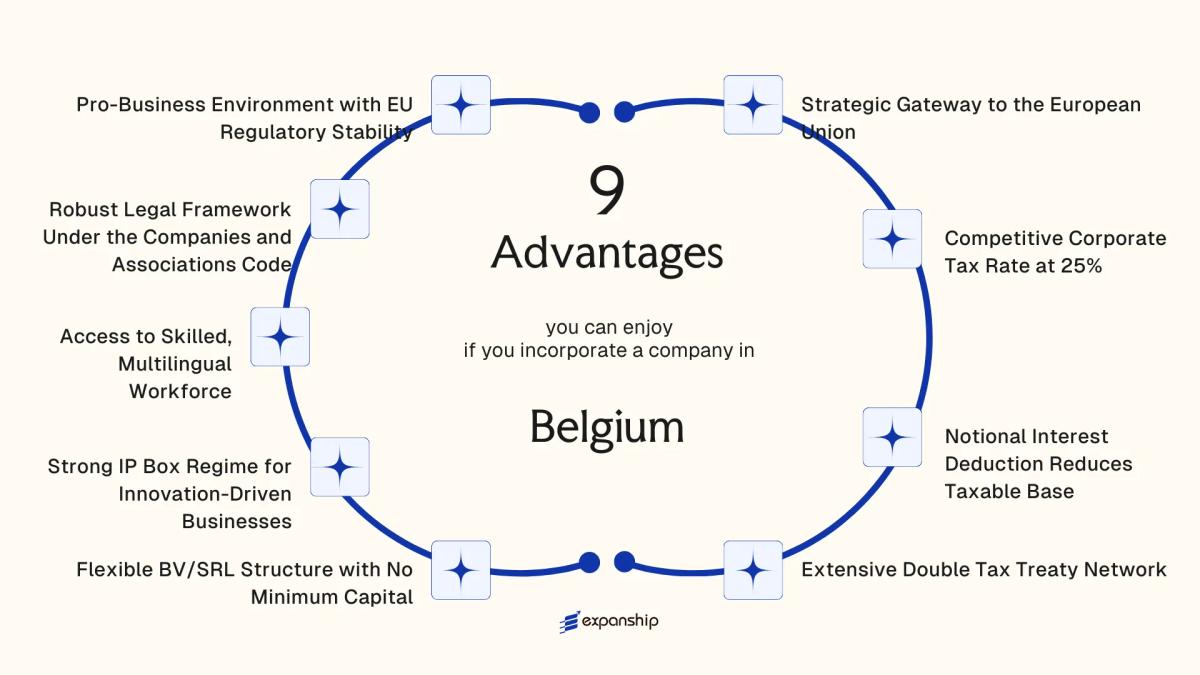
Strategic Gateway to the European Union
Belgium EU market access for businesses is shaped by a single structural reality: the country sits at the geographic and institutional centre of the EU, with Brussels hosting the European Commission, the Council of the EU, and NATO headquarters within the same metropolitan area.
Physical Position and Cross-Border Reach
Antwerp, Europe's second-largest port by cargo volume, and the Port of Zeebrugge together process a substantial share of continental trade flows. Your goods can reach the majority of EU consumers within 24 hours by road from either facility.
Institutional Proximity as an Operational Asset
Incorporating a Belgian entity places your business within direct proximity to the EU's primary regulatory institutions, which matters when your industry requires ongoing engagement with Commission directorates or European standardisation bodies. Belgian companies operate under full EU passporting rights across financial services, goods, and certain regulated professions. That access applies automatically upon incorporation, without secondary authorisation in each member state.
A Belgian entity gives you EU-wide operational reach from day one, backed by direct proximity to the institutions that set the rules governing that market.
Competitive Corporate Tax Rate at 25%
Belgium's standard corporate income tax rate stands at 25%, a figure that positions the country noticeably below several Western European peers such as France, which applies a rate of 25% to large companies but has historically sat higher, and Germany, where the combined federal and trade tax burden routinely exceeds 30%. For foreign investors structuring a European holding or operating entity, that gap translates directly into retained earnings available for reinvestment or distribution.
The Belgium 25% corporate tax rate advantage becomes more tangible when you consider that this rate applies to resident companies on their worldwide income, with the taxable base subject to a range of statutory deductions under the Income Tax Code 1992. Small and medium-sized companies meeting specific thresholds may qualify for a reduced rate of 20% on the first €100,000 of taxable profit, a provision that benefits newly established subsidiaries or lean operational entities during their early years.
What makes the rate structurally competitive rather than just nominally attractive:
- The 20% reduced tier applies automatically once qualifying conditions are met, requiring no separate application
- Dividend received deduction rules allow qualifying inter-company dividends to be largely excluded from taxable income
- Capital gains on qualifying shares benefit from an exemption under conditions tied to the participation exemption regime
- Tax consolidation through the system of fiscal unity, introduced in 2019, lets eligible group companies offset profits against losses across entities

Company Incorporation in Belgium
Set up your Belgian company with full compliance support across entity selection, registration, and ongoing corporate administration.
Notional Interest Deduction Reduces Taxable Base
Belgium's notional interest deduction benefit gives incorporated entities a mechanism to reduce their taxable income based on the equity sitting on their balance sheet, without actually paying interest to anyone. The deduction is calculated by applying a notional rate to the company's adjusted net equity, effectively treating equity financing on a comparable footing to debt financing for tax purposes.
| Rate Category | Applicable To | Rate Period |
|---|---|---|
| Standard NID rate | Large companies | Annually set by Royal Decree |
| Increased NID rate | SMEs (as defined under Belgian law) | Same fiscal year |
| Calculation base | Adjusted net equity per GAAP balance sheet | Prior fiscal year-end |
For foreign-owned firms capitalising a Belgian subsidiary with equity rather than intercompany loans, this mechanism directly lowers the corporate tax base. The practical result is that equity-heavy structures, which in many jurisdictions carry a tax disadvantage relative to debt, become fiscally more neutral under Belgian rules. The NID is governed by Articles 205bis to 205novies of the Belgian Income Tax Code (WIB 92 / CIR 92), providing a statutory basis that gives investors planning certainty.
SMEs receive a slightly higher notional rate than large companies in any given fiscal year, making the Belgium taxable base reduction proportionally more favourable for smaller incorporated entities. Eligibility is subject to an anti-abuse provision: the equity base used for the calculation excludes certain assets, including shares in subsidiaries and assets with no business connection, which keeps the benefit tied to genuinely productive capital deployed in the business.
Extensive Double Tax Treaty Network
Belgium's double tax treaty network advantages are among the most tangible structural benefits for foreign investors. With over 95 bilateral tax treaties in force, Belgium has one of the densest treaty networks in the world, covering major economies across Europe, Asia, North America, and Africa. These agreements, negotiated under the OECD Model Convention, reduce or eliminate withholding taxes on dividends, interest, and royalties flowing across borders.
For a holding entity incorporated in Belgium, this matters directly. Withholding tax rates on dividends can be reduced to 5% or even 0% under certain treaty provisions, depending on the counterparty jurisdiction and ownership threshold. That reduction directly affects the after-tax return on cross-border investments. The full treaty list is maintained by the Federal Public Service Finance.
Keep these points in mind to qualify for treaty benefits:
- The entity must be a tax resident in Belgium, with effective management located there
- Treaty shopping arrangements may be challenged under Principal Purpose Test (PPT) provisions in newer treaties
- Domestic withholding tax exemptions under Belgian law may apply separately and should be assessed alongside treaty provisions
- Each treaty has specific conditions; ownership percentage thresholds for reduced dividend rates vary by agreement
Belgium applies a domestic participation exemption (definitief belaste inkomsten, or DBI/RDT regime) that can complement treaty benefits, potentially reducing effective taxation on qualifying dividend income to near zero even before a treaty is invoked.
Flexible BV/SRL Structure with No Minimum Capital
The Belgium BV SRL no minimum capital benefit is one of the most consequential structural changes introduced by the Companies and Associations Code (CAC), which came into force in 2019. Under Article 5:9 of the CAC, a besloten vennootschap (BV) or société à responsabilité limitée (SRL) can be incorporated without a statutory minimum share capital. This eliminates a barrier that, in many EU jurisdictions, requires founders to lock up capital before generating a single euro in revenue.
Capital Adequacy Replaces the Minimum Capital Rule
The CAC replaces the fixed minimum with a financial plan obligation. Founders must prepare a documented financial plan demonstrating that the entity will have sufficient assets to sustain its projected activities for at least two years. This shifts the standard from nominal compliance to actual financial viability, which is meaningful for investors putting real capital at risk rather than satisfying an arbitrary threshold.
Practical Flexibility for Foreign Founders
For a foreign founder structuring a holding company, subsidiary, or project vehicle, this means the firm can be capitalized at whatever level the business model genuinely requires. There is no obligation to tie up funds in a statutory reserve before operations begin. Shares in a BV can also be issued without par value, and the CAC permits multiple share classes with differentiated voting and economic rights.
Founder liability does apply where a deficient financial plan contributes to insolvency within three years of incorporation, so the financial plan must be substantively sound rather than formulaic.
Structure Your Belgian BV/SRL Correctly from Day One
Expanship advises on capital planning, share structure, and financial plan requirements for BV/SRL incorporation in Belgium.
Strong IP Box Regime for Innovation-Driven Businesses
Belgium's IP box regime for innovation businesses is governed by the Innovation Income Deduction (IID), introduced under Article 205/1 of the Income Tax Code 1992. Under this regime, 85% of qualifying innovation income is deductible, resulting in an effective tax rate of approximately 3.75% on that income — well below the standard 25% corporate rate.
Qualifying income includes profits derived from patents, supplementary protection certificates, copyrighted software, orphan drug designations, and data or market exclusivity rights. This breadth is a direct advantage for tech companies, pharmaceutical firms, and software developers, since the IID covers a wider category of IP than many comparable European regimes.
- The deduction applies to net income, meaning development costs are factored out before the benefit is calculated, which aligns relief with genuine economic activity rather than gross receipts.
- A nexus requirement applies: the qualifying income must be proportionate to the R&D expenditure incurred directly by the entity or through unrelated third parties, limiting treaty shopping while still accommodating legitimate structures.
- Existing IP assets can be grandfathered into the regime under certain conditions, so businesses acquiring or migrating IP to Belgium are not automatically excluded.
Your firm can apply the IID alongside R&D wage withholding tax exemptions, creating a combined tax position on innovation income that few European jurisdictions match structurally.
Access to Skilled, Multilingual Workforce
Belgium's multilingual skilled workforce advantage is one of the most operationally significant factors for foreign firms establishing a European presence. The country has three official languages — Dutch, French, and German — and English proficiency rates rank among the highest in continental Europe. For a business hiring locally, this means your teams can serve clients across multiple EU markets without requiring dedicated translation infrastructure.
The workforce is also formally credentialed. Belgian universities, including KU Leuven, Ghent University, and ULB, consistently produce graduates in engineering, law, finance, and life sciences. The result is a talent pool with sector-specific depth, not just general availability.
Employers operating under Belgian labor law access this talent through structured frameworks governed by the National Labour Council (Nationale Arbeidsraad / Conseil National du Travail). Sectoral collective agreements set baseline conditions, which reduces negotiation complexity when hiring across different professional categories.
According to the EF English Proficiency Index 2023, Belgium ranks among the top-tier countries in Europe for English proficiency, scoring in the "Very High Proficiency" band — directly relevant for multinational teams operating across language borders.
Robust Legal Framework Under the Companies and Associations Code
Belgium's Companies and Associations Code (Wetboek van vennootschappen en verenigingen, or WVV/CSA), which entered into force in 2019, replaced a century-old legal framework with a modernised, consolidated statute. For foreign investors, this matters because the WVV/CSA reduces legal ambiguity across entity types, making rights, obligations, and governance rules predictable from day one.
The code introduced a clear hierarchy of company forms and standardised rules on shareholder agreements, director liability, and capital distributions. Predictable governance structures mean your legal counsel spends less time interpreting conflicting provisions and more time operationalising your business structure.
Corporate disputes fall under the jurisdiction of specialised Enterprise Courts (ondernemingsrechtbanken), which handle commercial matters with dedicated expertise. Resolution through a court system that understands commercial law reduces exposure to procedural delays that generalist courts often produce.
Key protections codified under the WVV/CSA include:
- Statutory flexibility to customise articles of association within defined limits
- Defined rules on related-party transactions and conflict-of-interest disclosures
- Statutory provisions on minority shareholder protections
The WVV/CSA applies to entities incorporated under Belgian law; foreign branches operating in Belgium remain subject to the law of their jurisdiction of incorporation for internal governance matters.
Pro-Business Environment with EU Regulatory Stability
Belgium's position as a founding EU member state means your company operates under a legal and regulatory framework that has been shaped by decades of institutional participation. For foreign businesses, this translates into a predictable, stable operating environment where the rules governing trade, contracts, data protection, and competition are consistent with those across the single market.
As an EU member, businesses incorporated here benefit from passporting rights and the ability to operate across 27 member states without re-incorporating locally. The Belgium pro-business EU regulatory environment removes the need for parallel legal structures in other EU countries, reducing administrative overhead for firms that sell goods or provide services continent-wide.
Regulatory oversight is distributed across established institutions:
- The Financial Services and Markets Authority (FSMA) supervises financial markets and products
- The Belgian Competition Authority (BCA) enforces antitrust rules in line with EU competition law
- The Centre for Cybersecurity Belgium (CCB) coordinates national compliance with the EU's NIS2 Directive
Each body operates within a framework that aligns with EU-level regulation, so compliance in one jurisdiction largely satisfies the regulatory expectations of the broader single market. For a foreign investor managing cross-border operations, this alignment reduces the cost of maintaining separate compliance programs for each EU country where the firm is active.
The Companies and Associations Code, in force since 2019, also reflects EU directives on corporate transparency and beneficial ownership disclosure, ensuring your entity meets both domestic and Union-level governance standards from the point of incorporation.
Why Belgium Stands Out Among European Business Destinations
Three jurisdictions make for a natural comparison when evaluating Belgium's position as a European incorporation destination: the Netherlands, Luxembourg, and Ireland. All four target internationally oriented businesses, sit within the EU single market, and are regularly assessed side by side by foreign investors and advisers. The comparison below focuses on parameters where Belgium holds a neutral or favourable position, drawing on regulatory, structural, and fiscal characteristics already detailed across this blog.
What the table makes visible is that no single factor explains Belgium's incorporation profile. The combination of the notional interest deduction, the IP income exemption under the Companies and Associations Code framework, no minimum capital requirement for the BV/SRL, and a treaty network covering over 90 jurisdictions produces a layered set of conditions that, taken together, distinguish Belgium's advantages over other European business destinations from those of comparable EU jurisdictions.
| Parameter | Belgium | Netherlands | Luxembourg | Ireland |
|---|---|---|---|---|
| Standard Corporate Tax Rate | 25% | 25.8% | 17% (up to €200k), 24.94% above | 12.5% (trading) |
| Notional Interest Deduction | Yes | No | No | No |
| IP Box Effective Rate | ~3.75% | ~9% | ~5.2% | 6.25% |
| Minimum Share Capital (private company) | None (BV/SRL) | None (BV) | €12,000 (Sàrl) | None (Ltd) |
| Double Tax Treaties | 90+ | 90+ | 80+ | 70+ |
| Multilingual Official Languages | 3 (FR, NL, DE) | 1 (NL) | 3 (FR, DE, LB) | 2 (EN, GA) |
| EU Passporting Rights | Yes | Yes | Yes | Yes |
Compliance Services for Companies in Belgium
Maintain your Belgian entity in good standing with ongoing statutory filings, annual accounts preparation, and regulatory reporting under the Companies and Associations Code.
Conclusion
Belgium combines a corporate tax architecture, an IP incentive framework, and a treaty network that together create a coherent case for foreign businesses seeking a permanent EU base. The notional interest deduction reduces the effective tax burden on equity-financed operations, while the Innovation Income Deduction under Article 205/1 of the Income Tax Code 1992 reduces the effective rate on qualifying IP income to 3.75%. For businesses where capital structure and intellectual property are central to operations, these two mechanisms interact in ways that few European jurisdictions can match structurally.
The absence of a minimum capital requirement under the Companies and Associations Code for the BV/SRL makes initial incorporation accessible without tying up working capital. Paired with access to over 100 bilateral tax treaties, your business can distribute profits and repatriate income with measurable certainty across most major trading partners.
The right fit depends on your business model, financing structure, and the markets you intend to serve. An asset-light technology firm will derive different value from Belgian incorporation than a manufacturing entity or a holding company. Determining which structural features apply to your specific circumstances requires a precise reading of both Belgian company law and applicable tax provisions. That analysis is the logical starting point for any formation decision.
Start Your Belgian Company Formation with Expanship Today
Expanship supports foreign business owners through every stage of Belgian company formation, from selecting the appropriate legal structure under the Companies and Associations Code (CAC) to meeting the filing requirements set by the Crossroads Bank for Enterprises (CBE). The benefits covered across this blog, corporate tax rates, the notional interest deduction, IP regime advantages, and the BV/SRL structure, each carry specific compliance obligations that require precise execution to remain valid.
Expanship Belgium business setup services cover the full administrative and regulatory scope of establishing a local entity:
- Preparation and legalization of incorporation documents, including articles of association
- Registered office and agent provision to satisfy CBE address requirements
- Filing coordination with the CBE and the competent Enterprise Court clerk's office
- Post-incorporation compliance management, including annual accounts and UBO register obligations
- Government liaison for VAT registration with the FPS Finance
- Banking introduction assistance to facilitate corporate account opening with Belgian financial institutions
Incorporate in Belgium through Expanship by contacting our team directly via Expanship Belgium.
Frequently Asked Questions (FAQ)
Yes, non-residents can incorporate a BV/SRL in Belgium without being physically present, provided they grant a notary a power of attorney to execute the deed of incorporation on their behalf. The notary must be a Belgian civil-law notary, as incorporation of a BV/SRL requires a notarial act under the Companies and Associations Code. Remote incorporation is therefore possible, though the notary will still require certified identification documents and a founding act that meets the statutory requirements.
The BV/SRL structure has no statutory minimum share capital under the Companies and Associations Code, which came into force in 2019. Instead, founders must demonstrate that the company has sufficient equity for its intended activities, supported by a detailed financial plan covering at least the first two years of operations. If the firm becomes insolvent within three years of incorporation and the financial plan is deemed inadequate, founding shareholders may face personal liability.
The Notional Interest Deduction allows a Belgian company to deduct a notional interest charge calculated on its adjusted equity from its taxable base, reducing the effective corporate tax rate below the headline rate of 25%. The deduction rate is set annually by the Belgian tax authorities and is based on the yield of 10-year Belgian government bonds. Only equity that qualifies under the specific rules of the Belgian Income Tax Code is included in the calculation base.
Once all required documents are prepared and the notarial deed is executed, registration with the Crossroads Bank for Enterprises typically takes one to three business days. The total timeline from initial preparation to receiving an enterprise number depends on how quickly founders supply the financial plan, identity documents, and articles of association to the notary. In practice, the entire process from instruction to active registration often takes between one and three weeks.
Belgium's IP Box regime, governed by Article 205/1 to 205/4 of the Belgian Income Tax Code, applies to qualifying intellectual property income derived from patents, supplementary protection certificates, and certain other protected assets, including those granted by foreign patent offices recognised under the rules. The effective tax rate on qualifying IP income is approximately 3.75%, achieved through an 85% deduction on net IP income before applying the 25% corporate rate. The regime follows the OECD-compliant nexus approach, meaning only IP developed through qualifying research and development expenditure by the company itself or through contracted parties generates the full deduction.
Belgian law does not impose a mandatory requirement for a resident director in a BV/SRL. The Companies and Associations Code permits a sole director, who may be a natural person or a legal entity, and that director may be a non-resident. However, having at least one director with a local address can simplify administrative processes such as correspondence with the Crossroads Bank for Enterprises and interaction with the Belgian tax administration.
Belgium has an extensive treaty network covering more than 90 jurisdictions, including major economies such as the United States, China, Japan, India, and all EU member states. These treaties are designed to eliminate or reduce withholding taxes on dividends, interest, and royalties paid between treaty partners, and to prevent the same income from being taxed twice. The specific rates and conditions vary by treaty, so the applicable agreement between Belgium and the investor's home country should be reviewed directly.
Legal Disclaimer
The information provided in this article is for general informational purposes only and does not constitute legal, tax, or professional advice. While we strive to ensure the accuracy and timeliness of the content, laws and regulations are subject to change, and the application of laws can vary widely based on specific facts and circumstances.
Readers should not act upon this information without seeking professional counsel tailored to their individual situation. Expanship and its authors disclaim any liability for actions taken or not taken based on the content of this article.
For specific advice regarding your business setup, compliance requirements, or any legal matters, please consult with qualified legal and tax professionals in the relevant jurisdiction.